







Abstract
Descriptive representation occurs when elected politicians are typical of the larger class of persons that they represent, such that blacks represent blacks, disabled people represent disabled people and so on. Research undertaken in the context of the UK government's devolution programme helps us to judge the strength of the demand for descriptive representation amongst political activists and elites. In the case of women, one grouping where proportional descriptive representation has (almost) been achieved, substantial benefits are perceived, for example in relation to improvements in the deliberative function of democracy. In the case of other ‘minority’ groupings the absence of descriptive representation is thought to have entailed significant costs. This failure has necessitated the development of complex bureaucratic structures that are seen as a poor substitute for descriptive representation. In this and other respects the innovations in governance introduced with devolution have helped to stimulate demand for descriptive representation. This demand exceeds the supply of representation on offer and descriptive representation will be the focus of an increasing amount of debate and controversy in future.
There are systematic patterns of under-representation in the decision-making structures of democratic countries in respect of women, ethnic minorities, people who define themselves as disabled and groups defined by faith, sexual orientation and other significant markers of social identity. There is, however, no consensus that under-representation is such a severe problem that root-and-branch reform is required in order to correct it. While much has been written about the philosophy and ethics of under-representation, and the reforms that may be required to eliminate it, our understanding of the demand for reform is limited. UK research and commentary indicates that some members of under-represented groups feel marginalised and believe they are the targets of discrimination intended to exclude them from decision-making (Campbell and Oliver, 1996; Coote, 2000; Saggar, 1998; T. Phillips, 2000) but our knowledge of the way these sentiments translate into a demand for fundamental reforms is patchy.
At a time when a new statutory framework 1 is being introduced to further the descriptive representation of women in the UK's legislatures, this paper will show that the demand for fundamental change amongst the elites of some important under-represented groups has grown as a consequence of the reforms introduced with devolution. Some of these individuals make their demands as members of political parties, particularly as activists and politicians. Others demand change as leaders of organised civil society. Many of the pressures to which politicians will have to respond originate in wider social movements that have spawned some of the bodies of civil society. In other cases quite specific interest groups have become advocates of change. In both cases questions could be raised about the extent to which the organisations of civil society can claim to be representing those who have previously been excluded from decision-making. In future work 2 we will pursue such questions by way of empirical research amongst the members of these organisations. In the present paper we are concerned with the way reforms required to address under-representation have assumed new significance in political life and amongst the key decision-makers in organised civil society. Amongst some groups, for example those for disabled people, devolution reforms appear to have brought the question of representation to attention for the first time, and increased representation has been promoted towards the top of the priorities of many other organisations. As part of this process, issues that had only been important in academic debates are receiving much more attention than many of us would have anticipated. We begin by briefly exploring some of these issues and debates.
Political Science and Under-representation
Well-known writers point out the ethical objections to any suggestion of representation by quota; the fact that no reform can address the under-representation of every group; and that to help only a minority of the minorities simply makes matters worse. On the other hand, arguments in favour of reform are often couched in terms of fundamental principles such as the need to reflect the diversity of society or promote equal opportunities. Some of these arguments take a more pragmatic turn. They refer to the way in which improving representation can bring positive benefits for society including improvements to the democratic process and better policies. We will show that it is these arguments that are closely associated with the demand for correctives to under-representation amongst elites.
The most popular of these arguments is associated with ideas of deliberative democracy. For some, deliberative democracy involves ‘collective decision-making with the participation of all who will be affected by the decision or their representatives’ (Elster, 1998, p. 8, emphasis added). For others deliberative democracy ‘… also underpins a concern for minority viewpoints, and sets limits on what the majority can legitimately do … a deliberative democracy does not require the institutions of a direct participative democracy’ but rather, ‘the need for a balance between representative and participative institutions’ (Chowcat, 2000, p. 755). Gutman and Thompson (1996, p. 55) maintain that the main barrier to achieving democracy is the ‘self-interest’ of the participants. Problems arise when participants represent the interests of fundamentally different groups within the polity. This is a point addressed by Gargarella (1998) when he explains why full representation of all groups in civil society is necessary. Gargarella (1998) argues that elected representatives will fail to put themselves in the position of those that they are supposed to represent, and will not be sufficiently motivated to advance others’ causes and cannot be trusted to do so.
Within this general framework we also find the view that democracy works better with ‘proportional descriptive representation’ (Mansbridge, 1999, p. 647). According to this view, elected politicians should be typical of the larger class of persons that they represent, such that women represent women, disabled people represent disabled people, and so on. Mansbridge suggests that descriptive representation both ‘reduces distrust and increases democratic legitimacy’ and ‘furthers the substantive representation of interests by improving the deliberation’ (Mansbridge, 1999, p. 654). Mansbridge also points out that
the demand for proportionality is accentuated by the fact that almost all democratic assemblies are aggregative as well as deliberative … [this] requires that the members of the representative body cast votes for each affected conflicting interest in proportion to the numbers that such interest bears [sic] in the population (1999, p. 637).
According to Mansbridge, ‘in practice … disadvantaged groups often need the full representation that proportionality allows in order to achieve several goals: deliberative synergy, critical mass, dispersion of influence, and a range of views within the group’ (Mansbridge, 1999, p. 636). Moreover she argues that descriptive representation has to be proportional to the wider population in order to avoid ‘essentialism’, the assumption that all members of a group have ‘an essential identity that all members of that group share … [it] implies an essential quality of womanness or Blackness that all members of that group share’ (1999, p. 637).
Phillips also notes the dangers of essentialism for accountability and debate (1996, p. 150) and thinks that without the presence of women, or ethnic minorities, or disabled people, deliberation is ill-informed (Phillips, 1995, 1996). The participants in deliberation forego the opportunity to have their views shaped by engaging in debate with those who have direct experience of being disabled (and so on). Finally, Phillips claims that ‘the real importance of political presence lies in the way it is thought to transform the political agenda’ (1995, p. 176). In a more recent treatment of this theme she argues that descriptive representation should be about more than equality of opportunity:
If gender matters, it is still because men and women occupy very different positions within social and economic relations; and what matters about this is that it generates different interests and policy concerns. Numbers alone are important, but the longer term significance lies in the opportunity for mobilising a wider range of voices, articulating concerns that would otherwise be discounted, and thereby developing more just social policies (Phillips, 2000, p. 64).
In the case we have researched it is highly likely that many elite members are familiar with these academic arguments (also see Childs, 2001). Writers like Phillips and Mansbridge have taken part, although perhaps indirectly, in the construction of a demand for reform to correct under-representation. We are not, therefore, reporting on an empirical test of the theories of Mansbridge and Phillips that will show if there is any evidence for the benefits (for example, for the democratic process) they claim for descriptive representation. Instead we will show if there is any evidence that people perceive benefits such as those described by Mansbridge and Phillips, especially where steps have already been taken towards reform. In particular, we think it is important to find out whether groups that have not yet benefited are as likely to identify these benefits as those groups which have been directly affected. We find evidence that these experiments have created a strong demand for reform, particularly amongst those groups that hope to benefit in future.
Our evidence is drawn from a study of reforms that accompanied the programme of devolution which has taken place in the UK since 1999. Devolution serves as the largest experiment yet attempted in the UK to address problems of under-representation. We will consider data from cases where reforms have increased representation (which allow us to investigate the perceived benefits) and from cases where there has been no increase in representation (which allow us to investigate the perceived costs of failing to reform).
Devolution and Descriptive Representation
The constitutional reforms and programme of modernising government initiated in the 1997 parliament were predicated, in part, on the need to end the marginalisation and exclusion of ‘minority’ groups from the process of government (women can be included in the category of ‘minority’ precisely because they are under-represented). For example, the UK Cabinet Office set a target of equal representation of women and men in public bodies by 2002. 3 Other innovations in this area included the establishment of the cross-cutting Women's Unit that supports the Minister for Women, the Disability Rights Task Force (DRTF) and Commission (DRC), and the Home Office Race Equality Unit and Race Relations Forum. Thus the final report of the Disability Rights Task Force called for measures to ‘assist disabled members of political parties in putting themselves forward as candidates and participating fully in their party's activities’ (DRTF, 1999, Recommendation 6.10 and chapter 9, section 18).
The idea of ‘inclusiveness’ is one of the ‘keystones’ of the Modernising Government programme (Cabinet Office, 1999a, b), where inclusiveness means
ensuring that policy makers take as full account as possible of the impact the policy will have on different groups – families, businesses, ethnic minorities, older people, the disabled, women – who are affected by the policy … The principal way of achieving these objectives is by involving a wide range of interested parties – such as those that will be affected – service deliverers/implementers, academics and voluntary organisations – in the policy process. (Cabinet Office, 1999b, paragraph 8.1).
Devolution in Scotland, Wales, Northern Ireland, and London, has been designed to increase this sort of involvement. 4
Each of the laws passed to bring about devolution – the Government of Wales Act, 1998; Northern Ireland Act, 1998; Greater London Authority Act, 1999; Scotland Act, 1998 – has equality clauses. In addition to these clauses the new legislatures are also bound by the European Convention on Human Rights. Hitherto marginalised groups have recourse to this Act if they feel that devolved government has discriminated against them in the course of its functions (see, for example, Section 107 of the Government of Wales Act). The Government of Wales Act is, however, unique in that it enshrines a legal duty to promote equality of opportunity that extends beyond policy outcomes and applies to the way that the legislatures operate as institutions. Leaders of the women's movement in Wales helped to ensure that devolution was established in such a way that the concerns of excluded groups would be prioritised.
Both the White Paper announcing the government's proposals for a revised form of government in Wales and the cross-party National Assembly Advisory Group (NAAG 1998) charged with providing detailed recommendations on the form and functioning of the Welsh legislature called upon the political parties to end past failings and seek the election of AMs representative of Welsh society as a whole. The White Paper was forthright:
the Government attaches great importance to equal opportunities for all – including women, members of the ethnic minorities and disabled people. It believes that greater participation by women is essential to the health of our democracy. The government also urges all political parties offering candidates for election to the Assembly to have this in mind in their internal candidate selection processes (Welsh Office, 1997, p. 24, para. 4.7).
Despite exhortations like these, reference to the gender, (dis)ability and ethnicity characteristics of members of the devolved bodies (Table 1) shows that it is only in the case of gender that there have been significant modifications to traditional patterns of representation.
Number and Percentage (−) of Elected Members Belonging to ‘Minority’ Groupings in the Devolved Bodies
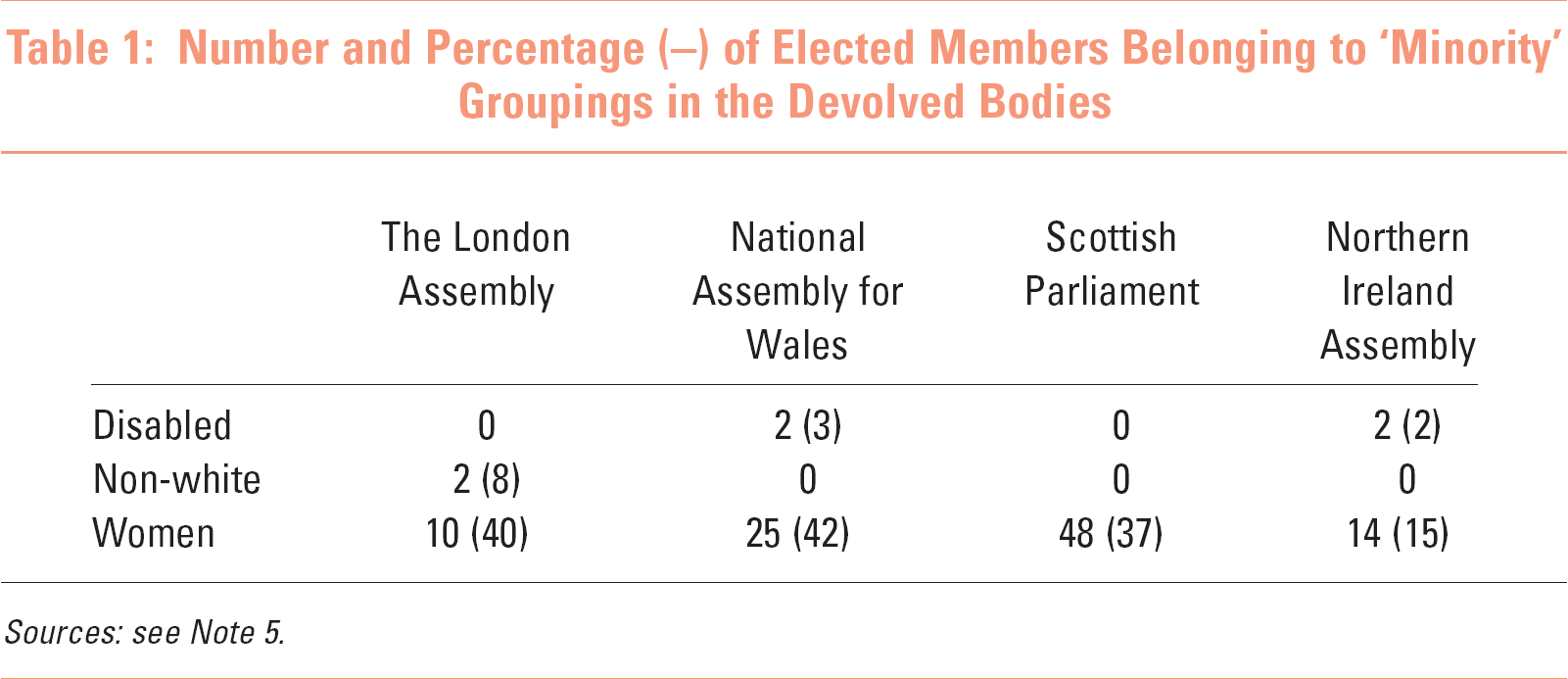
Sources: see Note 5.
The case study which we have selected from the four strands of the devolution programme is Wales. The Welsh Assembly now has 25 women members (and, at the time of writing, five out of nine cabinet members are women) but in Wales, as in the rest of the UK, the minorities have been under-represented at all levels of political decision-making. There are just three female chief executives out of a total of 22 serving unitary local authorities in Wales (Trainor, 2000) and the maximum number of women MPs Wales has returned to Westminster remains at four (out of a total of 40 MPs in the 2001 general election). There was great disappointment about the lack of ethnic minority representation in the Assembly (Williams and Chaney, 2001, and see p. 907 below). Disabled people have long been under-represented in Welsh politics and the first Welsh general election in May 1999 did little to change established patterns of exclusion (Betts et al., 2001). As we know, this was not the case with women, indeed one male AM has called the Assembly's high level of female representation its ‘most distinctive feature’ (Edwards, 2000). Women, ethnic minorities and disabled people had a common history of under-representation throughout Welsh politics, but for women the National Assembly elections resulted in an outcome close to the proportional descriptive representation advocated by Mansbridge. We will explain how such different outcomes occurred below, but it is worth noting the influence of the women's movement on procedures for candidate selection and, indeed, the way leaders of the women's movement appeared on the lists of candidates.
Our findings stem from a research project involving a total of 200 interviews conducted between May 1999 and October 2000 with managers of 90 organisations for women, ethnic minorities or disabled people, together with a third of Assembly Members and key senior civil servants. Unless otherwise attributed, all quotations below are taken from these interviews. Field notes were taken during participant observation of key meetings of these groups and, together with secondary data sources such as published interviews, newsletters and grey literature, internal correspondence, minutes of meetings, policy and consultation documents, these permitted triangulation of interview data.
We have identified all of the organisations claiming to represent women, ethnic minorities and disabled people in Wales. These organisations constitute the population from which we drew the sample of organisations for study. The minority organisations we studied were chosen to reflect the diversity of these sectors as defined by factors such as geographical location, membership size and organisational aims. Some were well-organised, long-established bodies with a large membership (one women's organisation has 41,000 members). Others were newly formed with a limited membership (typically under a dozen people), little funding and were struggling to survive. Some were indigenous Welsh organisations while others were branches of British or UK bodies. The aims of these groups varied: some were single-issue groups; others had a wider, sectoral remit, such as the umbrella organisations to which many individual groups were affiliated and which sought to co-ordinate activity on a broader basis.
It is clear that there are enormous variations in terms of political representation between such groups. In the case of broad women's organisations, for example, it might be claimed that fully half the population was represented. Census data suggests that only 1.5 percent of the population of Wales can be numbered amongst the ethnic minorities, and some of the organisations we studied claimed to represent only one ethnic minority or a segment of ethnic minority opinion divided in some other way, for example by gender or occupation. Amongst disabled organisations there were some which had a very specific interest and little claim to represent disabled people across a range of policy areas.
At this point we should repeat that, while we think that the organisations we studied were representative of particular sections of organised civil society in Wales, we are making no judgements about these organisations' various claims to represent previously excluded groups or to be democratic organisations. There are serious questions about these organisations' capacity for representation (see p. 902 above) and even more fundamental questions about whether such organisations represent good ways of giving voice to excluded groups in principle. 6 For the purposes of the present paper, which is concerned with the demand for descriptive representation amongst influential elites, these questions can be put to one side.
Some of the elites whose opinion we gauge derive their influence from their role as members of the National Assembly for Wales, but the National Assembly also underpins the influence of the civil society elites. In large part this happens because the organisations of civil society are treated as if they are representative by the National Assembly. As we will show later in the paper, it is on these bodies that the Assembly relies in its consultation processes (Chaney and Fevre, 2001b) and it is through the role of these organisations in umbrella bodies that the Assembly hopes to give excluded groups a formal role in decision-making. The devolution process and the subsequent actions of the Assembly have also ensured that these organisations have gained first-hand knowledge of the nature and limitations of the reforms that have been introduced to make sure the groups they claim to represent are involved in devolved decision-making. It is amongst these organisations that the demand for still greater involvement has tended to arise.
What Are the Perceived Advantages of Descriptive Representation?
So far as women are concerned, our study produced evidence that suggests that, not only is descriptive representation perceived to have advantages, but these advantages also become more tangible the closer that this representation is to proportionality. At this point we should remind readers that we are not suggesting that this amounts to evidence of a naturally occurring demand for descriptive representation. The advantages that are commonly identified are very often the ones to which writers like Phillips and Mansbridge draw attention.
There were vocal advocates for proportional descriptive representation amongst the new Assembly Members. These included Val Feld (Labour) and Helen Mary Jones (Plaid Cymru) who had previously managed the Equal Opportunities Commission in Wales before they became leading AMs. Val Feld, who died in 2000, was one of Anne Phillips' co-contributors (Feld, 2000a) to the Institute for Public Policy Research publication (edited by Coote, 2000) New Gender Agenda: Why Women Still Want More. In the Assembly, Feld argued for proportional descriptive representation as an antidote to essentialism (in the context of the Assembly) in a very similar way to Mansbridge (Feld, 2000b). There is a strong suggestion of cross-fertilisation between the academic arguments in favour of descriptive representation and those used by politicians and activists. Very similar arguments in favour of descriptive representation to those put forward by Mansbridge and Phillips were made by the elites which not only helped to design the detail of devolution in Wales but ran the various campaigns which made devolution a political reality, and led the first generation of AMs (Betts et al., 2001; Chaney and Fevre, 2001a).
This cross-fertilisation does make it difficult to test the academic theories against the empirical evidence and we ask our readers to remember that we are not attempting such a test but rather trying to gauge the extent of the demand for descriptive representation that has been created amongst particular elites in Wales.
To this end the origin of the arguments that persuade people that descriptive representation is a good thing is irrelevant. What matters is whether people do indeed find them persuasive. Before we assess perceptions of the benefits of descriptive representation, we must first explain briefly how this level of representation was achieved, in the absence of legal compulsion, through the voluntary activity of the main political parties.
The proportion of women in the UK parliament is a slightly higher proportion than the European average – and gives Westminster fortieth place in the International Parliamentary Union ranking (IPU 2002) – but the UK presently lags behind EU partners like Germany, Spain and the Netherlands which have laws and policies which are intended to secure equal gender representation in political bodies. At this point it is worth noting how the European context helps to underpin the acceptance of descriptive representation in the UK. 7 The European Parliament collects statistics on women's representation at all levels and the European Commission urges member states to correct under-representation. The numbers of women in the European Parliament (and in positions of responsibility within it) are a key factor in the European context and this supports the suggestion (see p. 911 below) that increased descriptive representation produces readily perceptible changes.
The process of twinning constituencies to achieve gender equality amongst Labour Party candidates for the Assembly has been described as ‘a one-off emergency mechanism for kick-starting proper female representation in Welsh political life’ (Edwards, 2000). Under this arrangement the 40 single-member Assembly constituencies where AMs were to be returned under first-past-the-post were divided into pairs – or ‘twinned’ – under a single candidate selection committee that decided upon one male and one female candidate. Other parties found different ways to increase the representation of women in the National Assembly. In the Assembly's electoral system the 40 single-member constituencies are augmented by 20 regional seats where candidates are elected under proportional representation (using the D’Hondt formula). This mechanism was used by Plaid Cymru to boost female representation. As a Shadow Minister stated
We did not twin but we put women at the top of all our regional lists … it would be nice if we had not had to do so, but our contribution to the presence of women in this Chamber also needs to be recorded (Jones, 2000, unpaginated; for critical analysis see Edwards and McAllister, 2001).
These measures, together with twinning, helped to ensure that a ‘critical mass’ of women were elected to the Assembly (Jones, 2000). Some women AMs referred to ‘strength in numbers’ and women AMs being more ‘up front’ and challenging because there were now more of them. Some referred to a unity or ‘sisterhood’ amongst fellow women AMs which cross-cut party allegiances and sought to promote a ‘women's agenda’. Speaking about women in the cabinet, one AM noted that ‘those women know they have the good wishes of all the other women in the chamber with them, not just the women from their own party … I feel there is a sort of sisterhood thing definitely’. For women AMs significant descriptive representation in government for the first time was central to their hopes, and one concluded:
I have no illusions, it's not going to work perfectly and I will undoubtedly be disappointed in certain ways, but there's one thing you cannot change, you cannot change the sex of those there and that's really going to have an impact, I'm sure of that.
This level of representation apparently helped to ease feelings of mistrust (cf. Mansbridge, 1999, pp. 641–3). A response typical of the women interviewed was that of a manager of a women's organisation who said of the women AMs:
I know that they are the type of people that will influence, will make change, will give us the transparency. I feel confident that it is going to happen. I think that, you know, that it can't do anything but happen, because you only have to look at what they are.
The majority of women AMs interviewed referred to the way in which descriptive representation improved the deliberative process. One noted: ‘I have been struck in the Assembly by the change in style of debate … I believe it has happened because of the large number of women here to influence it’. Another spoke of the need to ‘tackle some of the issues about the macho, knockabout culture of politics. If we are to achieve a genuine equality, women should not and must not have to operate like men in order to succeed.’ A leading AM said of women's presence in the Assembly:
I think that its led to a more rational discussion about issues, I think that it's calmed things down and when it comes to the crunch and the real issues there's less politicking. Nobody tries to get away with cheap comments, in the main, on issues surrounding equality since there's been more women there.
Members of women's organisations we interviewed also claimed there had been a change in the deliberative process. One spoke of the ‘distinctive influence of women because there are so many of us here … when you get all women debating or a majority of women debating the tone of the debate changes’. Another felt that ‘there was a determination to break down tribal, confrontational politics’ and to ‘relate better to ordinary voters who don't like all this shouting and banging and all the rest of it’.
Of course it may not simply be the number of women in political office that is thought to be important, but what women do when they get there (Lovenduski, 1990, 1997; Phillips, 1995). In this vein, one AM commented, ‘we are now in there on the agenda and part of the game. What matters now is what we do with this chance.’ Our respondents seemed to be convinced that women would make a better job of representing women because they are better able to understand and articulate the concerns of women than men are. Here the lead was again provided by Feld who told the Assembly that this would lead to better policies for women. Women AMs would make better policies because they had personal experiences and aspirations which they shared with other women (Feld, 2000b). This view was also expressed by a Liberal Democrat AM:
without women taking part in decision-making, their views and needs are bound to be overlooked to a certain extent. It means that the life circumstances and perspective of 52 percent of the population are inevitably ignored, played down or tackled inappropriately. This does not assume that all male politicians are chauvinist pigs, although sometimes those in the House of Commons may manage to give us that impression. It simply recognises that one sex, however sympathetic, cannot fully and fairly represent the interests of the other (Randerson, 2000).
Edwina Hart, a minister in the Welsh executive, thought women's contribution to the legislature had already made
a difference in terms of the way that we discuss issues. I don't think that if there hadn't been so many women we'd have moved this equality agenda so fast. There is a definite willingness to move the gender issues forward and once you move the gender issues forward you tend to move the other issues forward as well (Hart, 2000).
Ample evidence is now emerging to support such claims. In its first two years, the Assembly took action to promote equality of opportunity in the process of government and to close the gender pay gap. In 2002 it was agreed that middle- and junior-ranking Assembly civil servants would benefit from an equal pay deal which would add 22 percent to the Assembly's wage bill over three years (Chaney and Fevre, 2002). Other steps were taken to ensure greater diversity in public appointments and to promote equality of opportunity through the use of contract compliance and in the provision of public services (NAW, 2000a, b). The relationship between these emerging policy changes and the increased representation of women has also been noted – in respect of Scotland as well as Wales – by Squires and Wickham Jones (2001) and by Ward (2000).
It is clear that those who have benefited from descriptive representation see a great many advantages in it. Elite women inside and outside the Assembly see increased representation, the statutory duty to promote equal opportunities enshrined in Section 120 of the Government of Wales Act, and the way the Assembly's priorities have been shaped as interconnected. Their demand for direct representation is stronger than ever, but what of other excluded groups which seem to have missed out on one of the key components of the mix that seems to work so well for women? Have the leaders of their organisations been radicalised in the same way?
So far as women are concerned, proportional descriptive representation amounts to parity with men. It is clearly the case that the small ethnic minority population of Wales can never achieve the ‘critical mass’ which women's representation has achieved, but in practice it often seems that leaders of ethnic minority organisations simply ignore this fact. They are very impressed by the way that they see women benefiting from the advantages of direct representation, and questions about the relative size of that representation are secondary, at least for the moment. For disabled people's organisations the issue is a little more complicated. Unofficial figures indicate that disabled people are members of 57 percent of families (John, 1998) and comprise one in six voters (John, 1999, p. 11). These figures suggest the potential for critical mass but, as we will shortly see, there is evidence to suggest that organisations for disabled people are less politicised than those for women and ethnic minorities.
The Perceived Disadvantages of Failing to Achieve Descriptive Representation
We begin by showing that the absence of descriptive representation for other minorities was indeed seen as a failure. In the devolved assembly elections across the UK the political parties disregarded the calls by the Commission for Racial Equality (CRE) for proportional descriptive representation that, inter alia, recommended the ‘adoption of transparent candidate selection procedures’ and that ‘each political party should set itself a target for ethnic minority representation in proportion to the ethnic minority population contained within that body’ (CRE, 1998; also see Anwar, 2000).
In Wales, Bradbury et al. (2000, p. 20) noted ‘the readiness of the Wales Labour Party to apparently subvert the equal opportunities conditions of the approval procedure and not to intervene against what were seen as unfair practices in local constituency selection‘. One activist observed that ‘Plaid Cymru – the Party of Wales, the Liberal Democrats and the Conservatives failed miserably in not putting forward any Black and ethnic minority candidates … it is hard to believe that this situation should have occurred’ (Mader, 1999).
The lack of significant levels of descriptive representation was bitterly disappointing for respondents we interviewed from the organisations for disabled people and people from an ethnic minority background. They expressed anger at, as one disabled peoples' group's manager put it, ‘the institutionalised discrimination’ that the Assembly elections exposed. A manager with a multicultural carers’ organisation expressed the view that ‘the whole purpose of the Assembly was to be as inclusive as possible but by the very fact that they do not have a minority ethnic representation suggests that it has failed already’. Another Black group's spokesperson said, ‘one could use an emotive term and say that in effect we were hoodwinked’. To many it was not difficult to identify who was to blame:
I think that a lot of individuals who are members of the [Wales] Labour Party from Black and minority ethnic communities are very bitter. They feel that they were set up to fail, especially with the National Assembly Election selection procedures … That left a bitter taste with many communities … they don't realise the level of disappointment … they feel that the Labour Party has given them a raw deal … taken them for granted.
Just as the achievement of descriptive representation for women seemed to build trust, so distrust amongst the elites of other minorities increased following the Assembly elections. One activist said the Assembly lacked ‘people who we trusted, people who we could relate to, we could go to with our problems’. A cabinet minister understated things by saying: ‘I have a feeling that maybe the level of trust from ethnic minority populations was less strong than it is among the white population’. A leader of a Bangladeshi organisation told us that ‘the sad part of it, I mean, there isn't any ethnic minority representation at all within the Welsh Assembly. There isn't any provision for us, so our voices are not really heard.’ For most interviewees the core aspiration appeared to be ‘getting a voice’. One group's manager said that without Black AMs ‘we are invisible, it's all about visibility and … they are blind to certain people from certain communities and so the people continue to lead an existence as invisible people’.
Leaders of organisations for disabled people interviewed after the first Assembly elections also made their feelings plain: ‘that's the biggest tragedy of them all, there aren't any disabled AMs’, ‘I mean there is an awful lot of distrust’, ‘I don't trust those politicians!’. At the heart of their concerns was the competency of able-bodied politicians to represent their interests. A leading activist and prospective Plaid Cymru Assembly candidate, himself disabled, said of Assembly Members:
There is an awful lot of talk about doing the right thing … a lot of people talking to me and saying the right words. But I am not sure that they actually understand what it really means to be disabled; what a total reform of our culture will be required to actually achieve a level playing field for disabled people to interact on an equal basis … The right words were being said but I think that if you start to probe a little bit under the surface then you find that, yes, that is the case but they have no way of knowing of what to do about creating this inclusive society.
Others spoke of perceived barriers to lobbying non-disabled AMs. A representative of a disabled people's group said, ‘I feel that there's a fear about actually going to meet the [Assembly] Members’. Following the Assembly elections one co-ordinator of a disabled people's group said, ‘we are excluded … what happens in the meantime until such time as there are disabled people representing people's views “from the inside” if you like?’
This point was addressed by a coordinator with a disability group who identified the daunting educative role now required of such groups to appraise able-bodied AMs of the basic concepts relating to disability. Significant progress depended on this:
We've got to bring them [Assembly Members] on board with that basic social model idea of disability. Then, hopefully, the development of the service side with specific [Assembly] Subject Committee policies will be a lot easier, they will be applying that social model principle to decisions. But until we get over that basic conceptual hump then we're on a loser basically. It's going to be a much, much harder battle.
One disabled interviewee saw Plaid Cymru's method of increasing the representation of women by making space for them on the regional lists as a precedent:
I think the list system as part of PR has shown already that you know, a very practical way of voting, it can be used in a very positive way. I think the parties though, if they want to really talk about inclusion will have to look at positive action around race and disability as they have done around gender.
Others thought that something more was needed from their own organisations. One interviewee said, ‘I think we all identify the need to take responsibility ourselves as disability groups, we have a part to play in getting involved in issues that might affect us, we want to take responsibility for that’.
Other disabled people were actively exploring ways of gaining the necessary skills:
I'm just wondering at the moment, perhaps we've got four years before the next Assembly elections, perhaps we should be thinking of apprenticeship working with the Assembly and then in ten years’ time perhaps we'll be looking at ten disabled Assembly Members.
In this respect ethnic groups appeared to be higher up the Assembly's agenda. A senior Assembly civil servant explained:
as part of capacity-building and training … what we are looking to do – and we would welcome the participation of Black Voluntary Sector Network Wales and other black and minority ethnic organisations – are two projects. One to do with work-shadowing, the second, a more innovative job-sharing/job-exchange scheme aimed at the black and minority ethnic community … it's a start in actually getting black people into the Assembly to see how the Assembly works, to be able to contribute to how the Assembly works.
Throughout our research we found that the leaders of disabled and ethnic organisations were looking for descriptive representation as evidence that the historic transition to (limited) self-government in Wales was going to be meaningful to them. For leaders from an ethnic minority background there were important questions about the legitimacy of the Assembly (cf. Mansbridge, 1999, p. 650). One activist said,
well, I think the first problem that black and Asian people living in Wales, is that of legitimacy as far as they're concerned. I think because the final composition of the Assembly does not include any black or Asian candidates or Asian Assembly Members, I fear that it lacks legitimacy with them. I would expect to see that put right which I don't think is a realistic prospect, so really I mean it's a question of legitimacy at this stage, and fair representation.
Another interviewee added,
I started to bring the Asian community into the political process, I started to inform the politicians of the contribution that Asian people can make, but that particular process in terms of awareness is beginning to start with both sides, from the politicians’ side as well as the Asian community. But what I think we still have failed on, and still are failing on, is the issue of legitimacy.
Another manager of an ethnic organisation put it bluntly: ‘as far as I am concerned the Welsh Assembly is not going to meaningful to black people at all’.
Surrogates for Descriptive Representation
The failure to achieve proportional descriptive representation of ‘minority’ groups in the Assembly placed even greater importance upon umbrella bodies and overarching bureaucratic structures designed to enable ‘minority’ groups to participate in the work of the devolved legislature. All of these innovations bore a strong family resemblance to the reforms envisaged in the Modernising Government programme (see p. 900 above) where the emphasis was on ‘involving’ elites rather than on representation.
This approach is evident in the Assembly's mechanisms for giving disabled people and those from an ethnic minority background a voice in the devolved government. In this process the Assembly Civil Service was given a key role. One senior civil servant explained:
The role of the [civil service] Equality Unit is to provide advice and guidance … Part of that advice and guidance has been looking at … consultation mechanisms and how we can build better mechanisms, particularly at a policy level, which will enable the Black and ethnic minority community to sit at the table which is something that didn't use to take place, not in the Welsh Office ‘as was’ … (Willie, 2000)
The idea of a forum from which the concerns of the ethnic minorities can feed into the process of Welsh government emerged from consultations between Ron Davies, the former Secretary of State in the UK government who was the principal architect of devolution in Wales, and community groups prior to devolution. This led to the formation of an All Wales Ethnic Minority Association (AWEMA) to link people from an ethnic minority background into the subject specialisms of the Assembly's seven policy-making Subject Committees. Similar mechanisms have developed for disabled people. Disability Wales, an umbrella body representing approximately 370 disabled peoples’ groups across Wales, and the new Disability Rights Commission are the principal bodies in the sector. Other umbrella bodies are organised around specific types of disability, such as Wales Council for the Blind and the Standing Conference of Voluntary Organisations for People with a Learning Disability Wales (SCOVO).
Mansbridge and Phillips warn that a failure to achieve proportional descriptive representation entails the danger of reverting to essentialism (see p. 899 above). In our research we found evidence of anxieties about essentialism amongst women, but such concerns were far more widespread amongst the other groups and were particularly likely to crop up in discussions about the new surrogates for descriptive representation. One project worker felt that ‘one person cannot possibly represent the whole of various communities under the umbrella of black and that's where we go wrong each time’. Another added, ‘you can't rely on one person and what we don't want is token gestures … the idea that because we've got one person in there we are going to be heard’. Another said,
The Bangladeshi Community tends to be left out … even when there are, for example, people from the Indian or Pakistani community or Afro-Caribbean, the Bangladeshi community usually gets … because we're titled under the ‘Asian’ title, there is a tendency to leave us out, not to hear our own distinct opinions and so on.
A Plaid Cymru AM acknowledged the problem when she said: ‘it's not just enough to have more women or to have a black face or to have somebody in a wheelchair, it's having different sorts of those people as well’.
Many of those from disabled and ethnic organisations interviewed were not happy with the indirect representation afforded by the bureaucratic structures such as AWEMA. One interviewee expressed how to him it felt as if the politicians were saying ‘you can't get in with the top boys but we'll feed you a bone that you can fight with amongst yourselves’. This has further reinforced mistrust and alienation from the political process. It led some (but by no means all) to talk of giving up on the political parties and forming new parties representing the ‘minority’ groups.
Conclusions
In the case of many of our respondents, and especially those with a professional background in equal opportunities, our interviewees were already convinced of the case for descriptive representation before the National Assembly began its work. Some of them had in fact played an important role in the process that led to high numbers of women AMs and so had good reason to find advantages in the new pattern of representation. Nevertheless there is now very widespread agreement on the success of this pattern, for example in making women feel considerably less marginalised than they did and in respect of improving the quality of deliberation. But in order to grasp the full extent of the demand for descriptive representation that has been created in the devolution process we had to look at the groups which did not benefit from it.
Our other respondents saw the prominence of women in the Assembly and understood that the Assembly had structures and priorities which made it easier to achieve the aims of minority organisations. There might be something to be gained from this situation without descriptive representation but it also made descriptive representation even more attractive to those who had not achieved it. Minority groups other than women feel that there are real costs – typically amounting to increased alienation and decreased legitimacy – associated with failing to deliver a promise of better representation. The strength of these feelings was underlined by the way these minorities appear desperate for redress and by the way surrogates for the missing representation were quickly introduced. Problems with these surrogates centre on the perceived dangers of essentialism and reinforced distrust if already marginalised groups feel they are being fobbed off with a second-best alternative. Here, as elsewhere, the benefits which Phillips and Mansbridge ascribe to descriptive representation are widely recognised amongst elites.
The accounts we were given which referred to the direct representation of women covered all of Mansbridge's central themes: critical mass, the dispersion of influence, the need for a range of views and of course the avoidance of essentialism. Although we find the term a little vague, there may even have been evidence of ‘deliberative synergy’. Mansbridge and Phillips also claim proportional descriptive representation can reduce distrust and increase legitimacy, and our respondents appeared to think this too.
There is considerable variation in the pressure for representation between those social groups which have been under-represented in the past. A great deal of this variation can be explained by differences in the numbers of people involved and by other obvious factors such as the relationship of some groups to successful social movements, in particular the women's movement. This may mean that the solutions to patterns of under-representation favoured by the National Assembly for Wales will prove problematic in the longer term. For the moment we can see there is a cumulative effect on expectations in which success in achieving some of the aims of the strongest social movement leads to increased demand from smaller or less politicised ones. The Assembly is helping to ensure that there will be successive waves of demands from the organisations linked to these movements and other interest groups. 8
None of this should lead us to conclude that all the aims of the women's movement have been achieved. In Wales, less than a quarter of each party's candidates for the 2001 general election were female. The percentages of candidates for each party who were women were Labour 23, Liberal Democrats 21, Conservatives 17, 9 Plaid Cymru 18 10 and SNP 22. 11 Amongst the 137 women who were Labour candidates only 26 were standing for safe seats and the number of Labour women MPs was expected to fall for the first time in a quarter of a century (The Times, 4 April 2001). In the event the total number of women MPs fell from 121 to 118. The percentages of women amongst the MPs elected in the 2001 general election were 23.5 for Labour, 9.6 for the Liberal Democrats, 8.4 for the Conservatives, 20 (1 out of 5 MPs) for the SNP and zero (0 out of 4) for Plaid Cymru.
Only four out of the 34 Labour MPs elected in Wales in the 2001 General Election were women (i.e. 11.8 percent as opposed to the 23.5 percent of all Labour MPs who were women). None of the MPs belonging to other parties were women. Moreover, the current level of representation for women in the National Assembly may well fall in 2003 (Edwards and McAllister, 2001). There is no sign that descriptive representation will be extended to other groups (Michael, 1999) and there is no consensus in favour of descriptive representation in any of the political parties (Bradbury et al., 2000; Flynn, 1999; Morgan and Mungham, 2000; Roberts, 1998).
Amongst elites there is a demand for descriptive representation which appears to exceed the supply of representation currently on offer by a considerable margin. On the one hand, the pace of change in respect of the representation of women might seem to be painfully slow. On the other hand, devolution – together with the passing of the Sex Discrimination (Election Candidates) Act 2002 (see note 2) – leads elites amongst other minorities to become increasingly sensitised to their under-representation. It is certainly true that, thus far, the demand for descriptive representation has been limited to elites. Despite claims from some women politicians (for example, The Times, 4 April 2001), there is as yet no real reason to expect an impact on voting patterns, especially when there is little difference between the parties on this issue. All the same, elites, which have identified positive benefits in descriptive representation, will not acquiesce to being deprived of these benefits. Arguments about descriptive representation look set to become a permanent feature of UK politics for some time to come.
Footnotes
Acknowledgements
We acknowledge the support of the University of Wales Board of Celtic Studies that funded the project from which these findings are drawn. We would also like to express our thanks to the editor of this journal and to our anonymous reviewers. Their suggestions substantially improved this paper.
1
The new Sex Discrimination (Election Candidates) Act allows positive action by political parties in selecting women candidates. This legislation privileges women over other under-represented groups, and produces parallel circumstances to those explored in this paper.
2
Economic and Social Research Council (R000239410), ‘Social Capital and the Participation of Marginalised Groups in Government’, August 2001–July 2003
3
4
There are interesting distinctions to be made between ‘inclusiveness’, ‘involvement’ and ‘representation’ (see Chaney and Fevre, 2001a).
5
Data source for the London Assembly: http//www.london.gov.uk and London Assembly Information Unit. Two Welsh Assembly Members disclosed that they had disabilities in interviews with the authors. Gender data for the National Assembly for Wales from  . The Public Information Office of the Scottish Parliament informed the authors that ‘No MSPs have informed the Parliament of any “disability” by their individual terms or by the terms of the DDA‘ (7 November 2000). Gender details from Gill and Tarkowski (1999, p. 8). Data source for the Northern Ireland Assembly: the Information Office confirmed to the authors (7 November 2000) that no data was held on whether Assembly Members defined themselves as disabled or not – or whether they conformed to any disbility criterion e.g. DDA 1995. A subsequent postal questionnaire survey by the authors received responses from 79 out of 109 Assembly Members. Of these, two NI Assembly Members stated that they had a disability. For all four devolved bodies, disability is self-defined unless otherwise stated. For the non-white category, other measures of ethnicity show that a number of elected members come from countries outside the respective devolved polities. Thus Bradbury et al. (2001, p. 3) show that 38 percent and 19 percent of candidates for the Welsh Assembly and Scottish Parliament respectively were born outside Wales and Scotland respectively.
6
Particularly in comparison to alternative methods of giving voice such as community-nominated spokespeople.
7
We are grateful to one of our anonymous reviewers for this point.
8
One obvious example of this process is the way the Assembly has recently established an umbrella group for gay and lesbian organisations.
9
The Guardian, 21 March 2001; The Times 4 April, 2001.
10
Source: Plaid Cymru Central Office. As at 5 April 2001, 32 male candidates and seven female candidates had been selected. One constituency had not selected a candidate at that time.
11
Source: SNP Central Office, 9 April 2001. 56 male candidates, 16 women candidates.