







Abstract
To explore the impact of the press in Britain during the first New Labour administration, we used aggregate-level analysis to assess the relationship between the economic content of press and changes in the public's political and economic attitudes. We examine the effects on attitudes of economic coverage in the broadsheets, ‘black top’ and tabloid newspapers. The results suggest that the broadsheets and ‘black tops’ do exert an influence on voters’ views, whereas the tabloids do not. The impact is, however, not global, but confined to particular segments of the population. The modest effects we have charted, nevertheless have important cumulative political significance in the medium- to long-term, and they put press influence into sharper and more realistic perspective than many current accounts. Methodologically our results suggest the need for further work to focus on press effects on specific groups of voters.
Central to contemporary Britain politics is the relationship between the media and the political parties. The media lavish considerable attention on the personalities, policies and practices of national politicians, and, in turn, political parties expend a great deal of energy on media relations, image management and ‘spin doctoring’ (McNair, 2000). A central but largely unspoken assumption here is that the media in general, and the partisan press in particular, have either a potential or actual impact on the way the public think about and evaluate the political parties. But for those engaged in research in the area of ‘media influence’, this assumption is contested, and some contend that the evidence is too sketchy and the results too contradictory to make a definitive call on the overall potency of the press (Corner, 2000). Researchers have stopped asking whether the media generally, or the newspapers in particular, do or do not have an impact. Instead, they have begun to look at the complex and often situationally contingent relationship between media coverage and the public's political preferences.
The question remains: what precisely are these contingencies and what can we say about the potency, or otherwise, of particular news messages? We sought to address these issues through the analysis of the aggregate relationship between newspaper output and changes in the public's political attitudes. The results show a complex pattern of influence. They suggest that there is still room for the notion that, in some clearly defined circumstances and for some important segments of the population, particular newspaper groups (though not all) make a significant contribution to the formation of public opinion.
Research on Media Effects
An extensive literature exists on the media's agenda-setting and priming capacities (McCombs and Shaw, 1993; Iyengar and Kinder, 1987). However, essentially, this deals with the media's role in directing the gaze of the public (and the implications that follow), rather than their ability to change public attitudes and behaviour. If, on the other hand, the quest is to get a clearer understanding of the media's impact on attitudes and actions, a set of problems emerge. These revolve around the fact that researchers use a wide variety of data sources and empirical techniques to explore ‘impact’. A look at some of the principal studies in the field highlights the issues. For example, Harrop (1987) used what might be termed a ‘deductive’ approach in marshalling evidence that suggests that voters are more vulnerable to the media than they were previously. He pointed out that audiences use the media as an important source of political information and that, in turn, coverage of politics has reached saturation point. But he also noted that partisan attachments to political parties are weakening, that there are more floating voters and that, in this sort of context, the public can be swayed by media messages. In these circumstances, he argued, surely the media must have an impact.
Harrop's deductive inferences have found support in Webber's (1993) research, which focused on the relationship between the circulation of newspaper titles and the vote for particular parties. He was particularly interested in the ratio of Sun-to-Mirror readers and Telegraph-to-Guardian readers across parliamentary seats, and noted that the former newspaper in each case outperforms the latter in distinctively Conservative-oriented constituencies. 1 But the nature of the relationship here is, at best, difficult to interpret and may simply reflect the rather mundane notion that Conservative newspapers are more likely to sell strongly in areas that have high Conservative turnout at elections. This is a long way from establishing that high levels of newspaper sales in some sense cause rising support levels for the parties endorsed. The data, in this instance, are incapable of helping us distinguish between rival interpretations.
Researchers have increasingly turned to survey evidence to assess how the reading habits of individual voters are related to their propensity to vote for, or change to, particular political parties. Dunleavy and Husbands (1985) highlighted the close correspondence between newspaper reading habits and voting behaviour, yet the issue of which was cause and which effect was again underexplored. Subsequently, Miller et al. (1990) noted that the swing to the Conservatives between 1986 and the election in 1987 was most pronounced among readers of the most strident Conservative newspapers (the Sun and the Star). However, they also observed a similar, if less pronounced change among Daily Mirror readers and those who read no newspaper at all (Miller et al., 1990, p. 89). Newton (1992) went on to argue that, if we look at the 1983 and 1987 elections, a correlation between press readership and vote is evident, even after we control for the public's political attitudes, and he suggested that this is potent evidence of press influence. Although these studies form a more plausible basis for press influence than Harrop's deductive approach, they belong to an era when the political climate and the political positioning of the newspapers were quite different from what they were at the end of the twentieth century or are at the beginning of the twenty-first.
Work on the 1992 election (Curtice and Semetko, 1994), the 1992–97 period (Curtice, 1997) and, latterly, by Newton and Brynin (2001) also deployed individual-level, questionnaire-based techniques to explore press impact. These studies tend to suggest that the press has a measurable effect on the public, but a number of issues emerge across this body of research as a whole. First, there is a distinct lack of agreement about precisely how strong, and therefore how politically significant, this impact is. Curtice (1997, p. 21) and Newton and Brynin (2001, p. 280) suggested that the impact is small and may only help determine the outcome of an election during the most closely fought of contests. Second, these studies produced results that are often difficult to interpret or that generate findings that are, at best, anomalous and may even contradict the ‘impact’ thesis. Press impact fails to materialise (or model parameters fail to achieve statistical significance) in all the conditions and situations where one might expect it to.
Finally, these studies tended to deploy a rather rough-grain measure of impact – they focused on the individual's vote choice or change of vote between elections, rather than the impact of the press on people's attitudes towards politicians, parties or policies. But more importantly, these studies did not focus in any direct way on what is the proximate cause of attitude or vote change – the content of press coverage and newspaper reports. This is of more direct significance in interpreting their results. These studies still only dealt, in essence, with an individual's self-reported reading habits and the relationship between these and vote or vote change. The analysis was supplemented by a set of assumptions about the sort of coverage that particular newspaper titles (or groups of titles) produce. But in the current context, we can have much less confidence in our assumptions about continuity of political coverage than previously. Newspapers have not maintained a consistent editorial line on any or all of the political parties, their leaders and their policies. For example, as Curtice acknowledged, the Telegraph may support the Conservative Party on polling day, but this did not stop it suggesting the Conservatives were ‘mired in sleaze and [are] incapable of shame’ (Curtice, 1997, p. 13). Nor did it stop them criticising John Major and supporting alternative candidates for the leadership. Likewise, in the early 1990s, the Sun supported the Conservative's Eurosceptic policy position, but remained critical of the leader's political tactics and overall performance. The point here is that assumptions about the editorial content of the press are not as safely grounded as they were previously, and models based solely on readership exposure to a particular newspaper title are weakened in this sort of context.
Some studies did focus directly on press coverage (Sanders et al., 1993). Others did this in the context of the sort of quasi-experimental approach that is perhaps most clearly suited to illuminating the direct causal impact of the press (Norris et al., 1999). Sanders et al. (1993) followed Mosley's (1984) earlier study and deployed content analysis to assess whether newspaper output was related to changes in public perceptions of the economy and government popularity during the first two Thatcher administrations. However, the results suggest that there was a very weak relationship between coverage and public attitudes towards the economy and no measurable direct relationship whatsoever between press output and voting intentions. If we turn to those studies that used quasi-experimental techniques to isolate the impact of the media at general elections, we find a similar scepticism about impact. Norris et al. (1999) performed a content analysis of press reports during the 1997 election campaign and noted a very pronounced shift in coverage from ‘sleaze’ to ‘Europe’. At the same time, they were able to track the salience of these issues for the public via surveys at the beginning and end of the campaign. However, this natural experiment showed that, while the press changed its tune, apparently the public did not whistle along in chorus. Even after a barrage of coverage, ‘Europe’ was scarcely more salient to the public than it had been at the beginning of the campaign. The press, in this instance, seemed to have little impact on attitudes.
This review of the existing literature points up a number of key issues. First, there is a distinct lack of consensus about whether, and to what extent, the press influences the attitudes and behaviour of the public. Second, many of the studies were conducted under conditions that were perhaps unique and, in any event, quite different from those that prevail under New Labour. Third, a number of the survey-based studies used rather coarse measures of impact (focusing on behaviour or behaviour change) and, more importantly, did not focus directly on the substance of political coverage – the news copy. Instead, they relied on a set of assumptions about press output that look quite problematic in the context of the complex, and often ‘contradictory’, editorial lines now taken by what Seymour-Ure (1998) calls the ‘unhinged press’. Finally, if the coverage is patterned and complex, we need to look at the issue of actual exposure to newspaper reports. We can conceptualise the global impact of press coverage on the broad climate of opinion, but particular types of newspapers – the so-called ‘broadsheets’, ‘red tops’ and ‘black tops’ – reach particular segments of society. Therefore, we need to consider what impact their coverage has on their particular ‘constituency’.
Approaching the Analysis of Press Impact under New Labour
We sought to address these issues. First, we conducted the study in 1999 under the first Labour government in nearly a quarter of a century, and therefore we tested whether the relationship between the press and public perceptions differs under Conservative and Labour administrations. Second, we focused on the role of the press in changing the economic and political attitudes of voters – a rather more ‘fine-grain’ measure than a voter's choice of party or their vote change between elections. Third, we deployed content analysis to measure quite subtle changes in the nature of press coverage (the proximate stimulus for attitude change), rather than a newspaper's broad political stance or editorial recommendation. Finally, the data allowed us to explore the impact of particular sets of newspaper titles on particular socio-economic groups – the influence of the red tops, black tops and broadsheets on those segments of the population where their sales are highest.
We did not analyse the general impact of the press on political attitudes – we focused on the area of economics. We know that ‘the economy’ is a central issue in the battle between political parties (Gavin and Sanders, 1997). But the economy is important for the public too (Nannestad and Paldam, 1994; Lewis-Beck and Paldam, 2000). British-based research also suggests that the economy and economic perceptions influence attitudes towards the government and voting intentions (Sanders, 1991). Furthermore, we know that the way the public perceives the economy has important implications for the way people evaluate political leaders (Clarke et al., 1997). The importance of economics is therefore undeniable, and our analysis was focused exclusively on economic news.
Specifying a Model of Press Impact
As intimated above, our main focus was aimed at assessing the extent to which the press's economic coverage influences government popularity. The general hypothesis we sought to test is that the overall quantity of good or bad economic news in the press as a whole is reflected in, respectively, growing or diminishing popularity for the Labour government. However, we extended this line of analysis to include a wider range of variables than simply the correlation between press coverage and political attitudes. Previous research has highlighted a range of additional factors that impinge on the overall level of government popularity. These include ‘personal prospective perceptions’ (the public's assessment of their immediate economic prospects – the so-called ‘feel-good factor’); ‘prime ministerial approval’ (approval or otherwise of the sitting prime minister's record); ‘government approval’ (tapping the public's general assessment of its record to date); and ‘economic management competence’ (reflecting the way the public think the governing party is handling the economy). We sought to assess the way in which these variables might mediate the impact of press coverage of economic news on party popularity. In addition, although the economy is undoubtedly important, we need to bear in mind that significant national and international events may colour public evaluations of the government. Since 1999 was a busy year in terms of such developments (with, most noticeably, a shooting war in Kosovo), we consider it important to test whether these events had an impact on the public over and above press coverage of the economy.
Newspaper Content and Model Specification
Previous research has tended to look at the global output of the media and at its impact on the political attitudes of the population as a whole. However, as we know, the newspaper industry is driven by the need for advertising revenue, and different advertisers are interested in reaching different segments of the population. This is reflected in the demographic profile of the readerships of the broadsheets (the Times, the Independent and the Guardian), black tops (the Daily Mail and the Daily Express) and red tops (the Daily Mirror and the Sun) that we analysed. Although we acknowledge that many of these titles attract readers from across the socio-political spectrum, the vast bulk of broadsheet readers are in the ABC1 social groups (Table 1). The black tops and red tops have a more complicated profile. The former have a readership that is skewed towards the ABC1 side of the class spectrum, with a 70:30 split across a ABC1:C2DE divide; the latter appeal strongly to the working class, with their readership divided 30: 70 across the same divide. The opinion poll data at our disposal allowed us to disaggregate our opinion poll measures and track the opinions of these separate sections of society on all our dependent variables. We were therefore able to explore the impact of the press news on different sections of society.
Social Class and Newspaper Readership
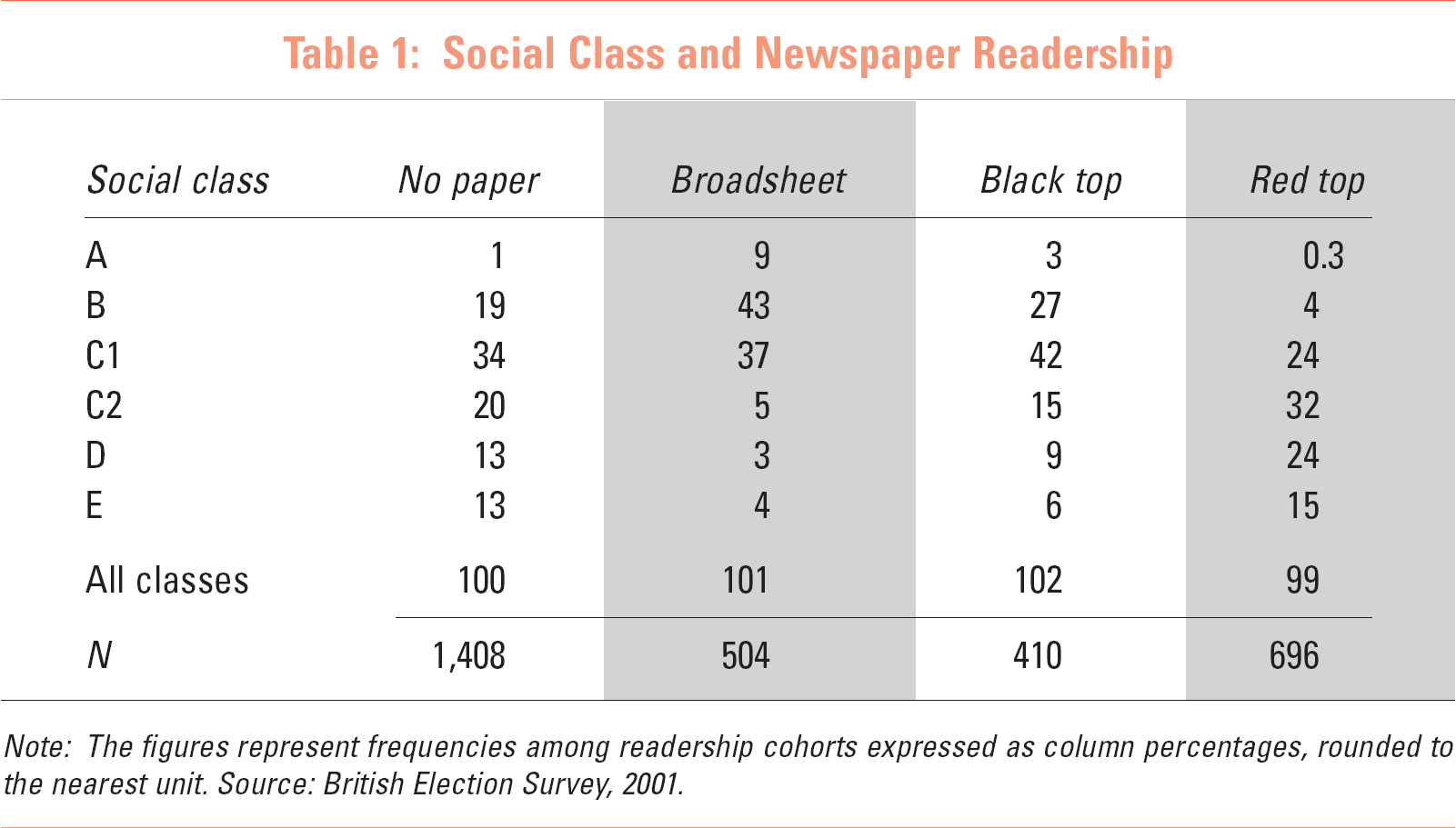
Note: The figures represent frequencies among readership cohorts expressed as column percentages, rounded to the nearest unit. Source: British Election Survey, 2001.
A secondary consideration is the placement of economic reports inside the average newspaper. Most, if not all, tend to carry detailed economic commentary in specialist pages towards the rear (including details of company mergers, board-level changes and stock reports). However, a substantial amount of economic coverage is carried in the ‘home news’ pages when the news is considered to be of broader relevance to the public or of more direct interest to readers. Here, we are talking about interest rate changes affecting us all or marked changes in unemployment. We thought it important, therefore, to distinguish between the news carried in these rather different locations, the assumption being that home news is accessible to the broad mass of readers, whereas business news is more likely to appeal to those with a special interest in economics.
Operationalising and Measuring the Variables
The evidence we used to test these models includes weekly opinion poll data on the political and economic perceptions of the public (derived from Gallup's Political and Economic Index). Labour support was measured using responses to the standard voting-intention question: ‘If there were a general election tomorrow, which party would you support?’. The ‘feel-good factor’ (personal prospective perceptions) was also measured using the standard question: ‘How do you think the financial situation of your household will change over the next twelve months?’. A rating for prime ministerial approval was measured using the Gallup question: ‘Who would make the best prime minister?’. Labour's relative economic management competence was measured using the question: ‘With Britain in economic difficulties, which party do you think could handle the problem best – the Conservatives or Labour?’. This ‘competence index’ was constructed by subtracting the percentage specifying Conservative from the percentage specifying Labour. Finally, government approval was measured using the question: ‘Do you approve or disapprove of the government's record to date?’. The poll data covered the period from 4 January to 22 December 1999, giving a total of 50 weekly observations. 2
The data on press coverage were derived from a content analysis of economic news copy from the three broadsheets and four tabloid titles identified earlier. The coding regime draws on the work of Page et al. (1987) and Sanders et al. (1993). It uses precisely the same techniques that were successfully deployed in two earlier studies of media economic output and its impact (Gavin, 1996 and Sanders, 1996, pp. 70–1, 81–2; 1998, pp. 98, 109-11). We chose to focus on stories covering 11 principal economic sub-themes: jobs and unemployment; inflation/prices; interest rates; taxation; sales and spending; wages, pay and disposable income; imports/exports and the balance of payments; short-time working; state borrowing; the housing market; and a final broad category of stories encompassing the ‘economy generally’ (including the issues of recovery, recession, trade, production, investment, growth, business and references to the general health of the economy). 3
The calculation of the quantity of ‘good’ and ‘bad’ economic news was carried out in two principal ways. In the first (the ‘key-term count’), we analysed all the references to economic trends within a news story (for example the number of times unemployment figures, job losses and closures were referred to in a particular news story). 4 This count is not particularly robust and could be prone to the miscoding of particular references, which could effect the reliability of the measure. But it does give a fine-grained appreciation of the weight of ‘good’ and ‘bad’ economic information put out by the press in any one day. In contrast, in the second way of consolidating figures (the ‘story count’), we analysed whether the economic stories a newspaper carried had, on balance, more references to ‘good’ economic news than ‘bad’. This measure gives scores of +1 (more ‘good news’ than ‘bad news’ key-term references within a story), -1 (more ‘bad news’ than ‘good news’ key-term references) or 0 (in the unlikely event of a tied balance). For example, a story on Marks and Spencers might make reference to falling sales (-1) in the context of loss of business confidence (-1) and the prospect of shop closures (-1), but it might also make reference to the falling price of goods in this chain (+1). ‘Bad news’ key terms, therefore, outnumber ‘good news’ key terms, giving the story an overall story count of -1. This measure was much more robust and reliable than the first measure, in that it is not dependent on the coding of individual key-term codes within a story, but focuses on whether, overall, ‘good’ outweighs ‘bad’. In the event, it was the latter measure that proved the most useful. 5
Model Specifications
Our approach to modelling the impact of press coverage of the economy draws on both our earlier work and that of other researchers working in the field (Mosley, 1984; Sanders et al., 1993; Sanders, 1999). The core idea is that a proper specification of press effects must apply controls for other theoretically relevant variables that might affect the key dependent variables in the model. The overall model that we opted for was a simple three-stage model of the form shown synoptically in Figure 1. The theoretical underpinnings of the relationship shown in the model, together with supporting empirical evidence for the 1990–94 period, can be found in Sanders (1996). We hypothesise that press coverage of the economy does not have a direct effect on voters’ party preferences. Rather, the effect is indirect. Press coverage affects voters’ economic expectations. These, in turn, influence voters’ perceptions of the major parties’ relative economic management capabilities, which then affect voting intentions. The intuition underlying the model is that, ceteris paribus, when voters feel that the economy is going well they are more likely to view the incumbent government's economic management skills positively, which means that voters are more likely to strengthen their electoral support for that party.

A Simple Three-Stage Model of Party Support
The model that we estimate, however, is rather more complicated than that shown in Figure 1, for two reasons. First, we need to control for other relevant variables that might affect each of the dependent variables in the model. Second, the model needs to be specified in a way that allows us to test for the indirect role that press coverage of the economy is hypothesised to play. In fact, we use five sets of explanatory variables in our model of party support.
As anticipated above, the first cluster of variables relates to the images of the major parties. These comprise perceptions of economic management competence, perceptions of the party leaders and approval or disapproval of the government's record. Unsurprisingly, we hypothesise that support for the incumbent party will vary positively with perceptions of the party's economic competence (measured as the percentage that thought Labour would be best at handling economic difficulties minus the percentage that thought the Conservatives would be best); with perceptions of its leader's popularity (the percentage that thought Blair would make the best prime minister); and with approval of the government's record.
The second variable set is a single variable – personal economic expectations. As indicated above, we hypothesise that rising (or falling) economic confidence will lead to an enhanced (or diminished) management competence image for the incumbent party. It is also possible, however, that expectations could exert a direct effect on their support – if one is optimistic about the economic future, then one is more likely to wish to maintain the political status quo that generated my optimism. Accordingly, we need to test for a possible direct effect of expectations on party support.
The third variable set relates to the objective economy. Economic voting studies have shown that party support patterns can be strongly linked to movements in objective economic factors, notably unemployment, inflation and interest rates (Hibbs, 1987; Lewis-Beck, 1988; McKuen et al., 1992; Anderson, 1995, 2000). Although the evidence in the UK is indecisive, we include controls in all our equations for change in these variables.
The fourth set of explanatory variables relates to ‘unusual political events’. Such events (like the Falklands War or the 1980s miners’ strike) are capable of having significant, if not always enduring, effects on party support levels. Accordingly, the impacts of events have to be correctly specified in order that the effects of other variables can be properly estimated. During the period that we studied, the main potentially disruptive events were associated with NATO's bombing of Serbia, which was aimed at forcing the Serbs to withdraw from Kosovo. This campaign could have damaged the government's standing with the electorate, though it appears to have produced more of a modest, temporary ‘rally round the flag’ effect. We specify this effect as a series of dummy variables for weeks 2–4 of the campaign (31 March to 21 April 1999).
The final set of explanatory variables relate to press coverage of the economy. Inevitably, there are a variety of ways in which press coverage can be characterised. We focused on the impact of the economy as reported in the ‘home news’ pages of newspapers. 6
Our initial model specification takes the form of three linear equations. We restrict our reported modelling of party popularity to support for Labour for two reasons. First, our data contain insufficient cases each week to give us meaningful measures of the weekly variations in support for either the Liberal Democrats or the nationalist parties (these supports were a tiny cohort in an otherwise representative sample of around 1,000). Second, models of support for the Conservatives (not reported here) turned out to be ‘mirror images’ of Labour models, so in this sense there is no additional analytic pay-off of modelling Conservative support. We also restrict all the reported relationships here to the effects of the various exogenous variables at time t, because, after experimentation with various lags, we found that all of the significant relationships were simultaneous.
Our first equation, then, is for Labour support. Initially, we specify this as a function of the five sets of exogenous variables identified above:

where Lab is the percentage intending to vote Labour; Labm is Labour versus Conservative economic management competence; Blair is the percentage saying Blair would make the best prime minister; Approval is the percentage who approve of the government's record; Pexp is the ‘feel-good factor’; K3/4 is a dummy for weeks 3 and 4 of the Kosovo campaign; dUN is the change in the number of reported unemployed since last week; dRPI is the inflation rate; dRIR is the change in real interest rates since last week; Broadsheet, Blacktop and Redtop represent the respective press coverage of economic news; and ut is a random error term. Following the logic of Figure 1, we expect to find that most of the coefficients in equation (1) are non-significant, since Figure 1 implies that only economic management competence should have a direct effect on Labour support.
Our second equation seeks to explain variations in what is hypothesised to be the key explanatory variable in equation (1) – economic management competence. Following the logic of Figure 1, the key independent variable, for which we expect a significant coefficient, is economic expectations. However, in order to confirm that competence perceptions are not directly affected by either the objective economy or by press coverage, terms for these variables are also included, as well as a dummy for the effect on competence perceptions of the second week of the Kosovo campaign (K2). This produces

Our third equation is for the key explanatory variable in equation (2) – personal economic expectations. Here, we expect to find that expectations are influenced both by the objective economy and by press coverage of the economy, though not by the Kosovo campaign. This yields

We began our empirical analysis by estimating equations (1)–(3). Following the general-to-specific econometric methodology advocated by Hendry and his associates (Hendry, 1995), we then re-estimated each equation, including only the significant terms from the initial specification. This gives a more parsimonious model specification and a more robust estimation of the coefficient magnitudes.
A Qualification: The Potential Role of Social Class
One of the distinctive features of newspaper readership in Britain is the class composition of different sorts of title. As already noted, Table 1 shows the class profiles of the three types of newspapers that we analysed. The broadsheets are almost exclusively middle class; the red tops and black tops each have a pronounced class skew, but they straddle the middle-class/working-class boundary to a greater degree than the broadsheets. This differential class pattern, in turn, suggests that the effects of newspaper coverage on voters’ perceptions (in terms of our model, on voters’ economic expectations) might be different for middle-class voters than for working-class voters.
All of this suggests that, as an alternative to equation (3), we should also estimate two further equations. First,

where MCPexp denotes weekly variations in the economic expectations of middle-class (ABC1) voters. The strong expectation here is that the Broadsheet terms should be significant, but that the Blacktop terms may be significant and the Redtop terms should not be. Second, we should estimate

where WCPexp denotes weekly variations in the economic expectations of working-class (C2DE) voters. Here, we expect to find that the Redtop term is significant (because most readers of the red tops are working class), but that the Broadsheet and Blacktop terms are non-significant (because readers of the broadsheets and black tops, as shown in Table 1, are predominantly middle class).
Model Estimation Results
Table 2 shows the results of estimating equations (1)–(4b) for the period from 4 January to 22 December 1999. Table 1 Table 3 shows the consequences of re-estimating each equation as a reduced form, incorporating only the significant terms from Table 2. The results provide strong support for the sort of causal sequence outlined in Figure 1. In equation (1) in Table 2, only competence (together with an appropriate Kosovo term) has a significant impact on Labour support. Over and above the effects of competence, there is no explanatory role for leadership perceptions, approval of the government's record, the objective economy or press coverage. In equation (2), a similar pattern occurs. The only significant term is for economic expectations (again, together with an appropriate Kosovo term). There is no role for either the objective economy or press coverage. In equation (3), the results are less robust but nonetheless suggestive. The objective economy, in the form of inflation, plays a significant role in generating expectations, whereas the effects of press coverage (measured without any form of class differentiation) are at the margin of statistical significance (see the almost-significant term for broadsheet coverage in equation (3) in Table 2 and Table 3). As equations (4a) and (4b) clearly suggest, however, when class differences in economic perceptions are explicitly considered, the effects of press coverage become more pronounced. Coverage in the broadsheets (see equation (4a) in Table 2 and Table 3) clearly affects middle-class expectations; and coverage in the black tops (see equation (4b) in Table 2 and Table 3) clearly affects working-class expectations. The red tops, in contrast, appear to exert no influence on either segment of the population.
Estimates of Equations (1)–(4b), Full Specification
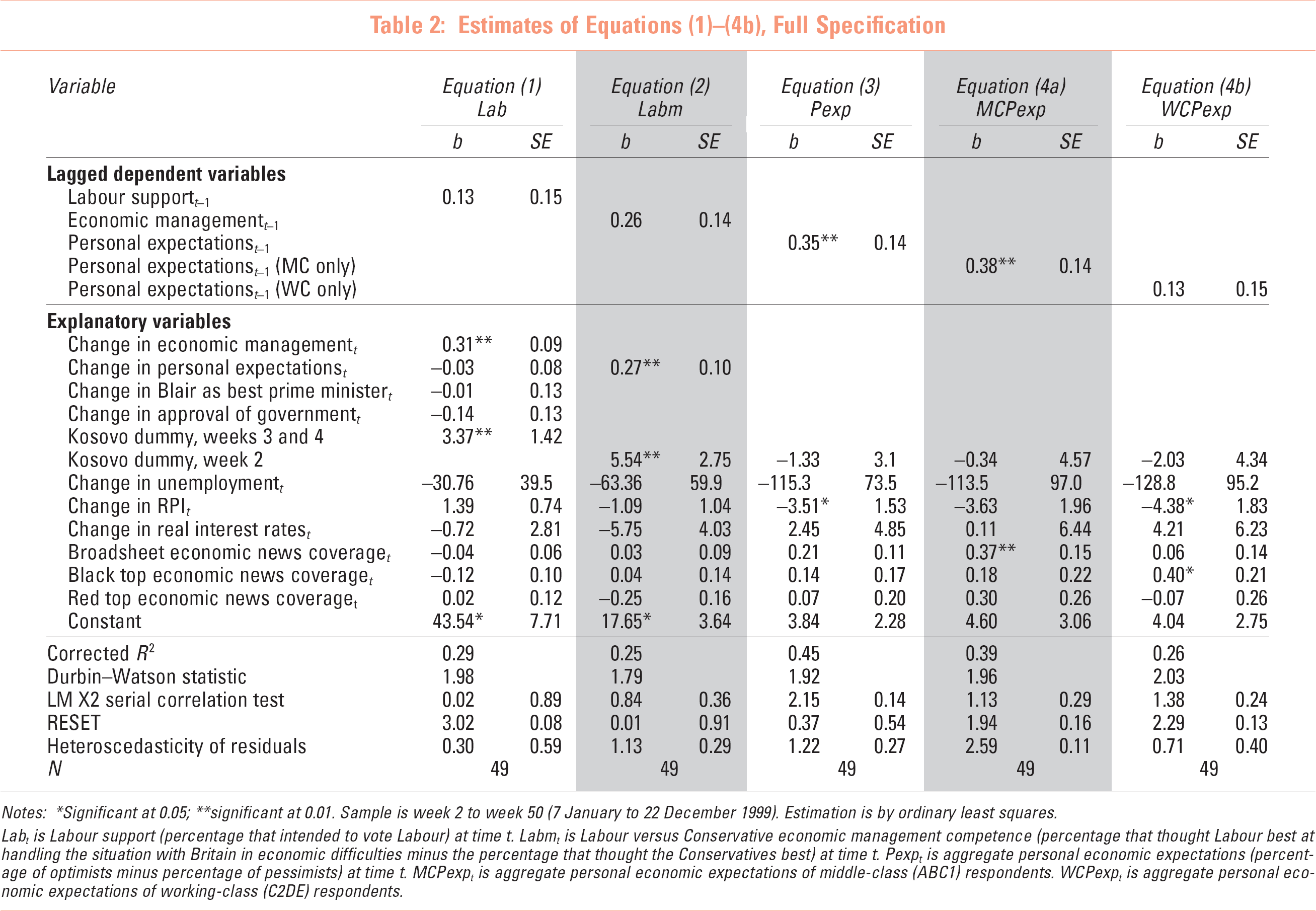
Notes: * Significant at 0.05; ** significant at 0.01. Sample is week 2 to week 50 (7 January to 22 December 1999). Estimation is by ordinary least squares.
Lab, is Labour support (percentage that intended to vote Labour) at time t. Labmt is Labour versus Conservative economic management competence (percentage that thought Labour best at handling the situation with Britain in economic difficulties minus the percentage that thought the Conservatives best) at time t. Pexpt is aggregate personal economic expectations (percentage of optimists minus percentage of pessimists) at time t. MCPexpt is aggregate personal economic expectations of middle-class (ABC1) respondents. WCPexpt is aggregate personal economic expectations of working-class (C2DE) respondents.
Estimates of Equations (1)–(4b), Reduced-Form Specification
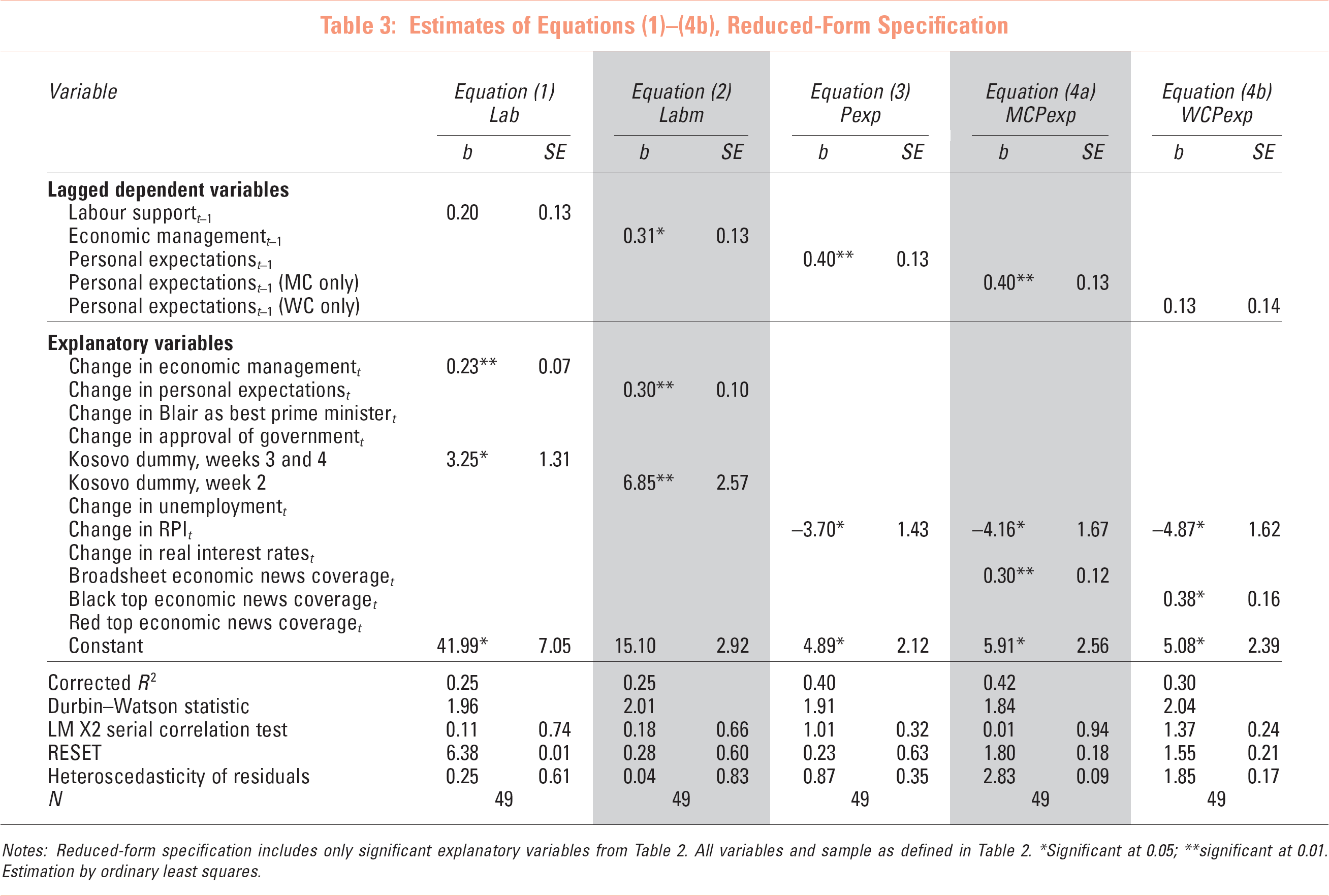
The model parameters suggest that a unit of ‘good’ economic news in the broadsheets (by which we mean a story that carries, on balance, more ‘good news’ about the economy than ‘bad’) increases aggregate economic expectations among the middle class by 0.30 of a percentage point, with a comparable unit of ‘bad news’ exerting a proportionate reductive effect. The corresponding change in expectations for working-class readers of the black tops is 0.38. Certainly, these are not massive effects in themselves, but they need to be seen in the context of the substantial number of economic news stories regularly carried in these titles. Over the course of a year (or, indeed, a parliament), numerous stories have the potential to change expectations to a significant degree and, in turn, influence overall support for the government.
But we have to enter a note of caution here when talking in terms of a straight causal connection between press news and movement in public opinion. The issue here is ‘reciprocal causation’. Two alternative ways of reading the relationship are at least plausible: (i) both press and public are responding to ‘real world’ changes in the economy; or (ii) newspapers may simply be responding to the oscillations in the public mood. The former is the easiest to discount, as our models actually contain measures of ‘real world’ change (inflation, unemployment and interest rates) and our press variables still continue to show significant parameters. The latter may be plausible, but only at the broadest level of editorial policy. For example, the Daily Express or the Sun might have become more sympathetic to New Labour when, and only when, the public became more comfortable with Blair. The operation of this kind of mechanism, however, is scarcely plausible when we look at day-to-day economic reporting; it is highly implausible to suggest that journalists are aware of short-term changes in public expectations and adjust their copy accordingly. Other journalists, not the public, are the most important people in a correspondent's frame of reference (Harrison, 2000, p. 117). Moreover, the economy as portrayed in the press is couched in a technical and relatively depoliticised discourse. The economy grows or contracts and sales go up or down, as do interest rates and unemployment and inflation figures. It is a domain of linear movement, and one typically reported as a ‘valence issue’ – who, after all, would consider rising unemployment, prices or interest rates as ‘positive’, or burgeoning sales, economic growth and rising incomes as ‘negative’? In short, then, press reporting of the economy is not done in the sort of context where we would expect economic coverage to ‘respond to’ short-term shifts in support for the political parties or, for that matter, changing economic expectations.
Reciprocal causation aside, the influence of the broadsheets on middle-class expectations is perfectly understandable, given that this segment of the population represents its primary consumer – likewise, the lack of impact of the red tops, which have a relatively high proportion of readers with a low interest in politics (as Table 4 suggests) and, in any event, carry relatively little ‘dull but worthy’ economic copy and are more dedicated to sensation, celebrity and salacious trivia. On the other hand, the result that suggests an impact of the black tops on the working class is more difficult to explain and is counter-intuitive, given their predominately middle-class readership. The answer may lie in a combination of factors, including the size of their working-class readership, the partisan characteristics of those exposed to their news and, finally, the overall balance of their economic coverage.
Interest in Politics and Newspaper Readership
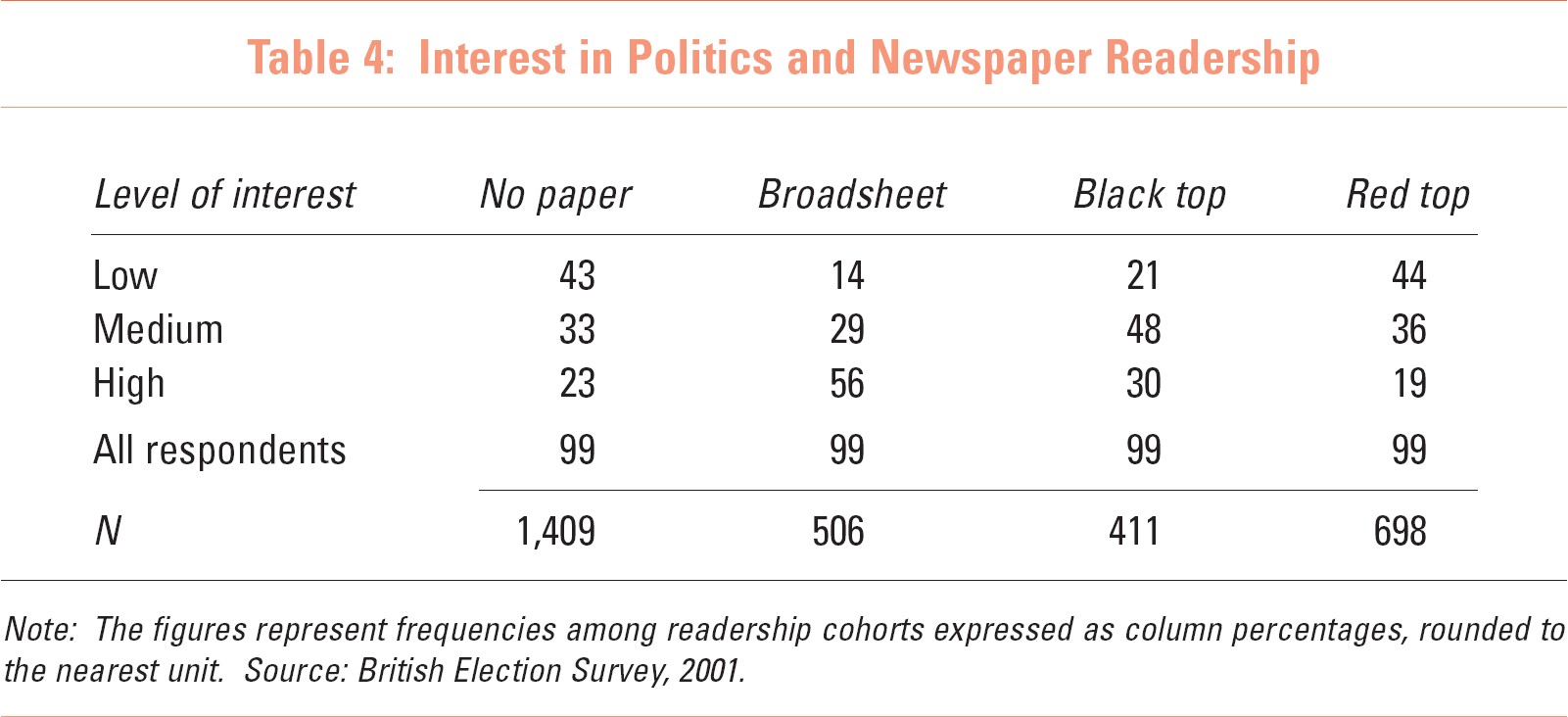
Note: The figures represent frequencies among readership cohorts expressed as column percentages, rounded to the nearest unit. Source: British Election Survey, 2001.
According to industry figures, the black tops sell to around three million readers, about a third of which are working class (Table 1) – a sizeable chunk of the electorate. In addition, the black tops lie somewhere between the broadsheets and red tops in terms of the level of sophistication of their coverage and (as Table 4 suggests) the level of interest in politics of their readers. Finally, the partisan leanings of the readers of the black tops are different (as Table 5 suggests) from the readers of the broadsheets and red tops. The principal issue here is that the partisanship of the middle-class and working-class readers of the broadsheets and red tops are roughly comparable. There are as many Conservative partisans in the middle-class group as there are in the working-class group, and this holds true for both Labour partisans and the ‘unaffiliated’. However, when we look at the partisan leanings of the readers of the black tops, we see a distinctive asymmetry. In the middle-class group, Conservative partisans predominate; in the working-class group, Labour partisans predominate. And among the working-class readers of the black tops, there is a greater proportion of ‘unaffiliated’ people than among the middle-class readers.
Crosstabulation of Social Class, Newspaper Readership and Partisanship
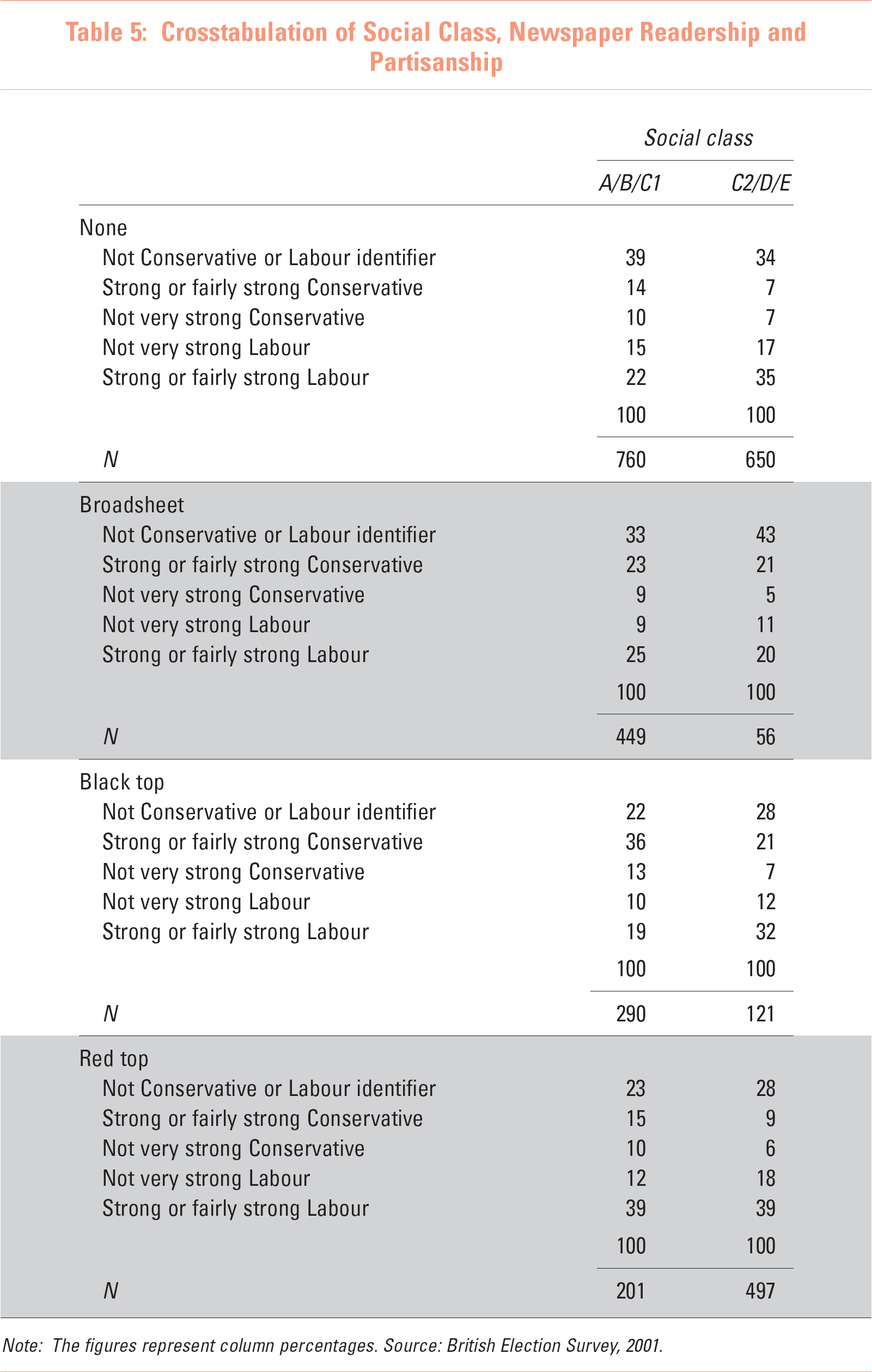
Note: The figures represent column percentages. Source: British Election Survey, 2001.
At this juncture, it is also important to note that, across the period that we studied, the overall balance of economic news in the black tops was distinctly positive – ‘good news’ far outweighed the ‘bad’. Furthermore, by 1999, the largest-selling black top (the Daily Mail) was beginning to take a distinctive pro-New Labour stance (and even the Daily Express had become less strident in its condemnation of the Blair government). We might anticipate, therefore, that Conservative-inclined partisans among the middle-class readers of the black tops would be inclined to dismiss news about a buoyant economy or the more positive line on New Labour – selectively perceiving or interpreting the prevailing message. On the other hand, the working-class Labour incliners would be more likely to have their expectations amplified, and the more numerous working-class ‘non-affiliates’ might be more likely to acknowledge that the economy was on the up and adjust their expectations accordingly. In terms of these interacting factors, a differential impact on the middle-class and working-class readers of the black tops is perhaps less surprising.
Conclusions and Implications
Although, admittedly, the impact of the ‘the media’ may extend beyond simply ‘the press’, the conclusions that can be drawn from our study are fairly clear. 7 The press is capable of having an impact on the political and economic attitudes of important segments of the public. Clearly defined and numerically significant portions of the population are affected by some of the most widely circulating newspapers. Importantly, when we compare our results with those from studies during the last Conservative government (Sanders et al, 1993), it is clear that the influence wielded by the press is stable and consistent – it is not transitory or dependent on the type of serving administration.
The results also highlight a range of issues that must be considered when we try to gauge the influence of the media. It is no longer sufficient simply to look at the editorial recommendation of a newspaper before an election, then at the public's exposure to that title and their subsequent voting behaviour. We must look directly and in more detail at what, precisely, newspapers are telling their readers, because the messages reported can be mixed, inconsistent with such recommendations or just plain idiosyncratic – whether we are talking about the economy or any other issue. The message here is clear for those undertaking individual-level analysis of media impact, but there is also a message for those deploying aggregate-level techniques. We found that the press only affect the attitudes of particular parts of the electorate (differentiated in our study at an operational level by social class, but in effect mirroring the exposure or circulation characteristics of particular newspapers). The results suggest, therefore, that we need to be wary of looking at the impact of media content on the whole population. We must not lose sight of the fact that the audience is variegated, and subsequent studies need to make allowances for this.
The results are somewhat at odds with those of an earlier study that suggested that the press had little or no impact on the public's issue agenda during the 1997 general election (Norris et al., 1999). But the contrast is relatively easy to understand. That 1997 study did not disaggregate the audience (as we sought to do) but analysed the impact of overall press coverage on the whole population. More importantly, it is precisely in the context of an election campaign that we might expect the press to have limited influence. After all, it is at this time that the public get most impatient with the quantity and intrusiveness of political coverage and are most aware of the blandishments of politicians. It is perhaps not surprising, then, that the press fails to exert the influence it obviously thinks it does. The contrast in results, then, highlights the need to extend our focus beyond elections to the long interlude between them – the ‘continuous campaign’.
We need to be bear in mind, however, that the press influence we have exposed is not in any sense strong or determinant, and this highlights the contingent dimension of media impact. First, not everyone reads a newspaper, and non-readers are unlikely to be directly affected. Second, even those who do read a newspaper may be uninterested in the political or economic content and may also be unaffected. This may explain our finding that the Sun and the Daily Mirror apparently fail to exert any influence. Finally, it is clear that those who both read a newspaper and are interested may still interpret news in a way that is consistent with their own pre-existent partisan dispositions. These contingencies help explain why parameter coefficients are of the order of magnitude we find in our models. But this also puts into perspective some of the more apocalyptic prophesies that focus on ‘tabloidization’ or ‘dumbing down’ of politics in the more ‘raucous’ newspapers (McNair, 2000, p. 4) or on the pernicious influence of their proprietors (Franklin, 1994). Moreover, in the light of our findings, the Labour government should perhaps be less concerned about the bluster of the red tops than they appear to be – a conclusion that could have important implications for the way the government approaches any future referendum on the euro.
Qualifications aside, all broadsheets and black tops typically carry a significant quantity of economic reporting, and this gives them the potential to influence the economic and political attitudes of the public. Given the economic conditions in the period that we studied, the fact that ‘good’ economic news outweighed ‘bad’ in both broadsheets and black tops is not a surprise, and it may go some way towards explaining the Labour's sustained support throughout its first administration. But, by the same token, the press has the capacity to make life more difficult for the government, especially if it speaks with a unified voice and we see something like a rerun of the petrol price crisis of 2000 or Britain caught in the backwash from American or German recessions.
Footnotes
This research was funded by the Economic and Social Research Council (Ref: R000237642), and we gratefully acknowledge their support. We are also grateful to Gallup for access to their omnibus poll data.
1
The reverse is also true, in that constituencies with relatively high Daily Mirror and Guardian sales show distinctively Labour tendencies.
2
Resource constraints prevented us from sampling a longer period.
3
Details of the coding schedule can be obtained from the principal author.
4
The key terms were easy to code, as ‘the economy’ in the news is composed of what amounts to a set of ‘valence’ sub-issues that are reported as trending in a linear and predictable manner.
5
A third method (‘consolidated story‘) counts across whole classes of newspapers, although this measure was found to be of limited utility.
6
Extensive experiments with the business section alone, and with a combined measure summing the business and home sections, failed to produce any significant model parameters.
7
The authors are currently working on an analysis of the conjoined impact of both the press and television.