






Abstract
Despite the success of his party systems theory, Giovanni Sartori's predominant party system is a type that is consistently avoided by party systems scholars, yet the reasons for this have been unclear. This article exposes the flaws in Sartori's predominant party system, but we also argue that it remains a useful concept and, consequently, that the literature's rejection of predominance and retreat to the cruder dominance notion is unnecessary. Instead, we amend predominance to ensure its coherence within Sartori's typology and consistency with his party systems theory. We show that our amendments improve the value of predominance as a category for empirical analysis of the effects of party systems.
The predominant party system was introduced by Giovanni Sartori to identify party systems in consolidated democracies that are anchored by only one relevant party. These characteristics are sufficient to make the predominant party system a ‘type’ alongside the other types that Sartori proposed in his classic Parties and Party Systems: A Framework for Analysis (1976). However, while his other democratic party system types — ‘one-party’, ‘hegemonic’, ‘two-party’, ‘moderate pluralism’ and ‘polarised pluralism’ — became tenets in the party systems literature, the predominant party system has been largely abandoned. Yet the reasons for scholars' discomfort with the notion, and for their retreat to the older notion of dominance, have been unclear. And there has been no proper assessment of whether their de facto abandonment of predominance is a better choice than either persisting with Sartori's predominance concept or revising it to improve its utility as a category for empirical analysis. This article addresses these two gaps.
First, we identify the sources of scholars' resistance to predominance. There are two serious problems in its conception and elaboration. The first problem is that Sartori's predominant party system is not conceived using the theoretical dimensions that he uses to construct his other types of democratic party system. The other types are derived using two criteria: fragmentation and polarisation. These dimensions are not used to derive predominance, which is instead defined by reference to patterns of power alternation. The result is that the predominance type is dislocated from his overall framework. The second problem concerns the structure of the predominance concept. Careful scrutiny of Sartori's remarks on predominance reveals that the concept should be understood as a radial category with an unambiguous core and fuzzy boundaries, but Sartori's explicit definition uses a classical mould. The result is that his empirical analysis uncovers only obvious cases of predominance and neglects the subtle variants that become apparent when its radial structure is unpacked.
Second, in light of the problems with predominance, we assess whether progress in the study of party systems is more likely by either: (1) abandoning Sartori's notion, which has been the general tendency among researchers; (2) persisting with Sartori predominance in spite of its flaws; or (3) revising predominance to remedy its flaws while retaining Sartori's basic intuitions. We argue that the third option is best, for predominance captures essential aspects of party systems that cannot be captured using dominance or any of Sartori's other party system types, and predominance can be reconstructed to remove its liabilities while remaining true to Sartori's initial ideas. To show that the choice to revise predominance offers benefits over abandoning the concept or persisting with it, we present empirical data that support the idea that predominant party systems have distinctive effects on economic outcomes, and that our revised predominance concept captures these realities more accurately than does Sartori predominance.
The article is organised as follows. In the next section, we discuss the problems with Sartori predominance. We then assess whether these problems warrant the abandonment of the concept and a return to the older notion of dominance, which has been the literature's general approach. We argue that this response is both problematic and unnecessary. Instead, we recommend a recasting of predominance; this is the task of the third part of the article. We embed predominance within Sartori's typology by anchoring his framework in power alternation — the latent dimension in his analysis — instead of ideological polarisation. Recognising that predominance is a radial concept, we extend its bounds to include the possibilities of predominant coalitions, interrupted predominance and sub-national predominance. These subtypes, though absent from Sartori's elucidation, are shown to exhibit the essential mechanics of his predominant party system type. In the fourth section, we consider the practical returns from our theoretical revisions. Using a data set of predominant party systems, we show that our amendments of predominance improve its utility as a category in empirical analysis.
The Problems with Sartori Predominance
Incoherence within Sartori's Typology
Frustrated by the numbers-of-parties approach (e.g. Duverger, 1954), Sartori (1976, p. 125) proposed a typology of party systems based on multidimensional criteria or ‘attribute compounds’. He proposed fragmentation, or the number of relevant parties in a party system, 1 and polarisation, the ideological spread of the relevant parties, as fundamental dimensions. His typology, supposedly derived from these dimensions, comprises six party system types: one-party, hegemonic, predominant, two-party, moderate pluralism and polarised pluralism (Sartori, 1976, p. 125).
A predominant party system describes ‘a power configuration in which one party governs alone, without being subjected to alternation, as long as it continues to win, electorally, an absolute majority’ (Sartori, 1976, p. 127). To identify predominance in practice, Sartori outlined three further conditions. He argued, first, that predominance in seats, rather than election votes, was the relevant criterion. Second, his majority criterion was relaxed for countries that ‘unquestionably abide by a less-than-absolute majority principle’ (Sartori, 1976, p. 196). This means that a predominant party system can exist in countries where ‘minority single-party governments remain a standing and efficient practice’ (Sartori, 1976, p. 196). Third, Sartori added that party system predominance is established when the predominant party wins three consecutive legislative majorities. Using these criteria he identified predominant party systems, for various periods, in India, Ireland, Japan, Norway and Sweden (Sartori, 1976, p. 198).
Yet none of these requirements is related to Sartori's overarching classification theory, for neither fragmentation nor polarisation is at play in his construction of the predominant type or in his identification of real-world predominant party systems. Instead, Sartori uses power alternation to define and pinpoint predominance. The potential for power alternation is the key difference between a hegemonic party system on the one hand, and a predominant party system on the other. Predominant party systems are therefore genuinely competitive while hegemonic ones are not: ‘[t]he hegemonic party neither allows for a formal nor a de facto competition for power’ (Sartori, 1976, p. 230). The key distinction on the other side of Sartori's spectrum — between predominant and two-party systems — also turns on power alternation. When, for three successive elections, the potential for power alternation does not translate into actual alternation, a party system can no longer be treated as two-party and must be regarded as predominant. Thus, Sartori predominance is not derived from his party systems theory and therefore does not fit coherently within his typology.
Although fragmentation is not an essential attribute of predominance, and therefore not necessary for its definition, Sartori is able to mesh predominance with this dimension. He explains that predominance can exist in party systems with varying degrees of fragmentation. Thus, he observes that the predominance of the Democratic Party in the American South occurred instead of a two-party system but he predicts, in contrast, that ‘if the [Japanese] LDP loses the absolute majority of seats, Japan may easily qualify as a polarized system’ (Sartori, 1976, p. 200). Polarisation, however, is completely unrelated to predominance. Its power to discriminate between stable and unstable multipartism, which — as we explain later — is the only analytic leverage that it supplies, comes at the high cost of the coherence of predominance within Sartori's typology.
A Radial Category Misconceived in a Classical Mould
A classical category has clear defining attributes that are shared by its members and absent in non-members, whereas a radial concept has a primary (or essential) definitional attribute and secondary (important but non-essential) attributes that branch out from this core (see, e.g., Collier and Mahon, 1993). We argue that predominance possesses a radial rather than classical structure. This was not recognised by Sartori in his brief elaboration of the concept, with the result that Sartori predominance is delimited in ways that clash with central ideas in earlier chapters of Parties and Party Systems and significant research since its publication.
In chapter 5, Sartori explains a crucial distinction between the format and mechanics of party systems. ‘Format’ refers to the number of relevant parties; it encapsulates Maurice Duverger's earlier approach. Sartori's innovation is his stress on a party system's ‘mechanical predispositions’, which denote ‘how it works' and its effects on ‘the overall political system as a consequence’ (Sartori, 1976, p. 128). He identifies the mechanical properties of a predominant party system as: (1) a unimodal power concentration; and (2) an absence of power alternation (which he later clarifies to be limited power alternation) (Sartori, 1976, p. 128, pp. 196–8). Thus, a party system with both of these properties is predominant irrespective of its format. The format is necessary only for identifying the variants of a mechanical type. However, in the discussion that follows, Sartori identifies predominant party systems that together represent only a small range of formats that are consistent with predominant mechanics. There are party system formats that are consistent with predominance but which are overlooked by Sartori in his discussion of empirical examples.
First, he does not consider the possibility of predominant coalitions in moderately or highly fragmented party systems. Yet it is possible for a coalition to predominate a party system when, through a coalition agreement, 2 it forms a unimodal power concentration and, through electoral successes, it secures recurring legislative majorities. Although Sartori (1976, p. 200) accepts that predominance is consistent with varying degrees of party system fragmentation, he does not take the step, implied by his framework, of admitting the possibility of coalitional predominance. Therefore, he overlooks lengthy and stable predominance by multiparty coalitions in countries such as Austria (1949–96) and Luxembourg (1984–94). Instead, all of his examples — in systems of varying fragmentation — feature single-party predominance. For the coalitional systems that Sartori considers, such as Norway and Sweden, he is able to write of ‘the predominant party’ (Sartori, 1976, p. 200). But in so doing he falls foul of one of the central aims of his book, to maintain the distinction between parties on the one hand, and party systems on the other. 3
Sartori predominance is also defined too narrowly in two other respects: its temporal and spatial bounds are overly strict. Defining a party system as ‘the system of interactions resulting from inter-party competition’, full specification of a party system must identify where it starts and stops (Sartori, 1976, p. 44). To delineate its temporal bounds, Sartori explains that a predominant party system ceases to exist as soon as its mechanics are altered by a redistribution of power in the party system. While this is true of each party system type, Sartori argued that predominance was ‘subject to a peculiar kind of fragility: Small differences in returns, or the mere changing of the electoral system, can more easily transform the nature of the system’ (Sartori, 1976, p. 199).
This claim is questionable not only empirically — as the persistence of predominance in cases such as post-war Japan attests — but also conceptually. Sartori's temporal specification implies that even slight aberrations are sufficient to alter the character of a party system. Yet his conceptualisation of party systems turns on the idea that systems of inter-party interactions have enduring mechanics. That is, established party systems have a ‘systemic identity’ (Bardi and Mair, 2008, p. 153). If a party system exhibits an anomalous pattern for a short period, after which it returns to its regular type, then the exceptional period should therefore be treated as an aberration rather than a transformation of type. Accordingly, despite a brief interregnum (August 1993–October 1994), the post-war Japanese party system (1955–2009) exhibited an enduring — but interrupted — pattern of predominance (Krauss and Pekkanen, 2011). This approach has also been a standard practice in analyses of two-party systems, where scholars expect general — rather than consistently perfect — patterns of power alternation (e.g. Tufte, 1973). It is reasonable, therefore, to consider in classification the pattern of competition that follows the termination of a predominant spell. When an apparent end of predominance is followed, after a brief interlude, by a further predominant spell, we can consider this to be a single but interrupted episode of predominance.
The spatial scope of predominance is also problematic. Sartori claims that a party system takes its form from the competition for its highest office. Thus, for Sartori, predominant party systems — like all party systems — are national in scope. His discussion of the American South underlines this view. He writes, contra V. O. Key, that ‘when American scholars speak of the “one-party” areas of their country, the label is inappropriate and misleading’ (Sartori, 1976, p. 84). Instead, because party systems are national phenomena, ‘[w]hat they are really describing is a situation in which two parties … fail to produce the mechanics of twopartism’ (Sartori, 1976, p. 84). The American South, Sartori contends, is more accurately described as predominant. 4
Yet subsequent research has challenged Sartori's assumption that party systems are national in scope (e.g. Bardi and Mair, 2008; Gibson and Suarez-Cao, 2010; Jones and Mainwaring, 2003). To use Sartori's terminology, the dynamics of inter-party competition may diverge between national and sub-national party systems, and therefore the latter can exhibit quite distinct mechanics. And the history of Southern party politics suggests that such separate mechanics can persist for a substantial period within a sub-national region (Black and Black, 1992; Key, 1984). These mechanics do not necessarily trend toward convergence on national patterns. As Pradeep Chhibber and Ken Kollman (2004) show for Canada, India, the UK and the US, national and sub-national party systems are often only loosely connected. Party systems tend to become more horizontally uniform when authority, policy and political opportunities are centralised, while decentralisation fosters the detachment of sub-national systems from national dynamics (Chhibber and Kollman, 2004, p. 21). When decentralisation occurs, as in the UK post-1997, distinctive regional party system dynamics emerge or are strengthened. In sum, these theoretical and empirical observations imply that sub-national predominant party systems can exist, and indeed may constitute some of its most enduring episodes.
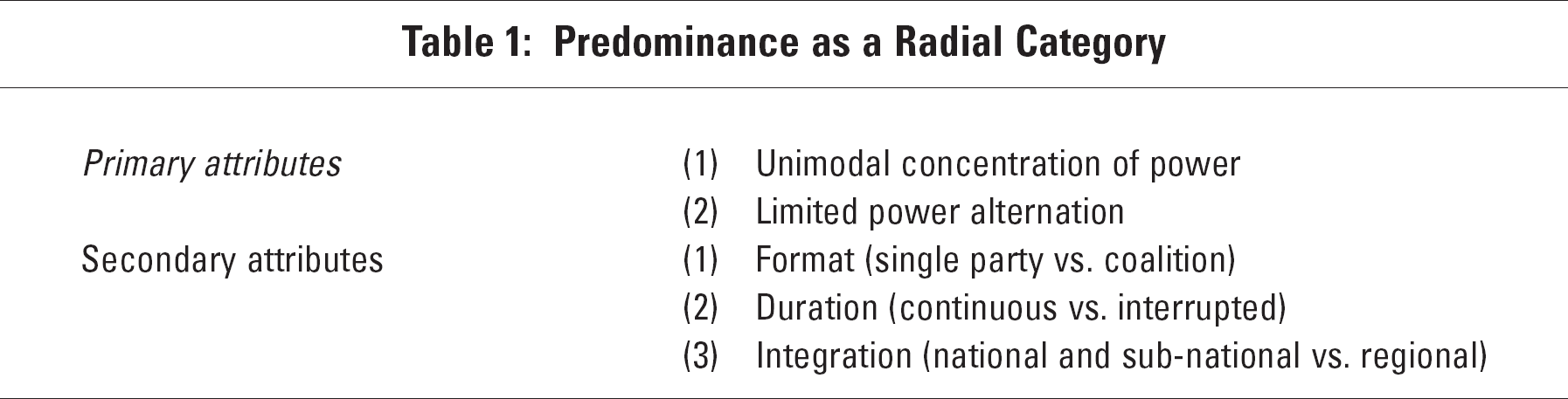
Rather than the classical parameters in which Sartori grounds his analysis, predominance possesses a radial structure. As shown in Table 1, its primary components are given by Sartori's mechanical properties, a unimodal concentration of power and limited alternation in power, and its secondary components are: (1) format (single-party vs. coalition); (2) duration (continuous vs. interrupted); and (3) integration (national and sub-national vs. regional). A party system is predominant if it fulfils the primary components, but predominance is purer — and more obvious — if it is by a single party, continuous, and the predominance permeates both the national and sub-national party systems.
Predominance as a Radial Category
The Retreat to Dominance
Scholars' reluctance to use the predominant type in their analyses of party systems suggests that there is a general recognition that it is a problematic concept, even if its precise flaws have not been previously elaborated. The dominance notion of Gabriel Almond (1970) and Maurice Duverger (1954) is typically preferred for analyses of party systems that might be categorised as predominant. This approach enables researchers to steer clear of the problems of predominance, but it is accompanied by equally serious problems. As Sartori realised, dominance is a fuzzy residual category that conflates two central distinctions in comparative politics: (1) democracies and non-democracies; and (2) structured and fluid polities.
First, while Almond and Duverger had in mind the relatively vibrant democracies in India and Scandinavia, their dominance category also leads us to admit the 1950s and 1960s party systems in countries such as Iran, Mexico and the Philippines, where elections were not contestable. The crucial difference between these two classes of dominance, Sartori explains (1976, p. 195), is ‘the authenticity of [election] victories’. Those systems where ‘we can close an eye to electoral irregularities' became Sartori's predominant party systems (Sartori, 1976, p. 195), while the rigged remainder formed his hegemonic class. This separation of democratic and non-democratic political monopoly embodies a central distinction in comparative politics between democratic and non-democratic regimes (Kalyvas, 1999, p. 324; Lijphart, 1968, pp. 8–10). 5
Second, the dominance ‘omnibus' type is used to describe both institutionalised and fluid polities (Sartori, 1976, p. 245). Yet the party systems in new democracies are emergent and undeveloped — or ‘provisional’, as Sartori (1976, p. 246) labels them. Whatever their other characteristics, their outstanding features are formlessness and volatility (see also Sanchez, 2009; Toole, 2000). Because of this, the challenges for these systems — societal permeation and democratic survival — bear no resemblance to the party politics in consolidated democracies. It is misleading, therefore, to acquire a theoretical understanding of the dominant ‘type’ by combining insights from structured and unstructured systems. As Sartori writes (1976, p. 246), ‘the entire construction is enfeebled [because it] implies that the fuzzy evidence drawn from fluid polities is brought to bear on the formed polities’.
Retreating to the old dominance notion resurrects these problems, with the result that substantial gains in our understanding of democratic monopoly in structured party systems rely on uncertain conceptual foundations. The literature presents various competing definitions of dominance (Blondel, 1968; Dunleavy, 2010; Greene, 2007; O'Leary, 1994; Pempel, 1990; Ware, 1996). This absence of consensus on definitions, distinctions and cases leaves researchers either to propose their own criteria (Greene, 2010; Kalyvas, 1999; Sanchez, 2009; Templeman, 2010), or to study obvious, non-marginal cases such as India (Rudolph and Rudolph, 2008; Spiess, 2009), Israel (Aronoff, 1990; Levite and Tarrow, 1983), Japan (Krauss and Pekkanen, 2011; Pempel, 2008), South Africa (Spiess, 2009) and Sweden (Esping-Andersen, 1990; Krauss and Pierre, 1990). Thus, there remains a basic need for the concept of the predominant party system as an identifier of democratic monopoly in structured party systems. Applying the predominance concept also means that dominance can be reserved for descriptions of democratic monopoly in unstructured party systems. 6
Recasting Predominance
We argue that a better approach than returning to dominance is to recast predominance on more solid foundations. To do so, we introduce four amendments to Sartori's notion. The first three follow straightforwardly from criticisms that we outlined earlier: predominance should be extended to include the possibilities of coalitions, interruptions and sub-national predominance. These secondary characteristics are consistent with the primary essentials of predominance but absent from its purest manifestations. The fourth task is to embed predominance in Sartori's party systems mapping. We argue that interpreting Sartori's other types using power alternation, rather than polarisation, embeds predominance within his typology while maintaining a rigorous foundation for deriving his other types.
Extending the Parameters of Predominance: Temporal Aspects
Predominance continues to exist even if it is sporadically interrupted. Furthermore, because parties are distinct from party systems, predominant mechanics can persist in a party system even if the identity of the predominant party (or coalition) changes. This holds only if a party's predominant spell is followed immediately by the predominance of a rival party. Thus, Peter Mair (2008, p. 215), summarising the pattern of inter-party competition in the British party system, concludes that:
what had been a classic two-party system drifted towards what might better be seen as alternating predominant party systems, with the Conservatives holding power through three further elections, usually with massive majorities, and with Labour winning with its own overwhelming majority in 1997, and repeating this victory in 2001 and 2005 (see also O'Leary, 1994).
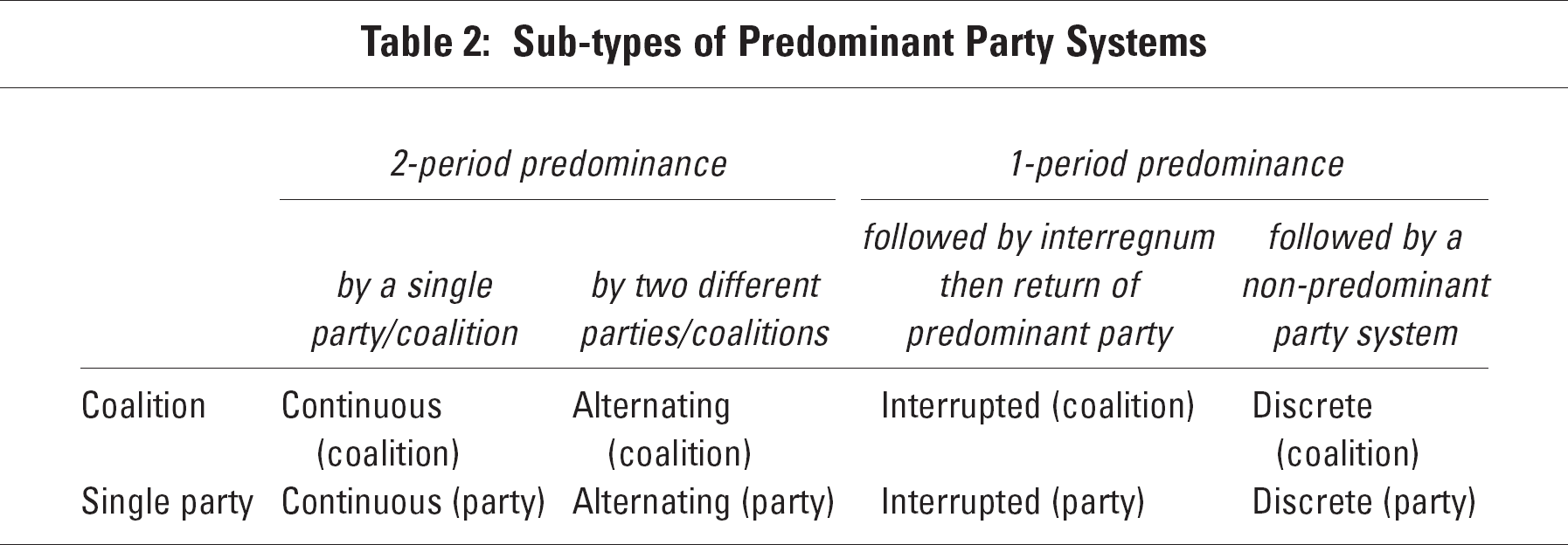
Variants of predominance can therefore be identified on the basis of, first, the duration of a party's (or coalition's) predominance and, second, the pattern of inter-party competition that follows a first period of predominance. Cross-tabulating these temporal sub-dimensions yields a typology of four subtypes of predominant party system, which can exist in single-party or coalitional formats. These are presented in Table 2.
Continuous Predominance
A party's or coalition's predominance may be long-standing or continuous if it lasts for a substantial period. If we set this threshold at six consecutive election victories, which is twice the length of Sartori's threshold, then an example of continuous predominance by a single party is the six parliamentary majorities (House of Representatives) secured by the Australian Labor Party from 1983 to 1996. No coalition has been completely unchanged for six consecutive elections (though the Grand Coalition in Austria [formed by the ÖVP and SPÖ] that governed over five consecutive legislative terms [1949–96] came close). However, if we relax slightly the rule that the entire coalition must be completely unchanged to the requirement that the major party in the coalition remains unchanged, then Belgium from 1975 to 1998 and Luxembourg from 1980 to 2010 qualify as continuously predominant party systems.
Sub-types of Predominant Party Systems
Interrupted Predominance
This describes when the end of a party's (or coalition's) predominance is followed by a return to power of that party or coalition, which is able to secure once again a predominant position. 7 In New Zealand, for instance, the National Party that had won a majority of seats in the previous four elections was badly defeated in 1972 and yet was able to win a majority of seats in elections in 1975, 1978 and 1981. Iceland was governed by a coalition between the Independence Party (IP) and the Progressive Party (PP) following elections in 1979, 1983 and 1987, but this coalition was replaced in power (the interruption) between 1989 and 1991 by a coalition between the Progressive Party and the Social Democratic Party. However, following the election of 1991, the IP—PP coalition returned to power and over the next decade achieved predominant status.
There are also cases of interrupted predominance that cut across the single-party/coalition formats. Thus, Japan exhibited interrupted predominance between 1975 and 2009, and this episode of predominance combined both single-party and coalitional predominance. Predominance by the LDP from 1975 to 1991 was succeeded by an LDP-led coalition that governed from 1992 to 1993. Then came the period of aberration during which the LDP-led coalition was replaced in government by a coalition of eight parties led by the Japan Socialist Party. But this coalition collapsed within a year and the LDP returned to power, first in coalition with the Socialists (1995–6), then as a single party (1997–2000) and then in a coalition with the Liberal Party and the New Komeito Party (2001–9).
Alternating Predominance
As Mair (2008) indicates, alternating predominance offers a better description of situations where the predominance of one party (or coalition) is followed by the predominance of one of its rivals. The alternation from three terms of Conservative UK governments (1979–97) to three terms of Labour governments (1997–2010) corresponds to this pattern. The modern German party system provides an example of this dynamic in a coalitional system. After the SPD—FDP coalition achieved predominant status, returning to power in four consecutive elections (1969, 1972, 1976, 1980), the CDU/CSU—FDP coalition predominated the party system in the decade that followed with election victories in 1983, 1987, 1990 and 1994.
Discrete Predominance
Predominance can be ended abruptly. As Sartori (1976, p. 196) puts it: ‘a predominant party can cease, at any moment, to be predominant. When this happens, either the pattern is soon reestablished or the system changes its nature, i.e., ceases to be a predominant-party system’. The first possibility, when predominance is re-established, we have labelled interrupted predominance. The second, when the system changes its type, we call discrete predominance. In this latter situation the party system develops more balanced competitive interactions that resemble either the two-party or multiparty types, depending on the fragmentation of the party system. Examples of such discrete spells of predominance include, for single-party predominance, the Liberal Party governments in Australia (1998–2007) and Canada (1993–2004) and Fianna Fáil government in Ireland (1957–73) and, for coalitional predominance, the coalition between the Mauritian Socialist Movement and Mauritian Labor Party that won parliamentary majorities in the elections of 1983, 1987 and 1991.
Sub-national Predominance
Luciano Bardi and Peter Mair (2008) show that a polity will tend to support a plurality of party systems when it is characterised by horizontal, vertical or functional divisions. Predominance is consistent with each of these divisions, though in distinct formats, but only horizontal divisions can support a sub-national predominant party system.
Horizontal divisions exist because of a layering of government resulting from federalism, devolution and decentralisation. Each can create a distinct, and possibly predominant, pattern of inter-party competition in a particular region. In Australia, the pattern of inter-party competition in the state of Queensland has often diverged from the pattern at the national level. In Queensland, a period of Labor Party predominance persisted from 1915 to 1956 (with an interruption from 1927 to 1932), and it was followed immediately by a spell of Country/National Party predominance until 1989 (though interrupted for a short time in 1968). During these two periods of interrupted predominance in Queensland, national politics in Australia often displayed non-predominant patterns of competition, and the predominant spells that did occur at the national level sometimes empowered parties that held a minority standing in Queensland. For instance, Labor predominance in Queensland coexisted with the start of Liberal Party predominance at the national level (1949–72) and Country/National Party predominance in Queensland coexisted with the start of Labor Party predominance at the national level (1983–96).
Vertical divisions are associated with ‘pillarised polities' — such as Northern Ireland and Belgium — where the national party system is divided by deep ethnic, religious or linguistic cleavages. Such polities normally operate under a consensual model of democracy and therefore predominant coalitions are the most likely format of party system predominance. 8 Yet because there is one system of inter-party competition from which governmental offices are filled, it is improper to regard the parties forming such coalitions as predominant within their separate communities.
Functional divisions are a result of the multiple arenas — electoral, parliamentary, governmental — in which parties compete. That the dynamics of party competition may diverge between these arenas is clear in party systems with electoral parties that differ from the collection of parliamentary alliances, as in Italy (Giannetti and Laver, 2001), Poland (Szczerbiak, 2001) and the supranational European Union party system (Kreppel, 2002). Because Sartori predominance is derived from the pattern of competition for high governmental office, predominant legislative coalitions are possible in these systems but such predominance is national or supranational and not sub-national.
Predominance and Sartori's Typology
Although Sartori predominance depends on power alternation, he neglects this hidden dimension of his framework. 9 Indeed, he proceeds as if only fragmentation and polarisation undergird his typology even though his discussion of predominance reveals this to be untrue. If we try to unify Sartori's types within a single theoretical framework, it is preferable to root such a frame in power alternation. The other alternative, trying to interpret predominance using polarisation, is only possible if we radically transform predominance and thereby abandon Sartori's intuitions regarding this type, whereas using power alternation to derive Sartori's non-predominant types does not require that we redefine these types. Indeed, we argue that power alternation provides a better grounding for Sartori's typology than polarisation; while the degree of power alternation is a key distinguishing feature of one-party, two-party and multiparty types, the analytic leverage from ideological polarisation is more limited.
Despite its power to discriminate between stable moderate pluralism and unstable polarised pluralism, ideological polarisation is quite redundant as a dimension for party systems with two or fewer relevant parties. In these cases polarisation offers no guidance on the functioning of the polity because governments consist of only one party. Thus, polarisation is a blunt tool for four of Sartori's six categories (one-party, hegemonic, predominant, two-party). If, however, we replace polarisation with alternation in power, then Sartori's typology makes even more sense. Instead of Mair's (1996, pp. 89–90) spatial distinctions between degrees of power alternation (non-existent, partial, wholesale), Sartori's allusions in his discussion of predominance suggest the duration of a government's incumbency — a temporal rather than spatial distinction — as the key discriminator. Thus, as we show in Table 3, Sartori's typology can be organised around fragmentation and power alternation (rather than polarisation). Now, rather than being apparently structured by one theoretical framework but actually combining two, the typology is securely rooted in a unified framework combining fragmentation and power alternation.
In this amended typology a one-party system is defined as one with no alternation in power and low fragmentation (i.e. no other parties). In hegemonic party systems there is again an absence of power alternation but there exists a more fragmented party system because small (and non-relevant) parties are permitted to exist. Sartori (1976, p. 230) describes these as ‘ “second class” minor parties’ despite their presence ‘the possibility of a rotation in power is not even envisaged’. Predominance differs from hegemony because limited power alternation occurs. In a two-party system power alternation is regular.
Sartori's Typology Anchored in Power Alternation
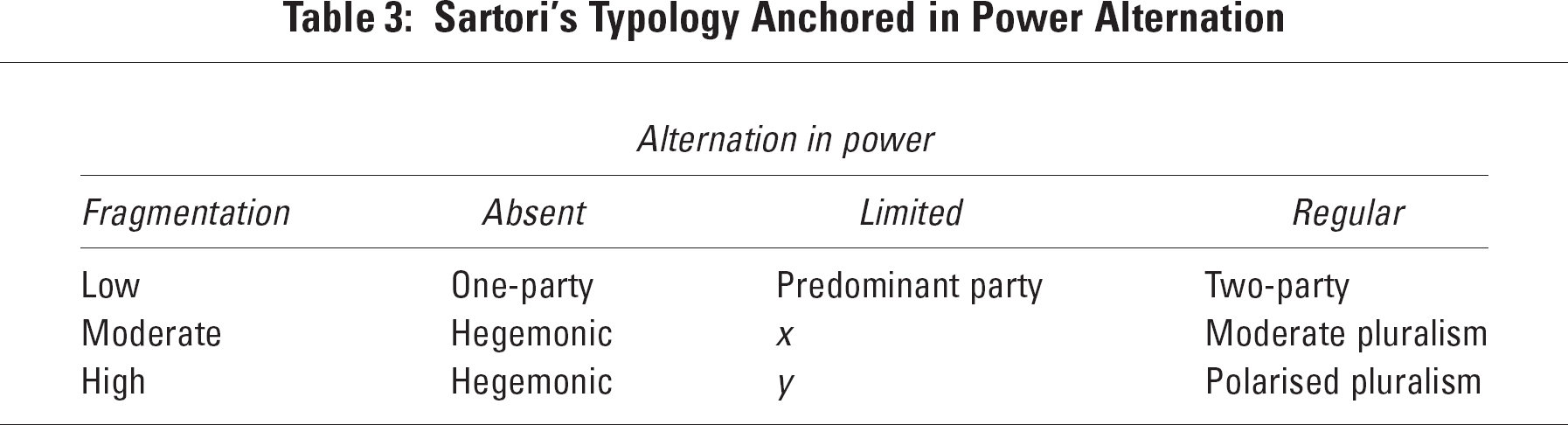
Moderate and polarised pluralism combine regular power alternation with multipartism (i.e. moderate and high levels of fragmentation). This version of Sartori's typology also suggests latent types — designated x and y — which, because he does not explicitly theorise power alternation, remain under cover in his original treatment. Their mechanics, however, reveal them to be multiparty systems with limited power alternation and therefore likely to exhibit predominant coalition formats.
The Empirical Value of the New Conceptualisation
The theoretical refinements that we propose yield benefits for the empirical study of party systems. For example, our theoretical revisions enable the more rigorous testing of the effects of predominant party systems. Past attempts to investigate the effects of predominance have run into difficulties because of the concept's flaws. Sartori argued that: (1) centripetal competition is conducive to stable democracy because it moderates potentially polity-threatening conflict; and (2) lower levels of fragmentation and polarisation are associated with centripetal competition. But because predominance is not derived from fragmentation or polarisation he was unable to locate the predominant party system in centrifugal—centripetal competition space and, therefore, unable to predict its effects on democratic stability (Sartori, 1976, p. 292). Paul Pennings (1998) tried to use measures of ideology and fragmentation to test the effects of Sartori's party system types but he was also unable to place predominance because, as Jocelyn Evans (2002, p. 159) puts it, ‘where fragmentation and ideological distance are portrayed as orthogonal axes, the predominant type is notable by its absence’. Our re-conceptualisation of Sartori predominance provides a better basis for analysing the effects of predominant party systems. We use data from the World Bank Database on Political Institutions (see Beck et al., 2001) to show that our revisions enable a more accurate testing of the effects of predominance on two indicators of economic performance: inflation and unemployment. 10
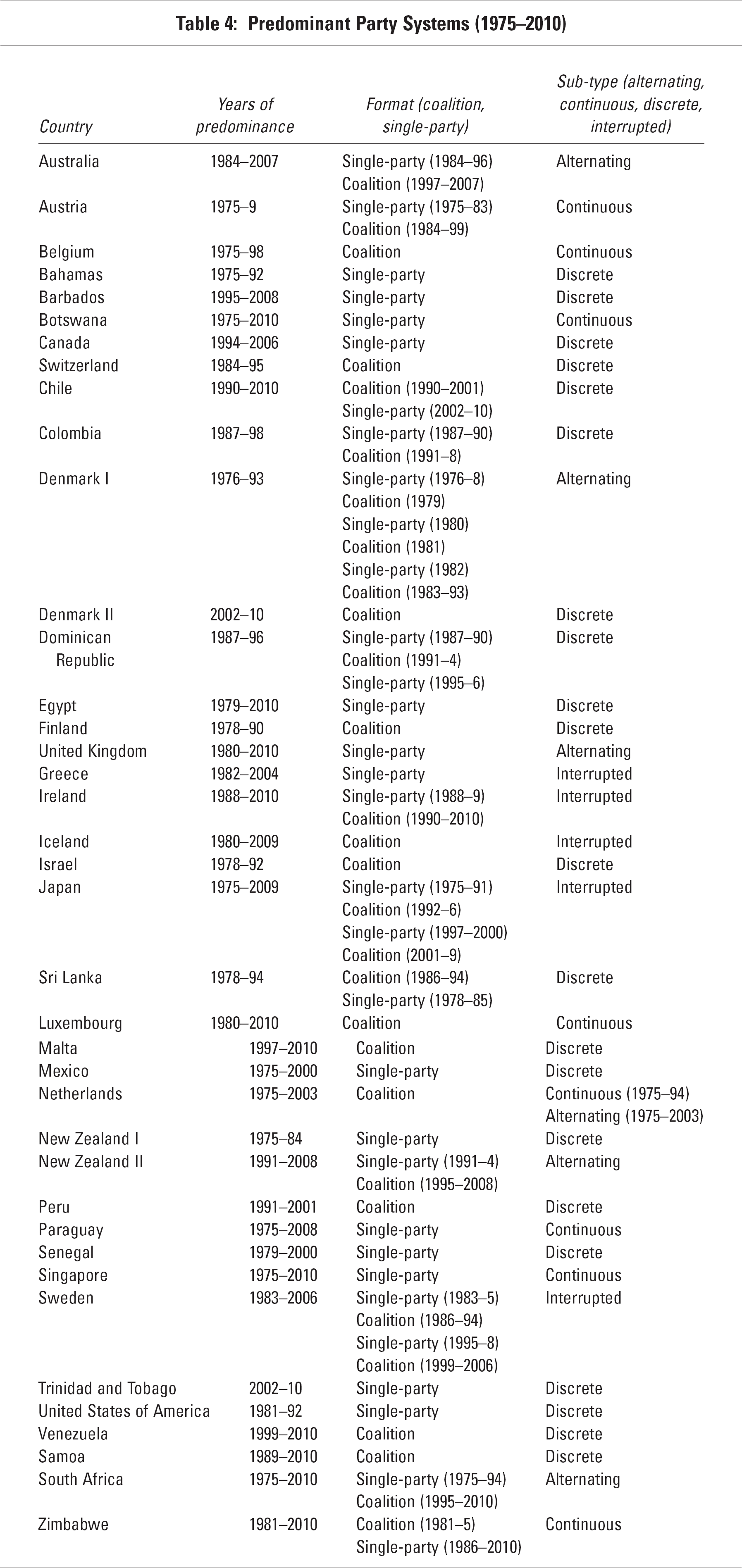
To identify predominant party systems using the World Bank data set we apply the criteria developed in the previous sections to data on patterns of inter-party competition at the national level for each consolidated democracy between 1975 and 2010. Thus, a party system is classified as ‘predominant’ when one party (i.e. the predominant party) or one (relatively unchanging) coalition (i.e. the predominant coalition) is able to entrench itself in power by winning at least three consecutive elections for the nation's highest executive office. 11 As the concept of predominance applies to only structured party systems (i.e. those in consolidated democracies), we must first distinguish between consolidated and unconsolidated democracies. 12 To distinguish between these two groups of democracies we draw on research by Milan Svolik (2008) estimating the dynamics of the process of democratic consolidation. He observed (p. 164) that ‘the increase in the probability that an existing democracy is consolidated is greater during the first 20 years after its transition than during any later period. Thus our belief that a democracy is consolidated depends most crucially on its survival during these initial two decades’. We use this observation to ground the classification rule that countries with at least twenty years of uninterrupted democracy can be considered to be ‘consolidated’ democracies. 13 For the 75 countries that thereby qualify as consolidated democracies, 37 have had predominant party systems for some period between 1975 and 2010. A list of these countries, and the sub-types of predominance that occurred within them, is presented in Table 4.
If we had followed Sartori's criteria for identifying predominance instead of the criteria that we have developed, Table 4 would look different in two ways. First, the set of cases of predominance would not include those sub-types of the phenomenon that Sartori overlooked but which are consistent with his mechanical definition of predominance. This means, for our sample, that no predominant coalitions would qualify as predominant party systems. 14 Second, without our amendments, we would be unable to distinguish between the sub-types of predominance.
Do these amendments help us to understand better the effects of predominant party systems on economic outcomes? Richard Gunther and Larry Diamond (2003, p. 190) state that empirical analysis is generally strengthened by ideal types that ‘capture all of the defining elements of a concept’ (see also Sartori, 1970, p. 1038). To show that this claim is true in the case of predominance we propose three conditions which, if they are satisfied, confirm that our refinements improve our ability to test the effects of predominant party systems. First, it must be the case that predominance is associated with distinctive empirical outcomes; otherwise Sartori's concept, and our refinements of it, cannot be used to explain variations in outcomes. Second, for coalitional predominance to be confirmed as a sub-type of predominance it must exhibit properties that render it part of the predominant type. Third, for the other sub-types to be useful categories for empirical analysis, it must be shown that there are differences between them and that these differences are consistent with our claim that predominance is a radial concept. This means that we should expect, for instance, that the effects of predominance will be stronger for episodes of continuous predominance than for episodes of discrete predominance. This is because, whatever are the effects of a predominant party system, it is reasonable to expect that they will be amplified by a longer duration of predominance.
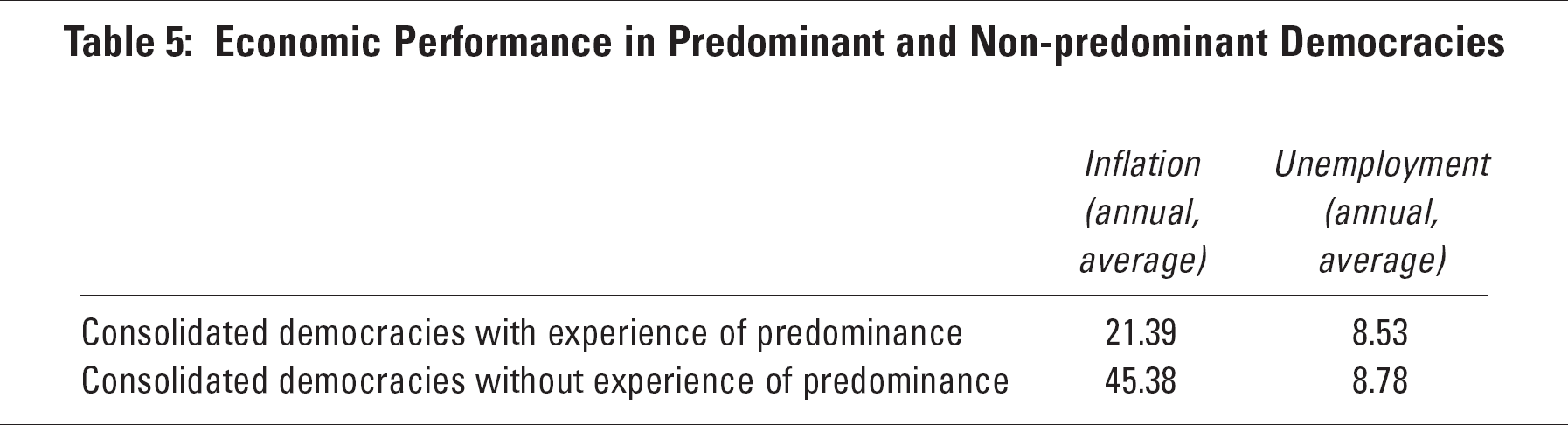
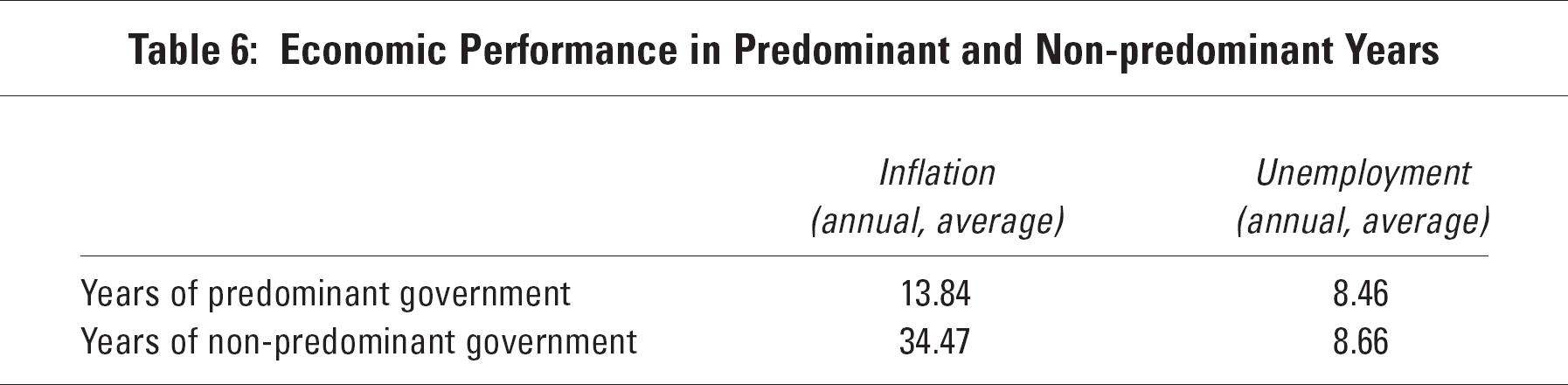
To address the first condition, we compare the average annual unemployment and inflation rates in consolidated democracies that had a predominant party system for some time between 1975 and 2010 to those that did not experience predominance during this period. We then look specifically at those countries that experienced predominance and consider whether there is a notable difference in the unemployment and inflation rates for these countries during their predominant years compared to their non-predominant years. The second test therefore controls for factors (such as regime type — presidential or parliamentary) that may vary between the two groups in the first test. A significant difference between the groups in each comparison offers prima facie support for the proposition that predominance is associated with distinctive empirical outcomes.
As shown in Table 5, both the average rate of inflation and the average rate of unemployment are lower in consolidated democracies that experienced predominance between 1975 and 2010 than in consolidated democracies that did not experience predominance. The difference in the rate of inflation is substantial: countries that experienced predominance had an average inflation rate (21.39 per cent) that was less than half the average rate of countries that did not experience predominance (45.38 per cent). However, the difference in the average unemployment rate between these two groups of democracies is small (0.25 per cent). Table 6 provides further evidence in support of the contention that predominance is associated with lower rates of inflation and unemployment. For countries that experienced predominance, the average inflation rate during a predominant spell (13.84 per cent) was less than half the inflation rate of an average non-predominant spell (34.47 per cent). Unemployment is also lower during predominant spells, though the difference between predominant and non-predominant years is small (0.2 per cent).
Predominant Party Systems (1975–2010)
Economic Performance in Predominant and Non-predominant Democracies
Economic Performance in Predominant and Non-predominant Years
Economic Performance during Episodes of Predominant Formats and Sub-types
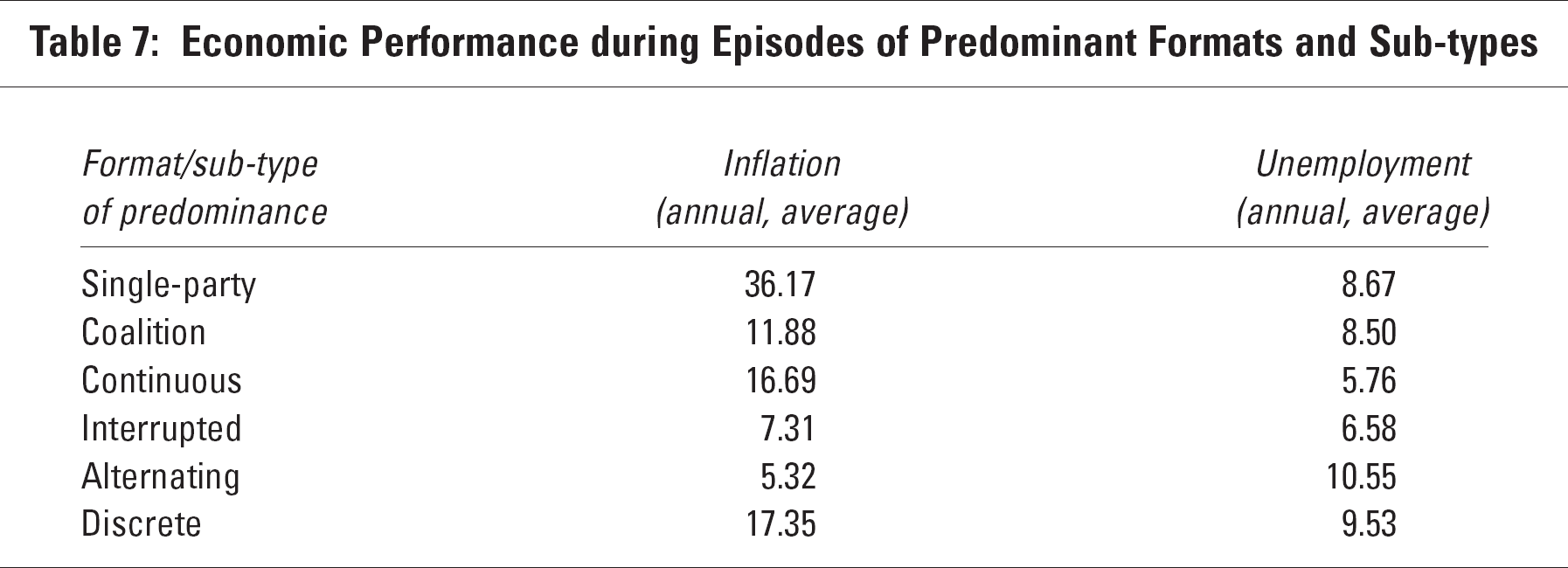
To satisfy the second condition, we must show that coalitional predominance is associated with outcomes that confirm that it is a predominant sub-type. Table 7 presents the average unemployment and inflation rates that are associated with the formats and subtypes of predominance. Coalitional predominance is associated with inflation and unemployment rates that are on average lower than those that occur during episodes of single-party predominance. This satisfies the second condition; indeed it suggests that coalitional predominance may have more distinctively ‘predominant’ effects than single-party predominance.
For the third condition to be satisfied, the sub-types of predominance must differ in ways that are consistent with the concept's radial structure; episodes that more closely resemble the fullest manifestation of predominance should have more distinctively predominant effects. Thus, we should expect that continuous predominance should exhibit lower average unemployment and inflation rates than the other sub-types of single-party predominance. This expectation is borne out in the unemployment figures, but the inflation figures offer weaker support for this conjecture. Unemployment is lowest with continuous predominance, followed by interrupted predominance. In both situations the predominant party is in power for twice as long as with discrete predominance (i.e. six consecutive election victories instead of three), though in the case of interrupted predominance another party governs after the predominant party's first spell of predominance. Unemployment is highest in the cases of discrete predominance and alternating predominance. Both sub-types are limiting cases of predominance. Alternating predominance occurs for a longer-than-usual predominance, but it is by two different parties. Discrete predominance is for only one three-election period.
The inflation figures associated with the different sub-types are less consistent with the expectations that follow from predominance's radial structure. Inflation rates are lowest with alternating predominance and second highest with continuous predominance. This confounds the expectation that the effects of predominance on inflation are likely to be stronger for episodes of continuous predominance and relatively weak for the alternating sub-type. However, the inflation figures for the other sub-types — interrupted and discrete predominance — are consistent with our conjecture. Discrete predominance is associated with the highest average rate of inflation (though still much lower than the average for a consolidated party system without a predominant party system), and interrupted predominance is associated with relatively low average inflation.
Overall, these comparisons of the occurrences of predominance and non-predominance and of the predominant sub-types establish prima facie that our refinements of predominance may be used to improve our understanding of predominance in practice. More extensive and more rigorous tests are necessary to establish more firmly how predominance impacts on outcomes relating to the economy and democratic stability, but our preliminary analysis suggests that there may be value in such inquiry and that the theoretical refinements that we propose provide a better foundation for such empirical analysis than does Sartori's initial conceptualisation.
Conclusion
In this article we have critiqued and refined Sartori predominance. We identified two major flaws: the incoherence of predominance with Sartori's party systems theory; and Sartori's elaboration of predominance in a classical mould rather than as a radial category. Despite these problems the literature's desertion of predominance is a second-best solution; Sartori's idea of the predominant party system remains useful because it identifies a distinctive type of party system. Using ‘dominance’ to describe predominant party systems ignores the fundamental differences separating consolidated democracies from fluid (non-consolidated) democracies and autocracies, while also risking the conceptual overstretch of dominance. A better solution than retreating to dominance is to remedy Sartori predominance. Therefore, we proposed remedies to render a coherent notion of predominance that remains true to Sartori's initial aims. Our amendments recognise the radial structure of predominance with the result that the ‘mechanics' of predominance may appear in party systems that look very different from prototypical cases. For instance, predominance may be coalitional, interrupted or sub-national. Our reconstruction also reveals the potential for power alternation to ground a more coherent version of Sartori's typology.
Although this article's aims are theoretical, the broader purpose of party systems theorising is to provide frameworks for studying real-world party systems. Therefore, a basic question for any new theory, or for a major revision of an old theory, is its empirical value. Theoretical inquiry yields greater returns if it can be shown to improve the prospects of empirical analyses. We show that our revisions enable a more accurate examination of the effects of predominance on inflation and unemployment. Our preliminary analysis of the relationship between predominance and these indicators of economic performance reveals results that are consistent with the theorising underpinning our revisions: predominance is a distinctive type of party system associated with distinctive outcomes; coalitional predominance is a sub-type of predominance; the differences between the other predominant sub-types (alternating, continuous, discrete, interrupted) are broadly consistent with the radial structure of predominance.
Our empirical analysis suggests that a predominant party system is associated with lower inflation and lower unemployment. What explains this result? There are several intuitive possibilities. Predominant parties may be better placed to enact and entrench policy changes that are accompanied by relatively small short-term costs but larger long-term gains; or it may be that the persistence of a single party in office reduces capital investors' uncertainty and therefore lowers borrowing costs and stimulates investment and productivity; or, by stabilising the bargaining relationships between the government, employers and trade unions, predominance may enable a country to obtain improved terms of trade between inflation and unemployment. It is necessary to examine the adequacy of these explanations, and to test more extensively the effects of predominance on economic outcomes and other variables relating to democratic stability. This line of research may have major implications for the important research agenda exploring the relationship between regime types and political and economic outcomes, which generally ignores the potential effects of party systems. Including party systems in empirical analyses may confirm, qualify or challenge the results of important studies by Arend Lijphart (1999), Juan Linz (1990) and others, but our analysis suggests that their neglect is unwarranted.
Finally, the theoretical investigation in this article also provides foundations for empirical analysis following the small-N track: studies focused on the origins, sustenance and transformation of party systems. For instance, a coherent predominance notion provides a basis for analysing the strategies that predominant parties use to remain in power, and for comparing these to the strategies used by hegemonic and dominant parties. A plausible conjecture is that hegemonic and dominant parties have a stronger incentive to enact incumbent-protecting electoral laws than predominant parties because the latter face a greater chance of election defeat and, therefore, the prospect of reciprocal electoral manipulation by a rival party. 15 Instead of trying to skew the electoral system overtly in its favour, a predominant party may be more likely to cooperate with its principal rival to ‘cartelise’ their competition (Blyth and Katz, 2005; Nwokora, 2012; Pelizzo, 2004).
Footnotes
1
A party is ‘relevant’ when ‘its existence, or appearance, affects the tactics of party competition’, which implies that it must have either coalition or blackmail potential (Sartori, 1976, p. 123).
2
The equivalence is clear when — following  , p. 46) — we see both parties and coalitions as fusions of factions. In the case of a party, a faction joins or remains in a party because its submission to ‘the discipline of other factions with different tastes … [generates] more favored government outputs' than would otherwise arise. In the case of a coalition of parties this same incentive impels their cooperation but is too weak (compared with other incentives) to cause fusion.
3
He describes as ‘[a] major source of confusion’ the idea that ‘a single party produces a “system of parties” ‘ (Sartori, 1976, p. 44).
4
This classification also depends on viewing Southern party politics as generally contestable and therefore not hegemonic.
5
In emphasising democracies' distinctiveness, Sartori uses a minimalist, electoral requirement, which admits an expansive range of polities. The nations that are therefore excluded generally differ fundamentally from those in the class of electoral democracies. While some electoral democracies are ‘pretty illiberal’, , p. 16) explains, ‘virtually the only countries that adhere to the rule of law and provide their citizens with extensive civic freedoms are democracies’.
6
Sartori argued that dominance is ‘unfit for typological purposes' because, he reasoned, three of the types he proposed –‘one-party’, ‘hegemonic’ and ‘predominant’ — were sufficient to capture the entire range of party systems anchored by one party. However, this is not quite accurate. Sartori is clear that there are types of democratic regime (consolidated democracies with structured party systems and non-consolidated democracies with fluid party systems), as we have discussed. Dominance remains useful to identify the second of these scenarios of democratic monopoly.
7
We set the length of interruption at one election (i.e. one term out of government).
8
The Northern Irish party system between 1922 and 1972 qualifies as an exception (Mair, 1989, p. 130).
9
Mair (1996, pp. 89–90) finds that alternation in power also exists as a latent dimension in Duverger's typology. His distinction between two-party and multiparty systems hinted at a difference in the likelihood of wholesale power alternation. On this basis, Mair discriminates between wholesale, partial and non-existent power alternation.
10
Annual inflation and annual unemployment data are taken from the World Bank Development Indicators.
11
A coalition is ‘relatively unchanging’, and therefore qualifies as predominant, if over the course of three elections the parties that comprise it remain unchanged or if, when there is a change in the party composition of the coalition, this change does not include the largest party. Thus, the minimum requirement for a predominant coalition is that its largest party remains in the government throughout the spell of predominance.
12
To determine whether a country is a ‘democracy’ we use the ‘Executive Indices of Electoral Competitiveness’, which assesses the degree of real and potential competition for executive office using a scale from 1 (competition not permitted) to 7 (flourishing competition and participation). Following the standard approach with this indicator, a country is deemed ‘democratic’ if it scores either 6 or 7. The World Bank scores as ‘democracies' some questionable cases, such as Zimbabwe.
13
A government's lengthy tenure is an episode of predominance only if it occurs after this twenty-year threshold is crossed or if this threshold is crossed during its period of incumbency. (A lengthy tenure before ‘consolidation’ is more usefully described as an episode of dominance, as discussed earlier.)
14
If the sample was extended to include predominance at the sub-national level, these episodes of predominance would also not be identified using Sartori's criteria.
15
Hegemonic parties, which exist in autocracies, and dominant parties, which exist in non-consolidated democracies, may face a higher chance of being dislodged from power by extra-constitutional means such as a coup.