






Abstract
A major debate within foreign aid literature is whether civil society can be ‘purchased’ through outside assistance. We test this proposition by exploring the influence of aid provided by the United States Agency for International Development on post-communist civil rights environments. A review of research critical of international assistance highlights the risk of unsustainability, polarization and dependence among recipient civic organizations. We argue that a more effective stimulant is socio-economic growth, which stimulates committed constituencies, higher citizen expectations and pressure on the state to protect civil freedoms. Using cross-sectional, time-series data from 27 post-communist countries, we find no evidence that aid independently promotes stronger civil rights environments but that economic growth produces substantial improvements. Further, any aid effectiveness appears to be conditional on economic strength. We conclude that developmental organizations should reassess how and where civil society aid is targeted.
A major debate within foreign aid literature is whether civil society can be ‘purchased’ through outside assistance (Adamson, 2002; Henderson, 2002). It is a subject of interest both for scholars and for development practitioners due to the perceived bond between civil society — or the arena of social interaction independent of the state that fosters social capital and articulates public demands — and democracy. The conviction that this bond can be established and sustained with external assistance has been a mainstay of foreign aid strategies for decades. As Thomas Carothers (2004, p. 115) notes, ‘In the political domain, civil society development is now deemed crucial to stimulating the public pressure and participation necessary to force poorly functioning state institutions to become more responsive and accountable’.
Recent budget crises in the United States and elsewhere have revived the debate over aid effectiveness and necessitate a reassessment of aid policy (Sirleaf, 2011). To date, case study research has revealed much about foreign aid and civil society (Henderson, 2002; 2003; Sundstrom, 2006), but cross-national generalizations remain limited. We address this gap by providing an empirical test of civil aid's effectiveness in 27 post-communist countries that have been the recipients of substantial foreign assistance since 1990. We examine whether the civil rights environments of these countries benefited from foreign assistance, internal development in the form of socio-economic growth, or both. We focus our analysis on aid from the United States Agency for International Development (USAID), the largest bilateral Western donor in post-communist Europe.
To help shed light on this important debate, we first explore the various civil society objectives of USAID funding. USAID has dispersed aid to parties, labor unions, human rights groups and many other civic organizations with the goal of improving and consolidating laws that protect civil rights and safeguard against government intrusion. A subsequent review of extant research, however, highlights many deficiencies in international support. As we discuss, aid to civic associations can contribute to unsustainable activities, encourage polarization among groups and promote organizational dependence. These dynamics hinder the impact of organizations and, in turn, undermine the influence of foreign aid in improving states' civil rights environments. We instead argue that, ceteris paribus, the determinants of strong civil rights are largely domestic. Socio-economic development endows civic sectors with sustainable resources, popular constituencies and higher expectations of the state. We hypothesize that these factors allow civic organizations to pressure the state effectively to develop strong and sustainable civil society environments.
Using cross-sectional, time-series data on the civil rights environments of 27 post-communist countries, we test the effect of civil society aid, socio-economic growth and their interaction. We find no evidence that USAID aid independently promotes stronger civil rights environments. However, economic growth produces substantial improvements. We also find that any aid effectiveness is largely conditional on economic strength, indicating that aid is often the most helpful in relatively affluent states that do not necessarily need the assistance. The models also reveal an important division between states in Central and Eastern Europe (CEE) and former Soviet republics (FSRs), sub-regions with divergent legacies and post-communist developmental trajectories. There is substantial evidence that the effects of both USAID aid and economic growth are weaker in FSRs than in CEE countries. In sum, our results reveal serious limitations to civil society aid and highlight the importance of domestic economic conditions in shaping countries' civil rights environments.
USAID and Civil Society Promotion
At the end of the Cold War, private and bilateral Western donors made civil society development a priority in post-communist Europe (Encarnación, 2002). Overcoming the communist experience through community engagement, volunteerism and political participation was deemed essential to the success of democratic transitions (Bernhard and Karakoç, 2007). The United States, working through USAID, was one of the largest contributors to this objective (Carothers and Ottaway, 2000). Today, the agency contributes over $1 billion annually to programs aimed at strengthening democratic institutions, law and justice, elections and civil society development. 1 Within the Democracy, Human Rights and Governance sector budget, civil society aid comprises 41 per cent and includes support for mass media, civic education and labor rights. In 2011 and 2012, USAID allocated nearly $343 million to civil society programs globally. 2
In order to test the effectiveness of these investments over the past two decades, it is necessary to clarify what exactly USAID promotes with foreign civil society assistance. This is a rather difficult task because of the lack of consensus on a definition of civil society, which some claim leads to poor use of funds by Western donors (Encarnación, 2006; Narozhna, 2004). USAID defines civil society as ‘non-state organizations that can or have the potential to champion democratic/governance reforms' (Hansen, 1996, p. 3). The agency expects its grants to ‘provide support for activities which: increase the public awareness and knowledge of laws and legal procedures; help citizens organize to advocate changes in the legal system; help citizens protect their individual and property rights, and activities which help citizens utilize the legal system for the adjudication of conflicts' (USAID New Independent States Task Force, 1993, p. 20).
The Agency partners with contractors, international organizations and host governments to facilitate targeted investments in local, grassroots civic organizations and independent media. Aid recipients promote civic engagement, human rights, government accountability and a host of other advocacy services. Perhaps most significant, USAID contends that because ‘civic action and engagement with government can result in political reform, USAID emphasizes support for civil-society organizations whose advocacy efforts give voice to citizens and increase their influence on the political process' (USAID, 2012). For example, in 1992 USAID launched a Democratic Pluralism Initiative Project in Russia and other post-Soviet states (USAID New Independent States Task Force, 1993). The program provided grants to participating agencies to help develop political parties, civic organizations, labor unions, independent media and rule of law (focused especially on law drafting and revisions).
USAID civil society funding thus has a larger goal of institutionalizing the rights and freedoms of the various sectors in which it invests. Like other donors, USAID provides financial support for overhead costs, equipment, staff training and the development of project frameworks. Groups then use these inputs to create and implement projects that ultimately affect state policy. As Harry Blair (1993, p. 10) notes, ‘Donor work, in sum, is largely restricted to building and strengthening CSOs [civil society organizations] and then, with a little guidance, setting them on their own course. After their initial launching, the CSOs become, as it were, largely internally guided missiles’.
For USAID and other donors, civil society aid ultimately seeks to prevent the ‘repenetration’ of the state into society by investing in a pluralistic and healthy civic sector (Cohen and Arato, 1992). Talcott Parsons (1971, pp. 62–4) explains this as a form of pressure exerted by a civil society that can lead to the institutionalization of rule of law and place restrictions on government power. International assistance ultimately strives to deepen government accountability through the participation of citizens and organizations that can prevent policy abuses and advance policies beneficial to the citizenry or a specific constituency. This does not always require aid to be distributed to organizations that are explicitly political in nature. As Bronislaw Geremek (1992, p. 4) explains, ‘the idea of a civil society — even one that avoids overtly political activities in favour of education, the exchange of information and opinion, or the protection of the basic interests of the particular groups — has enormous anti-totalitarian potential’.
Our study investigates whether the allocation of civil society aid to social organizations (as described by USAID publications) is in fact ensuring that governments comply with the rule of law — which can be conceptualized as the degree to which women's rights, minority rights, freedom of speech, freedom of assembly and labor rights are respected by the government. The key question is whether micro-level civil society funding for local actors and programs stimulates improvements in a state's civil rights environments. If it does, then there is empirical justification for the distribution of millions in aid to post-communist actors and organizations. If it does not, then aid organizations should re-evaluate how and where aid is dispersed.
Critiques of Civil Society Aid
Over the past twenty years, post-communist communities have experienced a surge in NGOs, educational exchange programs, civic seminars, teacher training and legal and technical assistance. Donors have not disguised their goal of promoting democratization through the promotion of these causes (Adamson, 2002, pp. 177–8; Sundstrom, 2006; Van Rooy, 1998). The role and influence of international assistance in stimulating domestic democratic change has come under increased scrutiny in recent years, with some suggesting that it can be a positive force (McFaul, 2007) and others warning that it is ineffective and can lead to democratic backlash (Beissinger, 2006; Collins, 2009; Kelley, 2012). Fundamental questions also remain about foreign aid's ability to bring about permanent shifts in civil society (Carothers, 1999; Diamond, 1999; Mendelson and Glenn, 2000; Ottaway and Chung, 1999). Some question its influence in shaping state policy while others suggest that it may actually be detrimental to democratization (Robinson and Friedman, 2007; Van Rooy, 1998).
One critique is that the development of civil society is a ‘top-down’ process, facilitated by the financial support of foreign donors. Aid is often distributed without consideration of how civic organizations will survive in the long term with few internal resources and minimal community support (Petrova, 2007, p. 1284). A lack of long-term strategizing can result in unsustainable organizations and activities (Adamson, 2002). Too often local organizations craft missions that align with funding requirements without a committed constituency or popular mission. Consequently, they have little hope of securing the necessary community support to pressure government. Marina Ottaway and Theresa Chung (1999) point out that local organizations are sometimes so well funded by local standards that they are unable to maintain their services if and when foreign aid runs out. Larry Diamond (1999, p. 254) also notes that after the immediate democratic transition, ‘international donors move on to political dramas in other countries while others transfer their attention and investment to the (now presumably legitimate) governmental agencies of the new democracy’.
A second criticism cites the lack of contextual considerations on the part of Western donors. In some states, aid engenders adversarial behavior among civil society actors (Mendelson and Glenn, 2000; Wedel, 1998). For instance, Julie Hemment (2004) argues that international aid to civil society organizations in Russia has created an intransigent hierarchy of NGO leaders with uncooperative mentalities. Organizations compete for aid by seeking to monopolize their claim over a particular issue area. This competition for funding and policy domination breeds civic polarization. In her study of foreign aid to Russian NGOs, Sarah Henderson (2002, p. 140) notes that ‘rather than fostering horizontal networks, small grassroots initiatives, and civic development, foreign aid contributes to the emergence of a vertical, institutionalized, and isolated (although well-funded) civic community’.
The former Soviet region offers its own complications. The newness of civic organizations and endemic post-communist corruption has left citizens skeptical of NGOs and foreign assistance (Henderson, 2003, p. 55; Sundstrom, 2006, pp. 30–1). This mentality is compounded by a tepid commitment of state leaders in FSRs to an autonomous civic sector. Lisa Sundstrom (2006, p.3) argues that in Russia, ‘even in areas where foreign donors are present in force to promote certain values regarding proper NGO behaviour, local political and normative conditions significantly affect the extent to which NGO activists adopt those values in their discourse and behaviour’. The loosening of restrictions during the final years of the Soviet Union witnessed the birth of numerous public organizations but, as Henderson (2003, p. 41) points out, ‘this emerging social organization did not approach the level or scope of other nascent civic groups emerging in Eastern Europe at the same time’. States such as Poland, Hungary and Czechoslovakia drew on previous civic traditions after the fall of communism to develop a more modern civil society than that found in FSRs (Diamond, 1994).
Finally, a host of research suggests that civil society itself can facilitate anti-democratic conditions (Encarnación, 2006). An edited volume by Petr Kopecký and Cas Mudde (2003) reviews the ‘dark side’ of civil society in Central and Eastern Europe. Rather than promote democracy, many subversive and nationalist ‘civic’ groups have grown in post-communist societies to challenge democratic institutions and values. In central Asian republics, Fiona Adamson (2002, p. 179) finds that although aid has produced changes at the micro level, ‘many [aid] programs have interacted with the local environment in ways that unintentionally aggravate a number of conditions, such as corruption, income inequality, and dependence on foreign aid’.
As a growing literature on the politics of foreign aid in Africa has argued, too much outside assistance makes governments complacent and unresponsive to their citizens, leading governments to depend upon foreign aid to provide basic day-to-day services (Easterly, 2007; Moyo, 2009; Van de Walle, 2001). In a similar vein, NGOs and CSOs may become complacent as they become dependent upon foreign aid, to which the behavior of organizations studied by Ottaway and Chung (1999) attests. As a result, these actors become less willing to pressure their governments for the rights sought by USAID. This is a particular problem in many FSRs given the lack of previous civic traditions relative to other CEE countries.
In sum, civil society aid is accused of contributing to unsustainable organizations, interacting negatively with local contexts and producing marginal impacts on long-term civil society conditions. These critiques are buoyed by evidence of weak civic participation in post-communist Europe (Howard, 2003; Raiser et al., 2001). As Tsveta Petrova and Sidney Tarrow (2007, p. 76) point out, ‘much of the literature on the region emphasizes weakening, demobilization, and even the disintegration of civil society; the increasing political apathy of post-socialist citizens; and radical or egotistic individualism, social anomie, amoral cynicism, paternalism, and distrust as predominant characteristics of the mass level of these polities’. The region's populace offers a particular challenge to aid organizations seeking to spur an effective and sustainable civil society (Rose, 2001; see Gibson, 2001; Petrova and Tarrow, 2007, for counter-arguments to these claims). 3
Economic Development
A more effective stimulant to the growth and sustainability of strong civil rights environments emerges domestically. Recent research highlights the importance of domestic and international factors interacting to spur social and political change in the post-communist region (McFaul, 2007; Stewart, 2009). Valerie Bunce and Sharon Wolchik (2006), for example, find an important correlation between international assistance and favorable domestic conditions in stimulating successful electoral revolutions. Certain post-communist traditions such as the lack of a politicized military and domestic conditions such as experienced activists improve the probability of breaking from authoritarian governance (see also Pop-Eleches, 2007; Schmitz, 2004, for further discussions on why strong domestic conditions often trump the importance of international assistance).
One such domestic factor, economic growth, has a storied lineage in comparative politics in aiding democratization (Lipset, 1959; Przeworski et al., 2000). We argue that economic wealth produces more sustainable civic organizations, committed constituencies and higher citizen expectations, which consequently improve the ability of the civic sector to pressure states to protect the civil rights environment. As Sundstrom (2006, p. 22) argues succinctly, ‘More income and spare time provides resources to support civic mobilization’. Improvements in economic conditions help develop the civic norms and expectations that spur activism (see Petrova, 2007, p. 1285). They also bolster sustainable civic sectors that apply substantial pressure on governments.
Economic conditions and the quality of civil society are intertwined. The observed decline of civil society in post-communist societies during their democratic transitions has been attributed to hyperinflation, deindustrialization and unemployment (Encarnación, 2006, p. 360). Joblessness from industrial restructuring in particular has devastated the role and power of labor organizations. In an analysis of civil society in post-communist Armenia, Armine Ishkanian (2008, p. 8) notes that during the ‘harsh socio-economic conditions in the early post-Soviet years, most people did not have the time or inclination to participate in civic projects and the civic activism that had become a part of Armenian life in the late 1980s was replaced by disillusion, apathy, frustration, and dislocation in the 1990s’. Poor economic conditions also make civil society organizations dependent on foreign donors, which contributes to dependency and unsustainable activities. Whereas foreign aid fosters adverse dynamics, economic growth allows organizations to focus in earnest on their community mission without the constant pressure to obtain funding for survival (Henderson, 2002; Ottaway and Chung, 1999; Robinson and Friedman, 2007, p. 644).
The connection between economics and civil society aligns with research on development and democracy (Boix and Stokes, 2003; Epstein et al., 2006; Lipset, 1959). This is particularly the case made by Robert Dahl (1971, pp. 76–88), who argues that socio-economic development is one of the essential prerequisites of polyarchy: as economies become more advanced, more people acquire sufficient resources to participate in politics. Better economic conditions lead to higher social capital, defined as the presence of community trust and activism, which is a necessary component of a robust civil society (Putnam, 1993).
Our claim also aligns with social movement literature. 4 Poor economic conditions such as unemployment can stimulate large-scale social movements (e.g. ‘crisis movements’), but improved economic conditions also provide higher expectations among citizens about what the state should provide, more time to pursue their goals and ultimately equally powerful civic movements (e.g. ‘affluence movements’). For example, one of the reasons for the success of the civil rights movement in the United States in the 1960s is the improved mobilization of resources (Davies, 1969; Oberschall, 1973). Others note that ‘as the amount of discretionary resources of mass and elite publics increases, the absolute and relative amount of resources available to the social movement sector increases' (McCarthy and Zald, 1977, p. 1224). Indeed, affluence movements — defined as a surplus of resources such as time, money and energy — are more likely to begin within social organizations than with the spontaneous actions symptomatic of economic deprivation (Kerbo, 1982).
Existing research posits a positive relationship between economic development and civil society in post-communist countries. Petrova (2007), for example, finds a strong relationship between economic development and the financial and organizational capacity of the NGO sector. This is in line with literature that attributes capitalist development to a counterweight to state infringement (Moore, 1966; Rueschemeyer et al., 1992). Marc Howard (2003) investigates the reasons behind weak civic engagement in post-communist states and argues that greater economic security breeds the willingness for political participation. Conversely, without the resources, time and financial flexibility necessary to volunteer, participate in advocacy programs and petition for democratic reforms, norms of civic participation are less likely to form.
Data and Methods
We want to know how USAID aid and economic conditions have impacted on the development of civil rights environments in post-communist Europe. To uncover their influence, we develop and test ordinary least squares regression models with panel-corrected standard errors (PCSE) across 27 countries between 1990 and 2004 (with a total of 368 observations). Cross-sectional, time-series structures risk serial correlation and heteroskedasticity, so we employ the PCSE technique proposed by Nathaniel Beck and Jonathan Katz (1995). 5
We conceptualize our dependent variable as the degree to which the state protects civil freedoms and key civic sectors which, as discussed earlier, are the ultimate focus of USAID funding. To this end, we measure the civil rights environment using an index compiled by Steven Finkel et al. (2007). The index is compiled from a factor analysis of six ordinal-level variables: organizational restrictions on minorities, freedom of assembly, religious freedom, workers' rights, freedom of movement and women's economic rights. The organizational restriction of minorities is developed and reported by the Minorities at Risk Project (2009) and the other five attributes were drawn from a data set by David Cingranelli and David Richards (2004). A score of 50 indicates an average civil rights environment, those approaching 100 indicate a stronger environment, and scores closer to 0 indicate a weaker environment.
We believe this measurement is superior to other possibilities. For example, another method would be to calculate the number of civic organizations or citizen memberships in a country and then track how aid changes these numbers over time. These approaches present a number of empirical and theoretical limitations. Time-series data on civic participation and organizational growth are simply not available or reliable for most countries in the post-communist region (Howard, 2003). Civic organizations to which aid is distributed are not very visible and often exist in name only. Additionally, these measures do not capture the effectiveness of foreign aid in promoting a robust civil rights environment. As Ferenc Miszlivetz and Jody Jenson (1998, p. 85) note, ‘An increased number of organizations in the civil sector … does not necessarily mean that the real participation in civil society or its impact on political decision making has increased in the same proportion or with the same speed’. We measure the factors that USAID seeks to affect through aid, namely the strength of laws that protect civic sectors and freedoms.
The first independent variable is the amount of USAID aid allocated to civil society programs. We draw this figure from the Democracy Assistance Project data set by Finkel et al. (2007). The authors disaggregate the components of USAID aid, such as money to political parties, elections, media and business development; we use only that money targeted toward the promotion of civil society (this includes investments in civic groups, labor unions and other organizations meant to strengthen civil society). This variable is the most accurate figure available as to what money is entering the region specifically for civil society development. It is measured in millions in constant 2000 US dollars. The second independent variable taps countries' levels of socio-economic development. Specifically, we use gross domestic product (GDP) per capita, which is measured by dividing each country's total gross domestic product in 2000 US dollars by midyear population. It is drawn from the World Bank and measured in thousands of dollars. To test if the effectiveness of civil society aid is conditional on economic conditions (and vice versa), we interact the USAID aid and GDP per capita variables.
We control for several factors in order to rule out important alternative explanations of differences in the civil rights environments of post-communist countries. One important variable controls for alternative (non-US) sources of direct government-to-government foreign aid. Controlling for this variable rules out the possibilities that USAID aid is ineffective either because there is already a sufficient level of aid in these countries (and therefore USAID aid is superfluous) or that there is too little aid for USAID aid to be more than a drop in the bucket.
To rule out differences between countries receiving democracy assistance from the European Union and those countries without such assistance, we include a control variable measuring the impact of the European Union on civil rights development. These differences are captured using a variable measuring the (logged) distance (in kilometers) between countries' capital cities and Brussels, the heart of the European Union. While this is admittedly a rough proxy for European Union involvement in promoting the development of institutions that are conducive to vigorous civil rights environments, this distance measure captures important differences in the civil rights environments of post-communist countries. In addition to the fact that European Union involvement occurred only in the countries that are most proximate to other member states, distance from Brussels is strongly correlated with civil rights environment scores (R = −0.52), making this an important control variable for explaining variation in civil rights environment scores.
We control for democracy with Polity IV scores. 6 Democracy is an important factor to consider for multiple reasons. First, previous research has argued that the effectiveness of civic organizations in pressuring for a more open society requires a responsive government willing to negotiate with and respond to citizen pressures (Hall, 1999; Skocpol and Fiorina, 1999). Further, weak state institutions may contribute to weak adherence to the rule of law rather than democratic behavior (Armony, 2004). And an increase in the strength of democracy can theoretically damage civil society. As Omar Encarnación (2006, p. 363) explains, ‘The notion that little has changed under democracy (especially with respect to the economy and human rights protections) is often noted in surveys as a reason for people's lack of interest in participating in the political process and civic organizations’.
We also control for the percentage of the population that is Muslim. Research finds that states with large Muslim populations are less democratic than those with smaller Muslim populations (Fish, 2003; Midlarsky, 1998; Salamé, 1994), and may therefore have weaker civil societies. We control for the political system with a dichotomous variable for pure presidential systems (coded one, all others zero). There are significant differences in democratic consolidation between parliamentary and presidential systems (Mainwaring and Shugart, 1997; Przeworski et al., 2000; Stepan and Skach, 1993), and Steven Fish (2005) notes the particular problem of superpresidentialism for democracy and civil society in post-communist countries.
Finally, we explore the regional differences between FSRs and CEE. To account for the possibility noted above that aid is less effective (and potentially even detrimental) in fostering development in FSRs, we include a binary variable for the fifteen post-Soviet countries in our sample and interact this with USAID aid. To account for the additional possibility that, like civil society aid, economic development has been less effective in FSRs, we also interact the FSR variable with GDP per capita.
Results
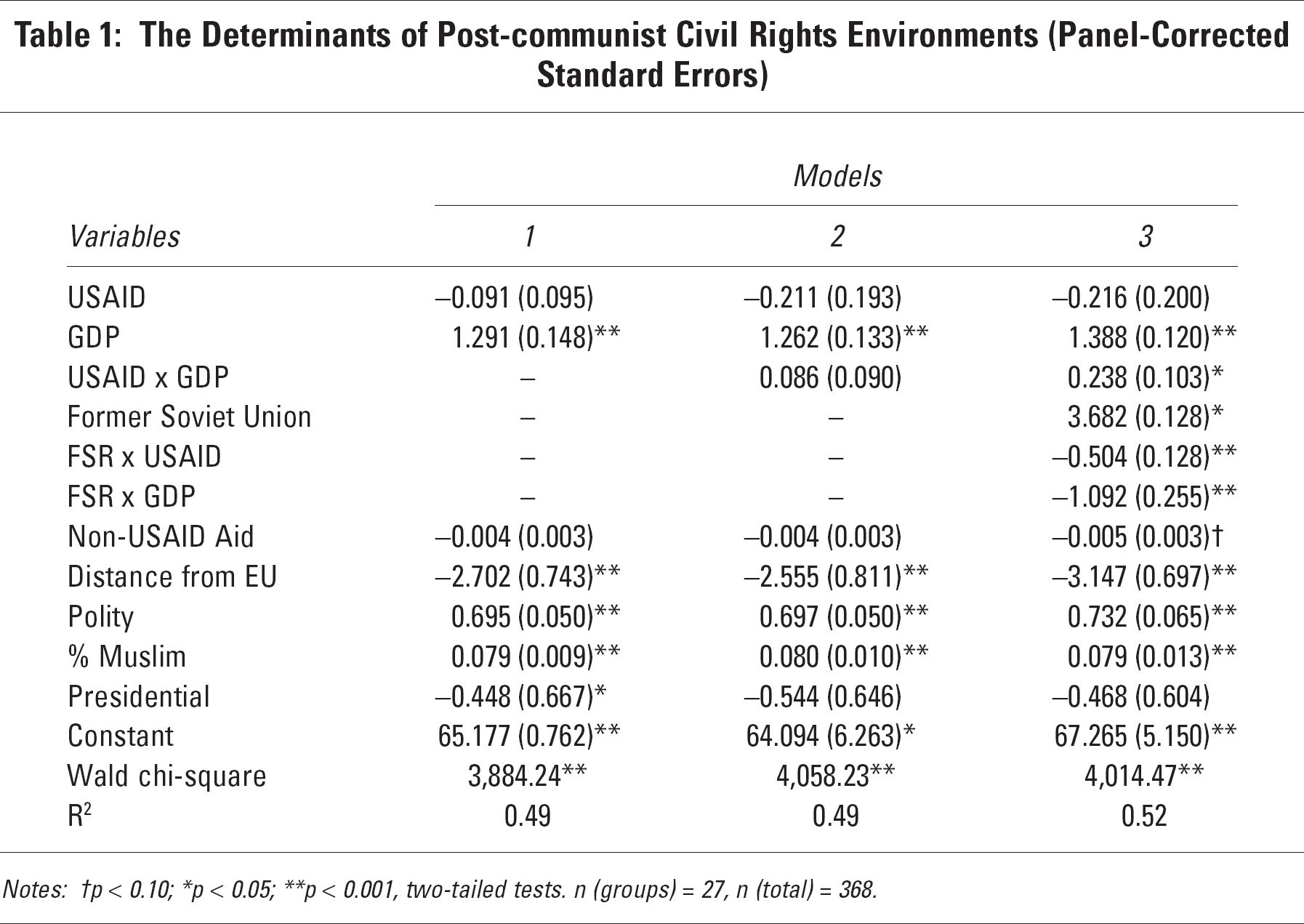
Table 1 presents coefficients and panel-corrected standard errors for three models. Model 1 reports the results for our two main hypotheses. We first test the direct effect of USAID aid on civil society. Model 1 reports that the coefficient for USAID aid is statistically insignificant. We thus fail to find evidence that USAID aid independently influences civil society in either direction. The insignificant statistical results do not necessarily mean that aid is inconsequential, but given the strategic prominence placed on foreign assistance, the null finding provides preliminary support for critiques of this approach. ‘Purchasing’ civil society through outside assistance can produce or exacerbate adverse conditions and behaviors which deplete, rather than stimulate, an effective civil society movement. This in turn can lead to ineffectual pressure on the state to uphold civil freedoms.
The Determinants of Post-communist Civil Rights Environments (Panel-Corrected Standard Errors)
Notes: †p < 0.10; *p < 0.05; **p < 0.001, two-tailed tests. n (groups) = 27, n (total) = 368.
Model 1 also tests the influence of GDP per capita on civil society. As hypothesized, the GDP variable is positive and highly statistically significant at the 0.01 level, indicating that higher socio-economic development contributes to stronger civil rights environments. A $1,000 increase in GDP per capita produces a 1.3 unit increase in the civil society index, a modest but relatively impactful effect. This finding aligns with our discussion about the benefits of economic strength for the ability of actors to influence the state. Taken together, the results from model 1 support the broader assertion that civil society development is principally a domestically driven process, conditional on sustainable organizations and individuals with enough financial flexibility to pursue civil society improvements.
In model 2 we introduce an interaction effect to test whether aid's effectiveness is moderated by economic conditions. This relationship is important to consider for two reasons. First, if aid is conditional on GDP per capita, our claim that domestic conditions are the critical determinant in civil society development is reinforced. Civic pressure to uphold civil society is less sustainable if organizations are dependent on foreign assistance. If, however, the civic sphere enjoys economic stability, it is more likely to offer sustainable pressure on the political sphere. A second justification for this test is that if aid effectiveness is conditional on strong economic conditions, then aid is often targeted towards countries that do not need the assistance or countries that cannot benefit from it. Strong economic conditions, as illustrated in our models, are themselves a stimulant to civil society. If aid requires such conditions to work but is otherwise ineffectual, this raises serious questions about its targeted recipients and general value.
To explore this possibility, we test an interaction between USAID aid and GDP per capita. Although the coefficient for this interaction effect, reported in model 2, is not statistically significant at the 0.05 level, this variable is jointly significant with the two main effects. The fact that the interaction effect is positive corroborates the theoretical arguments about aid's limitations. Instead of improving civil society conditions in the countries with economies that are not well-developed enough to foster a robust civil society, the positive coefficients for both GDP per capita and the interaction suggest that aid only leads to improvements in civil society in countries with well-developed economies.
This can be seen more clearly in Figures 1 and 2, which plot the marginal effects of GDP per capita and USAID aid, respectively. Figure 1 shows that while the effect of GDP is positive across the entire range of USAID aid, the positive effect of GDP strengthens as USAID aid increases. In other words, the benefits of socio-economic development are enhanced as USAID aid increases. The reverse, however, is not true, as demonstrated in Figure 2. As GDP increases, the effect of USAID aid becomes positive, though this effect is not jointly significant. 7 At low levels of GDP, the effect of USAID aid is actually negative (though, again, statistically insignificant). Taken together, these findings display even more clearly that additional economic development, not aid, is driving the improvements in civil rights environments. Additionally, these results demonstrate that any positive effects of aid are only seen in countries that have relatively robust economies, and therefore are the countries that need aid the least. Furthermore, the fact that aid is associated with better civil rights environments only in well-developed economies demonstrates that socio-economic development may be a necessary condition for aid to be effective in improving civil society and raises concerns about the criterion for where aid is targeted.
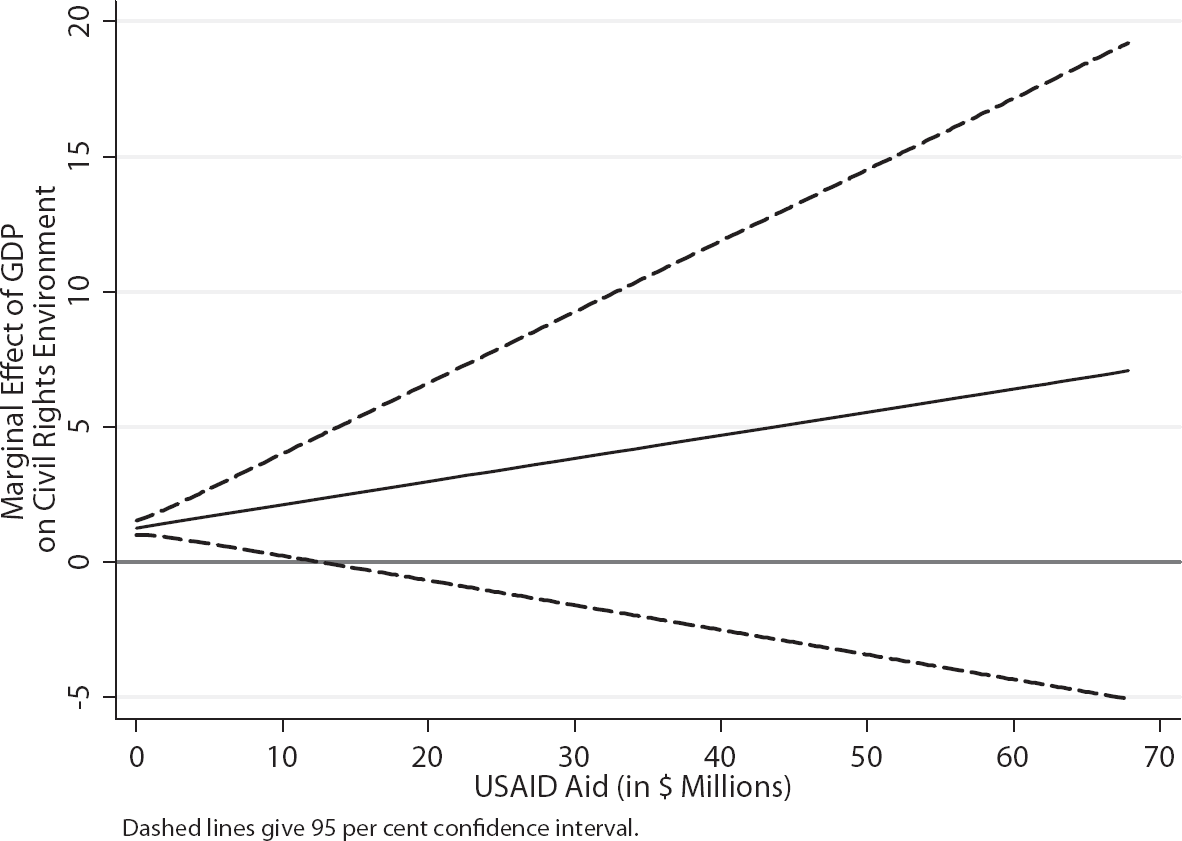
The Marginal Effects of GDP per Capita on Post-communist Civil Rights Environments
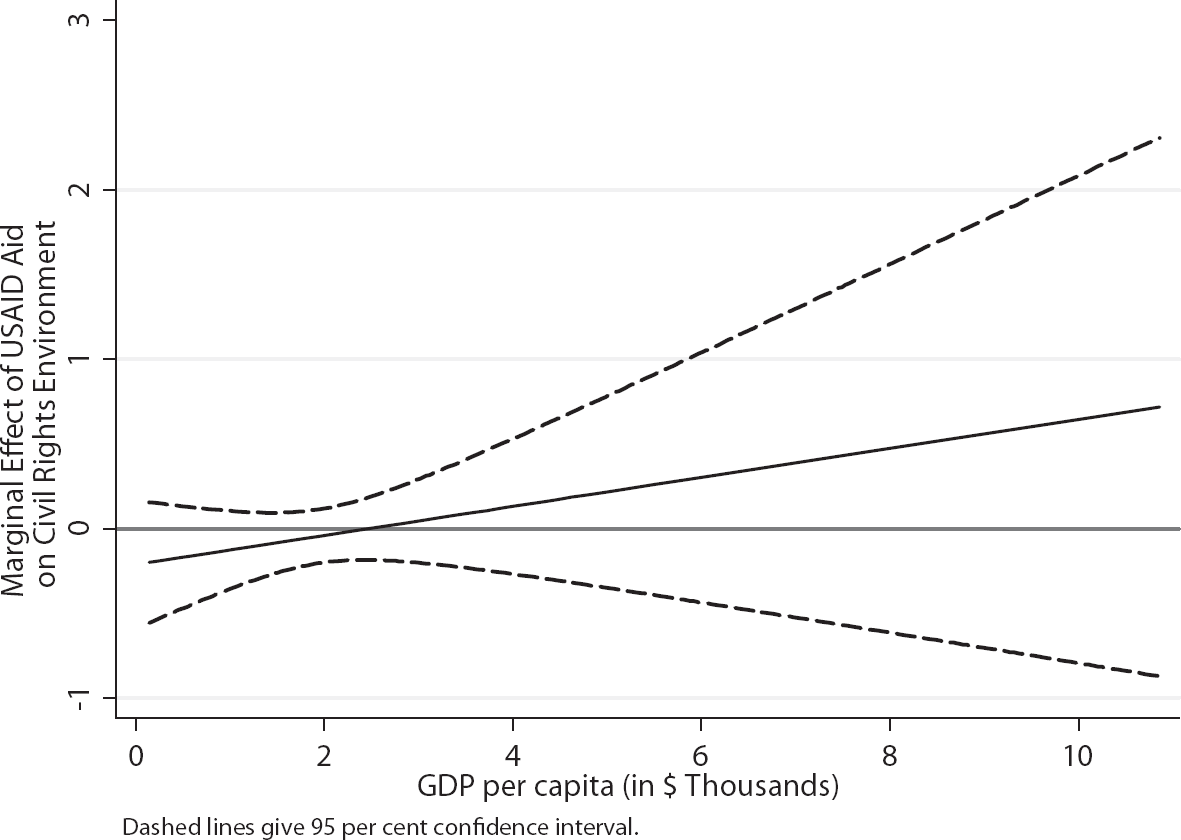
The Marginal Effects of Civil Society Aid on Post-communist Civil Rights Environments
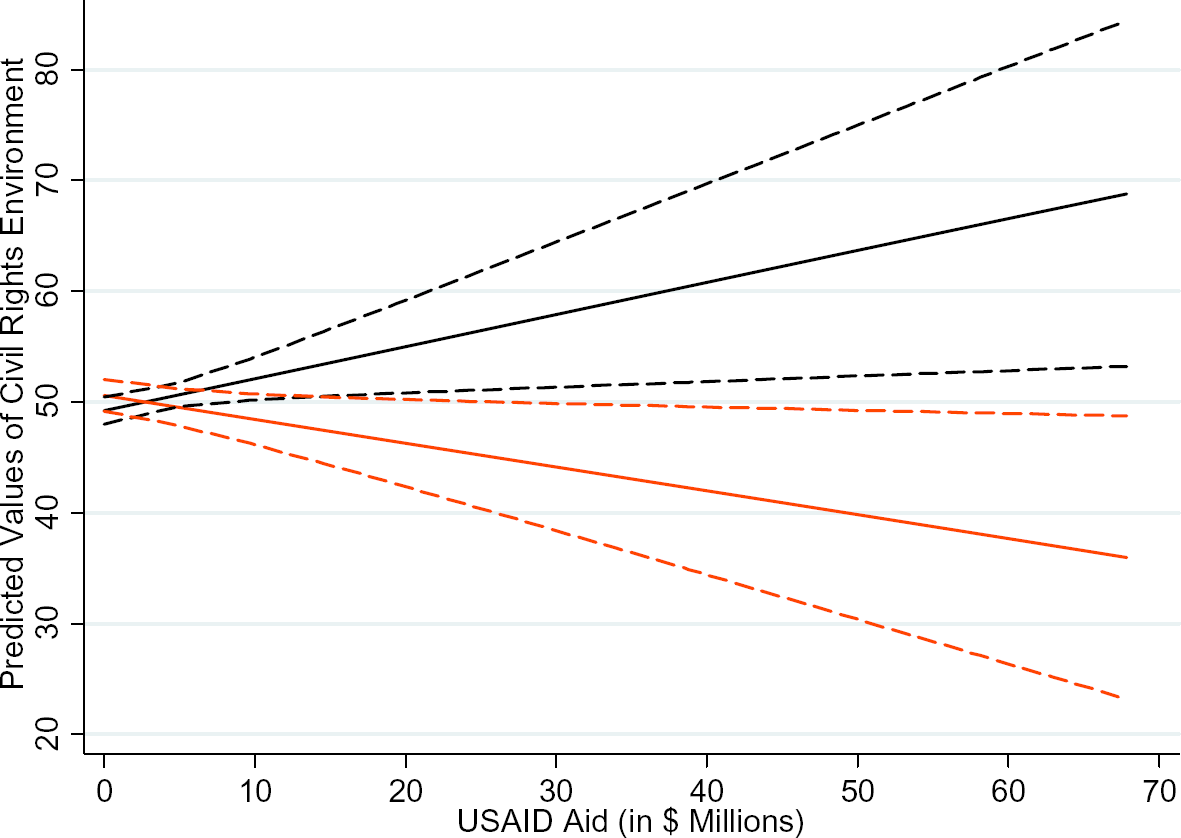
The Effects of Civil Society Aid on Post-communist Civil Rights Environments by Region
We also examine whether these effects differ by region. As discussed earlier, there are significant historical and contemporary differences between CEE and FSRs that may influence the development of civil society (Bernhard and Karakoç, 2007). Model 3 in Table 1 presents results with a binary variable measuring FSRs, as well as the interactions with USAID aid and GDP. In addition to demonstrating the robustness of the findings in models 1 and 2, the results in model 3 show that the performance of both USAID and GDP are less effective in FSRs than in CEE countries.
To illustrate these findings more clearly, Figures 3 and 4 present graphical representations of these effects. Figure 3 shows the predicted values of the dependent variable across the range of USAID aid in FSRs and CEE states, holding GDP per capita at its mean (and holding all other variables at zero). The black lines represent the effect of USAID aid in CEE, while the orange lines represent the effect of USAID aid in FSRs. In CEE countries, the effect of aid becomes larger and more positive as GDP increases. This effect is much smaller in FSRs, becoming negative at higher levels of USAID aid. 8 Because each region's predicted effect falls beyond the other region's confidence intervals, these effects are statistically significant. What this latter finding suggests is that USAID aid produces negative effects on civil rights strength, absent solid socio-economic conditions.
Turning to the differences between FSRs and CEE states regarding the effects of GDP, Figure 4 shows the predicted values of the dependent variable across the range of GDP per capita in FSRs and CEE, holding USAID aid at its mean (and holding all other variables at zero). As above, the black lines represent the effect of USAID aid in CEE, while the orange lines represent the effect of USAID aid in FSRs. As in Figure 3, the predicted values of civil society strength in Figure 4 are higher in CEE than FSRs. The data show that each region's mean falls outside the other region's 95 per cent confidence intervals, particularly at higher levels of GDP per capita; this indicates that these are significant differences.
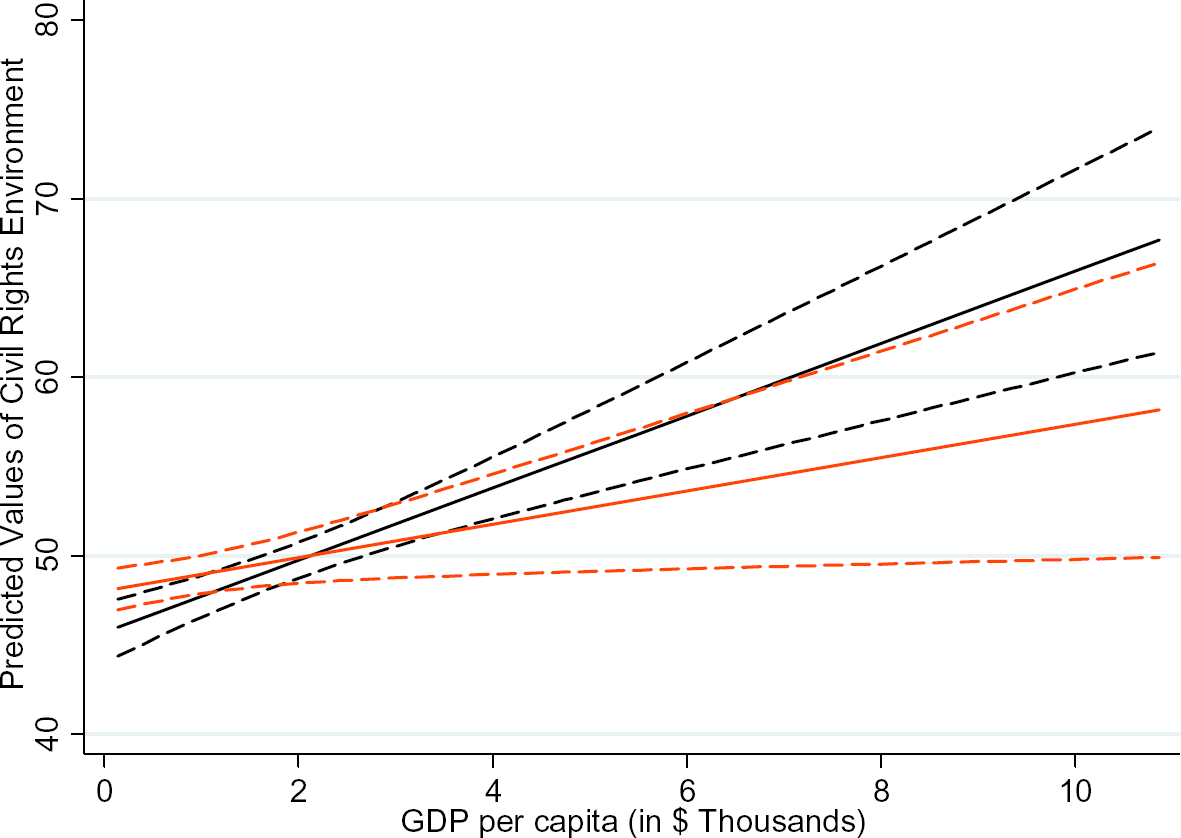
The Effects of GDP per Capita on Post-communist Civil Rights Environments by Region
Taken together, the data presented in Figures 3 and 4 demonstrate that regional effects are present. The effects of both USAID aid and GDP per capita are weaker in FSRs than in CEE states. FSRs undoubtedly lack healthy civil societies (especially compared to CEE states), and are consequently the recipients of millions of dollars in external support. But even if the aid distributed to CEE between 1990 and 2004 was redirected to FSRs, it is unlikely that it would have produced a noticeable difference in the strength of these countries' civil rights environments. This inference is supported by the fact that aid appears less effective in FSRs and has significant effects only at higher levels of GDP.
Putting all of these discussions into perspective, the findings do not bode well for the efficacy of foreign assistance. The results do not indicate that aid has a significant positive effect on civil rights environments. What seems to be a more powerful stimulant are the domestic socio-economic conditions with which the aid interacts. Even when aid does have significant benefits, it is only effective at higher levels of socio-economic development, suggesting that aid is not effective in those countries where it is most needed (i.e. countries without well-developed economies). This problem is even greater in FSRs, where aid is not only less effective than in CEE countries, but also has a negative effect on civil society strength at low levels of socio-economic development. While GDP per capita is also less effective in FSRs, it remains an important condition for civil society development and far more substantial than foreign aid. These findings highlight aid's conditionality on adequate domestic conditions, a point that has been raised in past research on other developmental topics (Bunce and Wolchik, 2006; Gourevitch, 1978).
Conclusion
Since 1990, the 27 former communist countries of CEE and the post-Soviet region have received millions of dollars in aid from Western donors eager to establish robust democracies. Civil society development is a particular focus for donors because it is believed to be a necessary condition for successful democratic transitions. This strategy follows a mainly ‘top-down’ methodology, as donors disperse money, resources and training to local NGOs ranging from environmental organizations to women's rights groups. The expectation is that these recipients form the backbone of an associational sector which then pressures post-communist governments to protect civil sectors and freedoms. While certainly well intentioned, the outcomes from the ‘top-down’ tactic raise serious questions about the limit of foreign assistance in ‘purchasing’ civil societies.
The empirical analysis provided here illustrates these limitations. As past research has argued, civil society aid is often ineffective at spurring sustainable organizations with committed constituencies. At times, the influx of outside assistance can facilitate adverse conditions that diminish rather than improve civic influence. Sarah Henderson (2002, p. 164) explains this consequence as a depletion of reciprocity among civic associations, a critical component of communal trust. As she writes, ‘The intrusion of foreign aid radically adjusts this dynamic, for civic groups no longer are building norms of reciprocity with each other and with their clientele, but rather are doing so with their patrons’. A more impactful stimulant to civil society arises domestically from healthy economic conditions. Donors seeking to improve civic engagement and organizational success may focus on improving community economies before investing in seminars and equipment for CSOs.
This study is not an indictment against USAID and other donors' commitment to post-communist development. Indeed, USAID contributes substantial assistance to economic development and a host of other sectors which, based on the analyses provided here, may be the more prudent use of funds. Rather, this work contributes cross-national empirical evidence to a growing literature critical of ‘top-down’ methods of civil society assistance. The two-decade civil aid experiment in post-communist Europe offers scholars and policy practitioners an opportunity to assess the strengths and weaknesses of various forms of assistance. As the world witnesses the emergence of new democratic movements in Northern Africa and the Middle East, aid organizations should take note of the post-communist experience with civil society development.
Footnotes
3
This type of mass disenchantment and apathy is similar to behavior found in Latin America, which also suffers from weak civil societies and low civic participation (Brysk, 2000).
4
It is important to note a distinction between our study and this literature. We seek to measure the consolidation of civil freedoms, not the determinants of civic protests, revolutionary challenges and social violence, which is a main focus of social movements research. Nevertheless some of the conditions that determine what successfully consolidates social movements may be similar to what leads to successful civic organizations, and ultimately a strong civil rights environment.
5
The results presented here are robust to alternative estimators, such as feasible generalized least squares (treating standard errors as homoskedastic or heteroskedastic), and Prais-Winsten regression (estimated using either PCSEs or feasible generalized least squares). While the results are not robust to fixed and random effects regression, we are confident that the results presented here are correct for two additional reasons. First, the small number of time points makes the use of fixed and random effects problematic; in such situations,  recommend the use of panel-corrected standard errors. Second, the results match those from an analysis in which all variables are averaged over time; because analyzing time-averaged means reduces the problems of time-series inference (i.e. serial correlation, temporal dependence, etc.) for data sets with a small number of time points, the results presented here using PCSEs support the use of this method over other estimators.
6
Unlike Freedom House measures that tap dimensions associated with civil freedoms, and thus risk endogeneity problems with the dependent variable, Polity data measure the strength and transparency of specific state institutions. This lowers the risk of endogeneity.
7
While this effect becomes significant in model 3, this finding (whether significant or not) shows that aid is not helping the countries that need it the most.