






Abstract
‘Culture’ features prominently in the literature on international mediation: if belligerents share cultural characteristics, they are likely to have a common understanding and norms. This creates a common identity and makes coordination less costly, which ultimately facilitates mediation occurrence and effectiveness. Surprisingly, existing quantitative research largely neglects any cultural ties the antagonists might share with the mediator. This article addresses this gap by offering one of the first joint analyses of fighting parties’ and mediators’ culture – and the interaction thereof. Based on existing work, a theoretical framework for mediation occurrence and effectiveness is developed and innovative measures for belligerents’ cultural ties and the links to the mediator are used. Contrary to expectations the results suggest that larger cultural distances between antagonists make mediation more likely, while cultural dissimilarities between them and the mediator have the opposite effect. Evidence is also found for a conditional effect between the two culture variables on mediation occurrence.
Keywords
International mediation – ‘a process of conflict management where disputants seek the assistance of, or accept an offer of help from, an individual, group, state or organisation to settle their conflict or resolve their differences without resorting to physical force or invoking the authority of the law’ (Bercovitch et al., 1991, p. 8; see also Touval and Zartman, 1985) – is generally perceived as a crucial and effective instrument for the non-violent resolution of inter- and intra-state disputes. For instance, the Issue Correlates of War (ICOW) dataset (Hensel et al., 2008), which we will be using for the empirical analysis of this research, list 244 issue claims1 between 1816 and 2001, of which 132 (54.10 per cent) have seen at least one mediation attempt according to the definition above. In total, the data identify 532 different mediation attempts, of which 219 (41.17 per cent) were effective to the extent that the belligerents either complied with a mediation agreement or an issue claim was comprehensively settled.
Given the importance of this conflict-resolution tool, it is not surprising that previous research examined international mediation extensively, with a particular focus on the determinants of mediation occurrence and success (for recent literature reviews, see e.g. Hellman, 2012; Wallensteen and Svensson, 2014). In short, both the belligerents and a (potential) mediator must have an interest in an intervention – i.e. demand and supply-side incentives are a necessary requirement for mediation to occur (e.g. Beardsley, 2008; 2010). Moreover, Touval and Zartman (1985, p. 40) emphasise that ‘third parties are only accepted as mediators if they are likely to produce an agreement or help the parties out of a predicament’. In this context, the factors that may influence the occurrence and outcome of international mediation focus on the characteristics of the antagonists, the characteristics of the dispute, and the mediators or type of mediation.
Particularly with regard to the belligerents’ characteristics, the literature identifies ‘culture’ as a prominent influence of mediation occurrence and effectiveness (see Londoño Lázaro, 2003, p. 325). Culture is a ‘system of meaning and value shared by a community, informing its way of life, and enabling it to make sense of the world’ (Cohen, 1996, p. 109). More formally, we define culture along the lines of Carnevale and Choi (2000, p. 16; see also Inman et al., 2014, p. 4):
Culture specifies what behaviors are desirable or proscribed for members of the culture (norms), for individuals in the social structure (roles), as well as the important goals and principles in one’s life (values). Culture also specifies how things are to be evaluated (Carnevale, 1995). This implies that people of different cultures will have greater difficulty in interaction, in understanding, and valuation.
Common cultural bonds or, conversely, cultural distances between the disputants are likely to affect mediation and its outcomes: ‘because leaders of countries make the decisions about whether or not to engage in mediation, culture will ... shape their perceptions of the utility of the method’ (Inman et al., 2014, p. 5).
In more detail, culture forms actors’ reality, perceptions and evaluations of issues, their ideas and preferences (Londoño Lázaro, 2003, p. 325). If actors have a similar culture or even share the same one, this shared understanding forms a connection between them that should make both mediation and an effective outcome more likely due to two interrelated, but different reasons: a common identity and fewer costs of coordination (e.g. Inman et al., 2014; Leng and Regan, 2003; Lohmann, 2011). First, a shared understanding and a cultural bond between actors form a common identity (Bercovitch and Foulkes, 2012; Burton, 1969; Hofstede, 1980; Kandogan, 2012; Lohmann, 2011; Sunoo, 1990). In turn, a common identity may make it more likely that the antagonists agree on a mediator (due to shared norms, such as the norm of conflict resolution) and can more easily negotiate with each other (e.g. due to the same negotiation styles, perceptions, ideas, understandings or interests). Sunoo (1990), for instance, demonstrates that individuals interact and negotiate very differently across cultures, which could prevent successful negotiation outcomes and lead to conflict instead.
Second, cultural dissimilarities make coordination more costly. If the cultural distance between the actors is high, there might be different norms, different perceptions and more misunderstandings. Agreeing on some form of third-party intervention or even negotiating the terms of a peace agreement may not be impossible then, but certainly more difficult. In fact, Burton (1969) contends that dissimilar cultural characteristics between a fighting party and a mediator might well hamper mediation due to higher coordination costs. Effortless coordination between the parties, however, could make it easier to communicate and agree on some standards (such as how to negotiate, where, with what representatives), and it facilitates the decision-making process due to a lower likelihood of misunderstanding and, as a result, the resolution of a conflict (e.g. Beardsley, 2008; Beardsley et al., 2006). For example, Augsburger (1992, pp. 73ff) focuses on concepts like ‘face,’ ‘harmony’ or ‘honour’ and studies their role in Western and traditional cross-cultural negotiations. He notes that Western cultures are more individualistic while the traditional cultures are more collectivistic. While this makes negotiations and conflict resolution between actors from these different cultures more difficult due to the absence of shared norms and common understandings, he also notes that a mediator could be able to circumvent these cultural barriers. Hence, the literature presents convincing arguments for why actors’ (i.e. belligerents’ and mediators’) culture may matter for mediation occurrence and effectiveness.
Somewhat surprisingly, however, the existing quantitative work largely focuses on the cultural relationship between the belligerents, while it neglects cultural ties to the (potential) mediator and any interactive effects between the belligerents’ culture and the cultural ties to the third party. Noteworthy exceptions from diplomatic history do exist (e.g. Iklé, 1964), but these are largely of a qualitative nature, only examine specific cases and may be limited in their generalisability. For example, Henry Kissinger, Jimmy Carter and Richard Nixon highlight the role of culture in their memoirs when talking about their mediation efforts (see Avruch, 1998, p. 41). Moreover, several scholars claim that the cultural disharmony between Secretary of State James Baker and Iraqi Foreign Minister Tarik Aziz was the major cause of the failure of the US mediation efforts over the course of the Iraq-Kuwait conflict in 1990–1991 (Kimmel, 1994; Payne, 1995, p. 93).
This article seeks to address the cultural impact on mediation by offering one of the first joint quantitative analyses of antagonists’ and mediators’ culture – and the interaction thereof. We first develop a theoretical framework for mediation occurrence and effectiveness that focuses on cultural links between the fighting parties, ties from the antagonists to the mediators and the joint impact of these factors. To this end, we argue that cultural similarities (distances) between the belligerents should make mediation occurrence and effectiveness more (less) likely; that cultural similarities (distances) between the belligerents and the (potential) mediator should make mediation occurrence and effectiveness more (less) likely; and that the interaction of belligerents’ culture and the cultural ties with the mediator also matters for explaining mediation occurrence and effectiveness.
In the next section, we review existing and develop new theoretical arguments, which lead to the expectation that cultural distance between the actors involved generally decreases the likelihood of mediation occurrence and effectiveness. Afterwards, we describe the research design and present the results. Our findings show that mediation is more likely to occur when, first, the belligerents are in fact culturally more dissimilar and, second, when (potential) mediators share cultural similarities with the belligerents. At the same time, however, culture is unlikely to affect mediation outcomes. Finally, the analysis of the interactive effects demonstrates that the cultural ties between the antagonists condition the impact of the cultural links to the mediator on mediation. We conclude by discussing these results in light of the previous research and by presenting implications for future studies.
Culture and Mediation: A Theoretical Framework
Belligerents’ Culture and Mediation
Generally, culture forms norms, expectations and values, which influence state leaders and, thus, states’ behaviour (Inman et al., 2014, p. 2). It seems unlikely that international mediation is an exception here: states are influenced by norms and values, and therefore by their identity and cultural background when considering mediation, when offering it, and when belligerents actually negotiate with each other in the context of third-party mediation.
Bercovitch and Elgström (2001) offer the first systematic analysis of how cultural differences and similarities between the belligerents influence mediation. This study inspired succeeding work with a similar focus in international relations – e.g. Leng and Regan (2003), Bercovitch and Foulkes (2012), or Inman et al. (2014). 2 The argument for why the fighting parties’ culture might influence mediation is fairly common in these and related studies: a shared culture leads to a common identity and fewer coordination costs, which makes it more likely that mediation occurs and is effective. In more detail, first, culture forms identities, which in turn may fuel in-group and out-group dynamics (Cohen, 1996; LeBaron, 2003; Ting-Toomey and Oetzel, 2001). Culture can thus contain a body of meaning shared by a group, which then facilitates coordination, or it is a ‘barrier that excludes those who do not belong to the group’ (Londoño Lázaro, 2003, p. 340). However, similar cultures are related to common patterns of interacting and reacting to the actions of others, as well as shared values and beliefs (Leng and Regan, 2003, p. 432). If belligerents have cultural similarities, in-group characteristics may weigh substantially, ‘fostering an acceptance of mediation or other cooperative conflict resolution methods’ (Inman et al., 2014, p. 6). In other words, a shared identity is based on common norms, expectations and values, which form a connection between the parties that makes it more likely that they agree on a common norm of conflict resolution: mediation. Hopmann (1996, p. 144) states that there are cultural values and beliefs that affect all aspects of negotiations. Even the way that nations conceive resolution processes might reflect their cultural heritage. For instance, the negotiations between the Israelis and Palestinians or the US and Cuba (with or without third-party mediation), are affected by persuasive cultural factors.
Second, the coordination between antagonists from different (or distant) cultures will be more costly, ‘based on either inferred or experienced divergences in conflict style, norms, communication and emotional expression’ (Inman et al., 2014, p. 6; see also Ting-Toomey and Oetzel, 2001). In the words of Cohen (1996, p. 110), ‘culture constructs reality, different cultures construct reality differently, communication across cultures pits different constructions of reality against each other’. As a result, the higher the cultural distance between two parties, the more likely it is that misunderstandings exist, the difficulty of communication increases and coordination becomes less straightforward. Leng and Regan (2003, p. 434) highlight that ‘problems may arise from misunderstandings generated by dissimilar negotiating or bargaining styles, or in the meanings attached to signals’ in mediation contexts involving belligerents from different cultures. Ultimately, the belligerents may perceive that the costs associated with mediation outweigh the benefits of a peaceful agreement (Inman et al., 2014, p. 6).
In light of these two different, yet highly related claims, actors from different cultures react, behave and perceive signals differently (Leng and Regan, 2003, p. 432). This makes it more difficult to find a ‘common ground’, decreasing the chances of mediation occurrence and effective outcomes. Note that the argumentation we reviewed here essentially focuses on the belligerents only (see also Inman et al., 2014, p. 8; Londoño Lázaro, 2003, p. 330) 3 and we seek to go beyond this in the following. That said, the discussion so far leads to the first hypothesis (see also Bercovitch and Elgström, 2001; Bercovitch and Foulkes, 2012; Inman et al., 2014; Leng and Regan, 2003):
H1: The higher the cultural distance between the belligerents, the less likely it is that they agree on mediation (occurrence) and, if it does occur, that it is successful (outcome).
Belligerents’ Cultural Ties to Mediators
A (potential) mediator must have certain characteristics that make them attractive for the antagonists to be allowed to intervene. The previous literature has identified credibility as being one of the most important factors here (e.g. Beardsley, 2008; Beardsley et al., 2006; Kydd, 2003; 2006; Rauchhaus, 2006; Savun, 2008; Smith and Stam, 2003; Svensson, 2007; 2009; Svensson and Lindgren, 2013; Wallensteen and Svensson, 2014). In fact, a prerequisite for the provision of information leading to efficient and effective coordination is the credibility of the mediator (Dorussen and Ward, 2008, p. 193): the more credible a mediator, the more likely it is that he or she is accepted by the disputing actors as an intervener and the higher the prospects for success (see also Bercovitch and Houston, 2000; Regan and Aydin, 2006). In light of this, we argue that common cultural characteristics between the antagonists and the mediator could be credibility assets, which ultimately influence the prospects for mediation occurrence and effectiveness (Kydd, 2006; see also Bercovitch and Foulkes, 2012; Carnevale and Choi, 2000; Inman et al., 2014; Leng and Regan, 2003; Ott, 1972; Young, 1967). For instance, Davis (1981) uses an experimental design to demonstrate that cultural similarity between conflicting actors and a potential mediator affects attraction, making the third party more credible and, thus, acceptable to both sides.
First, and similar to the argumentation above, culture forms norms, expectations and values that, if shared with a potential mediator, form a connection between the belligerents and the third party (Bercovitch and Foulkes, 2012; Block and Siegel, 2011; Burton, 1969; Carnevale and Choi, 2000; Hofstede, 1980; Kandogan, 2012; Lohmann, 2011; Sunoo, 1990). This connection leads to a common identity between the mediator and the antagonists: links between a (potential) mediator and the belligerents generally make the transmission of information about interests and intentions more credible (Dorussen and Ward, 2008). In turn, the belligerents perceive the third party as ‘one of them’, and may eventually increase the probability of mediation occurrence and effectiveness due to common norms, similar ideas and preferences (Bercovitch and Foulkes, 2012; Block and Siegel, 2011; Carnevale and Choi, 2000). In the view of Carnevale and Choi (2000, p. 106) and Londoño Lázaro (2003, p. 334), ‘cultural ties to a mediator may be a positive factor in international mediation’ as mediators can then bridge intercultural coordination and communication gaps between disputants (see also Bercovitch and Foulkes, 2012; Block and Siegel, 2011; Cohen, 1996). Conversely, it is difficult to achieve positive outcomes without common norms and perceptions – i.e. in an environment with severe cultural differences and the absence of a common identity between the disputants and the mediator. As Leng and Regan (2003, p. 436) emphasise, ‘there is a greater degree of rapport and trust [credibility] when the mediator and parties are from the same social or political culture, as opposed to when they are not’ (see also Bercovitch and Foulkes, 2012; Block and Siegel, 2011; Carnevale and Choi, 2000). Kydd (2006, p. 459) similarly states that ‘mediation works best when the parties and the mediators share some bonds’. For example, Iran and Iraq only accepted a mediation offer from Algeria, which arguably shares several cultural characteristics with these two belligerents, during the war in 1982 (Princen, 1987, p. 350).
Second, culture affects the costs that are associated with coordination. Cultural dissimilarities restrain coordination, make it more costly and, thus, signal that a mediator might be less suitable and effective if differences do exist (see also Bercovitch and Foulkes, 2012; Block and Siegel, 2011; Carnevale and Choi, 2000): ‘[I]f the assumptions of disputants regarding the role of the mediator are different from the mediator’s own views, the latter may employ tactics that are ineffective, or even offensive’ (Leng and Regan, 2003, p. 434). Effortless coordination between the parties, on the other hand, helps facilitate the decision-making process and, as a result, makes mediation generally less costly (see e.g. Lohmann, 2011). We argue that shared cultural characteristics can bridge the divide between the mediators and the belligerents, and can smooth both the beginning and the progress of mediation, while dissimilar cultural characteristics might well hamper coordination. Due to cultural ties, a mediator simply has better access to the belligerents, making them more likely to deliver positions and agreements that facilitate mediation effectiveness (Bercovitch and Foulkes, 2012; Carnevale and Choi, 2000, p. 108). 4 The third-party intervention in the 1999 Kosovo conflict may illustrate this (Kydd, 2003, p. 597). Russia, a culturally close partner of Serbia, was the only mediator capable of convincing Slobodan Miloševic´ to accept a NATO peace proposal. A culturally more distant mediator would have had more problems due to more difficult access, a lack of shared norms and more costly coordination between the actors.
Ultimately, we contend that a shared cultural language between the antagonists and a third party raises the likelihood that mediators are accepted in the first place and more effective, as they can guarantee credibility due to a shared identity and lower coordination costs during the negotiations: 5
H2: The higher the cultural distance between the belligerents and the mediator, the less likely it is that they agree on mediation (occurrence) and, if it does occur, that it is successful (outcome).
The Interaction of Belligerents’ and Mediators’ Cultural Ties
We finally argue that the two factors – belligerents’ cultural similarities and the cultural ties to the (potential) mediator – are likely to interact (see also Leng and Regan, 2003, p. 434). Specifically, we argue for a joint effect of both variables that leads to an even stronger impact on mediation, and for a conditional effect to the extent that belligerents’ cultural similarities condition the impact of the antagonists’ cultural ties with the mediator on the prospects for mediation occurrence and effectiveness.
First, while the previous sections focused on the individual effects of our core variables, it is likely that the impact of culture is complementary – i.e. belligerents’ cultural similarities should facilitate mediation even more positively when cultural similarities with (potential) mediators exist as well. To illustrate this, imagine that two belligerents i and j are connected through cultural similarities. Our argument outlined above predicts that this should increase the chances of mediation and facilitate effective outcomes. We should observe this outcome as well if cultural similarity with a third party is given. In addition, however, regardless of these independent effects, we argue to consider these effects jointly as there might be a complementary impact of both factors: coordination among the parties may be even more facilitated as compared to a case where only one of the two similarities is given. For instance, the cultural similarity of all actors involved in the Beagle Conflict of 1978 not only made it more likely that mediation occurred, but also that it was effective (Garrett, 1985): Argentina and Chile shared the same cultural-religious aspect of Catholicism, and they also had this in common with the Vatican as the eventual mediator. In the absence of only one of these cultural similarity relationships, the prospects for (successful) mediation might have been lower:
H3: The joint impact of (1) cultural similarity between the belligerents and (2) between them and the mediator should increase the likelihood of mediation (occurrence) even more and, if it does occur, its success (outcome).
Second, we argue for a conditional effect: if a high cultural distance characterises the fighting parties, it is implied that the mediator can be culturally similar to only one of them. Put differently, if i and j do not have strong cultural links with each other, one of these must have by definition only weak cultural ties to the (potential) mediator. This points directly to the bias literature. Generally, a mediator is seen as biased if he or she has links or shares preferences with one of the antagonists, but not the other one, and unbiased if he or she remains impartial or neutral (Kydd, 2006). Kydd (2003), for instance, argues that a mediator must be biased towards a disputing party if they want the antagonists to perceive them as an honest and credible communicator. Similarly, Savun (2008) finds support for her argument that biased mediators increase the chances of successful mediation as they are the only third party that can credibly provide information about the belligerents. Although she focuses on mediation effectiveness, Savun (2008) claims that the same factors that determine mediation outcomes will influence whether we see mediation in the first place. However, Smith and Stam (2003) contend that biased mediators are not effective and Rauchhaus (2006) obtains evidence that although biased mediators may be effective, impartial mediators are even more so. In a similar vein, Kydd (2006) discovers that if a mediator is to help resolve a conflict caused by mutual mistrust, that person must be unbiased.
Ultimately, on the one hand, scholars argue that impartiality makes the mediator more attractive because this raises his or her credibility and the trust between the mediator and the antagonists in the context of coordination. Not only does this make impartial mediators more likely to attract mediation, but a neutral mediator might turn out to be more effective as well (see also Kleiboer, 1996, p. 365; Ott, 1972; Young, 1967, p. 80). Note that this argumentation also points to the joint effect we argued for in our third hypothesis (i.e. since the belligerents are culturally close to each other, a mediator might be either culturally close or distant, but he or she can never be biased towards one of them). On the other hand, studies challenge the concept of an impartial mediator and suggest instead that biased intermediaries are more effective in resolving a conflict since they are more credible when providing information (see also Pruitt, 1981). It is undisputed by this stream in the literature, however, that a biased mediator may find it more difficult to be mutually accepted by the belligerents in the first place (Crescenzi et al., 2011). In other words, conditional on the cultural ties between the belligerents, it may well be that third parties’ culture affects mediation not as expected in our unconditional hypothesis above. We thus seek to test this in our last hypothesis:
H4: Belligerents’ cultural similarities affect the impact that cultural ties between the antagonist and the potential mediator have on mediation occurrence and effectiveness.
Research Design
Data
For the empirical test of our hypotheses, we use cross-sectional data from the ICOW project (Hensel et al., 2008), which cover territorial claims in the Western Hemisphere and Western Europe, river claims in the previous two regions plus the Middle East, and maritime claims in the Western Hemisphere and Europe. The advantages of the ICOW data are twofold: first, we can compare cases across various issues of contention; and second, our analysis is not limited to situations that become militarised at some point, thus addressing to some extent the problem of selection bias.
We use ‘the potential mediator for each year of a dyadic claim as the unit of analysis’ (Crescenzi et al., 2011, p. 1081). Specifically, after focusing on the ongoing years of a dispute claim between a challenger and a target (i.e. the belligerents), there is a new observation for every potential third-party state that may intervene in a given year. A potential mediator is defined as any state from the same conflict region or a major power as classified by the Correlates of War Project (Crescenzi et al., 2011, p. 1081). As Crescenzi et al. (2011) point out, all states could in principle be considered potential mediators, although this choice would bias the dependent variable’s values towards 0. Hence, a more parsimonious sample is warranted. With this setup, our data comprise 237,335 observations over the period 1817–2000. 6
Dependent Variables and Methodology
For capturing the concept of mediation, we rely on Bercovitch et al. (1991, p. 8; see also Touval and Zartman, 1985). Hence, after dropping cases that experienced military interventions or bilateral conflict management, the final data include information about attempts to manage or settle each ICOW claim through peaceful third-party mediations. 7 The first dependent variable, Mediation Occurrence, receives the value of 1 if a potential mediator actually intervened in a specific year for a dyad-claim and 0 otherwise; the second dependent variable, Mediation Outcome, is coded 1 if mediation led at least to an agreement between the belligerents in a year under study and 0 otherwise (see also Crescenzi et al., 2011, p. 1081). 8
Various studies in the literature on international mediation indicate that there may be problems of selection bias. The decision to mediate is itself a strategic consideration and, thus, there are many underlying factors that are likely to influence both the decision to mediate and mediation effectiveness (Böhmelt, 2010; Crescenzi et al., 2011; Gartner, 2011; Gartner and Bercovitch, 2006). Ultimately, we face a selection problem that may either under-estimate the impact of our explanatory variables or exaggerate it. Regular probit models, which might be the obvious choice given our dichotomous dependent variables, may yield biased estimates if selection is an issue, though. In order to deal with this problem in more depth, we use a probit-type Heckman selection model (Heckman, 1979). After assessing this model, however, we move to regular probit regression models to examine our expectations on mediation occurrence more thoroughly.
Explanatory Variables
The theory focuses on the cultural distance between the belligerents, on the one hand, and their cultural ties to the (potential) mediator, on the other. To this end, we adopt Kandogan’s (2012) revised variable of Kogut and Singh’s (1988) standardised measure of cultural differences. This variable is more accurate than previously used measures of culture as it moves beyond simple indicators of common religion, similar languages or political systems. In more detail, while the degree of cultural differences is notably difficult to conceptualise, Kogut and Singh (1998) offer a simple and standardised measure of cultural differences that is based on Hofstede’s (1980) dimensions of national culture. Hofstede (1980) provides a powerful framework to classify cultures that circumvents the intricacies of culture (Kirkman, Lowe, and Gibson, 2006). Similar to our approach above, Hofstede (1980, p. 25) defines culture as ‘the collective programming of the mind which distinguishes the members of one human group from another’. A ‘group’ can refer to nations, regions, ethnicities, religions, occupations, organisations or gender. Hofstede classified countries along four main anthropological issue areas that societies handle differently: the ways of coping with inequality, the ways of coping with uncertainty, the relationship of the individual with his or her primary group, and the implications of having been born female or male. In turn, Hofstede translated these into four dimensions of national culture: power distance – i.e. the strength of social hierarchy; uncertainty avoidance – i.e. the discomfort with uncertainty and ambiguity; masculinity versus femininity – i.e. preferences for achievement, heroism, assertiveness and material rewards for success versus cooperation, modesty, caring for the weak and quality of life; and individualism versus collectivism – i.e. preferences for a loosely knit social framework in which individuals are expected to take care of only themselves and their families in contrast to preferences for a society in which individuals expect members of a particular in-group to look after them in exchange for loyalty.
These dimensions of national cultures are rooted in people’s values, where ‘values’ are ‘broad preferences for one state of affairs over others ... they are opinions on how things are and they also affect our behavior’ (Hofstede, 1985, p. 347). As such, by explicitly taking into account the values held by the majority of the population in each of the surveyed countries, these dimensions can effectively capture differences between countries in their norms, perceptions and ways of dealing with conflicting situations. Higher cultural distance pertains to higher divergence in opinions, norms or values. As we argue above, this should, in turn, affect the odds of mediation occurrence and success.
Against this background, Kogut and Singh (1988) developed a composite index based on the deviation from each of Hofstede’s (1980) four dimensions of national culture. Their measure has been applied to studies on foreign investment expansion, entry mode choices or the performance of foreign invested affiliates, among others (e.g. Shenkar, 2001). Kandogan (2012) revised the original variable by moving beyond the assumption in Kogut and Singh (1988) that the covariance between the four different dimensions of culture is 0. In order to take into account the skewed distribution of this time-invariant variable, we calculated the natural log. For the belligerents’ cultural distance (Belligerents’ Cultural Distance), we use this log-transformed variable, while we rely on a ‘weakest-link’ specification for the cultural ties of the fighting parties to the (potential) mediator(Cultural Distance)– i.e. the value of this cultural distance variable is determined by the cultural distance of the culturally closest belligerent-mediator combination: after merging the cultural distance between the challenger belligerent and the potential mediator, and the distance between the target belligerent and the potential mediator, we compared the values and only introduce the value of the lower cultural distance into the models. 9 Note that this operationalisation underlines our claim that there must be a biased mediator when the antagonists are culturally distant from each other. In order to capture the interactive effects between these two variables (as stated in our third and fourth hypotheses), we also consider a multiplicative term between Belligerents’ Cultural Distance and Cultural Distance.
In terms of the control variables, we consider a broad set of demand and supply-side factors. We list these controls and a short description of their operationalisation/source in Table 1. For a more detailed overview, in particular their underlying theoretical mechanisms, we refer the interested reader to the previous literature that discusses these factors in depth – e.g. Beardsley (2008; 2010), Böhmelt (2010; 2013), Crescenzi et al. (2011), Hellman (2012), or Wallensteen and Svensson (2014).
Control Variables
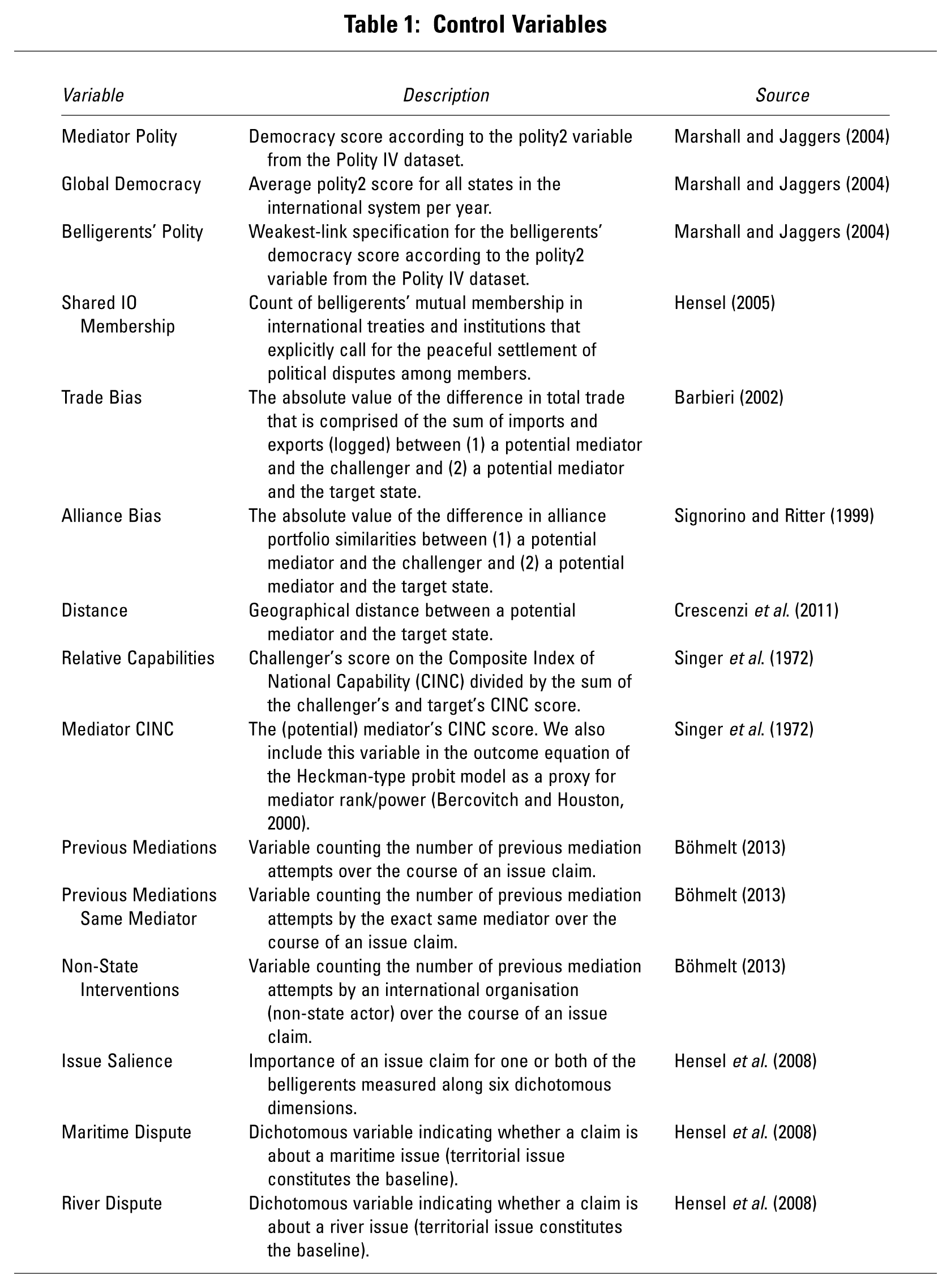
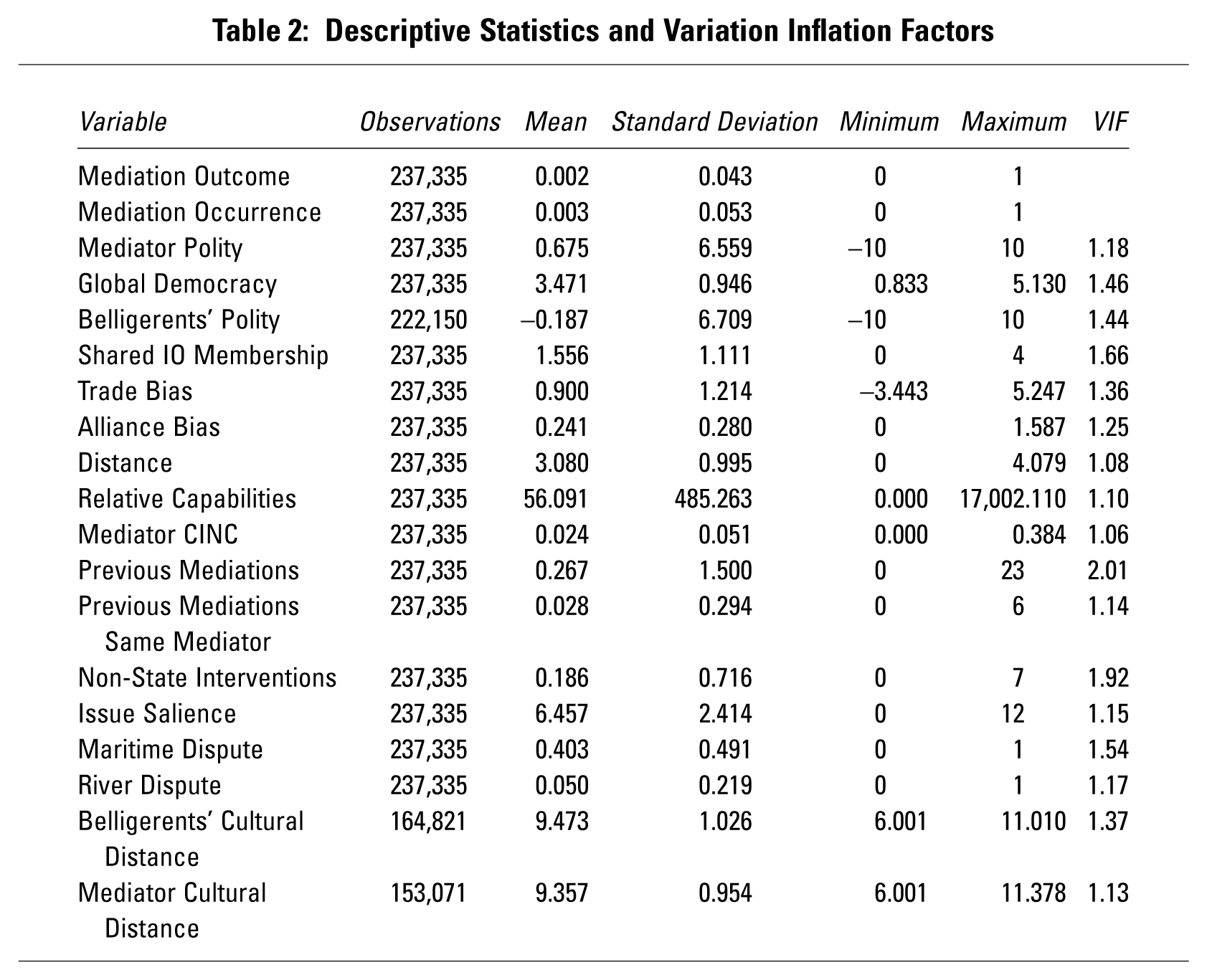
Table 2 summarises the descriptive statistics of all variables discussed so far as well as the variation inflation factors (VIFs) of the explanatory factors. Two issues are worth noting. First, according to the VIFs, multicollinearity is unlikely to be a major issue since all VIFs are well below the common threshold value of 5. Second, the occurrence of mediation is a rare event: less than 1 per cent of all observations have actually seen this form of third-party intervention in the full sample. Nor does this frequency change substantially in that sample, which is only covered by our core explanatory variables. While this is driven by the unit of analysis, it follows from this that the effects we will identify are likely to be small in substance.
Descriptive Statistics and Variation Inflation Factors
Empirical Findings
Table 3 summarises our results: model 1 is based on the probit-type Heckman selection model (Heckman, 1979), while models 2–3 are regular probit models. Hence, while model 1 jointly analyses mediation occurrence and effectiveness, models 2–3 only focus on mediation occurrence. The difference between model 2 and model 3 is the inclusion of the interaction between Cultural Distance and Belligerents’ Cultural Distance in the latter. 10
Culture and International Mediation: (Heckman) Probit Models
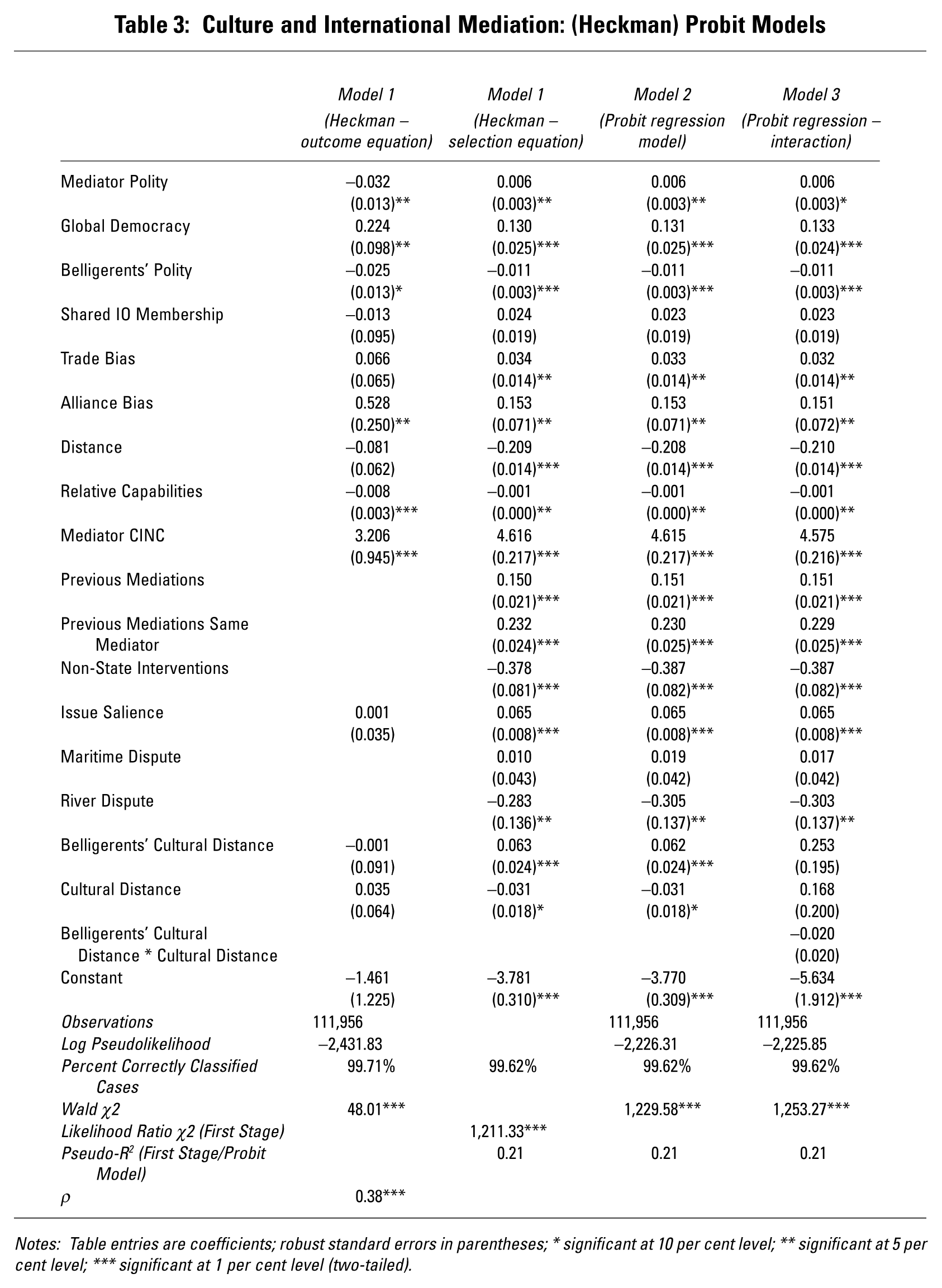
Notes: Table entries are coefficients; robust standard errors in parentheses; * significant at 10 per cent level; ** significant at 5 per cent level; *** significant at 1 per cent level (two-tailed).
Beginning with a discussion of our core variables of interest – Belligerents’ Cultural Distance and Cultural Distance – both variables are insignificant in the outcome equation of the Heckman-type probit model. Therefore, it is unlikely that cultural similarities affect the prospects of mediation success. Unreported models that include an interactive term between our core variables in the outcome equation point to the same conclusion: cultural ties, either between the belligerents or to the mediator, are unlikely to affect mediation effectiveness. This mirrors previous findings by, for example, Inman et al. (2014) and questions the effectiveness part of our hypotheses. Note, moreover, that our estimate for the ρ parameter is positive and statistically significant. This suggests that unobserved features that increase the likelihood of selection (i.e. mediation occurrence) also increase the probability of mediation success.
However, because of the insignificant coefficient estimates of Belligerents’ Cultural Distance and Cultural Distance in the selection model’s outcome equation, we focus on the regular probit models for the occurrence of mediation. 11 As coefficients in such non-linear models cannot be interpreted as slopes or elasticities (only their signs and standard errors allow for a direct reading),we present substantive quantities of interest –i.e. first difference estimates for Mediation Occurrence = 1 as one explanatory variable changes values from its minimum to its maximum, while all others items are held constant at their medians (King et al., 2000). These calculations are presented in Table 4.
First Difference Estimates (Model 2)
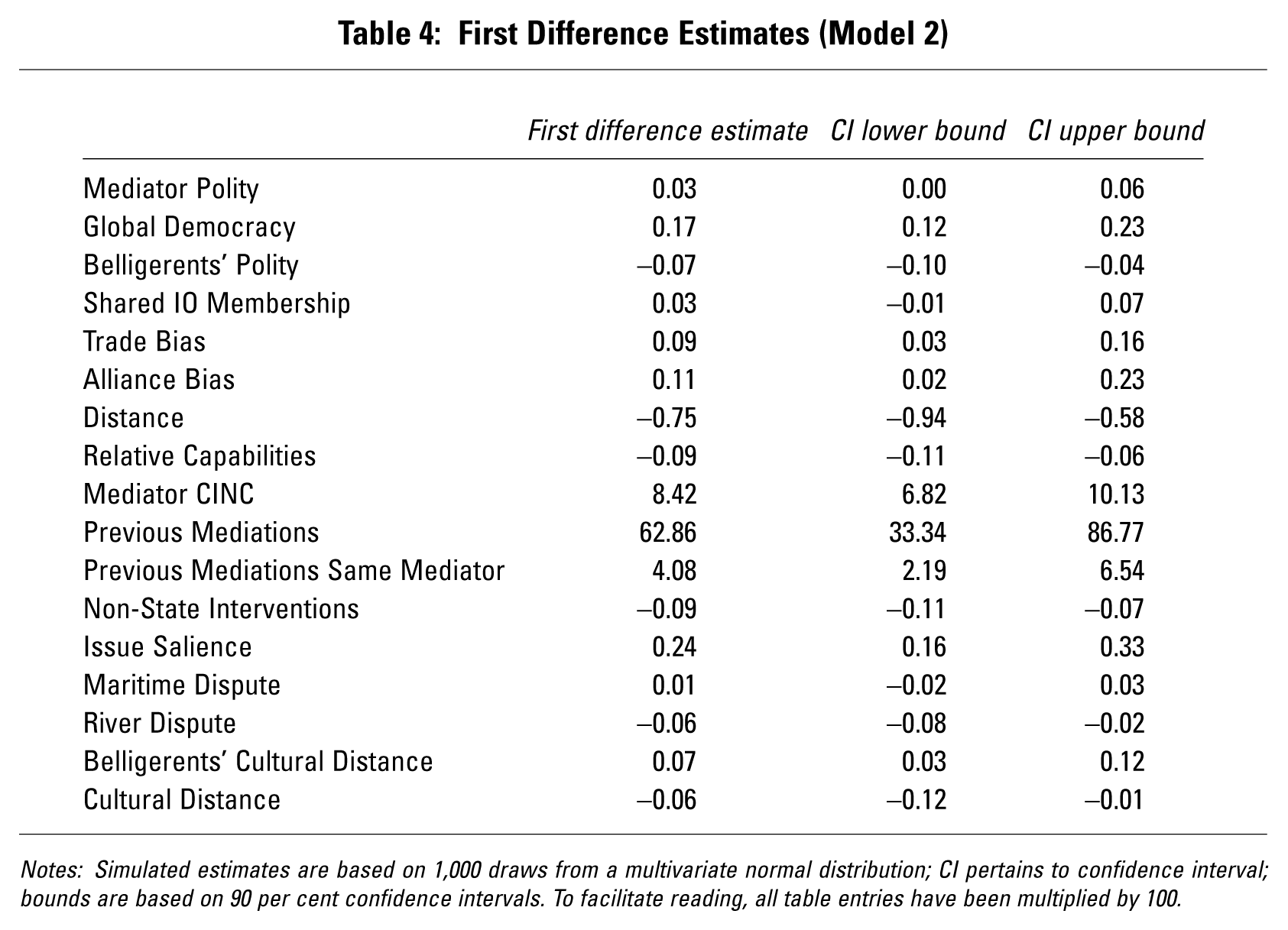
Notes: Simulated estimates are based on 1,000 draws from a multivariate normal distribution; CI pertains to confidence interval; bounds are based on 90 per cent confidence intervals. To facilitate reading, all table entries have been multiplied by 100.
When focusing on the results from model 2, contrary to our expectations, Belligerents’ Cultural Distance actually has a positive first difference that is statistically significant at conventional levels: the chances of mediation occurrence increase by 0.07 percentage points when Belligerents’ Cultural Distance is raised from its minimum to its maximum. Only Cultural Distance has the expected negative sign: the higher the cultural dissimilarity between the belligerents and the mediator, the less likely it is that mediation occurs. Substantially, the likelihood of mediation occurrence decreases by 0.06 percentage points when Cultural Distance is raised from its minimum to its maximum. Both findings are consistent with our estimates of the selection equation in the Heckman-type probit model. In absolute terms, these first-difference estimates appear to be very small, but recall that mediation occurrence isa rare eventinour dataset(lessthan1percentofall observations have seen mediation). This induces that our substantial quantities estimated by any statistical model are automatically very small. Overall, our first hypothesis must be rejected, while we obtain some support for our second one: our expectations regarding occurrence are met, but not in terms of effectiveness. We return to these findings in the last section.
In addition, regarding the third and fourth hypotheses, while we could not obtain support for an interactive effect in terms of mediation effectiveness (see above), there is evidence for an interactive relationship for mediation occurrence (model 3). Since we cannot directly interpret the size, signs and z-statistics of the components of a multiplicative specification, we calculated average marginal effects for Belligerents’ Cultural Distance according to Cultural Distance and vice versa (Braumoeller, 2004, p. 815). Figure 1 depicts our findings.
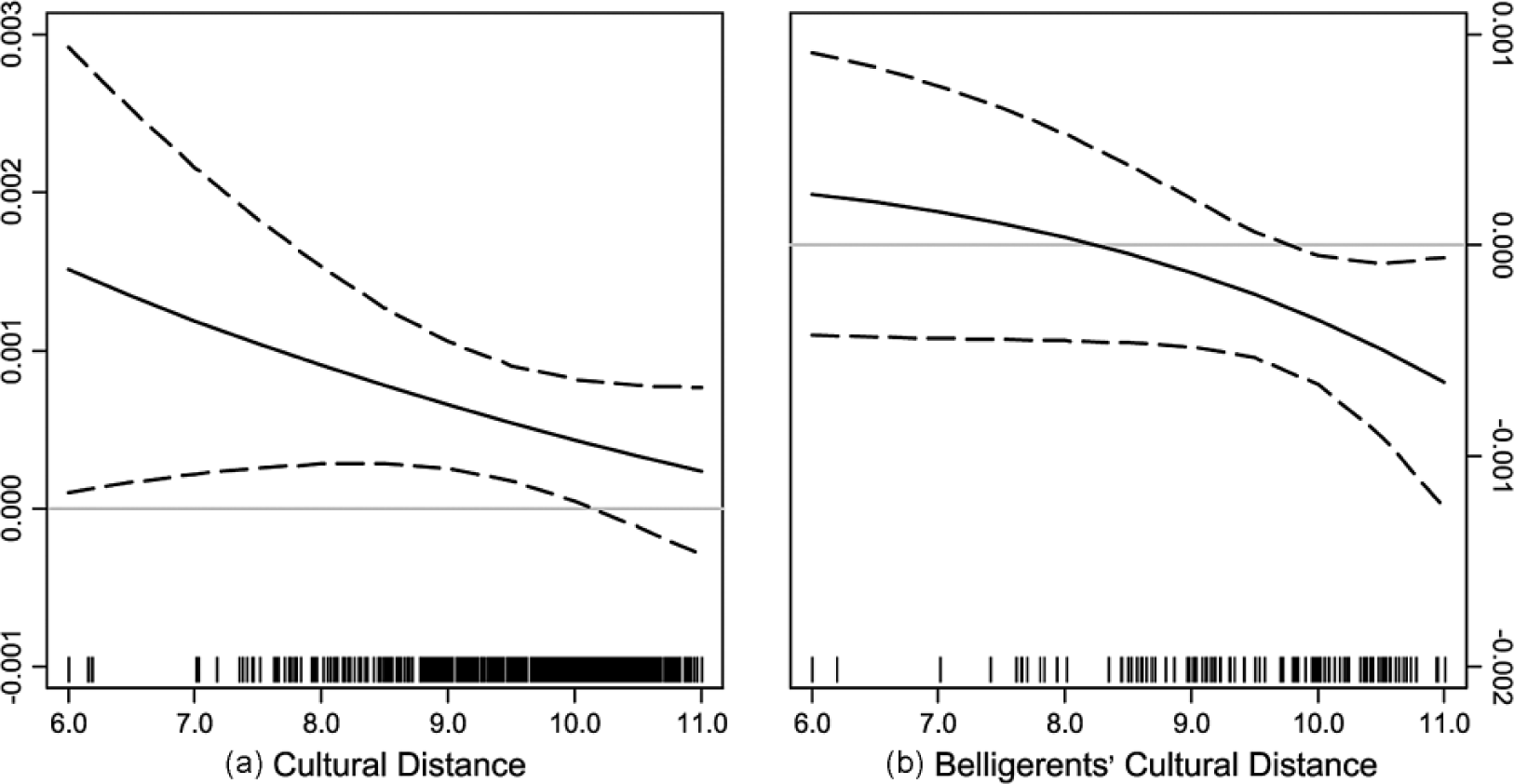
The Interaction of Cultural Distance (Model 3): (a) Impact of Belligerents’ Cultural Distance on Probability of Mediation and (b) Impact of Cultural Distance on Probability of Mediation
As this figure shows, the marginal impact of either variable decreases with the values of the other measure of cultural distance. Interestingly, however, Belligerents’ Cultural Distance largely remains at positive values independent from the values of Cultural Distance (left panel), although there is a negative slope. Hence, the intervening impact of Cultural Distance seems actually rather weak, as the positive and unconditional impact of Belligerents’ Cultural Distance we identified in model 2 remains robust. In other words, we do not find support for our third hypothesis as there is no evidence for a joint effect. Moreover, the right panel in Figure 1 models the impact of Cultural Distance conditional on Belligerents’ Cultural Distance – i.e. this constitutes the test for our fourth hypothesis at the mediation occurrence stage. While we observe an insignificant impact for low to moderate cultural distances between the antagonists, the marginal effect of Cultural Distance becomes negative and significant when the cultural distance between the fighting parties is large. This confirms our expectation that a conditional effect between the two culture variables exists: when the belligerents are dissimilar from each other, but the mediator is quite similar to one of them, the mediator must be dissimilar from the other fighting party. This finding that mediation is more likely to occur when the belligerents are dissimilar but the mediator has low cultural distance with the nearest belligerent mirrors prototypical bias. This might appear counterintuitive at first sight, but it can be explained with the literature on mediator bias: if a mediator is biased towards either side, the non-favoured fighting party apparently does not have many incentives to argue against this mediator, but perceives them – also in the shadow of prospective mediation success – as sufficient to help settling a conflict. Arguably, this is an ad hoc explanation, but it mirrors Kydd (2003) who claims that a biased mediator is more likely to be effective. If this applies, it would virtually preclude the need for a culturally neutral mediator.
Coming to our control variables, when comparing our models with previous work that relies on the same data source, we see that the control covariates’ findings largely match previous results both in substance and coefficient signs. First, the more democratic a potential mediator, the more likely it is that he or she is accepted as an intervener, but the less likely it is that they perform mediation effectively. Second, the more democratic the international community, the higher the chances that mediation is effective. We find a similarly positive result in terms of mediation occurrence, which mirrors Mitchell’s (2002) argument that the peaceful resolution of disputes is facilitated by global democratic values. Third, democracies are less likely to use mediation for settling issues (e.g. Ellis et al., 2010), while they are also less likely to reach effective outcomes. Fourth, the membership in international institutions with conflict resolution mechanisms is unlikely to influence mediation outcomes or the likelihood of mediation occurrence.
Both Trade Bias and Alliance Bias seem to increase the chances that we will observe mediation: the two variables are positively signed and statistically significant in the estimations of Mediation Occurrence, either in the Heckman setup or the regular probit models. In line with our findings for the fourth hypothesis (Kydd, 2003; Crescenzi et al., 2011, p. 1086), this actually points to the conclusion that belligerents may not necessarily opt for impartial – i.e. neutral interveners. Instead, in light of the better prospects for mediation success, biased mediators are already preferred at the selection stage. Consistently, the alliance and trade bias variables have positively signed coefficients also in the outcome equation on mediation effectiveness, although only the former is significant at conventional levels.
The larger the geographical distance between a potential mediator and the target state, the less likely it is that the former actually intervenes. While this finding is based on the rationale that geographically close states have a more vivid security interest for settling conflicts in their neighbourhood and, thus, may have higher chances of getting involved in the first place, model 1 does not suggest that Distance affects mediation outcomes.
Relative Capabilities has the expected negative effect on both mediation occurrence and mediation outcomes. The variable is also significant in either equation. Hence, the more asymmetric the capabilities to the extent that the challenger has more military leverage at their disposal, the less likely it is that mediation will be accepted since the challenger can pursue their interests more effectively with military means (Mason and Fett, 1996, p. 550; Young, 1967).
Mediation is more likely to occur and supposedly be more effective when the mediator has a higher rank (or is more powerful) and the more important an issue is from the perspective of the belligerents. While Mediator CINC is in fact a very strong predictor in both stages of the Heckman-type probit model and in the regular probit estimations, Issue Salience is positively signed, but reaches conventional levels of significance only when focusing on the occurrence of mediation. Note, however, that this mirrors Gartner (2011, p. 386), who claims that ‘certain types of disputes are less conducive to management, but once conditions change to induce mediation, these conflict characteristics have less influence on agreement durability’.
All remaining control variables are used in the selection equation of the probit-type Heckman or the regular probit models only. In short, there is a negative impact of River Dispute (territorial conflicts constitute the baseline): territorial issue claims are likely to cause the most intense conflicts (Hensel et al., 2008) and, hence, may be most in need of being mediated – at least more than river claims; the impact of Maritime Claims is insignificant. Finally, the controls for previous mediation efforts all suggest the following: the more previous mediation efforts over the course of an issue claim, independent from whether these previous mediations come from any mediator, the same third party, or an international organisation, the more likely it is that mediation occurs again (see also Böhmelt, 2013).
Discussion and Conclusion
Which factors influence mediation occurrence? What drives the outcome of third-party mediation? The previous quantitative literature identified culture as a crucial element for answering these questions, but mainly focused on the cultural ties between the belligerents. We sought to contribute to this literature by providing a thorough analysis of the cultural relationships that form the triangle of two belligerents and the (potential) mediator.
Our theoretical framework reviewed the existing research on belligerents’ culture and developed new arguments: according to our hypotheses, the larger the cultural distance between the belligerents, and between them and the mediator, the less likely it is that mediation occurs. Shared cultural features induce a common identity and fewer coordination costs. This makes it more likely that the actors involved agree on mediation and that it is more effective.
However, we found that the larger the cultural distance between the belligerents, the more likely it is that mediation occurs. Also, cultural similarities between the belligerents and the potential mediator do not necessarily guarantee the effectiveness of the mediation attempt: cultural characteristics may affect the selection level of mediation, but not necessarily the outcome. Finally, although we obtained evidence for an interactive effect between our culture variables (third and fourth hypotheses), only our expectations as summarised in the fourth hypothesis could partly be confirmed: cultural ties between the antagonists condition the impact of the cultural links to the mediator on mediation occurrence, but not effectiveness.
What explains the discrepancy between mediation occurrence and mediation effectiveness in terms of the impact of our variables? First, a potential explanation is given by Fearon’s (1994, p. 240) distinction between general and immediate deterrence. The former pertains to situations in which no threats are immediately issued, but the actors involved generally compete over some issue (or are in an adversarial relationship); the latter pertains to situations in which real threats have been issued or force has been used. Due to a self-selection mechanism into situations of immediate deterrence (see also Fearon, 2002), which involves prior beliefs about adversaries’ willingness to use force, the core implication of Fearon’s (1994, p. 245) work is that ‘hypotheses that are true for general deterrence may be exactly reversed for immediate deterrence’. Consequently, ‘if general deterrence does fail, immediate deterrence will then be less likely to succeed’ (Fearon, 1994, p. 245). This setup is related to our work in the following way: mediation is a strategic process, driven by demand and supply, which ultimately points to (self-)selection of mediators into a dispute. Actors’ prior beliefs about the likely effectiveness of an actor, which is determined, among other characteristics, by common cultural features, could turn out to be wrong after the occurrence of mediation has taken place. If subscribing to this claim, mediation still involves several stages that are highly interrelated, but some factors such as our culture variables may in fact be unrelated to what happens after we have seen the occurrence of third-party intervention. In essence, this mirrors the argumentation in Inman et al. (2014, p. 8).
Moreover, the result that greater cultural distance between antagonists makes mediation more likely deviates from the existent findings on culture, but is actually consistent with other findings on democracy and mediation. Specifically, one of the most important norms of democracies is the peaceful resolution of conflicts. This should make democratic belligerents more likely to agree on mediation (e.g. Raymond, 1994). Other studies come to the opposite conclusion, however: democracies are more likely to use bilateral negotiations for settling issues (e.g. Ellis et al., 2010). The basic argument here states that democracies are able to strike effective bargains without third-party influence on their own (Ellis et al., 2010, p. 376). These patterns may well apply to cultural similarities too: the smaller the cultural distance between belligerents, the less in need are these actors for mediation. In turn, this also decreases the chances that we see this particular form of third-party conflict resolution.
Several avenues for further research exist. We outline two of them. First, although we provided explanations for those findings that go against our hypotheses and for the discrepancy between mediation occurrence and effectiveness, future research may want to examine these issues more thoroughly. Second, despite the innovative nature of our cultural variables, they are macro measures that capture cultural characteristics at the national level. Several parts of our theoretical framework, however, rely on micro-level arguments that focus on the individual. A more thorough investigation of these claims, also in light of the existing psychology literature, seems necessary.
Footnotes
Appendix S1:
Robustness checks.
Supporting Information
Additional Supporting Information can be found in the online version of this article at the publisher’s website: