






Abstract
Petroleum subsidies are economically costly and environmentally destructive. Autocracies tend to offer higher subsidies for petroleum products than do democracies. Why? This study uses a global dataset of gasoline prices in developing countries for the years 2003–9 to show that the autocratic subsidy premium stems from countries where much of the population lives in small cities. Urban riots are a major threat to autocratic political survival, and high fuel prices cause social unrest. In large cities, autocrats can use public transportation to mitigate the effects of high fuel prices, but this strategy is not practical in small cities. Therefore, autocratic rulers offer high petroleum subsidies if they have large urban populations living in small cities. These findings suggest that the exact nature of urbanization has a critical effect on the political calculus of leaders and on policy outcomes.
Governments around the world subsidize petroleum products such as gasoline and diesel. The International Monetary Fund (IMF) estimates that in 2008 these subsidies peaked at US$520 billion, or 0.7 per cent of the planet’s gross domestic product (GDP) (Coady et al., 2010, p. 9). Reducing these subsidies could help countries combat inflation, cut fiscal deficits and mitigate climate change. Accordingly, understanding the political and economic determinants of petroleum subsidies is a crucial issue for academic researchers and policy analysts. Why do governments subsidize petroleum products so heavily despite the ensuing environmental and economic problems? What are the conditions under which a leader concerned about political survival would offer generous petroleum subsidies, despite their high cost?
To answer these questions, we must consider the difference in petroleum subsidies between autocracies and democracies. 1 In autocracies, gasoline was sold for an average price of US$0.97 in 2008; in democracies, the price averaged US$1.28 per liter. The price gap across regime type is notable even among developing countries: fuel prices averaged US$0.97 in autocratic developing countries and US$1.12 in democratic developing countries in 2008. This snapshot of gasoline prices suggests a systematic difference in the level of fuel subsidies across regime types. 2
Recent research has aimed to explain the autocracy-democracy difference with political-economic factors. According to David Victor (2009), autocracies use petroleum subsidies to deal with social unrest. Cheon et al. (2013) show that this is true for autocracies with weak institutional capacity to implement other policies, such as direct cash transfers. More generally, petroleum subsidies are part of the ‘urban bias’ that characterizes autocratic rule (Ades and Glaeser, 1995; Ballard-Rosa, 2013; Bates, 1981). Since urban constituencies are capable of collective action in the form of direct political mobilization, their support is essential for authoritarian political survival. For key petroleum products, such as gasoline and diesel, the benefits of low prices indeed tend to accrue to the urban middle class (Fattouh and El-Katiri, 2012) instead of to poor people who predominantly live in rural areas (Sterner, 2011). Therefore, an autocratic ruler can reduce social unrest and adverse political mobilization by offering petroleum subsidies.
Here, we show that the patterns in subsidies primarily stem from a small city bias. We argue that autocracies with significant populations living in relatively small cities have strong incentives to subsidize petroleum products. The needs of urban populations living in large agglomerations are best satisfied with public transportation and infrastructure, given that most of these services are readily available. As a result, their capacity to engage in collective action need not be offset with environmentally and economically harmful policies. However, urban populations living in small cities are different. Public transportation infrastructures are costly and ineffective in these settings owing to the lack of economies of scale, so the autocrats instead use petroleum subsidies to avoid political mobilization. The hypothesis of a small city bias states that in autocracies, petroleum subsidies are generous when a large share of the population lives in small cities.
The evidence for this argument comes from a global analysis of annual data on domestic gasoline retail prices in 2003–9 in up to 142 developing countries, depending on model specification. To ensure robust results, we measure the population of large versus small cities and rural areas in several different ways. For one, we distinguish between the largest and all other cities. Since many countries have multiple metropolitan areas, we also distinguish between agglomerations with at least one million people and other cities. Encouragingly, both approaches produce similar results.
An empirical focus on gasoline prices as the dependent variable is warranted in several respects. First, we are able to capture the level of gasoline subsidies by examining domestic retail prices because any difference in gasoline prices is explained almost entirely by subsidies (Coady et al., 2010). Second, gasoline represents the most important transportation fuel and gasoline subsidies account for a substantial share of fossil fuel subsidies (GIZ, 2012). Finally, gasoline is exactly the kind of product that benefits politically active and influential urban dwellers under authoritarian rule.
Our empirical analysis reveals a small city bias in autocracies, as gasoline prices decrease when the share of people living in small cities increases. A 10 percentage-point increase in the share of the population living in small cities is found to decrease gasoline costs by US$0.08–US$0.12 per liter within five years. With a mean gasoline price of US$0.87 per liter in the data, this decrease is more than 10 per cent. However, no such effect exists for democracies, and population increases in large cities in autocracies have no such effect.
The first contribution of this article is to characterize the circumstances in which autocracies offer high petroleum subsidies. Victor (2009) has previously noted that subsidies present a ‘populist paradox’ in that they are commonly offered by governments lacking democratic accountability. We show that this paradox derives from the need to appease the needs of urban constituents living in areas where public transportation is not a practical solution to mobility problems.
Second, our findings demonstrate the importance of understanding variation in the exact nature of urbanization. Cities around the world are growing fast. To understand petroleum subsidies in autocratic countries, it is not enough to evaluate the relationship between urban growth and policy; one must also distinguish large urban centers from small cities, where much of the urban growth now occurs (United Nations, 2012). In fact, while the urbanization discussion often centers on the visible and dynamic growth of megacities, population in megacities accounted for only 9.9 per cent of the world urban population as of 2011. The majority of the world’s urban population (50.9 per cent) lives in small cities with fewer than half a million inhabitants (United Nations, 2012). Indeed, the nature of urbanization varies across countries with similar levels of urbanization. For instance, Brazil’s share of urban population is similar to that of Argentina, but Brazil’s urban population is less concentrated within the largest city of the country. Meanwhile, Saudi Arabia is much more urbanized than Egypt, yet the proportion of people living in the largest city is relatively similar.
Finally, we extend the urban bias literature by specifying the conditions under which urbanization leads to greater gasoline subsidies. Our contributions lie in the provision of new theory and evidence from an issue area that has not drawn the attention it deserves in the urban bias literature. While urban bias is much more than agriculture, it is the case that autocratic leaders provide generous gasoline subsidies only when urban populations are dispersed across small cities.
The article is organized as follows. First, we present our theory and hypotheses. We then offer the quantitative cross-national analysis. For further evidence, we examine variation in gasoline prices across Chinese cities and offer a qualitative case study of Singapore’s fuel taxes. The concluding section summarizes and discusses the results.
The Small City Bias: Theory and Hypotheses
Understanding the small city bias requires answers to three questions. First, why is there an urban bias in autocracies? Second, what are the key analytical differences between large groups of people living in small and large cities? And finally, what are the implications of these population distributions for petroleum subsidies?
Urban Bias in Autocracies
By ‘urban bias’, we refer to the notion that the government systematically favors urban interests over rural interests (Bezemer and Headey, 2008; Lipton, 1977). As Robert Bates (1981) and Bates and Lien (1985) have previously shown, this strategy is often favored by autocrats. Their political survival is not subject to the electoral approval of the rural masses, but they do need to retain the support of the urban population. Since the concentrated urban population can engage in collective action such as riots and protests more easily than the dispersed rural population, people living in cities and towns are a much more serious political threat to an autocrat than rural dwellers. Following the urban bias literature, we assume economic issues, including high gasoline prices, are one important reason why urban dwellers riot and rebel. Conversely, they tend to support an autocratic leader whose policies provide material benefits. Majumdar et al. (2004) also propose that urban dwellers have more information about the government’s policies and their effects on welfare than their rural counterparts, which pushes the government to cater to urbanites. According to Abdulaziz Shifa (2013), urban bias is possible in predominantly agricultural societies even without rural-urban differences in political power as the dictator’s cost of creating a rural support base is high.
We focus on end-use subsidies to the consumers of major petroleum products – notably gasoline – and exclude production subsidies from the analysis. We hypothesize that urban bias in autocracies increases petroleum subsidies. As chapters in a volume edited by Thomas Sterner (2011) show, the primary petroleum subsidies, gasoline and diesel, tend to favor the wealthy middle class because poor people usually cannot afford an automobile. In North Africa and the Middle East, where fuel subsidies are particularly high, their distributional effects are heavily skewed to the benefit of wealthy urban dwellers (Fattouh and El-Katiri, 2012), while the vast majority of rural dwellers who do not own an automobile gain nothing. This notion of a divide between the rural poor and the urban middle class is also the core of Jon Strand’s (2013) recent model of gasoline subsidies in democracies and autocracies.
In democracies, rural residents have more power because of their ability to vote (Adserà et al., 2003; Lake and Baum, 2001). Since they do not benefit from low prices on the key petroleum products – even daily cooking is based primarily on firewood in rural areas of developing countries (Arnold et al., 2006) – there is no incentive for those voters to support expensive subsidies that divert resources from productive public investment by the state. Accordingly, democratic governments should have much weaker incentives to provide petroleum subsidies than autocratic governments.
H1 (petroleum subsidies in autocracies): Petroleum subsidies are higher in autocracies than in democracies.
To summarize, we expect petroleum subsidies to be higher in autocracies than in democracies. In what follows, we examine the importance of urbanization and distinguish between small and large cities.
Small and Large Cities
In addition to the difference in petroleum subsidies across democracies and autocracies, variation among autocracies remains to be explained. It is clearly established that among autocracies major oil producers tend to offer higher petroleum subsidies than other countries (Cheon et al., 2013). Even among countries that are not major oil producers, however, considerable variation exists in the levels of fuel subsidies they provide. Among non-OPEC autocracies, the per liter gasoline price ranged from US$0.21 to US$2.59 in 2008.
How might such variation be explained? If petroleum subsidies exist to favor the middle class, the first step towards explaining the pattern is to note the extreme differences in per capita income in rural and urban areas. Rural residents usually earn much less than do urban residents: recent estimates by Ravallion et al. (2007) suggest that the rural population share stood at 57.5 per cent in 2002, but the rural areas accounted for 75.8 per cent of poor people. This pattern persists across different regions of the world. The country-specific data also confirm the urban-rural income gap. In India, urban residents earn more than twice the income of their rural counterparts on average. 3 Notable urban-rural income gaps are also found in China, where the per capita income of the urban population was more than three times that of the rural population in 2011. 4
Given this rural-urban difference, we propose that high urban shares of the population are conducive to petroleum subsidies. When most people live in the countryside, a petroleum subsidy is not an optimal policy for an autocrat. In a rural autocracy, where only a very small elite lives in urban centers, the autocrat can offer direct income transfers to his or her loyal supporters. A system of petroleum subsidies is not necessary to avoid riots or protests because the autocrat can simply distribute rents to key constituencies. In this regard, it is notable that Ades and Glaeser (1995) find that authoritarian rule itself produces ‘urban giants’ because dictators prefer to allocate resources to concentrated, politically powerful constituencies in cities.
If the urban population is large, however, ruling through the direct distribution of rents is no longer practical. With millions living in urban centers and potentially ready to organize collectively against the leadership, the autocrat needs a practical means of preempting political mobilization by frustrated citizens. Fuel subsidies are one such method. Given the substantively higher levels of income in cities and towns than in the countryside, fuel subsidies offer a direct and visible benefit to urban members of the middle class. In that sense, reduced prices for gasoline constitute a straightforward and effective means of increasing the autocrat’s popularity. Therefore, we expect autocratic countries with large urban population shares to offer higher fuel subsidies.
While the rural-urban difference is important, we also note the important distinctions across urban centers. To simplify the analysis, we might assume that people live in two types of urban location: the first is a large agglomeration, potentially with millions of inhabitants, and the second is a smaller city with tens, or at most hundreds, of thousands of inhabitants. In the empirical analysis, we measure the importance of small and large cities in different ways. We do not attempt to specify an exact cut-off for ‘large’ versus ‘small’, and the results are not sensitive to the exact measurement approach.
The small-large city difference is important because smaller cities are significantly more conducive to high fuel subsidies than large cities. On the one hand, large cities are naturally conducive to public transportation. Developing public transportation systems requires high fixed costs, such as subway station construction and station and track maintenance. Higher population density in large cities lowers the fixed costs per passenger, thus increasing the cost effectiveness of public transportation provision in large cities. In India, for example, the population census of 2011 indicates that ‘30 percent of urban trips are served by the public transport in cities with population between 1 and 2 million, whereas it’s 42 percent for cities with populations between 2 and 5 million, and 63 percent for cities with populations over 5 million’ (Jaiswal and Sharma, 2012, p. 3). For this reason, it is cheaper in the long term to develop public transportation systems than to provide fossil fuel subsidies in large cities.
Furthermore, higher population density tends to increase per vehicle occupancy, and thereby the cost-effectiveness of private transportation (Parry and Small, 2009). When several people use one vehicle for their trips, the per capita cost of driving is low. This means that the per capita benefit of a fuel subsidy is lower than if each vehicle was mostly used by a single person. This is another reason why fuel subsidies are not as important for large as for small cities.
On the other hand, large cities also tend to suffer disproportionately from pollution problems if private transportation is encouraged. High automobile use rates in cities cause air pollution, and the extensive use of asphalt adds to storm water pollution (Newman and Kenworthy, 1999). Moreover, automobiles increase the need for land, energy, water and other resources. Data on greenhouse gas emissions from cities show that the level of reliance on the automobile for commuting is key to explaining the variation of emissions. For instance, per capita emissions of Denver are twice those of New York City in large part due to differences in the mode of commuting (Hoornweg et al., 2011).
The negative consequences of resource use and pollution are amplified in large cities with high population densities. In crowded areas, resources are already scarce. Since large cities tend to have high population densities, increased traffic can have significant effects on pollution levels. In turn, the total damage that high pollution levels cause is magnified in large cities due to the large number of people affected.
The logic of our theory is shown in Figure 1. It summarizes a hypothetical scenario of urbanization in a country. Autocratic leaders need the support of people living in urban centers for political survival (Bates, 1981). When urban centers are small, autocratic leaders can win the support of a very small elite group living in urban centers by offering direct cash transfers. Conversely, if urban centers are large, autocratic leaders must create policies to placate the urban population since it can easily engage in political mobilization against the leaders.
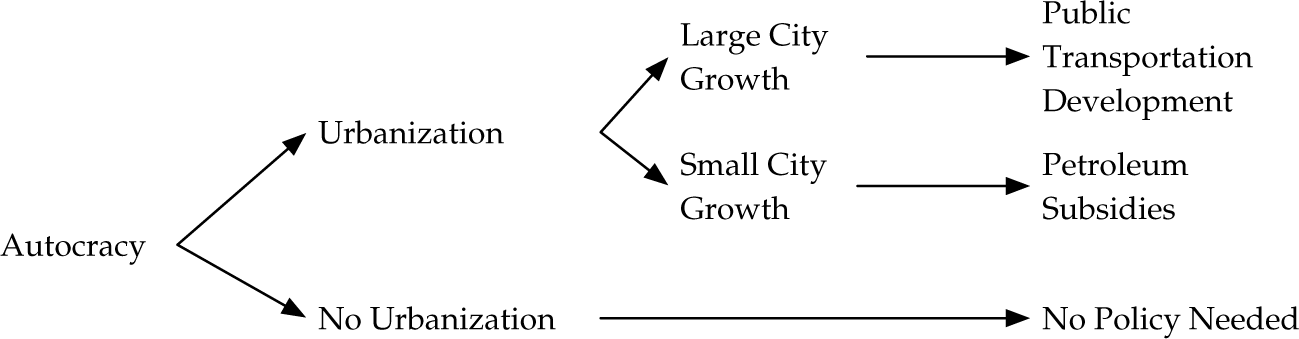
Urbanization and Petroleum Subsidies: Expected Effects
We broadly classify urban areas into two types: large and small cities. If the population lives primarily in large cities, autocratic leaders can buy the support of the urban population by investing in public transportation and infrastructure. In the case of most people residing in small cities, it is cheaper to provide petroleum subsidies than to develop public transportation and infrastructure in many small cities. For this reason, we expect to see higher petroleum subsidies in autocracies with small cities.
This logic can be turned into empirically testable hypotheses as follows.
H2 (urban population and petroleum subsidies in autocracies): In autocratic countries, an increase in the number of people living in small cities increases petroleum subsidies.
H3 (urban population and petroleum subsidies in autocracies): In autocratic countries, an increase in the number of people living in large cities has no effect on petroleum subsidies.
Research Design
To test the hypotheses, we use IMF data on gasoline prices per liter in up to 142 countries for the years 2003–9 (Coady et al., 2010). We also have data for the year 2002, which we use only for the lagged dependent variable. While we would ideally use data for a longer period of time, annual data on gasoline prices are not consistently available for a large sample. This time period is, however, of particular importance for the analysis. Since oil prices were at a high level and varied a lot, fuel prices were a politically salient issue and there was variation in the baseline price of gasoline over time. Moreover, the recent nature of the data means that the results are of interest for current policy issues.
Countries are indexed by i and years by t. Gasoline prices, presented in US dollars with 2010 constant prices, are used to approximate subsidies using the ‘price gap’ approach (Coady et al., 2010): since oil and gasoline markets are largely global, gasoline prices across the world should, some variation in geographic conditions notwithstanding, be relatively uniform. Major differences across countries thus reflect variation in national policy – i.e. net subsidies.
We estimate equations of the following type:

where Price i,t is gasoline prices in US dollars and r denotes geographic regions: America, Africa, Asia, Europe and Oceania. According to H1, the expression β2 + β5Small City (%) i,t−1 + β6Large City (%) i,t−1 should obtain positive values for the observations in the dataset. H2 states that β3 should be negative. H3 predicts that β4 should be zero. Since the Wooldridge (2002, p. 314) test indicates serial correlation in spite of the inclusion of a lagged dependent variable, we estimate generalized least squares models with random effects and AR(1) correction.
Explanatory Variables
The primary measure for democracy is the binary indicator for political competition introduced by Cheibub et al. (2010). This measure designates each country in a given year as democratic or autocratic, depending on whether or not the executive is selected in fully competitive elections. As an alternative, we also estimate models that use the Polity IV score for democracy (Marshall and Jaggers, 2007).
Our urban population data are drawn from the World Development Indicators. 5 We consider multiple approaches to measuring large cities. First, we distinguish between the population living in the largest and all other cities. This measure is useful because in most developing countries the largest city – in most cases the capital – is particularly large. We compute the percentage of a country’s population that lives in the largest city versus in all other urban areas.
As an alternative, we distinguish between the percentage of the population living in agglomerations with at least one million people and in all other urban areas. This measure is useful because in many countries the largest city is relatively small, often with just a few hundred thousand people living in it. We expect the two measures to produce fairly similar results.
One potential concern with this specification is that high gasoline prices could induce people to move into large cities. If substantial, such migration could cause endogeneity bias because the share of the population living in large cities would grow as gasoline prices increase. However, this bias should not differ across democracies and autocracies. Thus, we can test for the size of the endogeneity bias by investigating the extent to which high gasoline prices are associated with large cities in democracies. Since we find no such association, this particular bias does not seem to be present. However, we must recognize that we cannot rule out other forms of endogeneity since we cannot use experimental or quasi-experimental methods, such as instrumental variable analysis. In evaluating the results, it is important to note this limitation and interpret the coefficients as descriptive, as opposed to causal.
Control Variables
Because we conduct a regression analysis, we can control for confounding factors by including them as right-hand side variables in the regression equation. In such an expanded model, the association between key explanatory variables and the dependent variable is estimated such that the association between the control variables and the dependent variable is also estimated. In other words, it is as though the effect of changing the value of an explanatory variable is estimated while holding the value of all control variables at a fixed level.
First, we include the lagged value (t−1) of the dependent variable (LDV) as an explanatory variable on the right-hand side in the estimations to account for dynamics. Since gasoline prices may exhibit path dependence due to policy inertia and existing infrastructure, this approach to estimation is warranted. The LDV captures, for instance, the effects of earlier investments in public infrastructure that reduce the need for gasoline subsidies. Moreover, the LDV allows us to control for unobservable characteristics of the countries. Since urban population levels change only slowly, the LDV is clearly preferable to country fixed effects. As a further advantage, the inclusion of the LDV offers a simple approach to dynamic estimation (De Boef and Keele, 2008).
Next, we include a binary indicator for OPEC membership. Since OPEC is the world’s leading oil producer cartel, its members could underprice gasoline. Additionally, given the existence of several critical non-OPEC oil producers, we also include an indicator for a country’s status as a ‘long-term oil producer’ from Ross (2012). Those countries are also expected to underprice gasoline. We do not include fuel income per capita in the main model because it is endogenous to domestic gasoline subsidies, as countries with high subsidies lack the resources to explore for and tap additional oil resources. However, we do include this variable as a control in a model in the supplementary appendix, with no significant change in the result.
To control for economic factors, we include GDP per capita (US dollars, constant 2000 prices), consumer price inflation (%), and economic growth (%). Poor countries in economic trouble may choose to increase gasoline prices to reduce the fiscal burden of subsidies.
We also control for land area in square kilometers. It is plausible that the share of the population in small cities and gasoline prices might be spuriously related due to the country’s size: in countries with massive land area, residents might be spread out in several small cities. Residents in small countries, in contrast, might be concentrated in a small number of large cities simply because there is little space for distinct cities in different geographic areas. At the same time, countries with expansive land area might be abundantly endowed with natural resources and may have lower gasoline prices as a result. To account for the impact of land size on gasoline prices, we include the logarithm of land area.
To account for institutional factors, we control for corruption, as reported in the International Country Risk Guide. This corruption measure is based on annual expert surveys of various countries around the world, with ‘corruption’ defined as ‘enabling people to assume positions of power through patronage rather than ability, and introducing inherent instability into the political process’. 6 We reverse the original measure so that higher values indicate more corruption. In our data, the values range from 1.5 to 5.5. We also include a number of veto players – actors within the political system who can prevent the executive from acting – from the Database of Political Institutions to evaluate the effect of credible commitment to reform on gasoline prices. This variable is labeled ‘checks and balances’ in the database. The variable values range from 1 to 17, with higher values interpreted as more veto players. These two variables – corruption and veto players – are ideal for controls because Victor (2009) has shown that alternatives to petroleum subsidies are often administratively and politically more complex. Corruption undermines the implementation capacity of policies such as direct cash transfers, and a lack of constraints on the executive reduces the credibility of policy reforms.
We also include a binary indicator for the presence of a national oil company. According to Cheon et al. (2014), whose data we use, such companies increase the government’s incentives to offer petroleum subsidies because said subsidies can be implemented directly through the company, instead of the government explicitly including the costs of the subsidy in the budget.
In a final model, we also include trade openness as a percentage of GDP and energy intensity. International trade could reduce petroleum subsidies by subjecting the country to competition, and high energy intensity could encourage the government to increase the net taxation of petroleum products and other energy products. Our energy intensity measure is from the World Development Indicators and indicates energy use in kilograms of oil equivalent per US$1,000 of GDP.
All models include year fixed effects to control for common shocks such as oil prices. Region fixed effects are also included to control for geographic factors. We do not include country fixed effects because of the short panel, although we recognize this may raise concerns about omitted variable bias. The inclusion of the LDV on the right-hand side should guard against such bias, as the previous gasoline price at time t-1 is held constant in the estimation of the gasoline price at time t.
Results
This section presents our main findings and discusses a series of robustness tests. 7
Main Findings
The empirical results presented in Table 1 are consistent with our expectations. First, H1, which anticipates higher petroleum subsidies in autocracies, holds if we find that gasoline prices are systematically higher in democracies: the expression β2 + β5Small City (%) i,t−1 + β6Large City (%) i,t−1 should be positive. The estimation result of model 3 – the base model – indicates that this expression is positive for countries with at least 27.5 per cent of the population living in urban areas, either in the largest or the non-largest cities. Since more than 90 per cent of democracies have levels of urbanization beyond this threshold, we can conclude that democracies exhibit systematically higher gasoline prices in most cases, as expected by H1. Second, the negative sign of β3, the coefficient for the share of the population living in small cities, is in line with H2, which suggests that small city population share is associated with petroleum subsidies in autocratic countries. Finally, the coefficient for the share of the population living in the largest city β4 is found to be very close to 0. This finding indicates that large city growth has no effect on petroleum subsidies in autocracies as expected by H3.
Estimation of Fossil Fuel Subsidies, 2003–9
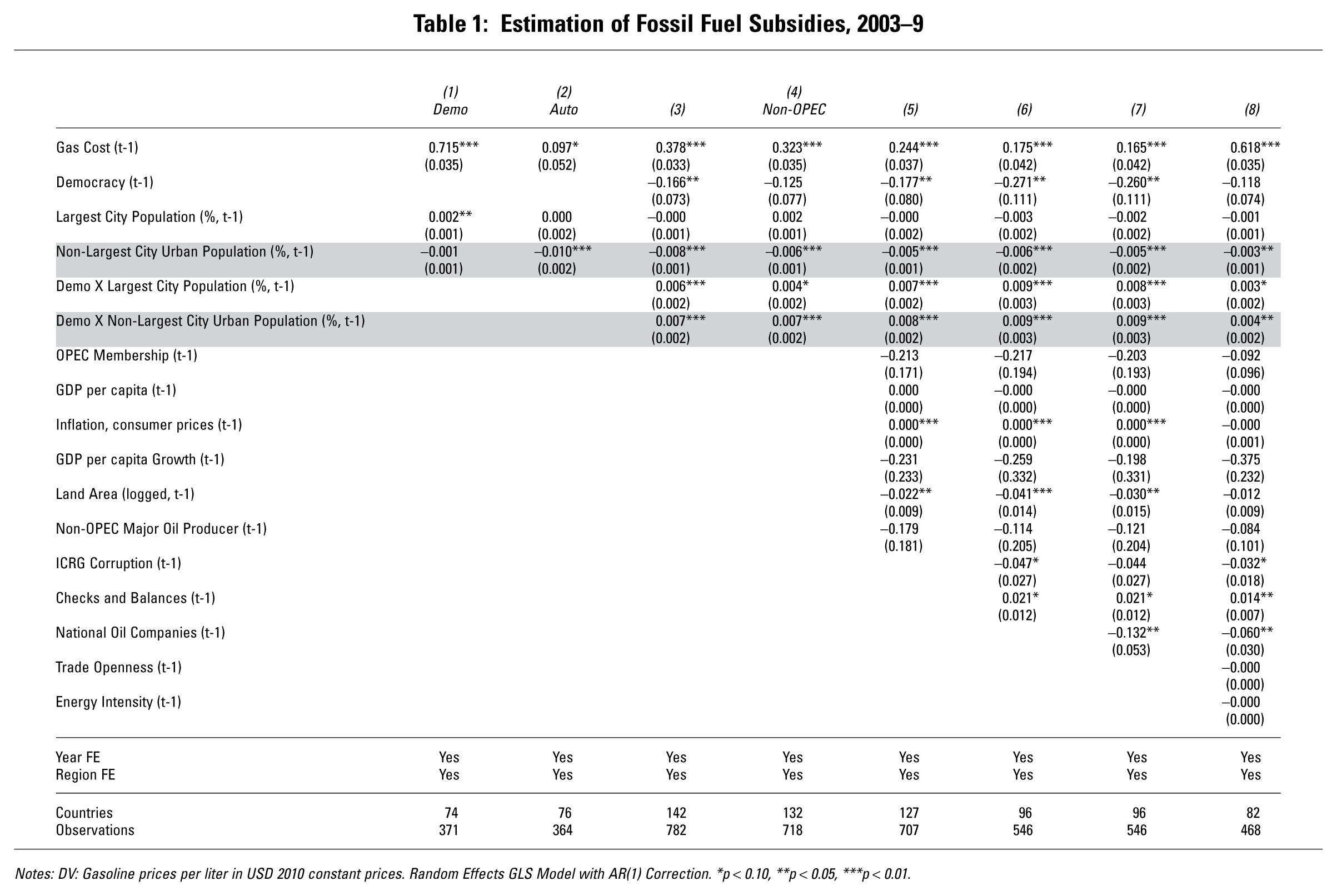
Notes: DV: Gasoline prices per liter in USD 2010 constant prices. Random Effects GLS Model with AR(1) Correction. *p < 0.10, **p < 0.05, ***p < 0.01.
These findings are consistent across all the estimated models presented in Table 1. We also estimate separate models for observations with only democracies (model 1) and with only autocracies (model 2). While the non-largest city urban population share appears to be substantial and statistically significant for the autocracy-only model 2, this finding is not observed using the sample with democracies only (model 1). The baseline estimation model 3 includes our main explanatory variables of interest and the lagged dependent variable as the only control variable. Model 4 excludes OPEC member states from analysis to ensure that our results are not driven by a small number of oil-producing states. We control for OPEC membership in models 5–8. We add a set of economic indicators in models 5–8, and a set of institutional factors such as the corruption level and checks and balances are included in models 6–8. Models 7 and 8 additionally control for the presence of national oil companies, and model 8 controls for energy intensity.
Figure 2 illustrates the computed long-run effect of growth in the population living in the non-largest city on gasoline price. The simulation is based on model 3 in Table 1. The upper (lower) panel describes a simulation where an autocratic (democratic) country’s share of urban population living outside the largest city is assumed to grow by 10 percentage points in year 10, and the dynamic effect of this change is computed based on the coefficient for the share of the population in urban areas excluding the population in the largest city, with the adjustment process defined by the LDV.
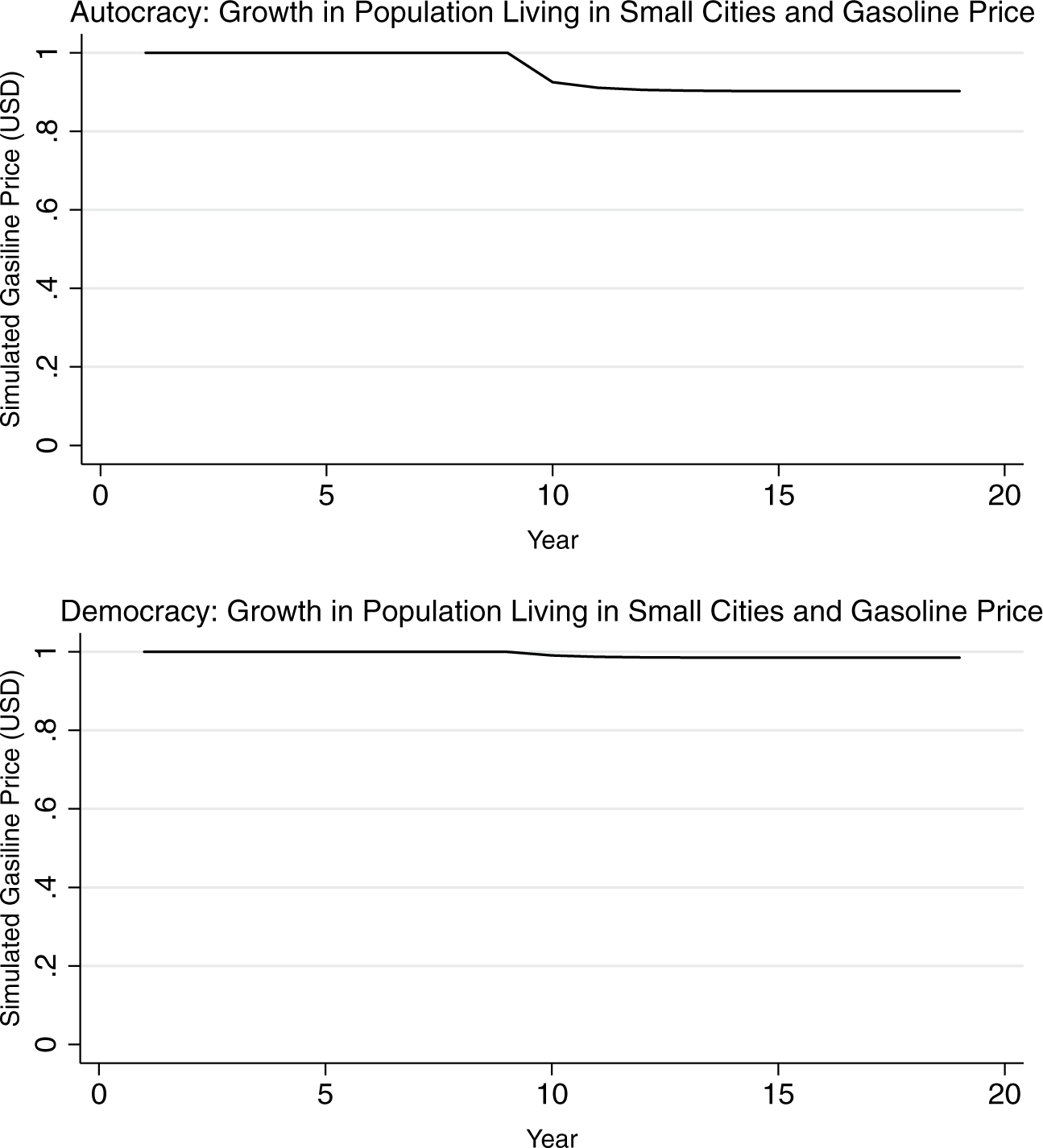
Simulated Long-Run Effects of Growth in Population Living in Small Cities on Gasoline Price
The simulation shows that, in the case of autocracies, the gasoline price is expected to drop by about 12 per cent within five years following the 10 percentage points growth in the share of the population in small cities. The substantive effects remain stable across all model specifications; the 10 percentage points growth in the share of the population in small cities is expected to decrease gasoline costs by 7.61–11.97 per cent depending on model specification. Of particular importance is the fact that the result is robust to controlling for the percentage of the population living in the largest city. This means that as people move from sparsely populated rural areas to densely populated cities, gasoline subsidies increase in autocracies – an observation that is consistent with the idea that higher population densities in urban areas encourage protests and force the government to offer petroleum subsidies to the urban population. In the case of democracies, by contrast, growth in the population share of small cities does not induce gasoline prices to decrease, as shown in the lower panel of Figure 2.
The results on control variables are also informative. Institutional factors turn out to be significant in influencing the level of fossil fuel subsidies, as we find a negative impact of corruption on gasoline prices. This suggests that corrupt governments might be more subject to lobbying by vested interests against fuel subsidy reform, leading to persistently higher fossil fuel subsidies in corrupt countries (Shenoy, 2010). We also find that executive constraints are positively associated with gasoline prices. This finding implies that executive constraints might help governments to implement fuel subsidy reforms and to maintain lower levels of fuel subsidies. Consistent with the expectation of Cheon et al. (2014), the presence of a national oil company seems to significantly reduce gasoline prices by allowing governments to implement petroleum subsidies easily.
Alternative Measurement of Large and Small Cities
We now estimate the same models using the measure of the population living in agglomerations and the population living in other urban areas, instead of using the distinction between the largest city and all other urban areas. Our measurement is based on the World Development Indicator’s agglomeration variable, which indicates the country’s population living in metropolitan areas with more than one million people. Since we expect autocratic leaders to offer petroleum subsidies in contexts in which small city size makes the provision of better public transportation and infrastructure more costly, our findings should remain intact when we use the share of the population living in agglomerations with at least one million people.
The results are reported in Table 2. Again, the estimation results provide empirical support for our small city bias hypothesis. First, we find systematically higher gasoline prices in democracies: the expression β2 + β5Small City (%) i,t−1 + β6Large City (%) i,t−1 is found to be positive for most democratic countries with at least modest levels of urbanization. Second, the negative sign on β3 indicates higher gasoline subsidies in autocratic countries with higher population share in non-agglomeration urban areas. Finally, the share of the population living in agglomerations is found to have little systematic association with gasoline prices. This suggests that autocratic leaders do not use gasoline subsidies in response to urban populations concentrated in agglomerations.
Estimation of Fossil Fuel Subsidies, 2003–9
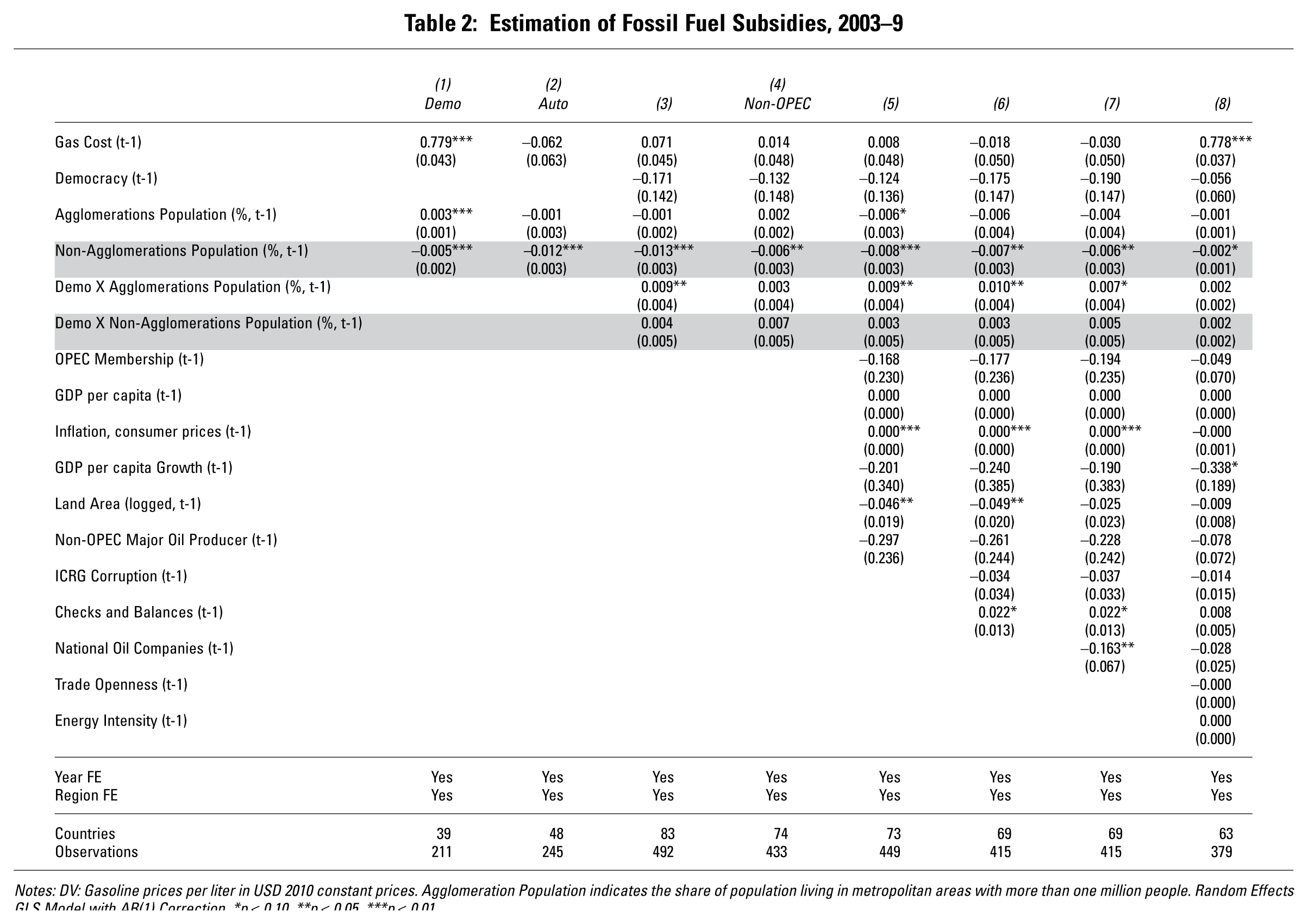
Notes: DV: Gasoline prices per liter in USD 2010 constant prices. Agglomeration Population indicates the share of population living in metropolitan areas with more than one million people. Random Effects GLS Model with AR(1) Correction. *p < 0.10, **p < 0.05, ***p < 0.01.
Further Robustness Tests
To verify that our main findings are not sensitive to model specification, we conduct two additional robustness tests, as presented in the supplementary appendix. First, we make sure that the main findings are not sensitive to our choice of democracy measures by alternatively estimating the models using the continuous Polity IV scores instead of the binary democracy measure. We still find that the impact of regime type is conditional on the share of the urban population living in the non-largest city. The share of the population living in the largest city continues to have no significant impact on the level of gasoline prices across all estimations.
Next, we estimate the same model excluding a subset of observations. In doing so, we choose to estimate model 5 instead of model 6 with all control variables in order to minimize the loss of observations because the energy intensity measure is not available for some countries. We exclude observations from different geographic regions one-by-one: Africa, America, Asia and Europe to ensure that our results are not driven by observations from a particular region. We also exclude the observations from the year 2008 to make sure that our results are not solely influenced by observations when gasoline prices reached their peak. We also check the influence of potential outliers by excluding observations with exceptionally high or low gasoline prices by estimating the models excluding observations with gasoline prices in the highest 10 per cent, and in the lowest 10 per cent in the dataset. Our findings remain robust across all estimations.
Quantitative Evidence from China
We examine the sub-national variation in gasoline prices in China. Our theory implies that autocratic leaders biased in favor of urban residents would be willing to provide higher gasoline subsidies for urban residents in small cities, but not for residents of large cities or of rural areas. This local differentiation strategy might not be feasible for leaders in small countries because citizens can purchase gasoline from other regions where cheaper or more subsidized gasoline is available. Yet, if this local differentiation strategy were feasible due to large country size, leaders would adjust the gasoline subsidies provided to different regions. One country in which this strategy might be feasible is China, a large authoritarian nation. Using sub-national gasoline price data, we examine whether we see lower gasoline prices in small cities than in large cities or rural areas as expected by our theory.
In China, the National Development and Reform Commission (NDRC), a macroeconomic planning agency, is in charge of overseeing the gasoline and diesel fuel sectors.
8
Tan and Wolak (2009) summarize the process of how gasoline prices are set in China:
The NDRC sets the base gasoline and diesel retail prices in all provinces and a certain number of cities as well as the prices of gasoline and diesel for other uses such as that by the military. Retailers then can set the price they would like to sell at within [a] range that is 8 percent higher or lower than the base retail price set by the NDRC.
This procedure implies that substantial regional variation in gasoline prices is induced by the government agency’s decisions. This allows us to examine how the government adjusts gasoline prices across different regions.
For the test, we collected data on the average gasoline prices in 44 Chinese cities and fitted a locally smoothed regression (lowess) against the population size of the cities. As to the limitations of our test, we unfortunately do not have reliable data for the smallest cities. However, we can exploit considerable variation in city size among major urban areas. Our gasoline price dataset is based on the daily retail gasoline prices of the state-owned company PetroChina from 29 September to 28 October 20139 and we averaged the prices during the period. While daily gasoline prices are available for different companies in various cities, we choose to focus only on PetroChina’s prices to control for subtle variation in gasoline prices from different companies. Overall, there is little difference between the average prices from all companies and the average price charged by PetroChina. Our prefecture-level population and public transportation availability dataset is from the 2011 China City Statistical Yearbook (Zhogguo chenshi tongji nianjian).
The fitted locally smoothed regression curve is presented in the upper panel of Figure 3. The figure shows that the gasoline price in China does not vary greatly for cities with fewer than seven million people but increases rapidly as city size grows beyond this point, peaking in the two largest cities in China, Beijing and Shanghai. This result is in line with our theoretical prediction. Autocratic leaders are willing to provide gasoline subsidies for urban residents in smaller cities because those residents are able to mobilize against the autocratic leaders. For urban residents in large cities, leaders can alternatively invest in public transportation systems, which is economically efficient in metropolitan areas. The Chinese data support this prediction. While there is nothing special about the threshold of seven million, in the Chinese data this seems to be one important threshold, although we recognize that the result is driven by Beijing and Shanghai. It is certainly possible that cities with fewer than one million inhabitants have even lower gasoline prices.
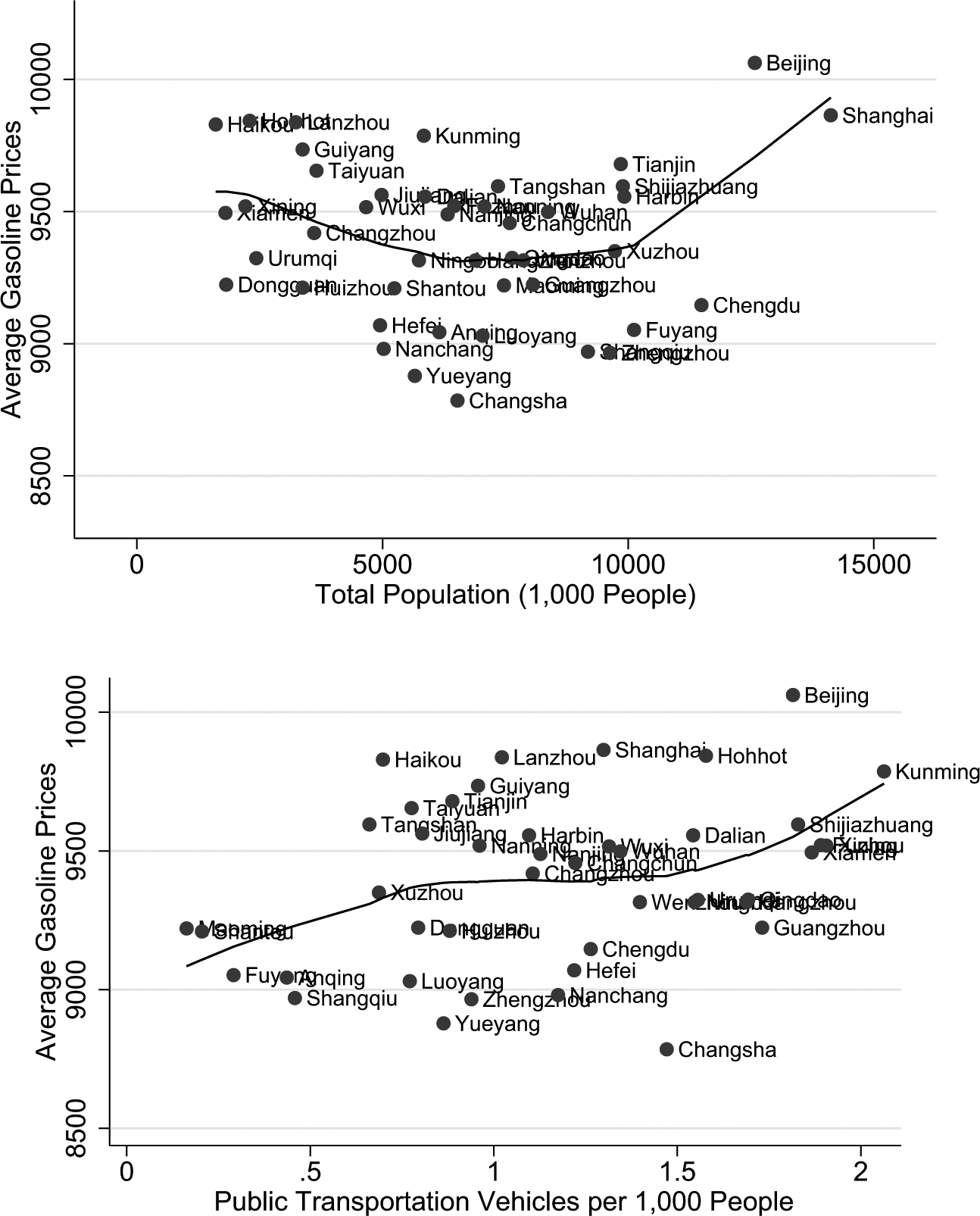
Locally Smoothed Regression of Average Gasoline Prices against the Size of Population (Upper) and against the Per Capita Number of Public Transportation Vehicles (Lower)
The lower panel of Figure 3 shows the same figure, except with the x-axis being the number of public transportation vehicles per 1,000 people. The figure shows that public transportation is a better fit than population, suggesting that the availability and cost-effectiveness of public transportation is a key explanation for why the government need not subsidize gasoline prices in many Chinese cities. If anything, this figure may under-estimate the relevance of large cities as it does not account for subway systems.
In the online appendix, we also report results from a simple regression in a sample of 44 cities on the relationship between public transportation and gasoline prices. Consistent with our assumptions, we find that increased use of public transportation is strongly correlated with gasoline prices. While we do not have data to repeat this exercise across countries, the evidence from China is consistent with the idea that large cities do not need low petroleum subsidies as public transportation is available.
Qualitative Evidence from Singapore
To illustrate our theory, we conduct a plausibility probe using the case of Singapore’s fuel and transportation policies. As a highly urbanized city state where most residents live in one major city, Singapore lends itself to scrutiny as the most likely case. In other words, it is an excellent illustration of the effect of city size on policies that mitigate the need for fuel subsidies. One of the main predictions drawn from our theory is that autocratic leaders provide smaller fuel subsidies when the population is concentrated in the largest city, and instead choose to develop public transportation to appease the needs of the urban constituents. We show that this is exactly how Singapore’s leaders have responded to the high level of urbanization. Despite increasing gas prices, the Singapore government has not adopted a subsidy policy, but has instead maintained petroleum taxes.
Singapore is a completely urbanized city state with almost four million people living in one major city. By our measure of urbanization from the World Development Indicators, Singapore is at the extreme end of urbanization and largest-city concentration: 100 per cent of its population lives in urban areas and 95 per cent live in the largest city, as of 2009. Given the challenge that this poses for autocratic survival, how have Singapore’s leaders coped with the extreme level of urbanization and placated the urban constituents?
Since the 1970s, the Singaporean government has invested in developing an efficient transportation system. A major goal of the government has been to improve public transport and dissuade the use of private vehicles. In 1975, the government introduced a road pricing scheme that required buying and displaying a license to enter a Restricted Zone (RZ) in order to dissuade the entry of private vehicles and taxis into the congested parts of the city (Phang and Toh, 2004). That policy was accompanied by the government’s broad investment in the public transportation system. The Mass Rapid Transit (MRT) system was introduced in 1987 and has been expanded since then, with existing lines extended and new lines introduced. 10 Government policy, furthermore, dictates that the government is responsible for capital investment in infrastructure, rolling stock and equipment, while operating companies are in charge of the operating costs and depreciation. The government also contributes to reducing the operating costs of public transport – for instance, it has granted a partial exemption of road tax payments and electronic road pricing charges on buses (Lam and Toan, 2006).
While the government is proactively engaged in promoting public transportation, it has resisted the adoption of fuel subsidy policies for private transportation. When rising oil prices and inflation prompted calls for reducing petrol taxes, the Singaporean government held its ground and maintained the petrol duty of US$0.44 per liter. In the face of rising gas prices, in 2008, National Development Minister Mah Bow Tan reportedly urged people to ‘reduce the number of trips, car pool, or take public transport’. 11 Director of Finance, Chin Sau Ho, also announced the plan to maintain the petrol duty in order to discouraging excessive use of vehicles. 12 Due to this explicit policy of avoiding fuel subsidies, Singapore’s gas price was marked at US$1.2 per liter, which is US$0.2 higher than the average gas price of non-OECD countries in 2009.
Conclusion
Petroleum subsidies are a major contributor to global warming and fiscal insolvency in developing countries, yet they are nevertheless a commonly used policy tool, particularly in autocracies. Motivated by this finding and by the wide variation in petroleum subsidies in different autocracies, this article has sought to understand the conditions under which autocratic rulers use petroleum subsidies to maintain power. Specifically, we have tested the hypothesis that population growth in small cities encourages autocratic regimes to increase petroleum subsidies. In general, petroleum subsidies are an expedient policy instrument for dealing with a major threat to the autocrat’s political survival: urban dissent. However, the strategy is relatively less effective in large cities, where public transportation is efficient and the expansion of automobile use causes serious pollution problems.
The empirical evidence supports the hypothesis. Using a global dataset of gasoline prices for the years 2003–9, we find that the growth of small cities in autocracies suppresses gasoline prices, whereas the growth of the largest city or agglomerations with over one million people has no such effect. To quantify the effect, a 10 percentage-point increase in urbanization outside the largest city causes a decrease of US$0.08–US$0.12 in per liter gasoline prices within five years. Given average annual per capita petroleum consumption of 758 liters in our sample of non-OECD countries in 2008, this effect constitutes a per capita difference of US$61.6–US$90.9, 13 assuming the hypothetical case in which the share of population living in urban areas outside of the largest city grows by 10 percentage points in a year followed by no growth. Of course, urbanization occurs rather slowly but continuously. The annual change in urbanization outside of the largest city ranges from −3.4 to +5.9 per cent and the ten-year change ranges from −10.7 to +25.8 per cent in our sample of non-OECD countries. Nevertheless, the findings explicate the significance of city sizes in seeking to understand the political incentives to implement fuel subsidies.
The contingent effect of autocratic political institutions on petroleum subsidies adds an important new insight to the literature on the political economy of subsidies. While Victor’s (2009) ‘populist paradox’ goes a long way towards explaining why autocracies dole out generous subsidies for petroleum consumption, it cannot make sense of variation across autocracies with similar political institutions. Here, the political costs of petroleum subsidies become relevant: such subsidies are attractive for relatively wealthy dwellers of small cities because they reduce the cost of private transportation, but they impose major costs in large cities with high population densities. Hence, the rural-urban difference is not enough to understand petroleum subsidies in autocracies; instead, the exact nature of urbanization requires careful attention.
The findings also carry practical importance, in two respects. First, petroleum subsidies are arguably among the most important threats to the global environment and to the economic development of poor countries (Coady et al., 2010). Understanding the political origins of these subsidies may help policy makers and international organizations to devise better strategies for dismantling them. Our findings suggest that autocratic countries with growing small cities are facing particular pressure to increase their petroleum subsidies. Second, urbanization is one of the great trends of the twenty-first century (Montgomery, 2008), affecting lives and livelihoods in the developing world in important ways. Unfortunately, one consequence of urbanization, especially its prevalent mode of small city growth, may be the growth of petroleum subsidies.
Footnotes
Appendix S1:
Data description.
Appendix S2:
Robustness.
Appendix S3:
Quantitative analysis of gasoline prices in Chinese cities.
Acknowledgements
We thank Andrew Cheon and Maureen Lackner for their help with data collection and manipulation. We also thank Dennis Chao-yo Cheng and Andrea Jones-Rooy for helpful comments on the draft.
Supporting Information
Additional Supporting Information can be found in the online version of this article at the publisher’s website: