






Abstract
Taking as its starting provocation Philip Cowley's ‘Arise, Novice Leader!’, this article contributes to the discussion of the nature of today's party leaderships. ‘Experience’, even for political office, should be viewed as ‘real-world’ work as much as time served in parliament. By quantifying non-political pre-parliamentary experience of post-war leaderships, I show both that current leaders are relatively ‘careerless’ and that this is not historically unusual. While Cowley's observation is that their parliamentary experience is also limited, by reintroducing ‘political experience’ into the numbers, I demonstrate that Cameron, Clegg and Miliband are among the most experienced leaders since 1945 in terms of total pre-parliamentary work but further removed from the ‘real world’ of those they represent. My argument is that in the contemporary context, such grounding at the top of politics partially explains the election of these professional leaders.
Keywords
When Ed Miliband emerged as Labour leader in 2010 he did so as a figure whose sole professional experience apart from ‘political experience’ was a year working as a researcher for the political journalist Andrew Rawnsley and gap year teaching at Harvard University. When he faces David Cameron in the Commons, he takes on someone who, apart from party political appointments spent just six years at Carlton Communications during which time he was actively seeking selection as a parliamentary candidate. And sitting next to the Prime Minister is his deputy and Liberal Democrat Leader Nick Clegg who, apart from European and British politics, spent just a year as a journalist and two separate years working with lobbying firms (the latter while nursing his Westminster seat and lecturing).
Philip Cowley (2012) makes a convincing case that when elected, and in terms of time served at Westminster, our current party leaders were the most inexperienced in the post-war era. Nonetheless, his analysis demonstrates the considerable ‘political experience’ gained by these modern leaders prior to entering parliament. Special adviser work, in particular, would seem to have become the prerequisite to a political career. As such Miliband worked with Labour's front-bench economics team in opposition shortly after graduation, going on to work for Chancellor Gordon Brown in the Treasury. Cameron worked at Conservative Central Office and was special adviser to Home Secretary Michael Howard and Chancellor Norman Lamont. Nick Clegg worked at the European Commission, eventually in the private office of UK Commissioner Sir Leon Brittan. Cowley argues that ‘political experience’ counted by leadership candidates today includes this time spent before entering the Commons.
Taking Cowley's argument as its starting provocation, this article contributes to the analysis by exploring non-political and political experience. It suggests that the definition of ‘experience’ must be quantified by more than either time served in parliament before becoming leader or even the ‘political experience’ gained before entering the Commons. By considering work experience gained in professional life it is possible to advance the analysis, demonstrating that all three political parties after 2010 have leaders with historically low levels of ‘real-life’ work experience. In this sense then, they are ‘careerless’.
This article uses three distinct definitions of ‘experience’. First, there is elected ‘parliamentary experience’, used by Cowley; second, pre-parliamentary ‘political experience’ such as being a special adviser and used by Peter Allen (2012) and Cowley, respectively; third, pre-parliamentary ‘work’ or ‘professional experience’ including ‘real-world’ careers such as the law (Cairney, 2007).
However, this article also discusses the historic data comparing this with the total pre-parliament experience of all leaders since 1945 to argue that our current cohort is actually among the most experienced in the post-war period. But given that the vast majority of this is ‘political experience’, unlike that recognisable to most working people, it can be said that Cameron, Clegg and Miliband represent professional politicians and leaders whose exposure to ‘real-world’ work is limited. This points increasingly to career politicians who are ‘careerless’ in their exposure to anything other than politics itself. While such backgrounds are subject to considerable academic criticism (Criddle, 2010), this article suggests that, given the requirements of modern party leadership, such ‘political experience’ could well be viewed by party selectors as effective preparation.
Non-political experience
Cowley demonstrates that, compared to the leaders they replaced, today's three incumbents spent very few years as MPs before winning their respective party's top job (Miliband and Cameron with just one term behind them, Clegg after just two years in Westminster, though he was previously an MEP). While this is a powerful observation, a similar case can be made about the extent of their non-political work experience prior to parliament itself. Cameron replaced Michael Howard, a barrister who practised for 21 years before his election to parliament in 1983. Gordon Brown was a university rector, lecturer and television journalist for 11 years before being elected (also in 1983) while Sir Menzies Campbell, Clegg's predecessor and retired athlete, was an advocate for at least 19 years before the 1987 general election.
Table 1 offers more comprehensive data for post-war leaders' work experience outside politics, showing numbers for individual leaders as well as the average time spent in working life before election to parliament, broken down by party. Naturally age has an impact on the numbers, as will be discussed later. Deliberately excluded is ‘political experience’ such as being a special adviser or party researcher, which is central to Cowley's explanation of how these candidates are able to win the leaderships so soon after becoming an MP. Figures are necessarily approximated and readers might reasonably dispute the loose definitions of work experience. Numbers were estimated from publicly available biographies and rounded up to full years. There is some judgement exercised in terms of training/work especially in relation to legal professions. Caution was exercised here. Elsewhere credit has been given to activities that might have limited value such as temporary engagement immediately after graduation.
Number of years' work experience prior to Westminster election, excluding ‘political experience’
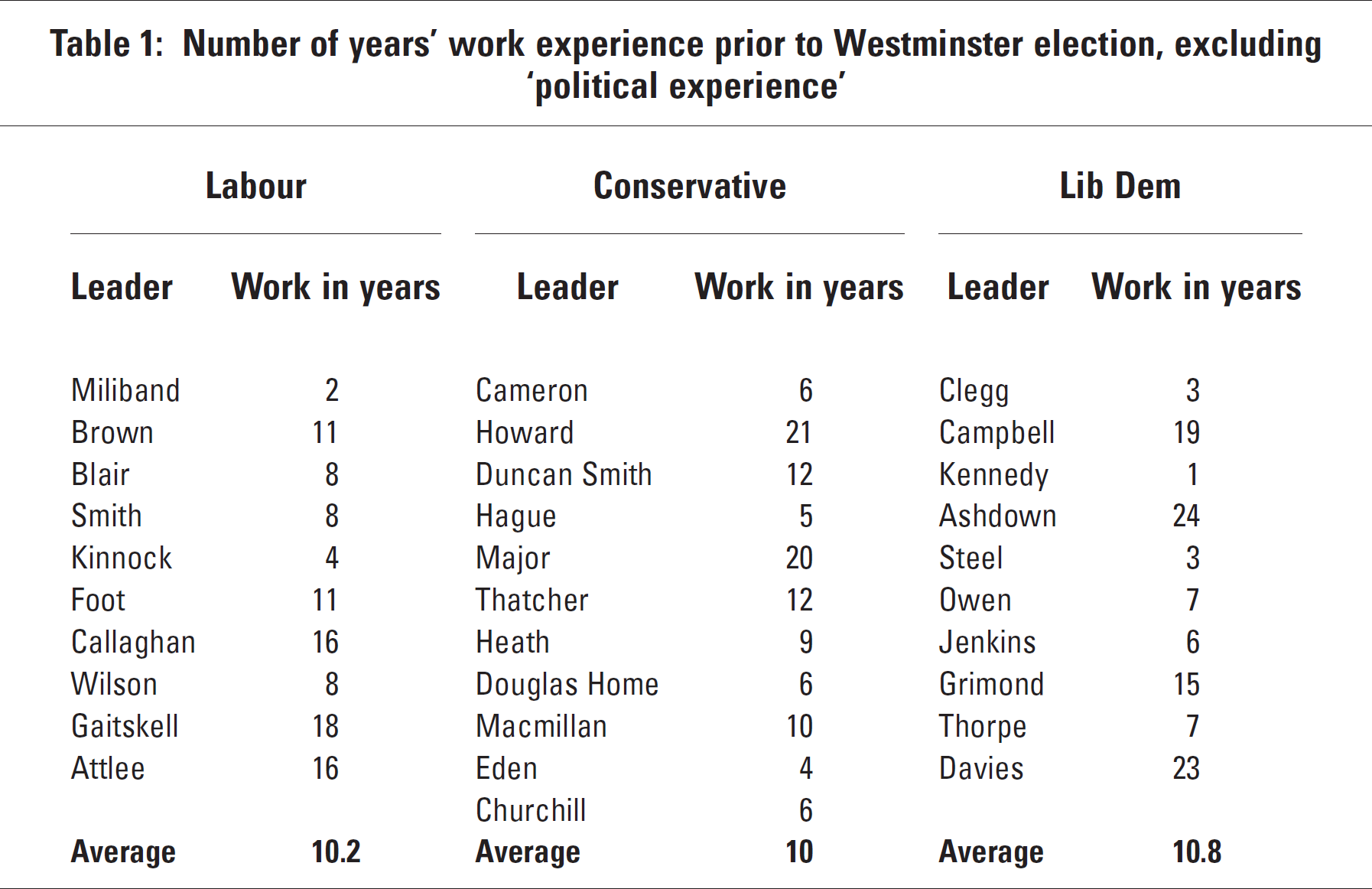
On this basis, the current cohort can be seen to be considerably below the average of about 10 years' employment prior to Westminster and fairly consistent across the three parties. While Miliband is Labour's least experienced leader by this measure, he is not far behind Neil Kinnock, who cannot claim comparable political experience. Cameron notches up more years than Hague and Eden while equalling Churchill and Douglas Home. Indeed, while Churchill's six years were packed with military adventure, Home led the life of an aristocrat spending much time playing cricket. Also noteworthy is that while Eden boasts a short but decorated military service during the Great War, before Oxford and election at the age of 26 he had a long ministerial career behind him (beginning in 1931) before becoming Prime Minister in 1955.
Clegg's three years equal David Steel's and exceed those of Charles Kennedy, who was elected to parliament at the age of 23. The Liberal Democrats and predecessor parties score an average comparable to the other parties but can count both the longest and shortest work experiences in the list. In contrast to Cowley's data for parliamentary experience, which show the third party on average picking leaders after shorter periods in Westminster, in this examination Liberal (Democrat) politicians took longer to get elected with most making multiple attempts before securing a seat.
While others have analysed the benefits of various types of pre-parliamentary employment (Cairney, 2007), it is difficult to judge the quality of this work experience which includes periods of unemployment for John Major, Paddy Ashdown and Iain Duncan Smith. It was considered that familiarity with the dole is not altogether useless for an elected politician and these periods were included in the figures. Nevertheless, among these leaders there are some distinguished careers before politics including several in law, headed by Clement Davis's 23 years, and Howard's and Campbell's 19, respectively. The longest is Ashdown's military and diplomatic career at 24 years with Major's 20 years in banking not far behind (neither took degrees). The academic, wartime civil servant and economist Hugh Gaitskell's 18 years top Labour's list but, in joint second place, James Callaghan's 16 years are remarkable (he did not take a degree). This is because Cowley reveals that he is also ‘the most veteran’ (Cowley, 2012, p. 32) with 31 years' parliamentary experience before becoming leader (although Churchill's earlier 38 years in parliament top this). To that might be added a substantial government record having held the great offices of Chancellor, Foreign Secretary and Home Secretary.
Figure 1 offers a snapshot of pre-parliamentary experience for the 31 leaders of the three parties since 1945. Life before politics can, of course, include multiple practices such as being a chemist and law for Thatcher, academia, military service and Toynbee Hall for Attlee or the civil service and trade unionism for Callaghan. Attlee and Major also served in local government before Westminster, something that both distinguishes them and illustrates a separation between central and local elites.
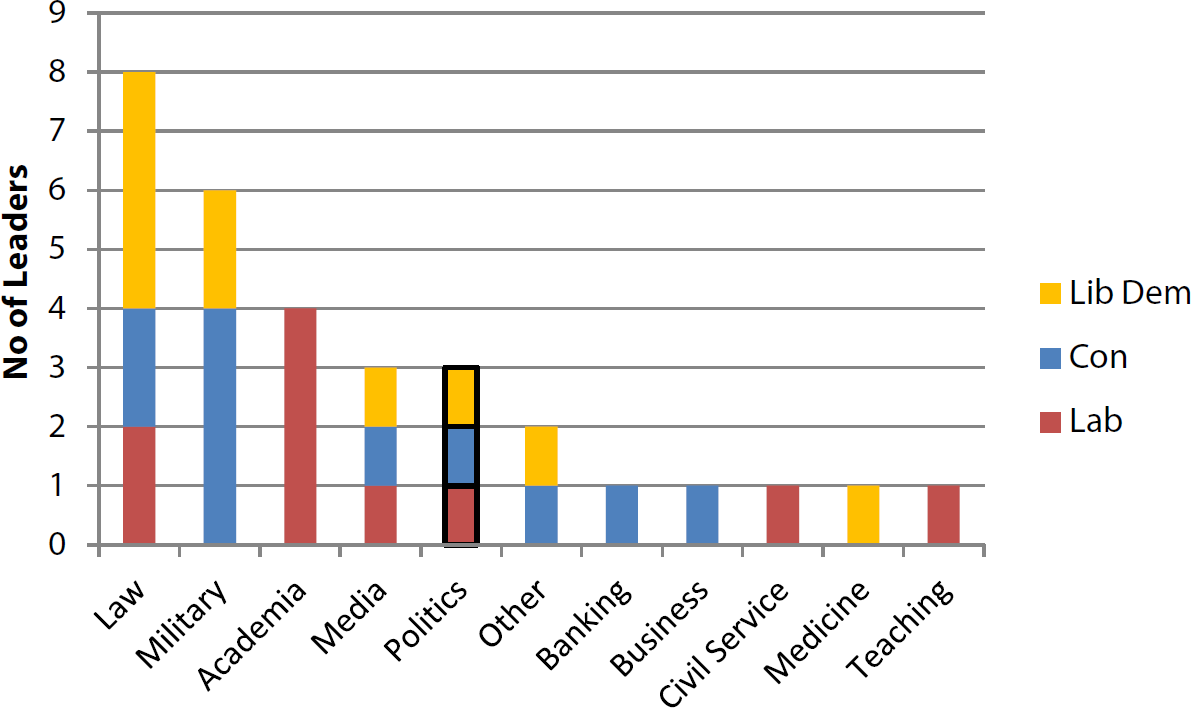
Primary pre-parliamentary professional or political experience
Nonetheless, the figure takes the single ‘primary’ experience from each of these leaders, a judgement that is naturally open to dispute as it unavoidably means that the aggregate weight of experiences is not necessarily displayed and when broken down by party exaggerates the bias. Methodologically it presents a dilemma comparable to those faced by previous studies with discussion to be found on the merits of measuring primary or other occupations (Allen, 2012; Cairney, 2007; Rush, 1994). Again a degree of judgement has been exercised in determining a ‘primary experience’ to place against each of the leaders. The experience selected in some cases is debatable and further quantitative and qualitative research might address this.
It can be seen that more than a quarter of the list bring primarily legal experience into their political career, with almost a fifth drawing on military experience. Here there is evidence of misleading bias since no Labour leader is shown to have a military background in comparison to three Conservatives and two Liberal (Democrats). However, this can partially be explained by the lack of substantive experience other than service during the respective world wars for Eden, Heath and Jenkins, whereas Attlee and Callaghan both saw action in their day but subsequently enjoyed substantial non-military careers. This notwithstanding, in more recent years both Ashdown and Duncan Smith brought military experience to their roles. Also notable is the significance of academic backgrounds for Labour leaders (though not recently, the last being Wilson).
This section does not attempt to critique the relative usefulness of these respective careers for party leaders but it does aim to illustrate the breadth of total pre-parliamentary experience from which leaders have been drawn since 1945. Distinct in Table 1, and highlighted against ‘political experience’, are Miliband, Cameron and Clegg. And it is with such data that the comparison can be made more acutely, showing that the three incumbent leaders of the 2010 parliament are relatively ‘careerless’ in terms of exposure to working life outside politics.
Above-average total pre-parliamentary experience
Contrary, perhaps, to expectation, there is little identifiable trend towards professional inexperience in any of the parties despite a complete current cohort who exhibit ‘careerlessness’. There have long been examples of leaders who entered parliament at a young age, thereby precluding substantial pre-political careers. One has only to look to the likes of Eden, Kinnock and Kennedy for evidence. These are politicians, it should be noted, who all served many years in parliament before taking their parties' leaderships.
Furthermore, this article has so far deliberately excluded the ‘political experience’ which Cowley argues (convincingly) has allowed candidates to become leaders of their parties shortly after election to parliament. However, if this time is reintroduced Miliband is able to add a further 11 years' total pre-parliamentary experience, which at 13 is above the post-war average (which now rises to over 11 years). Similarly, Cameron can add six years taking his total to 12, again above average. And Clegg's five years in the European Commission take his total to a slightly below-average eight (now greater than 11) but his term as an MEP should also be noted as it was largely excluded from Cowley's assessment.
From these observations it can be claimed that we are not seeing less experienced leaders in the quantified sense but rather that those who have been elected to lead their parties have predominantly political experience. That is to say, it is not so much the amount of experience but rather its nature that is noteworthy. The consequence of this professionalisation (Riddell, 1993) is that politicians have increasingly less exposure to the ‘real-world’ work of those they represent. Anthony King identified the rise of the career politician more than 30 years ago (King, 1981). What appears to have happened since is Cowley's hypothesis that our leaders are now gaining their ‘political experience’ before their election in the higher echelons of the executive, beginning soon after graduation, and skipping for the most part the longer apprenticeship in parliament and constituency case work. Allen (2012) demonstrates that MPs with ‘pre-parliamentary political experience’ are likely to be promoted and reach higher office more quickly, especially when compared to those with local government experience who are more likely to remain on the back benches. Here the respective roles of parliamentary backbenchers and frontbenchers are worth highlighting. The former can be seen to be primarily occupied with representing constituents, scrutinising legislation and facilitating the legislative process. Frontbenchers on the other hand form the executive or the shadow government, hold policy portfolios and are more engaged in political leadership. In this sense, Britain increasingly has leaders drawn from a political class or elite (Criddle, 2010; Jun, 2003; Oborne, 2008).
Cowley argues that party leaders are gaining political experience prior to Westminster and, if this is the case, it is not only at the expense of parliamentary service but also exposure to non-political careers. It can be seen that the current crop's predecessors had one or other (or both) of these under their belt before winning the top job. As an aside, there are examples of potential leaders who, having followed this new route, see the benefits of real-world careers after politics. Former Cabinet Minister James Purnell is one such figure: a Downing Street special adviser before his election, he left parliament in 2010 at the age of just 40 to pursue a career in community organising (arguably a political proxy) and the media.
Professional leaders
To understand why British politics appears to have shifted towards all three parties electing leaders with little parliamentary experience, it is necessary to compare the three incumbents with their immediate predecessors. In terms of pre-parliamentary activity, the experiences of Cameron, Miliband and Clegg can be said to be both political and at a high executive level. Thus, not only did they gain their political experience prior to Westminster but it can also be seen as almost a professional grounding for top-flight politics. It is worth reflecting upon this experience before setting it in the context of their respective elections to the leadership.
After the 1997 Labour victory, Ed Miliband worked in the Treasury as a Special Adviser to Gordon Brown, then a powerful Chancellor of the Exchequer. Sitting at the heart of Britain's economic policymaking and planning, he eventually became chair of the influential Council of Economic Advisers (Pickard, 2010).
Seconded from the Conservative Research Department to Number 10, Cameron briefed Prime Minister John Major ahead of his twice weekly bouts of Prime Minister's Questions. He subsequently became Special Adviser to Chancellor Norman Lamont during the 1992 Exchange Rate Mechanism (ERM) crisis and then to Home Secretary Michael Howard, notably during the row with Prisons Director General Derek Lewis (Elliott and Hanning, 2009).
Clegg spent five years working in Brussels at the European Commission, managing aid projects in Central Asia and acting as a global trade negotiator while a senior member of Commission Vice-President Sir Leon Brittan's private office.
Much has been made of the parliamentary inexperience (Cowley, 2012) and now the ‘careerlessness’ of Cameron, Miliband and Clegg in comparison to their immediate predecessors, who each enjoyed both multiple terms at Westminster before leading their parties and non-political careers before their election to parliament. But it can also be argued that the current cohort each replaced leaders who were relative failures –brought in at a precarious time for their parties. Indeed in two instances (Howard and Brown) their elevation to the leadership went uncontested.
Consider that Cameron, holding a shadow Cabinet portfolio for just five months before becoming leader (he had joined the shadow Cabinet in a policy role less than a year before), replaced ‘caretaker’ Michael Howard in the aftermath of the Conservatives' third consecutive general election defeat in 2005. Howard might have been a steadying influence at the top and the party increased its tally of parliamentary seats, but the 32.4 per cent of the vote won was only marginally higher than the disastrous 1997 result of 30.7 per cent, and left a mountain to climb for any future leader hoping for a majority. Howard, who had come last out of five candidates in the 1997 contest, assumed the leadership unopposed in 2003 as a response to the calamitous leadership of Iain Duncan Smith and a vote of no confidence by his MPs (Hayton and Heppell, 2010).
Miliband replaced Gordon Brown, who by 2010 was a much maligned Prime Minister. Accused of secretiveness and indecision, he had endured two years of speculation about plots and challenges to his position and is viewed as being ‘not well-equipped for the highest office’ (Theakston, 2011, p. 78). At the 2010 general election he led his party to its worst defeat since 1983. Brown had taken the leadership (and premiership) unopposed in 2007 following the departure of Tony Blair, who was by that time a controversial and divisive figure.
Clegg replaced Ming Campbell after accumulated pressure, ostensibly from the media, led him to resign the leadership in 2007. Campbell had delivered shaky performances in the Commons and had been lampooned over his age. He had become leader just 19 months earlier as the crisis over Charles Kennedy's alcoholism finally came to a head (McAnulla, 2009).
The appeal of Howard, Brown and Campbell to their respective parties was (at least in part) precisely their ‘experience’ – each representing a safe pair of hands during a difficult period. But for all this, their leaderships can hardly be judged great successes. Pressures on modern leaders, particularly in terms of media management, are intense and there is demonstrable correlation between the reputations of leader and party (Davies and Mian, 2010). It would seem that, having observed these performances, party members perceived parliamentary experience to be relatively less important when choosing their successors. It might even be argued that the grounding gained through pre-parliamentary political experience means that Cameron, Miliband and Clegg can be considered as professional leaders more prepared for their role than their predecessors.
Indeed the contexts of the three leaders' elections can be contextualised. Cowley shows that four of the five 2010 Labour candidates entered the Commons in 2001 or 2005 (but all had been in the Cabinet except straggler Dianne Abbot who was elected in 1987 having previously worked in the civil service, National Council for Civil Liberties, the media and the Greater London Council (GLC)), while Clegg faced Chris Huhne who had been elected to Westminster on the same day in 2005. Only Cameron encountered opponents with substantial parliamentary experience by way of Ken Clarke (1970), David Davis (1983) and Liam Fox (1992). In terms of their total pre-parliamentary experience, Labour candidates David Miliband's 12 years, Ed Balls's 15 years and Andy Burnham's seven years are not dissimilar to those of Ed Miliband, all being dominated by ‘political experience’. Each were special advisers prior to Westminster, though Balls spent four years at the Financial Times and Miliband five at the Institute for Public Policy Research (IPPR). While Clegg and Huhne had near identical parliamentary experience (both former MEPs), over 24 years, the older Huhne set up a successful City firm and became economics editor for The Guardian. As for the Conservatives, ministerial veteran Clarke was called to the Bar in 1963 and practised as a barrister for seven years. Davis had a 14-year business career while Fox spent nine years as a GP.
Cowley (2012, p. 37) identifies ‘a change in the nature of political life’ with the election of what he terms ‘novice’ leaders and it is surely likely that similarly ‘inexperienced’ candidates will emerge in the future. However, it is perhaps too early to identify a definite trend, even if all three parties have elected such figures. In comparing Cameron, Miliband and Clegg with Howard, Brown and Campbell it can be said that the similarities in the circumstances of their elections are also unusual and these must contribute to the outcome of the vote. Such circumstances are unlikely to be repeated in the next round of leadership ballots given that future electoral tests will inevitably mean mixed fortunes for the current crop and eventually new contexts for party members to choose successors and re-evaluate the qualities sought in a leader.
Conclusion
Measured in years, Cameron, Miliband and Clegg can be said to have total pre-parliamentary experience that compares favourably to the average of leaders since 1945. This article has argued that while it is possible to dispute the accusation that the three incumbents are inexperienced, they are notable in their ‘careerlessness’, that is, little contact with ‘real-world’ work. It can also be demonstrated that while their exposure to non-political careers is derisory, there is no identifiable trend towards professional inexperience even though the three incumbents won their respective parties' leaderships with the shortest parliamentary records of the post-war period. A comparison with their immediate predecessors shows them in poor light in terms of both non-political work experience and time served at Westminster. In explaining party members' willingness to elect these candidates, though, it can be argued that the leaderships of the ‘experienced’ Howard, Brown and Campbell were relative failures. By contrast, the high-level, executive grounding afforded to Cameron, Miliband and Clegg by way of their pre-parliamentary ‘political experiences’ makes them ‘professional leaders’. This context could be said to have contributed to party members' willingness to elect them to the top jobs and is partially supported by comparison with their respective rivals.
Cowley concludes with speculation about a future backlash against ‘inexperienced’ leaders. While this article has used different definitions of experience to demonstrate that in terms of total pre-parliamentary work, Cameron, Clegg and Miliband fare well in comparison to their predecessors, by excluding pre-parliamentary ‘political experience’ it shows this current crop to be among the most unfamiliar with work outside politics itself. While being highly prepared for operating within Whitehall, being ‘careerless’ in terms of ‘real-world’ work distances them from the lives of voters.
This article is necessarily limited to the prisms through which it views ‘experience’ but has sought to advance the analysis offered by Cowley. Further research would go beyond quantifying experience in terms of years in an effort to make qualitative judgements about the value of activities as preparation for future leadership. It might also compare trends in Britain to those elsewhere.
Footnotes
Acknowledgements
Thanks and acknowledgements to my anonymous reviewers whose constructive comments strengthened the article.