







Abstract
To understand negative numbers, must we refer to positive number representations (the phylogenetic hypothesis), or do we acquire a negative mental number line (the ontogenetic hypothesis)? In the experiment reported here, participants made lateralized button responses to indicate the larger of two digits from the range -9 to 9. Digit pairs were displayed spatially congruent or incongruent with either a phylogenetic or an ontogenetic mental number line. The pattern of decision latencies suggests that negative numbers become associated with left space, thus supporting the ontogenetic view.
Systematic performance in number tasks led cognitive psychologists to postulate a mental number line as the cognitive representation of the meaning of numbers (e.g., Dehaene, 2000; Restle, 1970). This representation is believed to be analog because the time needed to compare number magnitudes increases with the distance between the elements of a number pair (the split); this distance effect resembles a similar effect observed when magnitudes of physical stimuli are discriminated (e.g., Buckley & Gillman, 1974). Moreover, for a given split magnitude, comparison is faster when the two digits represent small magnitudes (e.g., 2–4) than when they represent larger magnitudes (e.g., 7–9). This size effect has been explained by postulating that entries on the mental number line are harder to discriminate when they refer to larger magnitudes, possibly because they are represented as more adjacent to each other on the mental number line than small magnitudes (see Brannon, Wusthoff, Gallistel, & Gibbon, 2001, and Dehaene, 2001a, for recent debate).
The mental number line also represents spatial positional codes, with small numbers on the left and larger numbers on the right. This inference is based on the fact that manual parity judgments are faster on the left side for small digits (e.g., 0 or 1) and faster on the right side for larger digits (e.g., 8 or 9; Dehaene, Bossini, & Giraux, 1993). This SNARC effect (for
The research reported here used the SNARC effect to test the assumption that the mental number line contains only positive entries. This hypothesis, based on the notion of an evolutionarily inherited “number sense,” was explicitly stated by Dehaene (1997, p. 87). Evidence from a wide variety of number-processing studies with rats, primates, and young infants indeed points to a basic ability to discriminate and enumerate objects that is shared by animals and humans alike (see Dehaene, 1997, or Gallistel & Gelman, 2000, for review). This phylogenetic hypothesis of the origin of our comprehension of numerosities implies that the cognitive representation referred to as the mental number line cannot easily represent negative numbers because it is not possible to experience negative numerosities. Hence, negative numbers may not become associated with space in the same way that positive numbers are.
Alternatively, negative numbers might become associated with the left side of space as a result of experience with them (the ontogenetic hypothesis). For example, the SNARC effect, which is the primary marker for the spatial representation of numbers, emerges only in the 3rd year of schooling (Berch, Foley, Hill, & Ryan, 1999), depends on one's habitual reading direction (Dehaene et al., 1993, Experiment 7), and can be reversed with task instructions (Bächtold, Baumüller, & Brugger, 1998). On the basis of this evidence for flexible associations between numbers and space, one would expect negative numbers to eventually become part of our mental number line. Our experience with coordinate systems, in which the horizontal axis of the graph extends to the left for negative numbers, makes us all familiar with the notion of a numerical continuum from −∞ to +∞. The hypothesis of a negatively extended number line receives support from Peled, Mukhopadhyay, and Resnick's (1988) report of two representational stages in children's development of number concepts: A first stage includes only positive numbers, and a second stage includes positive and negative numbers, organized symmetrically around zero along a mental number line. However, performance studies with negative numbers are surprisingly rare, and no published studies seem to have assessed the possibility of learned associations of negative numbers with space.
The phylogenetic and ontogenetic hypotheses make opposite predictions for the direction of the SNARC effect with negative numbers. According to a strong interpretation of the phylogenetic view (Dehaene, 1997, 2001a), negative numbers will exhibit a reversed SNARC effect: Larger negative numbers (e.g., −9) should be associated with right space because only their magnitude matters, not their sign. According to the ontogenetic view, however, negative numbers become associated with left space during mathematical training and the use of coordinate graphs. Therefore, in educated adults, responses to large negative numbers will be faster with the left than with the right hand, showing an extended SNARC effect and indicating an extension of the mental number line to the left of zero.
METHOD
Participants
Fourteen students (age range: 20–38 years; 9 females and 5 males) participated for pay after giving informed consent. All except one reported they were right-handed, and all were naive with regard to the hypotheses.
Apparatus
A Macintosh IIci with 15-in. monochrome monitor presented digits in 16-point Geneva font in black on a white background. Participants responded using the two external keys in the top row of the QWERTY keyboard with extended numerical keypad (38 cm apart from center to center). Viewing distance was approximately 40 cm, and digits were 5 mm × 5 mm in size.
Stimuli
The digits from −9 to 9, including zero, were paired such that the split between the digits in all pairs remained constant at 5 (see Table 1). This ruled out decision latencies being contaminated by the distance effect. In addition, the odd split ensured that each display contained an odd and an even number, thus preventing increased variability due to slower decisions for odd compared with even displays (Hines, 1990).
Mean reaction times (RTs) for each display (in milliseconds)
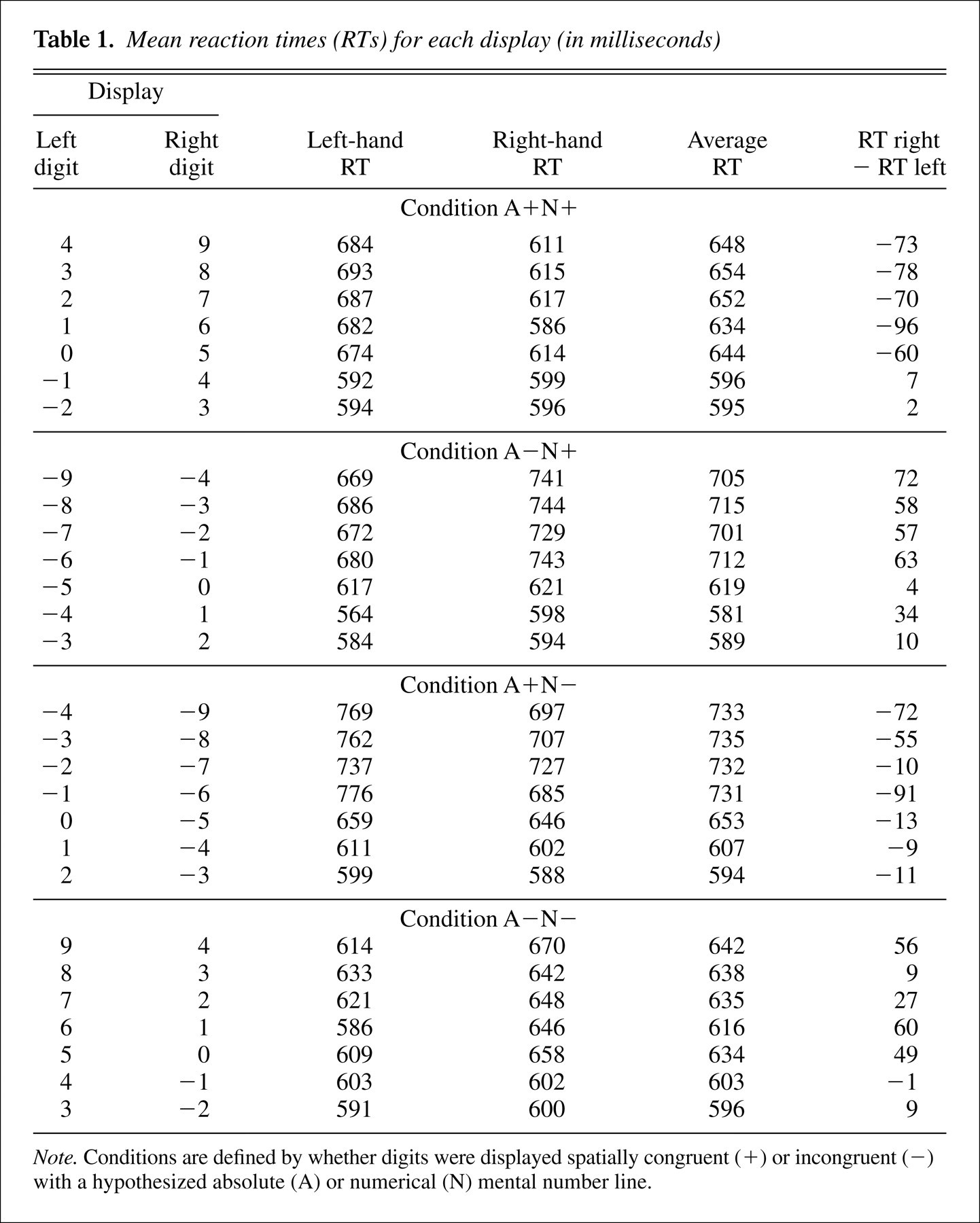
Note. Conditions are defined by whether digits were displayed spatially congruent (+) or incongruent (−) with a hypothesized absolute (A) or numerical (N) mental number line.
On each trial, the stimuli were displayed horizontally, one to the left and one to the right of fixation. The left-right ordering of the digits' absolute magnitudes was either congruent (A+) or incongruent (A−) with the left-right orientation of the mental number line, and the left-right ordering of the digits' numerical magnitudes was either congruent (N+) or incongruent (N−) with the left-right orientation of the mental number line. Thus, there were four experimental conditions. In condition A+N +, the value on the left of fixation was both the smaller absolute value and the numerically smaller value of the pair. In condition A−N +, the value on the left of fixation was the numerically smaller value but at the same time the larger absolute value of the pair. A further condition A +N− was generated by exchanging the sides for stimuli from condition A−N +, and a final condition A−N− was generated by exchanging the sides of stimuli from condition A+N + (see Table 1).
The stimuli included 10 pairs of positive digits, 8 pairs of negative digits, and 10 mixed pairs. The minus sign appeared equally often (13 times) with the left and with the right digit. All conditions paired the same Arabic numerals, which differed merely in their sign and side of presentation. Although the number of negative digits differed between conditions, it was identical for the critical conditions A−N + and A +N−, both of which contained 11 negative digits.
The phylogenetic hypothesis predicts faster comparison speed in the two A + conditions than in the two A− conditions because in A+ conditions the digits' magnitudes are ordered in spatial congruence with the postulated mental number line. The ontogenetic hypothesis predicts that numerical magnitude, as defined through the presence or absence of a minus sign, determines performance. Therefore, comparison speed should be faster in both of the N+ conditions than in the N− conditions because the digits are spatially arranged according to the left-extended mental number line. Both views on the cognitive status of the mental number line predict that condition A+ N + should be fast and condition A− N− slow. The critical conditions are A− N + and A+ N− because the two hypotheses predict opposite orderings of their average comparison latencies. According to the phylogenetic hypothesis, condition A+N− should be faster, whereas according to the ontogenetic hypothesis, condition A−N+ should be faster.
Design and Procedure
At the beginning of each trial, a box measuring 55 mm × 25 mm was presented centrally for 1,500 ms. Two digits then appeared 5 mm to the left and right of the center of this box. The stimuli were shown until the participant reponded or 1,500 ms had elapsed. Errors and responses with latencies faster than 100 ms and slower than 1,500 ms led to error feedback, and these trials were repeated later in the block. Each block contained 280 trials, consisting of a randomized sequence of items from all four experimental conditions. Each participant completed two blocks with different response rules (“press the button near the smaller number” and “press the button near the larger number”). The order of response rules was counterbalanced, and participants had 20 random practice trials prior to data collection for each block.
Analyses
Separate repeated measures analyses of variance evaluated the effects of numerical spatial congruity (N+, N−), absolute spatial congruity (A+, A−), and responding hand (left, right) on errors and comparison latencies. Post hoc tests were two-sided t tests. A regression analysis explored the relation between response bias and magnitude information in the display. For measuring response bias, the reaction time difference, dRT (reaction time for the right hand − reaction time for the left hand), was calculated for each stimulus display. These difference scores were regressed on the numerical sum of both digits, separately for each participant in each condition. The resulting slope coefficients were tested against zero (Lorch & Myers, 1990) and also evaluated with an analysis of variance for effects of absolute and numerical spatial congruity on response bias.
RESULTS AND DISCUSSION
There were 6.1% errors, with more errors for A+ than A− displays, F (1, 13) = 4.68, p < .05. This effect was modulated by numerical spatial congruity, F (1, 13) = 19.49, p < .001. The most errors (7.9%) were made in condition A+N−, and the fewest (4.2%) in condition A−N−. No other effects were significant, all ps > .42. There was a positive correlation between speed and accuracy, r=+.20, p < .05, indicating the absence of a speed-accuracy trade-off.
Decision latencies appear in Table 1 and 2 and Figure 1. Average categorization time was 649 ms. The main effect of numerical spatial congruity was significant, F (1, 13) = 7.14, p < .05; mean latencies were 646 ms for congruent and 653 ms for incongruent decisions. The main effect of absolute spatial congruity was also significant, F (1, 13) = 9.90, p < .01; mean latencies were 657 ms for the congruent and 642 ms for the incongruent condition. Absolute and numerical congruency manipulations interacted reliably, F (1, 13) = 41.87, p < .001. The theoretically important difference between conditions A−N+ and A+N− was highly significant, t (13) = 4.78, p < .001; decisions were 23 ms faster with numerical congruency than with absolute congruency.
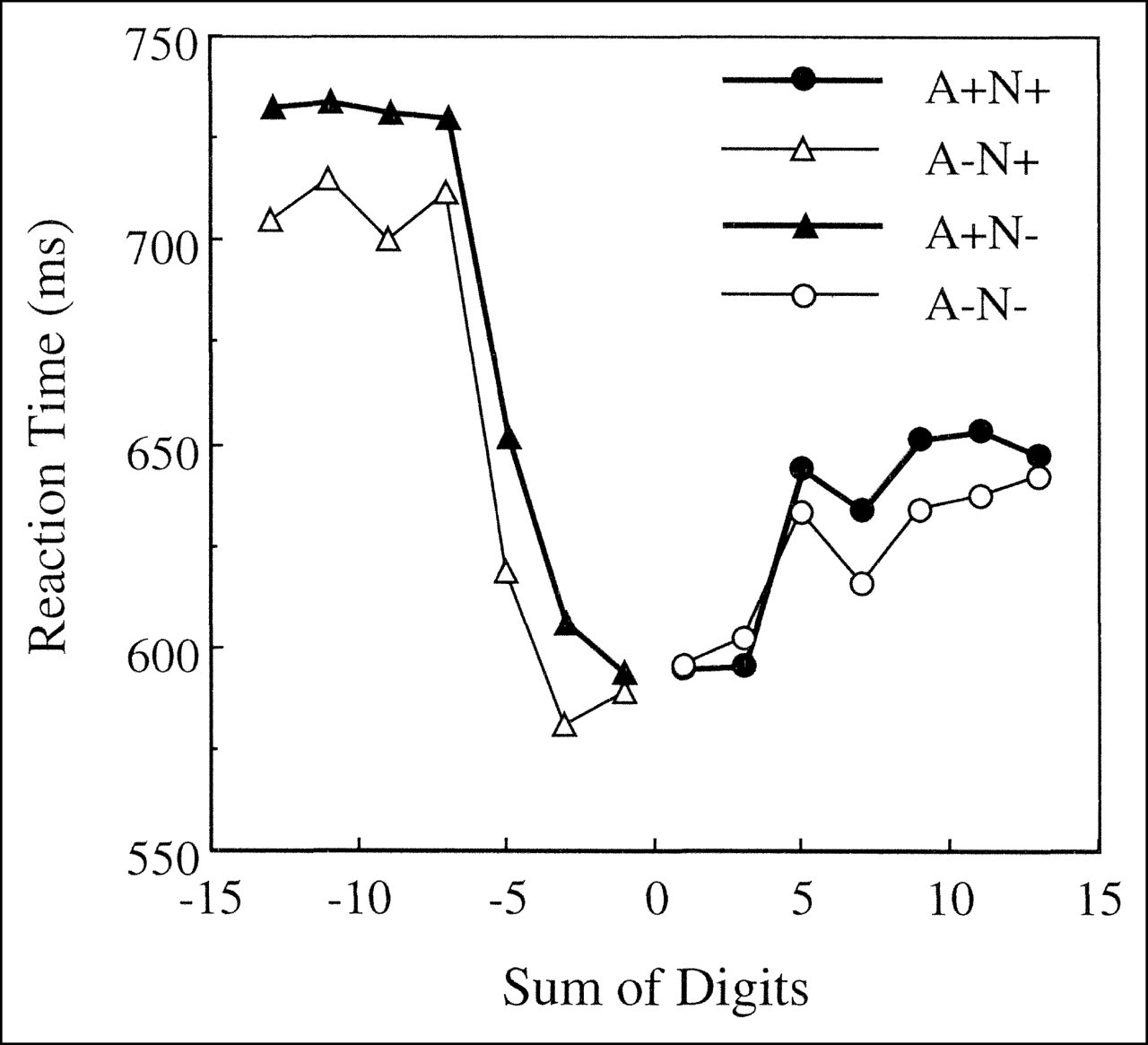
Average reaction time across hands (in milliseconds) as a function of the sum of the two digits in the display. Digits were dis-played either spatially congruent (+) or incongruent (−) with a hypothesized absolute (A) or numerical (N) mental number line.
The main effect of responding hand was not significant, F (1, 13) = 0.40, p > .54, MSE= 1,358.80. Responses with the left and right hands required, on average, 652 ms and 647 ms, respectively. Although numerical congruency did not interact with hand, F (1, 13) = 0, absolute congruency did, F (1, 13) = 40.37, p < .001. With A+ displays, right-hand responses were 45 ms faster than left-hand responses, F (1, 13) = 18.86, p < .001, whereas with A− displays, left-hand responses were 37 ms faster than right-hand responses, F (1, 13) = 18.39, p < .001 (see Figure 2). Finally, the triple interaction failed to reach significance, p > .05.
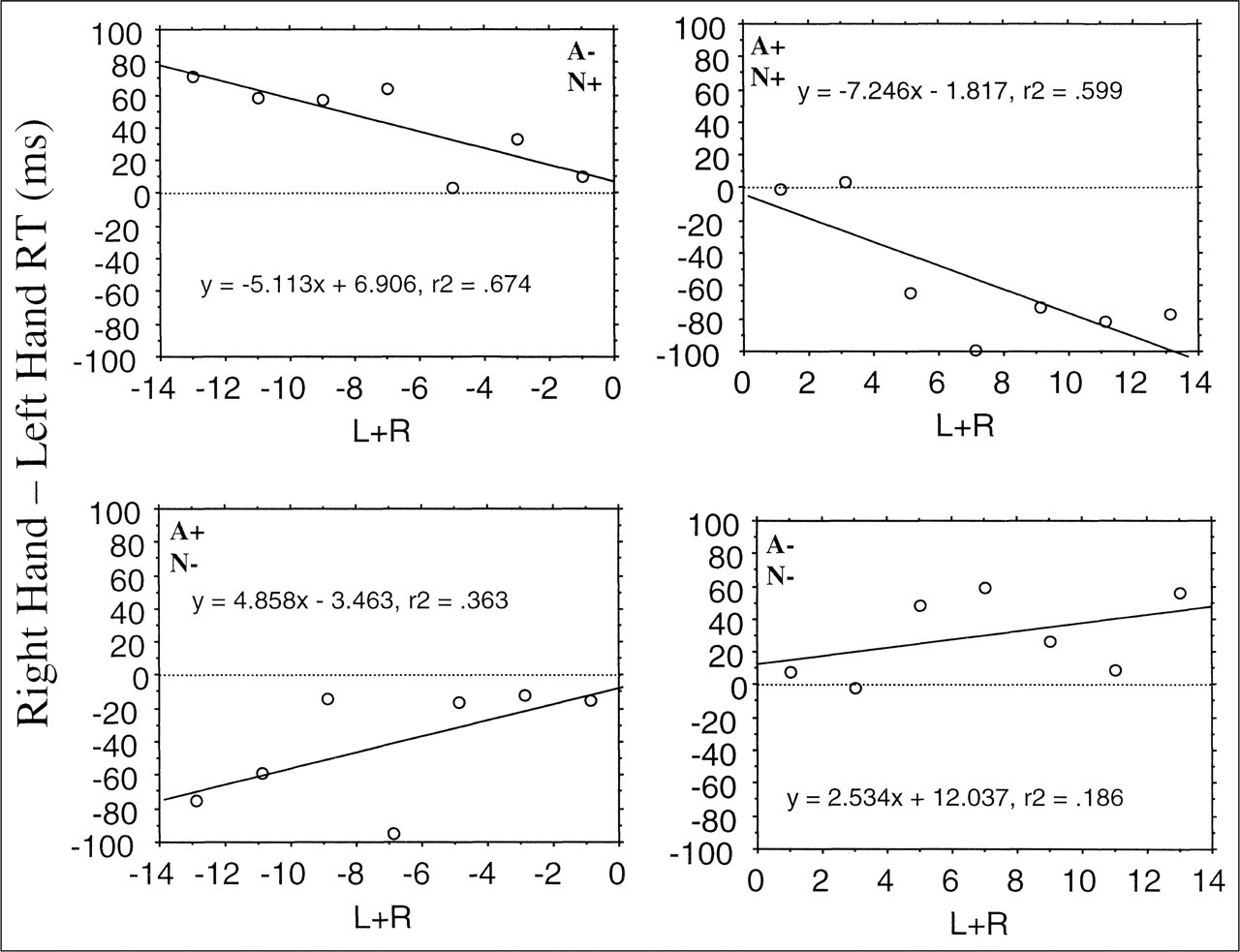
Reaction time difference (right hand − left hand; in milliseconds) as a function of the sum of the left (L) and right (R) digits in the display. Regression equations reflect the averaged data in each panel. Digits were displayed either spatially congruent (+) or incongruent (−) with a hypothesized absolute (A) or numerical (N) mental number line.
Plotting dRT against the sum of the two displayed digits shows that the direction of the response bias depended on absolute spatial congruity, whereas the change in response bias within each condition (the slope of the regression function predicting bias magnitude from display attributes) depended on numerical spatial congruity. Right-side responses were faster for A+ displays, and left-side responses were faster for A− displays. Morover, N+ displays induced negative slopes, and N− displays induced positive slopes (see Fig 2). The averaged slope coefficients were −7.24, −5.11, 3.00, and 0.75 in conditions A+N+, A−N+, A+N−, and A−N−, respectively. Only condition A+N+ differed reliably from zero, t (13) = 5.14, p < .001 (remaining ps > .08). Both N+ conditions differed reliably from the two N− conditions, F (1, 13) = 14.26, p < .01, whereas there was no main effect of absolute congruence, F (1, 13) = 0, and no reliable interaction, F (1, 13) = 2.34, p > .15.
These results support the ontogenetic hypothesis of an experience-dependent mental representation of negative numbers. When numerical congruency was manipulated, decisions were reliably faster in the congruent than in the incongruent conditions. However, when absolute congruency was manipulated, decisions were reliably slower in the congruent than in the incongruent conditions. This pattern was not due to a trade-off because there were also reliably more errors in the A+ than the A− conditions. When phylogenetic and ontogenetic orientations were set in conflict (conditions A+N− vs. A−N+), comparison latencies were significantly shorter when the display layout favored the ontogenetic number line.
Two aspects of the data require discussion. First, both the ontogenetic and the phylogenetic views predict that responses to A+N+ displays (e.g., 4-9) should be fast and responses to A−N− displays (e.g., 9-4) should be slow because in the latter condition digits are in spatial conflict with the mentally represented number line. However, the opposite results were found (see Table 2). A possible explanation comes from the fact that A+N+ displays led to faster right-hand responses, whereas A−N− displays led to faster left-hand responses. Thus, participants may have relied on a mentally rotated mapping when selecting their response to prevent a response conflict. Dehaene et al. (1993) found no evidence for a mental rotation process with number words, but whether spatial response patterns reverse during mental rotation of Arabic digits has apparently never been investigated.
Mean reaction times in the main conditions of the experiment (in milliseconds)
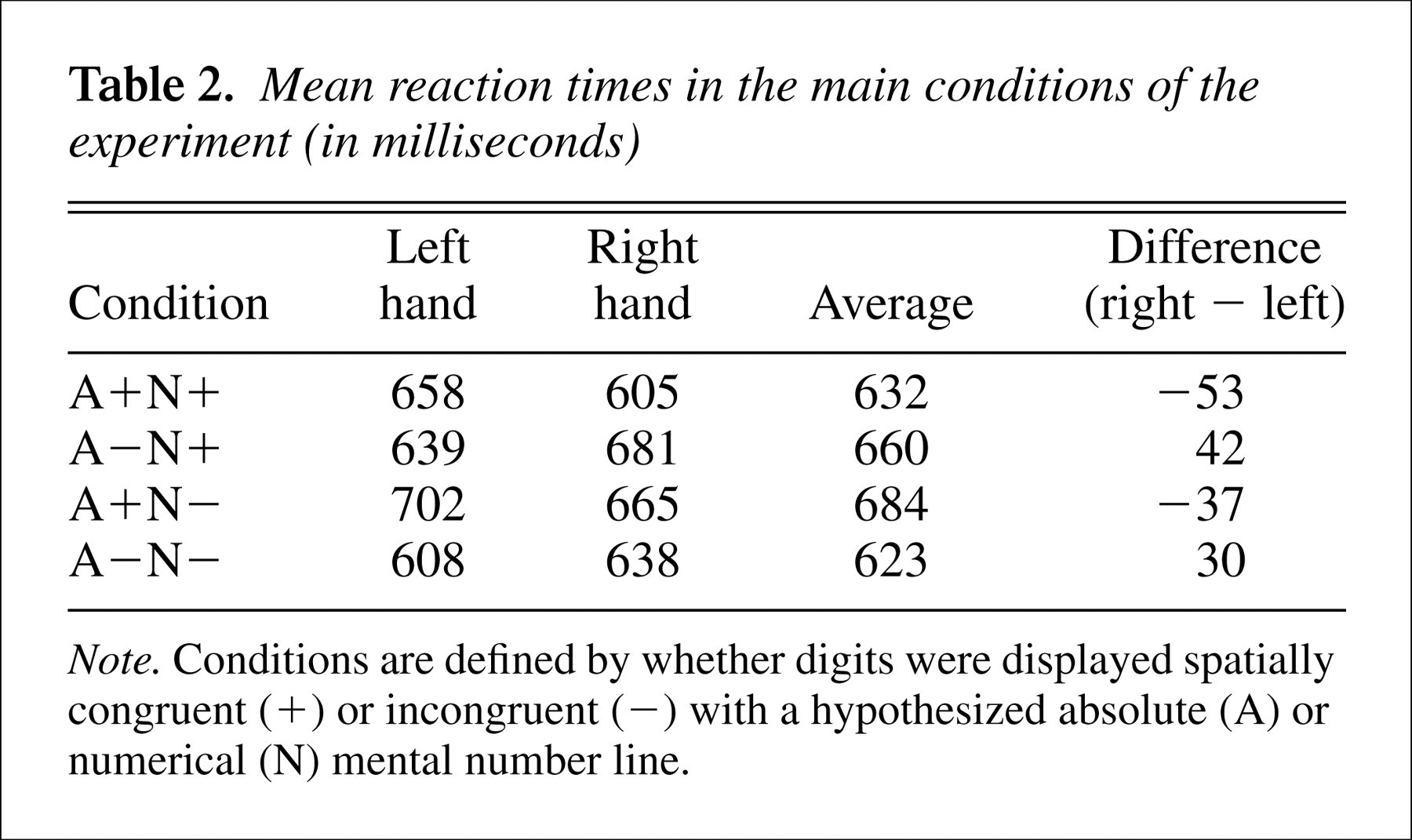
Note. Conditions are defined by whether digits were displayed spatially congruent (+) or incongruent (−) with a hypothesized absolute (A) or numerical (N) mental number line.
Second, why did absolute magnitude but not numerical magnitude interact with responding hand? The regression analysis shows that the direction of the response bias depended on absolute congruity, whereas the change in strength of the response bias within each condition depended on numerical congruity (see Fig 2). Thus, both the spatial relationship of the two digits and their numerical magnitude determined the overall response bias in this task. Stimulus displays in conditions A+N+ and A−N+ were congruent with the visualization of numbers along a coordinate axis, thus yielding a downward-sloping function when dRT was plotted across the displayed sum. Conditions A+N− and A−N− may have required a mental transformation of the stimulus display prior to its mapping onto the mental coordinate axis, yielding an upward-sloping function when dRT was plotted across the entire range of displayed sums. The long decision latencies for A+N− support this account, but the fast latencies for A−N− do not. However, from the results it is also clear that displays containing two negative numbers were processed especially slowly, implying additional cognitive operations. Neuroscientific methods such as functional magnetic resonance imaging, transcranial magnetic stimulation, and electroencephalography could investigate these possibilities further (e.g., Dehaene, Spelke, Pinel, Stanescu, & Tsivkin, 1999; Fias, Lammertyn, Reynvolt, Dupont, & Orban, in press; Goebel, Walsh, & Rushworth, 2001).
The current results show that our phylogenetically inherited number sense is flexible in the representation of number meaning as a result of our individual experiences with numbers. Future work must disentangle effects of different task demands on spatial response biases in number processing to advance our understanding of the mental number line.
Footnotes
Acknowledgements
This work was supported by the British Academy (LRG 31696). I thank Lyndsay Russell for efficient data collection.