






Abstract
This article explores the role of images in the workings of contemporary power. It examines one of the central ways in which sociology has approached images as representations and proposes an alternative understanding of images through the concepts of interactivity, intensity and the virtual. Focusing on the examples of three interactive mirrors, one a piece of artwork, another designed to be located in a designer shop and the other a medical mirror for tracking ‘vital signs’, it suggests that the mirrors emphasize the screen and, in so doing, disrupt a notion of images of representations. Images are instead brought to life; intensively experienced rather than extensively read. The article engages, first, with the increasing prevalence of screens and, second, with the moves in sociology towards theorizing the value of the concept of the virtual. Arguing that images are felt and lived out, the article seeks to contribute to how sociology has dealt with, and might further develop, the concept of the virtual as a productive way of understanding the relationships between images, screens, power and life.
Sociology's interest in images is well established, with subfields exploring the significance of images in relation to visual culture (Jenks, 1995), ‘old’ and ‘new’ media (Schudson, 2003; Slater and Miller, 2000), photography (Wells, 1996; Lury, 1998; Harper, 2001; Knowles, 2006), film and cinema(Diken and Laustsen, 2008), patterns of consumption (Corrigan, 1997; Cronin, 2000), urban life (Cronin, 2010) and the methods through which sociological research can be conducted (Prosser, 1998; Banks, 2001; Knowles and Sweetman, 2004; Pink, 2007; Margolis and Pauwels, 2011). In this article, I examine one of the central ways in which sociology has approached images through the issue of representation, and explore an alternative understanding of images through the concepts of interactivity, intensity and the virtual. This focus emerges first out of what is described to be today's ‘society of the screen’ (Manovich, 2002: 94), where, as Anne Friedberg (2007: 1) argues, ‘we spend more of our time staring into the frames of movies, television, computers, hand-held devices–“windows” full of moving images, text, icons and 3-D graphics’. Secondly, it engages with a series of moves being made towards exploring the value of the concept of the virtual for contemporary sociology (see, for example, Lash and Lury, 2007; Adkins and Lury, 2009; Fraser, 2009; Krarup and Blok, 2011), and for understanding contemporary images especially (Cronin, 2010; Coleman, 2009, 2012; Diken and Laustsen, 2008). While the focus of this article is on sociology, the discussion intersects with moves made in cognate social science and humanities subjects, including cultural geography, media and cultural studies, film studies and philosophy, many of which – though not all – are influenced by Deleuze's work on images, power and the virtual (see, for example, Deleuze, 2005a, 2005b; Deleuze and Guattari, 1994) and is part of what is termed the materialist and/or vitalist turn.
My discussion is centred on the production of images by three interactive mirrors; one a piece of artwork, another a mirror designed as part of a high-end shopping experience, and the third a medical mirror to track ‘vital signs’. 1 My aim is to explore how interactive mirrors produce images that problematize the notion of representation by focusing attention on the screen. I argue that interactive mirrors organize images through the screen and encourage particular modes of experiencing the image that operate through intensity and the body. In this sense, interactive mirror images are not so much representational texts to be read and deciphered, but are virtuals that are felt and lived out. I argue that if representation is no longer the only way in which images can be understood, sociology needs to continue to develop other methods for thinking about the power of images, both in terms of the pervasiveness of images in contemporary society, and the ways in which power works through images, or more specifically, through the virtuality of images.
My purpose in this article is to contribute to and extend sociological accounts of representation, screens and the virtual. In the context of the moves in sociology sketched out above and discussed in more detail below, my aim is to, as Lisa Adkins and Celia Lury put it, ‘turn to the surface’ (2009: 18). Such a turn ‘forces Sociology to break with representational models of the empirical … and requires the discipline to confront a new co-ordinated reality, one that is open, processual, non-linear and constantly on the move’ (2009: 18). I explore what sociology might have to say about the screen as a surface on and through which images are coordinated, and what kinds of questions, problems and issues a focus on the screen might open up for sociology. I understand my aim here then to be in keeping with the need for sociology to ‘keep open’ in order to remain critical; as Joanna Latimer and Beverley Skeggs (2011) explain, in order to ‘emphasise the importance of imagination for the politics of everyday life and experience’, it is necessary to ‘open up sociological accounts of how the social comes about’ (2011: 394). I draw on this idea of imagination in a number of ways, one of which is to conceive images not only as representations but also in terms of the imagined, the not-yet, the virtual.
The article begins by outlining how sociology has tended to be underpinned by a model of ‘representational thinking’, where images are approached in terms of the ‘politics of representation’, and I discuss the ways in which power is understood to work within such a model. It then introduces the interactive mirror case studies, considers how mirror images problematize a notion of representation and explores how interactive mirrors raise a series of other questions, including the need to understand how images are brought to life. I develop these questions in relation to sociological understandings of power, a discussion that is put to work through an exploration of the kinds of intensive experiences that the interactive mirrors produce. The article concludes by considering how sociology has dealt with, and might further develop, the concept of the virtual as a productive way of understanding the relationships between images, screens, power and life.
Images, representation and power
One of the primary ways in which sociology has attempted to understand images has been to approach them as representations. 2 Images are understood as representational texts to be read, that is as complex systems of signs and significations that can be de-coded by reading them in the correct way. In this sense, analytical approaches to images emerged out of the textual or discursive ‘turn’ in sociology and other social sciences from the mid 1970s onwards (Barrett, 1992). This representational approach to images has been an interdisciplinary project, where sociology has drawn on allied disciplines, such as media and cultural studies, film studies and cultural anthropology, to point out and intervene in the ways in which representations are not simply neutral reflections of the world, but come to (re)produce certain meanings that are attached and attributed to people and things in ‘real life’. For example, in Stuart Hall's (2003) terms, representations need to be understood in terms of the ‘work’ they do in ‘regulat[ing] and organis[ing] our conduct and practices – they help set the rules, norms and conventions by which social life is ordered and governed’ (2003: 4). As such, images are analysed in terms of their politics; who or what is represented, and how? Those working in the areas of gender, sexuality, race and ethnicity and disability have been especially interested in the relationship between representations and ‘real’ social life. Thus, in her discussion of the relationship between representation and difference, Kath Woodward (1997) argues that representations are the ‘signifying practices and symbolic systems through which meanings are produced’ and which come to structure ‘how we can make sense of our experience and of who we are’ (1997: 14). Representations – including images and language – therefore ‘involve relations of power’ where processes of inequality, subordination and domination are constructed (1997: 15).
It is clear from approaches such as Hall's and Woodward's that the concept of representation seeks to analyse the mutually constitutive relationship between media, culture and society, where representations feed back into and come to shape the ‘real world’. While analysing and interfering in the politics of representation has been and remains exceedingly important, the idea that images work only or primarily as representations is currently being reworked. One of the central aspects of this rethinking focuses on whether or not images can be separated from the world that they are understood to represent, that is, if images (help to) constitute ‘reality’, the task of distinguishing between a representation and the ‘real’ social world it represents becomes increasingly difficult. This, then, is not only a challenge to the concept of representation but, more broadly, a reworking of representational thinking, a mode of thought that has ontologically and epistemologically organized sociology and that ‘images or performs a distinction between a pre-existing real world to be described, and its description’ (Law and Hetherington, 1998: 2). 3 Recent social and cultural theories of performativity, for example, have argued in different ways that sociology does not only describe the social world but also, to some degree, constitutes it; sociology is performative in that through its ‘descriptions’ social worlds get made, arranged and understood in specific ways (Law, 2004; Law and Urry, 2004). What this implies, then, is an understanding of images not (only) as representations but as performing or bringing the world into being; images are not (only) texts that can be read and deciphered but are felt, experienced, lived out.
Indeed, the reworking of representational thinking implies that images function in ways that matter but that might not be contained within the model of the ‘politics of representation’. The politics of representation model developed alongside and as a means of analysing a specific mode of power, where power is understood to work as an external or underlying structure; as Hall's and Woodward's arguments indicate, through norms, domination and oppression. While this mode of power can be understood as ‘external’, so too can the mode of analysing images. Images are representations that can be read in order to uncover their underlying meaning, most often in the form of ideological messages that express and feed back into dominant norms and values. Thus, a print advert, television programme or film can be analysed in terms of its production values, its commercialism and place within a capitalist economic system, and for its accurate or distorted depiction of reality, that is for how successfully the image represents the social world. The ‘external’ organizing features of socio-cultural life are still evident – and thus analyses of the politics of representation remain necessary. However, in line with the rethinking of representation, power is also being theorized as operating in other ways, as not only ‘extensive’ but ‘intensive’.
For example, for Scott Lash, power today is operating ‘through a cultural logic of invention’ (2010: 132), not so much ‘over’ things/bodies (in terms of domination and oppression) but emanating ‘from within’ (Lash, 2010: 132). An appreciation that power is now, at least in part, intensive indicates a shift to a conception of post-hegemonic society (Lash, 2010). In a hegemonic society, power works through reproduction (as in the politics of representation approach to images) and is challenged through practices of resistance (for example by critiquing representations and arguing for more positive and/or realistic representations). However, in a post-hegemonic society, power operates not (only) from the outside, externally normalizing us, but ‘becomes immanent in its object and its processes’ and is involved in the creation and organization of difference (Lash, 2010: 138). What this suggests for images is that they work through involving and affecting the body – that is, images appeal to sense as well as meaning (see Diken and Laustsen, 2008; Coleman, 2009, 2012; Cronin, 2010; Featherstone, 2010) – and become ‘things’; not only or so much texts to be read as experiences to be lived out (Lash and Lury, 2007). As such, while ‘reading’ an image attends to what that image means, it cannot necessarily grasp what it is about the image that makes it so powerful, compelling, appealing. 4 Thus, an understanding of a film based on an external reading might well miss the sense of the film as a series of images, the intensity and affects of the film that are in excess of its representational meaning. In order to return to the question of intensive power for sociology towards the end of the article, in the next section I examine the ways in which interactive mirrors produce images that exceed representational thinking and require instead an understanding of intensive experience.
Interactive mirrors, representation and reflection
Mirrors are a helpful example through which to explore the questions of representation and power that are raised by a focus on the ways in which contemporary images work. As an imaging technology that is thoroughly embedded in everyday life, mirrors are commonly understood to be simply a reflective surface, a piece of glass that reflects back what is placed in front of it. While photographs, advertising, magazines, film and cinema, have received a good deal of consideration in sociological literature, mirrors have received little academic attention outside of Lacanian psychoanalysis, where the mirror functions as a metaphor for the child's recognition of itself as an autonomous being and hence its entry into the symbolic (ie the mirror-stage – Lacan, 1977). 5 However, despite popular assumptions that they are a simple and unremarkable imaging technology, mirrors have long been involved in the social organization of how bodies and selves are understood. For example, in her detailed historical account of changing understandings and cultural myths of the mirror, Sabine Melchoir-Bonnet (2001) describes how mirrors – both real and metaphorical – come to be part of the Christian tradition of regulating and improving moral and spiritual behaviour in the Medieval and Middle Ages 6 and later played a central role in the development of the significance of self-consciousness in the West; people came to reflect on, know and judge themselves and others through becoming aware of how they appeared. Mirrors thus came to organize social as well as moral behaviour and their gradual dissemination from the homes of the very wealthy to the homes of and public spaces visited by the middle and working classes helps to establish what Mike Featherstone (1991), among others, points to as the increasingly close relationship between the self and the body, where the self becomes understood through appearance. Historically, then, the mirror has been involved in the workings of power, by bringing into being specific modes of knowing, understanding and regulating the body and self.
This relationship between the image, the body and the self that Melchoir-Bonnet examines occurs through the reflective glass mirror. Here, reflection takes on two meanings; it refers to the technology of imaging itself, where the silver or aluminium applied to a plane of glass reflects back to its viewer their image in real time, and it refers to the process of reflecting or speculating on the image that is produced (that is, the self-consciousness mentioned above). Understood as reflections, mirror images trouble the notion of representation in different but inter-related ways. First, while photographs and films have captured a body in the past, mirror images are created in and as the present. They are created by, and valued for, their ability to reflect the movement of the body/self in front of them at that time (Coleman, 2009). It is thus difficult to capture and convert the movement of mirror images into a ‘text’ that can then be read and deciphered. Second, existing only ephemerally, mirror images are created and seen by the body/ies in front of the mirror. In this way, mirror images are commonly understood to be images that emanate from the body itself rather than as created through relatively complicated and complex technologies. 7 Third, in being seen as created in the present by the body in front of them, mirrors blur the boundary between representation and reality; mirror images are seen to depict reality as it is/as it is happening (see, for example, de Beauvoir (1949/1997: 643). In these ways, while other technologies of and techniques for imaging bodies – portraiture, photography, film and video, medical scanning, for example – are understood in terms of representational practices involving processes of selection, framing, mediation and perhaps manipulation, mirror images are seen to escape such procedures. 8
The challenge to the notion of images as representations that reflective glass mirrors establish is both drawn on and extended by the interactive mirrors that I discuss here. The interactive mirrors, I argue, carry through the assumption that mirrors ‘reflect’ the body directly and immediately and at the same time draw attention to the processes through which the body is imaged. Interactive mirrors vary in terms of the purposes for which they are designed (artistic, commercial, medical), the sites in which they are located (galleries, shops, homes) and the applications they include (some record and play back images, others enable the user to draw on the screen and/or connect up to social networking sites and facilitate textual conversations). However, what I am interested in here is how the mirror as a reflective surface is replaced with the mirror as an interface, a screen that requires interaction. More specifically, in what ways does the emphasis that interactive mirrors place on the screen trouble representational understandings of images?
One example of an interactive mirror is artist Daniel Rozin's Wooden Mirror (1999; see Figure 1), an installation of polished wooden tiles two metres tall by 1.5 metres wide. 9 The artwork films movement with a small concealed video camera, which is connected to a computer that analyses the differences between the image captured by the camera and the previous arrangement of tiles, and sends commands to those tiles that need to alter. While I do not have space here to develop the discussion of Wooden Mirror in detail, 10 it is a helpful example of interactive mirrors to begin with because, working through the medium of wood rather than glass, it raises interesting questions regarding how mirrors create images that reflect the body in front of them. For example, although the artwork is a digital installation, Rozin argues that the wood ‘conceals’ ‘the power of digital computation’ and operates instead through a material and physicality ‘more in touch with the human condition’ (Rozin, 2001: 2). In this sense, the artwork encourages the spectator to consider ‘the line between analog and physical vs. digital and computational’ (Rozin, 2001: 2). Indeed, in their discussion of it, Jay David Bolter and Diane Gromala suggest that Wooden Mirror engages the viewer because it ‘is a paradox. It is a mirror made of the unlikely material of wood. It is opaque, and yet it reflects’ (2005: 34).
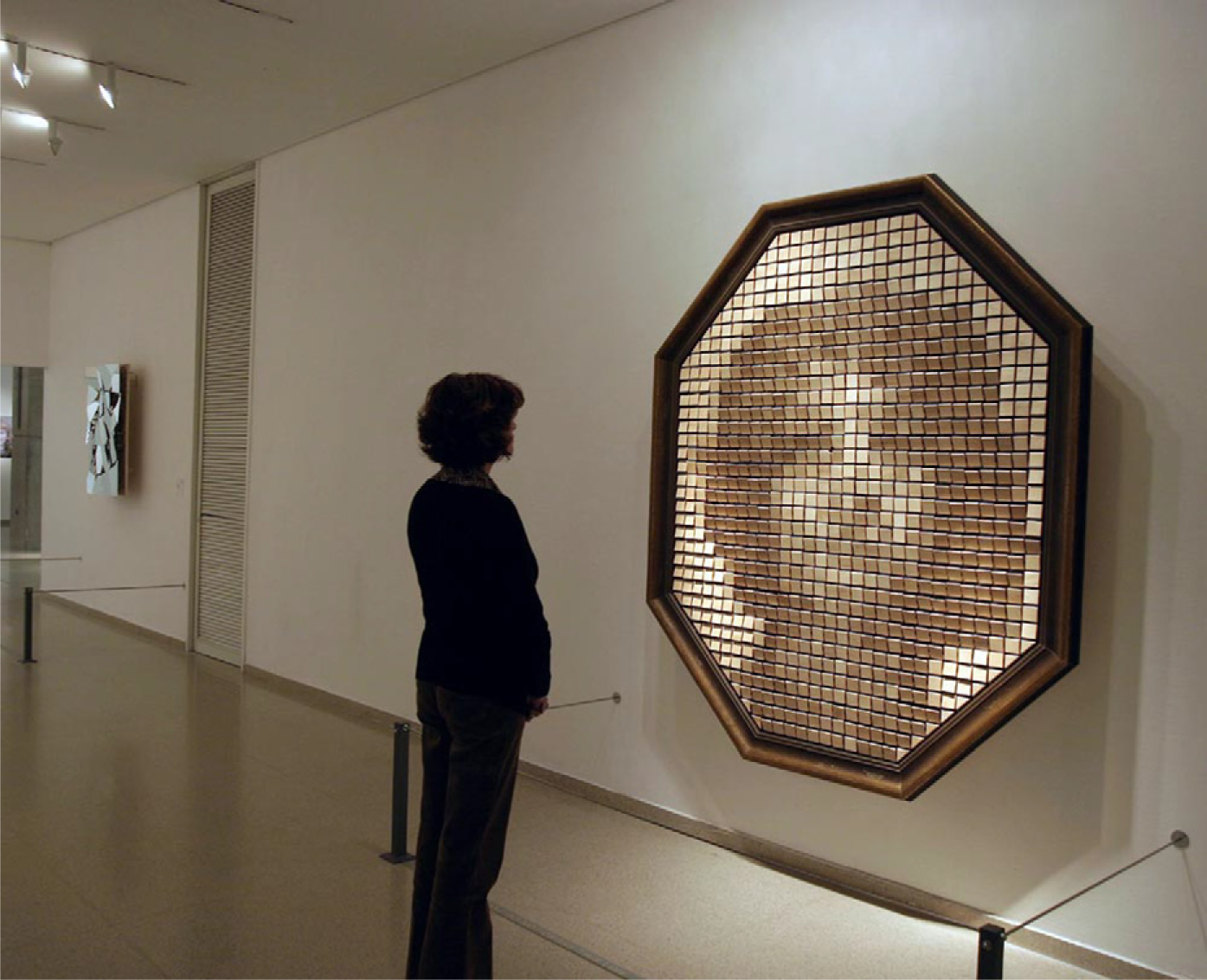
Daniel Rozin (1999) Wooden Mirror, Israel Museum. Image and short film of artwork available at: http://www.smoothware.com/danny/Permission for use of image kindly granted by Daniel Rozin.
Other examples of interactive mirrors have been designed to be located in high-end shops, for instance in the Rem Koolhaas/OMA designed Prada store in Manhattan, New York (2001; see Figure 2). Although the mirrors are no longer in use, having been subject to a number of technical problems (see Lindsay, 2004), they are a productive example to consider here, particularly because of the ways in which the store was designed specifically as a shopping experience. The synopsis of the design of the store on OMA's website describes how commercialization has meant that ‘museums, libraries, airports, hospitals, and schools become increasingly indistinguishable from shopping centres’, resulting in ‘a deadening loss of variety. What were once distinct activities no longer retain the uniqueness that gave them richness.’ The Prada store was designed with ‘the equation … reversed…. What if the shopping experience were not one of impoverishment, but of enrichment?’ 11 More specifically, the changing rooms are described as an attempt to ‘augment the experience of trying on clothes for the customer and enhance … the relationship between the sales assistant and the customer’. The changing room is
presented as a simple eight-foot-square glass booth. One wall forms the door, which the customer can make opaque for privacy during changing or clear to show off a garment to someone outside the booth. Another wall incorporates a ‘magic mirror’, a camera and display that adds a four-second delay so the customer can spin around and view all sides of the garment. The opposite wall has two interactive closets, one for hanging clothes and one with shelves. Sensors in the closets detect the electronic tags on store items and trigger a touch screen that displays the item and its related information, from availability to permutations of color, fabric, and size. (IDEO, designers of the changing rooms, http://www.ideo.com/work/staff-devices-dressing-rooms/).
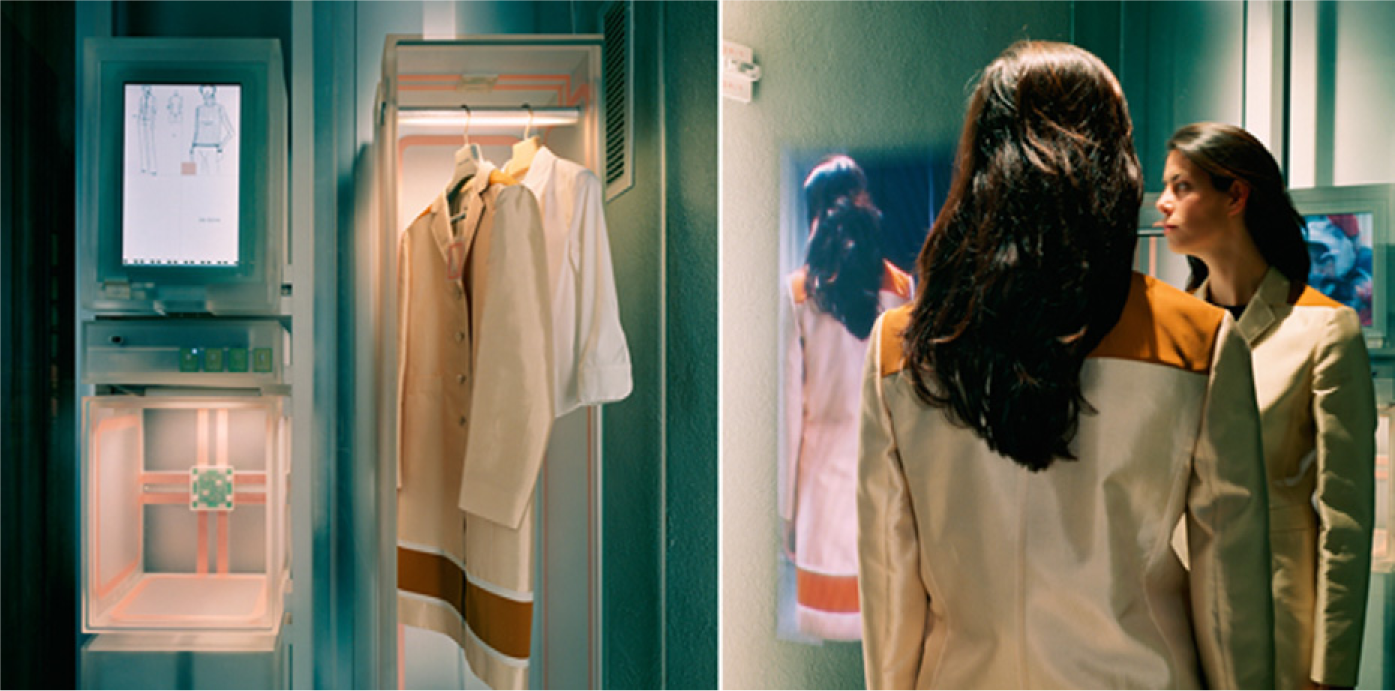
Interactive mirror in Prada store, Manhattan (2001). Image from: http://www.ideo.com/work/staff-devices-dressing-rooms/Permission for use of image kindly granted by IDEO.
While Wooden Mirror challenges assumptions about reflection through the opacity of its material, this interactive mirror seeks to carry through ideas about the reflective qualities of mirrors, by making the interactive mirror look and act like a reflective glass mirror, for example, and by placing it within a familiar setting of a changing room booth. However, the time-delay playback function, its ability to show the customer parts of her or his body that they would not be able to see in a reflective glass mirror, and its connection with other objects that emphasize interaction (the door, the closets), highlight the ways in which this mirror is not a commonplace (reflective glass) mirror, but is instead a ‘magic mirror’.
Another example of an interactive ‘magic mirror’ is the Medical Mirror, designed by Ming-Zher Poh as part of his PhD in health sciences and technology at MIT as a ‘contact-free and remote way of measuring vital signs’ (Poh in Fox, 2012) (see Figure 3). 12 The mirror measures heart and respiration rates via a digital camera, such as a webcam, located behind the mirror, via changes in light, as Poh explains:
Quite simply, [the mirror] uses light to measure the information from your body. Every time your heart beats, the blood in your vessels increases very slightly. Blood absorbs light and so this increase absorbs more mono light, decreasing the amount of light being transmitted or reflected by your body. Using optical methods for measuring the flow of blood is not new…. we're just using the ambient light around you: sunlight, room light or anything that's illuminating your environment. The camera then measures the mono light being reflected off you, in this case, your face (Poh in Fox, 2012).
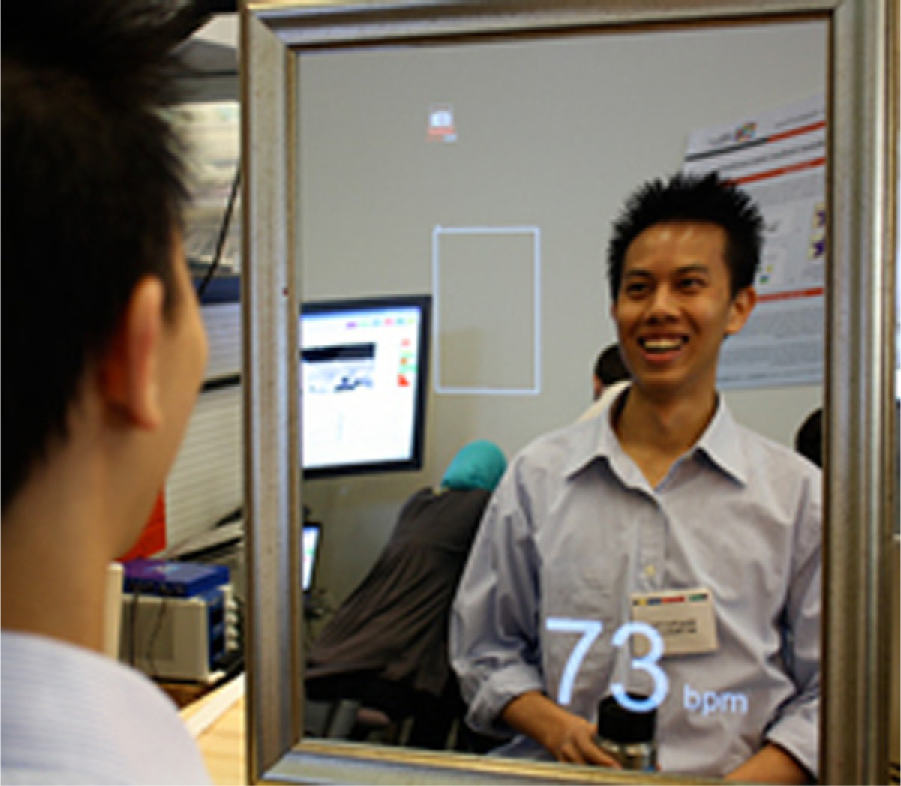
Ming-Zher Poh (2009) Medical Mirror. Image from: http://web.media.mit.edu/∼zher/research.html Permission for use of image kindly granted by Ming-Zher Poh.
The mirror, which is currently in development, is described by Poh in a short film interview (see http://web.mit.edu/newsoffice/2010/pulse-camera-1004.html) as useful because it enables the tracking and monitoring of patterns and deviations in these vital signs. For example, situating the mirror over a bathroom basin and connecting by the Internet to healthcare providers would enable a ‘simple and convenient way for keeping track of your health’, and also, more generally of fitness and well-being.
As with the changing room interactive mirrors, Medical Mirror functions through ideas about reflection, and in particular the ways in which mirrors distort the boundaries between the inside and outside of the body, external appearance and internal selfhood. Indeed, Poh states how ‘you see a reflection of your physical appearance and it projects your heart rate on top, which is a reflection of your internal, physiological state’ (in Fox, 2012), and in another interview says that the mirror ‘shows your inner health. Maybe as people use it, they'll say, “This is part of my identity. It's not just how I look on the outside”’ (in Mone, 2011). At the same time as it draws on ideas about reflection then, Medical Mirror also complicates them.
Intensive experience: Mirrors as screens
While Wooden Mirror, the changing room mirrors and Medical Mirror reflect what is in front of them, through techniques and technologies such as opaque materiality, time-delay and the projection of ‘internal’ states of being, the mirrors also highlight their surface; the screen on which the image is shown is brought into focus. For Bolter and Gromala, this emphasis on the surface troubles the way in which mirrors are usually understood in terms of transparency, as providing ‘an experience of looking at and looking through at the same time’ (2005: 34). While mirror images are always virtual rather than real, and we are always ‘really looking at the surface’ of the mirror rather than through the mirror, Wooden Mirror is ‘a playful reminder that a mirror is a surface and not a window onto a different world’ (Bolter and Gromala, 2005: 34). This reminder also applies to the changing room mirrors and Medical Mirror, where ‘viewers’ – shoppers and patients – become aware of the surface of the mirror, as well as their reflection.
Bolter and Gromala's interest in questions of transparency and reflection are developed in relation to the theory and practice of interaction design. They argue that designing digital interactive products, environments or experiences focuses attention on the screen where decisions are made regarding how far and when the surface is made apparent to the user and how far and when it disappears, or is transparent. For example, the idea of transparency is contested by interactive media through the ways in which the screen does not only disappear to provide seemingly unmediated access to the world it depicts, but becomes more apparent in that it requires engagement and interaction. What this suggests, as Manovich argues, is that not only is the screen a ‘window onto another world’, seeking a ‘complete takeover of the visual field’ (2002: 98), but also an interface, requiring attention in and of itself (see also Wood, 2007). In attempting to ‘augment the experience of trying on clothes for the customer and enhance … the relationship between the sales assistant and the customer’, the interactive changing room mirror both highlights its surface in turning from a mirror into a screen that plays back a film, and acts as a ‘window onto a different world’ in showing the customer who and what s/he is now, and who and what s/he might become with the purchase of these garments. Medical Mirror also highlights its surface, showing people what is going on inside their bodies through the projection of numbers that stand for their heart rate. Both of these interactive mirrors therefore ‘play’ with notions of transparency and surface, pulling through the idea that mirrors provide accurate reflections of the body and self and at the same time making explicit the processes through which such images are produced.
Thus, while the interactive mirrors take up the assumption that mirrors reflect, seemingly unmediated, the body in front of them, they also complicate the notions of reflection, representation and mediation by making explicit the fact that they are an interface, ‘reflecting’ what is before them only through specific practices of framing, filming and play back. Furthermore, the interactivity with the surface through which the image is created is also made explicit. With the changing room mirrors, customers move for the camera, turning around in order for the mirror to film and play back a view of the entire garment, learning more about the garment via the information on the touch screens and making the glass doors transparent or opaque. With Medical Mirror, ‘patients’ are aware that there needs to be certain levels of light and that they will also need to stand relatively still in order for their vital signs to be accurately measured. Through this interactivity with different interfaces and the ways in which all of the mirrors encourage ‘direct’ embodied connections with the screens, I suggest that the images produced by these mirrors are not so much texts, to be read and decoded from an external position, nor representations that are separate from the real world. Rather, interactive mirror images are intensive experiences; images created and lived out immanently, through the body.
Indeed, the three mirrors explored here have been, in different ways, specifically designed to create and be part of an intensive experience, engaging ‘viewers’ through sense and the body. Discussing how the artwork contests the opposition between digital media technology and the natural/humanness, Rozin explains that in drawing attention to its surface through its ‘natural’ material, Wooden Mirror is an attempt to appeal seemingly directly to the body by making the technological computer interface disappear; an interface ‘means putting some sort of membrane between you and the experience. With [Wooden Mirror], you understand immediately that it's a mirror, you know to operate it, and no interface is involved’ (Rozin, 2001: 2). This is also the case with Medical Mirror, where physiological signs can be monitored ‘by acquiring them continuously in an unobtrusive and comfortable manner’, that is without ‘requir[ing] patients to wear adhesive gel patches or chest straps that can cause skin irritation and discomfort’, as with electrocardiograms (ECGs) (Poh et al., 2010: 10763). The mirror involves no messy or explicitly technological connections between the body and image, instead seemingly reflecting the outside and inside of the body immediately, via the routine and familiar process of looking in the mirror. The changing room mirrors are part of an attempt to shift a store from being a ‘deadening’ commercial space to a ‘unique’ space that engages the customer through appealing to their distinctiveness or difference. This ‘rich’ shopping experience is created to appeal to imagination, sense and the body, via ‘[e]xperimental technology, intriguing materials, and innovative display methods’ for example.
In terms of all of these mirrors, then, images are produced through and as part of an interactive intensive experience and engage the body through affect and sense. The interactive mirrors indicate therefore that we ‘enter a world of operationality, a world not of interpretation but of navigation’ (Lash and Lury, 2007: 8). In other words, we interact with the images, ‘[w]e do not “read” them so much as “do” them …, or do with them’ (Lash and Lury, 2007: 8). The mirror image is, perhaps, an exemplary case through which to think about this doing of or with the image. For example, reflective glass mirrors depict the movement of the body in front of them, reflecting movement as it happens in the present. The interactive mirrors also work through ‘reflecting’ (exterior and interior) movement ‘on’ the screen, requiring the ‘viewer’ to interact with the screen to create their reflection. As a reflection, the image is animated through the movement of the body that ‘operates’ the mirror. The mirror image is, quite literally, produced through doing (with) it and, importantly, this immediacy is made explicit. Moreover, and as I have suggested, this doing with images is organized through the screen. The screens of the interactive mirrors are surfaces that are not read for their meaning but are interfaces that are interacted with. In this sense, the screen is a surface that animates, that brings images to life.
The conception that I am proposing here, then, is that the screen is not a defined or solid line between one space or time and another. The screen does not demarcate a ‘real world’ and a virtual image. Instead, the screen can be understood, in Anne Cronin's (2010) terms, as ‘a kind of mediation, although not in the sense generally deployed in studies of the media which see social institutions such as radio or television shaping, reflecting or relaying certain ideals, discourses or ideologies’ (2010: 144). Rather, the screen ‘is a form of mediation that is fully embodied, that confounds conventional distinctions between the material and immaterial’ (2010: 120). Indeed, the screen is a form of mediation that encompasses both the material and immaterial/not yet material, that ‘confounds’ the distinctions between the body and the image, the actual and the virtual. Through the interactive screen, the image is done with, the body is doing with the image. The screen is that which therefore works between and troubles – rather than establishes and bounds – the material and immaterial, the actual and the virtual.
As I have indicated above, the concept of the virtual, and the relationship between the actual and the virtual, have recently come to be significant in sociology, as well as in other disciplines. In general terms, the virtual refers in everyday life to that which ‘“is so in essence but not actually so”’ and, ‘[m]ore philosophically [that which] captures the nature of activities and objects which exist but are not tangible, not “concrete”’ (Shields, 2002: 2, reference omitted). In other words, and drawing on a Deleuzian vocabulary, the virtual is a potentiality (see, for example, Deleuze and Parnet, 1977/2002). It is relatively straightforward to see how the images created by the interactive mirrors (as well as images more generally) can be understood in terms of the virtual. In the terms that I am developing here, image refers not to the physical interplay of light on the mirror – ie that which creates a mirror image – but to the virtual – to the image on screen that exists but is not (yet) material. 13 In this sense, as I indicated in the introduction, ‘image’ encompasses an imaginary realm, in so far as imaginary here refers to that which is not-yet. But, as I will explore further below, sociology has become interested in the virtual in part because it requires a consideration of how that which exists but is ‘not actually so’ comes to be ‘concrete’, that is of how the virtual becomes actual. One of my concerns, then, is with how the actualization of the virtual is organized by the screen, that is with how the interactive mirror images are felt and lived out.
Indeed, discussing the seeming ‘reality’ of the image of reflective glass mirrors, Bolter and Gromala suggest that ‘the image offered by a mirror is what optics calls “virtual” not “real”. The rays of light only appear to come from beyond the glass. We are really looking at the surface of the mirror, and what we are seeing is a reflection of ourselves and the world around us’ (2005: 34, my emphasis). All of the interactive mirrors at stake here may be understood in terms of the virtual image. They all, for example, create images via the movement of the body, and it is this movement that animates or gives life to the image. Furthermore, the image is not a reflection in a silvered piece of glass, but a film, captured by cameras and played back, in real time or on a delay, to ‘viewers’. As such, both Medical Mirror and the changing room mirrors create images that are in excess of what the ‘viewer’ is able to see in ‘reality’. With Medical Mirror, the optical methods for measuring changes in blood flow create images of what is happening inside the body, hidden from view (although also measurable and made visible via other means). Without the assistance of the time-delayed film, customers in the Prada store would not be able to see ‘all sides of the garment’ on their bodies. The changing room mirror images are therefore virtual in that they exist as an image in the past (a delayed rather than real time ‘reflection’) and also in how they draw on and put to work notions of desire, potential and becoming that are central to consumer culture. In this case, the virtual image exists not only in the past but also signals future potential, a future that might yet become concrete with the purchase of this particular item.
While they differ in their locations, methods and interactivity, Wooden Mirror, the changing room mirrors and Medical Mirror are intensives experiences, working through the body, requiring the image of the body to not only be viewed but also to be interacted with, to be ‘done with’ and lived out. In all of these ways, they draw attention to the screen that shows the virtual image, as well as to the ‘reflection’ itself. They mediate, in the terms set out above, between the actual body in the store, art gallery or bathroom, and the virtual image ‘on screen’. The screen is not only transparent, drawing the viewer into a window on another world, but is also apparent; requiring interaction, attention, reflection. In the remainder of the article, I focus on how the screen mediates between the actual and virtual and consider some of the ways in which sociology might want to explore – or make sense of – the virtuality of interactive mirror images. In particular, I return to the argument that power is increasingly working through intensity, that is through the virtual.
Sociology, screens and the virtual
What is becoming clear is that the interactive mirrors produce images that function in excess of representational texts, as intensive experiences. In order to understand the intensity of such images and the screen as mediating between the actual and virtual, it is therefore essential, as Bulent Diken and Carsten Bagge Laustsen put it, to ‘appeal to sense as well as meaning, to sociological imagination as well as sociological reasoning’ (2008: 13). For these authors, such an appeal involves asking, ‘How can sociology activate its imagination, move beyond representational mediations?’ (2008: 13). I have suggested that a focus on the relationship between the actual and virtual is one way in which sociology might make sense of the intensity of the interactive mirror images. Indeed, while the relationship between intensity and the virtual emerges through the case study of the mirrors, it is also pointed to in the way in which social theory is arguing that power is now operating. For Lash, for example, power as intensive indicates that power is at once virtual; ‘Intensities are virtuals or potentialities’ (2010: 4). Such an understanding of power suggests, at least, two inter-related issues. First, it points to how contemporary society is becoming increasingly (organized around) the virtual. As Diken and Laustsen argue, ‘[w]hat makes the social is not only its actualized structures, stratifications and segments but also its virtual potentialities which are significant without becoming necessarily actualized (2008: 3, see also Adkins, 2009). In this sense, an attention to the intensity of the mirror images is in itself significant; the mirror images indicate that images function as virtuals, as requiring interaction and doing with rather than or as well as reading. Second, it suggests that a consideration of how the virtual is actualized is at the same time a consideration of how power comes to be lived out in and as specific kinds of bodies. In what ways are the virtual images done with? What ways of thinking and be(com)ing are brought to life?
To begin to answer these questions, it is necessary to think not only about how the virtual is conceived, but also how the virtual, and its actualization, might be approached. A focus on the virtual requires an attention to the intensive, to sense, to the immanent, emergent and processual. As I have suggested so far, images are not only texts to be read; approaches that treat images as a series of signs to be decoded for their underlying meaning cannot necessarily capture their experiential quality. Mariam Fraser (2009) argues that an appreciation of the virtual reorients sociology around concepts that are relevant to – make sense to – the object that is at stake. Whereas sociology 14 has tended to be organized around tracing the relationship between a concrete and actual situation in the present and its historical explanation, and has appealed to social structures in order to make this relationship meaningful, ‘[t]he virtual … is not a blueprint (a pre-established theoretical formulation for example)’ (Fraser, 2009: 75). Taking up Fraser's work in relation to Bruno Latour's Actor-Network-Theory, Troels Mageland Krarup and Anders Blok argue that ‘virtual theory entails an analytical commitment to remain sensitive to the dynamic, non-causal, and intensive patterns of relational social life (see DeLanda, 2002). At the same time, however, it also entails a commitment to move “beyond” actual-states of affairs, by attending to the creative work involved in making connections between different levels of abstraction’ (Krarup and Blok, 2011: 58).
In terms of the argument I have made so far, a ‘blueprint’ for analysing the images produced through the interactive mirrors might be the ‘politics of representation’ model, a model that pre-exists the image and that accounts for the image through reference to external structures; norms, subordination and domination, for example. What I have suggested is required is an attention towards how the virtuality of the images is brought to life through movement and interaction, through specific ways of imagining, moving and living out the body/self; ‘playing’ with the reflection of the body, interacting with the interface for instance. A focus on the virtual is therefore not to move away from the actual, material social world, but to explore how the social is brought to life (how the virtual is actualized), and to examine how power works through this intensive and virtual process. As Krarup and Blok put it, as a form of intensive rather than external methodology, ‘[v]irtual theory cannot tell us “what we are looking for”, but it can structure the evaluation of possibilities and uncertainties: “what actually happened here?”’ (2011: 59).
For example, the images created by the interactive mirrors appeal to sense and imagination rather than reason, reading or meaning. An analysis of the interests and values of the businesses, organizations and design and artworlds involved in the creation of the interactive mirrors needs to attend to the ways in which they were designed specifically to appeal to immediacy and intensity. While an ‘external’ or ‘blueprint’ approach might unpack the commercial interests of these examples and uncover their ideological meaning, they might miss their allure. This is not to celebrate the more playful or pleasurable aspects of the interactive mirrors but rather to trace how commercial interests and values resonate with the intensive and immanent interests and values of the bodies in front of the mirrors, as unique and varied ‘museum goers, researchers, travelers, patients and students’. Power is working through such intensive experiences, not as an external series of structures imposed on the body but ‘from within’, as ‘immanent in its objects and processes’. Medical Mirror is particularly helpful to consider here, as it is designed to be part of an ongoing monitoring of health. Responding to the question, ‘Do you think it is important to check your vital signs more often than when you visit the doctor?’, Poh says,
There's a growing awareness that is useful. There's a movement called the ‘quantified self’ movement and the idea behind it is that you can't really improve something unless you can quantify it. Until you start tracking something, how do you know how you're doing? (in Fox, 2012).
The idea for the mirror to be both a continual monitoring of health, and a means of quantifying health so that it can be tracked and improved, indicates the mode of power as intensive that I have discussed, as working in and through the body. It also intersects with the intensive methodology for studying the virtual that Krarup and Blok describe above: the need to see ‘what actually happened here?’ resonates with Poh's suggestion that ‘[u]ntil you start tracking something, how do you know how you're doing?’ In order to see what actually happened, how you are doing, an intensive approach is required. To attend to power as intensity is therefore not to overlook long-standing patterns that emerge but rather to examine how these patterns might be being made through intensity as well as extensity. For example, how does Wooden Mirror reinforce as well as seek to challenge distinctions between nature and technology? In what ways does OMA's understanding of shopping as ‘arguably the last remaining form of public activity’ strengthen as well as shift the experience of the significance of commercialization? What might be the implications for the social and the individual of the kind of ‘personalised’, intensive health monitoring that Medical Mirror is just one part of? In what ways is the ‘quantification’ of ‘vital signs’ through intensive methods a new, or extended, form of measurement and value (Adkins and Lury, 2012)? In other words, how do actualizations of the virtual contribute to power relations, either existing or emerging? How are images brought to life in and as actual bodies?
In arguing that power works intensively through the interactive mirrors, I am suggesting that, just as with a hegemonic understanding of power, where images as representations are part of the regulatory norms through which domination and oppression is produced and reproduced, images are a key way that ideas through which power operates today are circulated and made sense of. While I do not want to suggest that the politics of representation model should be entirely replaced with the non-representational or intensive approach to images that I am proposing here – it remains important to unpack the messages and ideals that are perpetuated in visual culture – my argument is that it is necessary to attend to how the workings of power through images have shifted. Indeed, questions such as those posed above emerge out of what I have argued to be the emphasis that interactive mirrors place on the screen. As I have discussed, this is not an understanding of the screen as a solid, static line that demarcates between one space and another (the 3D ‘real’ world and the 2D representation) or between one time and another (the present, the past and the future). Rather, the screen is a mediator of movement, process, becoming, a surface at once material and immaterial, a surface through which images are lived out. Understanding the virtuality of the images produced through the interactive mirrors therefore involves ‘a willingness to understand Sociology's relationship with the empirical as an experiment of – or with – the yet to come’ (Adkins and Lury, 2009: 18). In the cases discussed here,Wooden Mirror seeks to create an immediate experience, where the interface is both highly explicit and yet ‘humanizes’ the technological processes through which the mirror ‘reflects’ movement, the shop changing room mirrors openly explore and put to work the question, ‘What if the shopping experience were not one of impoverishment, but of enrichment?’ (my emphasis), and Medical Mirror seeks to track and find new ways of visualizing what is happening ‘within’ the body now, in order to improve it in the future.
The screens in all of these examples therefore experiment with possible modes of viewing, interacting with and experiencing the image, indicating that the images are themselves navigated through specific kinds of movement and interaction and that the images bring to life specific ways of seeing and knowing the body. As a surface that brings images to life, the screen is not ‘defined in contradistinction to depth, causal or explanatory models’ but is ‘a space in itself’ (Adkins and Lury, 2009: 16). As a surface through which the virtual is experienced, the screens of the interactive mirrors are part of the coordination of the social. This coordination occurs not ‘“above”, “behind” or “beyond”’ (Adkins and Lury, 2009: 18) the surface but through the intensity of the surface, because the social is itself (becoming) intensive, open-ended, processual.
Footnotes
Acknowledgements
Thanks to Matt Falla for introducing me to interactive mirrors, and to Anne Cronin and anonymous reviewers for their comments on earlier drafts of the article.
All websites accessed 13 September 2011.

2
I focus on the understanding of images as representations in this article, but this is not to suggest that this is the only way in which sociology has approached images; for example, another key trend has been to examine how images are involved in the relationship between vision and regimes of knowledge (Jenks, 1995; Novas and Rose, 2000), discipline (Foucault, 1977/1991) and surveillance (Lyon, 2006).
3
Law and Hetherington argue that this is one aspect of representational thinking in Sociology, and this is the aspect that I concentrate on in this article. The other aspects are that Sociology ‘is literary in form; more or less linear in structure; … mirrors or re-presents the world; builds a more or less coherent and consistent literary subject position’ (1998: 2).
4
This then is not a critique of representational analyses being misplaced in and of themselves, but rather an argument that ‘since the time of critical theory and since the emergence of the Birmingham tradition in the middle 1970s – things have changed’ (Lash and Lury, 2007: 3).
5
6
Melchoir-Bonnet's focus is on Europe, and France in particular.
7
I am not suggesting that mirror images are not created through technological processes, nor that other imaging technologies do not involve the production of the image through the body standing in front of it. Rather, as I return to below, I am highlighting the cultural assumption that mirrors produce images ‘naturally’ and ‘immediately’.
8
It is interesting to note that while theories of the politics of representation have been keen to critique the notion of reflection, in order to rethink the representational understanding of images it is helpful to consider the processes of ‘reflection’ in more detail. I return to this issue below.
11
12
Thanks to Celia Lury for bringing this example to my attention.
13
Thanks to an anonymous reviewer, who suggested I made this point clearer.