






Abstract
The notion of embeddedness (Granovetter, 1985) neglects of the material dimension of economic relations. This paper contributes to the literature of market devices (Callon et al., 2007) with an exploration of the material dimensions of economic embeddedness in the case of the everyday market activities of a group of non-professional investors in the UK. It examines the attributes of a materially embedded market through the categories of socio-economic embeddedness specified by Uzzi (1997) and draws attention to the superficial and rhetorical nature of the face-to-face social relations encountered in this market. The paper seeks to invigorate the notion of embeddedness by expanding the mechanisms through which socio-economic relations are understood to arise. The paper offers support to the literature of market devices' assertion that a concept of materially embedded economic relations can accommodate politics, culture, and regulation, and that it offers a nuanced perspective on agency and identity in the marketplace.
Introduction
In the three decades since Mark Granovetter's (1985) paper gave a name to the network-based analysis of economic relations, the concept of embeddedness has become pivotal to our understanding of market operation. It claims that social relationships play a significant role in the behaviour of market agents, that ‘the structure of our social relationships, and not simply a transaction specific maximisation rule, determines our choices of economic trading partners and how we interact with them’ (DiMaggio and Louch, 1998: 620). Granovetter's (1985) article drew together existing work in the area, and set out a map for future research: the concept of embedded markets has been explored and developed in reference to, for example, labour markets (Granovetter, 1973; Granovetter, 1983), production markets (White, 1981) and entrepreneurial firms (Uzzi, 1997), consumer markets (DiMaggio and Louch, 1998), and financial markets (Sassen, 2005). The notion of embeddedness became the conceptual core of the ‘New Economic Sociology’ (NES) appearing in numerous general expositions, book chapters and discussion articles. The concept has had a great impact in areas of the social sciences other than economic sociology; in organizational studies, for example, the social network perspective has led to a huge and varied literature, as reviewed by Kilduff and Brass (2010). Disciplinary bridges have been built and researchers have been encouraged by institutional theory (Powell and diMaggio, 1991), for example, to take a broader perspective, and to consider regulation, politics and culture. Sociology has been left with accounts of social (Uzzi, 1996), political (Fligstein, 1996) and cultural (Zelizer, 1994) embeddedness that sit one atop the other – to borrow Çalişkan's (2007: 242) metaphor – like a Venn diagram, with the object of study somehow located in central field; ‘embeddedness’ itself has become an ‘increasingly popular but confusingly polyvalent concept’ (Jessop, 2001).
Fligstein (1996, 2001) complained that networks are sparse social structures, unable to convey the power dynamics and politics of markets. More recently, scholars working in the social studies of finance have developed a critique over the unwillingness of social network analysis to tackle the material devices (Muniesa et al., 2007) through which economic relations are enacted. For these writers, ‘social network analysis should not be limited to studying ties among persons’ (Beunza and Stark, 2004). The present paper takes up this theme and explores how a narrow notion of embeddedness – the understanding that economic transactions are enmeshed in social relationships – may be reinvigorated by a focus on the materiality of everyday market practices. It will argue that market participants still seek the benefits of a Granovetterian embeddedness – improved information, trust and shared labour (Uzzi, 1997) – yet do so through social spaces and relationships that are mediated and constituted by market devices. In doing so, it contributes to the literature of material market studies (Callon, 1998; MacKenzie, 2006; Callon et al., 2007; MacKenzie et al., 2007). It offers a further development of this literature through a systematic consideration of the characteristics of material embeddedness in the light of the detailed framework of socio-economic embeddedness provided by Uzzi (1997).
The paper will proceed as follows. I will first of all summarize the key points of the literature on socio-economic embeddedness and the social network perspective. The paper will then introduce the sociological studies of financial markets, with particular reference to studies of market devices and the material nature of market settings. The study methodology is then presented. I continue with an analysis of the material embeddedness of the market activities of non-professional investors, focusing on screens, screen-based interaction, and division of labour. The paper then considers the role of the social in investors' activities, and concludes with a discussion of the theoretical implications of this study.
The social network perspective on economic relations
Kilduff and Brass (2010) characterize embeddedness as one of four core ideas that underpin the social networks perspective. More fully, these are social relations; embeddedness, that actors show a preference for transacting with network members; structural patterning; and the utility of network connections, epitomized by the theory of ‘structural holes’ (Burt, 2005). Network analysis has been successfully deployed at the inter-organizational level (Powell et al., 2005) and from structural perspectives (Pizarro, 2007). Embeddedness is an important determinant in inefficient markets where information is scarce (Burt, 1992), but also in perfect markets (Kilduff and Brass, 2010). Embeddedness, then, is set up in opposition to the atomized, maximizing rule of market transaction; ‘organisational networks operate on a logic of exchange which differs from the logic of markets … ongoing social ties shape actors' expectations and opportunities in ways that differ from the economic logic of market behaviour’ (Uzzi, 1996: 676).
Financial markets, perhaps because of their fluid nature as second-order, exchange role markets (Aspers, 2005) have already proven a fertile field for studies of the ongoing performance of economic relationships. The social embeddedness of financial markets was investigated (even before Granovetter's paper) by Baker (1984), who examined social interactions in trading pits, a subject returned to later by Zaloom (2006). Both documented the clear relationship between social interactions and market prices. MacKenzie's (2003b) study of hedge fund managers showed that a Granovettarian sociology could do much to explain the process of portfolio imitation that contributed to the downfall of the Long-Term Capital Management hedge fund in 1998. Abolafia (1998) examined the culturally embedded characteristics of trading rooms and Sassen (2005) the global geo-politics of electronic markets. Research has also considered the ways in which social infrastructures such as the layout of large trading rooms (Beunza and Stark, 2004) or organizational infrastructures in smaller hedge funds (Beunza et al., 2006) influence the calculative strategies employed by market agents.
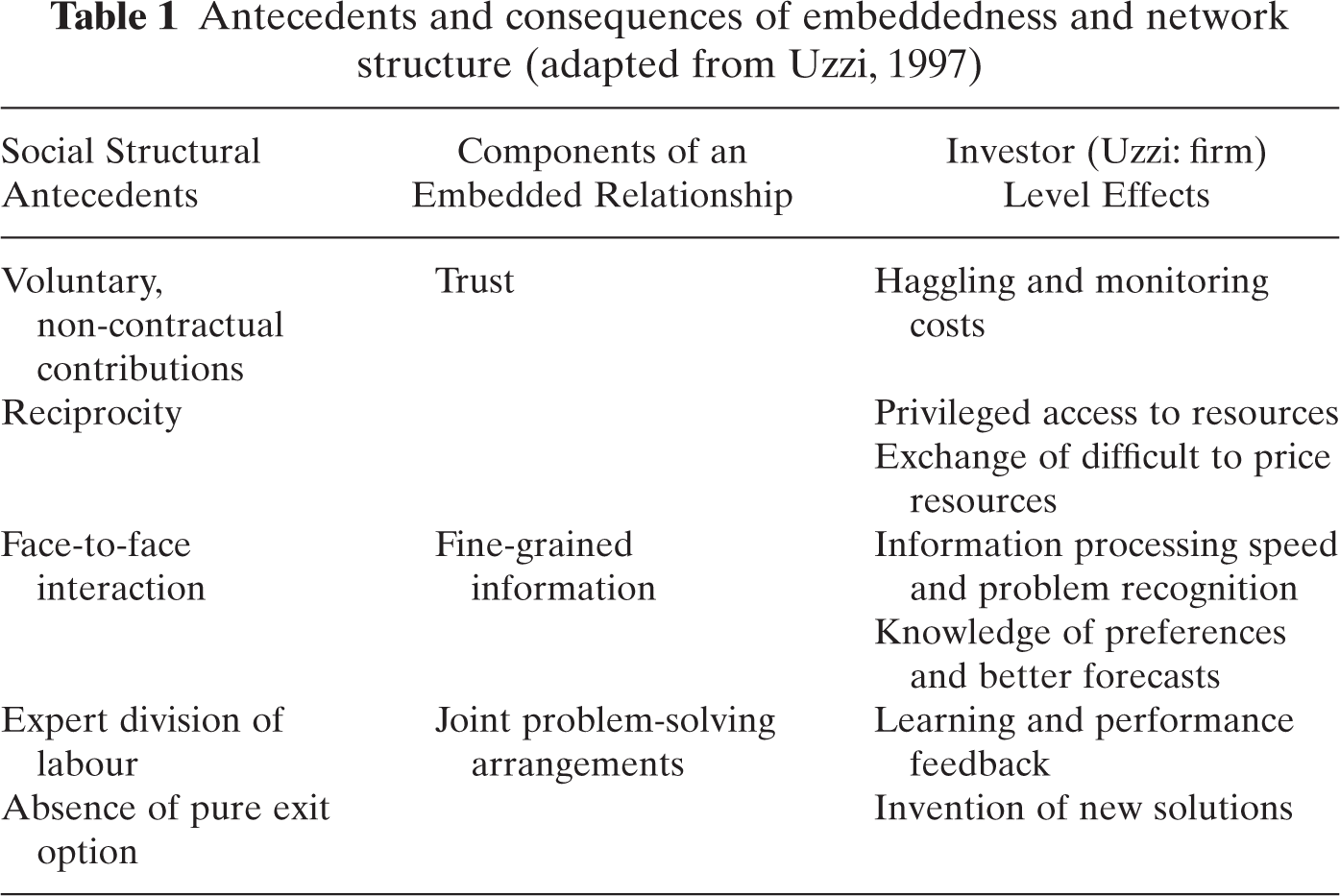
In this paper I seek to systematically analyse the constitution of economic relations in a financial market setting. To do so, I will make use of the taxonomy of embeddedness and its effects provided by Uzzi (1997). Uzzi's (1996, 1997) work is particularly useful in its intention to advance a systematic account of the functioning of social ties that can move beyond the programmatic and conceptually vague (1996: 674) statement that social relations may facilitate and/or derail economic exchange. Successful in this effort, Uzzi's papers are considered, alongside those of Granovetter (1973, 1983), as pivotal references for the literature of embeddedness (Kilduff and Brass, 2010). Uzzi lists five preconditions, or social structural antecedents, of embeddedness: voluntary contributions, reciprocity, face-to-face interaction, the division of labour, an absence of the option to exit the marketplace. He also identifies three components of an embedded relationship – trust, high-quality information, and problem-solving arrangements – and various firm level effects. His taxonomy is reproduced in Table 1.
Antecedents and consequences of embeddedness and network structure (adapted from Uzzi, 1997)
This paper sets out to explore and develop the analytic categories established by Uzzi (1997) through an actor-network (Latour, 2007) inspired approach, focusing on the embeddedness of agents within heterogeneous (Law, 1999) agencements (Callon and Muniesa, 2005): constellations of human agents, theoretically inscribed devices and performative scripts organized by routines and procedures. 1 As noted above, the social network perspective remains mute on the role of devices in market function, surprisingly so, for ‘can a market exist without a set of market devices?’ (Muniesa et al., 2007: 2). I will highlight the extent to which material relations perform market operation, and will draw into question the value of face-to-face social relationships in stabilizing market relations. First of all, however, it is necessary to review the existing literature on market devices and set out the theoretical debates behind these studies.
Material markets: devices and agencements
The role of the material in the constitution of economic markets has been brought to prominence by the theoretical innovations of sociologists who, following Callon (1998), have sought to emphasize the embeddedness of economic markets in constellations of material devices, termed agencements. Callon (1998) suggests that the economy is embedded in economics through theoretically informed inscriptions of material devices. Callon's innovation provides a means of theorizing embeddedness that can incorporate political relationships (Callon and Muniesa, 2005), cultural mores (Çalişkan, 2007) and regulatory frameworks (Millo and MacKenzie, 2009); it conceptualizes markets as stabilized by their material and linguistic arrangements (Çalişkan and Callon, 2009, 2010), which in turn frame the decisions of markets agents. For researchers using the notion of agencement, the market (or more broadly the ‘social’) is not a thing-in-itself, but the product of an organizing and stabilizing of ‘heterogeneous’ (Law, 1999), material agents (Latour, 2007), a process Callon (1998) describes as ‘performative’. As Muniesa et al. (2007: 10) note, this ‘pragmatic turn’ in economic sociology, focused on the market device embedded in calculative agencements, is ‘of great help in tackling materiality and in pointing to the distributed nature of economic actions’.
Such an approach has yielded rich empirical work on market formation. In a broader context, the importance of market devices has been demonstrated, for example, in mass retail (Cochoy, 2007; Kjelberg, 2007), the implementation of fishing quotas, educational practices and disciplinary regimes (Hoskin and Macve, 1994; Walker, 2010); the eclectic nature of this material highlights the broad reach of ‘device’, most usefully a thing that ‘holds together’ such that it may have objectified and singular characteristics (Callon and Muniesa, 2005). In the case of financial markets, the pivotal role of devices has been explored with reference to calculators (Beunza and Muniesa, 2005; Hardie and MacKenzie, 2007), and the equations that they embody (MacKenzie, 2003a), trading rooms (Beunza and Stark, 2004; Zaloom, 2006), and screens, whether seen as the ‘pipes’ and ‘scopes’ of the market (Knorr Cetina, 2005), or as a craftsman's bench on which the trader works as tool builder and sense maker (Beunza and Stark, 2004). Analysis of devices can be scaled up to speak to the coordination of whole markets (MacKenzie and Millo, 2003) and global firms (Millo and MacKenzie, 2009). Even prices, the most fundamental of all market outcomes, are performed by social and material interactions, be that in a small hedge fund in London (Beunza et al., 2006; Hardie and MacKenzie, 2007), or a cotton exchange in Turkey (Çalişkan, 2007).
Sociological research, then, has begun to understand financial markets as embedded in the socio-material performances of a heterogeneous array of market actors. The present paper offers a further contribution to this literature by examining the everyday economic embeddedness of one particular group of market actors: non-professional investors in the UK.
Studying non-professional investors
Non-professional investors – individuals who are neither salaried employees of investment firms, nor self-employed traders within organized investment markets – represent an interesting area for empirical research in financial markets. Their activities have received limited attention within mainstream finance research, with the exception of de Bondt's (1998, 2005) disparaging surveys; among sociological researchers in finance, these investors have received increasing attention with empirical work focusing, for example, on their decision-making strategies (Roscoe and Howorth, 2009), their participation in investment clubs (Harrington, 2007), and their solitary interactions with the screen (Preda, 2009).
The intention of this project was to develop a holistic and contextualized understanding of the activities of non-professional investors. I therefore set out to generate a rich body of data with a view to presenting a thick description (Lincoln and Guba, 1985) of investing activities. The research did not strive to produce a comprehensive account of activity as applicable to all non-professional investors – an impossible task across such a fragmented marketplace – but to generate a plausible or trustworthy (Ahrens and Chapman, 2006) account of one group that could speak to well-specified research questions. The study strives to present a valid account of investor activities (Dyer and Wilkins, 1991), with potential problems of observer bias and data access limitations addressed through the use of comprehensive description, multiple methods and observations (Lincoln and Guba, 1985; Ahrens and Chapman, 2006).
The data comprise a case study of a particular group of investors, a group defined in part by the chosen approach to data collection. Non-professional investors as a class are difficult to access due to the isolated and often invisible nature of their occupation, and qualitative studies have tended to recruit volunteers through social gatherings: public meetings (Mayall, 2006) and investment clubs (Harrington, 2007), for example. This project took a similar approach. I visited investment seminars and shows and used a short questionnaire to generate background data and as a means of facilitating interview requests. Interviews were still hard to come by, as indeed were questionnaire responses: three full days and two evenings of attendance at these events (with time equally divided between observation and questionnaire administration) yielded 95 questionnaires, generating 21 potential interviewees. Of these 13 individuals were finally interviewed, others failing to return calls, agreeing to speak at a time when they proved unavailable, and leaving false or out of date contact details. As a corrective to the contingent nature of the recruiting process, advertisements were posted on bulletin boards and interviewees were asked to recommend colleagues who were willing to be interviewed (a snowballing method). The remaining six interviewees were contacted through these methods. A total of 24 interviews were conducted with 19 non-professional investors. Interviews lasted between 25 and 50 minutes. Due to the geographical dispersion of investors, most interviews were conducted by telephone; with the exception of four interviews; two conducted in person, and a further two which took place at evening seminars, and were shorter and recorded by notes. Five investors were interviewed twice, with a gap of six months between interviews, in order to investigate emerging topics in further detail. Interview transcripts also gave me access to spaces such as investment clubs that remained, despite my efforts, unavailable. Table 2 gives details of the interviewees.
Interviewees
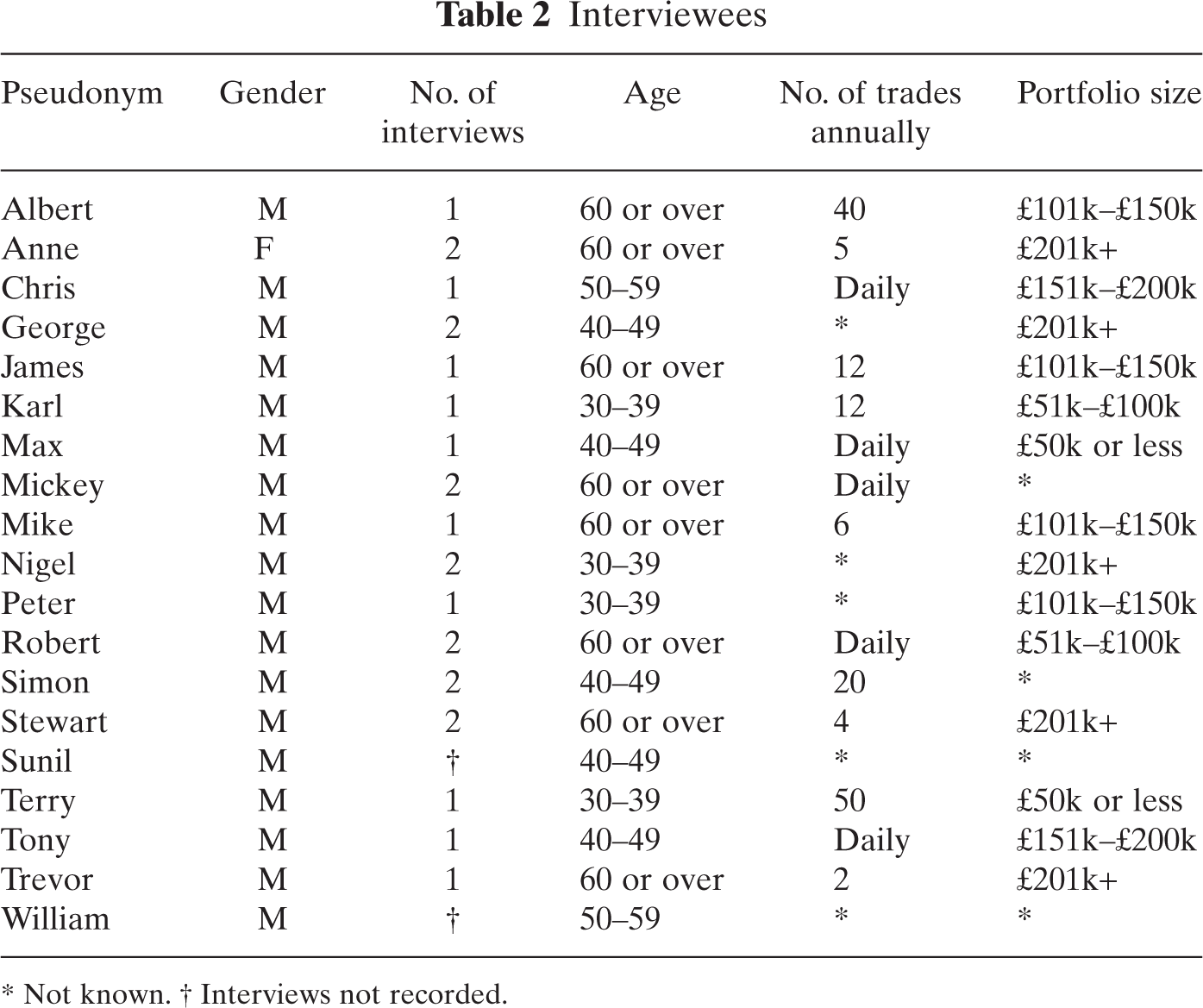
Not known.
Interviews not recorded.
Interview data were corroborated (Ahrens and Chapman, 2006) by the use of other methods: observation, the analysis of secondary material, and questionnaires which provided limited quantitative data (age, trading frequency, portfolio size) and qualitative data (eg media consumed) useful at a descriptive level across a large group of investors. 2 Observation took place at the investor events, and was recorded using field notes. Relevant brochures and demonstration material were collected at these events. Online investor resources were visited and other investment media were used where appropriate. Thus final data comprised interview transcripts, field notes, responses to the survey questionnaire, media articles, online materials, and marketing materials for investor products. Data were analysed from an early stage in the research process through comparison and re-comparison (Boeije, 2002). Themes were identified within interviews and across interviews; thematically clustered matrices (Miles and Huberman, 1994) were built to incorporate themes from literature as well as emerging themes in the data. Data saturation was considered to have been reached when analysis of interview and observation data contributed no new themes (Eisenhardt, 1991; Boeije, 2002); saturation was also evidenced by an increasing homogeneity of accounts, with investors detailing similar methods and articulating similar discourses of investing, for example with stock phrases of investment activity occurring frequently in interviews. The accounts offered by investors recruited through advertisement on referral did not present any additional or striking themes.
Materially embedded investing
The paper will now consider the role of devices in constituting the market agencements of investors. I will argue that investors are embedded in material relations where devices are not simply instruments in a post-social appresentation (Knorr Cetina and Bruegger, 2002) of others, but are active parts of a socio-technical arrangement. While the existence of devices points, in theory, to the myriad possibilities of market arrangement (Callon and Muniesa, 2005), in practice, devices closely specify the options available to investors and the outcomes of their calculations. Thus it is the material networks of investors that, echoing DiMaggio and Louch (1998: 620) ‘determine our choices of economic trading partners and how we interact with them’. This section will consider first of all screens, or more properly, the sites, texts and networks that the screens access. It will show that these media give rise to, and subvert, two core categories of embeddedness offered by Uzzi (1997): face-to-face relationships, division of labour. These categories will be considered in turn.
The screens
Screens were an important means for the non-professional investors studied to see and interact with the market, accessing via the open navigation of an Internet browser a wide and varied range of sites. It is, however, impossible to force the screens of the non-professionals into the background; these screens were overtly performative in the sense that they presented the market in a particular manner, constituting the user not only as a market participant in a general sense, but as a particular kind of investor (for example, a long-term investor, or a chartist) of value as a customer of the service provider. Interviewees were consumers of investment services, and the products and sites that they used were of a similar nature to the other sites that might be associated with everyday browsing and consumption activities: bright, dynamic and enormously varied, but at the same time carefully arranged with tightly specified functions and boundaries. Each space offered a different presentation of the market, different tools and different interpretations of market data, tailored to particular target audiences. Where the professionals use the screens as a workbench on which they can shape and enact the market (Beunza and Stark, 2004), non-professionals encounter pre-existent market performances, organized and curated by others, through which they may interact with the market in a particular kind of way.
Some websites achieve more prominence and centrality than others, and establish themselves as general gateways for non-professional investors. In doing so, they become simulacra of the market, spaces in which an investor could pursue the whole of his or her investing activity; they provide information, tools, context and meaning for the activity of investors. A discussion of market devices can benefit greatly from providing an analysis of the spaces in which they operate (Cochoy, 2007), and so it is useful to provide an example. One such example, ADVFN, 3 is an ‘investor portal’ and provides vast resources for non-professionals wanting to access the market. It offers investors access to real-time price data from the London Stock Exchange and Ofex (now Plus Markets), a news feed showing regulatory news and press releases, extensive fundamental data on companies, charting facilities, data on foreign exchange and futures prices, extensive bulletin boards and training. The only conspicuous absence from its offering is trading facilities, although these are offered through links to partner brokers. To give an idea of the popularity of this suite of online spaces, at the time of writing the site has 300,000 registered users, while 125,000 individual monthly users generate 30 million page impressions per month. 4 The overall impression of the website is of extreme busyness, a visual assault on the senses that mimics the hurly-burly of the financial markets; the homepage alone (see Figure 1) presents a wall of brightly coloured, restless information, including: index graphs, news and price feeds, the day's biggest risers and fallers, charting tools, as well as numerous advertisements. 5
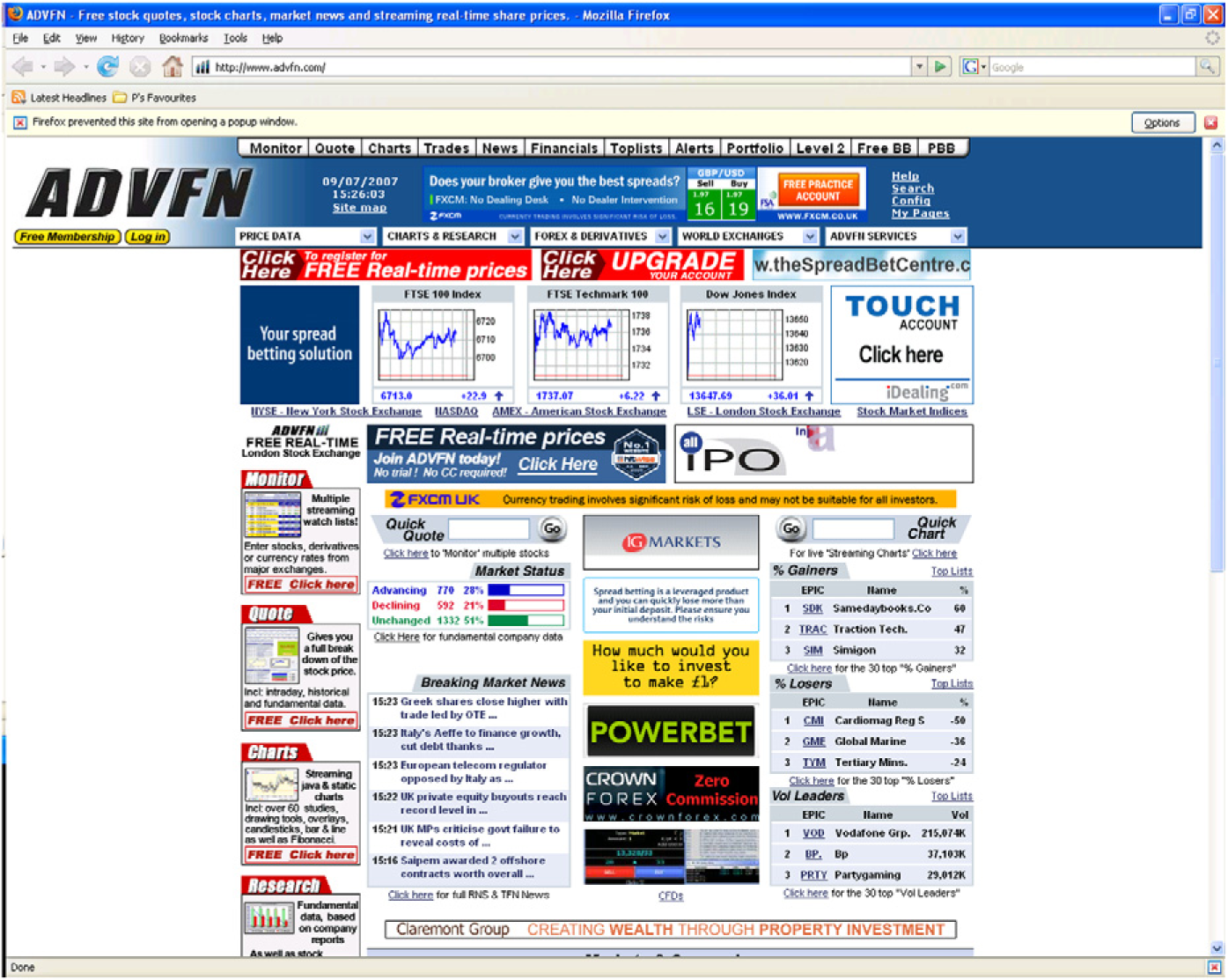
The homepage of the ADVFN portal, www.advfn.com (accessed 9 July 2007)
At the heart of ADVFN are the message boards: electronic fora where investors can interact, swapping ideas and opinions. The boards are busy, boasting 50,000 comments a month; 6 ADVFN's bulletin boards are but one example of a pervasive feature of non-professional investing. Bulletin boards are attached to portals, to stockbroker sites, represent specialist users and special interest groups. For operators they represent an opportunity to stabilize the community of users around a suite of revenue generating services, recalling Jessop's (2001) definition of embeddedness: the re-entangling of economic relations with social as a crucial precondition for the stability of markets. 7 Many bulletin boards are designed and organized in a way that fragments the universe of non-professional investors into groups defined by interest. There is, therefore, a tension between specialized sites and those general portals (such as ADFN) that seek to capture and represent the entire market. For users, however, these boards have a different function: providing a site for the social interaction of market participants.
Screen-based interactions
Studies of professional investors have viewed the activities of traders within the broader context of the organization (Beunza and Stark, 2004), or the market as an institution (MacKenzie and Millo, 2003). It is in these sites beyond the screens that politics of valuation, for example, are enacted (Beunza and Garud, 2007). Using Uzzi's (1997) taxonomy, these organizational sites may be understood as the loci of face-to-face interaction, reciprocity, and voluntary contribution, leading to trust and enhanced information. 8 Non-professionals lack such infrastructures; for those interviewed in this study, it appeared that the bulletin boards served as a substitute. Bulletin boards have different purposes for different investors. For some, this may only be a means of combating what Nigel describes as their ‘isolated occupation’, providing a social and institutional structure for solitary investors. For others, the message boards provide a space where they can develop an online performance as a market professional, emphasizing investment dexterity or specialist expertise. More active participants in these spaces, such as Nigel, got to know the online personae and were able to distinguish good quality posters from bad, making no distinction between the post-social presentation of a known other, and the entirely virtual phenomenon of the bulletin board colleague:
Interviewer: ‘Do you trust some posters more than others?’
Nigel: ‘Yeah! [with emphasis] Absolutely!’ (Nigel: interview)
Karl used discussion boards as sources of investment strategies to test out in the market. Robert has often invested on the basis of a bulletin board recommendation, and others, such as Simon and Nigel, used the boards as a source of first ideas for investment research. But electronic interactions remain first and foremost performances, in which true actions and intentions are not necessarily disclosed. For this reason, a minority of interviewees argued that the boards are of little value. Stewart said that he had ‘never found any comment of any use on a bulletin board’, while Mickey agreed: ‘I never use bulletin boards. There is generally such a load of crap on them whenever I've looked at them that I never bother.’ (Stewart and Mickey: interviews). These investors regarded bulletin boards as contentious sites, of dubious value, characterized by individuals with particular agendas acting anonymously, for example to ‘ramp’ stock by creating a false appearance of demand for the shares. But despite their reservations investors found it impossible to ignore these sites. Even Stewart and Mickey have enough experience of bulletin boards to pass judgment on their quality. Peter summed up the non-professional's troubled relationship with the message boards: ‘I get drawn into the bulletin boards, I do read them, I find them spectacularly dangerous.’ (Peter: interview)
The division of labour: devices and assemblages
Traditional notions of socio-economic embeddedness understand network relationships as existing between human agents: Uzzi (1997) lists face-to-face interaction as one of his five social structural antecedents of embeddedness. The bulletin boards illustrate the way in which distinctions between social and virtual are blurred as actors interact with virtual others in an electronic simulacrum of the market; actors on the bulletin boards were aware that electronic Others may be other than post-social mediations of trusted colleagues. The tidy categories of socio-economic embeddedness may be further eroded by examining a secondary phenomenon, the expert division of labour; another of Uzzi's (1997) preconditions for the development of embeddedness, as economic agents seek to achieve efficiencies by specialization. In a materially embedded market expert labour will be divided not only between human agents, but also between humans and devices, instruments inscribed with a variety of performative scripts. This is the very nature of an agencement: a distribution of agency and calculative activity. Moreover, in an investment service consumption market, these scripts will be calibrated for the configuration and retention of customers. Thus, online investment spaces are complemented by suites of tools offered by investment service firms, and these tools may actively shape the market productions that investors undertake. There is a dialectic relationship between tools and the sites that host them, with commentary and opinion on the message boards serving to educate investors in the use of tools, or to provide the particular world view or understanding that a device needs order to function. The complex tools of technical analysts, for example, require not only a certain proficiency in their use, but also depend on a given understanding of market function and organization (Roscoe and Howorth, 2009). Both may be easily learnt through the commentary offered on bulletin boards. Where investment service firms offer tools for use, they will form part of the process of customer differentiation achieved by the appropriate processing of market data: an execution-only broker targeting small-scale investors might offer recommendations for major shares, weekly or monthly tips, and some form of stock selection tool. Again, it is useful to offer an example. The ‘Share Picker’ (see Figure 2), provided by one such execution only broker, produces a shortlist of suitable companies on the basis of an investor's selection of key metrics; the broker hopes for a clientele of long-term clients with stable portfolios, and the metrics offered are staples of security analysis, such as dividend yield, P/E ratio, and earnings growth. Users of the device share labour with an expert in the shape of a screening tool, configured along the lines of the broker's requirements and integrated with the tips, articles, and advice provided by the broker's own staff.
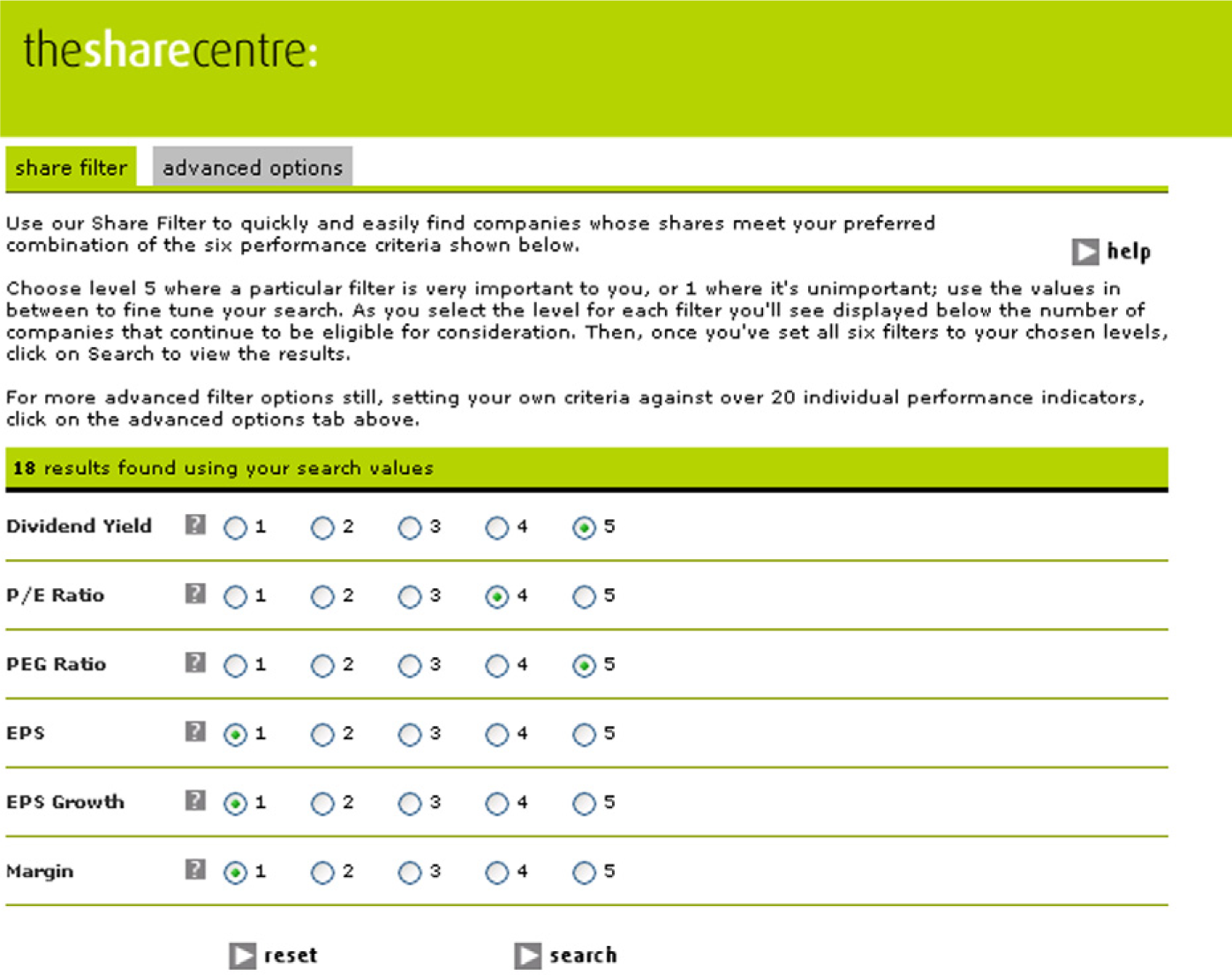
The Share Picker offered by the Share Centre (accessed 9 July 2007). Categories such as dividend yield and P/E ratio can be ranked in order of importance to generate a shortlist of stocks
Uzzi's (1996, 1997) analysis shows that economic agents spend much time in establishing themselves in social relationships in order to improve costs, information, and access to resources. An analytic perspective that stresses the material nature of embeddedness accepts the role of virtual others, calculative devices, and others actors represented by scripts such as newspaper articles. In this agencement, agency slips to even imaginary others: like Zaloom's (2003) ‘spoofer’, the spectre of the professionals’ ‘muddy footprints' haunted one interviewee's account:
The financial markets are actually set up to benefit the minority at the expense of the majority … they are manipulated quite cynically … you can actually see their [the big players'] muddy footprints all over the market as they trade, it's really uncanny. (Chris: interview)
Here we see another kind of performance, the solitary production of the market in the investors' own homes as individuals dramatically create relationships with real and imagined others (Preda, 2009). Remote, never met, even imagined others become counterparties in long-term relationships across the financial marketplace: the materiality of screen-based performance, analytic technology and performative text forms the basis of the embeddedness of these market agents. From these solitary performances interviewees slowly built their own representations of the market: Anne literally cut and pasted newsprint and magazine copy into her scrapbook, while Robert built up his computerized database with facts and figures on firms of interest.
At the same time, investors must interact with providers of financial services in order, for example, to gain advice and execute trades. Providers of advice and services to non-professionals position themselves explicitly against the monolithic financial sector. The investment writer Tom Bulford – who Simon follows closely – promotes himself thus:
I love banking big stock market gains – especially if it's on the blindside of other investors. Seven years ago I quit my high-flying career in the Square Mile to join a newsletter called … 9
Operators of these services are frequently owners of small firms who can develop social ties with their clients. But these relationships too can be dramatized interactions with others experienced in the form of text or screen. Simon referred to ‘my friend Mr Bulford’ (Simon: interview) while Albert says of the designer of his analytic software:
He is a wonderful man, he's so generous and kind and clever. Amazing man, I could follow him to the ends of the Earth. (Albert: interview)
Unlike their professional peers, non-professionals must build their own infrastructures using online services, tools and meeting places. Perhaps this may account for the sustained use of message boards, despite frequently expressed misgivings over the quality and intention of performances made there. It appears that, in their role as the online public places of the community, the boards were not representations of what is going on in the market. Rather, the performances they host are the market, at least as experienced by certain groups of investors, of whom these interviewees were one. The commercial segmentation of investing activities locks investors into particular sites, each with its own set of language, devices and investing folk wisdom, resulting in a proliferation of markets that reflects Law and Urry's account of the social sciences, where ‘different research practices might [make] multiple worlds, and that such worlds might be equally valid, equally true, but simply unlike one another’ (Law and Urry, 2004: 397). For interviewees it appeared that the message boards performed a similar function to the open outcry pits of pre-digital markets, as a site of performance of prices, where social interactions, non-verbal cues, and factors such as the overall noise level could be taken as indicators of the state of the market (Zaloom, 2006; Çalişkan, 2007). Non-professional investors can follow market activity by watching the interactions on the discussion boards. In place of a straightforward social embeddedness we find these investors building relationships of trust and shared expertise with heterogeneous and often material actors. Reciprocity and exchange emerge, even in the partnership of the advisory device and investment service customer. Recognizing that markets are embedded in material artefacts as well as social relationships – understanding, in other words, the agencements of these non-professionals – allows us to make sense of these relations.
The role of the social: spectacle and self-identity
It would, however, be untrue to suppose that the non-professionals' market is constituted solely by solitary interactions with devices and imagined others, for investors took part in a market that also enjoyed a rich social dimension. Interviewees visited training seminars and exhibitions, where they met expert traders, company directors, and promoters of investing and trading materials. They also formed investment clubs and other social groupings to discuss investment ideas, strategies and techniques, combining the business of investment with a pleasurable social excursion. Yet, as the nature of these venues implies, the social interactions of non-professionals at shows, seminars and clubs does not much resemble the long-term, needs-driven socio-economic embeddedness envisaged by Granovetter (1985) and Uzzi (1996). Instead, as the present section makes clear, the social slides into spectacle (Debord, 1983), becoming a performance of the most overt kind. I will argue that the concrete, physical presentations of markets fail to deliver the benefits of embedded economic relations as set out by Uzzi's (1997) categories. Instead, market performances appear to be closely linked to the presentation of identity and more appropriately theorized as a consumption activity (Harrington, 2007).
Investment shows and market spectacle
Large-scale investment shows epitomize the tension between society and spectacle in the activities of the non-professionals interviewed. These shows appear to be a particularly important aspect of the physical production of the markets for non-professional investors, giving them a rare opportunity to interact with an investing world on a larger scale. The show is part bazaar, part spectacle, and part learning experience; investors attend to browse, to learn, and to be part of a public performance of the financial market. It is worth analysing one show in more detail to illustrate this point. 10 The very layout of the show underwrote its intention as a performance. The venue, a hall in London's Olympia, offered space for approximately 45 stalls as well as two substantial auditoriums. It was configured in a large ‘U’ shape, with auditoriums on the left-hand side (from the entrance) and the majority of stands on the right. These stands were occupied by exhibitors, investment services companies ranging from the stock-broking arms of major financial institutions to small independent financial publishers and software providers. Stands were brightly coloured, illuminated, and in many cases furnished with armchairs and sofas, where attractive, young salespeople extracted signatures on account opening forms. In addition to the auditoriums, there was a further open seminar area beyond the stalls, seating approximately 50 and equipped with projector, screen and PA system. Two of the larger stands also had their own miniseminar areas, seating roughly 30, and similarly equipped. These were located at the corners of the ‘U’. A delegate, standing anywhere in the halls, was within aural range of one seminar at any given time. Those stands lacking their own seminar space were likely to have a large-screen television displaying the latest financial news. The rolling programme of seminars, backed by Bloomberg TV or CNBC, produced a wall-to-wall carpeting of market talk. The combination of name badges suspended on trader-style neck fobs (distributed at the entrance), the bustle, the barrage of computer screens displaying charts and market data, the ever-present noise from the seminars, the steady ebbs and flows of preoccupied people, all served to lend the show an air of authenticity, something of the flavour of the genuine trading room.
Despite the exhibitors' emphasis on sales, it was clear that investors had attended the exhibition primarily to learn, and considered exhibitors' stands to be of secondary importance to the exhibition's seminars. The seminar programme was substantial, and conference sessions and seminars dominated proceedings at the show. They represented a clear priority for the attendees; on numerous occasions the attendees were unwilling to complete a questionnaire because of an imminent seminar, or checked their watch before agreeing to do so. Where it was possible to observe seminars in progress I saw that they were full to capacity and often had a standing audience. There was, of course, a commercial aspect to many of these seminars. The representatives of investment service firms extolled the virtues of particular practices or techniques, and manufacturers of software explained how one aspect of market function (easily detectable through their proprietary algorithm) might be harnessed to deliver endless profits. On the other hand, there was a sense, manifested particularly in the panel debates that took place each lunchtime, that the nature of the market itself was still open to discussion; a keynote panel that explored the merits of technical analysis as against ‘fundamental’ investing sought an understanding of market operation, seemingly considering that operation to be malleable, one that could be contested and settled through a democratic process of analysis and debate. In these spaces investors did more than produce a pantomime of the market. Instead they took ownership of it, seeking to define and articulate it through their performances. As is the case with professional investors, the market becomes seen as an epistemic project (Knorr Cetina and Bruegger, 2000), a common object to be worked on and defined by the community of investors.
The investor show, therefore, becomes an arena for debates over the politics of valuation and market organization. Yet given the size and market power of professional investors as against the non-professionals, it is hard to see such politics being enacted. The debate becomes instead the venue for another spectacle, the rhetorical resistance to professional finance. Moreover, while the theory of embeddedness stresses the improved information available through social relationships (Granovetter, 1973; Uzzi, 1996), investors still had reservations about the quality of information gathered at these commercially hosted investment events. As Karl explained,
I like to go because you pick up some good things from fellow investors … in this one I didn't really pick up anything personally anyway, but sometimes although it seems like I didn't pick up anything now, in the future something might arise. (Karl: interview)
As do the bulletin boards, investor events offer individuals an opportunity to take part in public performances of the market, eruptions of a virtual, second-order market into the real world; like the bulletin boards, exhibitions are noisy, overwhelming, and often of dubious value in terms of information, and yet unmissable.
Investment clubs and self-identity
Another category of social event is the investment club. Investment clubs allow participants to meet and talk, and have been identified as a means for individual investors to access the capital markets (Harrington, 2007). Harrington's characterization of non-professional investment as a form of consumption activity recognizes the link between investment activity and identity:
More often, it was a matter of taste, or what Bourdieu would call ‘distinction,’ as in the case of the group that refused to buy stock in La-Z-Boy – a manufacturer of reclining chairs and sofas associated with middle-brow American décor – because, despite the firm's excellent economic prospects, it came with class-linked connotations that the investors thought would reflect poorly on them. (Harrington, 2007: 22)
Investment clubs allow investors to display expertise and serious intent, exemplified by Mickey's dismissal of less serious clubs is operating on a ‘Here's my fifty quid, now let's go and have a pint’ model. Yet the stated intention of these sites is social, and sociality. Albert describes formation of one such club:
A gentleman called [] who lived in Essex, had retired, had a lump sum, had been in business and clever with money, took his lump sum and started doing a pension scheme and was absolutely appalled how badly he was doing on the stock market, when he thought that he was good at it because he'd been doing figures all his life. So he wrote an open letter in the Investors Chronicle, and said: I'm retired, I'm doing this and it's a very lonely business and I'm very, very dismayed at how badly I'm doing. If there are any fellow travellers out there who'd like to meet for lunch once a month and commiserate and chat over the stock market, please write. (Albert: interview)
Investment clubs fill the need for an institutional and social framing of investment activity. Club members do develop genuine social relationships, and do divide labour, culminating in joint problem-solving and learning. But most of all, investors talk. At Mickey's club, members talk:
About shares, individual shares, how individuals arrive at particular shares, what trading they've done during the month … [or we] discuss particular sectors…. one of the guys has just done a presentation on the transport industry, he actually works in it as a logistics adviser. (Mickey: interview)
George attended a club where individuals run a dummy portfolio throughout the year based on their own investment preferences, such as high dividend yield, the ‘Zulu principle’, or George's favourite, small-cap technology stocks. At Albert's club members chatted over anything remotely related to investing, ‘what Tate & Lyle are doing, what Morgan Sindell has been doing, as builders what about the building sector … about politics and Gordon Brown and taxation and the world, the Green ecology system’ (Albert: interview); while in other venues they explore sophisticated strategies of charting and options trading. Social sites are spaces where investors can enhance their skills and abilities, learning new things and absorbing new information. More than this, they are a place for performance, enabling individuals to present themselves as investors, as experts, and as participants in a market that remains largely invisible to others.
In summary, social spaces formed an important part of the activities of these non-professional investors. Yet their purpose was as much that of performance, spectacle and entertainment, as it was a constituting aspect of economic relations. It seemed as if the social spaces presented an escape from the mundane and solitary activities of the individual investor (Preda, 2009), as much as they contribute to the quality of investment information and skills. An analysis of this one sector of the market must be most cautious in asserting the purely instrumental and economic value of social relationships.
Discussion
This paper has set out to consider the nature of embedded economic relations among one group of non-professional investors in the UK. It has explored their everyday interactions seen, for a group that trades relatively infrequently (Table 2), largely in terms of gathering information and forging networks. I have argued that the category of material, largely neglected in social network research (cf. Kilduff and Brass, 2010), is vital in understanding the embedded economic relationships of these investors. I have made use of the concept of agencement (Callon and Muniesa, 2005), popular in the science and technology studies inspired literature of financial markets, to describe the complex, agency-filled networks of device, theory, and place that surround these investors. I contribute to the literature's understanding of agencement by theorizing these network forms in terms of the analytic categories of embeddedness proposed by Uzzi (1997). In short, I demonstrate that material agencements may give rise to the components and effects associated with a social analysis of network embeddedness.
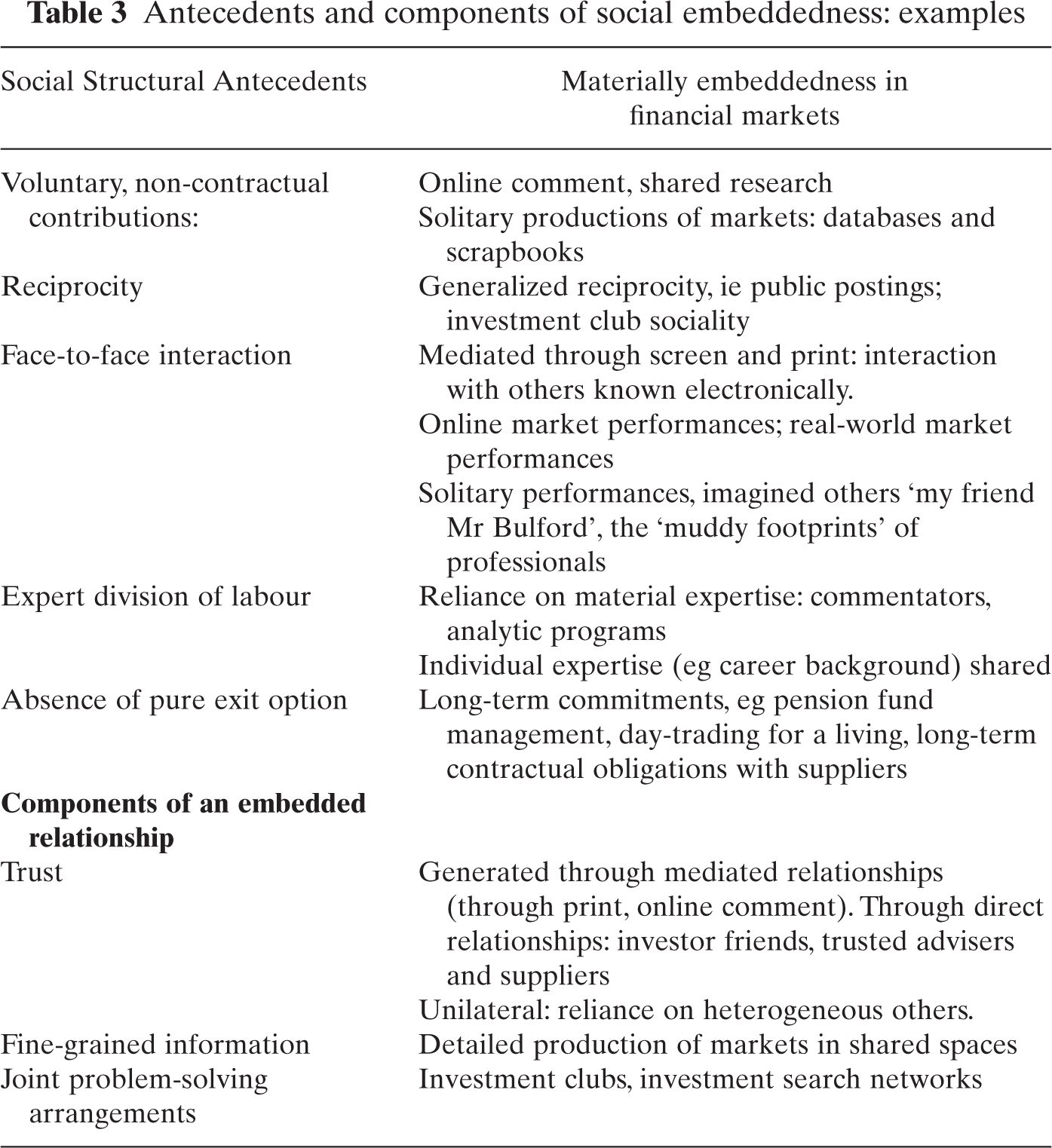
Uzzi (1997) lists five structural antecedents of embeddedness: voluntary contributions, reciprocity, face-to-face interaction, expert division of labour, and the impossibility of exit. Together these lead to embedded relationships epitomized by trust, better information, and joint problem-solving arrangements. Table 3 sets out these categories and considers some of the investors' everyday actions which correspond to these categories. Voluntary contributions, for example, are manifested by shared research, often posted online, and online comments. Once it is recognized that artefacts such as scrapbooks and databases enjoy a status equivalent to the human agents in interviewees' production of financial markets, solitary activities such as the compilation of investing databases can be included here. Reciprocity is present in a generalized form in public postings and the debates of investment shows, and more specifically in the bilateral exchanges of investment clubs, for example. Face-to-face interaction is found in numerous categories: mediated through screen and print, through interaction with others known electronically and in the real world; through solitary performances and imagined others, whether the amiable Mr Bulford or the muddy footprints of the city traders. Labour is divided among individuals – career experts offering presentations in investment clubs – and between commentators and analytic programs. Though not discussed explicitly in my analysis, the absence of an exit option is evident, with investors making long-term commitment to earn a living or manage a pension (Albert, Mickey, Chris, Terry: interviews). The table also details the components of an embedded relationship: (1) trust, which is generated through bilateral social relationships, bilateral mediated relationships or materially embedded relationships (ie with text or inscribed devices); (2) fine-grained information, manifested by the detailed production of markets in shared spaces; (3) and joint problem-solving arrangements in the form of investment clubs, investment search networks, online debate and criticism, and the development and sharing of more powerful kinds of investment decision making.
Antecedents and components of social embeddedness: examples
On a broader level, the insight of Uzzi's (1997) study – that economic pressure and the search for improved performance among participants in a confined market arena leads to the development of mutually helpful social relationships – can be seen to be true of the non-professional investors interviewed. Trust, for example, a cornerstone of social embeddedness theorizing since Granovetter's papers (1973, 1985) is manifested across agencements (in devices, algorithms and scripts) to a far greater degree than it appears in social relationships. At times, the human agent is invoked as a synecdoche for the device: Albert claims to trust his software program because he trusts its original designer, now the chief executive of a small firm selling financial analytics. Pundits such as Jim Slater, and ‘Mr Bulford’ though not known in person, are rich in symbolic capital (Bordieu, 2005) which becomes the basis for use of their books and trust of their advice.
Fligstein (1996, 2001) noted the sparse nature of social networks. The literature of market devices also finds networks sparse; while it sets out from the shared assumption that markets are inherently social, researchers have repeatedly argued for the inclusion of tools, instruments and material settings within the analytical framework of social embeddedness. The focus of these investigations has been the distributed nature of calculation (Callon and Muniesa, 2005): ‘What counts? Tools count. Instrumentation must be brought into the accounts of economic sociologists’ (Beunza and Stark, 2004: 370). For Beunza and Stark, calculation is distributed across persons and instruments, not simply embedded in social relations. Yet at the same time, studies of professional investors have incorporated conservative accounts of the role of the social. MacKenzie (2003b) discusses the Granovetterian sociology of hedge fund managers; Beunza and Stark (2004: 378) see the trading room as a ‘space of sociability’, and Hardie and MacKenzie (2007) present an account of socially structured mechanisms of a hedge fund. Calculation stretches out of instruments, across desks, and into social relationships. Muniesa (2008) argues that research should pay attention to the way in which the technical features of devices shaped action in particular ways; yet the device in question, the telephone, serves primarily to allow identification of counterpart and the construction of interpersonal networks of trust and recognition at a distance. As one trader says, ‘It's good to see who does what. It's important to be able to call the person’ (Muniesa, 2008: 9).
The present paper also sets out from the position that markets are social, and that social relationships have much to offer market participants (Uzzi, 1997). It asks how market participants construct sociability in the absence of institutional structures, and often in the absence of genuine social interaction, whether direct or technologically mediated. Investing, for many, was a lonely occupation (Nigel: interview). The non-professional investors examined in this paper exhibited the characteristics of a Granovetterian sociology: they sought to stabilize economic relationships, to guarantee market information, and to build relationships of trust. Yet the vehicles for doing so were the devices and spaces made available to them by the Internet and by investment media. Existing studies of market devices offers evidence of traders and analysts trusting the calculative power of their tools and instruments (Beunza and Muniesa, 2005); in my analysis of non-professionals this trust is developed further as devices take on the role of the social structures that surround professional traders. In an ironic turn, the analysis has shown that face-to-face relationships may even offer less to investors in terms of fine-grained information, shared labour, and trust; it appears that the value of investment shows and clubs is primarily in their spectacle and enjoyment value.
I offer a brief comparison with the contributions of three analysts who have pursued other relationship-based perspectives: Baker (1984), Abolafia (1998) and Zuckerman (2004). These contributors privilege, respectively, physical proximity, cultural norms and scripts, and classificatory regimes. Baker's (1984) pioneering study drew attention to the power of social structure in facilitating market operation. Bounded rationality and opportunism, major preoccupations for traders in the pits, could be most effectively overcome by micro-networks offering trust and social policing; these persisted whatever the size of the crowd. Baker determines an optimum crowd size for stable pricing, and shows in one sense that the physical matters. Yet his analysis neglects the sheer physicality of the trading pits as documented by Zaloom (2003: 263): ‘The tone of voice, the body language of the trader, who may be steadily and confidently holding his hands forward in engagement with the market or yelling his bids, spittle flying and eyes wide, in desperation to get out of the trade, are crucial inflections that traders draw on to form market judgments.’ While Baker's account omits this aspect of market physicality and its impact on traders' calculation, Zaloom has persuasively argued that a richer account of market cognition is offered by its inclusion. Similarly, the relative abstraction of his approach neglects the impact of trading tools and mechanisms: trading cards and stamps are mentioned in his methodology, yet do not feature in the analysis offered. Zaloom's (2006) account of the evolution of Chicago's trading rooms makes clear the importance of acoustics, pillars and telephones in constructing a functioning market.
Abolafia's (1998) study of ‘markets as cultures’ understands markets as held together by regulative and normative rules and behavioural scripts. These govern the pursuit of self-interest and stabilize everyday trading: customers' orders must always be executed first, and all transactions go ‘on the tape’ as soon as possible (1998: 71). Market efficiency and the competitive atomization of participants are guaranteed by a ‘caricature of the spirit of capitalism’ (1998: 72). As with Baker's study, material structures and artefacts lurk in the background: the understanding among market-makers that all trade should be brought to a particular spot, that orders must be placed ‘in the book’ and transactions ‘on the tape’. Abolafia's traders use ‘toolkits’ (1998: 72 and 77) and develop routinized procedures of sorting (1998: 75), yet these comprise linguistic and behavioural scripts, rather than actual devices. For Abolafia, as Baker, it is sufficient to abstract rules and scripts from the physical location in which they take place. For both, social processes are considered to organize the use of material artefacts, which appear as props in their account; a market-devices approach, on the other hand, recognizes the contribution of tools and artefacts to the development of social routines, which arise not merely as solutions to problems but through repeated use of market equipment.
Baker (1984) and Abolafia (1998) study infrastructures of pre-electronic markets that are robustly physical. A more recent contribution comes from Zuckerman's (2004) analysis of security pricing. Zuckerman follows Baker in his understanding that the social structure is the network of trade underlying markets, and that it emerges via attempts to solve market problems. He understands classificatory structures as ‘socio-cognitive processes by which market participants make sense of stocks even in the face of severe interpretative challenges’ (2004: 410). For Zuckerman, these processes are part of a ‘crude functionalism’ (2004: 428) that allows markets to function. An alternative approach would be to consider the impact of analysts' tools on these classificatory structures, viewing them as ‘socio-material-cognitive’ processes; as Muniesa (2008: 309) points out, market actors are complex arrangements, and the absence, presence and variety of material devices constitute ‘economic actors that are different and act differently’.
My analysis pursues Muniesa's line of questioning further. The embeddedness of social relationships in screens (Knorr Cetina and Bruegger, 2002) and telephones (Muniesa, 2008) is well established. In my account, technology becomes more than a mediating device for well-known and identifiable counterparts. The relationships of non-professional investors with electronic others, with others instantiated in text, or with analytic programs alone emphasize the importance of material devices in relationships. As Preda (2009) shows, solitary investors conduct negotiations with others imagined in their computer screens: what kind of embeddedness is this? My analysis is intended to develop, rather than to dismiss, the notion of the embeddedness of economic transactions. It is quite clear that the investors studied valued the consequences of socially based economic relations as identified in social network research: stability, trust, and better information. In this paper I show that the (largely beneficial) properties and effects of social embeddedness, as set out by Uzzi (1997) can be achieved by material relationships embedded into heterogeneous agencements, at times in the absence of any social relationship – technologically mediated or otherwise. I suggest that, while analysis of social structures remains a powerful tool for the analysis of markets, in order to provide convincing accounts of economic embeddedness, a broader understanding of ‘social’ must be introduced; that a broadening of scope to include material categories can do much to invigorate social network approaches.
A second implication stems from the potential for generalization on the basis of a systematic and plausible case study (Eisenhardt, 1989, 1991). In presenting a case relating to one niche within a broad market of non-professional, retail or even leisure (Harrington, 2007) investing – a group of time-rich UK investors who structure their activities around the face-to-face meetings where they were recruited – I cannot claim that my conclusions are representative of the entire marketplace. I suggest, however, that the effects detailed in this paper, and corroborated by existing literature on the professional marketplace, will occur in other sectors of the financial market as experienced by non-professional investors, and that this assumption may form a useful basis for future research. Moreover, where consumer facing economic markets (markets for financial products such as insurance and mortgages, for example) are increasingly served by electronic apparatus that resembles the agencements discussed in the paper, I would suggest that there is considerable potential for extension of the research topic into these areas.
As such, the argument has ramifications for approaches in economic sociology that persistently view economic relations as comprising social relationships built on face-to-face contact, or at the least technologically mediated relations between identifiable counterparts. Micro-level approaches using, for example, a concept of structural holes to account for entrepreneurial opportunity (Burt, 2005), might be more usefully served by following a theoretical model informed by the notion of material networks and agencements (Roscoe et al., 2012). Macro-level theorizing, wishing to take into account the claims of politics and regulation on the embeddedness of global electronic financial markets (Sassen, 2005) may also benefit from pursuing an analytic framework that is alive to the political, cultural and regulatory aspects of markets (Muniesa et al., 2007; Çalişkan and Callon, 2009). As Latour notes, macro-level social structures may usefully be understood as the product of a ‘summing up of interactions through various kinds of devices, inscriptions, forms and formulae’ (Latour, 1999: 17). My case study sees these concerns as inscribed in the devices through which investors encounter the market. The heavy regulation of financial services in the UK limits the scope and advice of products offered, and is evident in the disclaimers and guidelines provided alongside tools and products and in promotional material. Cultural practices may be seen in the understanding of market function, played out in debate and then inscribed into devices; the debate of ‘technical versus fundamental’ becomes crystallized into the choice between charting engine and Share Picker. Politics, both of resistance to professional finance, and of the simultaneous exploitation of investors as investment service consumers, likewise becomes enacted through the agencements of the non-professional investors.
Politics suggests another avenue for future research: a critical (Alvesson and Deetz, 2000) analysis of the relationship between non-professional investors and the investment service firms. These firms have been present throughout my account, shadowy figures in the background, yet instrumental in the production of the market for non-professionals. Carefully distinguishing themselves from the underperforming and disliked fund managers and the despised professional traders, these service firms provide the fundamental architecture of the financial markets as encountered by non-professional investors; customers may come and go, but the infrastructures of investor portal, investment road-show and brokerage site endure. Academic research in finance provides much evidence that individual investors damage their investment returns by taking unnecessary risks and trading too aggressively (Barber and Odean, 2000; Barber et al., 2009). Interviewees ascribed their lack of success to a lack of discipline, or a problem with their method which further efforts would iron out; they employed strategies of self-deception and mental accounting (Thaler, 1999) in order to bolster their investment performance and stay in the game. Being an investor and staying in the market requires considerable efforts in constructing and disciplining the self, a project that may be best understood, as Harrington (2007) suggests, in terms of consumer aspiration and self-identity (Schouten, 1991; Belk et al., 1996). A critical, emancipatory position may have much to offer investors as well as researchers.
In conclusion, let us reconsider the intention of this paper – to invigorate the notion of economic embeddedness through an exploration of its material aspects. The paper has argued that allowing the concept to include the material (understood as an agencement comprising agency-filled, performative devices and texts) provides a rich and nuanced account of market function that sits well in the context of global electronic financial markets. The paper has illustrated its claims with a study of one group of stock market participants, and in doing so has highlighted further peculiarity of material embeddedness – that the realm of physical presentation and personal contact becomes of less value in terms of information, and more important as a venue for political drama and the rhetorical construction of identity. The material, on the other hand, displayed the characteristics most associated with socially embedded economic relations. A materially informed account of embeddedness can, therefore, accommodate not only information, not only culture, regulation and politics but also rhetoric and self-identity. By relaxing the notion that only the social matters (surely not an overly contentious assertion in contemporary sociology), embeddedness becomes a powerful analytic framework and one that holds much promise for future work in the sociology of markets.
Footnotes
Acknowledgements
An early version of this paper was presented at the 2008 Annual Meeting of the American Sociological Association. The author thanks the reviewers, discussant Daniel Beunza, and the audience for their constructive suggestions. Rene Algesheimer, Shiona Chillas and Paul Hibbert read versions of this paper and provided invaluable advice. The author also thanks three anonymous reviewers and the editor of The Sociological Review. Errors and omissions remain the responsibility of the author alone.
1
The term agencement, approximately translated as ‘assemblage’, stems from studies of distributed cognition (Hutchins, 1995), from actor network theory (Latour, 2007), and more recent work in economic anthropology (Çalişkan and Callon, 2009,  ). Agencement is a more useful term than its English translation as it denotes the unity of agency and arrangement.
2
Eighty-six per cent of respondents were over 30 years of age with the modal category being 50 to 59 years. Eighty-four per cent of questionnaire respondents were male. Despite my best efforts, I was only able to interview one female investor, and noted that her opinions, phrases and even descriptive metaphors were very different from those of her male peers.
4
Source, www.advfn.com (, accessed 25 October 2010).
5
An observer might be struck by the prevalence of ‘spread betting’ advertisements on this page. At the time that this research was carried out (2006–2007), spread betting was being aggressively promoted to investors as a tax-free means of emulating the margin trading available to professionals. Interviewees spoke in excitement of the possibilities afforded to them, although one (Sunil) remarks that he had lost £5000 almost immediately on joining a spread bet site. While research notes that the epiphenomena of gambling are evident among non-professional investors (Kumar, (2009), my interviewees actively rejected the notion that they gambled, and the theme is not pursued in this paper. A similar rejection of gambling was encountered by in her study of Australian non-professional investors.
6
Source, www.advfn.com (, accessed 25 October 2010).
7
This author was, from 2001 to 2002, director of a company that operated investment bulletin boards.
8
10
IX 06, held in London's Olympia in October 2006. The researcher gained permission from the organizer to administer questionnaires and observe the exhibition.