






Abstract
This paper presents a study of one street, Calçada de Sant'Ana in Lisbon, Portugal. In 2007, the authors lived on that street for a month. The stay facilitated observations that together help to understand how the social and the spatial are woven together, and how seemingly very different processes, time-scales and types of actor, such as momentary human encounters and slow decay of buildings, produce a specific socio-spatial continuum, a ‘street-phenomenon’. Calçada de Sant'Ana can be characterized as a collective work, an oeuvre. Inspired by Henri Lefebvre's notion of rhythmanalysis, the paper explores how form, use and meaning are co-constitutive. Building on Doreen Massey's notion of urban places as specific articulations of both local and global, Gernot Böhme's idea that urban atmospheres concern the style and manner of the unfolding urban life, and Walter Benjamin's discussion of the porosity of space, we explore in detail a variety of moments in the social production of urban space. The study shows that an attention to urban rhythms provides important new insights in the analysis of public urban space. Calçada de Sant'Ana turns out to be a very positive example of open and inclusive contemporary public space, providing a counter-example to the dominant discourse of ‘erosion’ of its public character. Aspects of the case might be generalized as new tools of analysis and activism to create differential urban spaces elsewhere.
Introduction
Within architectural theory and discourse, we can identify three main approaches to the analysis of urban space and processes: diachronic, synchronic and experiential. Diachronic analyses are historical, focusing on change and the evolution of urban form and its constituents. Typomorphology (Moudon, 1994; Rossi, 1982) is one important example of a diachronic approach. Synchronic analyses focus on the present situation, studying the qualities, performance and effects of spatial configuration across scales; a well-known example of such an approach being Space Syntax (see Hillier and Hanson, 1984; Hillier, 1996).
Experiential analyses explore the non-quantifiable and relational aspects of urban space focusing, for example, on users' preferences, feelings or affects. The experiential approach is, for example, currently exemplified by the study of urban atmospheres (Böhme, 1998, 2001). While the basic analytic categories of form, use and meaning are usually all present in architectural analyses of urban space, their relations are theorized in a variety of ways. The ‘triad’ of form, use and meaning has close resemblance to the ‘instances’ of social production of space as discussed by Henri Lefebvre in the opening chapter of The Production of Space. Schmid (2005) traces the origins of Lefebvre's concepts to the early 20th-century phenomenology and linguistics. The notion of ‘the dialectic of space’ is Lefebvre's genial proposal to create a dynamic relation between the conceived, perceived and lived instances in the production of space. Dialectics of space unearths the political significance of urban space, characterized by its centrality and understood as a site of resistance and creation of new urban life forms.
In this paper we focus on one case, that of Calçada de Sant'Ana in Lisbon, Portugal (Figure 1). We will explore, first, how form, use and meaning are co-constitutive (Massey, 2005) in producing a specific urban entity; secondly, we consider how the social organization of this setting has produced a very positive contemporary public urban space, unquestionably inclusive and with open parameters of the ‘right to the city’ (Lefebvre, 1991; Mitchell, 2003); and, thirdly, we make an argument for the way in which aspects of the case might be generalized as new tools of analysis and activism in creating inclusive and differential urban spaces elsewhere.
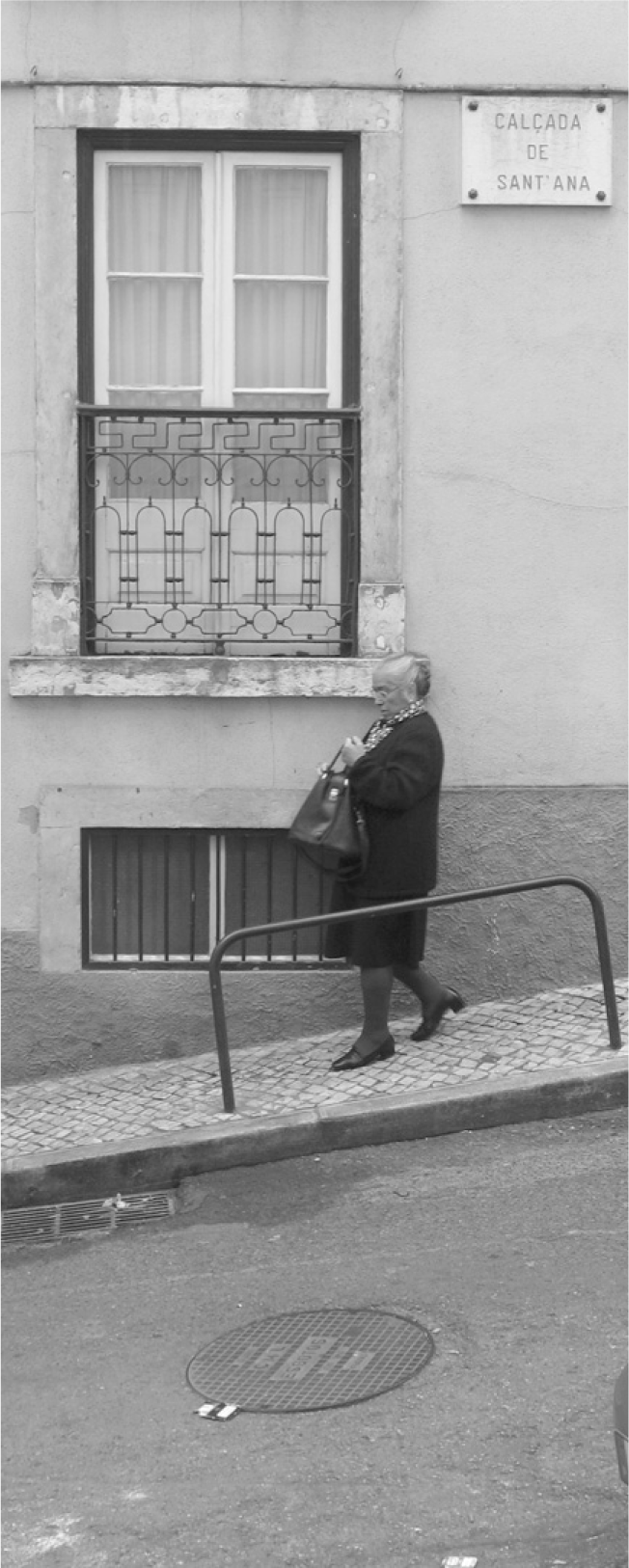
To choose a fairly unknown street as our case study is justified, first, by its positioning as a powerful counter-example to the dominant discourse on the erosion of public urban space. Calçada de Sant'Ana in Lisbon's inner city strikingly lacks the all-too-well-known signs of fear, control, commercialization and corporate power. It is a different contemporary space – even in the context of Lisbon. This difference raised our curiosity: there is something to learn and something to tell which is not limited to the geographic or climatic characteristics of the case. The case is justified, secondly, by its methodological links to a number of earlier detailed and specific studies on streets or neighbourhoods. We would like to mention Walter Benjamin's and Asja Lacis' work on Naples (1979 [1924]), Jane Jacobs' work on Greenwich Village (1961) and Edward Soja's work on Amsterdam city centre (1996). We are fully aware that at the moment of analysis, each of these places did belong to a set of larger systems or ‘networks’. But, still, a creative focus on one place or one ‘locality’ did provide useful and interesting insights. We hope that the following pages show that this approach is still possible in this decade, in spite of intensified non-local connectivity and the technological mediation of experience. To show that focusing on one, seemingly small, case is not nostalgic or limiting, but rather forward-looking and inclusive, is one of our aims in this paper.
Our interest in rhythms as a tool of analysis is not external or theory-based. Rather, rhythms offered themselves as the first and most inviting access point from which to start to observe, and make sense of, Calçada de Sant'Ana and its life. Despite the rather extensive academic work on production of space, both the malleability of urban space and its (relative) stability are still poorly theorized. Through our work on Calçada de Sant'Ana, we realized that an attention to urban rhythms provides important new insights into the social organization and production of space in general and, in particular, the analysis of public urban space.
The idea of rhythmanalysis in Lefebvre's late work can be seen as a direct continuation of his project to think spatiality and temporality together. Not to claim superiority for either of the two is a recurring methodological theme in the Critique of Everyday Life, The Production of Space and other texts (Lefebvre, 1991; Gottdiener, 1993, 1994; Elden, 2004). While Lefebvre does provide a general conceptual framework with which to grasp these dimensions, the empirical grounding of the discussion remains less than adequate; the ways in which small and mundane everyday acts simultaneously sustain urban space and are the ‘site’ of its change remains poorly developed. In this article, we wish to show the power of rhythms in exploring the two-way productive relations between people and space and in unearthing a dynamic co-constitution of elements that come together, juxtaposing themselves in urban space. Rhythms are not only ‘movements and differences in repetition, as the interweaving of concrete times’, but always also imply ‘a relationship of time to space and place’ (Nielsen and Simonsen, 2003: 917). In this theoretical frame, space is seen as a ‘concrete abstraction’ (Stanek, 2008), as a mental thing underpinned by real and material social practices. In the following pages we aim to demonstrate how rhythmanalysis opens new insights to social production of urban space and city understood as a collective and creative work, an oeuvre (Lefebvre, 1991).
1. Form, use and meaning
The butcher's cleaver
Calçada de Sant'Ana is a narrow, winding street, climbing uphill from the corner of Lisbon's main square Rossio (Praça dom Pedro IV). In 2007 our family – two adults, our twelve-year-old boy, and a puppy poodle – lived there for a month. Adjusting to the place, wondering where we actually were, and how to understand the place, we suddenly had a striking experience. One morning we woke to a repetitive sound: ‘thup-thup-thup’. Realizing that it was the cleaver of the butcher a few buildings down the street, we started to listen. Soon we became immersed in that and other sounds, each with their own rhythm. Children, cars, neighbours in the hallway, birds on balconies, and again: animal bodies cut, ‘thup-thup-thup’ … Half-sleeping, half-awake, we were grasped by the rhythms of the street – our street – and became first curious, then intensely interested in it, in them.
At first sight, Calçada de Sant'Ana has many characteristic, even cliché, signs of a south European urban space: colourful buildings, laundry hanging over the street, old men chatting in bars, Catholic nuns on Sundays and, indeed, open butcher's shops. But very quickly we realized that in its ordinariness the street was unique. While it felt different from our previous urban experience and of our conventional academic understanding of ‘contemporary cities’, it was also different from most other streets in Lisbon's older neighbourhoods. Calçada de Sant'Ana seemed to have its own rhythm and logic. The street had a power, its own radiance, but at the same time was open and inviting. Even though we were outsiders or ‘guests’, we felt very strongly that we partook in the production of Calçada de Sant'Ana (Lehtovuori, 2008).
The butcher's cleaver awoke us to thinking of how rhythmanalysis, inspired by Lefebvre, might help us to understand the characteristics of the street and its public life. We wanted to make sense of this specific place. As Simpson (2008: 813) has argued, ‘[w]hilst many have called for or suggested the usefulness of rhythmanalysis in examining “the city”, little work has appeared in print which engages in detail in actual, specific, everyday practices and performances in these cities through the lens of the Rhythmanalyst’. According to Cresswell (2010: 24), ‘Lefebvre delineates how rhythms, such as those visible on any city square, are simultaneously organic, lived, and endogenous and exterior, imposed and mechanical. Frequently the exterior rhythm of rationalized time and space comes into contradiction with lived and embodied rhythm.’ Specific places within cities can be ‘perceived as temporally distinct’ being ‘characterized by a particular sense of flow and a soundscape’ (Wunderlich, 2010: 45). In this spirit, we endeavoured to grasp the everyday rhythms and soundscapes which made Calçada de Sant'Ana so unique. We saw rhythmanalysis, following Edensor (2010: 2), as ‘a useful tool with which to explore the everyday temporal structures and processes that (re)produce connections between the individual and the social’. Rhythms, as being ‘a part of any social order or historical period’ (Cresswell, 2010: 24), would further help to grasp the historicity of the momentary and local experience in Calçada de Sant'Ana.
An initial spatio-temporal analysis
As Edensor (2010: 1) points out, ‘rhythmanalysis is particularly useful in investigating the patterning of a range of multiscalar temporalities – calendrical, diurnal and lunar, lifecycle, somatic and mechanical – whose rhythms provide an important constituent of the experience and organization of social time’. The body is the ‘site’ of rhythmanalysis, the starting point. Meyer (2008: 149) discusses the role of the body as ‘metronome’, a link between internal and external rhythms:
The Rhythmanalyst is all ears. He listens not only to words, however, but to everything happening in the world. He hears things that are usually hardly noticed: noise and sound. He pays attention to the babble of voices, but also to silence. … His role as observer is that of one lost in thought. He is always listening to his body, to whatever it communicates to him. It is only then that he perceives rhythms coming from outside. The body is, so to speak, his metronome.
Lefebvre's word for the role of body is ‘measure’ [mesure], which, in French, has double meaning as ‘meter’ and ‘moderation’. Bodily rhythms, such as hunger, sexual desire, sleep and awakening, menstruation, mid-winter depression and joy of spring, are cyclical and concrete. They provide an alternative ‘measure’ for the linear, repetitive rhythms of paid and regulated work and urban mobility. As Nielsen and Simonsen (2003: 918) note, ‘[t]he distinction and interaction between the cyclical and the linear manifests itself both in the body and in the city; both combine the cycle of day and night, need and desire with the linearity of gestures and manipulation of things – a measured, imposed and exterior time’. In Calçada de Sant'Ana, the cyclical rhythms were strong, if not dominant. Human gestures and voices, the cycle of morning, day, evening and night, as well as weekly and annual cycles characterized the experience of the street, while linear or repetitive rhythms remained in the background.
Calçada de Sant'Ana
Climbing uphill, Calçada de Sant'Ana has three distinct parts. Closest to Rossio, the street is very narrow. The hill is steep, and the street makes sharp turns, meandering uphill and branching to even smaller side-streets and urban stairs. After the labyrinthine first section, there is a straight but still rather steep section with one crossing, ending in a gentle turn to the left and another crossing. This is clearly the ‘centre’ of the street and the small neighbourhood defined by it: most shops, bars and restaurants are located in this central section. After the gentle turn, the street widens so that some cars can also park next to the one-way drive-lane. The top of the hill is closer, there is more light, and gradually some views start to open along the street to the sea and sideways to the neighbouring hills. Larger single concerns, such as Inatel, a public insurance and welfare agency, 1 an apartment-hotel and the local church, characterize the upper section. Life in the upper section becomes calmer and quieter. Also the socio-economic composition changes markedly: the lower part has a strong presence of immigrants, while the upper part is richer and more white in composition. Overall, the scale is very small: the width of the urban microcosm of Calçada de Sant'Ana varies between four and eight metres and its total length is less than half a kilometre.
In the upper part of the central section of the street, there is a place of specific interest. Exactly where the steep hill ends, turning to a gentler slope, there is a butcher's shop on the left side of the street. The butcher, a very talkative and social man, takes full opportunity of the moment when passers-by, and especially the elderly, are exhausted from climbing the hill and need a rest (the body, here, as a ‘measure’ of height and distance) exactly at this point. Standing in the doorway, the butcher waits for the clients, ready to start discussion. One after another, residents of the street stop there to exchange news and rumours, or just small talk, making the butcher's shop a real public exchange point. Between conversations, and often mixed with them, the butcher's cleaver makes its ‘thup-thup-thup’, following an organic, age-old dual rhythm of cutting meat and participation in street-sociality.
Gradually, encounters, observations, surprising findings and quiet reflections made us grasp concretely how the social and the spatial are woven together – how the performance of Calçada de Sant'Ana is structured. New perspectives and contacts were created by our child. Having a dog with us, gave further impulses. We learned how gestures, chance meetings, parties, rituals or the treatment of the homeless at night, as well as physical decay, vegetation, graffiti, Portugal's flags, canary birds on balconies, drying laundry or the rebuilding of a façade, all interactively produced this unique street, this unique socio-spatial continuum.
Atmosphere
The concept of atmosphere might help to analyse the street further. Gernot Böhme has developed atmosphere as a concept in aesthetics. For him, atmospheres do not exist outside (individual) perception but, nevertheless, are not subjective either. Atmospheres are ‘[s]omething between subject and object. They are not something relational, but the relation itself’ (Böhme, 2001: 54). This linkage helps to conceptualize public spaces so that the users of the street partake in its production. Atmospheres are spatial and to an extent material, but they cannot be pinned down to positionable places (Schmitz, 1969; Isohanni, 2006). Twilight is an illustrative example: one perceives ‘through’ atmosphere, but it also has some objectual materiality as a ‘half-thing’ (Böhme, 1998: 19; 2001: 61–63). When discussing urban places, Böhme (1998: 53–55) proposes that the atmosphere of a city concerns the style and manner of its unfolding urban life. 2 Atmosphere is not primarily a question of built forms, colours or light, for example, but of citizens' activities and presence. Atmosphere has to be lived (Lehtovuori, 2012: 82).
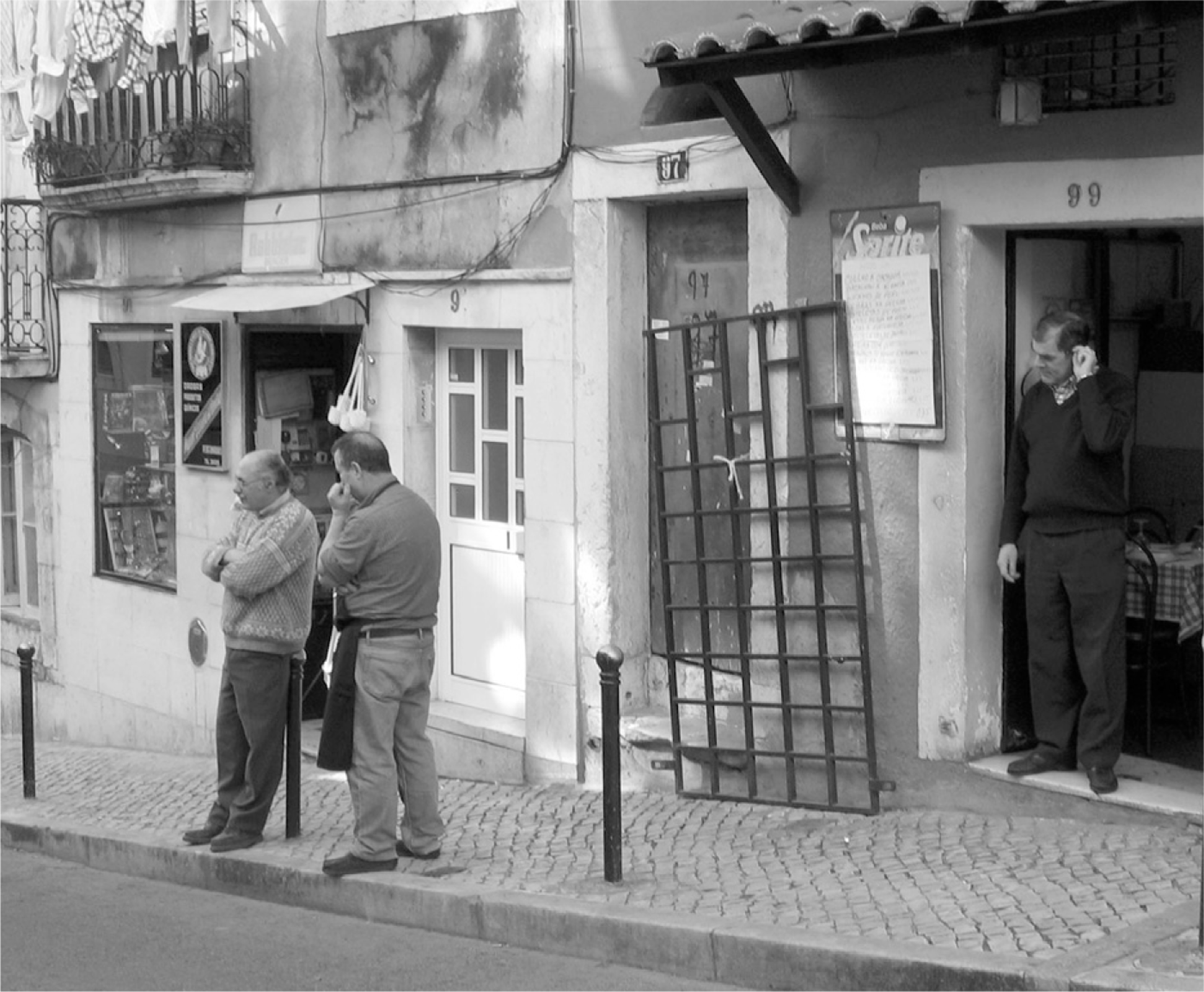
Clearly, in Calçada de Sant'Ana the changing atmospheres of the street from the dense and labyrinthine lower section, to the calm and serene upper part were the experienced result of the mutual socio-spatial process, and thus rhythmic, not just a visual impression of the historico-architectural frame (Figure 2). Birds in their cages were brought out to the balcony in the morning and back inside at dusk. Colours were strong and distinguished, from the annual orange season to the weekly rhythm of different trash bags populating the street – one day black for bio-waste, one day yellow for plastic and metal, one day blue for paper – and to the ever-changing patterns of sunlight on buildings and ornaments. Plants in abandoned balconies and on rooftops of empty buildings were having their own vegetative life in the moist Atlantic air.
Semiotic balconies and doorways
In order to grasp this fleeting object … it is necessary to situate oneself simultaneously inside and outside. A balcony does the job admirably, in relation to the street, and it is to this putting into perspective (of the street) that we owe the marvellous invention of balconies. (Lefebvre, 2004 [1992]: 27–28)
Calçada de Sant'Ana is an expressive or semiotic space. Windows, balconies, entrances and doorways are all used to make a mark, sometimes individual but often collective or communal. French balconies open the apartments – homes – to the street. Portuguese flags are hung on many balconies, colouring the scene in red and green. Many residents of the street clearly share a national sentiment and pride, not least because of football. As we have argued above, the street is unique and ‘local’, but it would be a mistake to omit the contribution of non-local elements or materiél in its production. As Edensor (2006: 537) convincingly argues, ‘local rhythms are often coordinated and synchronized with national rhythms, local customs are incorporated into the national cultural mosaic’. The habit of resting during the hottest hours of the day with family or friends is the prime example of such ‘national synchronicities’ or ‘the time-space of national identity’. In the intimate microcosm of Calçada de Sant'Ana, this rest, resembling the Spanish siesta, is a very clear, visible and audible break in the active babble and hum of the street. Assistants, cooks and clerks, all the different people in different positions, partake in a process where ‘[t]he rhythmic structuring of the day is not merely individual but collective, and relies upon a synchronization of practices that become part of how “we” get things done’ (Edensor, 2010: 8). Through their spatial practice they produce a national rhythm, ‘a thick spatial intertextuality that stitches the local and national together’ (Edensor, 2006: 537).
Besides flags in balconies, there is advertising and print media in many doorways, visible on the street. A stationer's pushes a selection of magazines and newspapers to its windows and to a stall on the sidewalk; a media or computer company has opened a tiny outlet, decorated with humorously space-age graphics; or the restaurants putting out their daily menus on small blackboards, adorned with a tiny colourful sunshade. Even though global brands are not visible, the street is connected and networked, opening to many non-local influences. But these influences unfold in a unique way. As Massey (2005: 183) puts it, ‘[o]ver and again, the counter-position of local and global resonates with an equation of the local with realness, with local place as earthly and meaningful, standing in opposition to a presumed abstraction of global space’.
Balconies and doorways are important places / moments in the social production of space in Calçada de Sant'Ana. Simmel famously discusses the bridge and the door as ‘archetypal artefacts that concretize an essentially human act, the act to separate and connect simultaneously’ (Stavrides, 2007: 175; Simmel, 1997). ‘The doorway’, as Stevens (2007a: 81) points out, ‘frames a dialectical transition between the personal and the social’. ‘Within the threshold, people are able to strike an acceptable balance between exposure to the unfamiliar and relative seclusion and safety’ (Stevens, 2007a: 85, italics added). People in doorways include butchers, waiters, barmen, loiterers, as well as other public figures on balconies, on the vertical façade of the street. The built environment type (Moudon, 1994) common in Lisbon's old neighbourhoods – intimate street, small lots leading to many doorways as well as the outward oriented buildings with small rooms and many balconies – is simultaneously the condition and product of the thresholds and their meaning. Here the potential is rehearsed: ‘At the moment when people cross thresholds between private and public space, they often make the most of the experiences which are possible there’ (Stevens, 2007a: 81). During our study, we witnessed countless social scenarios, where the threshold was crossed, someone from a bar or shop joining discussions or games in the street.
2. Right to the city
Football on the street
Calçada de Sant'Ana is a ‘shared space’ par excellence. There are sidewalks, even though very narrow, but people use the whole street independent of them. One of the sharp curves at the lower part of the street is often taken over by a game of football: children, teenagers and men are immersed in the game. Sometimes the ball escapes to the side-streets or jumps to the doorsteps of a bar, causing action and giving cause for jokes and laughter. Passers-by cannot avoid becoming part of the game. As Stevens (2007a: 87) observes, this is an urban game situation where ‘[t]he barrier between watching and playing is highly permeable’. If a car or a delivery van drives down the street, the players sidestep, but return immediately. People walk on the drive-lane, during lunch-time construction workers sit on the kerbstones, while the homeless hang around, play with their dog or chat with bar-owners and passers-by.
In the crossing with the occasional football game, all the spatial underpinnings of playful behaviour – paths, intersections, boundaries, thresholds and props (Stevens, 2007b) – seem to come together. The game, its occasional cuts either by car passing by or the ball being temporarily lost, and the breathless shouts of boys and young men define another rather complex spatio-temporal rhythm. Nielsen and Simonsen (2003: 917–918) explain Lefebvre's distinction between ‘rhythms of the self’ and ‘rhythms of the other’: ‘Rhythms of the self are deeply inscribed rhythms, performed by bodies themselves shaped in the conjunction of the two [self and other] and organizing a spatial temporality oriented towards private and intimate life, while rhythms of the other are rhythms turned outward towards and connecting in public life’. In our view, football on the street combines both.
Furthermore, the above-discussed semiotic elements, such as flags, posters and press, are an important part in the production of lively and open space. They are ‘easily arranged and rearranged’ so that they ‘create visually complex and culturally specific streetscapes’ and ‘readily convey the cultural meanings associated with the specific uses’ (Fernando, 2007: 69) Semiotic elements are additional ‘props’ for the multiplicity of uses, adding to the vitality and inviting quality of the street (Fernando, 2007: 71).
Walking
From the quick street-games of the teenagers to the slow ambulation of the elderly, from the wanderings of the tourists to the near-static stepping of waiters and shopkeepers at their doorsteps, the street encompasses a wide variety of walking practices. De Certeau (1984) has pointed to the power of individual users of public urban space in creating experiential and meaningful space through use, through walking. While hosting as many walking practices as almost any other street, Calçada de Sant'Ana's might be somewhat special in its ability to distinguish and stage each practice in a clear way. Students, tourists, nuns, night-hawks and early morning street-cleaners: all have their space and time. Discussing the links between time and place, Nielsen and Simonsen (2003: 919) state that ‘walking practices cannot be seen only as simple movements in space, they spatialize’ and ‘weave places (and scales) together’. Wunderlich (2008: 134), furthermore, creates a link from the variety of walking practices to our perception of time, saying ‘[w]alking practices, with their pace and rhythm, together with the temporal character of places imposed by their place-rhythms, influence our perception of time, in terms of its experience and representation’. Indeed, Calçada de Sant'Ana had a strong presence of its own time, or place-rhythm.
Stavrides (2010: 25) sees that ‘[r]hythm seems to be a promising concept in an effort to connect a theory of practice as meaningful performance with the experience of time and space’. The polyrhythmia, or a certain distinctiveness of the different walking practices, is thus linked to their meaning and, collectively, to the performance of the street space as shared and open public urban space.
Public underwear
Calçada de Sant'Ana is a ‘porous’ space in the same sense Benjamin and Lacis (1979) describe Naples in their famous 1920s Denkbild. Laundry hanging over the street provides an illustrative example. In a few days people around us learned in which flat we were staying and, thus, what kind of underwear our family wears. Such blurring of private and public would be unimaginable in northern Europe, but in Calçada de Sant'Ana it was commonplace. This common practice, the rhythm of washing, drying and wearing clothes, coloured the street community. It gave a twist to sexualities, desires and identities. People on the street were seen and sensed in a different way, creating different kinds of social ties. It was about intimacy without blaming, about mutual care, which was warm and close to you, but still didn't break the civilized publicity of the street (Sennett, 1977). As Lefebvre sees no binary opposition between the private and the public, this separation ‘is broken down with a starting point in the body and its senses, reaching out to the bustling world and linking the two’ (Nielsen and Simonsen, 2003: 918).
Thresholds between public and private are also about change. Stepping in and stepping out always opens an opportunity to encounter something new. Imagine the most mundane visit to the shop of the talkative butcher: you may hear news that will change your day. ‘Thresholds create or symbolically represent passages towards a possible future, already existing in the past’ (Stavrides, 2007: 177). Indeed, ‘both rhythm and exception are not only the means to establish a dominant spatial order but also forms through which spatialities of resistance are created … a possible ground of encounter with otherness’ (Stavrides, 2010: 19).
From a methodological point of view, our time in Calçada de Sant'Ana raises justified questions. The facts that we entered the street by chance (an empty flat found through the Internet) and lived there for a short period (almost as tourists) seems to suggest a weak position to conduct analysis; at best a fleeting and superficial outsider's view. Simultaneously, the production involved us. We were at a threshold, in an open situation of a two-way dynamic between people and space that our un-familiarity to the place made possible to study.
In Attempt at the Rhythmanalysis of Mediterranean Cities, Lefebvre and Régulier (2004: 88) discuss the position of the Rhythmanalyst: ‘[e]xternality is necessary; and yet in order to grasp a rhythm one must have been grasped by it, have given or abandoned oneself “inwardly” to the time that it rhythmed’. There might be a deep methodological point at hand here. If we understand correctly, Lefebvre and Régulier are saying that if you (as someone on the street) are fully immersed in your everyday routine, you are not able to analyse. But likewise, if you (as scientist) are too far in abstractions, you are not able to analyse, either.
A third position is needed. It might not be a coincidence that Benjamin and Lacis' classic rhythmanalysis of a Mediterranean city is a travel story. Their above-mentioned Denkbild, or impression, focuses on the ‘porosity’ and ‘porous architecture’ of Naples. They show the power of the ephemeral observer, someone who is capable of throwing oneself into urban life, grasping and being grasped, while remaining an outsider, a visitor, a guest. From this flickering vantage point, from a ‘weak place’ of re-thinking and re-imagining (Lehtovuori, 2000), something new could be said and written.
Tolerant and inclusive space
The clear positive qualities of Calçada de Sant'Ana seem to complement or counter the recent Anglo-American reasoning on urban change dominated by ‘a notion of the crowd as a dangerous entity pregnant with collective hostility and loss of control’ (Wilson, 1997: 134). In this reasoning, dominant discussions have focused the ways in which urban space is controlled and regulated, fortressed, and divided into privatized guarded zones and neglected areas. Public security, order and protection have become central issues, leading to the diffusion of insecurity, fear and phobia as influencing the use of space. In the name of fear, urban space is increasingly becoming a means of exclusion rather than supporting diversity and the positive notion of urbanity (Koskela, 2010). Unwanted behaviour is excluded, not tolerated; social integration and solidarity are replaced by segregation and zero tolerance. Bauman (2006: 130) talks about ‘security obsession’, referring to close connections between fear as an individual experience and fear as a transformation of political and normative dynamics within the socio-spatial order.
In Calçada de Sant'Ana, we could see and hear around us something very different: a compellingly positive exemplar of contemporary public urban space (Figure 3). We could hear, see and experience something which seemed to support diversity and positive urbanity, but not much that would allude to exclusion or obsession. In Calçada de Sant'Ana, discussions about insecurity were turned into discussions about a ‘right to urban space’ (Mitchell, 2003; cf. Lefebvre 1996), which seemed unquestionable. The street was tolerant and inclusive. Why?
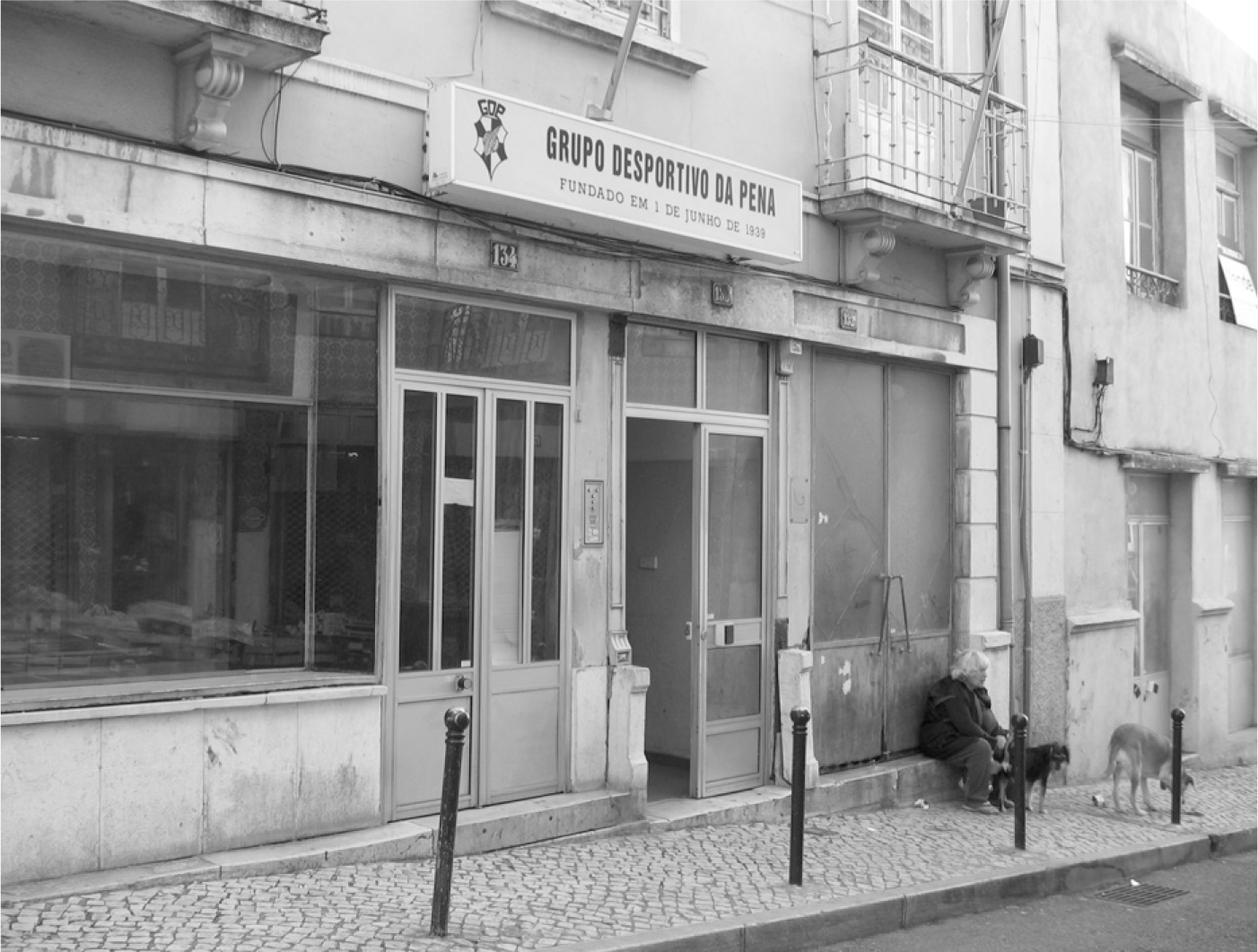
The street is very short and we learned to know it house by house. Despite its intimate scale the street crystallized all signs of difference, discussed recently in the social sciences. Differences in gender, age, colour, sexual orientation and, to an extent, religion were visible and tolerated. Also the ‘old-fashioned’, but in the end, and possibly most importantly, class-difference was present in an amazing spectrum of professions and public roles. The intimate urban space of Calçada de Sant'Ana has several ‘public figures’ (Jacobs, 1961), people with a special role in the urban community. More ‘eyes on the street’ (Jacobs, 1961) are provided by people spending time on their balconies and sometimes at their windows, watching and listening to the unfolding everyday drama of the street.
The visible public figures led us to list all professions on the street. In a rough order of visibility, the street hosted shopkeepers (butcher, stationer, grocer, jeweller, etc.), bar owners, bartenders, waiters, sellers, barbers, shop assistants, printers, construction workers, the homeless, dustmen and trash collectors (many types), street sweepers, cooks of the institutional kitchen and drivers of vehiculo electric bringing supplies to the kitchen, clerks of the insurance company Inatel in their suits, office workers, taxi drivers, students of medicine, nuns, school children, doctors, priests, cantors, tourists, hipsters, a transient peddler, musicians (auditory observation), artists and even a Santa Claus (a plastic representation). The street as a socio-spatial phenomenon was formed by habits and traditions but also by differences, meetings and constant communication. The street was shared, and its uniqueness was built exactly on that sharing.
After some days of acquainting ourselves with the street, we realized the complete lack of formal and technical surveillance, such as police patrols, private guards, surveillance cameras, burglar alarms or door stickers of security patrols. There were no posters either claiming something as ‘forbidden’, asking people to take care of their property (wallets, cars etc.), or requesting the public to inform the authorities if they see something suspicious (unattended objects, dubious behaviour and so on). Also many other all-too-familiar elements of fortified and commercialized public urban space were non-existent. There were, for example, no big commercial units, no supermarkets, chain stores nor known brands.
Human keynote
When listening to the street, grasping its rhythms, we realized further two ‘no's’: there was no silence – but also no noise. Studying urban soundscapes, Schafer (1977) distinguishes three types of sound: the keynote, sound signals and soundmarks. The realization that there was no noise in Calçada de Sant'Ana, led us to think of the street in Schafer's terms. The keynote, the background against which other sounds are perceived, was a combination of human voices, canary birds and wind, a quiet and beautiful sound with its own rhythms and changes. Sound signals were always ‘transparent’: be it a loud car finding a parking space, a shout in the next corner, or the church bell, the source was understandable and easy to locate. Soundmarks, unique and a-typical sounds that characterize a community or place, might have not existed at all, underlining the everyday character of the street. It was unique in its ordinariness.
If the ‘no list’ was illustrative, the complementing ‘yes list’ became too long to be meaningful. Nevertheless, a certain bohemian character and indifference was very strong: dripping pipes, peeling paint, fallen mortar and political graffiti, related to squatting rights. The felt indifference is interesting in the light of the strong presence of public figures. Clearly, the street was self-organized and humanly regulated, so that formal rules and institutional violence were absent, creating simultaneously an indeterminate and safe situation. Discussing ‘open streets’, Fernando (2007: 67–68) suggests a range of public uses and behaviours, such as ‘selling and buying, taking breaks from work, reading newspapers, sitting, walking, window-shopping, people-watching, meeting, socializing and waiting for transportation’. In Calçada de Sant'Ana, these were all present, and many more besides. Work itself, not only taking a break, was especially visible and audible. Printing and building but, just as much, homework: cooking, baking, making laundry. The street was also much about cycling, motorcycling, playing games, walking dogs – either on leash or loose, it did not matter – and even lifting groceries up with a rope to a friend upstairs on a balcony. Night-life was an integral part of the public life of the street: late night discussions between homeless and residents, sometimes leading to temporary sheltering; Sunday night's rock concerts in the local ‘sports club’; dustmen removing the colourful bags at early hours.
3. Towards differential urban spaces
While the rhythmanalysis of Lisbon's Calçada de Sant'Ana may for its small part answer to the perceived lack of work on everyday practices in cities, it should be seen in a broader context. The important question is, if we can learn something about the future of cities, about social production of differential spaces and the potential of the ‘urban continent’ envisioned by Lefebvre in La révolution urbaine (Schmid, 2005: 330). In this broad perspective, the micro-case of Calçada de Sant'Ana opens a fresh, contemporary view to the links between past, present and future as well as between form, use and meaning. A detailed and grounded analysis of the dynamic between everyday use and the change (as well as stability) of urban space as its ‘frame’ helps to understand how the rhythms of producing urban space reach from momentary to historic, in other words, how the seemingly small and ephemeral everyday habits link together to a long-lasting, spatially anchored process that can sustain and adapt itself over years, decades and centuries.
We no longer live in an industrial society of organized collective consumption, but at a threshold of something new. Only a small proportion of the residents and visitors of Calçada de Sant'Ana were in traditional industrial jobs, even though they also were part of its social and economic fabric. It is as if the street had its own time, where ‘all rhythms imply the relation of a time to a space, a localized time, or, if one prefers, a temporalised space’ (Lefebvre and Régulier, 2004: 89) and where ‘a sense of time as not only somewhat intersubjective but also place-specific’ (Wunderlich, 2010: 45).
Calçada de Sant'Ana provides a luminous contemporary example of open and networked public space. The lack of noise, differential walking movements up and down the hill, missing signs of themeing, self-organized and governed security and tolerant nocturnal life, provide valuable insights into both how to defend differential spaces today and how to facilitate changes for the better in the future. As Bauman (2006: 133) notes, ‘[f]ear takes root in our motives and purposes, settles in our actions and saturates our daily routines’. New forms of vulnerability appear to be combined with moral ascendancy and fear of the Other which easily leads to different forms of exclusion of people regarded as outsiders. ‘Meetings and encounters with different bodies of “strangers” and the emotions such meetings create’ are, as Nielsen and Simonsen (2003: 918) argue, ‘part of the construction of the city’: these encounters can not only promote apprehension, but ‘enjoyment and desire’ as well. Fear easily provides a justification for behaving in a self-centred and family oriented way: instead of being devoted to taking care of others, people become committed to sustaining social control and spatial exclusion (Koskela, 2010).
In Calçada de Sant'Ana, the rhythms and their spatialization (Shields, 1999) provide a counter-example: instead of fear and vulnerability, its socio-spatial pattern promoted boldness and tolerance. Edensor's (2010: 16) suggestion of ‘resistant rhythms, which proffer alternative modes of spending time, different pacings and pulses which critique normative, disciplinary rhythms and offer unconventional, sometimes utopian visions of different temporalities’, is very appropriate. The street – its space and people – was welcoming and tolerant, so that we could join its life in our way, but simultaneously it had power, so that our practices, roles in the family and even ideas changed. Evidently, as Massey (2005: 182) remarks, ‘[n]either a concept of the local as “only local” nor a romanticization of the local as bounded authenticity … offers much hope for a wider politics’. Nevertheless, our intention in pointing out the specific character of Calçada de Sant'Ana is not to despise or romanticize the place, but to present it as a ‘counter story’ for all-too common urban tendencies.
Conclusions: thresholds and cyclic rhythms
In Calçada de Sant'Ana the weaving together of social and spatial has produced a street-phenomenon, which can be characterized as a collective work, an oeuvre. This critical notion of Lefebvre's spatial thinking refers to both the process and result of an organic and rhythmic production of space, which has its own logic and time (Lehtovuori, 2008, 2010), uniqueness, radiance and style. A users' possibility to appropriate space, their freedom to do something meaningful and a certain indeterminacy of the space (Groth and Corijn, 2005) are important prerequisites for the process of oeuvre. Appropriation goes hand-in-hand with the notion of right to the city. In Calçada de Sant'Ana these rights were collectively held open in the tolerant but nevertheless structured urban life.
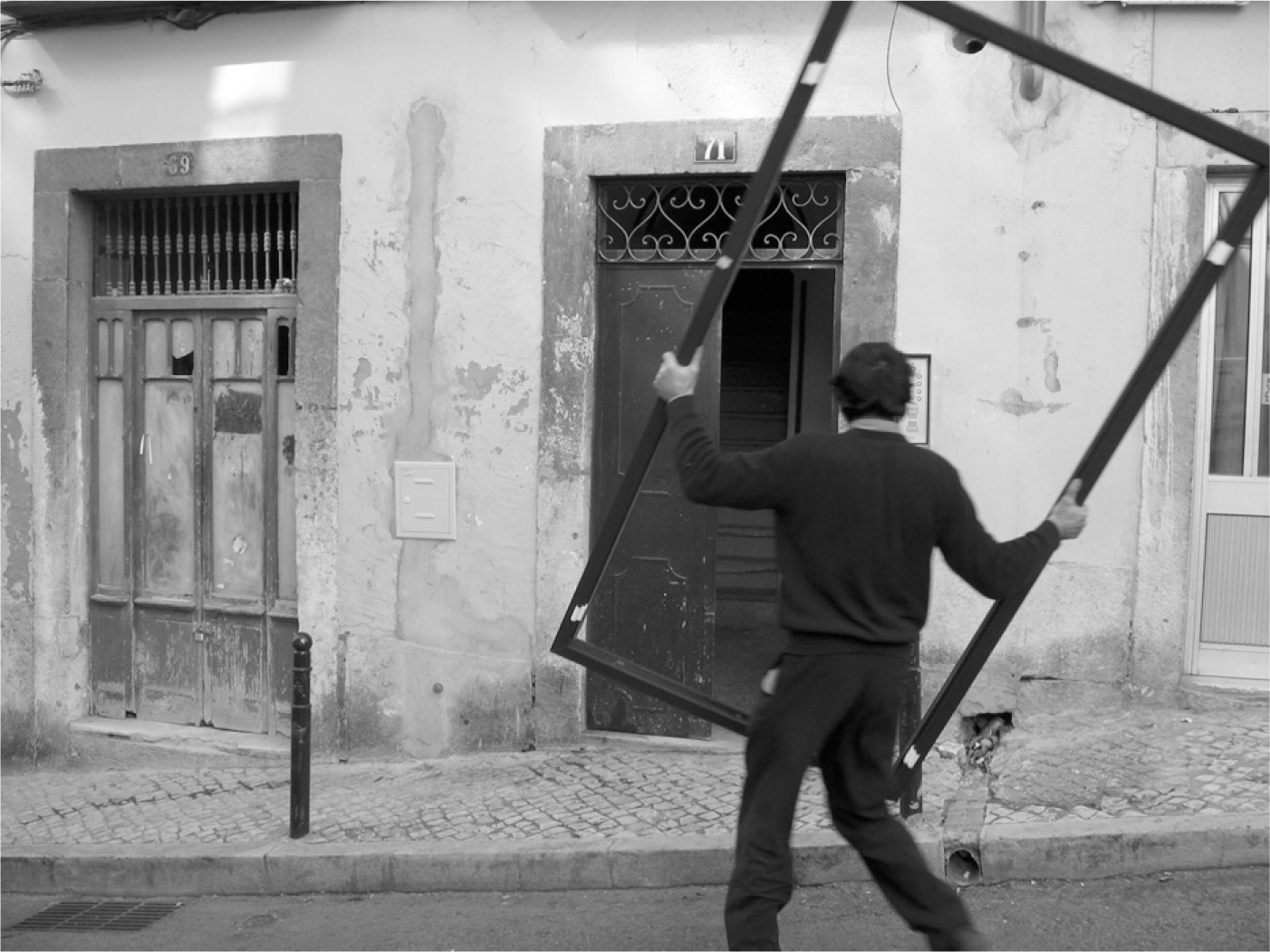
In the contemporary society, it is not necessarily easy to find oeuvres, as the dominant urban process is that of money and control (Figure 4). In Calçada de Sant'Ana, we found a counter-example, a contemporary, relatively central urban space that is sustaining a certain independence from the mechanical, repetitive rhythms of paid work as well as the boom-bust cycle of real estate and financial capitalism. The street is a pocket of local order (Ellegård and Vilhelmson, 2004), or a ‘time-space’. Such places are, as Massey argues, ‘open to the future; that makes them the ongoing constructions which are our continuing responsibility, the ongoing event of place which has to be addressed’ (2005: 180, our italics).
Above, we described our experiences in Calçada de Sant'Ana, contextualizing them in selected theoretical perspectives. We listened to the street as external observers, and walked on the streets as part of its public life. In the spirit of Edensor (2006: 532), we painted a particular view to a general process where ‘[t]he repetition of daily, weekly and annual routines, how and when to eat, wash, move, work and play, constitutes a realm of “common sense”, grounding culture and identity’. Besides ‘how’ and ‘when’, it is about ‘where’ and ‘in connection to which’. Material urban space with buildings, pavements and trees, has its own rhythm, which is sometimes very slow, reaching from years to decades and centuries.
Calçada de Sant'Ana has been able to sustain itself, to keep a certain coherence, identity and distinctiveness. At the same time, the street has been able to adapt, to change and take in new people, new habits and new programmes. This dialectic of continuity and change, sameness and difference, or repetition and modulation is unfolding all the time in everyday events and the tiny details of spatial practice. The ‘event of place’ has been a miraculous success. Walking and stopping, mundane meetings, gestures, sudden laugh, and a loud Sunday night party are all part of the process of producing urban space. Likewise, spatial and material characteristics and nuances play a role: steepness of the hill, balconies, provisional structures, waste containers, banners, graffiti, decay.
From the perspective of producing differential urban futures, two points seem to be above others: cyclical rhythms and creative thresholds. We have to acknowledge that ‘rhythm is not only a repetition of the same, but also the emergence of difference within that repetition’ (Simpson, 2008: 814). According to Lefebvre, this creative potential is related, especially, to cyclical rhythms that are linked to becoming, while linear rhythms are mechanical (Lefebvre and Régulier, 2004: 90).
The bodily and traditional rhythms were quite strong in Calçada de Sant'Ana, characterized by a polyrhythmia of daily, weekly, lunatic, annual and historic cycles. While we can follow Lefebvre (2004: 48) and confirm that ‘no genuine cycle returns exactly to its point of departure or reproduces itself exactly’, we need a clearer spatial understanding of this statement. Here, the notion of threshold is very fruitful. Stavrides (2010: 20) defines threshold in an active way as ‘a potential stage in which encountering otherness means visiting otherness, rehearsing, testing and exploring otherness.’ Furthermore, ‘[r]ecognizing, opening, creating and inhabiting thresholds can become an important characteristic of emergent emancipatory spatialities’ (Stavrides 2010: 41). The porous and closely knit oeuvre of Calçada de Sant'Ana was full of thresholds. It is not only about side-streets, balconies and doorways, but about the way these architectural elements are constantly rehearsed, so that their potentiality increases. At another level of abstraction, the whole street can be seen as a threshold between social groups, localized times and urban flows.
Is the character of Calçada de Sant'Ana an anomaly or a sign of a differential future? It is, of course, hard to say, but we hope that our observations help to find similar or related spatial and rhythmic characteristics elsewhere, to help in starting processes towards differential urban spaces, each of which might work as a test or pioneer of the ‘urban continent’ Lefebvre envisioned in La révolution urbaine. There also may be something specific in Lisbon. Referring to the Attempt at the Rhythmanalysis of Mediterranean Cities, Meyer (2008: 158) states that:
[a]s in the case of most historic cities, the big cities of the Mediterranean are doomed by virtue of the proliferation of suburbs. And yet historic character seems able to survive better in the Mediterranean than elsewhere – this is Lefebvre and Régulier's cautiously worded thesis. A dogged power of resistance seems to emanate from the everyday lived rhythms and the organization of time.
While Lisbon shares a group resemblance with ‘Mediterranean cities’, the lessons from Calçada de Sant'Ana are not limited to any specific geographical area. ‘As “the past continues in our present” so is also the distant implicated in our “here”. Identities are relational in ways that are spatio-temporal’ (Massey, 2005: 192).
We intend our case to provide concrete insights in sustaining differential spaces by keeping old (cyclical) rhythms and in producing new spaces by questioning current practices and providing alternative spatialities and time-patterns. We argue that it is precisely the character of the street as an oeuvre that explains its strong, radiating atmospheric quality – its ‘presence’ in Lefebvrean terms. Its atmosphere was not something to be enjoyed from a distance or like a tourist, but it was to be lived. In Calçada de Sant'Ana, history is exercised in every rhythm, in every moment so that ‘past, present and future always occur and combine in unique ways to make new temporalities’ (Edensor, 2010: 15). If we understand public space as an oeuvre, it becomes easier to value ‘everything there is’ – from feelings to chance encounters, from graffiti to carefully designed façade alterations, from temporary uses to big scale urban projects – as part of the same dynamic and meaningful space. Space, place, time, use and rhythms are not anymore seen abstractly as separate ‘layers’, but as an inter-woven socio-spatial process – how long has the butcher's cleaver been making its sound? How long will it continue?
Footnotes
In 2010, Inatel was re-organized as a private foundation.
Die Atmosphäre einer Stadt ist eben die Art und Weise, wie sich das Leben in ihr vollzieht (Böhme, 1998: 55).