







Abstract
This paper reappraises the meaning of space and place in contemporary class analysis. We explore how class is reshaped and mediated by neoliberal urban restructuring, of which the processes of gentrification and territorial stigmatization form critical parts. We focus on the contemporary interrelation of class and urban restructuring in the post-crash city by looking at the local lived experiences of the 2014 Commonwealth Games (CWG) in Glasgow’s East End. This high-profile regeneration effort in a deprived working-class neighbourhood reveals much about the functions of neoliberal financial capitalism, austerity and contemporary class formation. We show that gentrification and territorial stigmatization work in tandem within urban regeneration policy interventions as a punitive strategy for managing poor populations. This involves land value and (de)valuing of people and creates new localized class inequalities and insecurities. Our research highlights that in the face of national level cuts and commodification, residents’ local relations and support become essential social, economic and political resources. Yet, paradoxically, at the very same time, their local attachment to place is devalued, stigmatized and is at its most precarious. This exposes the coercive elements of the neoliberal class project; a distinct urban class inequality of our time and therefore, we suggest, a critical direction in class analysis.
Introduction
This paper revisits a classic theme in urban sociology: the relationship between urban and class restructuring. We reappraise the meaning of space and place in contemporary class analysis today, exploring how class is reshaped and mediated by neoliberal urban restructuring, of which the processes of gentrification and territorial stigmatization form critical parts. Historically, the class-urban relationship provided a powerful lens to understand both the workings of early to mid-20th century industrial capitalism and its localized manifestations in everyday life (Engels, 1987; Young and Willmott, 1957). But this perspective is adopted less so today, where instead the working-class neighbourhood is more emblematic of decline and dissolution of class in the late 20th century post-industrial imagination. Rendered redundant and stigmatized, working-class neighbourhoods are considered more often through the policy and media trope of ‘problem places-problem people’ than through a class lens (Haylett, 2003). Meanwhile many academic accounts deny the working class a complex relationship with global restructuring by privileging middle-class and elite counterparts as the vanguards of place-making and belonging (Butler and Robson, 2003; Bacqué et al., 2015; Savage et al., 2005, 2010). This is indicative of a broader shift within UK class analysis which relegates traditional questions of power, formation, exploitation and production in favour of defining class in terms of culture and consumption, typified by the recent Great British Class Survey (GBCS) (Savage, 2015). While this study has been critiqued on its methodological approach and preoccupation with consumption (Mills, 2014; see also the special issue in this journal, 2015), few critics reflect upon the urban nature of capitalist economies of class. The spatial intersection remains a marginal analytic in class analysis, both theoretically and empirically. Yet this disconnect is occurring at the very same time at which urban inequalities are intense and growing (Harvey, 2012).
This article demonstrates how the urban matters by looking at the local lived realities of the 2014 Commonwealth Games (CWG) in Glasgow’s East End – a high-profile regeneration project in a deprived working-class neighbourhood – in relation to territorial stigmatization and gentrification. This focus reveals much about the functions of neoliberal financial capitalism, austerity and contemporary class formation. We show how gentrification and territorial stigmatization work in tandem within urban regeneration, in differing ways, to define value. They revalorize and devalorize neighbourhoods as a means of extracting value and profit (Kallin and Slater, 2014). Thus at one end, gentrification extends the logic and aspiration through consumption such as homeownership and mortgage borrowing. At the other end the conditionality of welfare has intensified through use of stigma, sanctions and fines (Dwyer and Wright, 2014). This signals a renewed punitive strategy for managing impoverished and disadvantaged populations, and which involves land value and the (de)valuing of people, which creates new localized class inequalities and insecurities.
The first part of this paper explores the contours of urban restructuring as a class project through debates in gentrification, territorial stigmatization and social and spatial abjection. We begin by examining the role and form of state-led gentrification, of which mega-sporting events form a key part. State-led gentrification not only restructures the urban; it reshapes class. It commodifies land to create space for the more affluent user (Hackworth, 2002), through local authority partnerships with transnational capital, meanwhile contributing to the restructuring of the working class by encouraging their participation in gentrification, as more affluent consumers of private rather than collective, state provided support (Paton, 2014). To consider how these shifts in urban political economy restructure class, we draw upon class studies in the field of geography (Nayak, 2006; McDowell et al., 2014). We advance their focus to argue that housing and the city are as crucial analytics, in this context, as labour. It is here that recent analyses of the de- and recomposition of class which focus on value and stigma in governing economic crisis (Tyler, 2013; Wood and Skeggs, 2011) offer insights. We extend this notion of social and spatial abjection through the naming and reviling of classed places (Wacquant, 2007, 2008) to explore the complex contemporary relationship between class and urban restructuring. When working-class residents cannot be successfully marshalled towards private consumption in these post-crash times, austerity is used to justify the retreat of state interventions and the advance of welfare conditionality. Regeneration efforts contribute to the pathologization of places and their residents by shifting responsibility for both decline and the policy solution to individuals living there. Gentrification and territorial stigmatization then work together (Kallin and Slater, 2014) in a way which moves beyond extracting value in land to focus more on the working-class subject, and through this land and the (de)valuing of people converge.
The second part of the paper presents our research on the everyday realities of residents of the East End, an area subject to negative, stigmatizing discourses and ongoing regeneration efforts (Mooney, 2009; Gray and Mooney, 2011), throughout the Commonwealth Games period. Our research highlights that in the face of UK-wide cuts and commodification, residents’ local forms of support become essential social, economic and political resources. Yet, paradoxically, at the same time, their local attachment to place is devalued and at its most precarious as the Games compounded social insecurities. Despite ill-effects and disruptions, residents expressed support and gratitude for hosting the project. This tension revealed an internalization of stigma and abjection (Tyler, 2013). Debt and indebtedness, as conditions of austerity, offer critical explanatory insight: the success of this urban regeneration project was doomed and yet residents felt grateful to have been recipients of this urban intervention in times of growing welfare cuts. This exposes the coercive edge of the neoliberal project; a distinct urban class inequality of our time and therefore a critical direction in class analysis.
State-led gentrification in austerity times: new urban class frontier?
Throughout the 20th century, gentrification has been a, if not the, key vehicle of urban restructuring in ex- and post-industrial places. At a broad economic level, gentrification involves the extraction of land value. It offers that spatial fix in capitalism’s drive to resolve its inner crisis tendencies through geographical expansion (Harvey, 2007). Capital is invested into devalued land where there is, what Neil Smith termed, a ‘rent gap’ (1996). This, the difference between actual land value and projected profitable rent, is a feature which has seen gentrification appropriated by local states as a central mediator of urban restructuring. Gentrification is no mere process of ‘neighbourhood change’ nor is it a process driven by ‘hipsters’. Institutionalized as urban policy, gentrification is a ‘global urban strategy’ (Smith, 1996) against decline wrought by deindustrialization, emulated from Bilbao to Mumbai, from dockside developments to mega-sporting events (Atkinson and Bridge, 2005; Hackworth, 2002; Gray and Porter, 2014; Watt, 2013). This diverse character of state-led gentrification has been defined by Hackworth (2002) as the creation of space for the more affluent user. This term usefully encompasses the varied forms of gentrification – all bound in the role they play in supporting the shift in production of industrial capitalism to neoliberal market capitalism.
Gentrification involves social and economic regulation, including the manufacturing of resident aspiration towards private housing consumption to be more congruent with neoliberalism (Paton, 2014). This is expressed through entrepreneurial financial discourse of which mega-sporting events are key mediators ‘as cities compete for mobile forms of investment […] affluent consumers […] and new businesses…’ (Scherer, 2011: 783). Ward’s study of the 2002 Manchester Commonwealth Games considered it as part of a wider urban entrepreneurial endeavour. Yet the implementation of these Games involved much more rather than less state involvement in its attempt to ‘civilize’ the east of the city (Ward, 2003). Such policy strategies seek to recalibrate both space and subjectivities in ‘depressed’ urban places so gentrification means much more in this sense (Paton, 2014). It is not just concerned with displacing the disadvantaged as much as civilizing those residents with the aim of making them more productive and valuable (Uitermark et al., 2007).
State-led gentrification was momentarily challenged by the 2007 financial crisis (Harvey, 2010). This resulted in a shift in the mode of governance in which the imperatives of finance capital take precedence. Rolnik (2013) identifies this as triggering a global paradigm shift in housing policy, characterized by the large-scale state withdrawal from the housing sector along with the simultaneous creation of policies which support a market-based housing finance model. Housing is therefore repositioned as a primary commodity and a global financial investment asset. Thus in the post-crash city, state-led gentrification performs a greater rather than lesser role in the contemporary political economy. If gentrification was the spatial manifestation of neoliberal urban policies, then it is the management of individuals in these spaces which becomes the new frontier in the post-crash austerity city under neoliberal financial capitalism.
This is an intense hegemonic class project. Watt (2013: 101) describes how the 2012 Olympic Games in London were akin to blades in a pair of scissors, ‘simultaneously creating rent gaps and cutting out the last vestiges of Keynesian welfare state (KWS) public council housing and associated land’. For Deverteuil (2015) this activity markets the city in a way which denigrates those who do not fit into the new vision and is tantamount to creating a ‘post-welfare city’. Such welfare reforms are transformative and classed in the sense that they work to discipline ‘welfare populations’. They contribute to class decomposition by privatising welfare and entrenching discourses that ‘blame “the poor” who are pitted against the “working class”’ (Tyler, 2015; Haylett, 2003). So while urban policy debates are conspicuously de-classed (Haylett, 2003) and debates on welfare conditionality focus on work-related behaviour over spatial configurations, place continues to play a pivotal role in class composition, reshaped and mediated by neoliberal urban restructuring.
The specificity of financial capitalism and austerity come to bear locally and unevenly. The introduction of Universal Credit directly affects housing benefit, rent affordability and ergo arrears and eviction ‘hotspots’ (Paton and Cooper, 2016). This is more apparent with gentrification and mega-sporting events in the post-crash era which reveal a form of state activity which funnels global capital to particular places whilst simultaneously retracting welfare with intense, swift and often violent local impacts. Indeed housing policy has significant variances across England, Northern Ireland, Scotland and Wales, reflecting the nature of devolved policy-making. 1 Despite this, spatial analysis has become marginal within mainstream UK class analysis. To begin to think about this we draw from a body of work on class place-based identity.
Understanding class restructuring through place
While the study of elites and new taxonomies have come to dominate UK class analysis today, a place-based focus continued within UK geographical research around post-industrial geographies of class. One notable example is Nayak’s (2006) work on displaced masculinities in the north-east of England. Young men, the second generation of industrial workers, transitioning from a period characterized by relative stability to one of risk, seek out meaning in their lives through consumption and leisure practices focused on nights out. Similarly, McDowell et al. (2014) studied place-based class identity in relation to the labour market insecurity experienced by British South Asian young men in Luton. Experiencing racism on a regular basis saw these young men adopt a street masculinity as body capital. This has a local exchange value in their networks but put them at odds with labour market opportunities since these traits were not suitable for service sector employment, the main type of work available. In a similar vein, Lawler discusses how the white working class are seen as taking up an ‘anachronistic space’, where they suffer ‘from a political, social and cultural atavism: in the present, but not of it’ (2012: 418, original emphasis). These examples demonstrate how place still acts as an adjunct of class identity and phenomenological experiences but in fragmented, new and disparate ways that reflect economic restructuring. However, these studies focus on paid work and the lack thereof as the main analytic. Given the centrality of housing to the working of the contemporary economy, the distinctly urban nature of the crisis, land capital and the city are crucial analytics in understanding class.
Some inroads have been made within recent UK sociological work. Savage et al.’s (2005, 2010) and Butler and Robson’s (2003) studies, amongst others, characterize a ‘spatial turn’ in class analysis. These studies explore the spatial class identity of the middle classes, expressed through home ownership and gentrification. Here, place attachment is conceived as a middle-class proclivity, again emphasizing processes of consumption over questions of material relations and exploitation, reflected in a subsequent suite of research on the middle classes (Bacqué et al., 2015). A complex analysis of the restructuring of working-class place attachment under processes of global capital restructuring are weakly developed by comparison. Paradoxically, the ability of working-class residents to stay physically ‘fixed’ in their neighbourhood is weakened at a time when it is most essential as the marketization of housing ramps up precariousness (Paton, 2014). In fact, place attachment can be used as a key class marker (Mckenzie, 2015), not just in terms of identity, but also in relation to inequality and one’s ability to avoid being evicted or displaced (Paton, 2014). However, this is poorly articulated in terms of contemporary processes of financial neoliberal capitalism. As Toscano and Woodcock (2015) emphasize, the shift to relational and taxonomic approaches to class runs the danger of sundering the question of class from that of power:
only retaining the centrality of exploitation – while enriching this notion to incorporate, for example, contemporary mechanisms of financial expropriation […] can make good on the promise of a revival of class analysis that foregrounds its political stakes. (Toscano and Woodcock, 2015: 513)
A useful direction in relation to this can be plotted through those class analyses which explore how we are subject to the logic of capital and value and classificatory systems. Tyler (2015) demonstrates how processes of social abjection and devaluation become more meaningful in times of economic uncertainty. It is the creation of class stigma, she argues, which enables greater exploitation of political and economic capital:
national abjects, such as ‘the benefits cheat’, are mobilized as technologies of social control through which the transition from welfare to ‘postwelfare’ states is effected …. (Tyler, 2015: 495)
Tyler (2013, 2015), Crossley and Slater (2014) and Jensen (2014a, 2014b), foreground the growth in negative media representations of people experiencing poverty following the financial crisis and austerity imposed by the 2012 Welfare Reform Bill. ‘Poverty porn’ is used to describe those reality TV shows which dramatize the lives of benefits claimants, deriding and inviting judgment about individual deficit choices and values. ‘Deserving’ and ‘undeserving’ narratives help legitimate further welfare conditionality. The ‘blame’ for austerity is ideologically reworked from an economic to an individual problem (Clarke and Newman, 2012), positioning those in poverty as scapegoats of the financial crisis (Tyler, 2013, 2015). Therefore, the post-industrial working classes not only face precarious employment, downward social mobility, and extreme social insecurities but endure conditions of ‘heightened stigmatisation … in daily life as well as in public discourse’ (Wacquant, 2008: 24–25). This production of class stigma enables further class exploitation and decomposition which plays out locally.
From this we can see how the neoliberal agenda of calculation and the classificatory practices of valuing converge in the urban context. Exploitation under financial capitalism is not limited to the labour process: it relates directly to housing and, importantly, to land value. Processes of devaluing places and people underpin much of the public and policy discussions of working-class neighbourhoods. Territorial stigmatization expresses the powerful
The relationship between gentrification and territorial stigmatization processes is not new (Kallin and Slater, 2014). Representing two sides of the same coin, it involves an alliance between financial institutions and the state, with the latter creating the conditions that encourage private reinvestment. What is new is the state’s central role in contributing to place stigmatization which in turn devalues land creating a rent gap. This is the argument offered by Kallin and Slater (2014) in relation to the Craigmillar housing estate in Edinburgh, which they claim was premised upon a state constructed blemish of place for which it purported to have the remedy – gentrification. Territorial stigmatization performs a dual role as abjection becomes vital to processes of urban governance. This expedites the process of devaluation of people occupying that space, widening the rent gap and, as Ruggiero (2007: 395) notes, ‘educates its dwellers to devalue themselves’. It then produces a feeling of stigma that is internalized and plays to notions of worth, value and indebtedness. These processes are exacerbated by the dynamics of financial capitalism which fosters market discipline in citizens who become indebted through the withdrawal of social welfare. This is marked by reductions in benefits and social housing investment which can force further credit consumerism and borrowing.
It is within this context that we explore the 2014 CWGs in Glasgow’s East End, where gentrification and territorial stigmatization converge, and offer a critical view of the class-urban relationship today. The condition of life in parts of the East End, long labelled a place of blemish, was allegedly the inspiration behind Iain Duncan Smith’s, (who became UK Secretary of State for Work and Pensions in 2010) ‘Easterhouse epiphany’, lamenting the individual and social dangers of welfare dependency following visits to large outlying estates in 2007–2008. Recipients of regeneration in such neighbourhoods are expected to publicly perform in productive ways through which they escape from welfare dependency and thus redeem themselves (Skeggs, 1997). Failure to make the ‘correct’ decisions results in further pathologization as they are seen as economic lags on ‘progress’ and undermining the ‘legacy’ that such regeneration projects are to deliver. This is a class project that plays out so that when the aspiration towards private consumption fails or stalls, as might be expected with residents in the most deprived areas, value can still be extracted because dispossession can be achieved with more ease when the subject is indebted. This indebtedness relates to sense value, worth and the conditions imposed on benefits recipients as well as financial indebtedness.
Glasgow’s East End and the Commonwealth Games
Post-2007 crash, and under the UK Conservative-Liberal Democrat coalition Government and the Scottish National Party Scottish Government, Glasgow hosted the 2014 Commonwealth Games. This was the latest in a long line of large-scale regeneration programmes in the city. Mega-sporting events are one arm of gentrification, which are heralded by politicians and policy-makers as market ‘boosterist’ antidotes to depressed urban neighbourhoods as well as gilding world cities like London, such is their lucrative potential (Scherer, 2011). Today these events involve large transnational corporations as ‘partners’ or ‘proud sponsors’. Among those involved in 2014 was French multinational firm, ATOS, who are contracted on behalf of the Department of Work and Pensions to conduct Personal Independent Payment assessments of those in receipt of sickness or invalidity benefits and which was a source of some criticism before the Games.
The Games were positioned by Glasgow City Council as the would-be saviour of the East End where ‘the aim is to achieve unparalleled social, economic and physical change across various communities’ (Glasgow City Council, 2014: 20). The Legacy framework headline was to ‘regenerate the East End of the City’ with goal to ‘remediate land’ (Glasgow City Council, 2014: 20). The East End has faced economic and social problems since the 1920s. Much of the area’s economic base was a product of Glasgow’s boomtown period as the ‘second city’ of the British Empire: a Victorian industrial colossus built upon imperial expansion and war. The post-1914 economic slump and subsequently the contraction of shipbuilding, iron and steel and engineering industries after World War II hit the East End particularly hard and a long-term pattern of economic decline was established by the late 1950s and 1960s (Lever and Moore, 1986). In the 1970s industry and employment in the older inner districts collapsed, leading to major economic and social challenges. The establishment in the mid-1970s of GEAR, the Glasgow Eastern Area Renewal programme, signalled the first real policy recognition that the East End required state support in the form of targeted intervention through ‘regeneration’.
Hitherto regeneration efforts since the 1980s failed to regenerate the East End so the Games were presented as something of a final chance for the area, stigmatized and maligned publicly by media and political commentators, and touted as home of the notorious ‘Shettleston man’, who dies 14 years younger than other men in the UK at 63 (Mooney, 2009). The fact the East End was given a key role in hosting the CWG epitomizes the trickle-down logic used to justify regeneration: that economic and social capital will distil down to deprived residents: the ‘poor’ East End finds redemption as the CWG offers a commercial and civilizing salve to Glasgow’s untameable neighbourhood. Our research project ‘Beyond Stigma: Exploring Everyday lives in the East End of Glasgow and the CWG2014’ focused on the reality and lived experience in this stigmatized neighbourhood and builds upon previous research.
Methodology
Our research involved local residents keeping diaries throughout the CWG period to capture their daily lives before, during and after the event. These provided both an account of the Games as well as charting everyday life in austerity Britain. They also offered a potential challenge to the dominant policy narrative that focused on promises of ‘legacy’. Fifty people were involved in the project, through completing diaries and/or participating in focus groups from May until September 2014. Twenty-two participants submitted diaries between June to September 2014 (around a 50 per cent attrition rate over the research period), with the Games taking place between 23 July and 3 August. The diaries could be completed as a traditional paper format or online through a specially created blog, Glasgow EastEnders. 2 We recruited residents from the East End through advertising via social and print media and visiting community hubs such as the Shandwick Centre in Easterhouse. The diary data was supplemented by five focus groups with a cohort of our diary-keeper participants, held before, during and following the Games. We also ran a further two focus groups with non-diary participants.
As three academics responding rapidly to the Games without large funding, diaries were a very practical research method. Yet the choice also had political and ethical value. The East End has been subject to a number of regeneration efforts and scrutiny as an area of enduring inequalities in income, health and mortality (see Mooney, 2009), including ongoing projects at the same time as ours. In addition to this specific scrutiny, historically the working class have had to account from themselves (Steedman, 1998), to present value or desert to a range of authorities. In an area subject to stigma and the apparent ‘blemish’ of welfare dependency, interviews could reproduce a situation where residents felt inclined to present themselves as being worthy and deserving to counter a spoiled identity. As Skeggs (1997) notes, the working class’s long history of ill-representation, pathologization and devaluation contributes to their desire to dissociate with this identity. While this act of dis-identifying, noted in Skeggs’ research (1997) and also Savage et al.’s (2001) study, happened through the interview method, we felt that the diary method would avoid putting people in the position of having to justify themselves. This also had empowering potential by enabling people to decide what to report and how to report it. We provided guidance based on the project aims but the content was unstructured and led by participants. The diary entries asked two questions. The first asked people to record happenings in their everyday life, and the second asked what was taking place in the East End and their daily lives in relation to the CWG. The entries provided a rich ‘record of an ever-changing present’ (Elliott, 1997: 3), capturing the everyday and giving temporal insight to those experiences (Kenton, 2010). What emerged was a vivid picture of everyday life in the East End. People were reflexive and articulate about the effects of the Games on themselves, those around them and their area.
Beyond stigma, beyond apathy?
The East End is perceived not only in terms of social problems, it is also deemed to be ‘a political apathy hotspot’ (Hassan, 2013: n.p.). Yet there was much reflexivity and resistance towards the Games. Before our research began it was clear that the demolition of housing and population displacement were rife (Porter et al., 2009). As social renters, local residents were easily dispersed to other social housing neighbourhoods. One high-profile case saw home-owning resident Margaret Jaconelli’s unsuccessful attempt to resist a compulsory purchase order on her property, as it faced demolition to make way for Games development (Games Monitor, 2013). This case ended when Margaret and her family were forcibly evicted after a stand-off with Glasgow City Council with support from the police and sheriff officers.
A similar fate was experienced by the Accord Resource Centre for adults with learning disabilities which faced demolition to make way for a new Games related road (Games Monitor, 2014). Local women with disabled adult children were at the heart of the centre and relied heavily on it. In the face of substantial welfare benefit and service cuts, it occupied a much more meaningful place in people’s struggle to get by. In our findings, the importance of locality was central. Data from both the diaries and the focus groups found that many residents rarely leave the East End; they shopped and socialized there. Their lives were anchored in East End places rather than in the city centre or other parts of Glasgow. Further still, residents’ place attachment was evidently socially and materially more meaningful yet also more tenuous. Local forms of capital and value are displaced and devalued by these neoliberal processes to free-up land for more profitable use.
Bettie was in her 80s and partially sighted. She lives close to the Games site. Her world is local; geographically embedded in the East End where she has lived her whole life. Local changes and events were profoundly meaningful to her world. She reported how she enjoyed walking down the road without lorries; the tar from the Games related road reconstruction had ruined her shoes: a great expense to an elderly woman living on a state pension. Interruptions, no matter how small, can be devastating. Bettie often stayed at home, her only outings were to visit the doctor and sometimes she went dancing. She spent most of the Games period in hospital after having a fall. Bettie relied on local support and NHS services to recover from this event, which she gives thanks to in her last diary entry. She is vulnerable and the Games monolith not only dwarfs her world, its interruption can have a massive impact on her localized world and makes the services she requires, which are both locally and government provided, more insecure.
Not only was access to local services curtailed, there was ongoing disruption before, during and after the Games that affected people’s everyday routines. One woman explained how road closures meant that she could not access her weekly fitness class at her local community centre, as the bus she takes there was now rerouted. Again, what is a seemingly small personal trouble has greater public meaning. The pressure on individuals to take responsibility for their own health is not only a message from the Games ‘legacy’ but is part of wider policy discourses and most notably levied at the East End with its high mortality rates. As a woman in her 50s, she is part of that targeted demographic for health messages. She was ‘striving’ to keep fit while also having a social life, and was also active in her local community, but this was increasingly affected by Games-related infrastructure work.
The following entries from Isobel show how emotive the experiences were in relation to infrastructure work to support the Games:
Having endured weeks of road works and temporary traffic lights with queues of traffic on my route to and from work… (11 July). Can’t believe it… they are now REMOVING the traffic calming measures on the short section of the A724….more road works while they do that… plus what a total waste of money!!!!!! And they will probably reinstate them afterwards! AAAAGGHH!!! (18 July).
These developments were viewed as not only locally unbeneficial, they were actively pernicious:
The resident had saw the traffic wardens out booking people and remarked that this had now amplified since the games ‘carry on’. The resident felt aggrieved that the park at Tollcross (an East End neighbourhood) had been all fenced off and that the weather was to be nice and what were her young children to do? (Sharon, 11 June).
This does not, then, reflect the allegedly apathetic East Enders portrayed in wider media, official and policy discourses. Rather, there was a keen awareness of the political and ideological nature of the CWG project.
Pride and prejudice
Yet in spite of such issues, the diary entries often expressed a belief and hope in official claims about the potential of the legacy. Criticisms of the Games were muted in proportion to the amount of disruption reported. Even for those who could not afford to participate there was some optimism for the Games: ‘It’s like Christmas when you’re poor. You can at least enjoy the atmosphere’ (Focus group participant, 30 May 2014). This was expressed without any derision or resentment. We became aware of a reluctance to criticize the Games. Rather we found it was common for residents to express that they felt lucky to be the host area:
On completion of our shifts as Host City Volunteers, I would like to say it was an honour and great privilege to have taken part. (Anna, August)
People emphasized that they wanted the East End to be welcoming, to be seen as a place with ‘good people’ and ‘strong communities’. The prevalence of place stigma and the defensiveness of residents in regards to their area is illuminated by this comment from a focus group participant:
I was in a taxi and he [driver] was like ‘Lilybank?!’ [East End neighbourhood] why do you want to go to Lilybank?!’ But that’s not right. This area had a bad reputation in the 60s/70s and it’s stuck. There was a programme and it was edited to show the underbelly. That’s folklore but it stays with Lilybank. But that doesn’t exist. I wouldn’t live anywhere else. (30 May).
Those who were supportive also projected defensiveness with valiant statements such as ‘I refuse to be negative’ and ‘I am sick to death of people mumping’ (moaning) being quite common among individuals in the focus groups. In relation to the challenges to the local area disruption caused by the Games, one resident commented:
You’re faced with problems and you don’t crumble, you just roll your sleeves up. (Focus group participant, 30 May).
This was compounded by the announcement of a new city-wide marketing slogan – People Make Glasgow. This message promotes positivity, civic pride and a local responsibility. Local residents were positioned as the champions of the Games, which were being heralded as the ‘best games ever’:
We have badges now to give out to the public. People Make Glasgow. How true that statement is! Glasgow people are like no other in the world, they’ve great humour and friendliness and that will definitely come across in these Games. (Clare, 7 July).
As such, East End residents were reluctant to be the people who are the naysayers.
Internalizing stigma and devaluation
Diaries and discussion within the focus groups expressed an internalization of stigma and this was apparent in the circulation of myths around the Games. One story involved the existence of a ‘red zone map’ which was said to be issued to participating athletes denoting the unsafe ‘no-go’ areas that they should avoid. The story goes that a petrified athlete ran into a local shop clutching the map and asked the bemused staff member to help get them to safety. They were in the ‘red zone’ – Dalmarnock (a particularly impoverished part of the East End). Sharon discussed the map in her diary:
I popped into the ‘Myles Better’ café at Parkhead Cross and she told me that she has complained to John Mason, her MSP, over the fact that tourists and athletes had been given maps of the area. On these maps there was red spots to represent danger-zones and Parkhead and Tollcross were identified as danger-zones. A tourist had wandered into Parkhead and had been overheard panicking that she was in a dangerous area. Also two athletes had been using public houses in Parkhead Cross as this would be the last place people would look for them. (Sharon, 12 August).
This was a story was relayed far and wide, verified by taxi drivers, residents, and shop owners; people had ‘seen’ the map. We searched extensively, calling upon contacts before submitting a freedom of information request. It emerged that no such map existed. However, in the final focus group we were given ‘the map’ and realized it was a map of road and car parking restrictions (Figure 1). Even after explaining what was being mapped, participants were adamant that it was the ‘no-go zone map’.
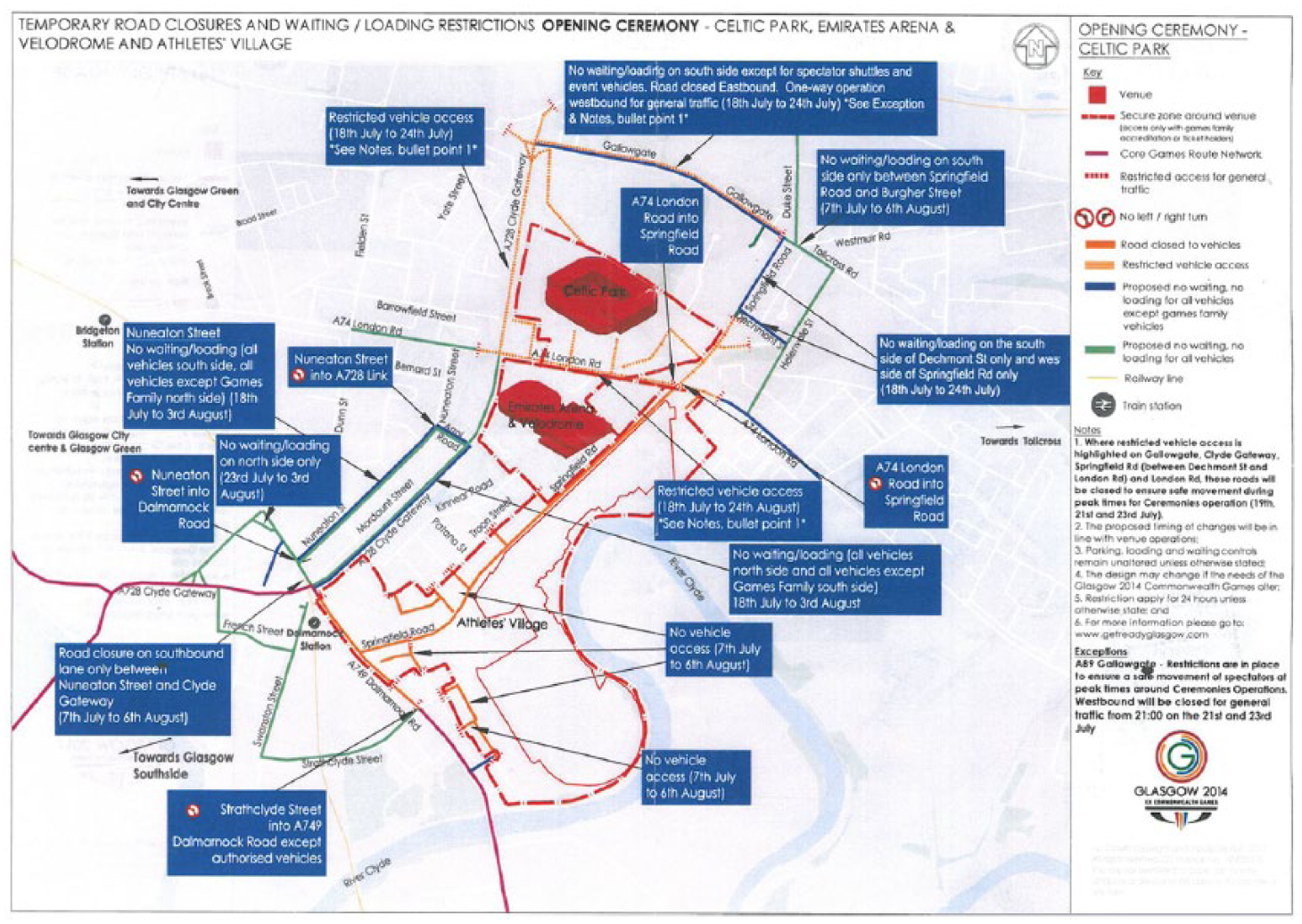
Glasgow Commonwealth Games Temporary Road and Parking Restriction Map.
Such myths outline the East End residents’ perception of themselves and their value, or lack thereof, which becomes internalized over time. This feeling was compounded by the high levels of security and fencing around the athletes’ village, which many questioned whether it was to keep athletes safe and corral and manage residents:
At the moment, we feel like the Games organisers want to keep local people away from the people coming to see the Games. With all the fences around the buildings. (Focus group participant, 29 May). Everybody talking about the helicopter that was flying over Parkhead last night – very noisy, people complaining about not being able to get to sleep. I was driving about last night and it seemed to be following me! It was like that scene out of The Goodfellas! (Peter, diary 23 July).
Despite examples of residents internalizing stigma, many were also critical of the processes the Games were initiating in their neighbourhood and this galvanized over the course of the summer. While diaries suggested that participants were initially supportive, subsequent entries and focus group discussions expressed a shift when residents recorded how they had experienced the Games:
The message people really wanted to get over is that the people of the East End had been treated shoddily, especially people in Dalmarnock. They have no shopping facilities a lot of older folk having to walk quite a distance. (Focus group, 29 May).
Optimism waned when promised benefits did not emerge and disruptions, instead, posed immense challenges to everyday life. Paul, one of the most enthusiastic participants, kept a faithful day-to-day, almost hour-by-hour account of his life throughout the four-month period. His diary outlines the intricacies of the effect of disruption to those who live, work and use the services in the East End. Paul, once employed in manual work, has retrained over the years. He now works as a driver for looked after children and has a key caring role with his grandchild. Paul is the epitome of the ideal flexible worker citizen; he is a ‘striver’ (Hayton and McEnhill, 2014). Yet his diary outlined the impact of the Games on his work and caring duties and his access to local services. This led him to grow critical of local restructuring and the impact and stigmatization it brought to an area he had lived his whole working life.
These experiences show the importance of place and the impact of state restructuring on the everyday lives of residents. Being involved in a large-scale sporting event sped up these processes of stigmatization and gentrification. The dynamic negotiation between where people live, their perceived value and feelings of devaluation and indebtedness highlights the intersectionality between class and place.
Conclusion
This paper highlights the evolution of state-led gentrification following the financial crisis, accelerating conditionality and welfare retraction while expounding the logic of growth and debt. The management of working-class places and people is ideologically and materially important. They are cast as barriers to neoliberalizing processes and submitted to the logic of capital so the value of land and the (de)value of people coalesce. Denigration of place and residents of that place is becoming evermore central to state strategies of abjection. The pernicious edge of gentrification is legitimated through various housing and welfare policies. Post-2010 regeneration sits alongside the retrenchment of welfare and the growth in individual and family debt. Increasingly devalued and indebted, those in receipt of welfare payments and with social housing tenancies are more easily dispossessed. Indebted subjects may be a key mechanism through which capital and value can be extracted. We suggest that East End residents face the double injustice of being injured by these processes but censured for failing to ‘buy-in’ to regeneration, not least their own individual ‘regeneration’ as ideal worker-consumer citizens. Since neoliberal policy solutions are based on the misspecification of the source of social and economic problems, failure is inevitable but residents in some of Glasgow’s most deprived areas are blamed for this failure personally. While universal services are cut, local amenities and sources of support are also undermined when they are needed most. This is a profound class inequality of our time and as such we need a new focus on spatial class analysis.
By ‘new’ we mean a recalibration, revisiting classic themes in a new context: how place reshapes class in new ways which reflect economic restructuring economy and the financialization of capital, value and debt. As Tyler notes, ‘the same movement through which neoliberalism decomposes class relations, new class relations are composed, not least in struggles against the inequalities that neoliberalism effects’ (2015: 498). Analysis of the everyday local experiences of capital processes goes further in beginning to understanding the de- and recomposition of class under financial capitalism than taxonomic accounts. The moral and economic class project of neoliberalism under austerity and financial capitalism is realized in a distinctly spatial way. The contemporary pressures to become places and people of value demonstrate the advance of this project, articulated through government policies of urban regeneration which are intimately linked with capitalist accumulation through spatial fixes. The political economy of the Games reveals a support for private finance and a simultaneous withdrawal of social support, which transfers the burden of debt from the state to the individual and the local, yet acceptance and appreciation is expected in return. As such, the struggles over urban space and the quality of everyday neighbourhood life are intrinsic to understanding the dynamics of class struggle beyond the labour process, requiring a reconceptualization of the working class to include all people who produce and reproduce urban life (Harvey, 2012).
Footnotes
Funding
This research received no specific grant from any funding agency in the public, commercial, or not-for-profit sectors.