







Abstract
The present study introduces a conceptualization of gender role self-concept that implies not only the commonly measured socially desirable expressive and instrumental traits (F+ and M+) but also feminine and masculine behaviors (FBehav and MBehav), and socially undesirable gender traits (F- and M-). Three different models were tested using structural equation modeling. For both men and women, F+ and FBehav load together on one dimension whereas M+ and MBehav load on a second dimension. F- and M- are conceptualized as independent dimensions that are mainly related to the cross-gendered latent factor. With the exception of these similarities, the self-concepts of men and women differed in several important aspects that point to a different meaning of gender roles for the two sexes.
People possess an important amount of self-knowledge that is gender-related. The goal of the present study was to analyze how people incorporate gender role related aspects into their gender-related self. The gender-related self can be conceived as an intersection in memory between the representation of gender-related knowledge and the self (Hannover, 2000). In the present study, it was assumed that the gender-related self has a multifactorial structure and that the gender role self-concept is an important and distinctive factor of the gender-related self.
The gender-related self has been a research topic for several decades (e.g., Bem, 1974; Constantinople, 1973; Deaux & LaFrance, 1998; Hoffman, 2001; Koestner & Aube, 1995; Spence, 1993; Spence & Buckner, 1995, 2000; Twenge, 1999). In the beginning, it was considered to be an unidimensional, bipolar construct with the two poles, femininity and masculinity (cf. Constantinople, 1973). This conceptualization implied that individuals who score high on femininity will have low scores on masculinity and vice versa. Women were thought to have a mainly feminine self-concept and men to have a masculine self-concept. This view changed with the development and application of two scales, the Bem Sex Role Inventory (BSRI; Bem, 1974) and the Personal Attribute Questionnaire (PAQ; Spence, Helmreich, & Stapp, 1974, 1975). These scales contain socially desirable instrumental traits (e.g., independent, active) and expressive traits (e.g., gentle, helpful) which are stereotypically associated with men and women. Given that the scales inquire about individual self-descriptions, they can be seen as measurements of the amount of gender-related traits that people have incorporated into their self-concept. In this sense, all questionnaires that ask for self-reports can be assumed to be measures of the individual self-concept.
Bem (1974) introduced the concept of psychological androgyny and proposed that femininity and masculinity are two independent, orthogonal dimensions. This means that individuals may use both feminine and masculine aspects of socially shared gender stereotypes to describe themselves. Several researchers have criticized the widespread application of the PAQ and BSRI as the sole measures of the gender-related self (e.g., Archer, 1989; Ashmore, 1990; Koestner & Aube, 1995; Spence, 1993; Spence & Buckner, 1995; Twenge, 1999). They argued that the scales primarily measure expressivity and instrumentality, and disregard other gender-related domains which may also have to do with the gender-related self. Both Ashmore (1990) and Spence (1993) conceptualized the gender-related self as an entity that consists of multiple factors. Thus, the gender-related self can be seen as a highly complex part of the self which integrates several different domains (factors). All these domains are gender-related and may or may not be related to each other. Ashmore (1990) proposed that
gender identity is an individual's structured set of gender-related personal identities. Personal identities are … links between the individual's self and biological/physical/material factors, interests and abilities, relationships with specific other people, social categories and dimensions of affect and personality, and styles of behavior (p. 514).
He particularly stressed the link between the self and social action. He assumed that the components of the gender-related self should be studied separately for their predictive capacity in relation to social action.
The multifactorial conceptualizations of the gender-related self take into account the fact that the psychological meaning of gender is very complex. The present discussion shares this view. Considering the importance of gender roles in societies, it is proposed here that people incorporate gender role aspects into their self-concept and that the gender role self-concept represents an additional and distinct part of the gender-related self.
Gender Role Self-Concept
People are aware of and share the expectations societies have with regard to women and men. They rely on gender stereotypes to build their individual picture of female and male roles (Burn, 1996). Moreover, people use gender stereotypes to describe themselves (e.g., Deaux & Kite, 1993; Eagly, Wood, & Diekman, 2000). The BSRI and the PAQ both include gender stereotypical traits. However, a closer look at gender stereotype research shows that gender stereotypes are complex (Fiske & Stevens, 1993) and that additional characteristics besides traits are also linked to gender (Deaux & Lewis, 1984; Jackson & Cash, 1985). Specifically, Deaux and Lewis (1984) found that gender stereotypes can also be differentiated on the basis of role behaviors, physical characteristics, and occupational status.
The present study focuses on the importance of gender stereotypic role behaviors for the gender role self-concept besides the traditionally acknowledged traits. Evidence for the existence of interrelations between self-descriptions with regard to traits and behaviors can be derived from studies that found correlations between socially desirable feminine and masculine traits and self-descriptions with regard to feminine and masculine gender role behaviors and interests, that is, the Sex Role Behavior Scale (SRBS; Orlofsky & O'Heron, 1987). Some studies found significant positive correlations between the self-concept concerning feminine behavior tendencies and socially desirable expressive traits, and between masculine behavior tendencies and socially desirable instrumental traits for both men and women (e.g., Archer, 1989; Orlofsky, Cohen, & Ramsden, 1985; Orlofsky & O'Heron, 1987). Spence and Buckner (1995) found positive correlations between socially desirable instrumental traits and self-valued skills for masculine typed activities, masculine typed interests and reading preferences for both women and men. Spence and Buckner (1995) also found corresponding correlations between socially desirable expressive traits and self-valued skills for feminine typed activities, feminine typed interests, and reading preferences. Most importantly, with only few exceptions the cross-gendered variables (e.g., socially desirable expressive traits with masculine behaviors) were not related in these studies.
The above-mentioned correlations indicate the existence of two underlying latent self-concept dimensions, a female role self-concept and a male role self-concept. These dimensions correspond to Bem's (1974) conceptualization of two independent, orthogonal dimensions, femininity and masculinity. Unlike Bem however, it is proposed here that these dimensions are determined not only by gender stereotypic traits but also by gender stereotypic behaviors.
Furthermore, there is considerable evidence that socially undesirable characteristics also make up an important part of gender stereotypes (e.g., Kelly, Caudill, Hathorn, & O'Brien, 1977; Spence, Helmreich, & Holahan, 1979). Spence et al. (1979) expanded the Personal Attribute Questionnaire with two scales containing socially undesirable expressive (e.g., servile, complaining) and instrumental (e.g., arrogant, dictatorial) characteristics (M- and F-). Generally, these scales correlate substantially and negatively with the cross-typed positive scales (i.e., M- with F+ and F-with M+; Helgeson & Fritz, 1999; McCreary & Korabik, 1994; Runge, Frey, Gollwitzer, Helmreich, & Spence, 1981; Spence et al., 1979). Spence et al. (1979) compared the socially undesirable traits F- and M- with the conceptualization of an unmitigated communion and agency proposed by Bakan (1966). In that sense, undesirable instrumental traits (M-) can be equated to unmitigated agency. According to Bakan, unmitigated agency is a focus on the self to the exclusion of others. Furthermore, undesirable expressive traits (F-) can be equated to unmitigated communion. Unmitigated communion involves placing the needs of other people above one's own, to one's own detriment. Thus, a possible interpretation for the negative correlations between the cross-gendered scales could be that agentic persons who are more focused on their own individual self (i.e., high M+) would rather not sacrifice themselves for others (i.e., low F-). On the other hand, people who are more communal (i.e., high F+) will not focus on the self to the exclusion of others (i.e., low M-).
To summarize, it can be stated that several scales exist that measure self-descriptions with regard to gender stereotypical traits and behaviors. Implicitly, it is assumed that the measured self-concepts are related. However, the underlying self-concept structure remains unclear. Thus, it was a main goal of the present study to take a closer look at the structure of gender role self-concept. By means of confirmatory factor analysis and structural equation modeling, I tested different possible models of gender role self-concept that can be derived from the literature. Basically, it is proposed that in addition to socially desirable expressive and instrumental gender traits (F+ and M+), gender stereotypical behaviors (FBehav and MBehav) and socially undesirable gender traits (F- and M-) are important components of the gender role self-concept. This procedure meets also the criticism of several authors concerning the sole usage of expressive and instrumental trait scales as measuring instruments of gender role self-concept (e.g., Archer, 1989; Ashmore, 1990; Koestner & Aube, 1995; Spence, 1993; Spence & Buckner, 1995; Twenge, 1999). It is assumed here that gender role self-concept is a multifaceted construct. Furthermore, all analyses were calculated for men and women separately, as gender roles could have a different significance for the two sexes which may result in different self-concept structures.
How can we conceptualize the structure of gender role self-concept? Figure 1 shows three possible models of gender-role self concept. An assumption based on early conceptualizations of gender role self-concept is that only one dimension underlies all six components (see Model 1). On the basis of Bem's theory (1974), we would assume that two independent dimensions exist, a female role self-concept (FEM) and a male role self-concept (MASC). Based upon this bidimensional conceptualization, a plausible possibility might be that the female role components (i.e., F+, FBehav, F-) constitute the female role self-concept and thus load together on one latent factor. Additionally, the male role components (i.e., M+, MBehav, M-) constitute the male role self-concept (see Model 2). However, there is considerable evidence that F- and M- correlate mainly with the cross-gendered scales and not with the same-gendered scales. Accordingly in Model 3, F- and M- are conceptualized as two independent factors. Moreover, Model 3 suggests that F+ and FBehav load together on one dimension, FEM, and M+ and MBehav load on an other independent dimension, MASC. F- and M- correlate negatively with the cross-gendered factors FEM and MASC (not with the same gendered factors).
METHOD
Participants
Data from three separate samples were combined to create a sample large enough for structural equation modeling. Although pursuing partly different aims, the three studies employed the same set of variables with regard to gender role self-concept.
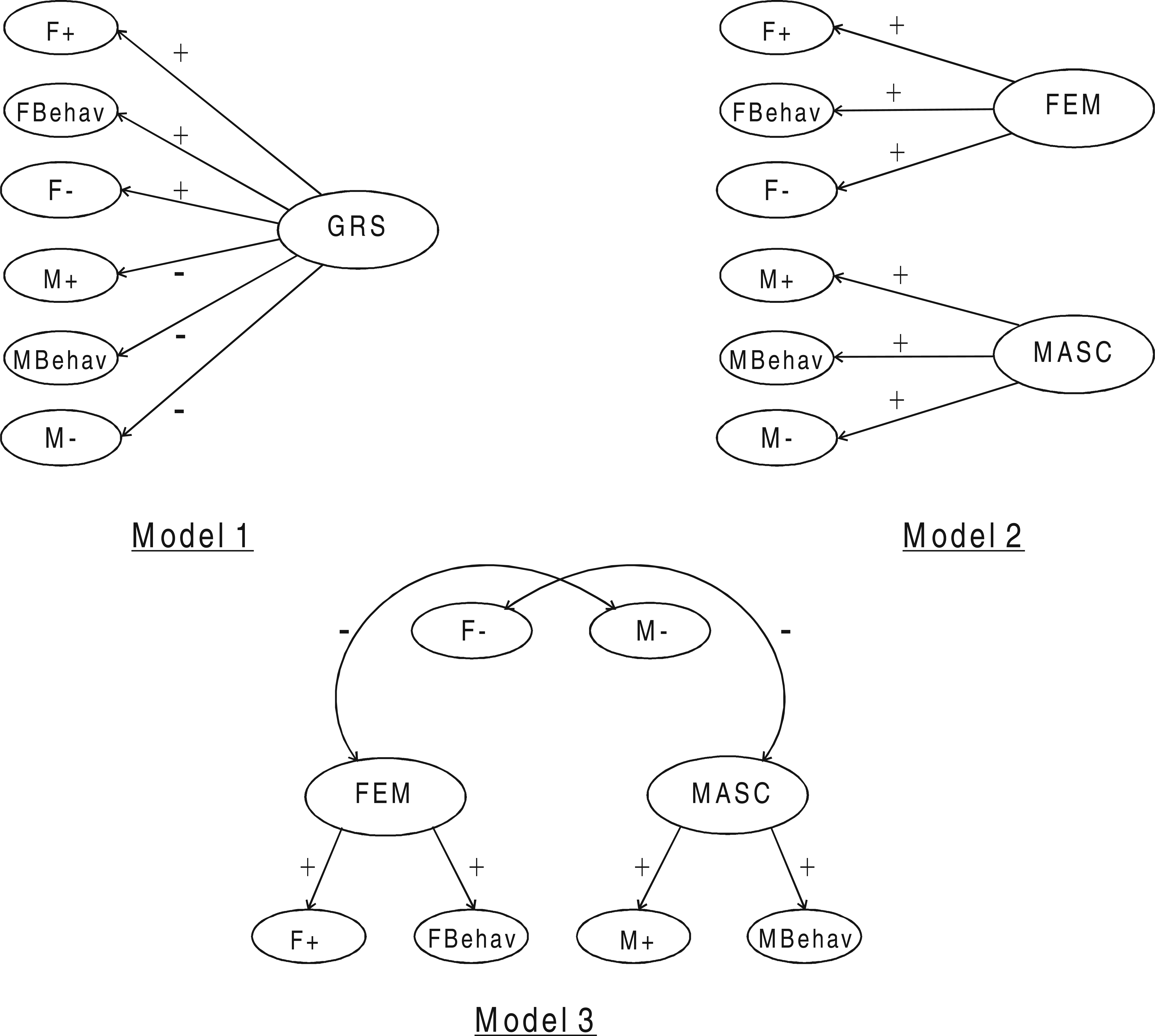
Three possible models of gender role self-concept based on the measurement factors F+ (socially desirable expressive traits), FBehav (feminine behaviors), M+ (socially desirable instrumental traits), MBehav (masculine behaviors), F- (socially undesirable expressive traits), and M- (socially undesirable instrumental traits).
Sample 1. Study 1 was conducted with course participants of a school for extended vocational training in Graz, Austria. I went into the courses/classrooms, briefly described the aim of the study, and distributed the questionnaires. An envelope was attached to each questionnaire that participants could use for returning it. They did not receive any payment or other compensation. The return quota for the 358 distributed questionnaires was 55%. I removed 44 people from the sample because of missing data. The final sample consisted of 87 men and 66 women. Most participants had a rather low educational level (only 38% had taken the final examination of secondary schools). The mean age was 29.6 years (SD = 8.1).
Sample 2. Study 2 was conducted with participants in different sport courses for students and staff members of the University of Graz, Austria. Again, I went into the classrooms, described the purpose of the study, and distributed questionnaires. Additional questionnaires were left with the instructors for participants who came irregularly to the courses. An envelope was attached to each questionnaire that participants could use for returning the questionnaire. In this case, a return rate cannot be calculated, as the exact number of distributed questionnaires is unknown. On the whole, 1515 persons were enrolled for the selected courses and that is how many questionnaires were prepared. Participants did not receive any payment or other compensation. I received 351 questionnaires. Fifty-six people had to be removed from the sample because of missing data. The final sample consisted of 119 men and 176 women. The mean age of the participants was 26.5 years (SD = 6.9).
Sample 3. Study 3 was conducted with a sample of 60 men and 68 women at the University of Graz, Austria. Participants were gathered using a snowball method, which means that the instructors asked students or friends to participate in the study and, in turn, to recommend additional people (Athenstaedt, Haas, & Schwab, 2004). The final sample consisted of 75 psychology students, 38 students with different majors, and 15 persons with various professions. Participants did not receive any payment. Psychology students received a certificate stating that they participated in the study which they need for their major. The other participants did not get any compensation for participation. The mean age of this sample was 23.0 years (SD = 4.9). There were no missing data.
The three samples combined provided a total sample of 266 men and 310 women. As indicated above, no missing data exist in the entire sample. The samples are heterogeneous with regard to age and education. However, the most important aspect of comparability is the correlation pattern of the gender role self-concept variables. All correlations were calculated first for the three samples separately. Although some of the correlations differed with regard to their size, they all pointed in the same directions. Thus, it seemed appropriate to combine the three samples for the analysis.
Questionnaires
Gender stereotypical traits. Socially desirable and undesirable expressive and instrumental traits were measured with four scales of the German version of the Extended Personal Attributes Questionnaire (Runge et al., 1981). The F+ scale consisted of eight items (e.g., “emotional”) and the M+ scale of seven items (e.g., “active”). The original two subscales FC- (undesirable communal qualities) and FVA- (verbal passive aggressiveness) were combined into one F- scale consisting of seven items (e.g., “complaining”). Finally, the M- scale consisted of nine items (e.g., “aggressive”). All items were rated on a 6-point scale (e.g., from not at all emotional to very emotional). Cronbach-α coefficients were calculated using the data of all three samples (F+: women α = .74 and men α = .76; F-: women α = .63 and men α = .66; M+: women α = .78 and men α = .76; M -: women α = .69 and men α = .67).
Gender stereotypical behaviors. As there was no German measurement for the self-description of gender stereotyped behaviors, I developed a new Gender Role Behavior Scale (GRBS) in the German language. Details from the questionnaire construction are described below.
The GRBS was developed as a German self-concept measure with regard to stereotypical feminine and masculine behaviors (Athenstaedt, 1999). At the beginning of the scale construction, the procedure was similar to the scale construction of the Sex Role Behavior Scale (SRBS) of Orlofsky and O'Heron (1987). However, the GRBS differs from the SRBS as it contains only items measuring behaviors whereas the SRBS contains both stereotypical behaviors and stereotypical interests.
In a first step, I selected 191 different behaviors from several life-domains. None of these behaviors were socially undesirable. A sample of 95 women and 95 men judged the gender-typicality of these behaviors (either more typical for men or more typical for women). A second sample (91 women and 92 men) evaluated the social desirability of all behaviors separately for men and women. Finally, a third sample (94 women and 96 men) was asked how typical the behaviors were for themselves. All three samples were gathered with the help of psychology students who participated in a questionnaire construction lecture at the University of Graz, Austria. Thus, the samples consisted mainly of friends and acquaintances of the students. The mean age of the first sample was 28.6 years (SD = 10.9). The mean age of the second sample was 28.5 years (SD = 9.2) and the mean age of the third sample was 31.2 years (SD = 11.7).
In a subsequent step, I selected behaviors which were found to be more typical either only for men or only for women and thus were designated to be gender-stereotypic. An analysis of the social desirability evaluations revealed that all selected feminine behaviors were more socially desirable for women than for men, and the selected masculine behaviors were more socially desirable for men than for women. Finally, an explorative factor analysis was performed with the data of the third sample (self-descriptive version), only for the selected items. It yielded two independent factors, one containing only masculine behaviors (e.g., “do repair work”) and one containing only feminine behaviors (e.g., “sew on a button”). Thus, the GRBS contains two scales, a feminine behavior scale (FBehav) and a masculine behavior scale (MBehav). 1 The items cover different domains of everyday life, such as household (see item examples above), office (e.g., organize company parties, work overtime), social interaction with friends (e.g., take care of somebody, pick up the dinner bill), social interaction with partners (e.g., tell your partner about problems at work, help your partner into his or her coat), and leisure time (e.g., watch soap operas, tinker with the car). The FBehav scale consists of 29 items and the MBehav scale of 23 items. All items are rated on a 7-point scale (from not at all typical to very typical). For the present study, the Cronbach-α coefficients were calculated for the entire sample (FBehav: women α = .83 and men α = .83; MBehav: women α = .83 and men α = .84).
RESULTS
Preliminary Analysis
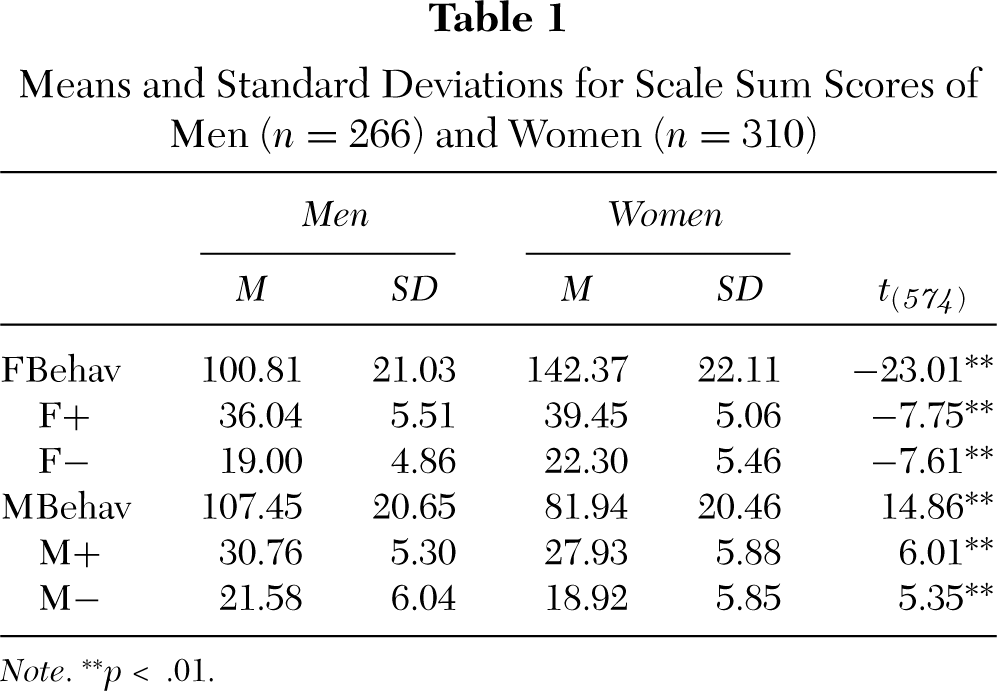
Descriptives. Table 1 shows the means and standard deviations for all scale sum scores separately for men and women. The included t-test results show that all means differed between men and women. On the average, women ascribed more feminine traits and behaviors to themselves than men did, and men ascribed more masculine traits and behaviors to themselves than women did.
Intercorrelations. Table 2 shows the correlations between the scale sum scores for men and women. In line with the literature, F+ and FBehav as well as M+ and MBehav correlated positively for both men and women. The scales measuring socially undesirable traits (M -, F-) correlated negatively with the cross-gendered scales measuring socially desirable traits (F+, M+) and with the cross-gendered behavior scales (FBehav, MBehav), respectively. Similar to the results of Athenstaedt (1999), the FBehav and MBehav scales correlated for men and women. The remaining significant correlations are not in line with the literature.
Means and Standard Deviations for Scale Sum Scores of Men (n = 266) and Women (n = 310)
Note. ∗∗ p < .01.
Correlations of Gender Stereotypical Behaviors (MBehav, FBehav), Socially Desirable Gender Traits (M+, F+) and Socially Undesirable Gender Traits (M-, F-)
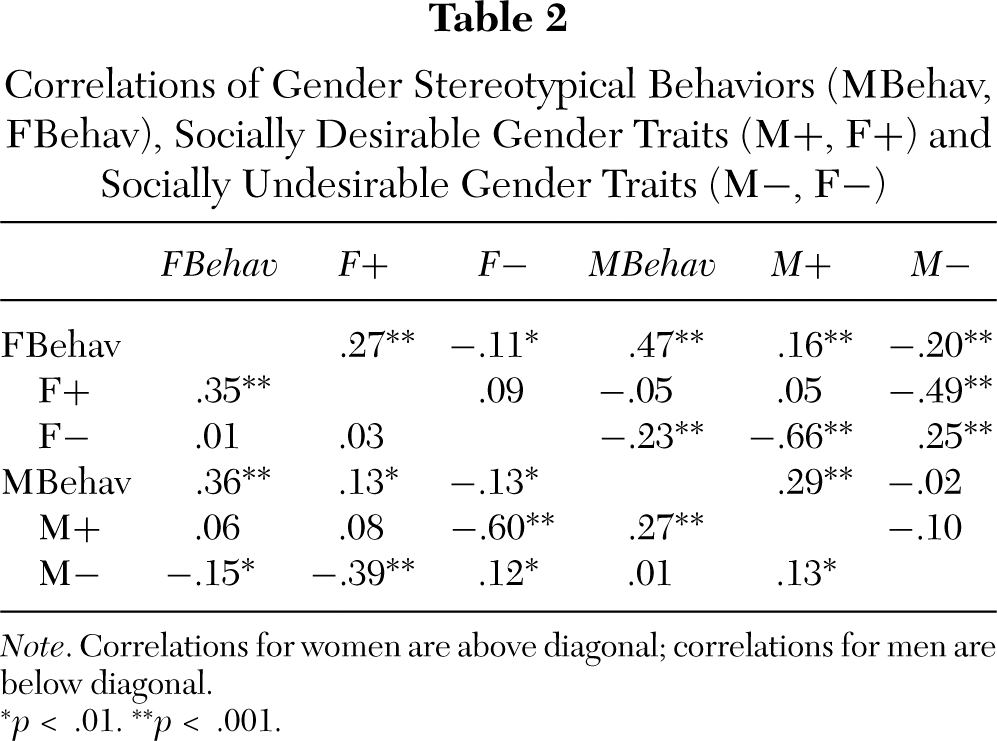
Note. Correlations for women are above diagonal; correlations for men are below diagonal.
∗ p < .01. ∗∗ p < .001.
Data Analysis Plan
Three models (Figure 1) were tested separately for men and women with EQS/Windows 5.7b (Bentler & Wu, 1995) using a maximum likelihood estimation. I used a two-step approach (see Anderson & Gerbing, 1988). In a first step, measurement models for latent variables of the six scales were analyzed. More specifically, measurement models for F+ together with M+, for FBehav together with MBehav, and for F- together with M- were tested for model fit. The three main models were analyzed in a second step. Model 1 and Model 2 are second-order confirmatory factor models. Model 3 implies a second-order confirmatory factor model nested in a full structural equation model. In this case the nested confirmatory factor model was also tested in an additional step.
On the basis of results of my own studies (Athenstaedt, 1999) and studies of other authors in connection with the SRBS (Koestner & Aube, 1995; Orlofsky & O'Heron, 1987), it was expected that the behavior scales would correlate positively with each other. Accordingly, covariances for the residual errors of the two latent factors (FBehav, MBehav; see Figure 2) were estimated to take this correlation into account. 2
Furthermore, the correlations in Table 2 indicate a positive relation between F- and M- for both men and women. As it is the case that both scales F- and M- have an un-desirability aspect in common, the correlation between F-and M- can be interpreted as a result of a habitual social desirability tendency (Paulhus, 1986). People tend either to admit or to deny socially undesirable characteristics regardless of their gender typicality. Thus, the correlation is not regarded as substantially relevant for the conceptualization of the gender role self-concept. However, the correlation between F- and M- was acknowledged for all three models. More specifically, in Model 1 and Model 2 the covariances of the residual variances of F- and M- were specified as freely estimated parameters. In Model 3, the correlations between F- and M- were estimated.
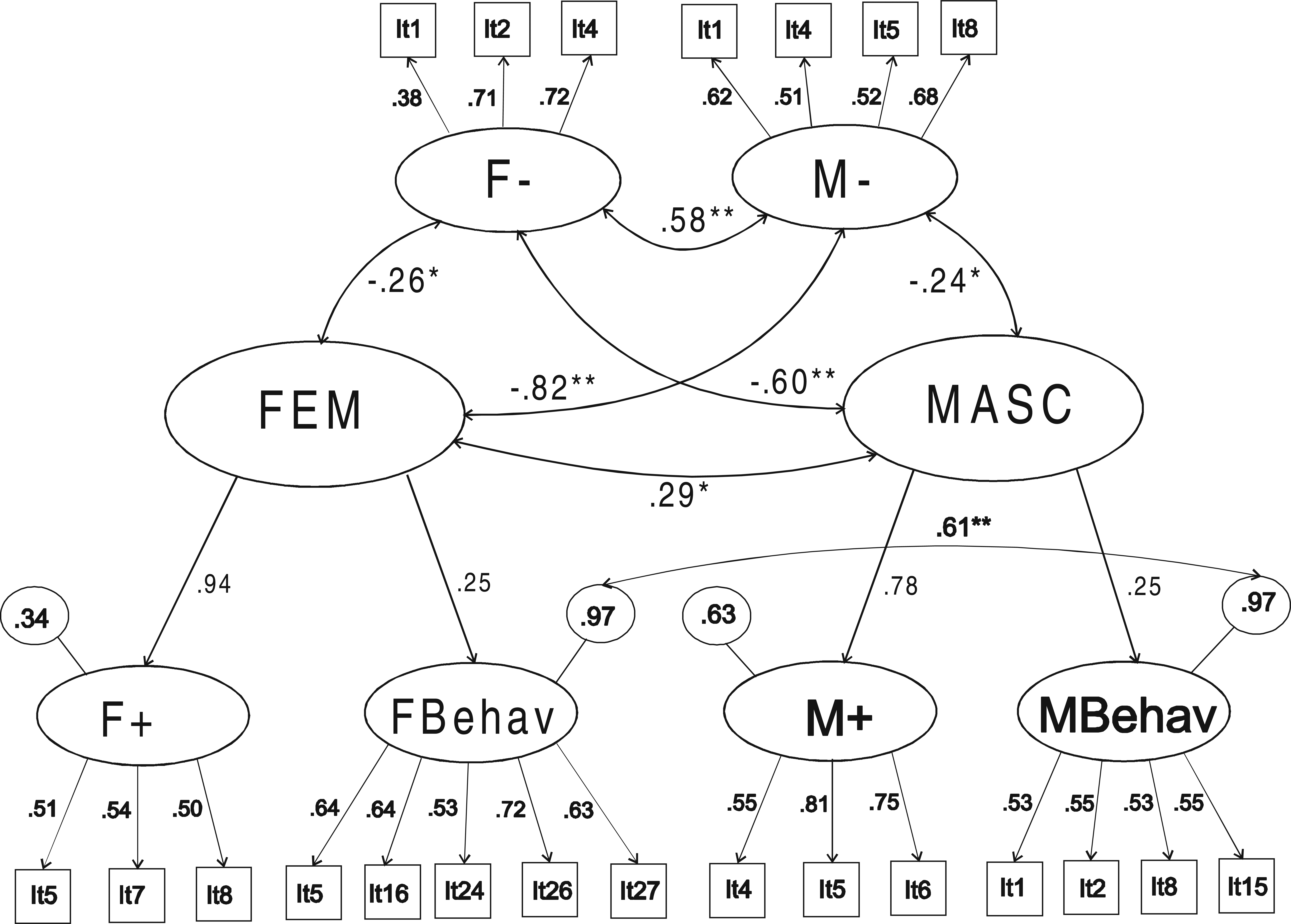
Final gender role self-concept model for women.
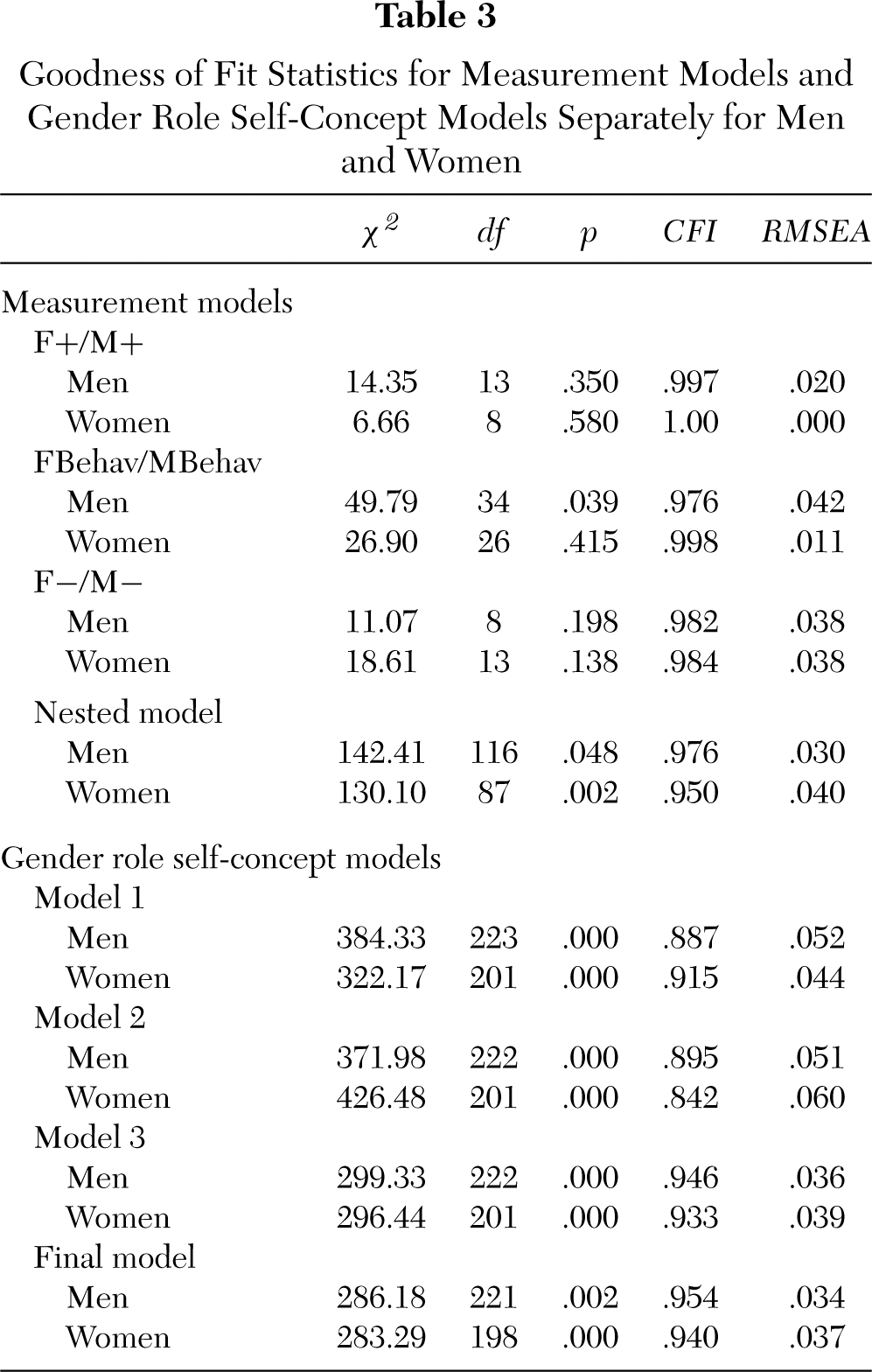
Several authors recommend the use of different fit indices for model fit assessment (e.g., Byrne, 1994; Hu & Bentler, 1998). For the present analysis, chi-square statistics, comparative fit indices (CFI), and root-mean-square error of approximation (RMSEA) are reported. In accordance with Hu and Bentler (1998), a CFI above .90 indicates an acceptable model fit. A CFI close to .95 as well as RMSEA less than .06 indicate a relatively good fit between the hypothesized model and the observed data.
Model Testing
The upper part of Table 3 shows the fit statistics for the three measurement models. Only three to six questionnaire items of each scale were sufficient as observed variables to get a good fit for the measurement models. All three models showed a good model fit for both women and men. More specifically, the χ2 statistics with only one exception (FBehav/MBehav for men) did not reach significance. The CFI were larger than .95 for all analyses and the RMSEAs were smaller than .06.
The lower part of Table 3 shows the model fit statistics for the three main models (Figure 1). The fit statistics of Model 3 were better than the fit statistics of Model 1 and Model 2 both for women and men. In an additional and more explorative step, I checked the parameters of Model 3 for a possible improvement of model fit.
For men, an improvement was possible acknowledging an additional correlation between MASC and M-. No other correlations reached significance and thus, did not improve the model fit. However for women, not only MASC and M- correlated significantly but also FEM with F-, and FEM with MASC. The fit statistics of these final models (Table 3) show that the additional estimations improved the model fit for men (Δχ2 (1) = 13.15; p < .01) and for women (Δχ2 (3) = 13.15; p < .01).
Figure 2 (for women) and Figure 3 (for men) show the results of the structural equation modeling for the final models. The conceptualization of the two second-order latent factors FEM and MASC was confirmed by the results of additional model analyses (see nested models in Table 3). A further inspection of Figure 2 and Figure 3 shows that FEM and MASC correlated as expected significantly with the cross-gendered socially undesirable traits (M-, F-) for both women and men. Thus, highly feminine persons ascribed themselves a low amount of socially undesirable instrumental traits. Highly masculine persons ascribed themselves a low amount of socially undesirable expressive traits. Although the models for women and men seem to be similar, a closer inspection of Figure 2 and Figure 3 shows that they differ in many respects.
Goodness of Fit Statistics for Measurement Models and Gender Role Self-Concept Models Separately for Men and Women
For men, FEM and MASC were uncorrelated and thus independent factors. Unexpectedly, MASC and M- correlate positively. Men who described themselves as more masculine also tended to admit more socially undesirable instrumental traits.
For women, FEM and MASC correlated significantly and thus were not independent factors. Highly feminine women tended to describe themselves also as highly mas-culine. Contrary to the results for the men, FEM and MASC correlate negatively with the same-gendered socially undesirable traits.
To summarize, confirmatory factor analyses confirmed for both sexes a bidimensional structure of gender role self-concept. FEM as well as MASC combined gender stereotypical behavior and gender traits. Furthermore, FEM and MASC were independent self-concept dimensions for men, but correlated positively for women. The socially undesirable traits were conceptualized as independent components of the gender role self-concept that correlated negatively with the cross-gendered dimensions. Thus, people with a pronounced female role self-concept ascribed to themselves less socially undesirable instrumental traits. People with a pronounced male role self-concept ascribed to themselves less socially undesirable expressive traits. Finally, it is important to note that gender role self-concept had a similar structure for men and women, but differed with respect to the specific correlations between the different self-concept dimensions.
DISCUSSION
The main goal of the present study was to analyze the structure of gender role self-concept by including self-descriptions of gender stereotypical behavior and socially undesirable gender stereotypical traits in addition to socially desirable gender stereotypical traits. Thus, the proposed conceptualization of gender role self-concept addresses the criticism of several authors concerning the prevalent usage of expressive and instrumental trait scales as the only measure of gender role self-concept (e.g., Archer, 1989; Ashmore, 1990; Koestner & Aube, 1995; Spence, 1993; Spence & Buckner, 1995; Twenge, 1999).
Three possible models were tested by using second-order confirmatory factor analysis and structural equation modeling (see Figure 1). The results of these analyses clearly support Model 3 for both men and women. Model 3 includes a bidimensional structure for the socially desirable traits and the gender stereotypical behaviors. Thus, the traits and the behaviors form two dimensions, a female role self-concept and a male role self-concept. The two dimensions are conceptualized as being independent from each other. Additionally, Model 3 defines the socially undesirable instrumental and expressive traits as two independent dimensions with significant correlations to the cross-gendered dimensions.
To summarize, the analyses did not support a unidimensional solution for gender role self-concept (Model 1). Further, the analyses did not support a content based solution (Model 2) that put together feminine aspects as one dimension and masculine aspects as another dimension. The supported Model 3 is similar to Bem's conceptualization as it includes two independent factors. However, it is more complex and points to the important cross-gendered connection between positive and negative self-concept content.
The existence of the correlations between the cross-gendered self-concept dimensions is known from several studies (e.g., Helgeson & Fritz, 1999; McCreary & Korabik, 1994; Runge et al., 1981; Spence et al., 1979). Spence et al. (1979) explained the relationship by comparing the socially undesirable expressive and instrumental traits with Bakan's (1966) theory of unmitigated communion and unmitigated agency. In this sense, agentic persons who are more focused on their own individual self do not sacrifice themselves for others and people who are more communal do not focus on the self to the exclusion of others. Less attention has been given to the incorporation of socially undesirable contents per se into the self-concept (see Taylor & Brown, 1999, p. 58). According to Steele (1997) such negative stereotypes of a person's own social group or social category represent a threat to the self and can have negative implications for self-esteem and performances. However, there is considerable evidence that people do use socially undesirable traits for self-description. The present study givesinsight into the way people incorporate these traits into their self-concept. First, the means for F- and M- shown in Table 1 indicate that on average women use more undesirable feminine traits for self-description and less undesirable masculine traits than men. This result indicates the self-relevance of the negative group stereotypes for both women and men. Second, the conceptualization of F- and M- as independent factors suggests that this could be a general feature of the incorporation of socially undesirable stereotypes into self-concept. Thus, it could be that other negative group stereotypes (for instance, national stereotypes, etc.) are also incorporated separately from the positive group stereotypes into the self-concept.
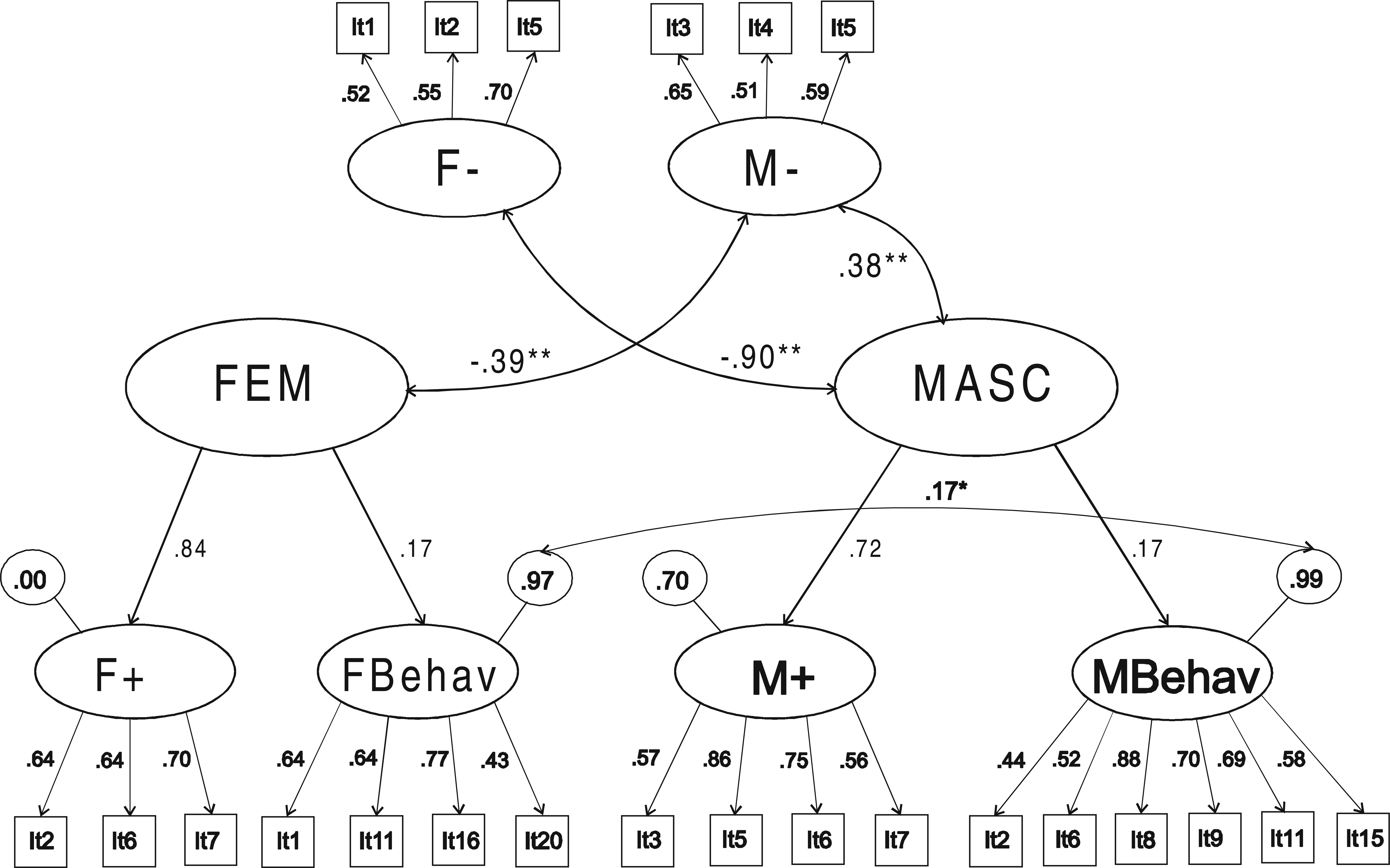
Final gender role self-concept model for men.
The decision to treat F- and M- as independent self-concept dimensions might be a critical aspect of the proposed conceptualization (but see Helgeson & Fritz, 1999). It also is plausible that these factors could be part of FEM and MASC. Especially for men, it seems to make sense that not to be feminine in a socially undesirable manner could be a component of the male role self-concept. However, the same argument is not plausible for the correlations of women as well as for the correlation between FEM and M- for men. Thus, the above-mentioned contradictoriness of the specific contents (Spence et al., 1979) seems to be the most plausible interpretation for the cross-gendered correlation. In this sense, the correlations might be special features of the gender role self-concept but not be relevant for other parts of the self-concept. More research is needed to clarify this matter.
Based on Model 3, additional post hoc model fitting analyses revealed somewhat different final models for men and women (Figure 2 and Figure 3). The most important difference concerns the relationship between FEM and MASC. For men, these two dimensions were independent. However for women, the two dimensions correlated positively. This suggests that if women incorporate gender role aspects into their self-concept, they tend to incorporate both feminine and masculine aspects. This unexpected result could be a consequence of societal circumstances, more specifically, of the higher value that is given to masculine characteristics. This fact could imply a pressure on women to incorporate male role aspects into their self-concept.
Another possible interpretation for the correlation between FEM and MASC for women could be that women tended to describe themselves in a socially desirable manner. Several structural features of the final model for women point to the relevance of social desirability (see Figure 2). Specific evidence for this statement comes from the significant positive correlation of the F- and the M- dimension. It seems that women tend either to admit or to deny socially undesirable characteristics regardless of their gender typicality. This could be interpreted as the consequence of a higher level of socially desirable responding among women (Paulhus, 1986). The significant negative correlation between the same-gendered dimensions (FEM with F- and MASC with M-) also points in this direction. For men, social desirability aspects seem to have less importance. The F- and the M- as well as FEM and F- were not correlated. Additionally, the significant correlation between MASC and M- was positive, which means that men who described themselves as more masculine also tended to use more socially undesirable instrumental traits for self-description. Thus, masculine men did not refuse to describe themselves with socially undesirable traits.
CONCLUSION
The present study adds to a large body of research dealing with the incorporation of gender into the self. One point of criticism of earlier studies was the common usage of scales evaluating expressiveness and instrumentality as sole measures of the gender-related self (e.g., Archer, 1989; Ashmore, 1990; Koestner & Aube, 1995; Spence, 1993; Spence & Buckner, 1995, 2000; Twenge, 1999). The here-proposed conceptualization includes not only self-concept contents concerning expressiveness and instrumentality but also contents concerning gendered behaviors. Thus, the conceptualization is broader and covers more gender role domains than former conceptualizations. However, it is not proposed that this conceptualization is complete. It is very likely that other gender stereotype domains (for instance, stereotypes related to occupations or physical characteristics; see Deaux & Lewis, 1984; Aube, Norcliffe, & Koestner, 1995) might be connected to the self.
The present conceptualization of gender role self-concept adds to the theories of Ashmore (1990) and Spence (1993) as it proposes that social role aspect of gender must be seen as a distinct part of the gender-related self. However, other gender-related domains may be important factors in the gender-related self. For instance, gender identity, which is defined as the basic sense of belonging to one's own gender (Spence, 1993), can be seen as another (independent) factor of the gender-related self. More research is needed to clarify the relationship between these different constructs as well as other relevant concepts.
To conclude, this study points to the importance that the social role aspect of gender has for the self-concept. People use gender stereotypes to describe themselves. On the basis of the complexity of gender stereotypes, it was shown that different gender stereotype domains are components of the gender role self-concept. Although the results revealed similar self-concept structures for men and women, there were some differences that point to the different meaning of gender roles for the two sexes. Finally, it can be stated that not only does the gender-related self have multiple contributing domains (Ashmore, 1990; Spence, 1993) but that in addition, these domains themselves are quite complex.
Footnotes
1.
An English version of this scale is available from the author.
2.
The correlation between FBehav and MBehav is not regarded as substantially relevant for the conceptualization of the gender role self-concept. Presumably, it reflects the individuals' habitual activity level. Being an active person means having a higher level of behavioral activity regardless of gender typicality.