







Abstract
Two hundred fourteen (214) married persons, 101 men and 113 women aged 20–60, with at least high school education, participated in the study which investigated the effects of gender, age, and educational attainment on assertiveness among married persons in Nigeria. The Assertive Behavior Assessment scale (ABAS; Onyeizugbo, 1998) was used to measure assertiveness. It was hypothesized that persons with higher educational attainment will report more assertiveness than persons with lower educational attainment. Results supported the hypothesis. In addition, interactions between gender and age, and gender and educational attainment were found. Younger men reported more assertiveness than younger women whereas older women reported more assertiveness than older men. Also, women participants of lower educational attainment reported more assertiveness than their men counterparts whereas men of higher educational attainment reported more assertiveness than their women counterparts. Results of this study suggest that women in Nigeria may become more assertive with age.
Sex roles are somewhat rigid in Africa, particularly in Nigeria. Gender differences are emphasized. Men are expected to be assertive (even aggressive), ambitious, and strong whereas women are expected to be submissive, passive, and gentle. This double standard borders on sexism and it imposes a limit on the extent to which women can assert or express themselves. For example, in Igboland (a major Nigerian cultural segment), a man is the one who is expected to verbally express “love” to a woman; accordingly a woman who takes such initiative is frowned at. Whereas women in Africa wield immense power in private as well as in public (indirectly), their subservient position culturally is self-evident. However, things are changing very fast. The Beijing conference of 1995 has been an eye-opener for many women as regards the extent of their subjugation and the absurdity of being treated as second-class members of the human race. Consequently, women are more aware now than ever of the need to claim their rights.
The literature from the West is contradictory with respect to gender differences in assertiveness. For example, Ory and Helfrich (1976, cited by Chandler, Cook, & Dugovics, 1978, p. 395) found that men are more assertive than women. Chandler et al. (1978) found that women were significantly more assertive than men in some specific situations, for instance, women (college students) were more willing to be socially “confrontative,” more willing to present themselves in person in competitive situations, such as job interviews, and more open and frank about their feelings. On the other hand, Maccoby and Jacklin in their study (1974) came to the conclusion that on the whole, there is no consistent tendency for one gender to be more timid than the other. Adejumo (1981), who studied college students from Nigeria, found that men were generally more assertive than women.
Studies in assertiveness employing age and educational attainment as variables are lacking. This study attempts to contribute empirical data in these areas. Understandably, most studies on assertiveness come from the West with very few coming from Africa; the present study therefore aims at providing data from Africa (Nigeria).
Most existing studies in the area use college students. However, the present study considers employed adults. Thus, this study will broaden the spectrum of evidence in this area. A recent study (Onyeizugbo, 2001) has found that assertiveness is related to greater marital adjustment. Therefore, the extent to which assertiveness is related to age and educational attainment could shed further light on this relationship.
Most of the existing studies have tended to employ one variable, for example, gender (Adejumo, 1981; Chandler et al.; 1978). The present study utilizes a multi-factorial approach to account for the interaction of factors. In this study, it is hypothesized that age will not play a significant role in assertiveness. This is based on the report (Rakos, 1991) that assertiveness is a social skill that responds more to environmental contingencies than to maturation. However, it is predicted that gender would interact with age. This is due to differential role expectations of women in Nigeria, especially in Igboland where submissiveness is expected of younger married women, but as a woman gets older, she is given more respect and more social recognition. It is assumed that formal education equips one for the acquisition of adaptive social skills—assertiveness being one of them. It is therefore hypothesized that persons with higher educational attainment will report more assertiveness than persons with lower educational attainment. It is further hypothesized that gender will interact with educational attainment in assertiveness. This prediction is based on the contradictory findings from studies utilizing a single factor, for example, gender. Perhaps, gender in isolation is not a valid predictor of assertiveness, but may interact with other factors to influence assertiveness.
METHOD
Participants
The participants were 214 married persons, 101 men and 113 women (mostly of the Igbo ethnic group). They were selected through stratified random sampling from workers at Nnamdi Azikwe University (NAU), Awka (Nigeria) and the Anambra State ministries of Education, Health, Information, Justice, and Works (also in Awka, Nigeria). At NAU, 20 participants were drawn from each of the following faculties—Education, Social Sciences, Arts, Engineering, and Physical Sciences. At the ministries, 25 participants were drawn from each of the ministries except the Ministry of Education where 30 participants were drawn because it had more people.
Ninety-two participants (41 men and 51 women) with a high school education, Teachers Grade Two certificate (TC II), or Ordinary National Diploma (OND) constituted the lower educational attainment group. One hundred twenty-two participants (60 men and 62 women) with a Higher National Diploma (HND) or University Degree (B.A., B.Sc., M.Sc., M.A., Ph.D., etc.), constituted the higher educational attainment group.
The age range of participants was 20–60 years. Participants in the age range 20–39 years (mean age 31 years) constituted the younger age group, while those in age range 40–60 (mean age 50.5 years) constituted the older age group. There were 110 participants in the younger group, 51 men and 59 women. There were 104 participants in the older group, 50 men and 54 women.
Instrument
The dependent variable, assertiveness, was measured with the Assertive Behavior Assessment Scale (ABAS; Onyeizugbo, 1998; see Appendix for complete set of items). The 18-item ABAS was developed and validated in Nigeria on an adult population. It is a 5-point Likert-type scale ranging from 1 to 5 (always-never). Items that indicate low assertiveness on the ABAS were scored in the reverse direction (numbers 2, 4, 7, 9, 10, 11, 13, 14, 15, 16, 17). The rest of the items (1, 3, 5, 6, 8, 12, 18) indicate high assertiveness.
In the process of developing the ABAS, 16 items were adopted from the “Assertion Inventory” by Gambrill and Richey (in Rakos, 1991). Twelve items were also adopted from a list of assertiveness items listed by Alberti and Emmons (1986), and 12 items were taken from the Rathus Assertiveness Scale (Rathus, 1973). The remaining 24 items were developed by the author based on social skills deficits observed in clients, as well as from personal observations. Some of these items taken from already existing measures were reworded and some rephrased to make them easy to understand by people with a high school education. Altogether, there were 64 items on the original list. Four clinical psychologists vetted (examined) the instrument for face and content validity. Eight items were then discarded because only items that the judges unanimously agreed would measure assertiveness were retained, thus reducing the ABAS to 56 items.
The remaining 56 items were administered to 50 participants. These were married adults with at least high school education drawn from the staff of the University of Nigeria, Nsukka. The internal consistency of the instrument was established through item-analysis, resulting in 18 items out of 56. Only item full-scale correlation coefficients of at least .30 and above were retained. The ABAS has a full-scale reliability coefficient of .76 obtained with the Cronbach coefficient alpha, and a split-half reliability coefficient of .69, which rose to .82 when corrected using the Spearman Brown correction formula. The ABAS was further subjected to principal components factor analysis to test whether the different dimensions of assertive behavior would emerge as separate factors to form subscales. All the items converged on a single factor.
The ABAS has several advantages over previous measures: (a) it has been standardized on married adults rather than college students; (b) the items have been constructed so that individuals with only a high school education can understand them; and (c) the items have been constructed to be applicable to a Nigerian population.
Procedure
The Assertive Behavior Assessment Scale (ABAS) was prepared in a questionnaire format and administered as a self-report inventory. It has provision for personal data such as age, marital status, gender, and educational qualifications. Two hundred thirty copies of the instrument were administered to the participants individually in their offices. The researcher administered the questionnaire with the help of three research assistants trained for the purpose. Before administering the questionnaire, the nature of the research was explained to the research assistants. Participants knew that participating was voluntary. After responding to the questionnaire, the purpose of the study was explained to them. All 230 copies of the questionnaire were returned. However, 16 participants were dropped because of incomplete information leaving a final sample size of 214.
Design and Analysis
The design of the study was a 2 × 2 × 2 factorial. A point-biserial correlation between age and educational attainment was calculated; the relationship was found to be nonsignificant (men r = -.09; women r = -.02). Analysis of variance was used to test the hypotheses that persons with higher educational attainment will report more assertiveness than persons with lower educational attainment, and gender will interact with age and educational attainment in assertiveness.
RESULTS
ANOVA results revealed no significant differences between men and women, and younger and older participants, as hypothesized. However, the more highly educated participants with a mean score of 60.51 (SD = 9.22) differed significantly from those lower in educational attainment with a mean score 54.63 (SD = 7.47), F(1,206) = 38.88, p < 0.0001. This implies that educational attainment is related to assertiveness.
There were two significant first-order interactions in the study: gender by age, F(1,206) = 76.01, p < 0.0001, and gender by educational attainment, F(1,206) = 20.99, p < 0.0001. In the gender by age interaction, younger men scored higher (M = 63.04, SD = 10.76) than younger women (M = 52.64, SD = 6.48); whereas older women scored higher (M = 62.13, SD = 6.26) than older men (M = 54.64, SD = 7.00; see Figure 1).
In the gender by educational attainment interaction, women participants of lower educational attainment scored higher (M = 56.43, SD = 7.29) than their men counterparts (M = 52.39, SD = 7.16) whereas men of higher educational attainment scored higher (M = 63.32, SD = 9.23) than their women counterparts (M = 57.79, SD = 8.44; see Figure 2). The three-way interaction was not significant.
DISCUSSION
As predicted, there were no significant main effects of gender and age. Significant differences were found in assertiveness among higher and lower educated participants, with those higher in educational attainment tending to be more assertive than their counterparts with lower educational attainment. Without underestimating the value of informal education, it is expected that a person with higher education has in the process acquired more of the necessary skills that facilitate assertive responding than his or her counterpart with lower educational attainment. On the other hand, it is possible that rather than education making people more assertive, more assertive people are more successful at obtaining a higher education.
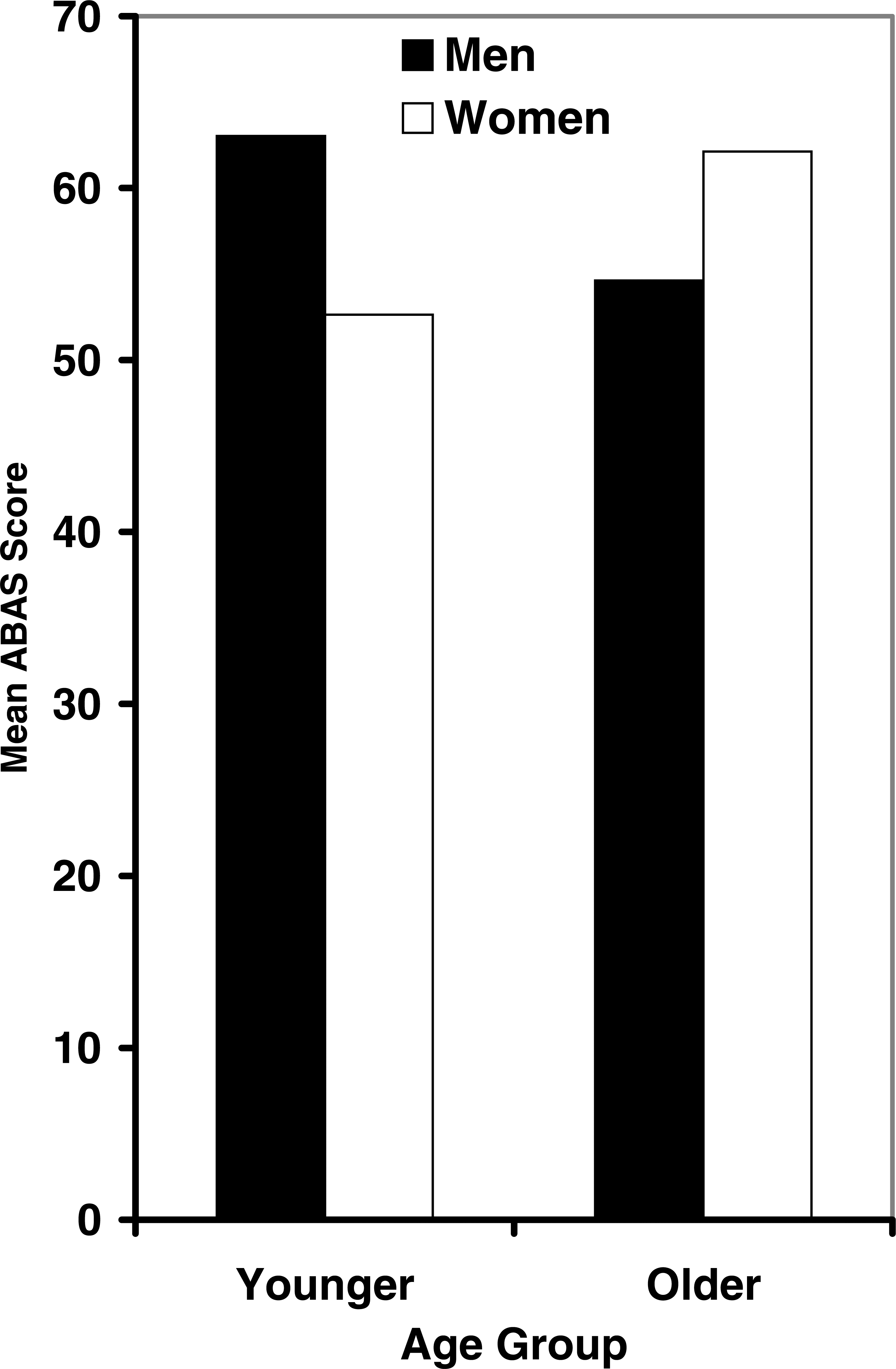
Self-reported assertiveness as a function of gender and age.
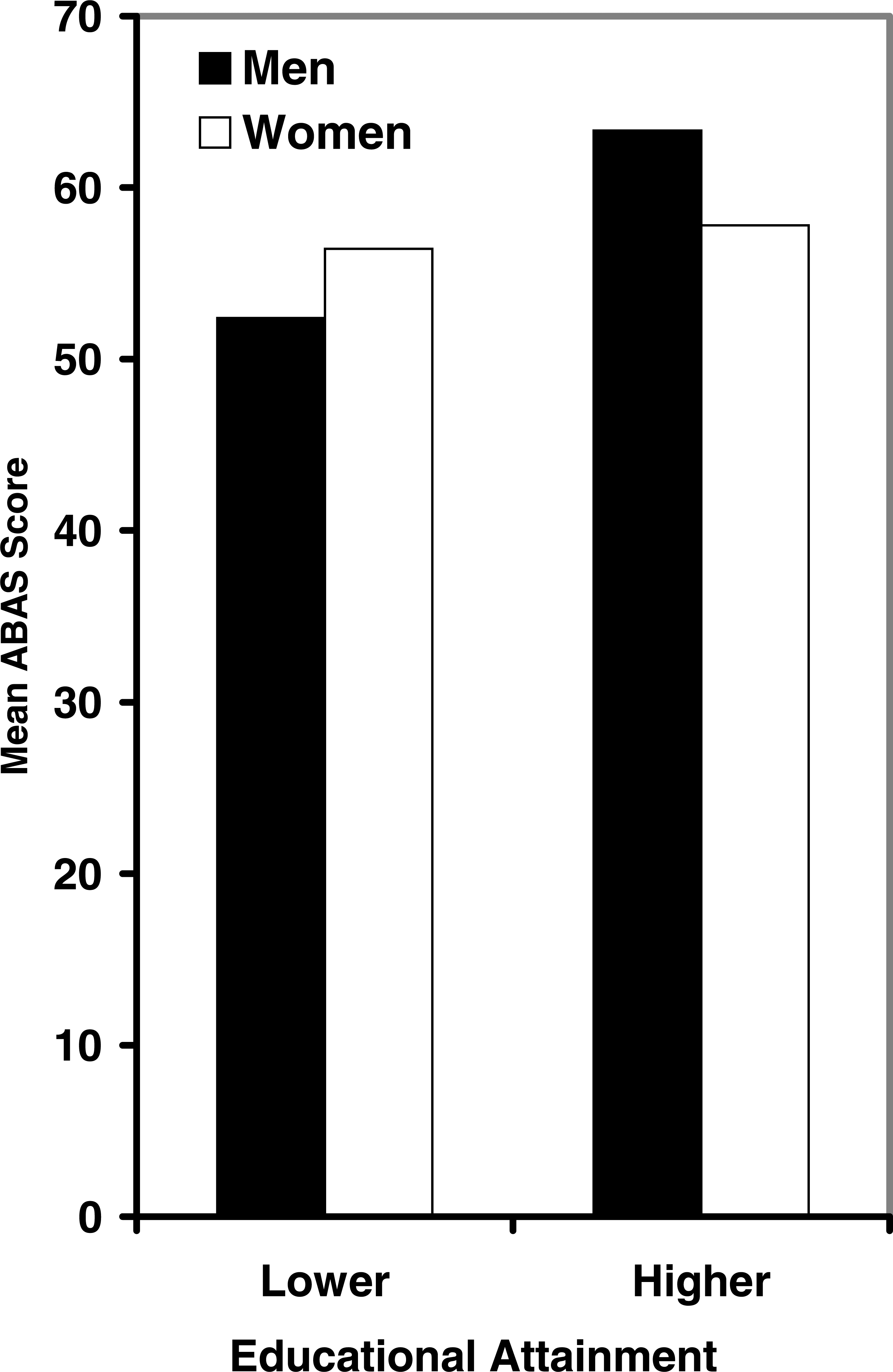
Self-reported assertiveness as a function of gender and educational attainment.
The significant interaction between age and gender implies that neither gender nor age alone is a reliable predictor of assertive responding. Younger men tend to be more assertive than older men—as the result of this study reveals. This may be because at a younger age (age 20 to late 30s), men are, physically, at their best and are likely to envision the attainment of their potential in other aspects of life. Therefore, they face life more courageously, unlike younger women who at this time are entering marriages, with all the culturally expected submissiveness that marriage requires of them. Many women at this stage feel that asserting themselves may entail disruption of their marriages and their prospects. Sexism is embedded in the Nigerian social system and women are adversely affected by it. Igbo society, in which this study was conducted, keeps women in a state of subjugation; hence, they do not have equal opportunities with their men counterparts to express themselves both in the home and in the public.
However, older Nigerian women were shown to be more assertive than both their younger counterparts and older men. At this stage it seems the rhythm of the drum changes. Men begin to let go of their illusion of invincibility as their women counterparts acquire more “power.” Financially, older women are in good shape because they can afford at this stage to engage in business and excel in their professions. In the family, they control things, for instance, children. Having spent time over the years establishing bonds with their children, they now reap the dividends of endearment and support from their children. Having acquired more power which boosts their self-esteem and courage, they are inclined towards more assertive behaviors.
The interaction of educational attainment and gender in assertiveness shows that at lower educational attainment, women tend to be more assertive than men, whereas men are more assertive than women at higher educational attainment. Results of the present investigation strongly suggest that assertiveness is a construct that interrelates with other factors to make its impact. Days are gone when a man's worth was determined by the number of wives he had or his physical strength which would enable him to cultivate the land, fight, and the like. Cultural contact with the West and consequent change in lifestyle has led, among other things, to an emphasis on education. Besides, the world has become a “global village” and to get around one needs a level of sophistication which education provides. Those who acquire this new power have more opportunities open to them while those who do not have it remain in the background. It is not surprising that men with higher education are more assertive than men with lower education. In the ministries, for instance, men with higher education are naturally in control of affairs while those with lower education do menial jobs, and naturally feel inferior and thus less assertive.
The trend is reversed for women who tend to assert themselves more at lower educational attainment than at higher educational attainment. This may reflect that the majority of women in this sample still live in environments in which higher education for women is looked on with suspicion by their men counterparts. In that situation, highly educated women tend to compromise a lot in order to please their husbands and maintain a “peaceful” marriage; under such circumstances, they appear to be less assertive. On the other hand, for women with lower educational attainment, their husbands or other men around them have nothing to fear. These women can afford to say and do anything and get away with it because they do not pose a threat to their partners; perhaps, that accounts for the apparently greater assertiveness of women at lower educational attainment.
The limitation of this study lies mainly in the fact that broad categorical variables such as age, gender, and education are often “packaged” variables, that is to say they are made up of many components, each of which might be affecting the dependent variable. As Epstein and his colleagues have written, “an individual's level of education is a multidetermined characteristic that is likely to be related to other factors such as intelligence, level of experience, level of authority, and sense of environmental mastery” (Epstein, Fullerton, & Ursano, 1998, p. 937). It is therefore recommended that future studies considering these variables, that is, gender, age, and education, should control for extraneous variables like those mentioned by Epstein et al. (1998). Although the results of this study may be applicable to adult men and women who are married in Nigeria, particularly in Igboland, the applicability of the results to other contexts and other populations, for example, unmarried and unemployed individuals, needs further investigation. Further, this study was conducted in Igboland, and it is assumed that most participants would be of Igbo background. It is recommended that ethnicity should be assessed more carefully in future studies in order to clarify findings.