






Abstract
Blame avoidance behaviour (BAB) has become an increasingly popular topic in political science. However, the preconditions of BAB, its presence and consequences in various areas and in different political systems largely remain a black box. In order to generate a better understanding of BAB and its importance for the workings of democratic political systems, the scattered literature on BAB needs to be assessed and structured. This article offers a comprehensive review of the literature on blame avoidance. It departs from Weaver’s concept of blame avoidance and subsequently differentiates between work on BAB in comparative welfare state research and work on BAB in public policy and administration. It is argued that between these two strands of literature a bifurcation exists since both perspectives rarely draw on each other to create a more general understanding of BAB. Advantages from existing approaches must be combined to assess the phenomenon of blame avoidance in a more comprehensive way.
Current public affairs are increasingly characterised by rising public expectations and by the media-induced politicisation and scandalisation of events (Flinders, 2014; Strömbäck, 2008). It is not surprising that these developments have an impact on the behaviour of actors at the centre of public affairs and media interest. This explains why the phenomenon of blame avoidance behaviour (BAB) has become an increasingly popular topic in political science. BAB displayed by public actors encompasses all kinds of activities intended to downplay or distance oneself from (potentially) blame-attracting and goal-threatening events. The study of this type of elite behaviour has experienced renewed interest in recent years, which is not least demonstrated by the growing number of articles published in various subfields of the discipline that consider aspects of blame avoidance. Although scholars generally agree that BAB is an important aspect of democratic governance that needs to be taken into account when the workings of democratic political systems are examined, the preconditions of BAB, its presence and consequences in various areas and in different political systems largely remain a black box (Hinterleitner and Sager, 2015). For instance, how does the political system handle blame? Is it still functional – can it cope with blame and fulfil its basic functions? Or does it lead to political polarisation, policy stalemate and public disaffection (Weaver, 2013)? These are only a few of the questions that need to be answered in order to gain a better understanding of BAB and its impact on the workings of democratic systems.
However, differences in approaches towards BAB abound.Afirst step towards answering these questions is a comprehensive review of the literature. This article departs from Weaver’s concept of blame avoidance and subsequently differentiates between work on BAB in comparative welfare state research and work on BAB in public policy and administration. As pictured in Figure 1, it is argued that these two strands of literature ‘sit at separate tables’ (Almond, 1988), each with its own focus of analysis and perspective on BAB, resulting in specific advantages and disadvantages in the ways BAB is studied. Little discussion ‘across tables’ impedes potentially fruitful dialogue since advantages from existing approaches can be combined to assess the phenomenon of blame avoidance in a more comprehensive way.
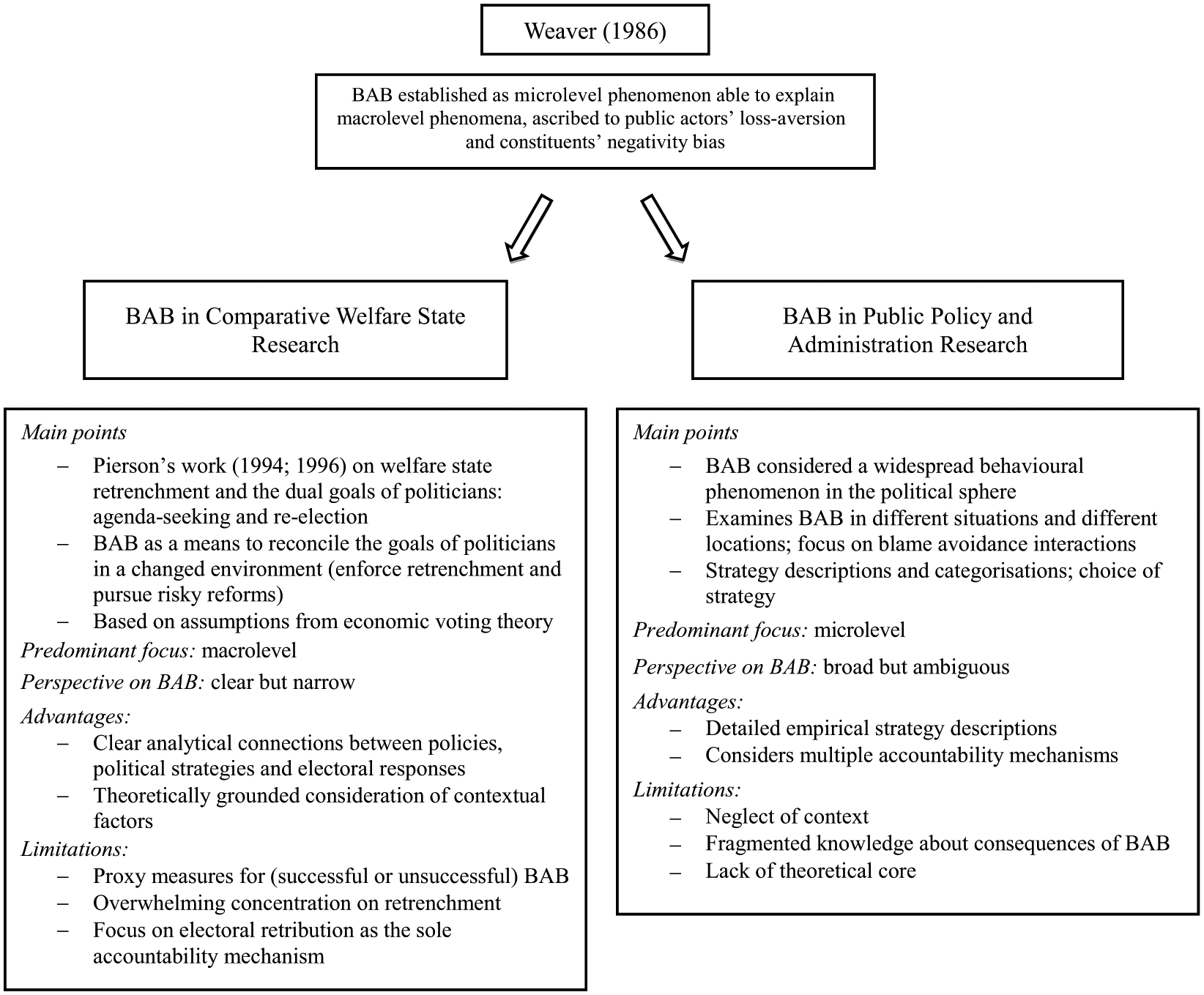
A Bifurcation in Research on Blame Avoidance Behaviour
Kent Weaver’s Work on Blame Avoidance Behaviour
Although the topic of blame avoidance has been touched upon in certain ways avant la lettre, ‘long before the term “blame avoidance” came into currency’ (Hood, 2011, p. 15), the introduction of BAB as an object of scientific study goes back to Kent Weaver (1986) who, in a seminal article, laid the groundwork for an expanding subfield in research on elite behaviour. Drawing on findings from early prospect theory (Kahneman and Tversky, 1984), Weaver ascribed the existence of BAB in the political sphere to the loss aversion of public actors and their consideration of the negativity bias of constituents – i.e. the propensity of voters to put stronger weight on real or potential losses than on gains (Lau, 1985). This leads politicians to apply different blame avoidance strategies, ranging from argumentative tactics like ‘agenda limitation’ to passing blame to others by ‘finding a scapegoat’. This line of reasoning towards elite behaviour departed from beliefs held long into the 1980s that the dominant strategy applied by political actors to reach their goals is to claim credit for their actions whenever possible (Mayhew, 1974; Twight, 1991). Weaver argued that this behavioural phenomenon needs to be considered in political science since it can contribute to the explanation of policy phenomena such as the deliberate surrender of discretion in policy-making by politicians.
The enduring contribution of Weaver’s approach particularly consists in the explanation of macrolevel phenomena by resorting to a certain type of microlevel behaviour, thereby transcending a weakness often found in various subfields of political science: neglecting or even denying the need for a micro-foundation that goes beyond rational actor theory (Beckert, 2013). Instead, Weaver showed that our understanding of political systems can be advanced by engaging in the meticulous assessment of individual actor behaviour and connecting it to macrolevel phenomena. One of the macro-phenomena Weaver connected to BAB was a change in the design of policies observable in the US in the 1970s and 1980s: the increased use of indexing provisions in federal programmes which equip policies with automatic adjustments for inflation (Weaver, 1988). Being loss-averse, politicians’ desire to avoid blame is stronger than their desire to claim credit. Consequently, they deliberately forego the possibility to claim credit for popular increases in benefits and automate decisions instead.
Following Weaver, there emerged a bifurcation in the study of BAB. Broadly speaking, since then the phenomenon of BAB has been studied in comparative welfare state research and public policy and administration.
Blame Avoidance Behaviour in Comparative Welfare State Research
The work on BAB in welfare state research has its origin in the seminal work by Paul Pierson on welfare state retrenchment (Pierson, 1994; 1996). Pierson argued that the factors and theories that explain welfare state expansion cannot be automatically applied to the study of welfare state retrenchment in times of austerity since the underlying political logic of retrenchment differs from a logic of expansion. According to Pierson (1994), politicians have two overarching goals: advancing their political agendas and getting re-elected. Given that the goals of politicians in the agenda domain have shifted from expansion to cutbacks and the latter cause immediate and tangible losses for specific (usually well-organised) interest groups and voters, advancing the political agenda threatens the re-election of politicians. BAB is thus described as a way to reconcile the goals of politicians in a changed environment: advancing the political agenda (retrenchment) while minimising the likelihood of electoral retribution (thereby securing re-election).
Following Pierson’s work, the study of BAB as a means to pursue unpopular reforms has been taken up by many scholars and the causal mechanisms exposed by Pierson have been applied to different contexts and confirmed in various case studies (Lindbom, 2007; Mortensen, 2012; Schmidt, 2001; Starke, 2006; Vis, 2009; Vis and van Kersbergen, 2007; Wagschal and Wenzelburger, 2008; Wenzelburger, 2011; Zohlnhöfer, 2007). Particular interest in the scholarly debate was directed at the conditions under which BAB as a means to pursue risky reforms is effective, such as institutional fragmentation and the partisan composition of the government (Jensen and Mortensen, 2014), party political consensus (Green-Pedersen, 2002) or the partisan, cultural and institutional context in more general terms (Ross, 2000). However, in recent years, scholars have also questioned the assumption that under all circumstances and for all types of political actors retrenchment leads to electoral punishment, raising doubts about whether blame avoidance strategies are really necessary to cut social policy successfully (Armingeon and Giger, 2008; Giger and Nelson, 2011; 2013; Schumacher et al., 2012). In a recent study, Georg Wenzelburger (2014) addressed this apparent contradiction between a lack of systematic electoral punishment for retrenchment and the continuing use of blame avoidance strategies by stressing that it is not the actual but the perceived electoral risk of politicians that entices them to engage in BAB.
This summary of literature on BAB in the welfare state domain shows that the perspective on BAB applied here is a clear but narrow one. BAB is treated as an important behavioural phenomenon able to explain changes in social policy over time and between countries. Work on BAB in this domain is to a large degree based on assumptions derived from economic voting theory (Anderson, 2007; König and Wenzelburger, 2014), where the basic tenet is that politicians are held responsible for their economic influence and performance at the ballot box, following a simple reward-punishment logic. The causal chain linking economic performance of politicians to voters’ assessments of that performance can be described as follows: (1) policies are enacted by politicians; (2) voters evaluate policies for their macroeconomic implications and the impact on their personal economic situation that results therefrom; (3) voters assign responsibility for the evaluated policies; and (4) they vote accordingly. In this context, BAB is typically considered a way to circumvent electoral punishment by influencing steps (2) and (3). This understanding of BAB comes with several advantages and limitations for a fuller understanding of the phenomenon of blame avoidance.
Advantages
First, the straightforward analytical connections between policies, political strategies and electoral responses can be considered an advantage. The role and significance of BAB in this particular context is clear and the consequences this type of behaviour exhibits at the macrolevel are well defined. The second advantage consists in the theoretically grounded consideration of contextual factors that influence the link between policy performance and electoral judgement. For instance, scholars have examined how differences in the political and institutional set-up influence the clarity of responsibility, describing the ease with which voters can assign responsibility for economic performance (step (3) in the causal chain described above) (Powell and Whitten, 1993). This context-sensitive approach provides an opportunity for asking clear-cut questions, like under which conditions BAB is successful and can be considered a suitable strategy to pursue risky reforms.
Limitations
In terms of limitations, there first is the fact that, in many studies on blame avoidance in the retrenchment domain, strategic BAB is rather assumed than studied empirically (Giger and Nelson, 2011; Wenzelburger, 2014). In other words, scholars infer the (successful or unsuccessful) use of BAB from macro-relationships between policies and electoral responses without examining actual BAB at the microlevel. To determine whether the design and promotion of a reform is characterised by motives of blame avoidance, one has to rely on proxies such as the degree of packaging of a reform, ‘because packaging a reform hides it’ (Vis, 2015, p. 19). However, a caveat applies in the above case since scholars need to establish unequivocally that the packaging was indeed driven by blame avoidance motives. The same problem arises when scholars consider election outcomes or approval ratings to measure whether BAB has actually been successful. If successful BAB is inferred from election outcomes (or approval ratings) after the passing of a reform, scholars need to control for a wide variety of (unrelated) factors that can influence a change in approval ratings. Hence, this strand of the literature mostly relies on proxy measures when studying BAB and, accordingly, there needs to be caution when associating policy outcomes with particular BAB. Wenzelburger (2014, p. 81) thus suggests that one should ‘test the effect of blame avoidance in a more straightforward and direct manner and provide some empirical evidence corroborating the hypothesis that blame avoidance does indeed matter’. Suggestions to determine whether blame avoidance strategies have indeed been applied focus on the close and systematic assessment of the reform context, encompassing the timing and packaging of reforms, but also the justificatory arguments employed by public actors (Vis, 2015). To measure the success of BAB, experimental research designs have been proposed (Wenzelburger, 2014).
Another important limitation of research on BAB in the welfare state domain is an overwhelming concentration on retrenchment issues, which does not allow for the phenomenon of BAB to be considered in its entirety or to assess its overall importance for the policy process and the workings of democratic systems. The assumptions made by Pierson (1994; 1996) on the dual goals of politicians – namely advancing the political agenda and seeking re-election – help to clarify this point. In Pierson’s logic, politicians only resort to BAB since the political context forces them to pursue a different political agenda that threatens their re-election. This implies that in situations where fiscal aspects play a minor role, BAB would not be necessary and thus would vanish from politicians’ repertoire of political strategies, making the phenomenon irrelevant from a scientific perspective. However, as will be shown in the next section, many other situations exist where politicians are forced onto the defensive and therefore resort to BAB, such as crisis situations and instances of government and policy failure. Likewise, the focus on electoral retribution as the sole accountability mechanism neglects other ways in which politicians are held accountable by the public (Bovens, 2007). Therefore, the analytical focus on BAB in the retrenchment literature is too narrow and underestimates the overall importance of BAB in a political system.
A more general assessment of the phenomenon of blame avoidance has much to gain from the systematic, conceptually grounded and context-sensitive approaches that can be found in the welfare state domain. Therefore, the concepts and approaches used in this literature should be applied to other instances in which public actors display BAB. However, one needs to examine actual BAB systematically at the microlevel instead of merely inferring it from observing macrolevel phenomena, especially if BAB and its consequences are studied in a more exploratory manner not limited to questions of retrenchment.
Blame Avoidance Behaviour in Public Policy and Administration Research
Besides research on welfare state retrenchment, the concept of blame avoidance developed by Weaver (1986) has been applied to other areas of interest, especially in public policy and administration research. Instead of merely treating BAB as a means to pursue retrenchment, scholars like Christopher Hood (2002; 2007; 2011) consider it to be a widespread behavioural phenomenon in the political sphere. The basic tenet, as indicated in the previous section, is that politicians are not only forced on the defensive when they cut social policy, but that other situations in the political process exist where the goals of politicians are threatened and, accordingly, BAB can be observed. This perspective on blame avoidance presupposes that public actors are not only accountable at the ballot box, but that public accountability ‘comes in many guises’ (Bovens, 2007, p. 454). Public actors are generally held accountable by different actors in different forums, for different things and in different situations. This means that BAB is not only applied in cases of social policy retrenchment, but in many other situations where politicians’ goals are threatened, making blame avoidance a much more pervasive phenomenon than presupposed by the welfare state literature.
Situations
To structure the situations in which public actors display forms of BAB, one can differentiate between anticipatory and reactive forms of blame avoidance (Sulitzeanu-Kenan, 2006). The type of BAB studied in the retrenchment literature can be conceptualised as an anticipatory form since politicians proactively try to address and deal with blame coming from unpopular policies in order to avoid electoral retribution. In more general terms, behaviour aimed at keeping problems and pitfalls off the agenda before they arise and become problematic for public actors can be classified as anticipatory forms of BAB. Reactive blame avoidance, instead, describes behaviour displayed after a problematic issue has appeared on the public agenda and related blame has to be dealt with.
Many studies on blame avoidance in the public policy and administration domain deal with reactive forms of BAB. For instance, scholars have studied BAB in various crisis situations, ranging from man-made political crises and failures to natural disasters (Boin et al., 2009; Brändström and Kuipers, 2003; Hinterleitner and Sager, 2015; Hood, 2011; Hood et al., 2009). In these situations, harmful events beyond politicians’ control and related accusations prompt them to engage in BAB. But anticipatory forms of BAB have also been examined in the public policy and administration domain. For example, scholars have studied the role of different types of arms-length institutional bodies in insulating, blame-deflecting institutional arrangements. With the help of the latter, ‘legislators not only avoid the time and trouble of making specific decisions, they avoid or at least disguise their responsibility for the consequences of the decisions ultimately made’ (Fiorina, 1982, p. 47; 1986; Horn, 1995). Hood (2007; 2011) considered both anticipatory and reactive BAB in politics and organisational life.
Locations
Besides different situations in which public actors turn to blame avoidance, research has also diversified with respect to the different locations in a political system where forms of BAB can be observed. Early studies on blame avoidance, including those on welfare retrenchment, concentrated on BAB exhibited by politicians, either during the policy process or during the normal courseof events. For instance, Richard Ellis (1994) has describeda more institutionalised form of blame avoidance at the top-executive level where presidents use cabinet officials as their ‘lightning rods’ to divert blame. Recent studies have started to examine BAB in other locations, such as bureaucracies and networks (Hood, 2007; 2011; Mortensen, 2013; Moynihan, 2012). A broadened localisation of BAB has also brought scholars to study blame avoidance interactions between different (types of) actors in a political system, labelled ‘blame games’ (Boin et al., 2009; Hood, 2002). Governments, chief executives, public servants and managers, parliaments and public companies have different orientations, goals and resources and apply different forms of BAB.
Strategies
The question of what kind of strategies public actors apply to avoid blame figures most prominently in the literature, producing an ever-expanding catalogue of strategies and categorisations. For instance, Weaver distinguishes eight different strategies that public actors can use to ‘respond to potential blame-generating pressures’ (Weaver, 1986, p. 384), ranging from argumentative tactics like ‘redefining the issue’ to passing responsibility and blame to others by ‘finding a scapegoat’. Hood (2002; 2007) has presented a useful categorisation of blame avoidance strategies by differentiating between three broad types of behaviour: agency strategies intended to shift responsibility to others; presentational strategies aimed at avoiding blame by shaping public perceptions; and policy strategies limiting formal responsibility and liability (presented in Table 1). The advantages of Hood’s typology are that it encompasses both anticipatory and reactive blame avoidance strategies and allows for the integration of strategies that have not yet been described in detail.
Types of Blame Avoidance Strategies
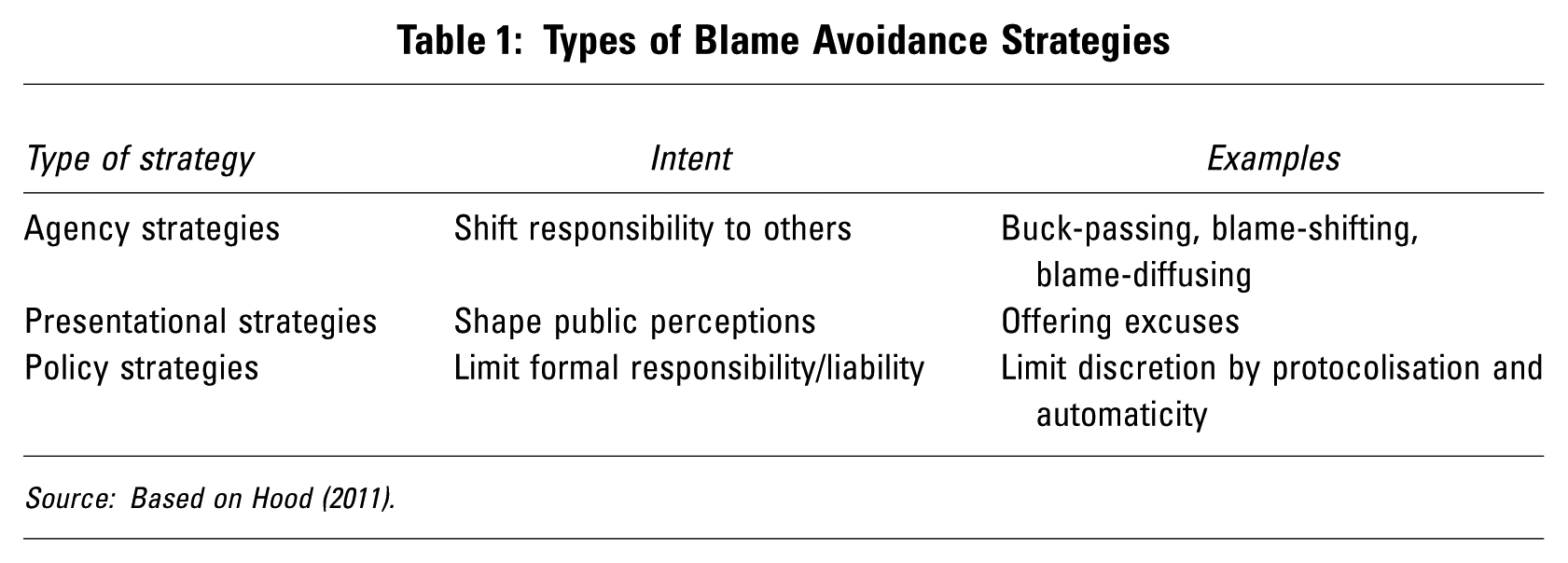
Source: Based on Hood (2011).
In addition to the descriptions and categorisations of strategies to avert blame, scholars have explored the choice of strategy. The sequencing of strategies, or ‘staged-retreat hypothesis’, figures among the most influential explanations (Brändström and Kuipers, 2003; Hood et al., 2009; Schütz, 1996). The assumption that actors apply a ‘trial-anderror’ approach and adopt the most convenient and advantageous strategy (e.g. problem denial) before they are forced to make more painful moves (e.g. admitting responsibility) is central to this explanation. Here, scholars profit from digitally searchable media to measure the immediate success of different blame avoidance strategies in mitigating ‘firestorms’ (Hood et al., 2009). Other factors supposedly relevant for the choice of strategy are the leadership style of an actor (Boin et al., 2010) and the anticipated behaviour of adversaries (Hood, 2002).
Comparing the work on BAB in public policy and administration research to that in the retrenchment literature, it is obvious that the focus of the former lies more at the microlevel and the perspective of BAB applied here is a much broader but ambiguous one. Macro-phenomena take a back seat and the particular behaviour exhibited at the microlevel is examined in a more thorough and systematic way. This focus entails several advantages and limitations for a more comprehensive assessment of BAB.
Advantages
The intensified empirical focus on BAB at the microlevel has contributed to the study of political strategies. This focus shows that the phenomenon of blame avoidance is much more widespread and versatile than presupposed by the welfare state stream of research. It can be observed not only when politicians try to push through unpopular reforms, but whenever motive combines with opportunity (Hood, 2011). As we have seen, motives are strong whenever the goals of public actors are at stake; and, as meticulous case study research has demonstrated, public actors are very creative in developing an expanding repertoire of blame avoidance strategies to help them seize opportunities to escape blame. One can conclude from this line of research that BAB is a phenomenon that ‘affects’ the political system in many ways.
Limitations
However, a broad and multifaceted perspective has also made the term ‘blame avoidance’ increasingly ambiguous (König and Wenzelburger, 2014), especially with regard to a unifying theoretical core and its consequences at the macrolevel. A closer focus on the microlevel is bought with a neglect of macro-phenomena, be it in the form of context that surrounds or the consequences that emanate from BAB. Moreover, although there have been important conceptual contributions, with new subcategories of BAB, the literature lacks a unifying theoretical core (Hood et al., 2009).
In the public policy and administration domain, scholars have mentioned a wide range of contextual factors that seem to stimulate or restrict BAB, such as the networks within which actors are situated (Moynihan, 2012) or the institutional advantages some actors enjoy in dispersing blame (Brändström and Kuipers, 2003). However, these factors are usually not included in the analysis from the outset. Instead, they are only partially enumerated and their likely importance for the case under study is addressed only in the conclusion. Moreover, the importance of each factor’s influence is discussed only ceteris paribus, which means that factors held to be relevant are not regarded in their entirety and interplay and are not compared across different political systems (Boin et al., 2009; McGraw, 1990). The fact that BAB by public actors occurs in a causally relevant and interrelated environment is generally not taken into consideration. Given the neglect of context, it is unsurprising that the results in the field are to some extent ambiguous and difficult to generalise (Hood et al., 2009; McGraw, 1990; 1991; Sulitzeanu-Kenan, 2006). In other words, we do not know how the political system ‘reacts’ when blame arises and whether it can cope with blame and fulfil its basic functions due to the incomplete embedding of BAB into a macro-context.
Although scholars have argued that BAB can be responsible for considerable political and policy change and can be detrimental to the workings of democracy, our knowledge about the consequences of BAB is still fragmentary. As described above, Weaver (1986) has argued that BAB causes policy change when public actors deliberately limit their leeway in decision making to avoid potentially blame-generating situations. Likewise, BAB is said to help politicians push through unpopular reforms. Besides, Donald Moynihan (2012, p. 568) has argued that BAB can undermine intra-network trust and cooperation – a fact deemed to be a ‘significant threat to the implementation of public policy’. Political consequences in the form of forced resignations or electoral consequences have also been studied (McGraw, 1990; 1991). Weaver (1986) and Hood (2002; 2011) have discussed consequences for the workings of democratic political systems in more general terms. When political entrepreneurs collect information during instances of blame avoidance, the public obtains an insight into the workings of the political system to which it otherwise would not be privy. However, in most cases ‘this information will be biased toward the negative, and may contain substantial distortions’, eventually polarising the political system and leading to public disaffection (Weaver, 1986, p. 395; 2013). Beyond these notable exceptions, there is no consensus in the literature as to whether positive or negative consequences prevail, in both the short term and the long run. A systematic assessment of consequences of BAB – for public actors, the policy process and the political system – is an under-researched aspect in the literature on blame avoidance.
Both the insufficient understanding regarding the influence of various contextual factors on aspects of BAB and the ambiguous knowledge about its consequences are strongly related to a lack of comparative research. The generalisation of inductively attained preliminary findings about BAB is often emphasised, but rarely pursued. Annika Brändström and Sanneke Kuipers (2003, p. 305) are not alone in stating that ‘additional comparative research is needed to test the robustness of [their] findings’. Analogous postulations can be found throughout the literature on BAB (Boin et al., 2010, p. 720; Hood et al., 2009, p. 716).
In sum, a more general assessment of the phenomenon of blame avoidance can profit from the empirical groundwork that has been done in research on BAB in public policy and administration research. With its stronger focus on the microlevel, this research has produced detailed strategy descriptions and categorisations. By focusing on the staged-retreat hypothesis, it has examined actor-related factors that help to explain the choice of blame avoidance strategies. However, these findings need to be connected systematically to the macro-context in which public actors seek to attain their goals – i.e. the political system. For instance, the choice of strategy not only depends on actor-related factors, but is also influenced by the contextual environment in which actors face blame-generating pressures (Hinterleitner and Sager, 2015). A systematic connection to the macro-context accounts for the fact that in real-world situations actor behaviour occurs in a causally relevant environment where interrelated combinations of contextual factors influence various behavioural aspects. Therefore, a more systematic and complete examination of relevant contextual factors and consequences of BAB is of particular interest for the study of blame avoidance. Moreover, when studying a phenomenon that can be spotted nearly everywhere when looking close enough (Hood, 2011), it is particularly important to base the study of this phenomenon on a theoretical core.
Reconciling Perspectives on Blame Avoidance Behaviour
By comparing the approaches regarding BAB in welfare state and public policy and administration research, it becomes obvious that both approaches offer advantages that can be combined in order to create a more general understanding of BAB and assess its consequences for the workings of democratic systems. Departing from this review, a comprehensive approach must assume an integrated perspective and bridge the streams of scholarship in order to get a clear but broader perspective on BAB.
‘Clear’ means basing the study of BAB on a unifying theoretical micro-foundation that systematises public actors’ orientations, goals, behaviour and resources, and specifies the various situations in which BAB can be observed. Taking into account these predispositions, a micro-foundation must point out how public actors react in these situations. Finally, the micro-foundation needs to be theoretically connected to macrolevel phenomena by examining how contextual factors influence different aspects of BAB and what consequences emanate from BAB in different situations and contexts. ‘Broader’ means acknowledging that BAB is a pervasive microlevel phenomenon whose importance for the workings of democracy needs to be assessed on a much broader scale than just in the area of retrenchment. This implies that in order to generalise inductively attained findings about BAB in different situations and contexts, BAB needs to be compared and studied across countries and political systems.
A key issue remains the operationalisation and measurement of less visible forms of BAB, for which in most cases proxy measures must be used. A reconciliation of perspectives on BAB should also offer advantages in this regard. On the one hand, concerning the study of less visible forms of BAB, the public policy and administration domain can profit from the systematic ways developed in the retrenchment literature to causally relate policy or institutional reforms to motives of blame avoidance. On the other hand, the retrenchment domain can benefit from the greater ‘experience’ of the public policy and administration domain at the microlevel – for example, concerning the clear descriptions and categorisations of blame avoidance strategies.
Footnotes
Acknowledgements
I would like to thank two anonymous reviewers and Fritz Sager for insightful comments and suggestions.