






Abstract

First Impressions
Professor Manfred Kets de Vries had worked with people from nearly every country in Europe and the Americas in his Challenge of Leadership (COL) program at INSEAD, a business school located in France and Singapore. Manfred, who specialized in leadership development, was also a psychoanalyst and psychotherapist. As he would say in jest, his work combined Freud's “impossible profession” (psychoanalysis) with Keynes's “dismal science” (economics). Top executives came to his program—three weeklong sessions spread out over the course of half a year (usually with a follow-up a year later)—to be “recycled,” as he put it.
In the COL group sessions, executives (who were typically in their mid-forties) tried to find answers to complex organizational issues, learn more about their personal leadership style, acquire greater insights about cross-cultural patterns in management, develop their emotional intelligence, and deal with critical life issues. Manfred encouraged people to look at themes running through their lives, and to think about ways in which past experiences affected their behavior and leadership styles. Manfred felt his major task was to help the participants to get “unstuck” from certain behavior patterns, thereby widening their choices in life.
Manfred had never worked with a Russian, however (in spite of his frequent visits to the country). When Roustam Tariko, a 38-year-old Russian entrepreneur, came to the 1999-2000 COL program, Manfred wondered what the Russian hoped to learn from him.
Roustam was an intense, dark-eyed young man whose mind seemed to be racing as he talked. He gave the impression that he was taking in not only everything that was being said, but everything in the room. He was obviously driven, and described the future of his organization with conviction. He told Manfred he came to the program because he wanted to gain legitimacy as a CEO whose organization operated according to Western standards, attracting Western investment. He said his ultimate goal was to become the Procter & Gamble of Russia, producing top quality goods and services that would give the label “made in Russia” the kind of cachet it had held for science and high technology in the past. And finally, he said, he wanted to continue to develop his leadership skills.
Manfred looked forward to the coming weeks when he would be working with Roustam in the COL course. Roustam had many questions about implementing Western organizational structure and systems. Manfred could see that this would be not easy; there were forces in both the Russian culture and in Roustam's personality that were influencing Roustam's organization in ways that he did not seem to be aware of. Manfred would have to dig deeper. Who was Roustam Tariko? What was driving him? No entrepreneurial organization can be analyzed without a close look at the personality of its founder, and Roustam's organization was no exception. In any entrepreneurial firm it is, after all, the founder's energy, enthusiasm, and charisma that are the source of the prevailing corporate culture. The time frame and the circumstances of the COL program would allow Manfred to explore these themes with Roustam in depth.
During the first week of the COL program, and in private conversations, Roustam talked with Manfred about the early start-up period of his organization, and the somewhat chaotic growth stage that the organization was currently in.
The Siege of the Rossia
Early in 1988, Manfred learned, when the developments of perestroika and glasnost were opening Russia to westerners, 26-year-old Roustam Tariko was working for a small cooperative that provided transportation services to foreigners. He heard about an Italian woman, Emanuela Carboncini, who had many clients wanting to come to Moscow. The problem was that she could not find anywhere for them to stay. Her company, Business Tour, specialized in booking hotel rooms in Moscow for Italian businesspeople. However there were only four hotels in Moscow that were allowed to have foreign guests, and Emanuela was having great difficulty working with the slow, bureaucratic, corrupt, and unresponsive official Intourist booking agency.
Roustam thought that there might be interesting opportunities wrapped up in Emanuela's dilemma. He went to see her. Emanuela recalled, “Right from the first, I saw something very intelligent in his face. I said to him, ‘If you want to make money, help me with one simple thing. Get me access to decent hotel rooms in Moscow. If you can do this, you will be very rich. Go to the Rossia Hotel, for example. They have four thousand rooms; I can't believe that there aren't at least two or three for me!’” Roustam agreed to help Emanuela find a way to circumvent the laborious Intourist process.
Through sheer persistence he managed to meet the director of the Rossia—Emanuela said that he simply waited for hours and hours outside the director's office until the woman finally agreed to see him. Roustam told the director that he represented Western clients who were not able to come to Moscow because they could not find hotel rooms. However, he explained, this situation could be turned to his company's benefit as well as that of the Rossia Hotel. The director agreed that the idea was an interesting one.
According to Roustam, within a short time the director called him back and said she had received permission for the Rossia Hotel to deal directly with foreigners (although it is not clear exactly how she obtained permission). By finding a way to turn Intourist's stonewalling into an advantage, Roustam earned enormous commissions over the next nine months—the period that he worked with Emanuela—proving that her prediction about him had been accurate.
An Entrepreneur is Born
During his successful partnership with Emanuela Carboncini, Roustam had already begun to ask himself, “What next?” Emanuela had introduced him to many Italian businesspeople, and after rubbing shoulders with the best of them, he realized that what he really wanted to do was to go into business himself. Because of his commissions, he had generated a great deal of start-up capital very quickly; at 27 he was well on his way to becoming a successful entrepreneur by Russian standards. But for Roustam, this was only the beginning. He decided to risk the capital that he had already earned to start his own import and distribution business.
Roustam was well aware of the challenges he would face. Entrepreneurs had never been loved in Russia, where biznesmen had been a dirty word for 70 years. People who intended to do business honestly often found their lives turned into nightmares. Faced with countless administrative restrictions and the need to pay endless bribes, many entrepreneurs soon found themselves operating under bizarre legal, financial, and logistical schemes and arrangements. In addition, they had to deal with the previously unknown phenomenon of racketeering, which was flourishing (since it met little resistance from either government authorities or entrepreneurs themselves). Given the difficult economic situation in Russia at that time—along with stiff competition, the criminal element and the low professional level of managers—few entrepreneurial companies managed to stay in the market for long. In spite of these odds, Roustam decided to go ahead.
Assuming that, like himself, most Russians were tired of the monotony and scarcity of food products, he approached representatives of Ferrero, the Italian chocolate manufacturer, whom he had met through Emanuela. He convinced Ferrero that they should offer for rubles goods that had previously been available only in Russia in hard-currency stores; by factoring inflation into the ruble price, they would make more money than they did selling for hard currency, and they would reach a much larger market. Agreeing to test Roustam's theory, Ferrero provided him with a consignment of chocolates. Roustam remembers the first time that Kinder Surprise chocolate eggs went on sale in a Moscow shop; in the poorly stocked, not very clean surroundings, the Ferrero display stand stood out like an apparition from another world. Everyone who came into the shop, from children to babushkas, went straight to the stand, and when Roustam explained that there was even a toy inside each egg, they eagerly bought the product. Despite the very high price to Russians, the chocolates sold out immediately. Roustam followed this success with a presentation of a business plan for importing Ferrero chocolates on a larger scale. Impressed by the plan, the firm hired him as their consultant for the Russian market. In 1992 he founded Roust Inc. to serve as the legal entity for his business.
News of this young Russian traveled fast in the Turin area of Italy where the Ferrero headquarters were located. Roustam was soon approached by executives from the nearby headquarters of Martini & Rossi. They reached an agreement with Roust Inc. to distribute Martini in Russia. When the first consignment arrived by truck at the Eliseevsky supermarket in Moscow, an energetic young man was there to unload it: Roustam himself.
Despite the astronomical price—the equivalent of about U.S. $50 at today's prices—people started to buy. First a bottle per day was sold, then five, then ten. Soon Roust Inc. had the necessary distribution network in place to supply Martini to other large supermarkets. By the end of the first month, Roust Inc. had sold more Martini in Russia than Martini & Rossi had sold there in the entire previous year. Pleased with these results, Martini & Rossi signed a deal making Roust Inc. their sole importer for Russia. By 1994, Roust Inc. had established itself as Russia's leading importer of upmarket alcohols. The company then enlarged its product line to include, among others, Johnnie Walker, Smirnoff, Gordon's, J&B, Bailey's, Metaxa and two brands of French champagne: Veuve Cliquot and Krug. In 1998, Roust Inc. became the largest importer of Martini in the world, with a volume of one million nine-liter cases per year. By 2000, Roust Inc. was importing 90 brands, controlling 80 percent of the Russian market for premium alcohols.
Manfred could see that Roustam had the kind of persistence, drive, and energy that typified successful entrepreneurs. However, he was concerned about Roustam's association with the alcohol industry, which has a reputation—both for Russians and foreigners—of being thoroughly corrupt. He asked Roustam how he had kept control of his organization at that point, and how he had begun to set up systems that reflected Western business standards.
Roustam explained he realized early on that he did not have the experience to run such an increasingly complex and profitable business on his own. He said that he adopted a deliberate policy of associating with major foreign companies for two reasons. The first was to learn from the Western companies and use them as models. He wanted his organization to be based on Western management systems and organization, rather than the old Russian way of doing business. He worked very closely in the beginning with Martini & Rossi executives, some of whom he still considered to be his mentors. He also frequently consulted with Goldman Sachs, McKinsey, and PriceWaterhouse-Coopers advisors. The second reason for his association with Western firms was the protection he thought they would provide against corrupt and criminal elements in Russia. Because he “worked in the shadow” of powerful Western companies, according to Roustam, Roust Inc. was less vulnerable to the influence of regional syndicates and the mafia.
Manfred felt that these decisions and actions sounded good in theory, but that there was more to the story. He asked Roustam: How did you do it in practice? How did you run your organization?
Friends in High Places
Roustam admitted that he was still somewhat naive in the early days of Roust Inc. As he began to set up his organization, he followed his natural inclination to gather an executive team that he could trust and control, people who would be as dedicated to the success of the company as he was. He also knew he couldn't afford to pay top salaries. Roustam felt that the best way for him to proceed was to put his best friends in key positions. He called on five of his oldest friends—all of whom, like Roustam, came from the same small city in Tartarstan—to help him run the growing business (see Exhibit 1). Although none of the friends were exceptionally qualified or had much experience, Roustam hired them because he felt he could trust them implicitly. Roustam's friends were strategically placed in Roust Inc., which by then had divisions in Moscow and St. Petersburg as well as agreements with distributors around those regions. Larisa Tihonova became administration director, a position from which she effectively controlled the information flow in the organization. Ilghis Muhametdinov became the director of Roust Inc. in St. Petersburg. Rashid Gazizullin handled logistics in the Moscow office. Andrey Semerikov was chief accountant. Later, Roustam's older cousin Nelia Nuriahmetova was hired to be the internal controller of the group.
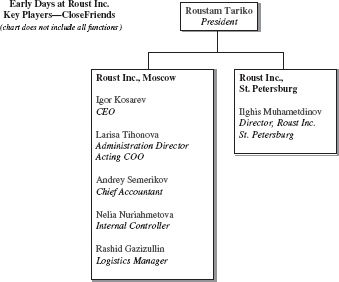
The fifth friend, Igor Kosarev, had perhaps the most important role, along with Roustam, in the early days of Roust Inc. He was the director of Roust Inc., Moscow. Kosarev and Roustam's roles were separate but complementary, creating an executive dyad at the top of the company.
Roustam explained:
I focused on establishing relationships with foreigners, and Igor established the relationships we needed with the government. Though he doesn't have very strong marketing and HR skills, he was essential in establishing the operations of the company. Igor easily makes friends with government officials. I am a Tartar, so I couldn't develop the kind of friendships with Russian officials that he does. He's a native Russian, so he's similar to them. He followed a classic Soviet career path before joining Roust. He worked for the government, for the Communist Party, and for the Moscow Pravda. He met Yeltsin regularly when Yeltsin was mayor and then first secretary of the Communist Party. I never wanted to work for the government, so I struggled with the travel agencies and the Italian companies.
Igor has quite a temper and is known for his emotional outbursts. However, he has helped the company enormously, because he can solve any problem we might have with the government. He's very creative in that area. We're the most successful importation business in the country. All our products pass the border with no problem, because the government trusts us. Igor manages our relationship with the tax authorities. If you don't have a good relationship with the tax authorities, every ten days or so a policeman will come to your office asking for a bribe or causing trouble. But Igor is very tough and well connected, so we've never had to pay any bribes.
According to Roustam, these special links to government officials, strengthened by the payment of required taxes, served as a “roof” for the organization, protecting it or smoothing the path in areas that the “shadow” of Roustam's Western allies didn't reach. For example, when a top executive of Roust Inc. in St. Petersburg was threatened by the mafia, Igor Kosarev appealed to his government contacts for help. They gave him a phone number to pass on to the people who were threatening the St. Petersburg executive. “We gave them the telephone number, and we never heard from them again,” Roustam says. “Probably what the government people said was, ‘Don't touch this company because it's under government control.’ The government looks at the bottom line; if a company is paying a lot of taxes, they protect it. Igor has gotten us out of many difficult situations like this, which is why he's so important.”
Manfred noted Roustam's comments about his friends, particularly Igor. While relying on friends in the start-up phase of an entrepreneurial firm is very common, it can also prove to be a liability later in the organization's growth cycle. However, before discussing this further with Roustam, Manfred wanted to hear the rest of Roustam's story.
Russian Standard Vodka
Roustam continued his story. By the late 1990s, Roust Inc. had become a successful import and distribution business. However, Roustam realized that distribution skills were not enough if he wanted his organization to continue to grow. He decided that the logical next step for him, after having distributed foreign brands for so long, would be to market and advertise these brands himself. He negotiated with people at Bacardi to give him advertising rights to their brands in exchange for a cut in his margins, and proceeded to create an in-house advertising and marketing division in Roust Inc. to promote these products. Through this experience, he became interested in brand management and focused on this area with advice from the consulting firm, McKinsey.
At the same time, he realized that he now had the experience and organizational structures in place to allow him to create his own premium alcohol brand, made in Russia. In 1997 he formed a company to develop and produce what would be called Russian Standard vodka—a product designed not only to conquer the domestic market, but also to challenge the popularity and market position of Stolichnaya and other established premium brands within Russia and all around the world. To exploit the brand management experience he had gained with Bacardi, he decided that Russian Standard would eventually evolve into a brand management organization.
Once again Roustam was taking on a major challenge. The domestic alcohol market, oversaturated already, was plagued by slim profit margins and onerous taxes. Government policy toward the production of alcohol and spirits partially accounted for the lack of major capital investment in the industry, the deterioration of quality standards, and the loss of traditional expertise. The few new development projects and production launches were mostly for regional markets, and all focused on medium or low price ranges, where demand was highest. Few companies dared to enter export markets, and even fewer succeeded. Added to this was the enormous problem of building a robust distribution network in a huge country where involvement with regional distributors, intermediaries, and even criminals was difficult to avoid, and robbery and hijacking were common.
Though aware of all these problems from his experience importing and distributing Martini & Rossi, Roustam said he was confident that if anyone in Russia knew the ropes, it was he. He decided to focus on the consumers he knew—drinkers of premium alcohol—and to launch a top-quality vodka for both domestic and export markets. The design and quality of the bottle, label, and cap were also developed to support the premium vodka image, though for the packaging, the company had to go to foreign manufacturers to meet stringent quality requirements.
The launch of Russian Standard Vodka was successful, and the new product quickly gained significant market share in the domestic market, even beating out archrivals Finlandia and Absolut. In some regions—for example, in St. Petersburg, the second largest city in Russia—it was a big hit. It did well in its export debut as well: it was launched in Italy in March 2000, and inventories intended to cover demand for a year and a half were depleted in one month. Roustam had even more ambitious plans to quickly enter the European and North American markets, and ultimately to build a worldwide brand. Ironically, acceptance by Western markets would give the Russian Standard brand a kind of cachet that would make it an even more desirable product in Russia and Eastern European countries.
Manfred had one nagging concern that he could not resolve, and that was the issue of the Russian mafia. He suspected that Roustam had some kind of connections behind the scenes, probably involving Igor Kosarev, that protected him from interference. Manfred had been told “the alcohol distribution business is the most corrupt of all indus tries in Russia.” Manfred had also heard unsubstantiated rumors: one Russian speculated that Roustam might have had a relative in the mafia, or, on the other hand, a Tartar connection in the government. Another Russian alleged that Roust Inc. might have functioned as a sort of “cash Laundromat” for a “dirty business” behind the scenes that generated a healthy cash flow.
Manfred knew that criminal activity is undeniably pervasive in both business and the government in Russia. Most Russian businesses pay a 10-20 percent protection fee to their roof, who then takes care of personal security and connections to friendly civil servants. Government officials at the highest levels are known to be corrupt. (The full extent of official lawlessness in the Soviet Union—the confiscation of property and the callous treatment of individuals—was not revealed until after the fall of Communism.) As the power of the Soviet state waned, the government's monopoly on corruption was fragmented and privatized. Now, although legal structures to curtail it are in place, the reality is that many politicians and businesspeople are still involved in some way, voluntarily or not, in corruption or organized crime.
Of course, even the most pessimistic observer could hardly claim that everyone is corrupt in every context. The situation is relative and highly subjective. Roustam Tariko seemed genuinely to want to run a clean business with consumers and commercial clients, or at least to appear to do so. He had expressed the hope that his organization would help improve the image and conditions of Russians. But, it was impossible to verify for certain that he was indeed practicing what he preached in all situations.
Manfred recalled something that Nikolai Gogol, a nineteenth-century Russian author, had once said: “I tell everyone very plainly that I take bribes, but what kind of bribes? Why, greyhound puppies. That's a totally different matter.” Bribery and corruption were still a fact of life in Russia. Western investors who were considering partnerships with Roustam's organization would get no more information than he, Manfred, had. At some point, in Russia, it becomes necessary to make a decision without having all the facts. Whether or not to work with Roustam was a judgement that people—potential employees as well as outside stakeholders—would have to make for themselves. What advice would Manfred give them?
Russian Standard: A Business Model in Search of Meaning
Roustam told Manfred that the creation of Russian Standard vodka marked the beginning of the transformation of Roust Inc. Parallel to the creation of Russian Standard vodka, Roustam began to think about developing a business model for his growing organization. He wanted to create a model that would allow steady evolution—and, even more important, stability—for the organization, even in periods of economic crisis. He could see that all around him Russia was crumbling. Borders were fluctuating; the government was unstable; the economy was in ruins; the ruble in freefall. Worse yet, he felt that Russians were suffering psychologically. And as they lost their status as a world power, and the pride that that status entailed, standards of various kinds declined or disappeared: moral standards, political standards, quality standards. Targeting the consumer market, the Russian Standard brand would promote new products and services that would recall what Russians perceived as the high standards of their country's pre-Revolutionary past, while at the same time becoming a symbol of a new Russia.
Roustam's vision, developed in the early days of Russian Standard, was that the brand would eventually reflect central Russian values, in the way that Coca-Cola represents the central values of Americans: freedom, friendship, and so on. If all went according to plan, he hoped that the Russian Standard brand would evoke Russia in the way that Mercedes is Germany, Coca-Cola is the United States, Sony is Japan, and Christian Dior is France. To him, these products are taken in each case as tangible symbols of the industriousness and intelligence of the people, or the prosperity and technical superiority of the nation.
The choice of Russian Standard as the name of the vodka as well as the brand management company was an obvious one. Russian Standard ideally would become a benchmark, synonymous with top quality and with honest, fair business practices with consumers. Above all, it would be truly made in Russia, an essential quality in a demoralized country.
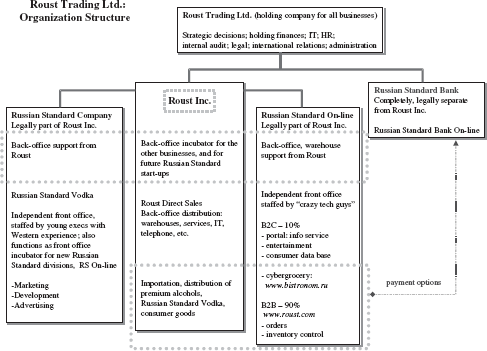
To this end, Roustam also set up Roust Holding Ltd., which would handle strategic decisions and financial control for the group. Under the watchful eye of the holding company, Russian Standard Company would produce and market its vodka, along with a line of other (preferably luxury) products and services to be identified and developed (Roustam was considering caviar, perfume, or a clothing line, among other things), while Roust Inc. provided back office support (warehouses and administrative services) for the distribution of Russian Standard products. Roustam explained:
Our philosophy is made very clear in our vision statement, which is posted on all our walls. We say that Russian Standard is not just a brand; it's a business model that unifies people. There are five key principles. The first is the overriding principle of our company: “Produce new value instead of redistributing existing assets.” The second is very practical, almost moralizing: “We are fair and thus rewarded with trust.” We emphasize that it's a big advantage to be honest. It's practical and useful, because if people trust you, business is easier. It's quite an important principle for us. The third principle is purely about our positioning: “All that we create is solid and beautiful.” We will produce only beautiful services or products. Not necessarily expensive. The fourth principle: “We build the future on the bedrock of the past.” The fifth principle: “We are working for the prosperity of Russia. We are a Russian company.”
My strategy is to combine services and goods that will leverage each other. My long-term goal is to build a brand management company like Unilever or Procter & Gamble, making not only premium products, but also products that are priced to reach a larger market. I'll do this in partnerships with other people, since I'm not personally interested in middle-market products. I'll use my marketing skills and consumer database to decide who our potential customers are, what they like, what they don't like. My partners will focus on the other side: the professional structuring of the business, how best to serve the customer, and so on. This will be much bigger than my business with the premium goods could be by itself.
In January 2000, the company rolled out an advertising campaign to promote the Russian Standard brand. The emphasis was on fixing in consumers‘ minds the concept that Russia has a past rich in splendor and tradition—a past from which Russian Standard brands drew inspiration, while at the same time firmly looking toward the future.
If you want to sell products to Russians, you have to look to the past. You need to understand who they are, what they will reject and what they will buy. The Russian Standard brand name makes sense because Russians would like to have standards! That's why all the messages that we try to communicate to the consumer with Russian Standard are based on Russian traditions. For example, the brand was launched with the famous film producer, Nikita Mihalkov, because he's a symbol, or standard, for Russians. Mihalkov's father was a well-known poet, and all children know his poems.
This is a kind of “co-branding” with Russian culture. You couldn't co-brand with Russian currency, or with the government!
By associating our brand with Mihalkov, we're saying, “This is a real product for real Russian people.” Maybe some Russians don't like him, but everyone recognizes that he's human, with his own opinions and principles. We want people to see that we make products with principles for individuals with principles. My task is to reestablish something that will be a standard for Russians.
Manfred could see that this is when Roustam's ambition of becoming the “Russian Procter & Gamble” had begun to take shape. At this point, Roustam had also set his sights on breaking widely into Western markets. Manfred was curious to know how Roustam intended to turn his vodka brand—one of many in Russia, albeit of a higher quality than most—into an internationally recognized product. And what would Roustam do once he had accomplished this? He had briefly mentioned that he had also founded a bank, but Manfred had not had the time to discuss this project with Roustam. How did this fit into his strategy? Manfred would have to wait until the second COL session to find out.
Russian Standard Bank
During the three month break between the COL sessions, Manfred thought about what Roustam had told him so far. Manfred saw that Roustam correctly identified two essential elements for the success of entrepreneurial start-ups: organizational structure, and a unifying and clear mission and vision for his organization. However, when Roustam returned to France in February 2000 for the second COL session and described the new projects he had underway, Manfred became concerned that the organization was growing too fast.
Roustam explained that the fallout from the August 1998 financial crisis in Russia ironically had provided an opportunity for his organization to expand in a new direction, and for him to test his business model. He felt ready to multiply his skills and broaden his interests. In early 1999 he decided that there was a niche market in Russia for a bank that would have “good assets, normal assets from a financial point of view.” He decided to start a bank that would operate according to Russian Standard's principles. The bank would serve foreign trade companies and small businesses, but its main focus would be on consumers.
Through McKinsey contacts, he met Alexander Zourabov, the former chairman of Menatep Bank, which had gone bankrupt during the crisis. Menatep Bank, one of Moscow's biggest, had been a traditional Soviet bank, with close links to the government. Zourabov bought the banking license of the bankrupt Rosagroprombank. The top management team for Russian Standard Bank was brought in from Mezhkombank, which had been one of the top banks for foreigners. Executives in this bank were younger and much more international. Russian Standard Bank opened in June 1999 with backing from Aeroflot and Itera, the third largest gas holding company in Russia.
Russian Standard Bank's strategy involved major expansion in terms of both its size (growing to form a banking network) and the range of its banking services to both businesses and consumers. To small businesses it would offer its services in credit, cash collection, and international securities. The initial plan was to provide business loans of U.S.$10,000-20,000, but calculations showed that this amount was too low to be efficient for the bank. Moreover, it would position the bank as a competitor of the EBRD. The credit range finally was fixed at U.S.$50,000-100,000. Russian Standard Bank's second business target was large foreign-trade companies that enjoyed good standing in the Russian market, such as Hewlett-Packard, Ericsson, Chevron, and McDonald's.
Soon the bank experienced a change in leadership. Its new CEO, Alexander Grigoriev, the former president of Mezhkombank, joined his former colleagues in Russian Standard Bank's top management team. Zourabov remained on the board but became vice chairman of Aeroflot.
When Roustam met Manfred for the second COL session, he proudly told Manfred that the bank had 170 employees and was ranked about forty-fifth in capital among the 800 banks in Russia. Then he pulled another rabbit out of his hat …
Russian Standard On-line, the Last Link in the Chain
Manfred now knew that as of early 2000, Roust Inc. had grown to about 300 employees, and had three successful divisions as well as the brand management and marketing branches. However he was amazed to learn that Roustam was already involved in yet another start-up division. As Roustam described it, the paint had hardly dried in Russian Standard Bank when another business opportunity fell into his lap. In the summer of 1999, friends from Goldman Sachs told Roustam that they saw him as the person to build an on-line Internet service in Russia. Roustam, who had already been thinking about the Internet, became intrigued by his friends‘ suggestions.
He began by developing a Web portal, Russian Standard On-line. Realizing that a portal would have to be linked to services, he cast about for ideas. His group developed entertainment and information sites for Russian On-line. However, Roustam felt that the scale of this business was too limited. He quickly found an answer: by exploiting the synergies between his divisions—Roust Inc., the importation and distribution division; Russian Standard Company, the product development division; Russian Standard Bank; and Russian Standard On-line—his organization could capture a share of the developing business-to-business and business-to-consumer market in Russia, and serve as a major distributor for Western companies.
Once again, Roustam faced a Herculean task. Traditionally, product manufacturers who want to be present in the Russian market have had to deal with a hydra composed of wholesalers (at least 1,500 in the Moscow region alone) who added a 100 percent markup but offered no marketing or advertising support. Although corruption and criminal activity were not unknown among these middlemen, most Western companies (and even Russian distributors) had been unable to bypass them. Roust Inc., along with four or five very powerful Western companies—among them, Coca-Cola and Mars—was among the very few that had managed to establish direct distribution networks to Russian supermarkets or shops (see Exhibit 2).
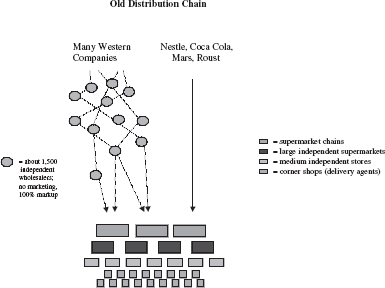
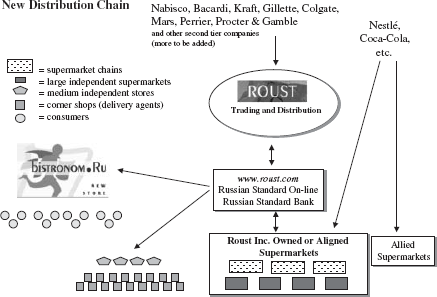
Systems and software were developed to link Roust Inc., Russian Standard On-line and Russian Standard Bank (which had its own, separate, Web site: Russian Standard Bank On-line). To establish the B2B element of this strategy (which Roustam estimated would generate about 90 percent of Russian Standard On-line's income), he approached Western organizations—including companies like Nabisco, who had tried to break into the Russian market but had failed to best the hydra—and convinced them to use Roust Inc. as their exclusive distributor and negotiator with Russian shops and supermarkets, with Russian Standard On-line as their Web interface. (Certain wholesalers would not like this arrangement, but Roustam said that the group would again find some protection in the “shadow” cast by Western partners and by a government “roof.”) Roustam proposed to distribute products for his Western associates with no artificial markup; he would make his profit on his regular wholesale margins.
It turned out that clients and producers liked dealing with a Russian who already had a long track-record with Western corporations such as Martini and Ferrero. The response was positive; in the first six weeks of operation, Roust Inc. sold $1 million worth of products through this system.
Roustam also negotiated to become part-owner of one of the three major Moscow supermarket chains. At a time when the owner was looking for foreign investment, Roustam proposed to act as his agent if the owner would sell Roustam 30 percent of the company's equity and agree to buy the products that Roust Inc. distributed. Although the supermarket's performance had not been stellar, both the owner and Roustam believed that they would be stronger if together, and so finalized the details of an alliance. Roustam planned to negotiate similar arrangements with other major supermarkets. Thus, he captured business even from those Western companies that prefer to distribute their products directly to supermarkets, without using Roust Inc.
The last part of the Russian Standard On-line strategy was the creation of a B2C cybergrocery, Bistronom.ru. Consumers could order goods directly through the Web site (with of course the option of paying through a Russian Standard Bank account or credit card) and could have them delivered to their doorstep or possibly to the nearest corner shop. “We tell shopkeepers, ‘Don't worry about people coming to your shops to buy our products. We'll find the customers through our on-line business and send them to you.’” The incentive was also there for customers: if they had their order delivered to the nearest Russian Standard On-line affiliated corner shop and pick it up there, they would receive a 10 percent discount and pay no shipping fees. Russian Standard On-line removed the last potential stumbling block in this development plan—the fact that very few Russians own computers—by providing to consumers, at no cost, a set-top box, the hardware necessary to connect to the Internet through their TV sets (see Exhibit 3).
Roustam was very excited about these developments, but recognized that he needed help in transforming the corporate structure of his growing organization. He felt that things were going very well, but were slightly out of control. He asked Manfred to come to Moscow and see for himself.
Russian Standard, Moscow
Manfred and Roustam's next meeting took place in Russian Standard's headquarters in Moscow. After hearing about the organization's rapid growth in somewhat diverse directions, Manfred wanted to see for himself what kinds of systems and structures Roustam had in place. Manfred wandered around the offices, Roust Inc. warehouses, and the Russian Standard Bank, getting a feel for the organization and talking to employees. Manfred could see that this organization had strengths and weaknesses typical of an entrepreneurial start-up, as well as some lingering effects of Soviet leadership and management styles. Roustam hadn't mentioned any of them. As Roustam and Manfred began to talk, Manfred asked him what his concerns were about his organization at this stage of growth. What were the main challenges he faced?
At that point, Roustam explained, the organization had over 400 employees and was still growing. The organizational structure had changed, though it had stayed rather flat. Physically, it had spread out. Igor Kosarev and Roust Inc. still occupied the building that once housed the whole organization—in a rather gloomy industrial district near Roust warehouses. Roustam and the Russian Standard Company, which included the Vodka and On-line executives, and Roust Inc.'s advertising, financial, and marketing departments, had moved to a prestigious new building downtown. Roust Holding Ltd. shared the same office and some of the same executives. Roustam was president of Roust Holding, and was responsible for strategy, financial control, and administration of the group. As Pavel Rjabov, head of Russian Standard Vodka, said
Roustam is like the goose that lays the golden eggs. He takes the eggs and decides which nest to put them in. He tells us, “OK guys, take this idea and create something, then get back to me and we'll talk about it again.”
Russian Standard Company served as a “front office incubator,” providing creative marketing and development support. This division was run by new executives with a great deal of Western experience. On the other hand, Roust Inc., (with Igor Kosarev as the director) in addition to its import and distribution functions, served as the back-office incubator for the newer businesses, providing administrative and warehouse support and not incidentally a reduction in redundant expenses. For example, the “crazy tech guys,” as they called themselves, at Russian Standard On-line depended on the Roust Inc. incubator for back-office and Russian Standard Company for marketing support until it was mature enough to be spun off. As for the Russian Standard Bank, after spending two months in the Roust Inc. incubator, it was now completely separate—physically and legally—from the rest of the organization, as required by Russian legislation (see Exhibit 4).
Roustam explained that he remained firmly in control of the organization and its divisions, but that he was also trying to build a top-performing management team with a strong intrapreneurial orientation. The divisions were having some growing pains.
Still a self-described micromanager and workaholic (“a deal a day keeps the doctor away!”), Roustam was directly involved in strategic and operational issues, and was also the key decisionmaker. All managers responsible for the various company functions and activities reported directly to him. The divisions used very strict IT reporting systems; all tasks and deadlines were entered into the system and all managers provided daily progress reports. This information was forwarded directly to Roustam. He checked out the system almost every morning, staying at the center of all activities and taking the pulse of the organization regularly. He sent e-mails to managers when he had a question or concern, following up with phone calls and scheduled meetings if necessary. Roustam also tried to be accessible for informal meetings and discussions. He filled a crosscoordination role, serving as a liaison between all functions. He maintained an exhausting schedule, working from home and in the office until well into the night, with time off only for a run and a working dinner. As Pavel Rjabov commented:
Although Roustam makes all decisions and I have to coordinate most of my moves with him, we test our ideas with each other. “Challenge me” and “What is your fantasy?” are our most frequent sayings.
The fact that all final decisions are up to Roustam has certain advantages and disadvantages. The advantage is that he always has up-to-date information and never loses control of the situation. The disadvantage is that his workload could become too heavy.
No matter how lowly or lofty the position, Roustam interviewed every job applicant himself, looking for ambition and evidence of an ability to learn. The interview process was relaxed, with an emphasis on getting to know the candidate and, within certain guidelines, creating a position to fit his or her strengths and interests. Most employees were young, though Roust Inc. also hired experienced professionals in positions that required them.
Though this system generally worked, Roustam had problems with conflicts between Roust Inc. and Russian Standard Company people. “The Roust guys are seen as more powerful. The RSC people are marketing guys who are intimidated by Roust. Roust fights them on the back-office side; for example, by not delivering goods on time.” Pavel Rjabov observed that Roust Inc. people had much less experience with Western business practices; sometimes it seemed as though the two groups had different values and were speaking different languages. But he also pointed out that while it is important to bring new brains, new blood, and new vision from outside the company, the loyalty of the old friends is also essential. He called the people from the early days of Roust Inc. the “skeleton, or the soul” of the company. Manfred noted that this situation had parallels to the early conflicts between executives at the Russian Standard Bank, although Roustam had reacted in distinctly different ways in each case.
Roustam explained to Manfred that two issues worried him the most. The first one was fairly obvious: how could he disengage from daily management so that he could focus more on future strategy and investors? The second one was seemingly less important, but had far-reaching implications nevertheless: the original friends whom he had depended on in the early days were increasingly a source of concern.
As Manfred reflected on what advice to give Roustam, he took stock of what he had seen and heard in the Moscow office. He was reassured more than worried about the future of Roustam's organization. Granted, the political situation in Russia was still problematic and would probably remain so for many years to come, to say the least. Manfred was not sure what recommendation he would give, at that point, to foreigners considering investing in the company.
On the other hand, the problems Roustam had identified within his company were common to maturing start-ups. It seemed to Manfred that Roustam's organization would have to go through a difficult culture change to foster a spirit of intrapreneurship. Roustam would have to make some possibly painful decisions regarding the close friends who were still his top executives. The organization then would be able to sustain and support Roustam's expansion plans, and would no longer be so dependent on him for ideas and direction. It was possible that if Roustam's organization developed a stable structure implementing Western practices where possible, then Roustam could eventually realize his dream of becoming the Procter & Gamble of Russia.
Roustam seemed to understand the need for these changes, but would he be able to put the structures and systems in place to facilitate them? It was easier said than done, Manfred knew. Before he left, Manfred gave Roustam some specific recommendations, and wished him luck.