






Abstract

British citizens are becoming increasingly discontented with politics and politicians. What explains this discontent, and what steps might policy-makers take to attract disaffected citizens?
In their celebrated study of public attitudes in Britain, the US, West Germany, Italy and Mexico, published exactly 50 years ago, Gabriel Almond and Sidney Verba claimed that it was Britain that came closest to a balanced ‘civic culture’. In Britain, people believed that they could act to change political decisions if they needed to, but also expressed a high degree of confidence and pride in their country's political actors and institutions. Yet in the decades since the publication of Almond and Verba's Civic Culture study, research has frequently shown Britain's political culture in a less flattering light.
To take stock of how citizens in Britain view politics and political institutions today, a conference – funded by the Political Studies Association and the School of Politics at the University of Kent – was held in London in September. The research presented at the conference helps us understand how far Britain has moved away from the ‘civic culture’ of the early 1960s, what causes citizens to be discontented with politics, and what might be done about it.
A Declining ‘Civic Culture‘?
As Gerry Stoker pointed out in the last issue of Political Insight, the noughties have seen rising levels of popular disillusion with politicians and political institutions in Britain. Back in the mid-1980s, only one in ten of the population said they never trusted British governments; today, that proportion has risen to almost one–third (see Figure 1). This picture of citizen discontent and Britain moving away from being a model ‘civic’ culture is supported by other data. Asked to rate the standards of politicians' honesty and integrity, around two–thirds of the population judge standards to be ‘very' or ‘somewhat' low, with fewer than one in ten judging standards to be high. The negative contemporary image of politicians is perhaps best captured by comparing this group's trust ratings with levels of trust in the police, themselves an arm of the state sullied by questions over conduct and probity. Yet while just one in ten of the population expresses ‘a great deal' or ‘quite a lot' of trust in British politicians, fully six times that proportion indicate that they trust the police.
Popular disillusionment with politicians and political institutions in Britain is rising
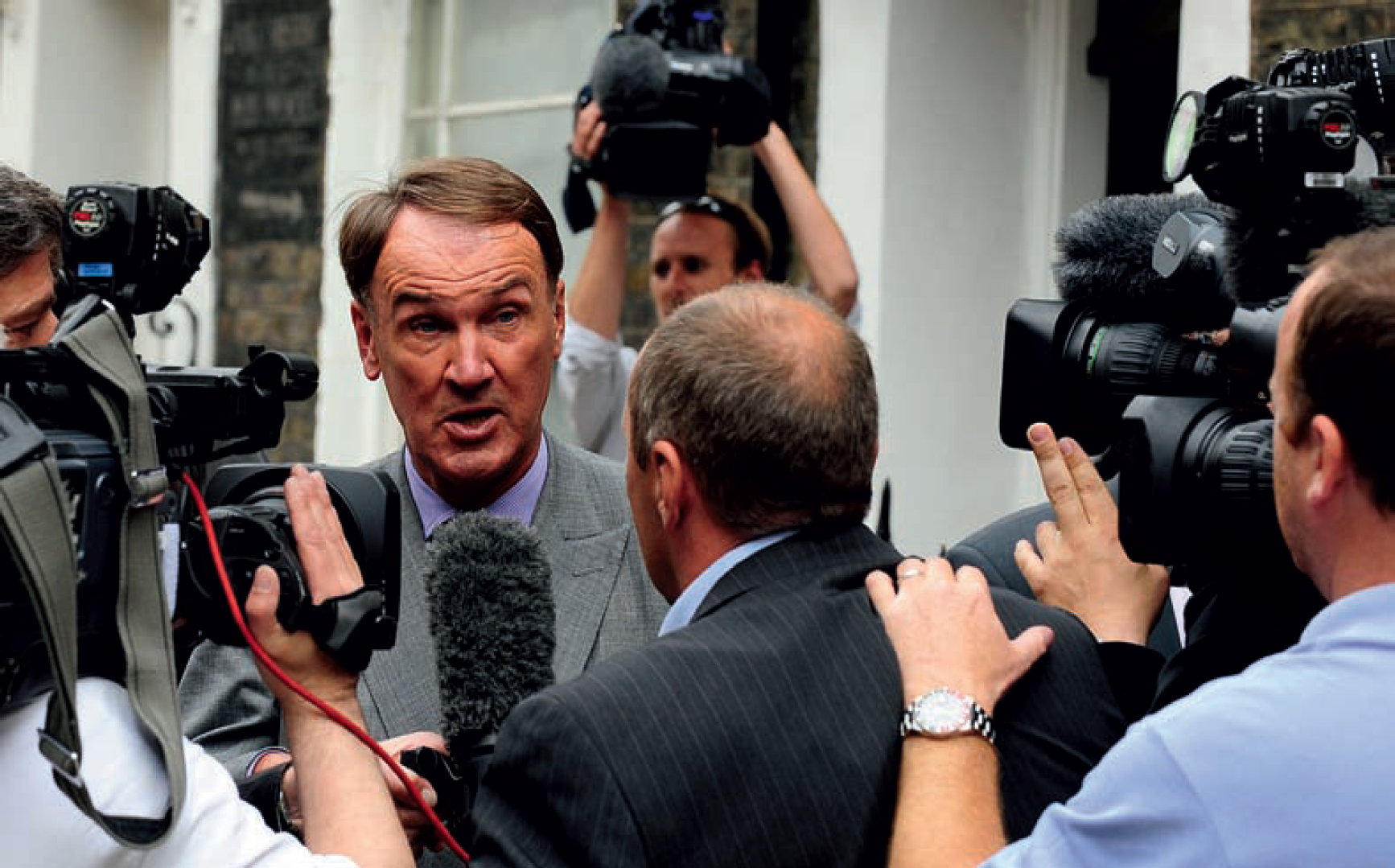
Conservative Andrew Mackay speaks to the media in Westminster after resigning in the MPs' expenses scandal. Levels of trust in British politicians fell after the scandal was revealed
The decline in citizens' trust in their elected representatives is by no means a linear or inexorable process, however. In fact, data collected by the British Election Study between 1997 and 2013 show considerable fluctuations in people's evaluations of government trustworthiness and honesty. As shown in Figure 2, the period starts with very high levels of trust in government, reflecting the change of government in 1997, an effect that is also evident in the data shown in Figure 1. There are also noticeable pick–ups in trust around the elections in 2001 and, in particular, in 2010. Elections that enable voters to ‘kick out the rascals' are clearly cathartic for feelings of political trust. But, with the exception of the very marked increase around the 2010 election, the falls in trust tend to be sharper than the hikes. Levels of trust fell precipitously in the aftermath of the invasion of Iraq in 2003, and again after the MPs' expenses scandal in 2009.
Public Negativity
What factors might explain these negative attitudes towards politicians? The research presented at the conference identified a variety of reasons, some of which related to specific judgements that citizens make of politicians, while others concerned more general impressions and images that citizens hold. Clearly, trust reflects in part a set of specific judgements among citizens. The upward and downward fluctuations in levels of trust shown in Figure 2 testify to the importance of people's reactions to particular events. More detailed analysis of these data conducted by Paul Whiteley shows that trust is substantially shaped by people's evaluations of how well governments are delivering for them. The more positively people feel about the state of the national economy, the higher their trust in government. The impact of economic evaluations on trust is found to be more pronounced under the ‘austerity' coalition government after 2010 than under the ‘boom' Labour governments before 2010.
Yet trust does not only reflect judgements about whether certain policy outcomes have been delivered; it also reflects judgements about how governments are seen to act. People who think that governments treat people fairly are significantly more likely to trust a government than people who feel unfairly treated. David Cameron's repeated claim that ‘we're all in this together' may have inadvertently set a standard by which his government is judged. Whiteley's modelling shows that the impact of fairness perceptions on trust is twice as large for the period after the coalition took office in 2010 as for the preceding period under the Labour government. Yet by far the strongest effect is from evaluations of party leaders. In particular, trust is highly responsive to people's feelings about the incumbent prime minister. The effects of liking the prime minister on trust dwarf evaluations of policy delivery or of procedural fairness.
So people's feelings of trust respond to particular events and to judgements about whether the economy is performing well and whether governments are fair or not. But people also use their feelings about party leaders, and particularly of the prime minister, as ‘shortcuts' in making trust judgements. The importance of party leaders as ‘weathervanes' for trust in the government as a whole may partly reflect the personalised or ‘presidential' nature of government in Britain today. But it may also reflect the possibility that people's judgements about politicians do not always rest on cognitive reasoning based on high levels of information. They may also rest on less cerebral factors; on general images and impressions.
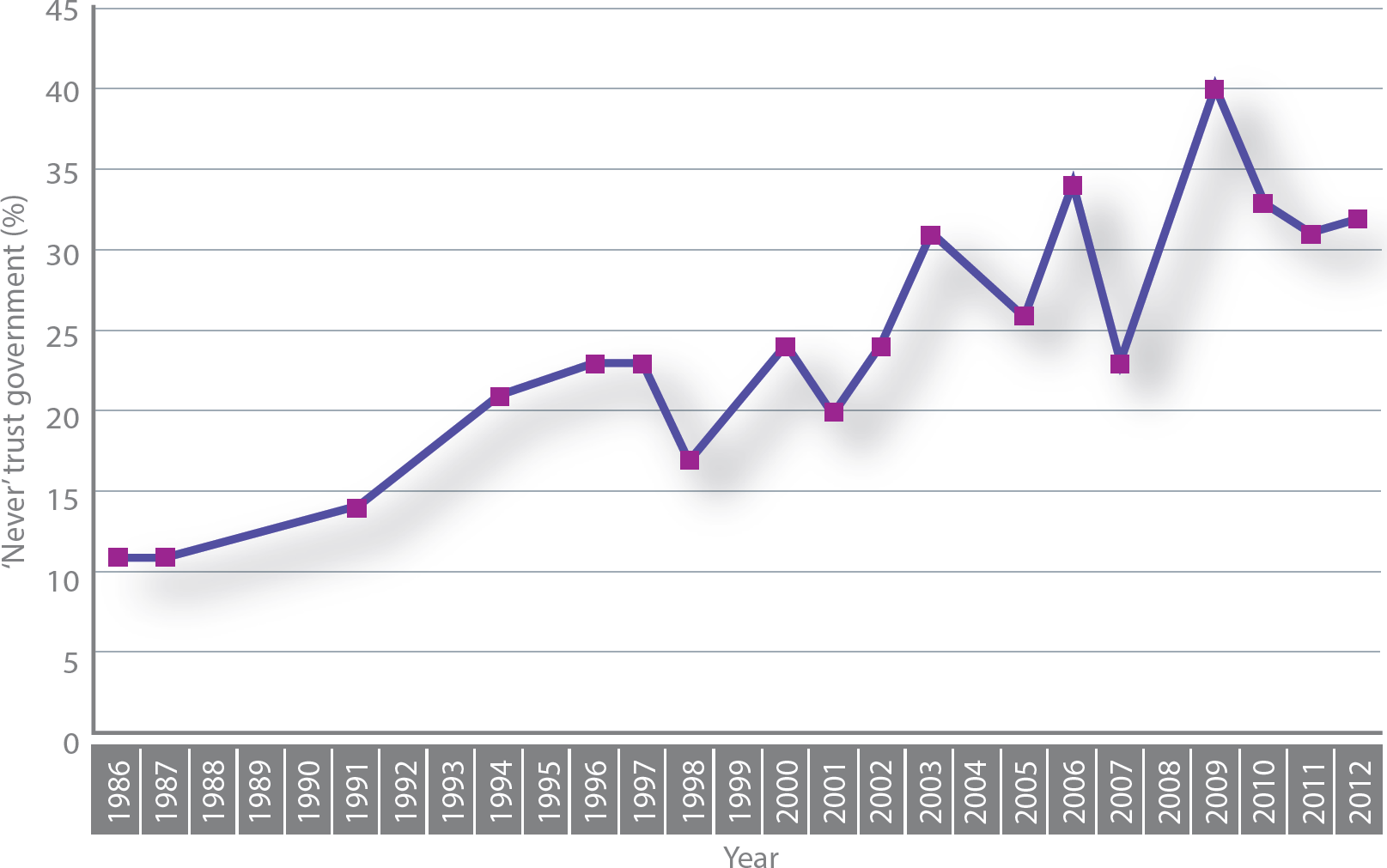
Proportion of citizens saying they ‘never' trust British governments, 1986–2012
Research findings presented to the conference showed just how powerful and overwhelmingly negative these images are. A study conducted by Gerry Stoker and Colin Hay asked participants in a series of focus groups to identify a single word they associated with politics. Of the 200 or so responses collected, just seven were found to be positive against 132 that were negative. Among focus group participants, politics was widely seen as involving spin, broken promises, ‘feather bedding' by MPs and corruption. Very few participants saw anything virtuous in modern politics.
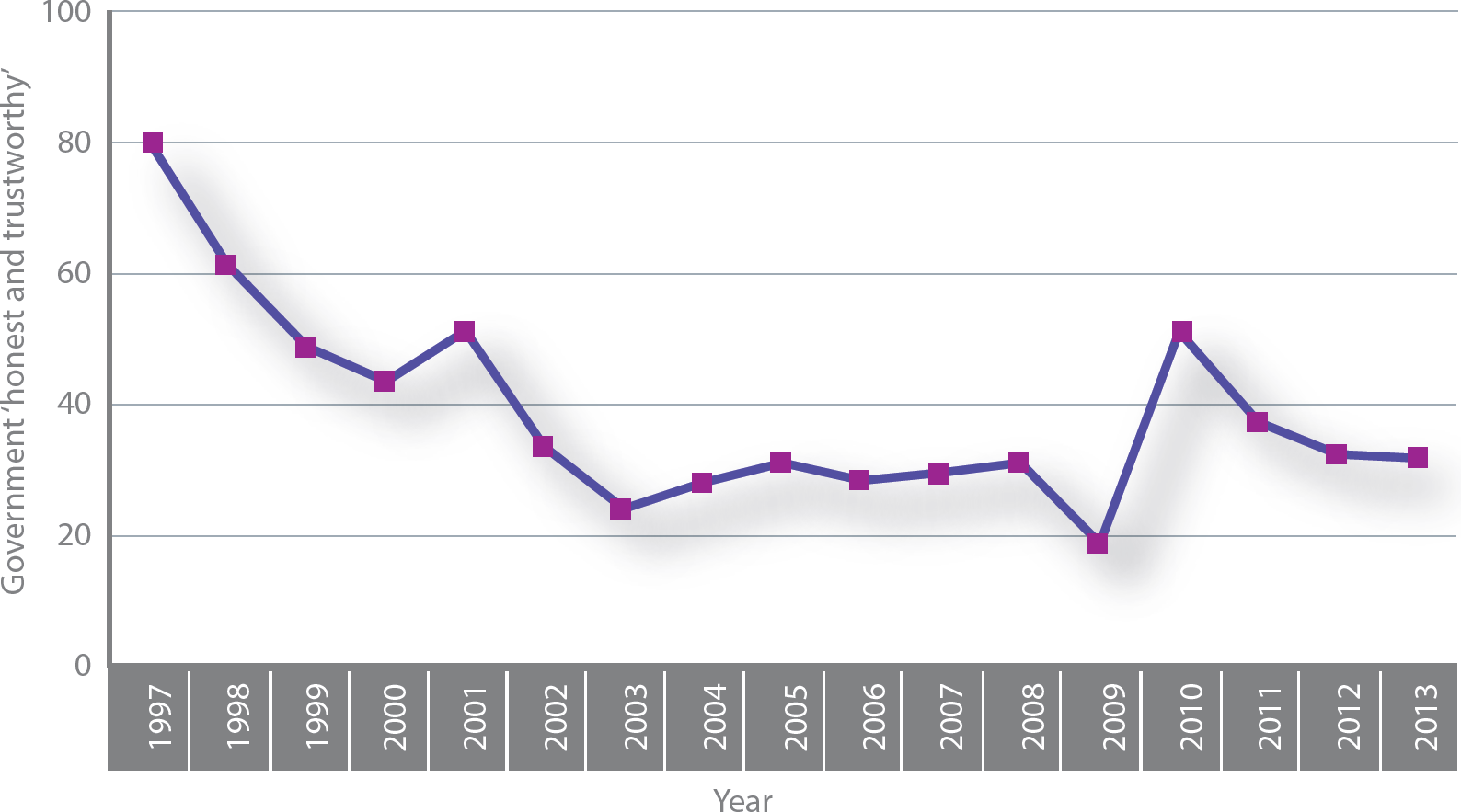
Proportion of people saying they think the government is honest and trustworthy, 1997–2013
The role of general images in shaping people's attitudes to politicians is also highlighted in survey research conducted by Nicholas Allen and Sarah Birch. Their work shows how people's judgements about the honesty and integrity of British politicians reflect their level of attentiveness to politics. The more attentive – and thus, presumably informed – people are about politics, the more honest they judge politicians to be. People who are attentive to and informed about politics are also less likely (compared to those who pay little attention to politics) to see specific forms of political misconduct – such as taking bribes – as a major problem with politics today. A similar finding emerged from Stoker and Hay's focus groups. While their research showed negative popular impressions of politics and politicians, they also found that discussing politics within the focus groups had the effect of encouraging more reflective and less one–sided views among participants. The more participants were encouraged to reflect on politics, the more their negative attitudes were leavened by a recognition of the difficulties facing politicians – even leading to some grudging respect for their representatives' work.
So judgements about the trustworthiness of politicians seem to involve both cognitive reactions to specific events, outcomes and processes, and more general images and impressions of politicians and the political process. Falling somewhere in between these cognitive and image–based causes of trust are the expectations that people have of politicians. Plenty of recent research in political science has pointed to the existence and role of an ‘expectations gap’: a disjuncture between what people expect from politicians and what they think they actually get. The role of such thwarted expectations is suggested by the data in Figure 2. Both in 1997 and 2010, the high hopes and expectations that people appear to have had about new governments quickly evaporated, with sharp falls in levels of trust. More robust modelling of people's evaluations of government honesty conducted by Allen and Birch also shows the damaging effects of high expectations: the higher the standards that people set for politicians' conduct, the lower tend to be their ratings of politicians' honesty and integrity.
Very few research participants saw anything virtuous in modern politics
YouGov President, Peter Kellner, speaks at the ‘Citizens and Politics in Britain Today: Still a Civic Culture?’ conference in London

What Can Be Done?
What can policy-makers do to improve the public standing of politicians? The task is enormous. The highly negative terms in which Stoker and Hay's focus group participants describe politics in Britain are testament to a deep-rooted popular scepticism about the work of politicians and the institutions they inhabit. Yet, on a more positive note, Whiteley's analysis of survey data suggests that people are willing to invest trust in politicians if they are seen to deliver appropriate policy outputs and to take decisions that are fair. There seems to be something, then, for policy–makers to play for.
Part of the solution may lie in reform of the institutions that shape the way politics works in Britain. Recent governments, both Labour and Conservative–Liberal Democrat, have enthusiastically followed this route. Alongside major constitutional changes introduced since 1997 have gone other important reforms that tighten the constraints under which politicians operate. The MPs' expenses scandal led to the creation of the Independent Parliamentary Standards Authority, while concerns over transparency have led to the Lobbying Bill that is currently before Parliament.
But are these various reforms likely to stimulate a greater sense of trust among the public? Evidence presented to the conference suggested that the payoff of the reforms might be limited. When it comes to tightening the rules governing MPs' conduct, research conducted by Allen and Birch suggests the new regulations may miss their real target. While survey data show the public to be concerned about MPs' financial probity, they show the public to be equally concerned by broader aspects of MPs' behaviour, such as whether they make promises they can keep and whether they provide straight answers to questions. The qualities that citizens favour among their elected representatives demand broad cultural change among MPs as much as reform of the formal regulations covering their financial affairs or relationships with lobbyists.
Both in 1997 and in 2010, the high hopes that people had about new governments quickly evaporated, with sharp falls in levels of trust after the general elections.
Changes to other constitutional rules may be thought to offer a better route to re-engaging dissatisfied citizens. After all, as Gerry Stoker has pointed out, citizens are keen to see reforms to the way politics in Britain is conducted, notably by giving citizens more say and by strengthening the accountability of politicians in between elections. This claim is largely supported in research conducted by John Curtice and the present author. Drawing on data from the British Social Attitudes survey, it can be seen that political reforms that give citizens a direct voice – such as referendums and the recall of MPs – are both widely popular and also attract particular support among people with very low levels of political trust. By contrast, reforms that maintain representative arrangements (such as changing the electoral system, establishing an elected House of Lords or fixing the parliamentary term) or that move towards a less party dominated form of decision–making (such as elected mayors and police commissioners) either attract lower rates of popular support or else do little to appeal in particular to those with low levels of trust.
That only certain forms of institutional change appear to have the potential to appeal to discontented citizens is also suggested in research conducted by Paul Webb. He shows that any attempts to give citizens more opportunities to participate in the political process may engage some groups within the population at the cost of alienating others. Webb identifies two groups of discontented citizens in Britain today: the first combine low trust in politicians with support for the basic representative processes that underpin political decision-making; the second, by contrast, combine low trust with a disdain for the conflict involved in representative processes and a preference for decisions to be taken without extensive debate and compromise. Webb labels the first group ‘dissatisfied democrats' and the second group ‘stealth democrats’. While dissatisfied democrats favour greater citizen participation in politics, stealth democrats are much less willing to participate. Only decision–making by referendums, which help to bypass elected representatives, provides the type of politics desired by this group of people.
Unpalatable solutions
The conclusion is an unpalatable one for politicians. Reforming the political system is only likely to stimulate greater levels of trust if power is transferred from politicians, governments and political parties to citizens themselves. Yet this is a step that elected leaders have tended to shy away from. Moreover, while constitutional change may hold some payoff, public discontent with politics and politicians is too great, and too deep–rooted, to be adequately addressed by merely reforming the rules of the political game.