






Abstract

A cross many advanced democracies, the cost of politics is under pressure. In Britain, the MPs’ expenses scandal remains fresh in the memory, even if it happened more than five years ago. A similar dynamic is evident elsewhere. In Italy, a recent report on the cost of politics was widely publicised to a critical electorate that is being punished by austerity measures and sees their elected representatives as self-aggrandising at voters’ expense and showing no restraint while doing so.
A crucial part of democracy is running regular elections, where those eligible to vote have the chance to choose their government. Part of the sceptical narrative around the cost of politics has focused on the conduct of elections in advanced democracies. For example, in many countries, elections to different levels of government are often combined on the same day. In 2014 English local elections were held in some places on the same day as the European Parliament elections. In 2011, the referendum on changing the Westminster electoral system was combined with both local elections and major devolved elections. More often than not, the explanation for such simultaneous voting is that it helps reduce unnecessary costs to the taxpayer. Is concern about the cost of elections justified? Or does it risk compromising the democratic process?
An Expensive Business
Running national elections is an expensive business. Ultimately, this public spending pays for the administrative capacity to hold effective votes. Without adequate funding, election staff and experts could not be employed, ballot papers could not be distributed, or voting and counting technology purchased. Elections therefore, require considerable levels of public expenditure to ensure a free and fair process is achieved.
It is surprisingly difficult to establish just how much running elections costs. In only a few countries is information about the cost of elections routinely published publicly. Figure 1 gives a picture of the cost of some recent major elections around the world, as well as an insight into the cost of referendums as a process which uses the same electoral infrastructure. It is worth noting that just one American state, Wisconsin, spent US$37 million (£32m) administering five elections in 2012, including presidential primaries, the general election, and a number associated with a recall contest.
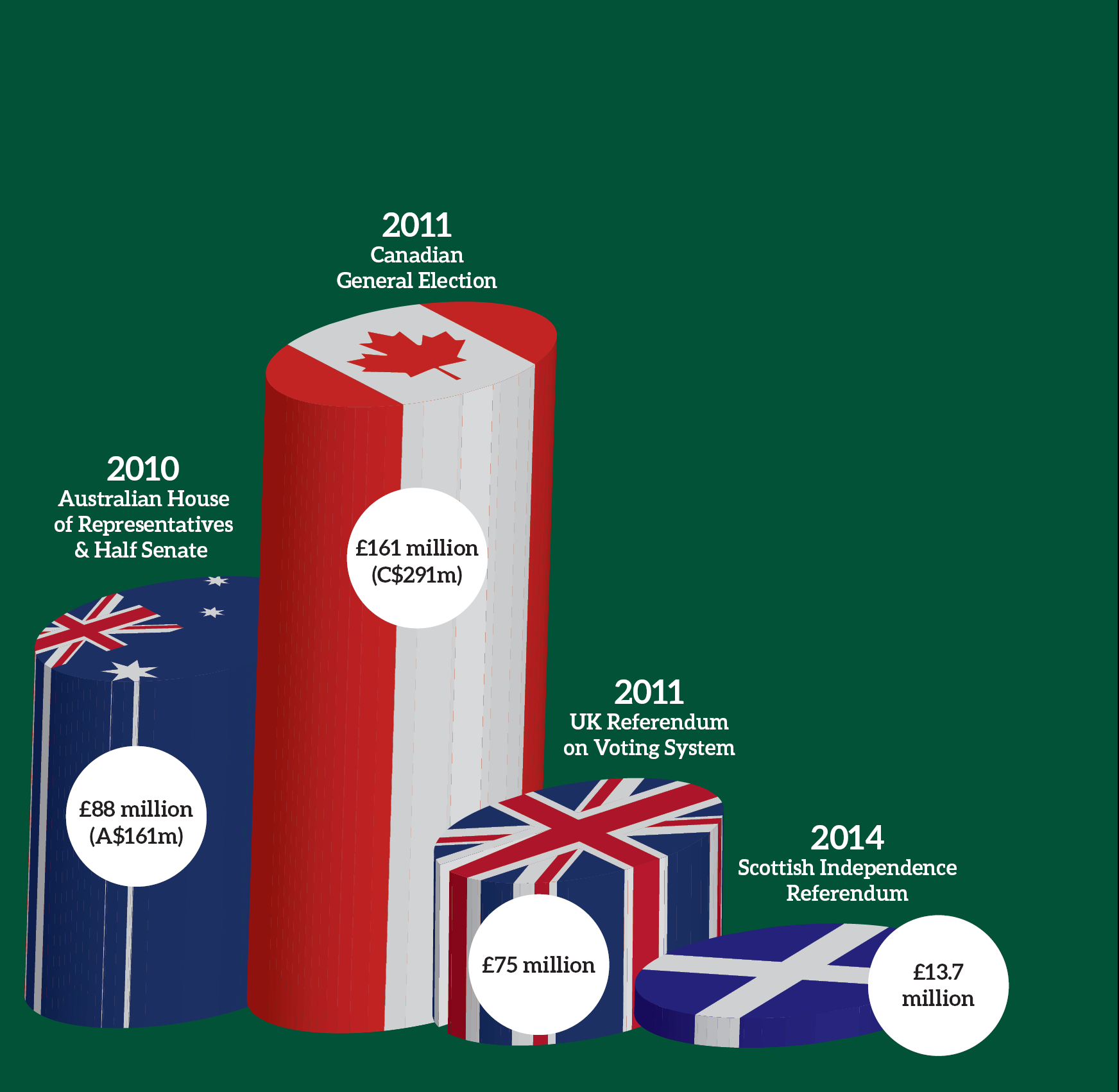
Cost of election administration in selected elections.
Distinctions can be made in the costs incurred in running elections. Key differences are between operational, personnel and integrity costs. Operational costs cover the maintenance of a network of electoral administration professionals, at both local and national levels, and the equipment and support they need. This includes funding for specific elections, which pays for things like maintaining a comprehensive electoral register, organising polling stations, printing ballot papers, purchasing any technology required for the election and running the count process. Integrity costs relate to the important questions of voter and ballot security. These considerations are likely to play a bigger role in election budgets in countries emerging from conflict and holding early elections than in advanced democracies.
Personnel and staffing is one of the major costs in running elections. Staff must be recruited and trained for the duration of the election, to set up and work at polling stations and to perform the count itself. These temporary positions are very responsible, although at the same time often quite routine. Many thousands of people work at elections. These are both the ‘unsung heroes’ and the ‘street-level bureaucrats’ of elections, beginning early in the morning, working until ate at night, checking that voters are eligible before they are issued with a ballot paper, then making sure each vote is accurately counted. Yet, low pay and a demanding workload can mean that in some countries many fail to turn up to work, leading to obvious deleterious effects on election quality.
Price Differentials
There is variation in how much is spent on personnel in different jurisdictions. Around 32 per cent of the 2011 Australian federal election budget of A$161.3 million (£88m) was spent on employee expenses. Similarly, around 36 per cent of election costs in Contra Costa County, California, went on election workers and staffing. Elsewhere a greater proportion is spent on staff. Of the US$21.1 million (£13.1m) spent on three elections in Wisconsin in 2012, around 59 per cent of costs went on poll worker wages and staff salaries. This is a similar proportion to the 60 per cent of election costs in Virginia taken up by staffing costs. In the general election year of 2010–11, the average spent by British local authorities on election staffing was around £200,000, with some spending as much as £1 million. Various additional influences determine the level of costs. These include the size of the electorate administered. Costs depend also on the type of electoral system being used. A system such as Mixed Member Proportional (MMP) or Single Transferable Vote (STV) is likely to be more expensive than a simpler system such as first-past-the-post, since they are more complex to count. The amount of technology used also matters. Beware those who suggest that deploying technology is a way to reduce the cost of elections. American experience in the aftermath of the Bush-Gore fiasco in 2000–01 suggests that the more technology deployed, the more costs are likely to rise. The longer that a democracy has been overseeing democratic elections, however, tends to reduce costs, because it increases expertise and builds capacity and professionalism among election administrators.
One way of trying to assess whether the amount spent on running elections is on the high or low side is to calculate the cost per elector. In a major 2005 report entitled the Cost of Registration and Elections (CORE), the UN Development Programme (UNDP) and International Foundation for Electoral Systems (IFES) provided some estimates for how much might be spent in three types of democracies. They suggest that advanced democracies, such as the US and Western Europe, will spend between US$1–3 (60p–£1.80) per elector. Democracies with less experience of multi-party electoral competition will spend somewhere between US$3-7 (£1.80–4.35) per elector. Finally, in post-conflict or emerging transitional democracies, costs are likely to be higher still, somewhere above US$8 (£5) per elector. How reliable these suggested indicators are is debatable. Analysis of recent Australian and Canadian elections suggests an average cost per elector of approximately US$10.8 (£6.70) in Canada and US$6.9 (£4.30) in Australia. Of course, inflation needs to be accounted for, but these figures are somewhat above the estimates made for advanced democracies by IFES/UNDP.
Rising Costs
Although evidence is sporadic, there seems little doubt that the cost of elections is on the increase. The 2010 Australian House of Representatives and Half Senate elections cost Aus$161 million (£88m), a figure that was only Aus$106 million (£57m) nine years previously. Even in the short period between 2001 and 2004, House of Representative and Half Senate elections rose from Aus$106 million (£57m) to $117 million (£63m). A shallower increase is evident in Canada. Elections Canada note, a rise in costs of running general elections from C$279 million (£153m) in 2006, to C$286 (£158.5m) million in 2008 and an estimated C$291 million (£161 m) in 2011. While there is pressure to reduce public spending in many democracies, this increasing trend seems likely to continue. Upward pressures include the need to pay reasonable wages to polling staff to ensure they turn up for work, the growing need for new technology and the expertise to support it, and the international move towards either early or postal voting.
The amount spent on election administration varies with the electoral cycle. More is spent in the immediate run up to elections than in the period between elections. However, the period between elections can still be very important as it is in this period that administrators are focused on ensuring up to date electoral registers, and planning for the forthcoming polls. Figure 2 shows how election spending is affected by the electoral cycle in Britain. In 2008–09, there were no major national elections. Consequently, UK Electoral Commission figures show that only around £55 million, or £1.19 per elector, was spent on election administration. 2007–08 and 2009–10 saw more spent because of devolved elections in 2007 and European parliament elections in 2009. Respectively, this equated to £87.7 million and £1.72 per elector in 2007–08 and £89.5 million and £1.98 per elector in 2009. In the 2010 general election, these figures rose to around £106.7 million, which represented a cost of £2.33 per elector. Expected turnout also has an impact on costs. While European and general elections are both UK-wide contests, typically less is spent in European elections because fewer electors are expected to turn out to vote.
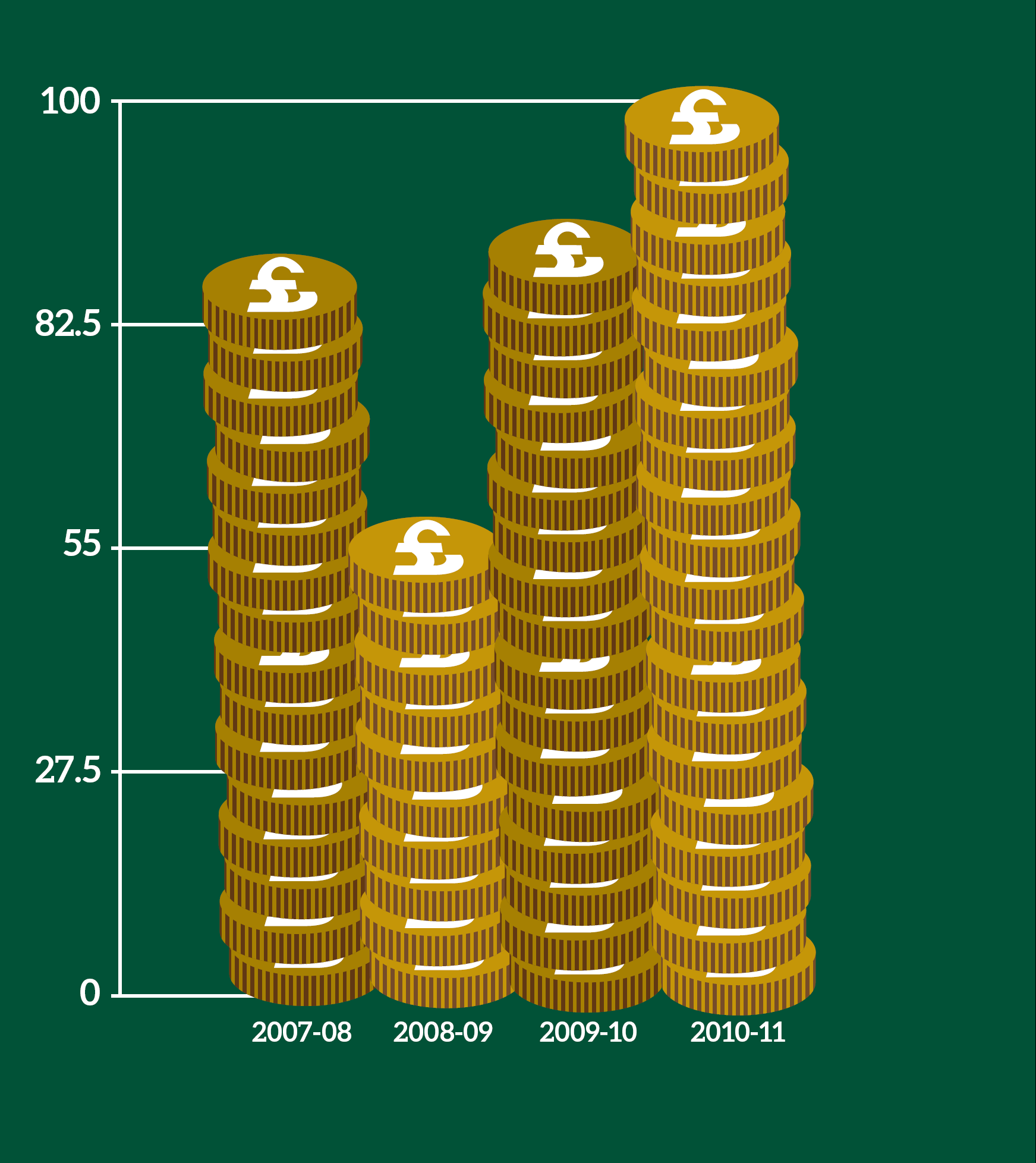
British election costs (£m).
Good Elections Cost
Does the amount of money spent on elections make a difference to their quality? When difficulties occur in election processes they are often explained away by a lack of resources available to pay for a range of electoral facilities. These can range from the complex – electronic voting and counting machines – to the seemingly more mundane – making sure enough part-time workers are recruited and trained to man the polls. The corollary is to suggest that if electoral administrators were better funded, there would be fewer problems and better run elections. This goes to the heart of what must be the central aim of electoral administration: that everyone who is eligible can cast a vote, and that their vote will be counted in the same way as everyone else's. The argument is that proper resourcing helps deliver this. Under-resourcing puts it at risk. But running elections is seldom the first priority for public administrations. With current austerity policies pressuring public service budgets, administering elections is likely to assume an even lower level of priority.
Mostly these arguments are asserted without reference to data. However, my research suggests that in the 2009 European election, higher levels of election spending in Britain did increase election quality. Correlating overall spending, spending on registration activities, and spending on election practicalities individually with an index of electoral integrity, demonstrates that there is a positive relationship between each of these aspects of election spending and increased election quality. The effects are not especially strong, but they were all statistically significant. Figure 3 provides a demonstration of this relationship, taking all aspects of electoral administrative spending together. In short, the more spent, the higher the local authority running the elections performed.
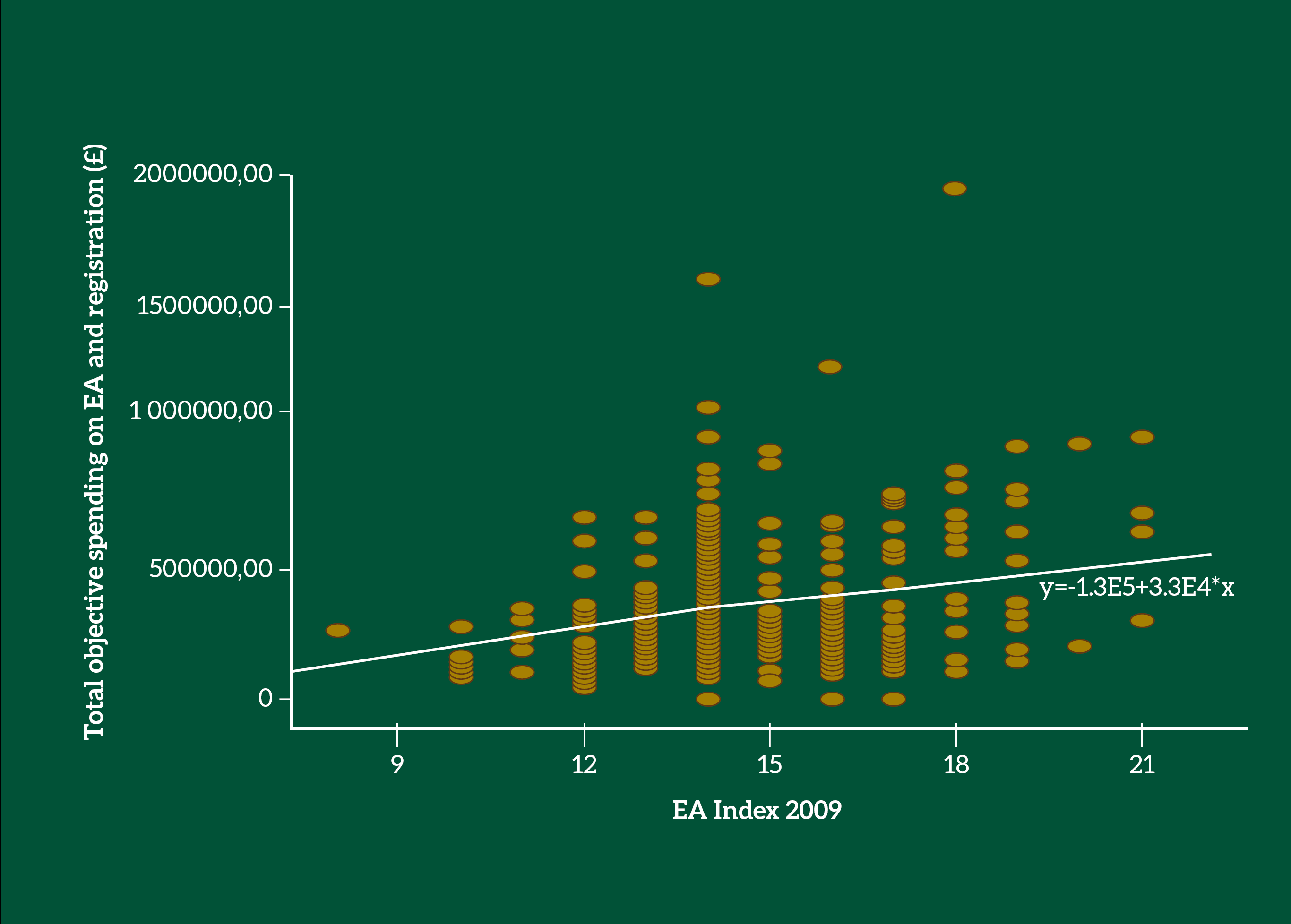
Relationship between total spending on electoral administration and performance index.
A more complex analysis that controlled for additional issues broadly confirmed these findings. Greater levels of overall spending (registration and practicalities combined) led to a gradual increase in levels of electoral integrity. In other words, spending on elections did lead to positive, gradual increases in levels of electoral integrity. In two of the models tested, these relationships were statistically significant. Curiously, however, when both spending on the practical aspects of elections and also on registration activities were analysed separately, it was spending on registration activities that appeared to have more of an impact upon electoral integrity in 2009. This was statistically significant across all three models tested.
These are important, albeit tentative, findings. They are tentative because they need to be confirmed with additional data, and under different circumstances – a national general election for instance. They are nevertheless important, as they begin to put some hard evidence behind often made assertions that more spending on election administration would improve election quality. While such improvements may only be incremental, the simple message is that, even in an era of austerity, elections need to be properly funded to ensure that electors’ voices are heard through the ballot box. Why does this matter? It matters because running elections effectively is a guarantor of one of the crucial aspects of representative democracy, that of political equality. At the ballot box, our votes all count for the same, whoever we are. To recognise this effectively, elections need to be properly funded.