






Abstract

Next year's General Election is the hardest to predict that I can remember. Normally we have some idea six months ahead about the likely outcome. Labour was plainly heading for victory in 1997,2001 and 2005 – and defeat in 2010. Occasionally the likely outcome is clear – and wrong: John Major defied the polls to lead the Conservatives to victory in 1992. This time, however, my crystal ball is decidedly murky. I have no idea whether, this time next year, David Cameron or Ed Miliband will be Prime Minister.
Two secondary predictions may be made with reasonable (though not total) certainty. Unless things change markedly over the next six months, neither Labour nor the Tories will win a clear working majority (normally defined as an overall majority of 20 or more in the House of Commons.) The target of 335 seats looks beyond both parties.
Secondly, relatively few voters will switch directly between Labour and Conservative. Although much talk on election night will be of the Labour-Tory swing, this is a useful statistical device, but only a partial reality. In large measure the swing will reflect the net effect of movements to and from other parties (such as Lib Dems, UKIP, SNP, Greens) and in and out of the ranks of the ‘don't knows’.
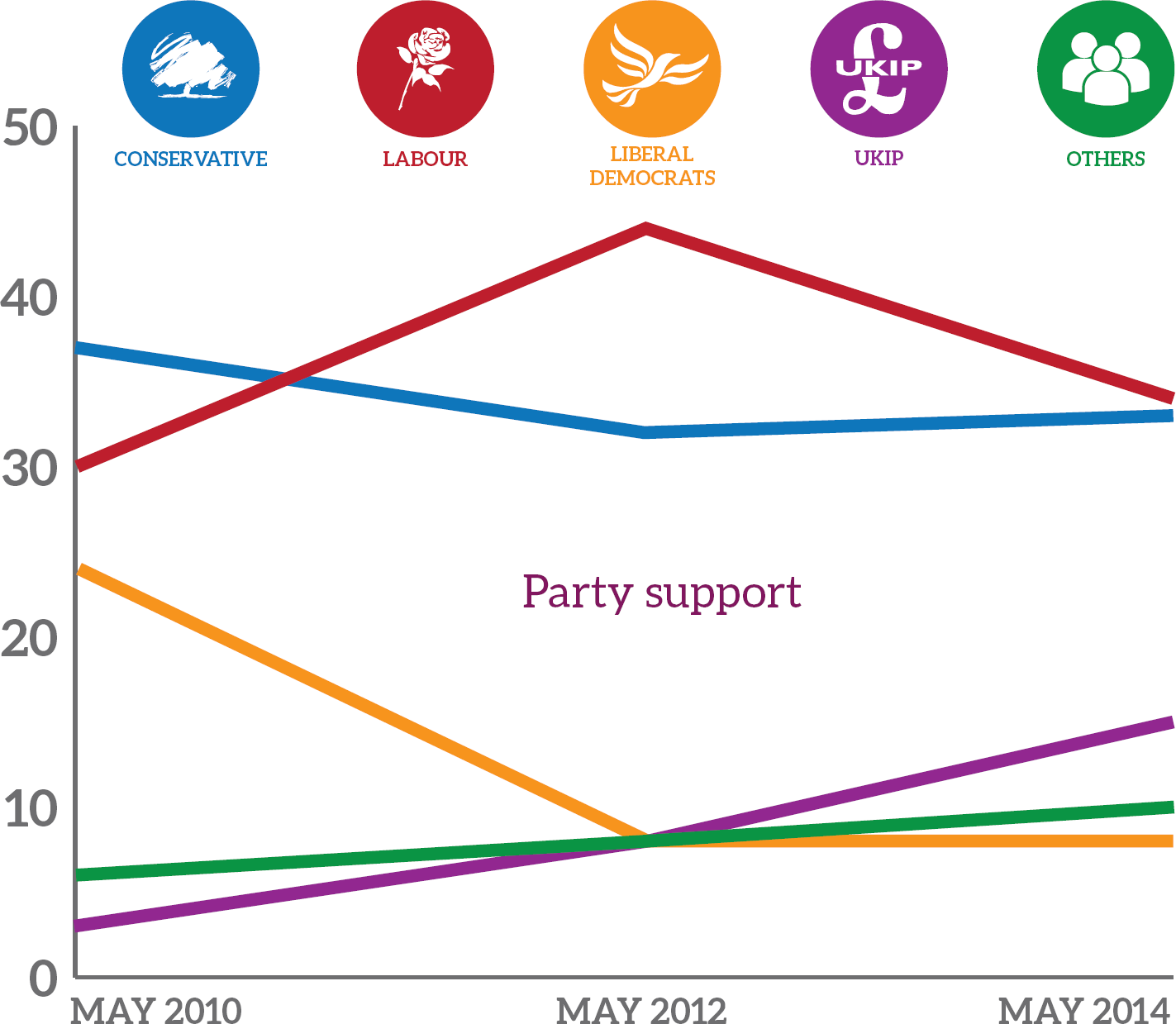
That brings us to the main reason why next year's election is so hard to call. The collapse of the Lib Dems since 2010, the arrival of UKIP as a significant force and the potential for the SNP to hurt Labour in Scotland – each of these factors could influence which main party comes out on top, and the impact of each is impossible to predict.
The overall state of the parties this autumn illustrates the uncertainty. The two main parties are neck-and-neck. In the early months of the current Parliament, the Conservatives – who ended up in 2010 with a seven-point lead over Labour in the popular vote – remained ahead. Then Labour edged in front in the spring of 2012, partly in response to George Osborne's ‘omnishambles’ budget which threatened to raise taxes on caravans, charities, churches and hot Cornish pasties. At this point, the Lib Dems were in deep trouble, having lost two-thirds of their votes since 2010 – and UKIP was beginning to make its presence felt.
One other feature of this mid-term pattern of support is worth noting. In May 2012, the combined votes of the two broadly centre-left parties, Labour and the Lib Dems, 52 per cent, was similar to their combined strength at the 2010 election, when together they secured 54 per cent of the vote. To the Right, the combined support of the Conservatives and UKIP was 40 per cent in May 2012, precisely the same as two years earlier.
Now compare that pattern with this autumn. Not only is Labour down and UKIP up compared with 2012, but the left-right balance is completely different. The combined support of the two right-of-centre parties, 48 per cent, now comfortably exceeds that of the two left-of-centre parties, 42 per cent.
On the face of it, there seems to have been a simple left-right swing in the past two years, with Labour supporters switching to UKIP. Undoubtedly some have done so, especially in the north of England. And the overall shift in the left-right balance does reflect the popularity of a number of the values normally associated with the Right, such as hostility to Europe, immigration and some welfare benefits. But that is only part of the explanation. YouGov research at the time of this May's elections to the European Parliament, when UKIP scored 27 per cent, compared with 25 per cent for Labour and 24 per cent for the Tories, found that UKIP took three times as many votes from the Conservatives as from Labour.
What seems to be happening is that, since 2012, the Conservatives have lost some voters to UKIP – but gained other voters, on the back of a recovering economy, from the Lib Dems, don't knows and a few from Labour. Ed Miliband, on the other hand, who has failed to persuade voters that he is up to the job of Prime Minister, has seen Labour votes drain away to UKIP, the Tories, Greens, SNP and don't know.
Historically, governing parties have gained ground, and opposition parties lost support, in the months leading up to general elections. If history repeats itself, Cameron will still be Prime Minister a year from now. But it is many decades since we had a peacetime coalition, or a serious challenge from an insurgent party such as UKIP, or the SNP with a chance of making significant gains. So will history repeat itself this time or not? Come back in May to find out.