






Abstract
Purpose
With technological progress, the integration of aged care with technology is a new challenge. This study developed a theoretical model of smart aged care in the community to meet the diverse needs of community-dwelling older adults.
Methods
This qualitative study recruited 22 participants from three communities in Chongqing, China. Through semi-structured interviews and grounded theory, this study analyzed the needs of community-dwelling older adults for smart aged care and identified strategies.
Results
Nine categories were identified, including five need categories, three important factors, and one outcome objective. Furthermore, four health provider topics were proposed.
Conclusions
Although the application of information technology has enhanced convenience and possibilities, its popularity and satisfaction are low. Information technology can be successfully introduced into the lives of community-dwelling older adults only by truly understanding their needs.
Implications of nursing practice
Smart aged care in the community has positive effects on nursing outcomes for older adults. This study's findings can help caregivers understand the various dimensions of the needs of community-dwelling older adults and relevant influencing factors under smart aged care to increase its popularity and satisfaction. Furthermore, this can promote the integration of intelligent technology and manual services in nursing practice.
INTRODUCTION
The complexity and opportunities in aged care have increased with the development and transformation of the healthcare system. However, it faces challenges such as care provider shortages, increasing care needs, and the development of information technology. As a global trend, information technology plays a crucial role in realizing healthy aging, sustaining high-quality care services, and leading aged care into excellence in the contemporary society (Schulz et al., 2015). New models and challenges of community-dwelling care appear with the gradual increase in the necessity and firmness of the development of smart aged care, which represents the various application modes of information technology in elderly care (Q. Zhang et al., 2020; Zhu et al., 2021).
Some popular types of smart aged care, such as smart homes (Cicirelli et al., 2016), Internet of Things platform (Tun et al., 2021), artificial intelligence (X. Wang et al., 2022), and other emerging forms, are currently being studied by researchers, entrepreneurs, and technology giants. However, some researchers have highlighted that, in most cases, community-dwelling older adults are unable to obtain better care (Bodker et al., 2019; Wu et al., 2021). Information technology can be introduced in their lives only after identifying their needs. Additionally, new service schemes can be pursued according to the endowment resources of the local community (Karlsen et al., 2017), which should be valued and developed to advance smart aged care theory and practice.
Research and inventions have been carried out on remote health monitoring (Guan et al., 2017), wearable technology (Z. Wang et al., 2017), assisted living tools (Mayer et al., 2019), and so on, making community-dwelling care present an informationalized and technical picture (Cavallo et al., 2018; Majumder et al., 2017). Studies have demonstrated that the application of information technology in the community can enable and improve communication between caregivers and the treatment team, improve the efficiency of operations, and allocate resources as per the individual's needs (Harding et al., 2021). Furthermore, the application can significantly eliminate the limitations of time and space, reduce the burden on family, and provide older adults with diverse, high-quality, and meticulous care (Tang et al., 2019; B. Wang & Xu, 2021). However, although various previous studies and inventions have attempted to meet some of the needs of older adults, they are relatively scattered and fail to fully meet their needs, thereby increasing the complexity and economic pressure of community pensions.
The seventh national census shows an acceleration in China's aging process (Jizhe, 2021). Additionally, older adults and their families have an increasing demand for a community-dwelling pension, which has become the main pension method in China (Fu & Chui, 2020; Z. Wang et al., 2020; L. W. Zhang et al., 2017). However, most of the current smart aged care in the community tend to focus more on the supply side structural reform, overlooking the situational characteristics and social behavior of older adults, and lack accurate segmentation of the needs, resulting in limited scope of application, complex operation, poor experience, low user acceptance, and many unused products or equipment. These further lead to the failure in meeting the multi-level needs of older adults and an imbalance between supply and demand, seriously affecting development of aged care (Meng et al., 2020; Mirjalali et al., 2021; Sapci & Sapci, 2019).
Therefore, this study used the grounded theory method to develop a theoretical model of a smart aged care service considering the Chinese economic and cultural background, thereby meeting the needs and preferences of Chinese community-dwelling older adults and its application in healthcare practice.
METHOD
Traditional grounded theory methodology
Strauss’ traditional grounded theory, which is based on pragmatism and symbolic interactionism, offers a methodology for researchers to construct a theoretical framework for enhanced understanding and development of smart aged care in the community. Based on the participants’ beliefs and experiences, this study employed the traditional grounded theory to determine the connotation and denotation of the needs of smart aged care. The interaction process and potential influencing factors between smart aged care and needs have been discussed.
Study design and participants
Before the formal interview, the literature was reviewed, and preliminary interviews were conducted based on the needs and smart aged care of two older adults who met the inclusion criteria in Yuzhong District, Chongqing, China; the interviews involved open-ended and exploratory questions. Through this preliminary interview and review, the problems and matters requiring attention in the interview during the program formulation meeting were summarized and the interview guidelines were determined by consulting the opinions of the community service center managers and professional nursing staff.
Community-dwelling older adults were recruited using the purpose sampling method in Yuzhong, Yubei, and Jiulongpo Districts. With the approval and help of the manager of the community service station, the qualitative interviews proceeded smoothly. All participants provided written informed consent (recording instructions and information confidentiality) before obtaining study information and answers to their queries. Inclusion criteria were (1) aged 65 years and above, (2) living in the community for more than 5 years, (3) able to communicate in Mandarin or the local language, and (4) amenable to provide written informed consent and consent to record the whole interview process. This process was completed when all categories of data were saturated. A total of 22 participants were recruited for this study (Table 1).
Characteristics of the participants (n = 22)
Data collection
From August to December 2021, semi-structured interviews were conducted by two interviewers with linguistic neutrality, who had received systematic training in qualitative research before this study and had rich experiences of conducting interviews.
In-depth interviews were conducted with participants, who were asked the following questions: (1) What care behaviors make you think that it is smart aged care? (2) What characteristics or functions do you think smart aged care should have? (3) What kind of influence does smart aged care have? (4) How can smart aged care improve the effectiveness of leadership? (5) Is there anything else that you would like to say? The interviews were filled with open-ended questions lasting 30–90 min, with an average length of 1 h. The interview outline was kept flexible to obtain more information.
Data were collected anonymously to protect interviewees’ privacy. Each interviewee was assigned a unique number, such as E01. The recordings were transcribed, and the pauses, voices, tones, and special emotional expressions in the patient's conversation were recorded within 24 h after the interview for further analysis. Additionally, relevant domestic media reports and comments were collected to supplement the data analysis.
Data analyses
The topics were examined by two professionally trained researchers according to Strauss’ traditional grounded theory of substantive coding (open coding, selective coding) and theoretical coding (Rieger, 2019). Consistent with the grounded theory approach, data collection and analysis were conducted simultaneously, which facilitates the process of continuous comparison and is a key cornerstone of grounded theory methodology. No new nodes were found after data collection and analysis, indicating that the interview content was saturated (Moser & Korstjens, 2017). By means of continuous comparison, descriptive codes were appended to the text fragments of each codex for initial coding, which was then divided into broad subject-oriented categories, and all text fragments belonging to the same category were compared (Chun Tie et al., 2019). During the coding phase, the researchers remained neutral (Noble & Mitchell, 2016). Finally, the core category and theoretical framework were generated by analyzing the relationship between each category and its concept in the data.
An expert interview approach was used to ensure the integrity and reliability of the results. First, the research team members (all authors) discussed the analytical framework and reached a consensus on its validity and applicability. Next, the results were reviewed by three experts, and the theoretical model was considered reliable without any objections from them.
Ethical considerations
Ethics approval was obtained from the medical ethics committee (approval number: 2022–132). Written informed consent for sample collection, analysis, and the publication of anonymized data was obtained from all participants. Each participant was interviewed in a private space to ensure their privacy, and all personal information obtained in this study was kept confidential. The study was compliant with the Declaration of Helsinki.
RESULT
Nine categories were identified by conceptualizing coding, refining categories, summarizing the theme of the interview data, and analyzing relevant media data. The core concept to emerge from the theoretical coding strategy of “cause, process, and result” in Glaser's traditional grounded theory was “demand-guided Smart Aged Care.” A theoretical framework of smart aged care based on the needs of community-dwelling older adults was constructed, including five need categories, three important factors, and one outcome objective. Furthermore, four health provider topics were presented (Figure 1).
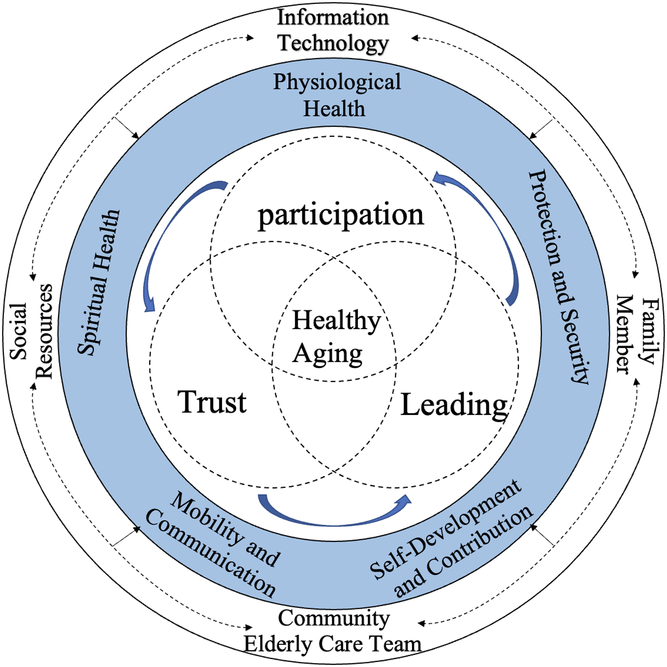
The smart health care framework based on the needs of Chinese community-dwelling older adults
Demand-guided smart aged care
This study identified five categories of needs of community-dwelling older adults to ensure improved health status.
Physical health
Physical health can be absolutely defined, including the need for daily living activities, health management, and medical care. The most basic requirement for older adults is to satisfy their basic physiological needs without leaving the community and to keep the living environment clean and stable. I live far away from the existing meal service station, and I need to walk for nearly 30 minutes every day. However, if it rains or I do not feel good, it is difficult to go out, and the basic food problem is difficult to solve (worried). (E3)
In contrast to living in pension institutions, sudden diseases or other accidents are undoubtedly very serious for community-dwelling older adults. In such cases, obtaining attention and effective help and treatment as soon as possible undoubtedly becomes a concern. Once diarrhea and vomiting occurred during the middle of the night. I had to crawl to the toilet to drink water, but no one had helped me. I was unwilling to call my son in the middle of the night, and I could not take emergency measures at that time. (E1)
Spiritual health
Comprehensive spiritual health needs were defined as the availability of churches, mental health centers, support groups, and counseling services. Self-esteem, self-concept, and overall perception of life satisfaction were also included. Older adults, however, often feel helpless and lost because of their inability to live. This also reduces their happiness in old age. Sometimes, I want to go to the hospital for a check-up, but how can I do it alone? I do not want to cause trouble to my son. I do not know what to do, except wait for my son to be free. (E18)
Protection and security
Protection and security include protection from negative impacts of the external and the virtual network environment. On this basis, the participants expressed that night monitoring, privacy and data protection, and safety support services, such as online shopping security, were essential for those living in the community. For security reasons, if the community and family are monitored throughout the process, it can ensure the control of hidden safety hazards, especially at night, which are most likely to go wrong. (E1) I saw a wristband on the TV that could automatically measure blood sugar. I don't know if it's real. I want to buy it and try it, but I bought a fake one before, so I do not know if it's true or not, and do not know who to consult. (E2)
Mobility and communication
The activity radius and content of community-dwelling older adults are severely limited because of the influence of age and body. Their mental health will be affected without rich life experiences and companionship, which cannot be ignored. Therefore, the construction of collective recreational activities within or between communities is particularly important. My children are often not around, my granddaughter is in college, and I do not come back often (lost). Now, I do not have to worry about food or clothing. The main thing is that I hope to talk to someone and go to the community to participate in group activities on weekdays to reassure my family. I am also happy (laughs). (E4)
Self-development and contribution
Based on this survey, the needs for self-development and self-worth satisfaction were observed to be particularly prominent for community-dwelling older adults. Their thirst for knowledge, especially health science content, was no less than that of any other age group. In fact, I like dancing very much, but when I was young, I did not have the opportunity and time to develop my hobbies. Now that I am at an age when I do not need to work, I should try more and learn new things (full of expectations). (E16)
Moreover, they want to use their skills to help others and share their stories and experiences with others. I used to be a hairdresser, so I would go to the community service station every other week to cut their hair, and it still felt very fulfilling. (E6) Today's kids lack too much discipline, and back when we used to… (talking endlessly). (E10)
Important factors of demand-guided smart aged care: “Participation, trust, and leading”
This study theoretically extracted three factors that affect community-dwelling older adults’ perception and use of smart aged care in life.
This study found that although smart aged care has penetrated some communities, because of the current development and progress of smart aged care mainly on the leading side of medical care (Harding et al., 2021; Huion et al., 2019), community-dwelling older adults do not have comprehensive understanding of information technology and are thus unable to completely trust it. Participation refers to allowing community-dwelling older adults to truly participate in smart aged care and experience the existence and significance of smart aged care. Continuous participation is based on self-protection measures to enhance participants’ sense of trust. Afterward, one should try to put oneself on the active side. The three gradually influence each other, and older adults can better perceive that information technology is around and can be used to meet their needs. I do not know what smart aged care is, and I often hear it, but it does not seem to have anything to do with me, and my life has not changed, and there are so many scammers on the Internet now, I cannot believe it easily. (E22) I only know that it is often said on TV. I do not know what it is. But listening to what my daughter said, it can really help her work. (E3)
Outcome objective of demand-guided smart aged care: “Healthy aging”
Smart aged care takes community home-based aged care services as the entry point, which can reduce the care pressure on the medical care team, reduce the wastage of resources, and have a positive impact on the physical, psychological, and social aspects of older adults. This can allow them to engage in their main role. Additionally, it can lead to healthy aging, change the status quo of the serious lack of positive and healthy concepts among Chinese older adults, enhance their will to pursue a healthy life, and achieve active and healthy aging.
Four health provider topics
Based on the above analysis, this study proposed four service provider topics. Besides the healthcare professionals involved in ensuring their physical health, community-dwelling older adults also require more social and young forces to be involved and influenced with each other. It is essential to allow them to have a deeper understanding of the development and progress of the current society. This can help them better integrate into the society and their families. At the same time, young adults should be exposed to the stories of old adults.
DISCUSSION
This qualitative study provides an understanding of the demand change of community-dwelling older adults in a new era of the rapid development of information technology. It highlights ways to customize a care program aimed at healthy, positive, and long-term life status of community-dwelling older adults combined with the development of information technology to maximize the use of community resources. Furthermore, it can enhance the possibility of involving community care partners and other care resources to meet the personalized and diverse needs of community-dwelling older adults. According to some researchers, high-quality and meticulous care in the daily life of older adults requires the use of intelligent technology (Tang et al., 2019). However, it was observed that, although information technology continues to enter the pension and enhances convenience and possibilities, its popularity or utilization rate is low. Owing to the lack of intelligent and safe equipment and professional medical staff, community-dwelling older adults have more unmet needs for an active and healthy life. China is now vigorously developing community-aged care, strengthening the construction and development of community-aged service station, and striving to meet the life needs of community-dwelling older adults through door-to-door services and other forms. However, the construction and development of community service stations are far more difficult than expected. Only by truly knowing the needs of community-dwelling older adults can information technology resources be introduced into their lives successfully according to the endowment resources of the local community (Yu et al., 2020).
Affected by various factors, older adults need more help in social life (Shi et al., 2021), especially for those with special difficulties, such as living alone, widowhood, advanced age, and disability. The introduction of information technology into the daily life of older adults can help them pursue a higher quality of life through rational arrangement of daily life and useful help. This study found that, in terms of the daily needs of life, older adults want to receive nutritional meal services the most, followed by agency services. Smart care in daily life should not only be reflected in the diet and nutrition of community-dwelling older adults but also involve the environment and safety. For community-dwelling older adults, home safety is also not negligible. In this study, many older adults expressed concerns about their home safety, especially those who lived alone. Regular door-to-door inspection should be actively provided for those who live alone and for empty-nesters in the community. Additionally, to meet the living characteristics and safety needs of community-dwelling older adults, precise, personalized, and professional services, the construction, furnishing, and renovation of houses, furniture facilities, and auxiliary equipment should be provided.
In this study, more than half of the participants suffered from three or more chronic diseases. However, most of them missed out on many professional rehabilitation and nursing services because of various reasons. Therefore, it is particularly important to effectively control disease recurrence and prevent complications. Currently, the supply and expected demand of care services for older adults in China are not equal (Zeng et al., 2021), especially for community-dwelling older adults, who face greater difficulties in obtaining care resources (Wu et al., 2021). In many cases, the use of m-health enables limited resources to reach more people (Latifi et al., 2021). Therefore, medical institutions or enterprises should be encouraged to use health management smart products for collecting information, monitoring physical signs, risk screening, providing health plan prevention and care, chronic disease management, emergency assistance, rehabilitation guidance, and other services. This can be done using the “online application, offline service” with model nurses who meet the qualifications and abilities, which can thereby help provide services for the people who are homebound.
In Asia, where collectivism and familism dominate, family ties are the most popular sources of support. Affection is of great importance for the psychological well-being of older adults. Studies have shown that loneliness, functional status, and the physical and mental health of older adults are closely related (O'Suilleabhain et al., 2019). Additionally, social relationships are often established through participation in social activities, and the relative importance of social networks is gained through personal activities, which can create a sense of belongingness and mission to life and give meaning to life (Brito et al., 2019). Older adults with higher social participation will have a stronger sense of belongingness to the community. Older adults with sufficient or strong social relationships can not only reduce the consequences of aging and delay the onset of disability but also relate to basic interpersonal relationships and self-actualization needs, which often have a strong impact on their physical and mental health.
At the same time, the experience, wisdom, and creativity of older adults are valuable social assets. They have great development potential and provide significant value to society. They are not only the beneficiaries of modern society but also the participants in its development. In this interview, about half of the participants mentioned that they hoped to share their experiences and information in various ways so that the listeners could gain something. Therefore, emphasis should be on solving the actual problem of needs of older adults concerning their pension, health, spiritual and cultural life, social participation, and other aspects, deeply tapping their potential and stimulating their vitality to effectively enhance their sense of achievement, happiness, and security. Studies have shown that participation in formal social events, such as public welfare activities, paid jobs, social clubs, and community mutual aid organizations, can provide older adults with entertainment and learning opportunities that they are interested in, enrich their spiritual and cultural life, benefit individuals, communities, and the wider society as a whole, reduce individualization in later life, and contribute to higher mental health, self-esteem, and life satisfaction (Santini et al., 2021). Additionally, communities should promote the online popularization of health knowledge and strengthen information services, such as data retrieval and the popularization of science and health education. Doctors and experts should be regularly invited to hold health lectures and other activities to help older adults in recovery and care. Micro classes should be conducted, and other information apart from health science popularization should be disseminated (such as social security, hot news and information, life entertainment, health care and life maintenance guidance, legal advisory services, etc.).
A study (Shen et al., 2021) has proved that the introduction of information technology can help older adults break the constraints of time and space at various levels of demand and provide them with more opportunities and conveniences. However, effective collaboration between care workers, healthcare providers, and community support services is also required. Therefore, under the old-age service system of community home care, the key to meeting older adults’ needs is identifying ways to perform various forms of old-age service and door-to-door service, break the constraints of time and space, and provide convenient services for older adults so that they can meet their basic needs without leaving the community. Fully absorbing and mobilizing various forces of the market, forming a joint force, providing high-quality and professional pension services for older adults, multi-community joint pensions, rational use of pension resources, ensuring that their needs are met, reducing resource wastage, and reducing the pressure on community pensions should be emphasized.
Limitation
This study is a preliminary exploration of the theoretical framework of the need for intelligent healthcare for older adults in the community. Further research is necessary to verify the relationships and influences between the three variables in this study. Additionally, interviews were conducted with participants in Chongqing, China. While the experience of older adults in Chongqing may be applicable to those in other Chinese cities to some extent, multi-center focus group dialogs should be considered in future studies.
CONCLUSION
The conditions of community-dwelling older adults are relatively backward, and their needs in many aspects are intense, especially for those living alone. The theoretical framework of the need for smart aged care services for community-dwelling older adults proposed in this study is only a preliminary research and exploration, which remains in the theoretical stage and requires long-term research verification and improvement. Follow-up studies, combining this framework with policy, local resource, and the development of information technology in aged care, can focus on improving the assessment standards and implementation system of the needs of smart aged care in community and taking full advantage of community health service centers.
AUTHOR CONTRIBUTIONS
Each author has participated sufficiently in data collection and analysis and critically reviewed the manuscript. Finally, they confirm to have given final approval of the version to be published. Miao LI has made substantial contributions to conception and design, including data collection, analysis, and interpretation of data. In addition, she conducted the whole writing. Jun Shen has been involved in the conception and design, supported the draft of the manuscript, and revised it critically for important intellectual content. Xinxia Wang and Qiu Chen substantially contributed to the conception, collection, interpretation of data, and revised the manuscript. Xiaoyan Liao and Liu Ren substantially contributed to the conception of the study, and the interpretation of data. All authors revised and approved the final version of this manuscript.
CONFLICT OF INTEREST
The authors declare no conflict of interest.
ETHICS STATEMENT
The studies involving human participants were reviewed and approved by Research Ethics Board of the First Affiliated Hospital of Chongqing Medical University. The participants provided their written informed consent to participate in this study.
