






Abstract
Purpose
The aim of this article is to present the Nursing Educational Framework (NEF) as an opportunity to integrate core elements of a humanistic person/family-centered view and as guidance in structuring a relationship-based curriculum.
Data sources
Empirical and theoretical literature studies were reviewed to define the framework rationale and its components.
Data synthesis
A deductive/inductive collaborative expert-informed approach was undertaken to develop this evidence-based codesigned framework. Its mission, along with unique components, implementation strategies, and outcomes, were successively integrated into the framework to guide nursing knowledge, learning, and curriculum development. A hermeneutic collaborative process of circular reflection was used in the development process.
Conclusions
The NEF contains central guiding principles and concepts that are intended to provide structural consistency across its included programs from a humanistic person/family-centered approach.
Implications for nursing practice
This comprehensive theory-guided framework allows educators to suggest specific directions for nursing practice within the nursing discipline and articulate nursing's unique and specialized approach to promoting excellent patient care outcomes. It can assist students to develop critical lens from a person/family-centered relationship-based practice approach.
Propósito
El objetivo de este artículo es presentar el Modelo Formativo de Enfermería como una oportunidad para integrar los elementos principales de una visión humanística centrada en la persona/familia y como una guía para estructurar un currículo basado en la relación enfermera/paciente.
Fuentes de datos
Se revisó literatura teórica y empírica con el fin de definir las bases fundamentales del modelo y sus componentes.
Síntesis de los datos
Con el fin de desarrollar el modelo, se planteó una aproximación deductiva/inductiva con enfoque colaborativo y basado en expertos. Su misión, junto con los componentes conceptuales más específicos, estrategias de implementación y resultados, fueron progresivamente integrados en él, para guiar el desarrollo del conocimiento, el aprendizaje y la conformación curricular. Se empleó un proceso hermenéutico colaborativo de reflexión circular.
Conclusiones
El modelo contiene los principios guía y conceptos que dan consistencia estructural a todos los programas incluidos, desde un punto de vista humanístico y centrado en la persona/familia.
Implicaciones para la práctica de enfermería
Este amplio marco teórico permite a los educadores sugerir direcciones específicas para la práctica de la enfermería dentro de la disciplina y articular su enfoque único y especializado para promover excelentes resultados en el cuidado del paciente. Puede ayudar a los estudiantes a desarrollar una lente crítica desde un enfoque de la práctica basada en la relación enfermera/paciente ycentrado en la persona y la familia.
INTRODUCTION
Nurse educators are overwhelmed by preparing students to work in a highly challenging, ever-changing healthcare environment (Repsha et al., 2020). High levels of complexity in healthcare delivery systems driven by immediacy-based demands for evidence-based practice have fueled the need to provide coherent integrated content across nursing education. Nurse educators face a myriad of new educational issues today as they confront increasingly complex challenges and sometimes inconsistent nursing curricula that tend to respond to the immediacy of nursing practice but forget the traditional conceptual roots of the discipline. Recent literature attests to the loss of nursing's spiritual foundations (Ali et al., 2018), content curriculum saturation (Giddens & Brady, 2007), nurse attrition (Chan et al., 2019), communication issues (Gropelli & Shanty, 2018), and the well-known theory-practice gap (Repsha et al., 2020). This significant loss of focus not only impacts nursing theory and practice but also affects nursing research. Some researchers recently referred to nursing as a “profession at the crossroads,” with the increasingly disturbing imbalance among philosophical, conceptual/theoretical, and empirical inquiry (Grace et al., 2016; Roy, 2018). Ultimately, multiple issues at very different levels pose a continuing threat to nursing educators regarding the maintenance of consistency among disciplinary nursing knowledge, accurate nursing-driven training programs, and corresponding well-balanced nursing education.
There is a growing acknowledgment of the need to develop consistent approaches to guiding nursing education and responding to changing health environment issues. In this regard, frameworks for nursing education have been proven to be effective (Jayasekara et al., 2018), and the benefits of integrating nursing theories in the context of practice have been demonstrated (Younas & Quennell, 2019). Several studies have found that nursing educational frameworks are the most influential in the development of nursing competencies and professional socialization (Jayasekara et al., 2018; Jokelainen et al., 2011; Kim et al., 2013). However, limited data addressing nursing educational frameworkss based on conceptual foundations have been found (Cook et al., 2018; Dickson et al., 2020; O'Donnell et al., 2020). It is essential that nurse educators work for providing learning that is theoretically and conceptually informed, within a structure that builds and transmits knowledge that prepares students to assume their role as future leaders in a variety of care settings. In a growing context of uncertainty and dispensability, the aim of this article is to present the NEF, a new nurse-driven, conceptually guided educational approach.
BACKGROUND
Over the last 50 years, nursing theories have consistently emphasized the centrality of the nurse–person/–family relationship (Boykin & Schoenhofer, 2013; Peplau, 1952; Koloroutis, 2004; Turkel & Ray, 2000; Watson, 1985), and the importance of the nurse placing the patient and his or her family in the center of the provision of care. Currently, person-centeredness has also become a global movement in health care (Bing-Jonsson et al., 2018; Britten et al., 2016; McCormack et al., 2021). From this humanistic perspective, the NEF has been developed to help educators provide students with solid and consistent relationship-based care training, to be prepared for daily nursing challenges, and to obtain educational outcomes that reflect the foundational humanistic basis of nursing. This educational framework is guided by the “Model of interpersonal relationship between the nurse and the person/family cared for” as described by Saracíbar-Razquin (2009). This model identifies that the essence of nursing lies in the interpersonal relationship that is established between the nurse and the cared-for person/family, and that this relationship expresses values about the nature of both (Rumeu-Casares et al., 2017; Saracíbar-Razquin, 2009). Accordingly, nursing is conceptualized as a healthcare relationship that focuses on the person who lives out health experiences through a common interaction with his or her environment. Based on this understanding, nurses help people realize the possibilities that come from within, to give meaning to their health experiences and their lives (Olano-Lizarraga et al., 2021).
These meaningful encounters that occur between the person/family and the nurse are accomplished within a unitary perspective of wholeness that seeks to understand patterns and experiences (Saracíbar-Razquin, 2009) within the mutuality of the unfolding, rhythmic processes through which insights into action arise (Newman et al., 2008). From this perspective, a meaningful intersubjective nurse-person/family relationship, which makes a difference in people's lives, emerges (Saracíbar-Razquin, 2009). To reach this level of meaningfulness, within every nurse–person/–family encounter, conducting the nursing process is critical as an integral component of daily nursing practice (Gengo et al., 2021), and as an essential element for nursing education. Recognizing the educational value that such theoretical perspectives may offer to nursing, a process to define a framework for nursing education was undertaken.
METHODS
A deductive/inductive collaborative expert-informed approach was undertaken over the past 10 years to develop a nurse-driven, conceptually guided framework. Its mission, unique components, implementation strategies, and outcomes were integrated. The empirical and theoretical literature was reviewed to define the framework rationale and its components. This evidence-based codesigned framework involved a hermeneutic process of circular reflection (Parse, 2001) through periodical workshops supplemented with personal consultation with experts. The authors’ extensive backgrounds in nursing education and nursing knowledge development, including their leadership roles in health systems and teaching fundamentals of nursing courses in formal baccalaureate and graduate programs, had substantive influence on the conceptualization of the framework. Collaborative collective creativity also inspired the development process (Sanders & Stappers, 2008).
DEVELOPING THE NURSING EDUCATIONAL FRAMEWORK
The outcome of the authors’ deliberations resulted in a framework that will be presented in the discussion to follow. Figure 1 offers a diagrammatic interpretation. The framework comprises four key components that include (1) mission and goals, (2) constituent elements, (3) strategies to accomplish goals, and (4) outcomes of the framework. Each element is an integral component of an ascending never-ending process (illustrated by an arrow) that represents the growth and development of the student. These explicit and sometimes implicit components are intended to provide structural consistency to guide and shape nursing knowledge development, use, translation, and evaluation across all nursing programs and their corresponding courses. Surrounding all the elements is the environment, in which they are manifested and unfolded.
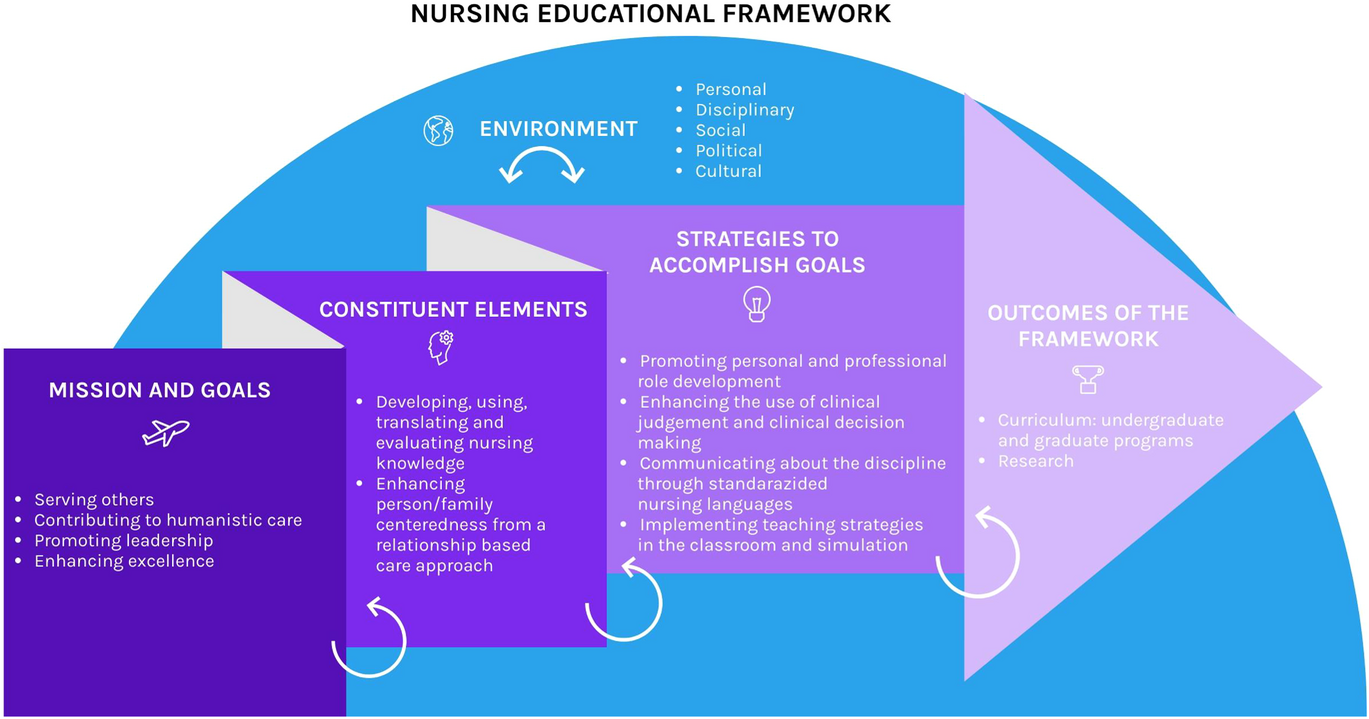
The Nursing Educational Framework
Mission and goals
To enable a sustained culture of educational excellence, it is essential to create a supportive environment that preserves student learning. The mission embedded within the NEF reflects the school of nursing's commitment to excellence in the education and preparation of nurses who are capable of promoting the humanization of care in accordance with the values of the nursing discipline, contributing to the advancement of nursing science and nursing knowledge development, and becoming internationally recognized in their profession. The mission of the NEF is realized through the principles of serving others, developing a culture of humanistic care that preserves life at every stage, and promoting leadership. It provides educators, students, and the institution with the needed guidance to understand the contribution their work makes to others and provides a clear direction to accomplish personal and professional goals.
Constituent elements
The constituent elements are central to the advancement of the NEF. They include the following: developing, using, translating, and evaluating nursing knowledge; enhancing person/family-centeredness from a relationship-based care approach.
Developing, using, translating, and evaluating nursing knowledge
In reality, current political, social, and economic issues sometimes pose challenges to the development and implementation of the nursing discipline. Despite the considerable achievements throughout time, it remains critical for educators to maintain a clear perspective on distinctive nursing knowledge, and to be diligent about its dissemination when preparing nursing students (Smith, 2016). The lack of emphasis on the disciplinary focus in nursing education has been defined as one of the most important threats for educators to contribute to nursing growth as a unique discipline. Many undergraduate and graduate nursing curricula do not ground student learning in the breadth and depth of nursing knowledge (Grace et al., 2016; Jones et al., 2023; Roy, 2018; Smith, 2016).
The link between the mission of the NEF—service, preservation of life, and leadership—and nursing knowledge development, use, translation, and evaluation is made explicit by being aware of the importance of using nursing theory to frame and guide nursing practice, research, education, and administration (Jones et al., 2023). As Newman (2008) noted, “nurses are thirsting for a meaningful practice, one that is based on nursing values and knowledge, one that is relationship-centered, enabling the expression of the depth of our mission, and one that brings a much needed, missing dimension to current health care” (p. 25).
From the NEF approach, educators develop knowledge within a person/family-centered humanistic perspective (Monge, 2017; Osacar, 2018; P. Diez-Del-Corral, 2013; Rumeu-Casares et al., 2017; Saracíbar-Razquin, 2009) and drive theory, practice, and research to be connected (Flanagan, 2021; Jones et al., 2023; Turkel et al., 2021). Preserving a unique nursing perspective in the development of a nursing curriculum, guided by theoretical principles that emphasize service, the preservation of life, and leadership, is essential for nursing to have a significant influence on excellent patient care. If nursing theory is not visible in practice, its unique contribution is obscured (Flanagan, 2019).
Educators conduct periodical internships to be clinically updated and translate nursing theory and research into practice. Through clinical sessions and workshops, they help create clinical educational environments in which theoretical content is effectively addressed. This intervention helps to reduce theoretical abstraction and makes theory more understandable to students and clinical nurses. The need for mutual and collaborative work among educators, nursing students, and clinical nurses remains critical (Shoghi et al., 2019).
Enhancing person/family-centeredness from a relationship-based care approach
Developing an authentic nurse-person/family relationship is essential to providing person/family-centered care (McCormack & McCance, 2006) and to achieving good health outcomes (Britten et al., 2016; McCormack & McCance, 2021; McCormack, Dewing & McCance, 2021). Accordingly, it is of the utmost importance to help students develop clinical nursing practices oriented to the establishment of caring and helpful relationships focused primarily on the person (Errasti-Ibarrondo et al., 2015).
Past research has uncovered that every authentic, specific, and unique nurse–person/–family relationship is composed of core elements. The “model of interpersonal relationship between the nurse and the person/family cared for” (Rumeu-Casares et al., 2017; Saracíbar-Razquin, 2009) highlights the values of respect, knowing the person, and intentional presence as the core elements of this relationship. Through respect, nurses manifest their genuine interest in serving the other and the awareness of not violating his or her privacy by creating safe spaces in which the patient's life remains preserved (P. Diez-Del-Corral, 2013). Respect includes advocating for the patient, promoting decision-making, and helping the person find meaning in the health process he or she is going through. Knowing the person involves knowing persons/families as unique valuable human beings who are living through experiences related to their health condition, and seeking to incorporate their personal values and goals into care delivery (Osacar, 2018; Somerville, 2009). Finally, intentional presence is described as “a consciousness and awareness that are directed toward (the person/family), with purpose and efficacy toward action, expectation, belief, volition, and even the unconscious” (Watson, 2002, p. 14). Intentional presence can also be understood as the interpersonal process characterized by the transcendent unity between two people who sustain their bond in a relationship that is satisfactory for both and in which the nurse intentionally builds a dynamic relationship with the person/family according to his or her uniqueness (Monge, 2017).
Considering that the way these concepts unfold in practice is nursing-specific, these three unique elements are central for the provision of person/family-centered care from a nurse–person/–family relationship perspective. From there, this theory-based framework helps educators promote students’ preparation for these attributes in their overall educational experiences overall. The NEF structure helps to teach these concepts threaded throughout the curriculum to promote greater understanding and its application. In doing so, educators create opportunities for students to expand their knowledge of the concepts to a variety of settings, populations, and experiences without needing to explicitly present its content in every course (Billings & Halstead, 2016; Giddens & Brady, 2007; Repsha et al., 2020). For example, instead of teaching about respect, leadership, or service in a variety of theoretical courses, such as ethics, adult care, and palliative care, students learn through exemplar case studies in simulation and learn how to apply its content in the corresponding theoretical courses.
Strategies to accomplish goals
There are several strategies that can be used by the educators to foster the mission of the NEF. They include the following: promoting personal and professional role development; enhancing the use of clinical judgment and clinical decision-making; communicating about the discipline through standardized nursing languages (SNLs); implementing teaching strategies in the classroom and simulation.
Promoting personal and professional role development
From the NEF perspective, to educate students to develop a culture of service, preservation of life, and leadership, educators embrace a commitment to students’ personal and professional growth through mentorship. Nursing mentorship, which contributes to students’ development through personal motivation and nursing professional competence (Mikkonen et al., 2022), plays a central role in receiving superlative benefits from educators (Lee & Chiang, 2021). Personal mentorship allows educators gain insight into each student's unique circumstances, enabling them to provide support, motivation, and new challenges that contribute to the students’ holistic growth and leadership development during their time at the university (Lleo de Nalda et al., 2020).
Through personal periodical interviews, the relationship established between the educator and the student helps them to know each other, challenge perspectives, facilitate honest discussion, and foster their involvement in the educational community. This reinforces their inclusion in social networks enhancing the teaching message and resulting in feelings of acceptance and desire for further connections (Yousiph et al., 2023). Through mentorship, educators also reformulate and reconceptualize what is learned in the classroom and what is observed and experienced in the practice setting. When this process is not part of the educational experience, it may compromise professional role development and result in challenging transitions to the practice environment. It is therefore essential that educators are prepared to promote personal and professional student development as an ongoing process of acquiring knowledge, skills, and attitudes over time, to provide service and respond competently to person/family needs (Ji et al., 2021; Schuler, 2021).
Nursing educators often come from practice settings where work expectations and the scheduling of time are clearly delineated. However, mentoring young students presents new challenges. Within the NEF perspective, a mentoring program for new faculty is offered as they sometimes adjust to an unfamiliar role. Within this structure, new faculty have a senior mentor who provides counseling and guidance not only in the field of mentorship but also in teaching topics, such as innovative classroom management, academic advising, and scholarship (Webber et al., 2020). A faculty mentoring committee headed by the head Departments and the Dean oversee the mentoring process to provide structure, organization, and continuity, to inform and promote the mentoring process.
Enhancing the use of clinical judgment and clinical decision-making
Within the NEF, clinical judgment and clinical decision-making are core nursing processes used to enhance problem, risk, or motivation solving that is responsive to nursing action (Herdman et al., 2021). According to Tanner (2006), clinical judgment can be considered “an interpretation or conclusion about a patient's needs, concerns, or health problems, and/or the decision to act (or not), use or modify standard approaches, or improvise new ones as deemed appropriate by the patient's response” (p. 204). Clinical decision-making can be regarded as reflective strategies for improving persons’ clinical status from their current conditions to favorable conditions (Shahraki Moghaddam et al., 2016).
Based on these approaches, a key educators’ competence is the ability to make students understand the connection between the academic world and nursing practice for the development of critical thinking skills that inform subsequent clinical judgment abilities when providing excellent patient care (Schuler, 2021). As nursing students address underdetermined and ambiguous conflicts in health settings, receiving relevant theoretical and practice-integrated education to enhance clinical judgment and decision-making skills is paramount to face and address daily clinical challenges.
The linkages between and among theoretical knowledge and a practice-integrated education are critical for the successful growth of nurse-driven professional practice and the development of professional roles based on excellent practice. From the NEF perspective, educators help students establish a liaison between what is learned in the classroom and its corresponding application to patients, families, and communities. It provides specific opportunities, such as integrated theory/practice-driven training (for instance, students learn how to write reflective diaries modeled by the integration of expected competencies and practical experiences), continuous formal and informal communication between academia and practice settings, and interdisciplinary seminars (Rosa-Salas et al., 2020). Furthermore, the NEF framework generates a reflecting led context that facilitates inclusion and embeddedness through periodic shared thoughtful discussion activities, such as theoretical learning sessions, journal clubs, and lifelong learning activities. General and profession-specific educational content are combined establishing a strong inseparability between theory and practice, concomitant teaching and learning between educators and students through active teaching methodologies, and diversified evaluative processes based on performance and competence development (Franco et al., 2016). Nurse educators transcend what questions to teach the why and purpose of nursing care, to facilitate the development of critical thinking skills (Huber, 2022).
In the context of the nursing process (Caro & Guerra, 2011), elements involved in clinical reasoning, decision-making processes, and nursing care delivery focused on identifying and measuring patient responses are based on thorough and comprehensive nursing assessments (Gordon, 2014; Flanagan, 2021). Educators incorporate this evaluative holistic gaze in every course in such a way that students come to accurately identify patient problems, risks and motivation to address, outcomes to achieve, and patient-tailored interventions to develop. Again, this is the work of nursing disciplinary knowledge, and it is why this work impacts persons/families and the nursing discipline's scientific advancement (Flanagan, 2021).
Communicating about the discipline through standardized nursing languages
SNLs represent nursing clinical judgments communicated through diagnostic terminologies, which are terms or concise phrases identified through clinical reasoning and validated by assessment evidence, where the idea or concept that represents the care problem, risk, or health motivation is condensed (Herdman et al., 2021). SNLs offer a way to investigate, demonstrate, and communicate the scope of the discipline of nursing. The diagnostic statements thus provide a common name that the whole community can use to express themselves, register in clinical records, and evaluate (Herdman et al., 2021).
The International Council of Nurses (ICN) considers SNLs use to be an essential strategy for nurse qualification and for the advancement of the profession as the development of a particular vocabulary promotes the strengthening of professional identity, the organization of clinical reasoning, and the improvement of practice (Figueir, 2018; Gómez-Salgado et al., 2018; Silva et al., 2020). Within the NEF perspective, the integration of SNLs in the nursing curriculum provides the use of a standardized vocabulary to communicate nursing visibility in the delivery of patient care among educators, students, and other healthcare professionals. By providing higher evidence-driven quality care, SNLs help to define problems, risks, and health motivations; choose the best interventions; and plan expected outcomes. Integrating this approach across the curriculum, programs, and courses also benefits nursing documentation, as it provides reliable valid approaches to record, organize, and analyze nursing information that is gathered in electronic healthcare records, which facilitates data compilation for nursing research (Gómez-Salgado et al., 2018). Documentation using SNLs aids communication among the various healthcare providers (Olatubi et al., 2019). Incorporating SNLs into the electronic documentation system provides nurses with a data base that makes visible the patient's experience and nursing's contributions to care.
From a person-centered relationship–based care perspective, incorporating nursing-specific descriptions of delivered care into healthcare daily records in a way that maintains the uniqueness of the concepts that represent nursing care (Rutherford, 2008; Schwiran & Thede, 2011; Olatubi et al., 2019) helps students understand patients’ needs with precision and formulate accurate nursing diagnoses, which facilitates the selection of more effective nursing interventions that lead to better outcomes (Olatubi et al., 2019; Rivas et al., 2016).
When educators use NANDA-International (NANDA-I), Nursing Interventions Classification (NIC), and Nursing Outcomes Classification (NOC), the nursing diagnoses, nursing interventions, and nursing outcomes are specifically defined and concreted. NANDA-I is a nursing language used widely for communicating patient problems, potential risks, and readiness for health promotion by nursing professionals who provide bedside care (Herdman et al., 2021). NIC is a classification in which each intervention has a unique identifier to facilitate computerization, a definition, and a detailed set of activities that describes nurses’ activities to implement the intervention. NOC helps to evaluate the effects of nursing interventions (Othman et al., 2020).
Scientific literature states that the use of SNLs increases evidence-based nursing care and improves efficient decision-making and critical thinking in the nursing process, which leads to positive effects on patient healthcare outcomes (Zhang et al., 2021). From there, the NEF framework threads and defines its curriculum through the integration of NANDA-I, NIC, and NOC (NNN) terminologies, which help educators, students, and clinical nurses deliver excellent and rigorous nursing care, lead the development of the nursing process, and be creative in solving patients’ problems through the use of critical thinking (Olatubi et al., 2019). The school organizes updated periodical training for educators and clinical nurses—seminars, online courses, and participation in research groups—to be prepared to develop, use, and apply NNN terminologies to the reality of nursing practice. Students learn to contribute to the nursing profession conducting didactic and interactive case studies to develop care plans and apply NNN in varied settings and populations.
Implementing teaching strategies in the classroom and simulation
Nurse educators need to align innovative teaching–learning technologies with the principles of focused person/family-centered care to prepare students more effectively to transition into diverse nursing roles and practice settings (Sanders & Stappers., 2008; World Health Organization, 2015). Nursing students must be prepared to reason like nurses, practice like nurses (Foronda et al., 2017), and manage the complexity of contemporary and essential nursing care (Benner et al., 2022). Considering the changing expectations of millennial students (Williams, 2019), this framework provides technologically advanced experiential learning opportunities in classroom, simulation, and clinical settings (Delaney et al., 2022). These elements are described as highly interactive holistic experiences attending to the intellectual, physical, and passionate components of learning through active participation (Benner et al., 2010).
Simulated experiences can contextualize learning experiences for students, as students have the opportunity to practice skills, apply theoretical principles, and develop clinical competences (Menard & Maas, 2019). Often, nursing students are faced with these new simulated or real practice scenarios and appear to have difficulties making the connection between what has been taught and what is being experienced (Schuler, 2021). Within the NEF, the value of simulation and the interest in generating innovative learning experiences to shape students’ future nursing identities are reinforced, as students are given an opportunity to integrate disciplinary knowledge in light of what is learned in the classroom (theoretical context), in simulations, and in practice settings. Utilizing multidimensional active learning methodologies with a combination of lectures, simulation, and clinical practices, the complexity of a real and sincere nurse-person/family relationship remains enhanced. Teaching innovation projects, such as the introduction of virtual reality for competency development or the implementation of objective structured clinical evaluation teaching in clinical simulation are deliberate actions that help to change teaching with the effect of contributing to students’ professional development (Tesouro & Puiggalí, 2015).
Outcomes of the NEF framework
The main outcomes derived from the implementation of the NEF approach are the following: Curriculum: undergraduate and graduate programs; research.
Curriculum: undergraduate and graduate programs
Curriculum design is a complex process that may include a variety of implementation approaches based on different categories (Annala et al., 2016). The NEF advocates for the integration of a humanistic relationship-based care approach to nursing education focusing on service, the preservation of life, and nursing leadership, for undergraduate and graduate programs.
Based on never-ending changes in science, healthcare systems, technology, and current models of curriculum design, curriculum revisions are periodically rigorously conducted following national, National Agency of Quality Evaluation (ANECA), and international, International Honor Society (SIGMA), nursing associations’ baseline agendas. The redesign and update of nursing curricula is continuous and needs to reflect the integration of newly generated knowledge, evolving human needs, and innovative learning methodologies consistent with the language proposed in the official standards of the institutions’ accrediting bodies, and the state boards of nursing (Giddens & Mullaney, 2023).
Although the acquisition of knowledge and skills is important to professional practice, nursing students are also required to develop attitudes, beliefs, and values that are central to the humanistic perspective of nursing (Brown, 2011). Incorporating the process of nursing knowledge development, use, translation, and evaluation through clinical judgment and clinical decision-making skills in all the constituent curricular elements helps to support a paradigm shift to a person/family-centered relationship–based nursing approach.
Research
Nursing research must be the foundation of comprehensive, evidence-based clinical practice (Lal, 2021), thus rendering it an essential component of the educational process (Tingen et al., 2009). The NEF advocates for not only introducing the research process into undergraduate and graduate nursing curricula but also making nursing research a tangible and more integrated experience for students, as an essential part of the evidence needed to identify problems, risks, and health motivations and guide interventions that promote nurse-sensitive outcomes. It is only with exposure and experience to research that students begin to understand the concept and importance of nursing research (Tingen et al., 2009). Creative strategies, including research fellowships and specific research programs, provide students opportunities to become more familiar with nursing research through involvement as team members working with educators, and to recognize the full scope of their future professional possibilities.
The NEF also provides opportunities for impactful and focused research that is committed to responding to current and pressing health challenges and anticipating future health challenges and priorities aligned with national and international associations, such as Joanna Briggs Institute and the National Institute of Nursing Research's (NINR) 2022–2026 strategic plan (National Institute of Nursing Research, 2022), mission, and guiding principles. The NEF offers guidance to foster a robust research agenda that contributes to knowledge development, use, translation, and evaluation, while supporting and nurturing the educational process.
Ultimately, the NEF research lens is one that is relationship-centered, that is based on a nursing person/family-centered conceptual approach, and that promotes service, the preservation of life, and leadership. Research and theory development focus on the person/family experience from a holistic and unitary perspective, while considering the dynamic and transformative nature of health-related lived experiences and the interconnectedness of human health with the multidimensional environment from a positive health approach.
IMPLICATIONS FOR CLINICAL PRACTICE
The NEF, a nurse-driven, conceptually guided approach, is presented as an opportunity to integrate the main elements of a humanistic person/family-centered view and as guidance for structuring a relationship-based curriculum for prelicensure and graduate nursing students; in addition to the mission of fostering service, preserving life, and promoting leadership, the framework also integrates constituent elements, strategies, and outcomes. Rather than requiring nurse educators to adapt isolated content to the immediacy of nursing practice, the use of the NEF supports structural and theoretical curriculum consistency for nursing knowledge integration across educational programs.
The shift from curricula emphasizing immediacy to comprehensive programs based on a conceptual foundation to promote disciplinary nursing knowledge development, use, translation, and evaluation and its corresponding integration into practice allows students to focus on the essential elements applicable to nursing at various levels and promotes the relationship among knowledge, practice, and research. Educators are able to use a variety of teaching strategies during the educational process to communicate content, maintain the integration of the evolving conceptual roots, and determine the appropriate strategies to fit anticipated outcomes. Existing programs are periodically reviewed and officially accredited in terms of their consistency with practice, and daily decisions are supported regarding these potential revisions. Choices of content and strategies are evaluated based on their congruency not only with the conceptual roots of the framework but also with the values and ability to drive positive change among all participants.
The NEF could be tested and evaluated to determine if it adequately informs the discipline, explains the components and processes of nursing education from a humanistic approach, and facilitates students’ clinical judgment and clinical decision-making abilities to achieve the identified goals. One way to address these critical needs could be incorporating evaluation strategies to assess global outcomes and students’ clinical judgment processes. The Clinical Judgment Measurement Model (CJMM) is an evidence-based model for measuring students’ clinical judgment. It promotes recognizing and analyzing cues, prioritizing hypotheses, generating solutions, acting, and evaluating outcomes, to help students making safe and competent decisions (Robinson et al., 2024). Thus, integrating innovative practical tools provided by complementary approaches could help not only to evaluate the NEF but to expand its impact and scope.
The dissemination of the NEF may be the beginning of a journey to enhance nursing education, clinical practice, and research through a conceptually informed approach to person-centered relationship–based practice and education. This framework provides a direction for linking nursing theory, practice, and research within the nursing discipline. The shift toward educating future nurses with disciplinary theory guidance for person/family-centered care is underway. The NEF offers nurses a clearer voice for describing the difference they make in advancing health and wellbeing for all.
CONFLICT OF INTEREST STATEMENT
The authors declare no conflicts of interest.
ETHICS STATEMENT
This work reflects the authors' own research and analysis in a truthful and complete manner.
