







Abstract
Two cities loom large in the history of American urban restructuring. New York City's 1975 technical bankruptcy and Detroit's 2013 Chapter 9 bankruptcy have played an oversized role in urban theory. This is currently reflected in competing theories of post–recession urban restructuring. “Austerity urbanism” uses Detroit as an exemplar, whereas “pragmatic municipalism” adopts the converse position arguing post–recession reform is defined by local context. This paper draws on the small cities literature to generate a different account of recent municipal bankruptcies and their broader impacts. It uses qualitative methods to survey the causes and outcomes of all eight post–recession Chapter 9 bankruptcies. The research recognizes the potential nationwide significance of these extreme events but avoids focusing on big city examples. The paper's findings suggest small and medium sized cities play a significant role in shaping recession–related restructuring.
Introduction
Two cities loom large in the recent history of American urban restructuring. The 1975 technical bankruptcy of New York City is described by David Harvey as the origination point of neoliberalism (Harvey 2006; also see Silver 2015; Tabb 1982). Pushed by “a powerful cabal of investment bankers (led by Walter Wriston of Citibank)” (Harvey 2006:45), New York City is described as being strong–armed into implementing soon–to–be–archetypal reforms that would prioritize bondholders, curb union powers, institute public sector wage freezes, and impose user fees (Phillips–Fein 2017). New York City's restructuring structure would, Harvey (2006) argues, go onto become a global model for politico–economic reregulation:
“The management of the New York fiscal crisis pioneered the way for neoliberal practices both domestically under Reagan and internationally through the IMF in the 1980s. It established the principle that in the event of a conflict between the integrity of financial institutions and bondholders’ returns, on the one hand, and the well–being of the citizens on the other, the former was to be privileged. It emphasized that the role of government was to create a good business climate rather than look to the needs and well–being of the population at large.”
(Harvey 2006:48)
Fast forward over 40 years and we find another large American city being theorized as the forefront of capitalist restructuring (Peck and Whiteside 2016; Schindler 2016; Silver 2015). In 2013, the City of Detroit filed for bankruptcy, marking the end of decades–long industrial decline and the height of America's post–recession urban fiscal crisis (Bomey 2016; Tabb 2015). Detroit's bankruptcy made headlines around the globe as its search for a budget fix threatened art collections, pensions, basic services, and bondholders.
The Motor City's bankruptcy reforms are now understood by critical social theorists as harbingers of future regulatory restructuring (see Silver 2015):
“Detroit's ‘perfect storm’ bankruptcy was always more than an extreme weather event; the city's predicament testifies to something closer to a climatic realignment, in the form of a prevailing pattern of urban governance increasingly predicated on financialized logics and technocratic practices.”
(Peck and Whiteside 2016:236–7)
Headline grabbing municipal failures in large American cities have therefore often served as starting points for understanding urban restructuring (Hackworth 2015, 2016; Schindler 2016). But do experiences of fiscal failure in large cities like New York and Detroit provide us with the insights necessary to understand post–recession urban restructuring? Current debates about “small cities” and post–recession urban restructuring suggest we should be cautious about relying on high profile, big city cases for understanding broader processes of urban change. The small cities literature (see Bell and Jayne 2006, 2009; Lorentzen and van Heur 2012) has argued that by focusing on large cities, social theorists have (1) uncritically associated theoretical significance with city size, (2) under–theorized the forms of connection between different cities (see Clancey 2004; Robinson 2006), and (3) lacked a concern with how smaller cities can negotiate and influence regulatory processes (see Gibson 2010; Jansson and Power 2010). Public policy scholarship on post–recession urban restructuring (Aldag et al. 2019; Kim and Warner 2016, 2017) has also argued that bankrupt cities like Detroit represent exceptional cases that tell us little about general patterns of urban fiscal reform.
This paper examines the relationship between city size and post–recession urban restructuring by comparing the causes and impacts of recent (post–2007) municipal bankruptcies. The eight bankruptcies included a range of urban settlements, spanning large cities (e.g., Detroit, MI), small townships (e.g., Westfall Township, PN), urban counties (Jefferson County, AL), and medium–sized cities (e.g., Stockton, CA). By comparing the eight municipal bankruptcies that followed the Great Recession, the paper presents two main findings. First, the causes of the eight bankruptcies varied across city size, indicating that theorizing from the experience on any single city, be it large or small, is of limited utility. Second, although bankruptcies in larger cities tend to be more complex and affect a larger group of stakeholders, the institutional impacts of any Chapter 9 case are not necessarily associated with city–size. In conclusion, the paper argues that theories of post–recession urban restructuring need to move beyond existing concerns with big cities and local government particularity, and therefore pay more attention to how extreme cases of restructuring, regardless of city size, can impact the “systematic regularities in urban life” (Storper and Scott 2016:12).
City Size and Post–Recession Urban Restructuring
The significance of New York City's (1975) and Detroit's (2013) bankruptcies to theorizations of late capitalist restructuring (e.g., Hackworth 2015, 2016; Harvey 2006; Peck 2014; Peck and Whiteside 2016; Tabb 1982, 2015) highlights the oversized role that larger cities tend to play in urban theory. According to Bell and Jayne (2006), this tendency to theorize from larger cities extends beyond recessionary restructuring:
“…the woeful neglect of the small city in the literature on urban studies means that we don't yet have to hand wholly appropriate ways to understand what small cities are, what smallness and bigness mean, how small cities fit or don't fit into the ‘new urban order,’ or what their fortunes and fates might be”
(Bell and Jayne 2006:2)
Given most of the urban population lives in small and medium sized cities (Bell and Jayne 2009), the tendency to derive urban theory from the study of large cities has created problems in terms of what urban theory explains (Lloyd and Peel 2007; Lorentzen and van Heur 2012) and how urban theory is constructed (Robinson 2006; Simone 2004).
Robinson (2006) makes the related claim that urban theorists have tended to conceptualize certain cities as sites of origination for urbanization processes (also see Peck 2015). This approach is seen to have generated urban theory that consistently places cities such as London and New York at the forefront of urbanization. Robinson's (2006) “ordinary city” thesis calls for a move away from this approach, arguing that “in a world of ordinary cities, ways of being urban and ways of making new kinds of urban futures are diverse and are the product of the inventiveness of people in cities everywhere” (1). Critics of this postcolonial perspective have recognized the need to study the diversity of cities (Peck 2015), but argued we must still be able to explain the politico–economic processes that structure cities (Brenner and Schmid 2015; Peck 2017a; Storper and Scott 2016). Storper and Scott (2016:12) claim that an emphasis on diversity in postcolonial urban studies has the potential to strip urban theory's ability to see the city as a distinctive social phenomenon:
“… the willful advocacy of the ‘messiness’ of urban life in some of these approaches—as in Simone's (2004:408) description of urban conditions as emerging from the interweaving of ‘complex combinations of objects, spaces, persons, and practices’—is superficially correct, but radically incomplete because, as we have argued, there are systematic regularities in urban life that are susceptible to high levels of theoretical generalization”
Similarly, Peck (2015) describes postcolonial urban scholarship as a “particularistic drift in contemporary urban studies” and has called for a sympathetic reengagement with politico–economic approaches to advance theoretical reconstruction in urban studies (also see Storper 2016).
Developing urban theories that understand the heterogeneity of cities (Robinson 2006; Peck 2015) in relation to the wider political economy is therefore a central challenge for contemporary urban scholarship (Peck 2017a, 2017b; Silver 2015; Storper 2016; van Meeteren et al. 2016). This challenge has increasingly been met by scholarship using concepts such as actor networks (Castells 2000; Smith and Doel 2011), relationality (Ward 2010, 2017), and assemblages (Hall and Savage 2016; McFarlane 2011) to explore the ways in which cities are discrete places bound up in numerous forms of connection. These theoretical perspectives attempt, in varying ways, to understand cities as constituted in, by and through various multi–scale processes (see Brenner 2018).
A recognition that cities should be more thoroughly conceptualized as integrated and connected has generated profound questions about what constitutes the city. For example, Neil Brenner (2013:87) has argued:
“… the geographies of urbanization, which have long been understood with reference to the densely concentrated populations and built environments of cities, are assuming new, increasingly large–scale morphologies that perforate, crosscut, and ultimately explode the erstwhile urban/rural divide.”
Brenner and Schmid (2015) have also argued that understanding the complex and multidimensional morphologies of urbanization should make us question the utility of the “city” concept. If all cities are deeply integrated and intertwined with global urbanization processes, can we talk meaningfully about cities at all? Although this position likely overstates the absence of city–scale processes (see Davidson and Iveson 2015), it again highlights how generating urban theory from the experiences of a city, or sets of cities, can generate flawed theoretical explanations (see Clancey 2004).
Urban theorists have therefore increasingly acknowledged that all cities, small and large, create policies, negotiate their contexts, and transmit innovations across the urban system (Leadbeater and Oakley 1999; Schlichtman 2009). Not only must we see small cities as part of the heterogenous mix of cities (Bell and Jayne 2009), we must also recognize that distinctive forms of policy–making and economic development take place in all cities. How then can we use the insights of the small literature (Bell and Jayne 2006, 2009; Clancey 2004) to inform existing debates of post–recession urban restructuring?
Critical scholarship has characterized post–recession urban restructuring as “austerity urbanism” (Davidson and Ward 2018; Peck 2012; Tonkiss 2013), where the neoliberal tendencies of municipal government have been intensified. Austerity urbanism (Peck 2012, 2014) sees post–recession restructuring involving the application of tried–and–tested neoliberal reforms onto a variegated urban political economy (Brenner et al. 2010). The result is that cities have been recipients of yet more downloaded fiscal responsibilities (Donald et al. 2014; Hackworth 2016), pushing them into a new period of retrenchment:
“Under conditions of systemic austerity, this phenomenon of ‘scalar dumping’ is taking on new dimensions, as cities are confronted with a succession of budgetary Hobson's choices. Some cities will be able to muddle through by cutting corners (and maybe the odd department), while keeping the streetlights burning; for many others, ongoing fiscal restraint, service retrenchment and public–private workarounds seem set to reshape the operating environment over the medium term. It is in the nature of downscaled austerity politics that these pressures are neither manifest nor managed uniformly, even as they are felt widely.”
(Peck 2012:647)
Austerity urbanism finds ideologically driven reforms being circulating throughout the governmental hierarchy, with them playing out differently according to the context they find themselves applied (Peck 2015).
Detroit's bankruptcy and subsequent restructuring has become an exemplar of austerity urbanism (Hall and Jonas 2014; Peck 2014; Peck and Whiteside 2016; Schindler 2016; Tabb 2015). It is seen as “a testbed for austerity models of public–sector employment and pension reform, for the triaged delivery of public services, and for postcrisis experiments in privatized regeneration” (Peck and Whiteside 2016:264). Just as New York City's 1975 bankruptcy came to foreground later neoliberalism (Harvey 2006; Tabb 1982), so does Detroit today. Detroit has therefore become a testing and application site for austerity reform, of which Peck (2012:649–9) characterizes as: (i) leaner local states (e.g., downsizing the public workforce); (ii) rollback redux (e.g., cutting even the “shadow” welfare state and enforcing “permanent fiscal vigilance”); (iii) fire–sale privatization; (iv) placebo dependency (e.g., local governance activities aimed at countering downloaded responsibilities with heightened economic growth strategies); (v) risk–shifting rationalities (e.g., offload of fiscal and service responsibilities); (vi) tournament financing (e.g., competition–based fund allocations); and (vii) austerity government (e.g., audit and accountancy driven government).
This understanding of post–recession urban restructuring has been rejected by some public policy scholars, where the theory of “pragmatic municipalism” has been offered as an alternative (Aldag et al. 2019; Bel et al. 2018; Kim 2018; Kim and Warner 2016). Pragmatic municipalism proponents (Kim and Warner 2016:1) acknowledge that some cities have undertaken deep austerity cuts but argue “that local governments are pursuing a ‘pragmatic municipalism’ that balances community needs and defends traditional local government services within the limits of fiscal stress.”
Pragmatic municipalism theorizes post–recession urban restructuring as a locally defined and contingent process (Aldag et al. 2019; Kim and Warner 2016). The idea that Detroit has become an exemplar (Peck and Whiteside 2016) is therefore rejected:
“Our results show that austerity urbanism, which predicts service cuts, privatization, and increased user fees, is too narrow to describe local government behaviour. Instead, we find support for our theory of pragmatic municipalism, which emphasizes the role of public managers. Local governments are doing much more than simply hollowing out—cutting services or privatizing. Municipalities under more stress use both more privatization and more cooperation.”
(Kim and Warner, 2016:12)
Pragmatic municipalism is, according to Kim and Warner (2016), not a new phenomenon. Drawing on prior literature, they challenge the idea that big city bankruptcies are appropriate vehicles for understanding urban restructuring. Kim and Warner (2016) claim that (1) service cutting is historically a last resort, and not preferred option, for US municipalities (Levine 1978; Wolman 1983), that (2) innovations in municipal fiscal matters tend to be focused on service retention (Scorsone and Plerhoples 2010; Warner and Clifton 2014), and that (3) privatization tends not to be an ideologically–driven agenda in US urban governance (Bel and Fageda 2007; Lobao et al. 2018; Joassart–Marcelli and Musio 2005). In contrast to the image of urban governance as being tightly confined by neoliberal norms (Peck 2014; Whiteside 2018), pragmatic municipalism characterizes city governments as active agents seeking out their own fiscal solutions.
Austerity urbanism and pragmatic municipalism therefore offer different theories of post–recession urban restructuring. Austerity urbanism is developed from case studies—predominantly Detroit (Hackworth 2016; Peck 2014; Peck and Whiteside 2016)—of extreme fiscal distress (i.e., bankruptcy). These case studies then provide a perspective upon how hegemonic reform prescriptions are cemented and circulated across other cities. Although this diffusion is acknowledged as an uneven/variegated process, it is pervasive since it involves a powerful ideological renarration of economic crisis via a demonization of the (local) state (Peck 2014). Pragmatic municipalism recognizes that elements of this reinvigorated neoliberalism exist, but also claims that this operates as a minor phenomenon amid a more varied set of state–conserving strategies (also see Lobao et al. 2018; Nelson 2012). Existing theories of post–recession urban restructuring therefore disagree on the extent to which neoliberal political ideology conditions fiscal and budgetary reform. However, in both theories there is an absence of attention towards the experiences of small and medium sized cities. Two aspects of this absence are important to note.
First, there is a continuing tendency to focus, in agreement and disagreement, on the “big city” case of Detroit (Hackworth 2016; Peck and Whiteside 2016). For Peck and Whiteside (2016), Detroit's bankruptcy has become a beachhead for financialized, neoliberal capitalism. They claim Detroit is “not–so–special” (235) and that the city has found itself at the forefront of “some across–the–board race to the bottom in municipal finances, leading to a flat earth of lean or bankrupt local states” (263). Kim and Warner (2016) argue that municipal bankruptcies are outliers: “the austerity argument is based primarily on case studies, such as Detroit, which are not typical of most US cities.” (13). The idea that Detroit has widespread significance for other municipalities is therefore rejected. Between these competing foci of the big city example and local context, the current debate therefore leaves little room for a consideration of the role of small and medium city bankruptcies in shaping post–recession restructuring.
Second, differing interpretations of geographical variations in post–recession urban restructuring have left underexamined many of the institutional structures that cities operated within (Storper and Scott 2016). For austerity urbanism, variations in urban restructuring result from the ways in which hegemonic ideologies (i.e., austerity) are conditioned via local application. In criticizing this ideological explanation, pragmatic municipalism sees variation as stemming from the ways “local governments are strategic and use a variety of delivery methods and revenue sources that fit their context.” (Kim and Warner 2016:12). One effect of this disagreement has been to leave understudied and undertheorized the various forms of interconnectedness between cities (see Storper and Scott 2016). In particular, an overwhelming concern with ideological conditioning—both arguments for (Hackworth 2016; Peck 2012, 2015; Peck and Whiteside 2016) and against this (Kim and Warner 2016)—has meant other institutional components of local government are often under–examined (see Brenner 2004; Saunders 2012). Consequently, many of the mechanisms by which small and medium size cities, in bankruptcy or not, might impact the institutional structures of urban governance have been under–studied.
This paper therefore examines all eight of the post–recession municipal bankruptcies (see Table 1) to generate an account of how extreme cases of fiscal distress had different causes and outcomes across cities of different sizes. It recognizes the potential nationwide significance of these extreme events (see Peck 2012; Silver 2015) while avoiding a focus upon big city examples (Peck and Whiteside 2016) or reducing the bankruptcies to the status of extreme outliers (Aldag et al. 2019; Kim and Warner 2016). The paper therefore draws on the small cities literature to both recognize the distinctiveness and connectedness of small and medium sized cities (Bell and Jayne 2006; 2009) and avoids the trappings of particularistic explanation (Peck 2015; Scott and Storper 2016).
Profiles of Post–Recession Chapter 9 Municipal Bankruptcies
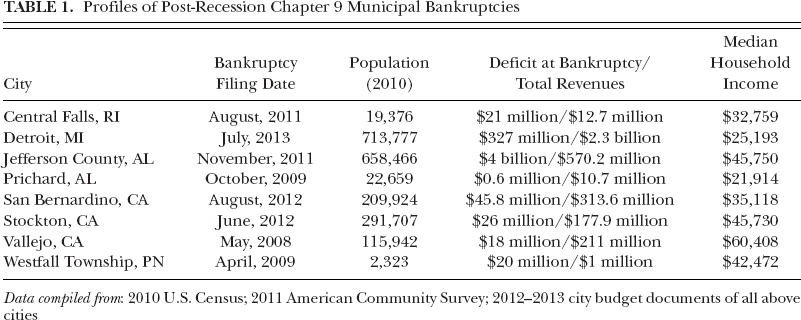
Data compiled from: 2010 U.S. Census; 2011 American Community Survey; 2012–2013 city budget documents of all above cities
Methodology
The paper draws on a multi–year (2010–2017), multi–part research project that examined the causes of, and local responses to, post–recession municipal bankruptcy. The paper uses the two parts of the project that examined (a) bankruptcy court proceedings and (b) popular and financial news media coverage of municipal bankruptcies. Comparing the causes and outcomes of municipal bankruptcy is a difficult task. Quantitative analysis of city budget data to examine the causes of bankruptcy is difficult across cities (Hendrick 2011). Not all cities use the same accounting practices and each city has its own distinctive financial structure (Sohl et al. 2009). It is therefore hard to compare the fiscal health of cities with precision (Pierson et al. 2015), particularly in the case of municipal bankruptcies, where you have a small sample size and irregular accounting practices. This research therefore adopted a qualitative approach, using secondary data to identify how various actors discussed (a) causation and (b) outcomes.
Two types of secondary data were collected over a seven–year period. To investigate how each of the eight bankruptcies was caused, the research comprehensively collected bankruptcy court documents for each case. These documents were available via state and local governments online. Each set of court proceedings include testimonies from the bankrupt cities and creditors, in addition to the legal opinions. The outcomes of the eight bankruptcies were examined via news coverage (2009–2018) on municipal bankruptcy collected using Google News Alerts. A total of 2,753 news articles from national and local press coverage of municipal bankruptcy were screened, collected, and analyzed. This data therefore provided a mechanism to assess how news and trade journalists narrated the broader impacts of each bankruptcy. All secondary data was digitized and converted to text format using Adobe DC software. Text files were cleaned of extraneous text, labeled, and collated for analysis in QSR NVivo. Secondary text documents were coded according to a set of predefined research themes based on the research questions.
Coding of the textual data related to causation began with a first pass content analysis to identify the various causes of bankruptcy discussed in the context of each case. With causes identified, two further stages of analysis followed. First, a trend analysis identified the contextual content of the cause mentioned. Second, a discourse analysis identified the discursive context with which the cause discussion occurred. For example, mentions of excessive labor expenditures were identified, then any immediate referencing of labor expenditures coded (trend: police and fire employees), before the broader context of the discussion was coded (discourse: power of police and fire labor unions). This produced a set of coding maps and statistics which identified the (a) causes (by frequency and emphasis) of bankruptcy and (b) the discursive context associated with both the content and trend codes. Coding maps were then used to identify causations associated with each case.
Qualitative analysis of outcomes proceeded in a similar fashion. A first pass content analysis identified the impacts associated with each bankruptcy case. Predefined keywords relating to “impact” and “effect” were identifying using the Roget's 21st Century Thesaurus. These words were then used to search and code the news media texts. Each identified impact was then examined for trend and discourse. Trend analysis specifically looked if an impact was associated with changed institutional relations. For example, a legal ruling associated with a case might be related to changes in legal precedent applicable elsewhere. Discourse analysis examined how the impact was discursively situated. For example, changes in legal precedent might be associated with broader shifts in the status of local governments with respect to state or federal government. With the three stages of coding complete, the coding maps were used to identify the outcomes associated with each of the eight cases. A key distinction introduced in the coding maps was between “outcomes” and “impactful outcomes.” This was introduced to distinguish those outcomes that commentators thought extended beyond the immediate city context (i.e., impacted the legal, economic, and/or political institutions shared with other cities). Once impactful outcomes were identified for all the cases, relevant news media was reviewed, and a narrative account of the impactful outcome written. This allowed for the impactful outcomes of each case to be characterized and developed into a basic typology.
The Causes of Municipal Bankruptcies
Qualitative analysis of bankruptcy court documents identified the city's (a) sources of fiscal problems and (b) major creditors. In each case, various causes of bankruptcy attributed in court documents were identified. Identification of creditors focused on isolating those classes of creditors with the largest financial liabilities. In each bankruptcy, there are numerous creditors. For example, in the case of Detroit, bankruptcy filings included a list of 76,169 creditors. This did not include the City's employees and retirees who were owed wages and pensions. Nor did it include over 66,000 property parcels that were owed real estate tax refunds. The analysis therefore used the classification of creditors in bankruptcy documents to identify those groups of creditors with the largest collective liabilities related to the bankruptcy.
The results of the analysis of causation are shown in Table 2. A summary of the qualitative discourse analysis is shown for each of the eight bankruptcies. In each case, the coding maps are different and reflect the particularities of each city and its bankruptcy. A comparison of the coding map across the cities does show that larger cities tended to have more complicated understandings of causation. For example, in the case of Detroit, a multitude of inter–twined factors were used by different stakeholders to explain the city's bankruptcy. These ranged from the State of Michigan's imposition of an emergency manager through to the risky interest rate swap deals of former administrations. In the smallest cities, for example Central Falls and Prichard, the coding maps were much less extensive. Causation tends to be explained via a more limited set of factors. However, Jefferson County was an exception. Although the second largest of the post–recession bankruptcies (by population and deficit), the causation was quite clear (i.e., sewer financing) and the case did not demand a complex narration.
Summary of Qualitative Analysis of Municipal Bankruptcy Causation
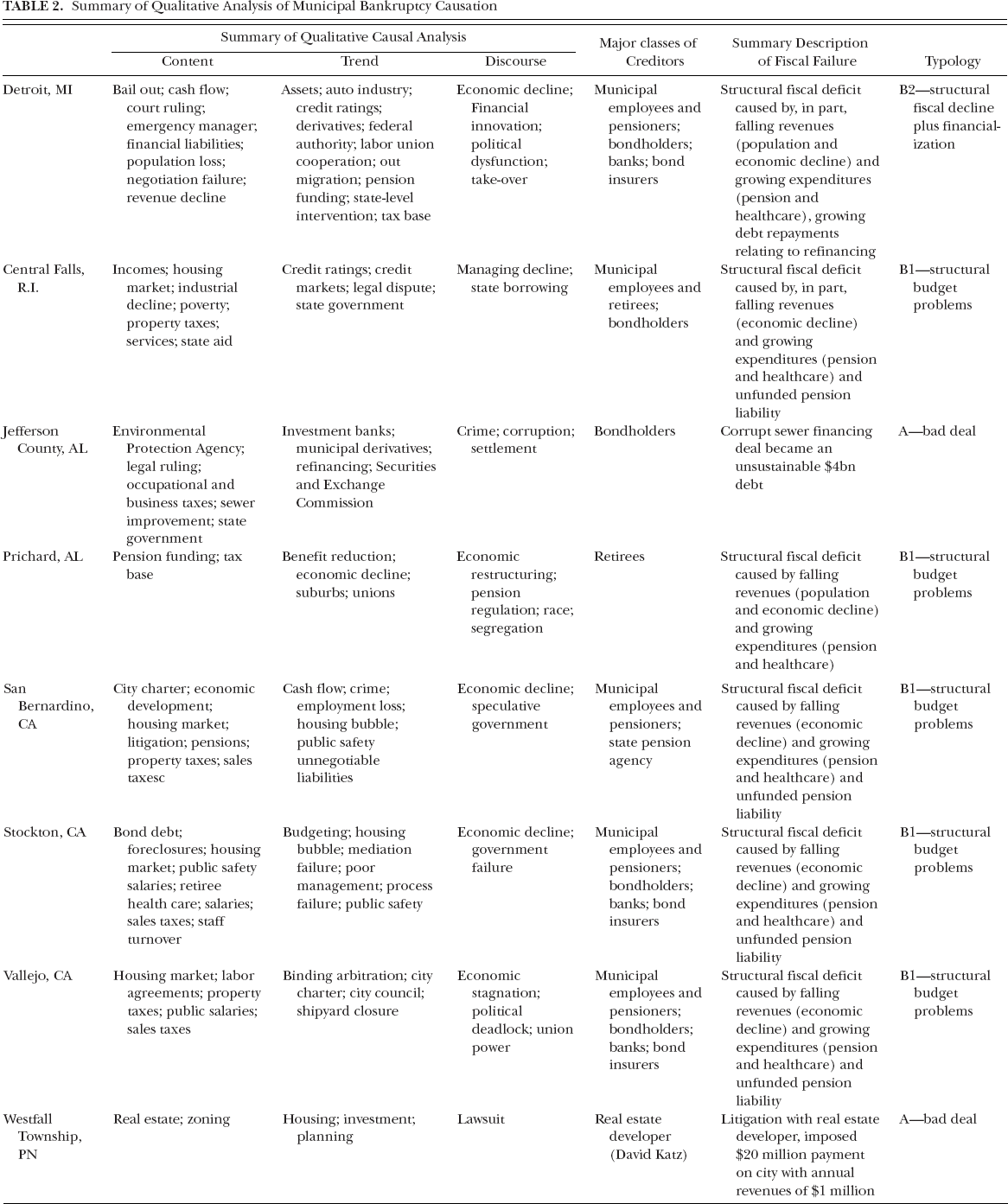
Coding maps were used to generate a simple summary of each bankruptcy. Causal codes were annotated according to magnitude (1 [major contributor] through to 5 [minor contributor]). Magnitude was assessed based on the results of trend and discourse coding, where any assessment of the importance of the causal force by the stakeholder was incorporated into digital annotations. These evaluations are therefore subjective assessments of the extent to which stakeholders in bankruptcy proceedings understood the significance of any single cause.
Table 2 shows that the most common cause of municipal bankruptcy is “structural fiscal deficit.” This encapsulates a host of factors but describes a general process of budgetary failure where expenditures could not be kept in line with revenues over a prolonged period. Five of the bankruptcies fall into this category: Central Falls, Prichard, San Bernardino, Stockton, and Vallejo. In the cases of San Bernardino, Stockton, and Vallejo, all the cities found themselves in weak budget positions leading up to 2007–2008. When the recession hit, the structural weaknesses of their budgets led to bankruptcy. However, this is not to say that causes of budget weakness were the same for all the cases, even in the three Californian cities. Coding for content showed that San Bernardino had distinctive problems in the organization of its city government. In contrast, Stockton's bankruptcy was directly related to a failed attempt at mediation and staff turnover within the city administration.
Detroit's bankruptcy is also summarized as relating to “structural fiscal deficit.” However, coding maps for the case reflected a unique aspect of the bankruptcy. Although Detroit had experienced budget problems due to long–term structural problems (e.g., economic decline, large retiree, and healthcare liabilities), it had also attempted to reduce these liabilities with financial instruments. Specifically, prior city administrations had used financial derivatives (interest rate swaps) in 2005 to help pension funding. These introduced more speculative risks into the city budget and, when the recession hit, these risks were realized (see Bomey 2016). The coding analysis therefore revealed two types of “structural budget deficit” bankruptcies. The first, labeled B1, are bankruptcies explained principally by structural budget problems. The second, B2, relates to Detroit and identifies the financialized element of the city's bankruptcy.
The third type of bankruptcy, generated from the summary statements, is that relating to “bad deals” (Type A). This type applies to Jefferson County and Westfall Township. These dramatically different sized local governments experienced Chapter 9 bankruptcy because they engaged in poor financial deals. In Jefferson County, a corrupt sewer financing deal brokered by investment bank JP Morgan left the city with insurmountable debts to bondholders. In Westfall Township, the “bad deal” was much smaller, involving a single real estate developer who sued the township over planning and zoning issues. However, the outcome was like that in Jefferson County, a single financial obligation defaulted the local government.
Qualitative analysis of municipal bankruptcy causation therefore finds no relationship between city size and default. Small, medium, and large cities all failed due to structural budget deficits. Likewise, a small township and large county both failed due to single financial transactions. However, there are some trends relating to city size worth noting. Results of coding showed that larger cities had more identified bankruptcy causes and larger amounts and types of creditors. This suggests that the process of Chapter 9 bankruptcy is different based on city size and that larger cities have more potential to impact institutional structures simply because they are more complex and actively engaged with more stakeholder groups.
The Outcomes of Municipal Bankruptcies
Although the Great Recession was followed by just eight municipal bankruptcies—according to the U.S. Census Bureau there are 9,492 municipal governments, 16,519 township governments, and 3,033 county governments in the U.S.—each one has generated innumerable outcomes. Analysis of news media coverage of the eight Chapter 9 cases sought to identify “impactful outcomes.” These are defined as consequences wrought by the bankruptcy that affected the institutional structures that cities operate within. Institutional structures were conceptualized as the legal (law), economic (financial relations), and political (intergovernmental relations) connections that cities work with and against (see Lubell et al. 2009; Savas 1978; Storper and Scott 2016).
By focusing on institutional structures, the qualitative analysis of news media used coding to associate each bankruptcy with a set of impactful outcomes. The results of this analysis are summarized in Table 3. Table 3 shows when news media identified the different bankruptcies impacting its legal, political, and economic structures. Given news media coverage is only indicative of impact; these results do not provide information on the extent or details of each case. Indeed, coding results showed that associating institutional changes with any single post–recession bankruptcy can be difficult. For example, the impacts of the concurrent bankruptcies in California were often discussed collectively in news media.
Summary Descriptions of the Impactful Outcomes of Municipal Bankruptcies
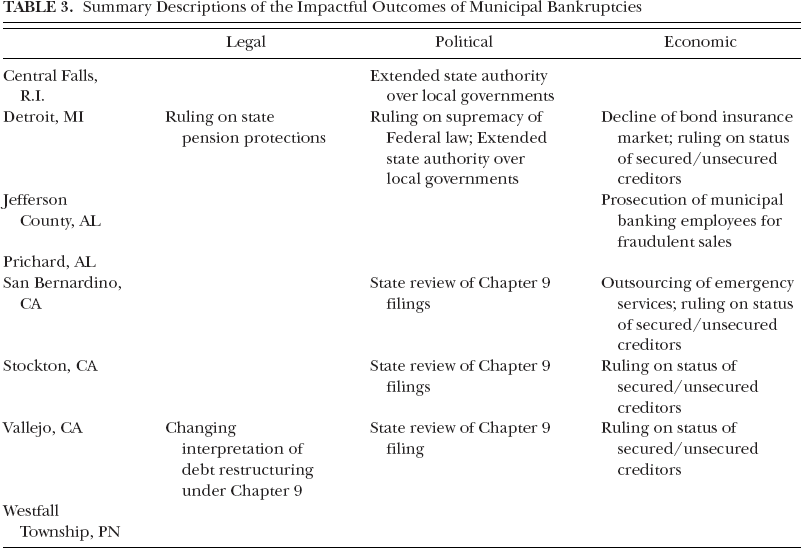
The following discussions of impactful outcomes therefore focus on key types of legal, political, and economic changes associated with post–recession municipal bankruptcies. The examples were chosen because of the frequency of news coverage and strong associations made in news media between institutional change and an individual bankruptcy. This selection criteria enables impactful outcomes to be discussed in some depth and across different city sizes. However, it does not allow for any city to be identified as representative of others or more impactful than another. The following accounts of legal, political and economic change are therefore indicative of the various ways that bankrupt cities of different sizes generated impactful outcomes, not comprehensive accounts of how the entire set of bankruptcies changed American urban governance.
Legal Structures: Local government in the U.S. is a creation of state and federal law (Skeel 2013–14, 2015; Trotter 2011). During recent municipal bankruptcies, the parameters of this legal relationship would be disrupted by the actions and claims of defaulting municipal governments (Martin 2015; Skeel 2015). Bankruptcy filings generated legal debates over (a) what constitutes a municipal bankruptcy and (b) what protections exist for various classes of municipal creditors. Federal bankruptcy court rulings made during the first Great Recession municipal bankruptcy in Vallejo would shift prevailing understandings of Chapter 9 legislation (Davidson and Kutz 2015).
Chapter 9 of the Bankruptcy Code serves to define what constitutes municipal bankruptcy and sets out the eligibility criteria for distressed municipalities. This part of the legislation is designed to safeguard against municipalities walking away from burdensome debt obligations while, at the same time, ensuring that creditors negotiate in good faith (Hempel 1973). In recent Chapter 9 filings, the issue of debt obligation has often been concerned with the costs associated with public employee remuneration (Pew 2013; Trotter 2011). Municipal bankruptcies are not usually associated with structural imbalances within General Fund budgets because revenues (e.g., property and sales taxes) and expenditures (e.g., salaries and pensions) are somewhat predictable. Furthermore, annual variation in revenues and expenditures can usually be covered by cuts in discretionary spending and short–term loans (Mayer 2008).
In Vallejo, just as in Central Falls, Detroit, Prichard, San Bernardino, and Stockton (Type B1 and B2), declining fiscal health meant an inability to pay employees and retirees. In all cases, this meant a voluntary renegotiation of Collective Bargaining Agreements (CBAs) and, following the failure of these negotiations, a court–mediated restructuring of CBAs under Chapter 9 protections. These court–mediated reforms generated two issues. First, to satisfy the conditions of Chapter 9, cities have had to demonstrate that good faith negotiations have taken place with creditors, including labor unions, and that it had been impossible to reach a solution. Second, bankruptcy judges have had to decide if Chapter 9 can be used as a tool to alter CBAs without creditor consent. As the first Chapter 9 bankruptcy case in the post–2007 era, Vallejo's court rulings set precedents in both areas.
U.S. Bankruptcy Code has been subject to several revisions. One of the most significant with respect to CBAs was Congress’ introduction of Section 1113 to the Bankruptcy Code after the 1984 National Labor Relations Board v. Bildisco & Bildisco decision. In this case, the judge ruled that under Section 365 of the Bankruptcy Code, Bildisco, a bankrupt New Jersey based building supply company, may reject the commitments made in its collective bargaining agreements (White 1984). In response to this ruling, Section 1113 was written to replace the preceding judgment about CBA rejection that had used from Section 365 of the Bankruptcy Code. Section 1113 served to reestablish some degree of protection over employee rights, since the Bildisco decision had favored the rehabilitation of the debtor (Sherwood 2014). Section 1113 therefore restricts the ability of bankrupt private companies to reject CBAs through ensuring a significant degree of union consent to restructuring.
When the City of Vallejo filed for bankruptcy, it requested approval to reject its CBAs. The presiding judge ruled that Section 1113 could not be applied to Vallejo's bankruptcy, since Congress had not written it into Chapter 9. The court argued that there “is no clear explanation why Congress excluded S1113 from Chapter 9, [but] many believe that Congress was concerned about encroaching on state rights under the Tenth Amendment” (quoted in Trotter 2011:21). Therefore Section 365 should apply to the case. This ruling has had the effect of creating a distinction between public and private employees within bankruptcy law (Trotter 2011). Through the course of Vallejo's Chapter 9 bankruptcy case, the City was found to have reached the conditions laid out in Section 365 and could, therefore, restructure and/or reject its CBA agreements.
Although Vallejo found agreement with most of its employee unions through the course of bankruptcy negotiations, the application of Section 365 to Chapter 9 and the subsequent ability granted to municipalities to restructure their CBAs changed the stakes of municipal bankruptcy. Contracts relating to pay and health benefits and, crucially, public pensions are commitments a city can now look to reform using Chapter 9 protections.
The impacts of the Vallejo ruling on CBAs have been evident in subsequent municipal bankruptcies. In news media coverage of Detroit's bankruptcy negotiations, the Vallejo precedent was recognized to have shaped CBA negotiations and the subsequent bankruptcy settlement (Stoll et al. 2013). This occurred even though public employee benefits were below national averages and pension funds remained adequately funded (Long 2013). In July 2013, a Michigan court judge ruled Detroit's bankruptcy ineligible since it contained an intent to restructure pension payments. The state judge claimed that this violated Article IX, Section 24, of the Michigan Constitution. This decision was a direct consequence of Vallejo's prior ruling on CBA reform. In asserting Michigan law over Federal law, the Michigan judge brought about a conflict between the two levels of government. The Federal judge presiding over the Detroit bankruptcy case ruled that any decision over CBA protections would be made in federal court, therefore enforcing Federal jurisdiction and clarifying the limits of state supremacy. The ruling confirmed that one cannot simply pick and choose what parts of Chapter 9 to enact (Trotter 2011:25). Once a State authorizes Chapter 9 filings, the federal bankruptcy courts then preside.
In ruling on Vallejo's claim, the federal bankruptcy judge would change the legal operating parameters of American cities that have the option of Chapter 9 bankruptcy. As other cities subsequently went bankrupt, the political decisions of a small Californian city would therefore resonate across the United States, and particularly in Michigan's largest city.
Political Impacts: Chapter 9 of the U.S. Bankruptcy Code only becomes applicable to U.S. municipalities when a state government makes its constituent municipalities conditionally or unconditionally permitted to file. Both federal and state governments are therefore responsible for enabling and shaping bankruptcy at the city level. Chapter 9 has proven a useful device for resolving failed developmental and infrastructure projects. However, recent bankruptcy filings have generated unwanted disruptions for state governments. For example, the bankruptcy filings of Vallejo, San Bernardino, and Stockton have caused concerns for California legislators in Sacramento. Although in rare events, municipal bankruptcies have stimulated some state governments to install more oversight and control of local government.
When Vallejo was granted permission to modified CBAs during bankruptcy, state legislators quickly fielded calls from labor unions (Sakai and Ng 2011). With the threat of fiscally beleaguered cities altering CBAs, state legislators drafted Assembly Bill No. 506 (AB506). The central purpose of AB506 was to introduce another step into the California's Chapter 9 procedure. The bill required cities to enter a “neutral evaluator process” prior to submitting Chapter 9 materials. This evaluator process was designed to have a third–party mediator bring together the debtor municipality with its numerous creditors. Crucially, the bill guaranteed that California's labor unions would have a seat at the mediation table (Noble and Baum 2013). The absence of labor unions from Chapter 9 restructuring negotiations was therefore mitigated at the state level. Although AB506 was backed by California's unions, the legislation did allow cities to file for Chapter 9 without mediation if a “fiscal emergency” was declared.
The AB506 process is “a procedurally complex mandatory mediation” (Noble and Baum 2013). It requires that the debtor (city) gives ten days of notice to all creditors with noncontingent claims of at least $5 million. The city must also inform indentured trustees, unions with CBAs, retirees, pension funds amongst other classes of creditors. This increased the number of creditors who must be consulted compared to the Chapter 9 process. AB506 also mandated that the mediations must not last for more than 60 days, although it did allow for a 30–day extension. AB506 was adopted in 2011 and therefore Stockton and San Bernardino bankruptcies all went through the process. Stockton used AB506 without success. San Bernardino claimed a fiscal emergency and therefore avoided mediation.
In Michigan, the actions of the state government in their dealings with fiscally stressed cities have been somewhat more proactive. When Detroit began facing a fiscal default due to ballooning debt repayments and shrinking revenues, Mayor Dave Bing approached the state government for support. The interaction between city and state was immediately more cooperative compared to that in California, where the state was reacting to multiple and varied municipal actions. In Michigan, the response of Governor Rick Snyder to Detroit's request for help made national headlines. With Detroit's finances in free–fall, the state legislature passed Public Act 4 in 2011. This enabled the state government to assume emergency management powers. What followed included the appointment of lawyer Kevin Orr as Emergency Manager, a failed attempt to restructure to city's debt and a protracted Chapter 9 filing. The emergency powers that reigned over Detroit ended in December 2014.
The differing actions of Californian and Michigan state governments in response to municipal bankruptcies demonstrates how the size of the bankrupt cities matters little when institutional structures are being disrupted. California's introduction of AB506 was a reaction to Vallejo's bankruptcy and sought to minimize the political and fiscal disruption of future bankruptcies. Michigan engaged much earlier in Detroit's bankruptcy to bring state control to an emerging fiscal emergency. After Vallejo's bankruptcy threatened to weaken union power at the city and state levels, a coalition of politicians and public–sector unions sought to counter through the creation of a state–designed fiscal adjustment process. In response, cities such as Stockton and San Bernardino developed their own strategies to work with, and around, state legislation. This back–and–forth between cities attempting to variously restructure debts and the state government attempting to minimize the related ramifications signals to the disruptive potential of any city, big or small. In both Michigan and California, it was not the size of the bankrupt cities that principally concerned state legislators, but the potential state–wide ramifications of local government action.
Economic outcomes: Municipal bonds are low–risk, low–yield investments. However, recent municipal bankruptcies generated new uncertainties in capital markets, particularly with respect to which creditors receive priority in bankruptcy settlements. In the cases of Jefferson County and Westfall Township, the issue of creditor priority was slightly easier to navigate since each city had accrued large liabilities with singular creditors (see Table 2). However, Central Falls, Detroit, Prichard, San Bernardino, Stockton, and Vallejo, the breadth and diversity of creditors meant that contests emerged over which would lose their investment. The collective impact of decisions over creditor priority made by these cities has included the disruption of market conventions and moves by state governments to minimize any potential tightening by lenders to other constituent municipalities.
The three main classes of creditors in most recent bankruptcy cases were (i) employees (i.e., those with CBA obligations); (ii) retirees (i.e., via pensions managed by retirement funds); and (iii) bondholders (i.e., capital markets who financed city operations and development schemes). Chapter 9 proceedings have decided on (a) whether all debt obligations can be restructured in Chapter 9 and (b) whether some creditors have priority over others. Without any legal rules or precedents to organize creditor priority, these creditors, individually and collectively, have all organized to respond to Chapter 9 filings to guard against losing out in bankruptcy settlements.
The status of pension obligations in Chapter 9 bankruptcies has been contentious and complicated (Long 2013). Although the bankruptcies of Detroit and Vallejo opened the possibility that municipal pension obligations could be revised, only Detroit fully explored this option. In Vallejo, the city did not seek to restructure its obligations to the state pension agency, CalPERS. CalPERS had been quick to warn Vallejo that extensive legal actions would be instigated if the City opted to renege on its pension payments (Walsh 2012). Eager to avoid yet more costly court cases, Vallejo focused on CBAs and retiree health benefit restructuring. Subsequent bankruptcies in San Bernardino and Stockton initially took opposing routes to pension reform. San Bernardino opted to restructure its CalPERS pension payments, which prompted CalPERS to challenge the city in court (Kasler 2015). After Chapter 9 proceedings began, San Bernardino withdrew its threat of pension readjustment and, like Stockton, moved to restructure bond debt.
Detroit's bankruptcy readjustment has dramatically impacted many of its retirees. Except for retired police and fire officers, Detroit's retirees have found themselves poorer and, in some cases, debtors. Starting in 2015, 12,000 city retirees had their pension checks cut by 6.7 percent. In addition, nearly 11,000 retirees have been required to repay over $200 million in interest they accrued in the city–managed savings scheme. The savings plan had guaranteed 7.9 percent interest, having the effect of draining $756.2 million from the city's pension fund (Christoff 2015). These pension reforms, amongst others, cut $1.7 billion of pension liabilities for the city.
Although bankrupt cities developed different approach for pension reform, both large and small bankrupt cities challenged the assumption that bondholders were the most protected group in Chapter 9 proceedings. In Detroit, Jefferson County, San Bernardino, and Stockton, municipal bondholders have all been subject to more severe Chapter 9 readjustments. The restructuring choices of these cities have brought the low–risk status of municipal bonds into question (Bernard 2015). Within municipal bond markets received wisdom taught that General Obligation Bonds were almost risk–free, since municipalities had tax raising powers to ensure repayment (Long 2011). A combination of low risk and taxation exceptions made municipal bonds attractive investments. Yet recent bankruptcies caused some to doubt simple assumptions about municipal bond risk. In Jefferson County, a bankruptcy caused by corrupt sewer financing resulted in a court–mediated restructuring that slashed bondholder payments. To fund basic public services, Jefferson's council appropriated sewer revenues (Connor and Reid 2012). This diversion of revenue funds and diminution of bondholder priority caused one financier to comment, “Jefferson County has really opened a Pandora's Box” (Richard Larkin, quoted in Connor and Reid 2012). Bankruptcies in California and Detroit pushed this concern further.
Until the Vallejo bankruptcy, no municipality had used Chapter 9 to repay bondholders anything but the full principal. In 2011, Vallejo used Chapter 9 to reduce interest payments to one creditor, U.S. BanCorp. In Detroit, bankruptcy restructuring further reduced repayments to bondholders and bond insurers. In San Bernardino and Stockton, bondholders were specifically targeted. San Bernardino entered a protracted legal battle with bondholders and insurers over its plan to repay only 1 percent of pension obligation bonds and general unsecured claims (Webster 2015). Similar troubles prevailed in Stockton. Investment firm Franklin Templeton sued Stockton for its plans to repay only 12 percent of its $36 million loan. Franklin's complaints were dismissed in court with the judge claiming the loss was balanced against a $550 million reduction in retiree benefits and that Franklin's settlement reflects “the bargain that Franklin made and the risk that it undertook” (Kasler 2015: np). As bondholders began to lose on investments in these cities, a further conjuncture became highlighted with bond insurers challenging the decisions of Federal judges to allow debt restructuring.
When recent municipal bankruptcies created the prospect of unprecedented debt restructurings, the financial relations between cities and creditors changed. Different creditors mobilized to ensure that their repayment obligations were accounted for in the remaining fiscal expenditures of each city. This played out differently in each bankruptcy, and it is difficult to identify the overall implications. In Rhode Island, home to bankrupt Central Falls, the state government responded to creditor insecurities by passing legislation to protect General Obligation bondholders, the intention being to ensure the state's constituent cities remained attractive sites for investment. The financial presses continue to warn of risks to municipal bondholders from unfunded public pensions (Meisler 2017).
Conclusions
The relationship between city size and post–recession urban restructuring has been understudied. The two main explanations of post–recession urban restructuring either derive theories from the fiscal failures of large cities (e.g., Peck 2014) or tend to understand it as a locally defined process (e.g., Kim and Warner 2016). By drawing on the small cities literature (Bell and Jayne 2006, 2009), this paper has worked between these two theories. This paper has examined how fiscal failure, in the form of Chapter 9 bankruptcy, differed in its causes and how it generated impactful outcomes across a variety of cities, ranging in population from 2323 (Westfall Township) to 713,777 (Detroit). The paper's findings inform the existing literature on post–recession urban restructuring in two ways.
First, by identifying the causes of bankruptcy across the eight cases, the research shows that Detroit does not represent all other cases. Indeed, Detroit is marked out by its supplementing of structural fiscal problems with speculative financial deal making. It therefore supports the claims of pragmatic municipalism proponents (Aldag et al. 2019; Kim and Warner 2016) that Detroit does not provide a broadly representative case of post–recession restructuring. However, the research also shows that small, medium, and large cities all failed due to structural budget deficits. What did distinguish the bankruptcy cases by city size was the growing complexity that comes with the failure of big cities. Larger cities tend to have more creditors, in number and type, which complicates both causation and the process of readjustment. This raises important questions as to whether the complexity of large cities generates distinctive analytical challenges—see Page (2015) on the problems associated with studying complex systems. For example, the competing claims of multiple creditors in bankruptcies such as Detroit and San Bernardino generated more complex legal and economic consequences in comparison to smaller cities with simpler readjustment plans.
Second, by focusing on how the eight bankruptcies impacted their legal, political, and economic institutional structures, the research shows that small and medium cities can have significant impacts on those institutional structured shared with other cities. This reiterates the criticisms of small cities scholars (see Bell and Jayne 2009), demonstrating how, in extreme cases of fiscal restructuring, small and medium sized cities have similar abilities to large cities to interact with, and potentially transform institutional structures. It also means that we should not reduce events like municipal bankruptcies to outlying “extreme cases” (Aldag et al. 2019; Kim and Warner 2016) with little relevance to broader processes of urban restructuring.
Beyond post–recession urban restructuring, the research also emphasizes how the study of small and medium sized cities should play a more significant role in urban theory building; particularly as its seeks to develop explanation attuned to both the distinctive histories of cities across the globe (Robinson 2006) and the politico–economic structures that cities are engaged in (see Peck 2015). By examining how the eight post–recession municipal bankruptcies generated outcomes that impacted their institutional structures, the interaction between the particular causations of fiscal crises and the “systematic regularities in urban life” (Storper and Scott 2016:12) have been partially illustrated. However, much work remains to develop urban theories that are informed the kinds of empirical study that identify how cities interact with, and shape, institutional structures. As this work proceeds (see Peck 2017a, 2017b), it will likely benefit from the continued study of extreme and/or rare urban phenomenon, such as municipal bankruptcies, since these moments often serve to demonstrate those points of connection that are less visible during more stable times.