







Abstract
Many studies focus on the relationship between social networks and performance. I study networking behavior as an antecedent of tie formation among entrepreneurs in business incubators. I distinguish between two types of networking behavior: individual networking orientation or building potentially valuable ties for personal gain, and tertius iungens orientation or facilitating tie formation between others. I find that both types of networking behavior are positively related with the number of business partners to whom entrepreneurs give business assignments. Contrary to expectations, I find no relationship between networking behavior and the number of business partners from whom entrepreneurs receive business assignments.
Introduction
The influence of social networks on new venture creation and performance has been studied extensively (Aarstad, Haugland, & Greve, 2010; Hoang & Antoncic, 2003; Slotte–Kock & Coviello, 2010). Many studies on social networks originating from the field of sociology focus on tie strength (Granovetter, 1973). In addition, they often apply a structural approach and focus on the extent to which an individual's position in a network brings certain benefits (Burt, 2004; Freeman, 1979). With respect to tie strength, strong ties, which are characterized by high trust, have been found to facilitate transactions and coordination in groups (Coleman, 1988). Weak ties, on the other hand, are valuable in gaining access to new information and new opportunities (Granovetter). Individuals that are strategically positioned to form—often weak—ties between two disconnected individuals can exploit this position either in terms of combining complementary pieces of knowledge or by acting as a broker (Burt, 1992).
More specifically, within the field of entrepreneurship, most studies focus on the content of network relationships, governance mechanisms, and network structure (Hoang & Antoncic, 2003). For example, having strong ties—family members or close friends that have their own business—is positively related with the chance of becoming an entrepreneur oneself. On the other hand, weak ties facilitate opportunity identification (Elfring & Hulsink, 2003) and are positively related with profitability (Davidsson & Honig, 2003). However, the majority of extant research focuses on the impact of social networks on performance, in which they treat the characteristics of network ties, the size of social networks, or the structural position within them as independent variables. Moreover, a number of authors criticize past studies for neglecting to treat social networks as dependent variables and highlight the need to study the process of network formation (Hoang & Antoncic; Slotte–Kock & Coviello, 2010) and the mechanisms through which ties emerge (Stuart & Sorenson, 2007).
The first contribution of this paper is that I study the relationship between networking behavior and tie formation. By studying individual networking behavior as an antecedent of tie formation, I respond to calls in the literature to study how the strategic actions of individual entrepreneurs influence tie creation (Slotte–Kock & Coviello, 2010; Stuart & Sorenson, 2007). Studying the effect of networking behavior on actual tie formation is a first step one needs to take before being able to isolate how occupying a specific structural position in a network, such as, for example, a central one (Freeman, 1979), influences performance. The second contribution is that I make a distinction between two types of networking behavior: networking orientation and tertius iungens orientation (TIO). First, networking orientation is an individual's propensity to actively try to meet other people from whom one hopes and/or expects to benefit in the future. Second, individuals with a TIO have a tendency to facilitate tie formation among (disconnected) individuals in their network when they think these other individuals might benefit from one another (Obstfeld, 2005).
Although the TIO construct was originally developed for predicting employee involvement in innovation within the firm, in this paper I argue that TIO is also a valuable construct in an entrepreneurial setting. Entrepreneurship research mainly focuses on entrepreneurs acting upon opportunities when they perceive them to be desirable and feasible (Krueger, 1993), either by setting up their own organization, selling the idea to someone else (Shane & Venkataraman, 2000), or collaborating with other organizations that possess complementary resources (Hitt, Dacin, Levitas, Arregle, & Borza, 2000; Sarkar, Echambadi, & Harrison, 2001). Past research, however, seems to ignore the possibility that entrepreneurs who identify opportunities that they themselves cannot (easily) exploit have the option to inform other entrepreneurs in their network whom they perceive to be better positioned or endowed to exploit the opportunity. Although entrepreneurs do not directly benefit from facilitating others to exploit business opportunities, one might expect that those who benefit from another entrepreneur's TIO will reciprocate this selfless bridging behavior (Blau, 1964).
I study the relationship between individual networking orientation and TIO on tie formation in the empirical context of entrepreneurs located in business incubators. Business incubators can be defined as organizations that provide office space and central services at a favorable price to firms that are often recently set up (Allen & McCluskey, 1990). More specifically, I study tie formation in the sense of contracting relationships among entrepreneurs in which entrepreneurs either give to, or receive business assignments from, other entrepreneurs in a business–to–business or factor market setting (Sarkar et al., 2001). Where early studies on business incubators focus on physical proximity, economies of scale, and cross–fertilization among firms that are colocated in incubators (Hackett & Dilts, 2004), more recently there has been a shift toward research on so–called networked incubators (Hansen, Chesbrough, Nohria, & Sull, 2000). Managers of business incubators can facilitate and actively foster the formation of network ties between entrepreneurs in incubators as well as with external business partners (Bøllingtoft & Ulhoi, 2005; Hansen et al.; Tötterman & Sten, 2005).
In contrast to Hansen et al.'s (2000) top–down focus on the role of incubator management in facilitating tie formation between entrepreneurs, others take a bottom–up perspective showing that colocation in incubators can lead to cross–fertilization among entrepreneurs (Phan, Siegel, & Wright, 2005). Entrepreneurs in incubators may benefit from close physical proximity to entrepreneurs with potentially complementary competencies, allowing for outsourcing of contracts or using the incubator as an internal market place (Bøllingtoft, 2012; Bøllingtoft & Ulhoi, 2005; Campbell, 1989). In order for entrepreneurs to benefit from cross–fertilization, incubators depend on “a minimum degree of altruism and collectivism” (Bøllingtoft & Ulhoi, p. 285). Networking behavior by individual entrepreneurs, especially in the form of TIO, may therefore be an important driver of cross–fertilization and the formation of business relationships among incubated firms since entrepreneurs that score high on TIO will actively link other entrepreneurs in business incubators, and by doing so facilitate the creation of new (combinations) of knowledge, resources, and exchange relationships.
This paper is structured as follows. I will start with a theoretical framework in which I discuss the link between entrepreneurship, social networks, and social capital theory. Next, I will discuss networking as a behavioral attribute and distinguish between individual networking behavior and TIO, and how this affects actual tie formation. This will be followed by a review of existing research in the field of business incubation, which is the empirical setting of this study. Next, I will present the results of the regression analysis. Here I estimate the effects of individual networking behavior and TIO on tie formation in terms of inward and outward contracting relationships among entrepreneurs in business incubators specialized in the creative industries. The paper will conclude with a discussion and ideas for future research.
Theory
Entrepreneurship, Networking Orientation, and Contracting Relationships
Entrepreneurship can be defined as the identification, evaluation, and exploitation of opportunities (Shane & Venkataraman, 2000). Entrepreneurship scholars traditionally focus on individual actor characteristics of entrepreneurs. First, these studies show that entrepreneurs have certain psychological characteristics that distinguish them from others. Entrepreneurs, for example, have a greater tolerance for ambiguity, a larger propensity to take risk (Begley & Boyd, 1987), and a higher degree of self–efficacy compared with nonentrepreneurs. Individuals that score high on entrepreneurial self–efficacy have a strong belief in their own entrepreneurial abilities, especially those related to innovation (Chen, Greene, & Crick, 1998). Second, others study the link between human capital, in the sense of skills and competences, and entrepreneurship. For example, individuals with a formal education and previous start–up experience are more likely to discover new opportunities or start a new venture. However, this does not necessarily mean that they are also more successful in exploiting these opportunities (Davidsson & Honig, 2003).
Over the years, entrepreneurship scholars have increasingly started to focus on the positive relationship between social capital and entrepreneurship (for extensive reviews, see Hoang & Antoncic, 2003; Slotte–Kock & Coviello, 2010). Social capital studies are concerned with how social structure facilitates the actions of actors within that structure (Coleman, 1988). This social structure often refers to a social network, which is also illustrated by the definition by Nahapiet and Ghoshal (1998) who define social capital as “the sum of the actual and potential resources embedded within, available through, and derived from the network of relationships possessed by an individual or social unit. Social capital thus comprises both the network and the assets that may be mobilized through that network” (p. 24). Since social capital is a rather broad construct and social networks are a key aspect of social capital, in what follows I will focus more specifically on social networks.
Social network research has seen a tremendous growth over the past decades and in a wide variety of social sciences. Social networks can be valuable because they can provide actors with access to crucial resources, new opportunities, legitimacy, and status (for a review, see Brass, Galaskiewicz, Greve, & Tsai, 2004).
Although there is a vast amount of research on network theory, one could make a broad distinction between those studying the characteristics of the ties and those that focus on network structure. With respect to the former, one makes a distinction between weak and strong ties. Weak ties such as acquaintances are more likely to be sources of novel information and opportunities such as job openings (Granovetter, 1973). Strong ties such as family members are characterized by emotionally close relationships, high trust, and joint problem solving (Coleman, 1988; Uzzi, 1997). The second stream of network research is concerned with the structural characteristics of networks and focuses on the relationships between actors occupying a specific position and the benefits they derive from it. Examples of often–used structural network measures are the degree of structural holes (Burt, 1992) and network centrality (Freeman, 1979). Actors whose networks are rich in structural holes occupy a position that allows them to benefit from brokering links between otherwise disconnected others (Burt). Actors, on the other hand, that occupy a very central position in a network have better access to resources and opportunities than their poorly connected counterparts in the periphery (Freeman).
At a fundamental level, researchers criticize the structural approach to network research and argue that individual actor characteristics may be an important driver in attaining a particular position within a network and therefore point out the need to study the mechanisms through which ties emerge (Stuart & Sorenson, 2007). One of the few studies that indeed focuses on the antecedents of network centrality found that centrality can, to some extent, be explained by individual personal characteristics (Klein, Lim, Saltz, & Mayer, 2004).
Specifically in the field of entrepreneurship, there is also an extensive stream of research on the effects of social networks (for extensive reviews, see Hoang & Antoncic, 2003; Slotte–Kock & Coviello, 2010). For example, strong ties such as family members and close friends are important in the early phase of setting up a new venture (Greve & Salaff, 2003) because they provide low–cost access to critical resources (Starr & MacMillan, 1990). Weak ties such as acquaintances, on the other hand, are more important for identifying opportunities (Elfring & Hulsink, 2003; Granovetter, 1973) and making the new venture profitable within a short period of time (Davidsson & Honig, 2003). In their review, Hoang and Antoncic focus on the content of network relationships, governance mechanisms, and network structure. They find that the majority of research is concerned with the impact of network structure on performance and note that there are only a few process–oriented studies in which networks are the dependent variable. More recently, Slotte–Kock and Coviello highlight the need to study the actual process of network development in entrepreneurship research.
In this article, I therefore focus on developing hypotheses about the effect of individual networking orientation as a personal characteristic on tie formation among entrepreneurs. First, I define networking orientation as the propensity of an individual actor to actively build informal social ties from which he or she hopes and/or expects to professionally benefit in the future. Entrepreneurs on average spent 5 hours a week developing and maintaining contacts (Aldrich & Reese, 1993). Networking behavior might be especially important for new start–ups to overcome their liability of newness (Stinchcombe, 1965). This is confirmed by a study that shows that entrepreneurs spend more time in developing networks in the early stages of the establishment of the firm (Greve & Salaff, 2003). Second, I study tie formation among entrepreneurs in terms of interfirm contractual relationships. The argument is that entrepreneurs that score high on individual networking orientation form more weak ties with other entrepreneurs, which, in turn, allows them to spot valuable opportunities for collaboration. When these opportunities are formally exploited in the form of a contractual relationship between entrepreneurs, it means that these weak ties have turned into strong ones.
Shane (2012) defines opportunities as “situations in which it is possible to recombine resources in a way that generates a profit” and notes that although many studies focus on entrepreneurship as the act or process of setting up new ventures, entrepreneurship research has seen little progress in studying entrepreneurship by individual actors in firms that already exist (p. 15). Moreover, firms, and especially the individual actors within them, need to continuously search for collaboration opportunities with other firms in order to remain competitive. Since entrepreneurship research is concerned with explaining performance differences between actors in discovering and exploiting business opportunities (Shane & Venkataraman, 2000), while social networks provide actors with access to resources and new opportunities, one would expect that entrepreneurs with a strong networking orientation are more likely to monetize their weak ties into strong ones in terms of receiving business contracts from other firms. I therefore hypothesize that:
Proactive entrepreneurs scan their environment in search of valuable opportunities (Lumpkin & Dess, 1996). Organizations do not always have all the required resources they need to successfully compete in product markets and can form collaborative ties with other organizations that possess complementary resources (Chung, Singh, & Lee, 2000). This means that opportunities are not restricted to product markets but can also entail opportunities in factor markets. With respect to factor markets, organizations can proactively scan their environment in search of potentially valuable opportunities for partnering with other organizations. Firms that are better informed about the factor market for partners are better at exploiting collaboration opportunities (Sarkar et al., 2001) through which they can leverage their resources (Hitt et al., 2000). In addition, organizations are more inclined to form collaborative ties when there is a certain degree of trust in potential partners based on preexisting ties between partners (Gulati, 1995). Therefore, entrepreneurs with a strong networking orientation might be expected to be more aware of potentially valuable collaboration opportunities and more likely to have established weak informal ties with potential partners before turning them into strong ones in terms of actual collaboration. I therefore hypothesize that:
Entrepreneurship, Tertius Iungens Orientation, and Contracting Relationships
Entrepreneurs act upon opportunities when they perceive them to be desirable and feasible (Krueger, 1993). The perception of feasibility is the result of an entrepreneur's evaluation of the chance that he or she is able to exploit these opportunities. Past studies on entrepreneurship identify three main possibilities for exploiting opportunities. First, one can set up a new organization. Second, one can sell the idea to another existing organization (Shane & Venkataraman, 2000). Third, when entrepreneurs identify potentially valuable business opportunities that they themselves are not able to—easily—exploit, they can collaborate or form an alliance with others possessing complementary resources (Hitt et al., 2000; Sarkar et al., 2001).
Past studies, however, ignore a fourth option. Entrepreneurs may identify opportunities that they themselves cannot easily or directly exploit. Yet, instead of ignoring these opportunities, they have the option of sharing this information with other entrepreneurs that are in a better position to exploit them. First, this information about a potential business opportunity can be shared with a single entrepreneur who is expected to be able to exploit this opportunity by himself or herself. Second, in instances in which an entrepreneur sees opportunities that can only be exploited by two or more actors if they form an alliance and combine their complementary resources, an entrepreneur can share this information with either one or all of them. This behavioral characteristic of facilitating coordination between actors within one's social network, when one believes these actors could benefit from collaboration, is termed a tertius iungens orientation (TIO) (Obstfeld, 2005). Although it is not measured explicitly, TIO research seems to suggest that individuals engage in TIO without expecting to benefit directly from their apparently selfless behavior.
Obstfeld (2005) contrasts the TIO construct with a tertius gaudens orientation in which individuals aim to profit directly by acting as a broker between two individuals that are disconnected within the network. Most previous studies focus on brokerage and show that individuals with networks that are rich in structural holes, or nonredundant ties, are in a position to benefit from brokering ties between otherwise disconnected others (Burt, 1992). The similarity between TIO and brokerage research is the focus on the structural network position an actor occupies between two actors that could benefit from being connected by the broker. The difference is that research on brokerage and structural holes in the tradition of Burt infers or assumes that actors occupying this strategic position will exploit this position to their own benefit. TIO research, however, shows that actors in a brokerage position do not necessarily exploit this position for their own direct benefit but also tend to bridge structural holes and act as an apparently selfless facilitator between other actors that could benefit from collaboration (Fleming, Mingo, & Chen, 2007; Obstfeld; Xiao & Tsui, 2007).
TIO was originally developed to study innovation processes within firms. Obstfeld (2005) shows that individuals that score high on TIO play an important role in the innovation process within firms. Individuals that score high on TIO have a tendency to connect people when they think these other individuals can mutually benefit from each other or when they share a common interest. Instead of studying TIO by employees inside the firm like Obstfeld did, in this study I focus on the effects of TIO among independent entrepreneurs. In addition, as opposed to studying the relationship between TIO and innovation, I study the relationship between TIO and contracting behavior. Entrepreneurs that score high on TIO actively link other entrepreneurs who could be able to exploit business opportunities that result from combining complementary resources. However, as opposed to TIO in the context of employee involvement in the innovation process where the firm is ultimately able to benefit by exploiting the innovation that results from it, TIO by entrepreneurs in an interorganizational setting does not directly seem to lead to benefits to those individuals engaging in this behavior.
Although TIO may be valuable to those other entrepreneurs that are being connected through this third person, this does raise the question of whether entrepreneurs who engage in TIO also benefit themselves in terms of access to valuable resources and opportunities. Social exchange theory argues that if one person voluntarily provides a benefit to another in terms of information, advice, or resources, this creates an obligation to the receiver to reciprocate (Blau, 1964). In addition, Adler and Kwon (2002) define social capital as “the goodwill available to individuals or groups. Its source lies in the structure and content of the actor's social relationships. Its effects flow from the information, influence, and solidarity it makes available to the actor” (p. 23). As a result of a general tendency toward reciprocity and the goodwill created through TIO, one might expect that individuals that actively forge connections between others might benefit from others reciprocating this altruistic bridging behavior (Obstfeld, 2005). In other words, the two potential alliance partners who benefit from the selfless brokering of entrepreneurs may be expected to return the favor by, in turn, connecting them to potential business partners within their own network. I therefore hypothesize that:
As stated earlier, organizations do not always have all the required resources they need to successfully compete in product markets and can actively scan factor markets in order to identify potential collaboration partners who possess complementary resources (Chung et al., 2000; Lumpkin & Dess, 1996). Therefore, one might expect that individuals who score high on the TIO dimension bridge more structural holes (Burt, 1992) and as a result have a greater knowledge of the activities of other entrepreneurs. This, in turn, gives them a competitive advantage in the sense that they have more information to identify complementarities or potentially valuable joint business opportunities. Precisely because individuals that score high on TIO have a better overview of the activities of other firms in their network, one might expect that they also have a greater ability to identify firms with whom they themselves have the possibility to exploit opportunities for collaboration based on the complementarity of their resources (Hitt et al., 2000; Sarkar et al., 2001). In addition, organizations tend to collaborate with others when there is a certain degree of trust based on preexisting ties between these partners (Gulati, 1995). Entrepreneurs are therefore expected to set up collaborations with others that are close within their network. I therefore hypothesize that:
Empirical Setting
The empirical setting of this study is entrepreneurs in business incubators. Research on the nature and benefits of business incubators has been on the rise since the 1980s (Hackett & Dilts, 2004), especially in relation to entrepreneurship (Bøllingtoft & Ulhoi, 2005; Marvel, 2011). Business incubators can be broadly defined as organizations that provide affordable office space and central services to—often recently set up—firms (Allen & McCluskey, 1990). These services can range from a shared reception and information technology facilities to legal advice and access to venture capital (Hansen et al., 2000). Many studies on incubators focus on top–down strategies by the management of incubators. Roughly speaking, one can identify two broad top–down incubator strategies: The first is concerned with real estate development where incubators provide new ventures with cheap office space in renovated old buildings or underdeveloped neighborhoods, while the second is concerned with actively fostering and supporting new ventures (Allen & McCluskey). These two broad strategies can be seen as a continuum (Brooks, 1986).
Early studies on business incubators focus mainly on the effects of physical proximity, economies of scale, and cross–fertilization between incubated firms (Hackett & Dilts, 2004), and provide evidence that firms use incubators as an internal market place for subcontracting or purchasing goods (Campbell, 1989). More recently, attention has shifted toward so–called networked incubators (Bøllingtoft & Ulhoi, 2005; Hansen et al., 2000; McAdam & Marlow, 2007; Tötterman & Sten, 2005). Most of these studies show which tools managers of business incubators have at their disposal to facilitate and foster the formation of networks, not only among entrepreneurs that are colocated in incubators but also between entrepreneurs in incubators and external business partners (Hansen et al.; Tötterman & Sten). Although incubator managers could add value by actively facilitating network formation in practice, this is often not the case. Ties between incubated firms and incubator management are found to be infrequent; incubator managers hardly introduce incubated firms to influential individuals (Honig & Karlsson, 2007), and when they do forge links with external parties, it ultimately does not lead to tangible results (Rice, 2002).
Possibly in reaction to these top–down approaches, there have been calls to focus on studying incubators at the level of the individual entrepreneur (Phan et al., 2005). One specific study looks at networking between entrepreneurs from the bottom up and found that colocation in incubators can indeed lead to cross–fertilization. More specifically, they found that firms in incubators are not primarily interested in learning new skills, but in buying other firms’ competencies through business contracting (Bøllingtoft & Ulhoi, 2005). In addition, firms that are located in incubators that are jointly established by entrepreneurs themselves, and, therefore, lack a strong central incubator management, are also found to actively combine their resources and competences to jointly bid for contracts and use each other as internal suppliers (Bøllingtoft, 2012). Others, however, find that ties among tenants are weak and mainly characterized by information exchange instead of contractual relationships, possibly because of the large degree of diversity among the activities of tenants (Tötterman & Sten, 2005). In addition, it should be noted that entrepreneurs are at times also suspicious and cautious in their networking behavior within incubators in order to protect their business ideas and valuable relationships with investors (McAdam & Marlow, 2007).
Previous studies predominantly use social capital theory to explain bottom–up contracting behavior among entrepreneurs within business incubators (Bøllingtoft, 2012; Bøllingtoft & Ulhoi, 2005). They do not, however, study the effect of active networking behavior by individual entrepreneurs to explain contracting relationships within the incubator. Therefore, instead of looking at top–down networking behavior by incubator management (Hansen et al., 2000), in this paper I focus on horizontal networking behavior among entrepreneurs located in business incubators. More specifically, I study the effects of networking behavior in terms of individual networking orientation and TIO and its effects on contracting relationships among entrepreneurs colocated in business incubators. The advantage of studying networking and exchange behavior between entrepreneurs precisely in business incubators is that there are clear boundary conditions, namely the building, its tenants, and the exchange ties among them. Moreover, Venkataraman (1997) suggested studying entrepreneurship as a nexus of individuals and opportunities. A business incubator is an especially useful setting since it is a prime example of a man–made nexus of individuals and opportunities that, to some extent, exists because of the assumption of positive spillover effects among incubated firms.
Data and Methods
I focus on a specific type of business incubator that is specialized in renting office space to firms and individuals in the creative industries. Creative industries, for example, include architecture, film, fashion, design, music, games, and performing arts (Florida, 2002; Scott, 2004). I used a survey to study networking and contracting behavior among entrepreneurs in four different creative industries incubators. These incubators were of varying size in terms of the number of tenants. At the time of study, the Arts & Crafts Lab had 84 tenants, the Beehive 52, the Kauwgomballenfabriek 63, and the Volkskrantgebouw 250. All of these incubators are based in the city of Amsterdam, the Netherlands. The management of these incubators announced the research project to all the entrepreneurs who rented office space in their incubator through their internal digital newsletter that they send around by e–mail. Approximately a week later, they were sent an invitation to fill in an online questionnaire in Dutch (see the Appendix for Dutch and English versions of the key scales, items, and instruments).
In June 2010, I sent an e–mail to the four incubator managers that contained an invitation to all the entrepreneurs in their respective incubators to fill in an online questionnaire. The managers of the four incubators agreed to forward this invitation to all their tenants in the hope and expectation that their endorsement would have a positive effect on the response rate. In the introduction of the online questionnaire, I clearly stated that this study was meant for academic research purposes and that their individual responses would not be made public or shared with any third parties including the management of the incubator. After 1 and 2 weeks, I sent reminders to all tenants who had not yet filled in the online questionnaire using a list of e–mail addresses made available by the incubator manager exclusively for the purpose of this study. Three weeks later, the remaining entrepreneurs were either telephoned, or if they did not answer the phone, visited on site to stimulate them to participate by filling out the questionnaire (Dillman, 2000).
I received a total of 125 surveys. This amounts to a response rate of 27.8%. I deleted 19 questionnaires that were incomplete. In addition, I deleted two questionnaires that were filled out by an incubator manager and a restaurant manager. 1 After performing sensitivity analyses, I also excluded three outliers and influential cases with a disproportionate effect on the outcome. The final sample consists of 101 completed questionnaires (n = 101).
Dependent Variables
I used two dependent variables to study the internal contracting relationships of firms within incubators. First, the variable inward contracting partners is the number of firms within the incubator from which a focal firm received paid business assignments in the previous 12 months. In the questionnaire, this was phrased as follows: “For which (maximum 5) persons in ‘[name incubator]’ did you (or did your firm) perform paid assignments? Note: This excludes unpaid assignments: Note: Over the period covering the previous 12 months.” Individuals could name a maximum of five individuals and were instructed to start with the largest contracting partner in terms of the total value of the contracts measured in euros (see Figure 1).
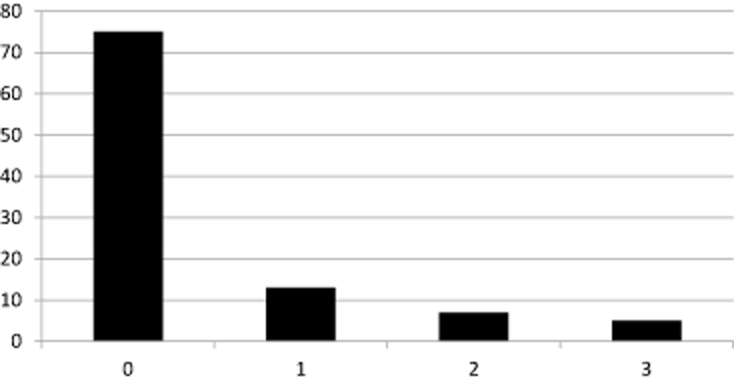
Inward Contracting Relations
Second, the variable outward contracting partners is the number of firms within the incubator to which the focal firm has given paid business assignments in the previous 12 months. This was phrased as follows: “To which (maximum 5) persons in ‘[name incubator]’ did you (or did your firm) grant paid assignments? Note: This excludes unpaid assignments: Note: Over the period covering the previous 12 months.” Again, individuals could name a maximum of five firms and were instructed to start with the largest contracting partner in terms of the total value of contracts measured in euros (see Figure 2).
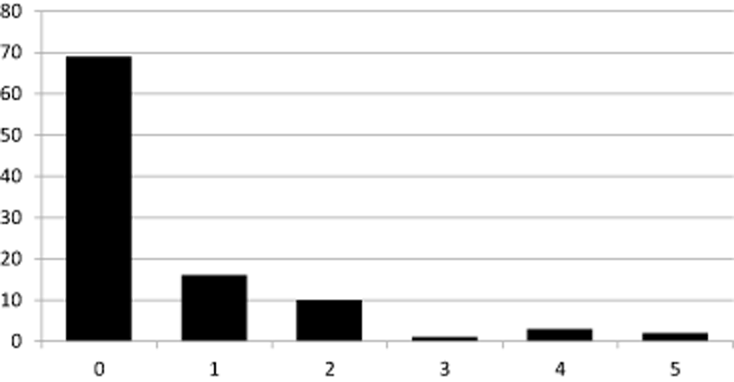
Outward Contracting Relations
I limited the number of names of persons that respondents could provide to a maximum of five in order to increase the response rate of the survey. I set this limit after exploratory interviews with entrepreneurs in incubators who informed me that it is very unlikely to have more than five contracting partners in the incubator. This is also confirmed by the data. With respect to inward contracting relationships, all entrepreneurs have less than five contracting partners. With respect to outward contracting relationships, only two entrepreneurs indicate that they have five partners. In these two cases, it might be possible that they had more than five contracting partners.
Independent Variables
First, the variable individual networking orientation is a 7–point scale adapted from a 5–item scale used in a previous study in the Netherlands (Hoogendoorn, Oosterbeek, & Van Praag, 2012). The fact that this scale has been tested in previous studies in the Netherlands avoids possible problems resulting from translating an English scale into Dutch. The Cronbach's alpha score based on the 5–item scale is .675. The item “I make time to keep in touch with my friends” item correlated poorly with the overall scale (.28) and was therefore dropped from the scale. In addition, the item “I run into friends in unfamiliar places” also correlated poorly (.29). After having dropped these two items, the Cronbach's alpha of this scale increased to .714. The three items used in the scale are: “I network actively,” “I participate in networking events,” and “I try to meet new people.”
Second, the variable TIO is an adapted version of the 7–point scale with the same name developed by Obstfeld (2005). This variable was translated into Dutch by the author. The original scale has six items. The item “I introduce people to each other who might have a common strategic work interest” was dropped since it did not fit the context of this study. The Cronbach's alpha based on the 5–item scale is .788. The item “I point out the common ground shared by people who have different perspectives on an issue” correlated poorly with the scale (.21) and was therefore dropped. This increased the Cronbach's alpha of this 4–item scale to .869. The four items used in the scale are: “I will try to describe an issue in a way that will appeal to a diverse set of interests,” “I see opportunities for collaboration between people,” “I introduce two people when I think they might benefit from becoming acquainted,” and “I forge connections between different people dealing with a particular issue.”
Control Variables
I included a number of control variables that could also explain the number of contracting relationships between entrepreneurs in business incubators.
First, variations in the initial number of ties are expected to have an effect on the subsequent development of an individual's network (Greve & Salaff, 2003). Although previous studies do not include relationships between firms that were already in place at the time of entry into the incubator (Hughes, Ireland, & Morgan, 2007), it can safely be assumed that prior relationships may have an effect on contracting behavior. The variable acquaintances is the number of other entrepreneurs the focal entrepreneur already knew at the time he or she entered the incubator. One might expect that the more acquaintances one has before entering the incubator, the larger the social network at the outset and as a result the larger the number of contracting relationships.
Second, the variable months measures the effect of the number of months a firm has been in the incubator. The longer an entrepreneur is based in an incubator, the larger its network and therefore its contracting relations are likely to be. The variables acquaintance and months also control for a liability of newness effect (Stinchcombe, 1965).
Third, I included a context specific dummy named art. The incubators that I studied were all predominantly renting office space to entrepreneurs in the creative industries. In the Netherlands, the creative industries are generally classified in three categories: arts, media and entertainment, and creative business services (Rutten, Manshanden, Muskens, & Koops, 2004). I included a dummy art for the first category since artists are often autonomous producers and, in addition, may have difficulty letting others do part of their work because they risk a loss of authenticity.
Fourth, the dummy subsidy represents tenants that receive a government subsidy to support the rent payments for their office space in the incubator. 2 Only entrepreneurs whose annual turnover is below a certain threshold are eligible for receiving this subsidy. The fact that they receive subsidies and have a low annual turnover might also have an effect on their degree of networking behavior and contractual relations with others entrepreneurs in the incubator.
Fifth, I included the variable firm size operationalized as the number of full–time employees (FTEs). I expect large firms to give more contracts to other (possibly small) firms because large firms produce more goods and services. The more goods and services a firm produces, the more possibilities they have for contracting out part of it to other firms.
Finally, the variable firm age is operationalized as the age of the firm in number of years since it was founded. I expect older or more established firms to be less active in, and dependent on, network ties with other firms in the incubator (Greve & Salaff, 2003).
Method
I performed a Poisson regression because the dependent variables inward contracting partners and outward contracting partners are based on count data that indicate the number of partners. Figures 1 and 2 show that the data resemble a Poisson distribution characterized by positive skew and a large number of zeros. Poisson models are appropriate when the variance is not much larger than the mean. When the variance is much larger than the mean, this could indicate overdispersion. The likelihood ratio test for the overdispersion parameter alpha (Cameron & Trivedi, 1990) was insignificant for the inward contracting partners model with a mean of .42 and a variance of .69, and significant for the outward contracting partners model with a mean of .60 and a variance of 1.26. This is an indication that a Poisson model is appropriate for the inward contracting partners model, while a negative binomial might be more suitable for the outward contracting partners model. However, because the sample size is rather small, specifying a negative binomial is not regarded to be the best choice (Long, 1997). I therefore specified Poisson models for both inward and outward contracting partners.
Results
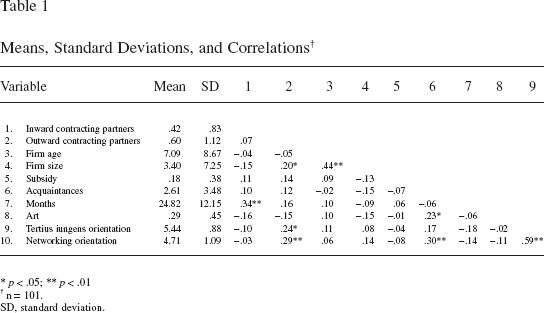
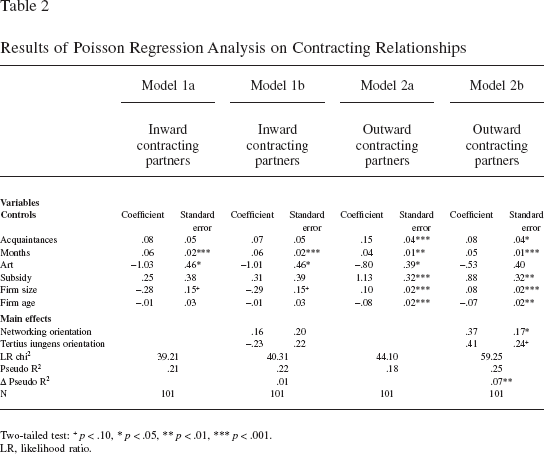
Table 1 shows the descriptive statistics and correlations, and Table 2 shows the results of the Poisson regression. With respect to the control variables in model 1a or the inward contracting partners model (pseudo R2 = .21), I found a positive and significant relationship between the variable months (β = .06, p < .001), which represents the number of months a firm has been in the incubator and the number of firms in the incubator from which it received paid business assignments over the previous year. In addition, entrepreneurs that can be classified as belonging to the art category—one of the three main categories in the creative industries that we identify—have significantly fewer ties to other firms within the incubator in terms of paid business contracts they receive (β = −1.03, p < .05). In addition, I found a marginally significant and negative relationship between firm size (β = −.28, p < .10) and inward contracting partners.
Means, Standard Deviations, and Correlations †
p < .05
p < .01
n = 101.
SD, standard deviation.
Results of Poisson Regression Analysis on Contracting Relationships
Two–tailed test:
p < .10
p < .05
p < .01
p < .001.
LR, likelihood ratio.
In model 2a, or the outward contracting partners model (pseudo R2 = .18), I found positive and significant effects with respect to the number of acquaintances (β = .15, p < .001) an entrepreneur has at the time of entry into the incubator, the number of months (β = .04, p < .01) an entrepreneur has been located in the incubator, the fact that an entrepreneur received a rent subsidy (β = 1.13, p < .001) from the government, and firm size (β = .10, p < .001) on the number of partners within the incubator to which a firm has given paid business contracts. In addition, I found a negative relationship between firm age (β = −.08, p < .001) and outward contracting partners. This last finding is an indication that incubators in terms of their function of internal factor markets are more valuable for very new ventures.
In the next step, I included the main variables linked to the four hypotheses. Model 1b provides no support for hypothesis 1: that there is a positive relationship between networking orientation and the number of firms from which an entrepreneur receives paid business contracts. Although the sign of the coefficient for networking orientation is positive, it is not statistically significant. Model 2b, on the other hand, shows that networking orientation does have a significant and positive effect (β = .37, p < .05) on the number of outward contracting partners a focal entrepreneur has among the others firms located in the same incubator. This supports hypothesis 2. This coefficient can be interpreted as a semielasticity. Scoring one point higher on the 1–7 network orientation scale is associated with a 37% increase in the number of outward contracting partners. Or alternatively, as an average marginal effect: scoring one point higher is associated with .37 × .60 = .22 additional outward contracting partners.
With respect to inward contracting partners, model 1b does not support hypothesis 3. This means that I found no statistically significant relationship between TIO and the number of contracting partners an entrepreneur receives business contracts from. Interestingly enough, although it is insignificant, it is worth noting that the sign is actually negative and in the opposite direction. Model 2b, however, does provide support for hypothesis 4. There is indeed a positive and marginally significant relationship between TIO (β = .41, p < .1) and the number of outward contracting partners. This coefficient can be interpreted as a semielasticity: scoring one point higher on the 1–7 TIO scale is associated with a 41% increase in the number of outward contracting partners. Or alternatively as an average marginal effect: scoring one point higher is associated with .41 × .60 = .25 additional outward contracting partners. Model 2b, which includes the main effects networking orientation and TIO, explains significantly more variance than the control model (Δ pseudo R2 = .07, p < .01).
Robustness Checks
I conducted a number of robustness checks. 3 First of all, I performed a variance inflation factor test to see whether multicollinearity could pose a problem. The mean variance inflation factor is 1.30 (highest 1.62) and therefore does not indicate a multicollinearity problem. I also ran a number of alternative models that included other variables that may possibly affect the results, but these variables turned out to be insignificant.
Second, I ran four regressions in which I left out either networking or TIO orientation in the inward and the outward contracting models to check for simultaneous effects. This did not affect the sign or significance of the main parameters.
Third, I included a dummy that identified whether the person that completed the questionnaire is either the owner or founder to make sure that the questionnaire is completed by the person that is assumed to be involved in, and aware of, the decisions taken at the firm level. This was the case for 88% of the questionnaires. This dummy was not significant in any model and therefore dropped from the analysis.
Fourth, I included three dummies to identify the four different incubators. The management of these incubators agreed to participate in this study under the condition that in the analysis I would not disclose any outcomes at the level of the individual incubators. I did, however, run the analysis with three dummies to test whether the results differed for any of these four incubators. None of these dummies were significant. This is also an indication that the findings may be generalizable to other incubators in the creative industries.
Fifth, I tested two models in which I transformed the dependent variables from count variables indicating the total number of contracting partners, into dummy variables indicating whether or not entrepreneurs have any number of contractual relationships with other tenants in the incubator. I performed a logarithmic regression and found that although the effect sizes differ and the level of significance dropped, the directions of the signs remain the same with respect to all the main variables. The fact that some results became insignificant could be the result of less variance in the dependent variable, possibly in combination with the already low statistical power due to a relatively small dataset. I believe, however, that logistic regression is not appropriate since discarding information about the actual number of contracting partners means that it cannot provide insights related to the hypotheses that deal with the actual number of contracting relations.
Sixth, I tested additional models that included interaction effects between the control variables months and networking orientation, months and TIO, and the two main variables of networking orientation and TIO. I included interactions with the control variable months to check whether the relationship between networking behavior and contracting relationships is moderated by how long an entrepreneur is based in the incubator. Including interactions between the two main variables allowed me to check if there are combined effects of networking orientation and TIO. None of these interactions were significant.
Seventh, I fitted a model in which I estimated the effect of networking orientation, TIO, inward contracting partners, and outward contracting partners on individual firm performance. I used two different performance measures as dependent variables: absolute annual turnover and relative turnover operationalized as annual turnover divided by the number of FTEs. Because of their nonnormal distributions, I performed a log transformation of the variable absolute annual turnover and a square root transformation of the variable relative turnover. Due to missing data, this regression was performed on 87 cases and, therefore, should be interpreted with care. None of the four independent variables were significant in any of the models.
Finally, since the networking orientation and the TIO scales have a correlation of .59, I performed a confirmatory factor analysis (CFA) to test whether a two–factor model is better than a one–factor model. I performed this CFA using AMOS 19.0 software (Arbuckle, 2010). In evaluating the fit of each of the tested models, I used the following indices: (1) chi–square goodness of fit to degrees of freedom ratio (CMIN/DF); (2) the comparative fit index (CFI); and (3) the root mean square error of approximation (RMSEA) (Steiger, 1990). Previous scholars suggest that a satisfactory model fit is indicated by a CMIN/DF lower than 2, RMSEA values lower than .08, and CFI values larger than .90 (Bentler, 1990; Brown, Cober, Kane, Levy, & Shalhoop, 2006) or .95 (Hu & Bentler, 1999). The results showed that the two–factor model (CMIN/DF = 1.363, p = .168; CFI = .986; RMSEA = .06) is a better fit than the one–factor model (CMIN/DF = 2.433, p = .002; CFI = .939; RMSEA = .12).
Discussion
In this paper, I studied the relationship between networking behavior of entrepreneurs and the number of contractual ties—in terms of receiving and giving business assignments—they have with other entrepreneurs. I made a distinction between two types of networking behavior: individual networking orientation and TIO. Individuals that score high on networking orientation tend to actively build informal social ties from which they hope, and/or expect, to professionally benefit in the future. Individuals that score high on TIO tend to actively facilitate collaboration between connected or previously disconnected others, when they believe these individuals might benefit from one another (Obstfeld, 2005). I studied these phenomena in the empirical setting of business incubators. I found that individuals that score high on networking behavior, both in terms of networking orientation and TIO, have more outward contracting relationships with other entrepreneurs in terms of providing them with business assignments. On the other hand, I found no relationship between networking orientation or TIO and the number of business assignments that entrepreneurs receive from other entrepreneurs within the incubator.
A surprising finding of this study is that, contrary to expectations, I found no significant relationship between networking behavior, either in terms of individual networking orientation or TIO, and the number of business contracts a focal entrepreneur receives from other entrepreneurs. Since past studies show that networks are important in providing actors with access to crucial resources and opportunities (Brass et al., 2004; Granovetter, 1973), one would expect that networking behavior and the resultant weak ties with other entrepreneurs will eventually lead to stronger ties in terms of formal business relationships from which entrepreneurs receive valuable business contracts. Although future research is needed to explain this surprising finding, past studies provide some guidance in identifying potential mechanisms.
First of all, it might be that entrepreneurs that score high on networking behavior are proactive individuals who themselves take the initiative to set up collaborations when they identify opportunities, instead of passively waiting for potential partners to take the lead (Sarkar et al., 2001). Second, it could be the result of restricting the current study to networking and contracting behavior among entrepreneurs within the boundaries of the business incubator in which they are located. It might be that entrepreneurs that score high on both types of networking behavior do receive more contracts from business partners but receive them from entrepreneurs outside—as opposed to inside—the incubator. In turn, receiving these assignments from outside the incubator would allow them to contract parts of these assignments to other entrepreneurs in the incubator. Finally, it could be that entrepreneurs scoring high on networking behavior are not suppliers of specialized inputs, but suppliers of products further down the value chain, the buyers of which are either larger firms or end consumers that are not located in the business incubator. As such, these entrepreneurs might be sourcing specialized inputs from their professional network in a similar fashion as producers in the project–based film industry (Ebbers & Wijnberg, 2009).
This study has a number of contributions. First of all, it adds to existing research on social networks in general and in the field of entrepreneurship in specific, by showing that individual networking behavior is positively related with tie formation. A number of scholars have noted that most studies on social networks treat network ties or positions as independent variables (Hoang & Antoncic, 2003; Slotte–Kock & Coviello, 2010) to explain various kinds of performance, while ignoring the actual mechanisms through which these ties or positions emerge (Stuart & Sorenson, 2007). On the contrary, I focus on tie formation as the dependent variable. The finding that individual networking behavior is positively related with tie formation—in the form of contractual relationships with other entrepreneurs—could be an important indication that networking behavior, which leads to weak ties, could, in turn, evolve into strong ties between entrepreneurs in terms of actual contractual relationships.
Second, I show the value of the TIO construct for research on entrepreneurship. Most studies disregard the situation in which entrepreneurs that identify opportunities they cannot easily exploit themselves, besides ignoring it, have the option of sharing this information with those in their network who are in a better position to do so. Whereas Obstfeld (2005) originally applied TIO to an intrafirm setting to predict employee involvement in innovation, in this paper I applied TIO to an interfirm setting as a predictor of contractual tie formation among entrepreneurs. Although in the intrafirm setting the organization will ultimately benefit from TIO of its employees since it can ultimately capture the rents of innovation, in the interfirm setting there is no guarantee that entrepreneurs will benefit from this apparently selfless behavior. In this study, however, I show that entrepreneurs that score high on TIO do seem to benefit from this altruistic bridging behavior by having more partners in their network to which they can contract (parts of) business assignments. This finding suggests that entrepreneurs that score high on TIO tend to have more social capital and are better able to mobilize resources from their social networks (Nahapiet & Ghoshal, 1998).
Third, this study also contributes to theory on alliance entrepreneurship. Previous research highlights the positive effect of alliance proactiveness, defined as the degree in which organizations identify and respond to partnering opportunities, on a firm's market performance (Sarkar et al., 2001). I build on this previous study by showing that entrepreneurs that spend more time on networking activities are more likely to identify potential alliance partners. In addition, I extend these earlier findings by showing that entrepreneurs that score high on TIO and actively facilitate alliance formation between other firms are also more likely to forge alliances themselves. It could be that entrepreneurs that spot alliance opportunities between other entrepreneurs, and actively share this information with one or both potential alliance partners, are benefiting from bridging reciprocity, in a similar fashion as employees in intrafirm settings as suggested by Obstfeld (2005). In other words, prospective or new alliance partners that benefited from selfless brokering behavior by entrepreneurs could be returning the favor by connecting them to potentially valuable alliance partners in their own network. However, more research is needed to find further support for this idea.
The fifth contribution is to incubator research. A number of studies show how business incubator managers can, and should, facilitate and actively foster networks of entrepreneurs located in business incubators (Hansen et al., 2000; Tötterman & Sten, 2005). However, ties between incubated entrepreneurs and incubator management are found to be infrequent (Honig & Karlsson, 2007), and TIO behavior by incubator management, in which they try to link their incubated entrepreneurs with potential business partners or resource providers outside the incubator, often do not lead to successful collaboration (Rice, 2002). However, even in the absence of top–down facilitation by incubator managers, colocation in incubators still leads to collaboration (Bøllingtoft, 2012). In this study, I found that networking behavior is an important antecedent for the emergence of this internal factor market. More specifically, I show that networking behavior does not have an effect on receiving business assignments, but does have an effect on giving them to other entrepreneurs. The internal factor market of the incubator, in other words, may give these entrepreneurs access to (complementary) resources of colocated entrepreneurs, allowing them to take on larger projects that they would otherwise not have been able to handle on their own.
In addition, there are a number of practical implications of the findings. First, since incubators are often dependent on start–up or operating subsidies by (local) governments, better insights into the performance of entrepreneurs that are located in incubators will help incubator managers to legitimize their efforts (Erlewine, 2007). The finding of this study that there indeed is collaboration between entrepreneurs, in terms of actual contractual relationships, provides additional evidence that there are positive spillover effects from being colocated. Second, since success at the level of the incubator depends on a minimum degree of altruism and collectivism (Bøllingtoft & Ulhoi, 2005), centrally managed or self–organized incubators (Bøllingtoft, 2012) might want to select tenants based on the degree to which they tend to engage in TIO that could result in cross–fertilization. Third, my findings show that entrepreneurs that actively engage in networking behavior should expect to benefit not in the sense of passively receiving business contracts from other incubated entrepreneurs, but from actively identifying potential partners with whom they could form alliances or subcontract parts of larger projects that allow them to take on larger projects. This is a relatively low–risk growth strategy since, in addition to the low risk of opportunistic behavior by fellow incubated entrepreneurs, it does not require entrepreneurs to directly hire new employees.
Finally, this study has a number of limitations that also provide opportunities for future research. First, although this study shows a relationship between networking and contracting behavior, it does not focus on the actual motivation behind this networking behavior, especially with respect to TIO. More research is needed on the actual motivations that play a role in this apparently “selfless” networking behavior. Second, this study focused on entrepreneurs in incubators. Studying contracting relationships among—especially new—entrepreneurs outside incubators could improve the generalizability of the findings. Third, future studies could include structural network characteristics, such as centrality, as independent variables. The response rate of the current study was too small to derive meaningful structural network variables from the data. Fourth, future studies could focus on the effect of physical proximity (Reagans, 2011), and similarity (McPherson, Smith–Lovin, & Cook, 2001), between entrepreneurs in terms of their business activities, size, and experience on the formation of ties. Fifth, in the setting of incubators, it might be interesting to study how TIO at the level of individual entrepreneurs is related to performance at the aggregate level of the incubator since incubators are set up partly under the assumption of positive spillover effects among incubated entrepreneurs. Finally, one could study the optimal level of similarity or diversity among incubated entrepreneurs since this might explain the variance in the degree of contractual relationships that is found among incubatees (Tötterman & Sten, 2005).
Conclusion
This study shows that networking behavior is positively related with the number of partners to which entrepreneurs contract (parts of) business assignments. I distinguish between two types of networking behavior: an individual networking orientation that aims to build potentially valuable ties for personal gain, and a TIO that is a tendency of actors to facilitate tie formation between other actors in their network, when they believe they may benefit from each other. In the empirical setting of new entrepreneurial start–ups in business incubators, I find that both types of networking behavior are positively related to the number of partners to which entrepreneurs give business assignments. Even though entrepreneurs do not seem to benefit from TIO directly, the findings do suggest that these entrepreneurs benefit from having more knowledge of potential business partners in close proximity in their business network, which can provide complementary or specialized resources.
Footnotes
Appendix
1.
I deleted these two questionnaires since this study is concerned with networking and contracting behavior among actual entrepreneurs in the incubator. I deleted the incubator management because it is not an incubated firm. I deleted the manager of the restaurant because this type of exchange relationship amounts to selling food and drinks to individuals for consumption instead of forming actual collaborative ties on factor markets.
2.
Eligibility checks for rent subsidies are performed by the Commissie Ateliers en (Woon)Werkpanden Amsterdam policy. This subsidy is meant for artists that can prove that they are professionally active as an artist, do not earn more than € 35.850 indexed on 1–1–2007, and are tied to the region of the city of Amsterdam (Gemeente Amsterdam, 2007).
2.
More detailed results of the robustness checks are available upon request.