







Abstract
Using resource–based logic, we integrate and extend theory and research on familiness and innovation in family firms. Supporting our efforts to do this is the suggestion that recent mixed results regarding the ability of family firms to innovate are at least partially accounted for by the failure to fully consider the importance of resource bundling processes as a mediator of the relationship between familiness as a unique organizational resource and innovation. Specifically, we suggest that the individual components of the resource bundling process—stabilizing, enriching, and pioneering—each mediate the relationship between familiness and innovation, and that these mediation effects account for at least part of the previously reported inconsistent results. Using theory and by integrating insights about familiness, innovation, and resource bundling, we seek to provide a more complete model of conditions affecting family firms’ ability to innovate.
Introduction
Innovation is a central driver of a firm's ability to develop competitive advantages (Greve, 2009) and ultimately, of its overall competitiveness (Galunic & Rodan, 1998) and survivability (Carrasco–Hernandez & Jimenez–Jimenez, 2012). However, designing and employing a successful innovation process remains challenging for many firms including family firms (Chirico, Ireland, & Sirmon, 2011; Craig & Moores, 2006). With respect to family firms specifically, the extant findings addressing relationships between family firms and innovation are inconclusive and inconsistent (De Massis, Frattini, & Lichtenthaler, 2013), making it difficult to identify an effective innovation process for use in these firms.
Work has been completed to study innovation in family firms. Resulting from these studies is a reasonably consistent finding suggesting that family firms tend to allocate fewer resources to innovation–based inputs such as research and development (R&D) compared with nonfamily firms (Chen & Hsu, 2009). Overall, however, considerable debate remains regarding the quality and quantity of innovation outputs such as patents and new products and services that family firms generate from using and managing the resources it allocates to innovation (e.g., Block, 2012; Chin, Chen, Kleinman, & Lee, 2009; Gudmundson, Tower, & Hartman, 2003).
Other studies are being completed with an expanded scope of activities to examine various parts (e.g., inputs, activities and/or processes, and outputs) of the innovation process (De Massis et al., 2013). The results from these efforts are intriguing. For example, Hsu and Chang (2011) found that family ownership is positively associated with the use of strategic behavioral controls; in turn, using these controls is positively related to the use of long–term strategic criteria when deciding how to allocate a firm's resources. In general, use of long–term strategic criteria results in decisions supporting innovation. Craig and Dibrell (2006) discovered that family involvement leads to more flexible decision–making processes and structures. Flexibility is important to innovation efforts in that shifting foci and methods is commonly necessary to respond successfully to changes in external and internal conditions that a firm encounters when pursuing innovation. Finally, a position taken recently is that possessing and appropriately managing resources are critical to innovation success in family firms (Chirico, Sirmon, & Ireland, 2013).
As a whole, the extant literature and the results reported in it appear to suggest that family firms and nonfamily firms differ with respect to several aspects of the innovation process, and the allocation and management of resources that are associated with that process. Still, additional work is necessary for us to enhance our understanding of conditions and factors that have positive or negative effects on actions taken in family firms to reach outcomes that are associated with competitive success such as adopting discontinuous technologies and innovating (Konig, Kammerlander, & Enders, 2013).
Innovation within family firms is the focus of the work reported herein. Relying on and drawing from resource–based theory, we concentrate on a resource—familiness (Chrisman, Chua, & Steier, 2005; Habbershon & Williams, 1999; Sirmon & Hitt, 2003)—that is unique to family firms. As Carrasco–Hernandez and Jimenez–Jimenez (2012, p. 32) note, familiness is “… determined by the family power, experience and culture.” Other terms are used somewhat interchangeably to capture familiness such as family involvement (Carrasco–Hernandez & Jimenez–Jimenez). More comprehensively, Konig et al. (2013) suggests that although not identical in their meaning, family involvement, family influence, family control, and familiness are terms that researchers employ to describe the essence of a family business. Because familiness results from interactions among individuals, a family, and a firm over time (Chrisman, Chua, & Steier, 2003) and because these interactions culminate in an intangible, unique resource, we chose to use this term for the purpose of framing our arguments.
Alvarez and Busenitz (2001) and Arthurs and Busenitz (2006) suggest that resource–based theory is becoming of increasing importance to efforts to understand entrepreneurship as well as what are commonly thought of as entrepreneurial outcomes such as innovation. The essence of resource–based logic is that firms differ in their resource endowments and that this resource heterogeneity matters and has the potential to affect firm performance (Barney, 1991). Within the context of resource–based theory, our argument is that as an idiosyncratic bundle of resources that results from continuous family involvement in a firm (Habbershon & Williams, 1999), familiness provides a unique and causally ambiguous resource. As a distinctive bundle of intangible assets, we believe that familiness has the potential to affect a family firm's efforts to innovate. We consider this possibility by developing theoretical arguments regarding how the relationship between familiness as a unique family firm resource and innovation is mediated by the three resource bundling processes of stabilizing, enriching, and pioneering (Sirmon, Hitt, & Ireland, 2007).
Thus, stated formally, our research question is, “How does familiness influence the use of the resource bundling process in family firms, and, in turn, how does that process influence innovation in those firms?” As noted, we use resource–based theory to suggest that the subprocesses of the overarching resource bundling process—stabilizing, enriching, and pioneering—each have unique mediation effects on the link between familiness and innovation. We believe that examining these unique mediating relationships has the potential to facilitate our understanding of the conflicting findings in the extant literature regarding family firms and innovation. We depict our arguments in Figure 1.
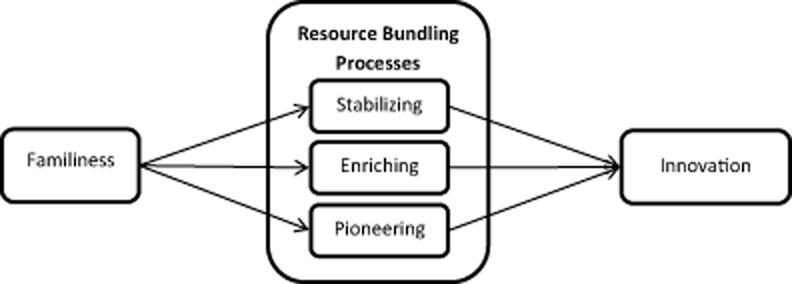
The Mediating Effects of Resource Bundling Processes on the Relationship Between Familiness and Innovation
In developing our model, several implications emerge. First, we develop a theoretical model for better understanding the mechanisms through which family involvement can influence firm outcomes. This helps us better reconcile previous conflicting findings regarding various resources that are unique to family firms (e.g., familiness) and outcomes such as innovation. In other words, by understanding how familiness influences the resource bundling process and, in turn, how these processes influence innovation, we can better understand why some family firms innovate much more successfully than their competitors, family and nonfamily alike. Second, we extend recent work in resource management by focusing on how the transformative bundling process directly impacts innovation as a different firm outcome, thus shifting the focus upstream in a firm's value creation from performance to innovation. Third, this model has significant implications for managers. Previously, work dealing with family firms and innovation was largely devoid of concrete actions and processes that managers could engage in to increase innovation as a desired outcome. Explicating how the resource bundling processes of stabilizing, enriching, and pioneering affect the link between familiness and innovation provides managers/entrepreneurs with specific activities that they can use to increase innovation in their family firms.
After introducing and briefly considering innovation, familiness, and the resource bundling process as it relates to family firms, we build theoretical arguments about the specific mediation relationship of each resource bundling process between familiness and innovation. We close with a discussion about potential scholarly extensions to this work including possibilities associated with structuring and leveraging as additional resource management processes.
Theoretical Framework
Innovation
Innovation is concerned with generating, accepting, and implementing new ideas, processes, products, or services (Thompson, 1965) that are the means through which a firm serves new market needs. Although noted earlier, it is worth stating again that innovation is linked to a number of positive organizational outcomes including success, survival, and renewal (Brown & Eisenhardt, 1995; Danneels, 2002). With a focus on commercialization, innovation is a process used to create and capture value as a foundation for generating wealth from an invention (Hitt, Ireland, & Hoskisson, 2013). There are two primary types of innovation: (1) systematic incremental updates to current products and (2) radical, disruptive changes, often with a technological base, with the potential to develop new products and services, and possibly to shift entire industries as a result of an innovation's functionality.
In general, incremental innovations facilitate a firm's efforts to exploit the benefits associated with implementing a current strategy, largely by emphasizing existing competitive advantages. In contrast, radical innovation and the new products associated with it is a function of a firm's efforts to explore new possibilities in terms of potentially developing new competitive advantages and strategies (Dunlap–Hinkler, Kotabe, & Mudambi, 2010). The arguments we develop within the context of the relationships shown in Figure 1 apply to family firms’ efforts to engage in both incremental and radical innovation. For the most part though, the arguments we construct deal with family firms’ efforts to develop radical rather than incremental innovation. The extant evidence is too coarse grained to permit the taking of absolute or definitive positions about the relationships shown in Figure 1 and incremental versus radical innovation. In our view, future research could be completed to develop arguments about the unique influence of factors and relationships on the two types of innovation.
Innovation remains a topic of interest to those seeking to identify factors explaining differentials in firm performance, including those observed within family firms (De Massis et al., 2013). Previously, Blundell, Griffiths, and Van Reenen (2005) found that innovation success, particularly with technology–based innovations, sustains superior firm performance while Geroski, Machin, and Van Reenen (1993) report that innovation contributes to a firm's ability to outperform its competitors.
Considering the effects of innovation on firm performance, scholars interested in family firms have devoted increased attention to this topic over the past few decades (De Massis et al., 2013). Integrating this prior work in a review paper, De Massis et al. (2013) report their conclusion that the extant evidence does not reveal a clear overall relationship between “family” (here we consider family broadly to include the often overlapping sets of activities and orientations associated with family involvement, family control, and familiness) and innovation. However, as noted previously, this evidence is not conclusive in that some work suggests a negative relationship between family firms’ efforts to innovate and the innovation output they achieve as a result of doing so, while others find a positive relationship. For example, Block (2012) finds that family ownership in large public U.S. firms in research–intensive industries is negatively related with the level of R&D intensity, while Chin et al. (2009) argue and find that tight control characterizing the ownership structure of family firms reduces the quality and quantity of patents received in a sample of Taiwanese electronics companies. Alternatively, Gudmundson et al. (2003) find that family ownership is positively associated with the introduction of new products and services.
To begin disentangling the conflicting results identified through their work, De Massis et al. (2013, p. 2) focus on the technological innovation process, which they define as “the set of activities through which a firm conceives, designs, manufactures, and introduces a new product, technology, system, or technique.” Thus, technological innovation captures the totality of innovation in the form of inputs (e.g., R&D investments), activities (e.g., search behaviors and decision processes), and outputs (e.g., patents and new goods or services). Using this conceptualization of innovation as a three–stage process for the purpose of categorizing the extant results yields greater consistency in the overall findings regarding innovation in family firms.
Specifically, there is evidence that family firms allocate fewer resources for the purpose of investing in R&D as compared with nonfamily firms (De Massis et al., 2013). Grounded in agency conflict and low–risk propensity arguments, Chen and Hsu (2009) find that family involvement is negatively related to the level of R&D investments while as noted above, Block (2012) finds that family ownership is negatively associated with the level of R&D intensity in U.S. public firms in research–intensive industries. These findings are further supported by the results of a recent study using behavioral agency theory and myopic loss aversion. In this work, Chrisman and Patel (2012) found that family firms usually invest less in R&D than nonfamily firms and that the variability of family firm investments is greater when performance is above expectations. All of this evidence is consistent with the position that distinctive characteristics of family firms, such as structure, goals, governance, and culture, affect R&D investments in family firms (Munoz–Bullon & Sanchez–Bueno, 2011).
While the consistency of findings between family involvement and innovation inputs is strong, conflicting findings arise when the effects of family involvement or familiness on innovation outputs are considered. Specifically, some studies continue to show a negative relationship between family involvement and innovation outputs such as the quantity and quality of patents (Chin et al., 2009; Czarnitziki & Kraft, 2009). However, other results show that family firms are better able to introduce new products and services (Gudmundson et al., 2003) and are better able to manage a broader range of product and service innovations (Westhead, 1997) as compared with nonfamily firms. Also, research suggests that family firms are overall more innovative than nonfamily firms due to the unique human, social, and marketing capital (e.g., a set of familiness resources) held by family firms (Nordqvist & Merlin, 2010).
In an attempt to help resolve these conflicting findings, De Massis et al. (2013) also consider studies that examine the activities occurring in the development of innovation such as search processes and decision processes. While the research in this area is still early in its development and broadly dispersed, findings generally suggest that family firms have some benefits in terms of efforts to innovate due to the use of strategic behavioral controls (Hsu & Chang, 2011) and more flexible decision making (Craig & Dibrell, 2006). These two conditions enable family firms to pursue longer–term goals (which often include innovation) compared with focusing on taking primarily short–term actions (which typically are less oriented to developing innovations and certainly radical innovations).
Recent work by Konig et al. (2013) suggests that family influence has conflicting effects on the adoption of discontinuous innovations by incumbent firms. Specifically, these authors argue that family influence is a limitation in situations that require fast recognition, aggressive adoption, and flexible implementation routines of discontinuous technologies due to the strong desire for continuity and consistency in family firms. However, once decisions to adopt have been made (albeit normally more slowly), family influence can provide strong benefits in the ability to implement adoption decisions faster and to sustain investments over a long period.
Viewed collectively, these results suggest that innovation within family firms is a complex task and that our understanding of these tasks and the processes associated with them remains incomplete. This notion also echoes the recent findings of a meta–analysis of family firms and performance, with the authors noting that overall, the empirical evidence is inconclusive (O'Boyle, Pollack, & Rutherford, 2012). Because of this, the authors call for greater, fine–grained theory building. In an attempt to further develop work along these lines, we suggest that familiness and resource bundling processes play an important role in family firms’ efforts to innovate.
Familiness and Resource Bundling
To enhance our understanding of the differences between family firms and nonfamily firms, scholars have identified several unique resources in family firms that are broadly referred to as the “familiness” of the firm (Cabrera–Suarez, De Saa–Perez, & Garcia–Almeida, 2001; Habbershon & Williams, 1999). Human capital, social capital, financial capital, and patient capital are examples of what can be unique resources for family firms (Pearson, Carr, & Shaw, 2008; Sirmon & Hitt, 2003). Habbershon, Williams, and MacMillan (2003) define familiness as the set of resources controlled by a firm resulting from a continuous overlap of a family system with the business system in a firm. Full specification of the familiness construct remains an active area of research (Pearson et al.). For our purposes though, familiness can be viewed as a continuous concept ranging from firms with very high family involvement having a strong familiness resource set (i.e., many unique family firm resources) to firms with no family involvement and thus having no familiness resources. Characterizing familiness as continuous in nature rather than strictly as a dichotomy between family and nonfamily captures the variability of familiness as a resource across family firms (Habbershon et al.). Furthermore, this characterization helps capture the overall unique essence of family firms in line with other researchers who have employed similar concepts of family involvement, family influence, and family control (Konig et al., 2013).
As a resource, familiness yields both advantages and disadvantages for family firms. Habbershon et al. (2003) label these as distinctive and constrictive familiness, respectively. Herein, we are broadly focused on the benefits familiness as a unique resource provides with respect to innovation, primarily radical innovation; thus, the focus of our paper is on distinctive familiness. However, we do briefly consider how the disadvantages of constrictive familiness influence innovation through the pioneering bundling process.
Familiness is an important part of a family firm's resource portfolio; however, from recent extensions to the resource–based theory, we know that resources owned or controlled do not directly produce firm outcomes. Indeed, resources must be managed in order for their value–creating potential to be reached (Chirico et al., 2013; Sirmon et al., 2007). Building from this logic, resource management has emerged to emphasize managerial actions with a focus on structuring the resource portfolio, bundling resources into capabilities, and leveraging the capabilities in marketplace competitions (Sirmon et al.; Sirmon, Hitt, Ireland, & Gilbert, 2011).
As is the case with the other two resource management processes, resource bundling is an important process that managers undertake to effectively manage a firm's resources. This process is concerned with how resources are recombined and transformed within a firm for the purpose of creating capabilities. In turn, firms rely on capabilities to perform tasks that are linked with achieving outcomes such as innovation, the focal concern in our work. Managers bundle resources with the hopes of maximizing their ability to create value (Sirmon, Gove, & Hitt, 2008).
Stabilizing, enriching, and pioneering are the three subprocesses of resource bundling. Stabilizing involves the activities required to maintain a current strategy or competitive advantage (Sirmon et al., 2007). This process focuses on making minor, incremental improvements in existing capabilities in order to sustain a firm's current capabilities proficiency. For example, requiring employees to participate in a certain number of training hours in order to keep knowledge and skills up to date is a stabilizing action.
Enriching goes beyond maintenance by extending and elaborating on a firm's current capabilities (Sirmon et al., 2007). This process is focused on recombining current resources such as knowledge and skills in order to create learning and extensions of a firm's capabilities. Creating new relationships within a current alliance to capture greater knowledge is an example of enriching actions.
Pioneering is focused on developing or creating entirely new capabilities. This process goes beyond extending current capabilities by focusing on the integration of new resources into the firm and recombining seemingly unrelated resources in novel ways. For example, SmithKline acquired Beckman instruments to gain access to its diagnostic technology capabilities. Due to the lack of obvious overlap, this acquisition was generally criticized by analysts; however, evidence suggests that because SmithKline was focused on recombining Beckman's diagnostic technologies capabilities with its drug research capabilities, the firm was able to create new capabilities in biomedical research (Sirmon et al., 2007).
Although the resource bundling process has received limited empirical attention in the literature, some evidence suggests that it influences firm–level outcomes directly by transforming resources internally. Specifically, Sirmon, Gove, et al. (2008) found that effective bundling of resources was vital for realization of a competitive advantage especially as competitive parity in resources was approached. Using a sample of major league baseball teams, the authors found support for the argument along with identifying some contingencies to the bundling and deployment of resources for competitive advantage. Additionally, Tzabbar, Aharonson, Amburgey, and Al–Laham (2008) explored the bundling of knowledge stocks to achieve innovation. They argue and find that the impact of any single knowledge stock (resource) is interdependent with other resources available within a firm and that the firm's knowledge of the different resources available internally helps to explain differences in innovation performance.
Coupling this work on resource bundling with work on familiness, we suggest that bundling consists of the processes used to transform familiness resources into firm–level outcomes, such as innovation. Specifically, bundling processes focus on recombining and transforming resources internally within a firm in ways that facilitate a firm's efforts to develop causally ambiguous innovations (Dierickx & Cool, 1989).
For several reasons, resource bundling processes are critical to a family firm's efforts to innovate, particularly when familiness is high. In general, developing innovation requires novel thinking and creative combinations of resources (Bradley, McMullen, Artz, & Simiyu, 2012). However, enhanced concerns for survivability and socioemotional wealth and a resulting preference for the status quo typically accompany higher degrees of familiness (Gomez–Mejia, Cruz, Berrone, & De Castro, 2011; Gomez–Mejia, Haynes, Nunez–Nickel, Jacobson, & Moyano–Fuentes, 2007). To counteract the likelihood that resources would be bundled in ways that promote and support existing competitive advantages and strategies in these instances, managers bundling resources in these cases are challenged to seek out novel and creative combinations of resources as a foundation for stimulating efforts to innovate. Additionally, bundling resources to create capabilities that lead to innovation is typically thought to require significant investments in R&D as well as in different and potentially unique technologies (Carney, 2005; Carrasco–Hernandez & Jimenez–Jimenez, 2012). But, Block (2012), Chen and Hsu (2009), and Chrisman and Patel (2012) all report some evidence indicating that family influence (or familiness in our framework) is negatively related to investments in R&D. As a result, managers bundling resources in family firms with low and perhaps insufficient allocations to R&D may search for ways to uniquely bundle resources as a means of mitigating the negative effects on innovation that accrue because of lower investments in R&D. However, as explained below, theory and the extant literature indicate that resources are not always bundled in family firms in ways that strongly support innovation. Thus, familiness affects the resource bundling process in family firms while how resources are bundled affects innovation as an outcome for these firms.
In the following section, we explore the mediation effect of each resource bundling process on the link between familiness and innovation.
Mediating Influences on the Link between Familiness and Innovation
Stabilizing
Organizational success is a function of multiple factors including the ability to both exploit and explore. Resources are allocated and used differently for the purpose of exploiting compared with how they are allocated and used to explore (Coombs, Deeds, & Ireland, 2009). Typically, exploitation is concerned with old certainties while new possibilities are exploration's focus. Efficiency, execution, and refinement are activities associated with exploitation whereas search, risk taking, and experimentation are exploration–oriented activities (March, 1991). Firms must balance the allocation and use of resources between these sets of activities in that too much exploration generates costs without gaining the benefits of experimentation. In contrast, too much exploitation can find a firm trapped in a suboptimal competitive position (March).
The stabilizing bundling process is focused on the maintenance and continued proficiency of current capabilities and strategies (Sirmon et al., 2007). The intent of stabilizing activities is often to maintain a current competitive advantage. The engagement of required training hours for employees, updating current software with released improvements, and maintenance of physical capital are all examples of stabilizing activities. As such, exploitation is the primary concern as firms engage in the stabilizing bundling process.
Firms characterized by a high degree of familiness demonstrate a stronger desire for continuity as compared with nonfamily firms and family firms with lower levels of familiness. Desires to transfer ownership of the family firm to the next generation (Miller, Le Breton–Miller, & Lester, 2010) and to retain wealth in or for the family (Gomez–Mejia et al., 2007) are indicators of continuity. In turn, a strong interest in and commitment to continuity in family firms (as shown by a high degree of familiness) results in a focus on maintaining and continuing to use existing and perhaps even previous strategies (and the exploitation activities through which they are implemented). This commitment, which is based largely on a family's shared history (Gomez–Mejia et al.), enhances a firm's desire to maintain and update current strategies to hopefully ensure their viability in the future. Thus, stabilizing activities are a predominant focus for firms with high familiness in order to maintain the proficiency and competitiveness of current strategies. In a similar vein, firms with high familiness value stability (Gomez–Mejia et al.). Stabilizing actions are focused on maintaining resources needed to support the firm's current capabilities as a path through which its current strategies are implemented.
Furthermore, high familiness often results in more rigid mental models in family firms (Konig et al., 2013). Specifically, long tenures of family managers create a form of tunnel vision that reinforces a commitment to the status quo (Gomez–Mejia, Nunez–Nickel, & Gutierrez, 2001). Possibly driven by a desire for maintaining socioemotional wealth, family firms with high familiness may even refuse to adopt a business system innovation (e.g., joining a local cooperative network) despite potential or even known financial gains (Gomez–Mejia et al., 2007). Together, these tendencies reinforce a family firm's desire to allocate resources for the purpose of exploiting historical benefits that have been generated by emphasizing existing competitive advantages while implementing current strategies.
Additionally, high familiness resulting from a complex and long social history as it has played out within a firm results in increased emotional ties to existing assets and organizational structures (Konig et al., 2013). Thus, despite the potential advantages of divesting current assets (Sirmon, Hitt, Arregle, & Campbell, 2010) in favor of adopting innovations, firms with high familiness often work to maintain the efficiency of current strategies rather than deciding to accept the risk of allocating resources outside of known patterns (Konig et al.).
Furthermore, firms with high familiness as a resource may be less willing to make significant internal or external changes associated with creating and adopting new innovations as there might be a risk of decreasing the family's socioemotional wealth (Gomez–Mejia et al., 2007). In other words, by changing internal or external systems through the adoption of new technologies, systems, organizations, or other innovations, there could be some reconfiguration of external social ties or internal power distributions—either of which may adversely affect the perceived socioemotional wealth of the family or the family's or firm's social capital (Arregle, Hitt, Sirmon, & Very, 2007). Thus, firms with high familiness may be further averse to creating and adopting innovations due to the unknown effects on socioemotional wealth despite potential or realized financial wealth. In this instance, the desire for old certainties is again preferred to the potential of new possibilities.
Also, high familiness often creates a deep firm–specific tacit knowledge base in both family and nonfamily employees (Sirmon & Hitt, 2003). The continual exposure and experience of firm activities embeds within employees the decisions, actions, and processes necessary to successfully engage in a current strategy. By previously knowing what and how to engage in these activities, familiness creates employees that have the innate knowledge of how to stabilize, maintain, and deploy current practices. In total, the evidence suggests that:
While the arguments above suggest that familiness and stabilizing are positively related, we believe that theory and existing evidence suggest that the impact of increased stabilizing due to high familiness on innovation is negative. As noted previously, innovation is concerned with developing new ideas, processes, products, or services with the potential to help the firm explore new possibilities. However, stabilizing does not yield the type of resource allocations and development of capabilities that are required to innovate through exploration. In contrast, stabilizing does facilitate and support a firm's efforts to maintain its current position by remaining “up to date” through incremental improvements or innovations with its existing products and processes. Thus, while stabilizing leads to incremental improvements, it negatively affects the exploration that is necessary to produce new ideas, processes, products, or services that are the foundation of innovation with the potential to significantly enhance a firm's performance, especially its future performance.
These relationships (between familiness and stabilizing, and between stabilizing and innovation) help us understand the complex link between familiness and innovation. Specifically, our arguments suggest that familiness increases the likelihood of concentrating on stabilizing when bundling resources with the intention of maintaining the firm's current strategy and competitive advantage(s). Moreover, greater familiness leads to a stronger focus on stabilizing. However, bundling resources for the purpose of focusing on known certainties negatively affects the firm's ability to develop innovations, especially radical innovations. Thus, the resulting mediation between familiness and innovation is complex because familiness enhances the use of the stabilizing process within a family firm while increased use of this process in turn decreases innovation. Stated formally, these arguments suggest that:
Enriching
The enriching process is focused on extending or elaborating a current capability (Sirmon et al., 2007). As a part of the total resource bundling process, enriching requires integrating and recombining existing resources in order to extend and improve the functionality of current capabilities. Due to the nature of the family and business systems overlap that creates familiness as a resource, and the accompanying complex and deeply tacit knowledge created by this overlap, familiness enhances the engagement of enriching activities within a firm.
Bundling resources for the purpose of supporting enriching activities finds firms seeking ways to integrate available resources. Integration is often a difficult and costly activity; but, to the extent that the familiness resource creates trust and a strong family bond in family firms, the governance costs of recombination are likely to be lower compared with the costs incurred in nonfamily firms (Sirmon & Hitt, 2003). While costs associated with enriching remain in family firms (Gomez–Mejia et al., 2001), these firms largely benefit from a centralization of ownership and control (Fama & Jensen, 1983), allowing for quick decisions and fast integration and reactions due to the presence of localized power and control (Konig et al., 2013). Specifically, a family firm with a high degree of familiness is characterized by the constant and continual interaction of family and business; this overlap may reduce the cost of governance in the form of incentive structures, monitoring actions, control systems, and organizational culture (Sirmon & Hitt). Thus, high familiness increases the efficiency of recombining and integrating activities that characterize the enriching process.
Enriching also involves recognizing current resource recombination opportunities. For a firm to extend its capabilities, it must change its resource combination mix to enhance current capabilities (Sirmon et al., 2011). High familiness is characterized by deep tacit knowledge among family members in a firm (Sirmon & Hitt, 2003). In turn, deep levels of tacit knowledge make it more likely that opportunities to recombine resources when bundling them into capabilities will be recognized. Because children often “grow up” in firms with high familiness, as managers, these individuals have experiences across many different levels, functions, and departments in a firm. In addition, the long tenure of family and nonfamily employees creates a strong system of social connections across multiple stakeholders (Arregle et al., 2007; Gomez–Mejia et al., 2001). This creates a greater opportunity to recognize how current resources can be recombined to extend existing capabilities in family firms as compared to nonfamily firms.
Beyond just the family members’ experiences in a firm, high familiness is also characterized by deep, long–lasting relationships with all employees (Miller & Le Breton–Miller, 2005). In other words, in cases of high familiness, nonfamily employees may feel a deeper commitment to the firm and thus have a longer tenure (Lansberg, 1999). Longer tenure and deep firm–specific tacit knowledge enhance the likelihood that individuals will recognize recombination activities as a part of efforts to bundle resources through enriching. These arguments collectively suggest that familiness as a resource increases the engagement in and efficiency of enriching activities within a family firm. Stated formally, we propose that:
Unlike the stabilizing mediation, the enriching mediation is positive overall due to a positive relationship between enriching and innovation. Because enriching is focused on extending current capabilities within a firm by recombining and integrating current resources, the firm achieves innovation in new products and technologies. Further, the recombination of resources creates learning opportunities, which in turn can improve current systems and the use of techniques within them. These types of improvements are a form of incremental innovation.
Family firms that exhibit the deep firm–specific tacit knowledge that is an aspect of familiness as a resource are likely to be more innovative than firms with less familiness. While familiness does enhance the commitment to past strategies that supports stabilizing activities, family firms with high familiness are better able to extend capabilities and produce more novel innovations by being better able to recognize recombination opportunities—beyond the incremental “keeping up to date” innovations that characterize the mediation of stabilizing on innovation. Thus, while enriching is not likely to create completely novel and discontinuous innovations, it does enable a firm to make noticeable innovations to improve its competitive advantage. In other words, engaging in increased enriching activities increases innovation in family firms.
Following from these arguments, the enriching mediation relationship between familiness and innovation is less complex compared with the other two mediating relationships. This is because both individual relationships (familiness to enriching and enriching to innovation) are positive. In other words, familiness as a resource enhances enriching activities that in turn increase innovation within a family firm. These mutually supporting relationships result in a straightforward, positive mediation:
Pioneering
The pioneering resource bundling process involves integrating new, external resources or capabilities with current internal resources (Sirmon et al., 2007), largely for the purpose of creating entirely new capabilities. Ahuja and Lampert (2001) suggested that a pioneering process requires exploratory learning, supporting the need for additional, new external resources and skills for internal integration and transformation. An example of pioneering is the acquisition of a seemingly unrelated company or resource due to internal knowledge of building new capabilities, such as the SmithKline acquisition example discussed earlier.
Our focus here shifts from the descriptive to the constrictive aspects of familiness in that for several reasons, familiness as a resource is likely to inhibit pioneering activities. First, the traits of familiness that enhanced the engagement of the stabilizing process work directly against engaging in pioneering. For example, the increased value of stability and commitment to past strategies based on a family's shared history (Gomez–Mejia et al., 2007) is at odds with the process of acquiring and transforming current resources into new and currently unknown capabilities. Moreover, the rigid mental models (Konig et al., 2013) and tunnel vision (Gomez–Mejia et al., 2001) that characterize family firms with high familiness inhibit recognition of the benefits and possible criticality of creating new innovations for ongoing firm survival. In other words, high familiness can create a false sense of security in past strategies that may cause firms to reject the notion of innovation (and certainly radical innovation) as a necessary prerequisite for survival and success, particularly in the long term.
The closure of family networks to other external systems brought about by the tightness of family emotional ties reduces the ability for new information to become known and accepted within a family firm (Coleman, 1988). Under this condition, the likelihood that bundling choices will support decisions to acquire and accumulate new resources is reduced. This is damaging to innovation in that new resources are the foundation for developing pioneering capabilities (Sirmon et al., 2007). Because firms with high familiness often develop organizational social capital on the basis of the family's personal social networks (Arregle et al., 2007), there can be large voids in the networks that have the potential to reduce the chance of acquiring new resources and subsequently of developing new capabilities. Similarly, familiness may also contribute to the presence of “collective blindness” (Nahapiet & Ghoshal, 1998), causing employees to ignore external sources of information. When this happens, the ability of a family firm to acquire or accumulate new resources as the foundation for developing new capabilities is further reduced. Because pioneering requires integrating new resources with existing ones in order to create new capabilities, collective blindness strongly inhibits a firm's ability to engage in the pioneering part of the resource bundling process.
Families often engage in nepotism (Webb, Ketchen, & Ireland, 2010) by hiring family members over external qualified managers. In turn, nepotism tends to lead to a reduction in the quality of managers (Holcomb, Holmes, & Connelly, 2009), as well as the heterogeneity of managers and their experiences that are vital to pioneering (Sirmon et al., 2007). The tendency to engage in nepotism is compounded because family firm leaders are often not in a position to objectively assess a list of desirable attributes for leadership or the degree to which their successors (likely children) possess those attributes (Sharma, 2004). The expectation in nonfamily firms is that successors would rely on their unique knowledge, experience, and networks to facilitate company growth, possibly by engaging in creative pioneering processes. In contrast, successors in firms with a high degree of familiness are likely to possess knowledge, experience, and networks that are similar to those held by the leaders they are replacing. The high degree of similarity in skills and orientations between successors and those they replace makes it more difficult for the newly installed leaders to integrate new resources for the purpose of forming unique capabilities (Konig et al., 2013). This evidence and reasoning suggests the following:
As noted, familiness decreases the likelihood that a firm will engage in the pioneering process in order to create new capabilities. However, the pioneering process is positively related to innovation. Ahuja and Lampert (2001) suggest that pioneering extends beyond building on internal knowledge and thus involves exploratory learning (March, 1991). Often, pioneering involves not only the recombination of existing resources as in enriching activities, but further requires acquiring and integrating new resources with existing resources to form new and hopefully novel capabilities (Sirmon et al., 2007). Pioneering often involves Schumpeterian logic with the intention of creating entirely new products or processes that will eventually cannibalize current competitive advantages as a result of integrating new resources (Sirmon et al.). Thus, the pioneering process is positively related to innovation.
Because high familiness inhibits use of the pioneering process as part of a family firm's efforts to effectively bundle and manage its resources, innovation in these firms is decreased. However, if a firm can overcome the constrictive aspects of its familiness resource (Habbershon et al., 2003), then it has the potential to develop viable and potentially substantial innovations, largely because of the strong positive relationship between pioneering and innovation. For example, while myopic behavior may reduce the perceived need to acquire new resources, once recognized, firms with high familiness will be able to quickly integrate the new resource with existing resources due to high levels of deep tacit knowledge across many firm levels and functions (Konig et al., 2013; Sirmon & Hitt, 2003). Thus, while high familiness may reduce the commitment to and use of the pioneering process in family firms, a decision to engage in pioneering is likely to lead to significant increases in innovation.
These arguments are similar to those developed by Konig et al. (2013) as they found that family influence has differential impacts on the adoption of discontinuous innovation. Specifically, the authors suggested that family influence hampers the speed of recognition and the aggressiveness in adoption of discontinuous innovation. However, they also found that once the need for adoption is recognized, family firms excel at quick implementation and maintaining stamina in adopting a discontinuous innovation (Konig et al.). These arguments parallel our own such that familiness inhibits engagement with the pioneering process; but if a family firm overcomes these challenges and engages in pioneering, its innovation outcomes will be more substantial.
Once again, we see a complex mediated relationship between familiness and innovation in family firms because familiness decreases the use of the pioneering process—a process that is strongly related to innovation. However, in this mediation, if a firm consciously chooses to work on overcoming the constrictive aspects of its familiness resource by acquiring and integrating new resources for the purpose of developing new and hopefully novel capabilities, the innovation resulting from the use of the capabilities created through pioneering would be highly unique due to integration with the original familiness resource. Thus, we propose the following:
Discussion
Using theory and building on existing research, we advanced a mediation model of familiness’ effect on innovation in family firms. In doing so, we focus on the three subprocesses of the overall resource bundling process through which unique family firm resources, such as familiness, can differentially influence innovation as an outcome. Theoretically, these processes are important because they help us better understand previously reported conflicting findings regarding family involvement in family firms and innovation as an outcome of organizational activities.
Grounded in resource–based theory, a central tenet of resource management arguments is that unique and valuable resources (Barney, 1991) are necessary but insufficient to create a competitive advantage; indeed, resources must be effectively managed in order for their value–creating potential to be fully reached through a firm's actions (Chirico et al., 2013; Sirmon et al., 2007, 2011). Relying on the logic of resource–based theory, we extend these arguments by integrating this mediation reasoning into the ongoing family involvement–innovation debate (De Massis et al., 2013). Specifically, our model suggests that a resource that is unique to family firms (familiness) differentially influences innovation through the resource bundling processes of stabilizing, enriching, and pioneering.
Several contributions and implications emerge from this work. First, we develop a theoretical model for better understanding the mechanisms or processes through which family involvement can influence firm outcomes such as innovation. Specifically, we build on prior work suggesting that continual interaction between the family and business systems creates unique and valuable resources that a family firm can utilize (Habbershon et al., 2003; Pearson et al., 2008). From this resource–based logic, we suggest that managerial actions have an important mediating role on the unique familiness resource to create outcomes such as innovation (Sirmon et al., 2007). The actions associated with the processes of stabilizing, enriching, and pioneering strengthen and mitigate the influence of different characteristics of the familiness resource, creating complex mediating relationships with innovation. The relationships indicated by these insights provide a foundation for a better understanding of why some family firms innovate more successfully than their competitors, both family and nonfamily firms alike.
Second, we extend work concerned with resource management. We do this by focusing on how the transformative resource bundling process directly affects innovation. To date, the majority of extant studies dealing with resource management questions have focused on firm performance as the primary outcome variable (Helfat et al., 2007; Holcomb et al., 2009; Sirmon & Hitt, 2009). Herein, we shift the focus to an upstream question concerned with how a firm–specific family resource affects the management of resources through the bundling process and, in turn, how bundled resources affect innovation as an outcome. Our focus contributes to an understanding of the influence of managing resources on more proximal firm decisions and outcomes. For instance, in our discussion of the pioneering mediation process, we highlighted the confounding effects of familiness on pioneering (negative) and pioneering on innovation (positive). In other words, we suggested that although as a firm–specific resource familiness reduces the use of pioneering as a bundling process in family firms, the firm capable of overcoming the obstacle of learning how to pioneer can expect to experience increased innovation.
Third, the model has significant implications for managers. At issue here is the fact that specifications of concrete actions and processes that managers could use to increase innovation are largely absent from the extant work concerned with the relationship between familiness (or its related concepts such as family involvement and family control) and innovation. In fact, the majority of previous research suggests that family involvement leads to decreases in allocations to R&D but increases to innovation as an outcome—largely inconsistent ideas and findings. By examining and discussing each of the transformative resource bundling processes, we provide managers clear illustrations of actions that can be expected to primarily stabilize current activities or create more novel innovations.
The arguments flowing from our model are largely consistent with prior work in resource management and in family business. In this regard, we suggest that familiness can both facilitate and inhibit the use of the transformative resource bundling process that in turn can both increase or decrease innovation. Konig et al. (2013) find similar complex relationships by showing that family influence can hamper the speed of opportunity recognition and increase the ability to quickly implement or make appropriate use of newly adopted technologies. Similarly, resource bundling has been shown to have a direct effect on firm innovation (Tzabbar et al., 2008). We use resource–based theory to integrate these two streams, allowing us to improve our understanding of the distal and proximal mechanisms of innovation in family firms. This contribution is consistent with research that has been recently suggested as a path to examining innovation in family firms (De Massis et al., 2013).
Building from the model advanced herein and current research, we suggest several questions for scholars to address. First, an interesting inquiry could be framed around exploring the resource management (and its related resource orchestration's operationalization) synchronization concept within family firms. As we discussed when examining the enriching mediation, familiness as a resource can inhibit external opportunity recognition and the necessary acquisition of external resources; however, once recognized and appropriately addressed through actions, familiness then supports the rapid and successful integration of new resources and in turn new capability development (Konig et al., 2013). Supporting this argument though is an underlying assumption that resources are properly synchronized across a family firm's activities. However, this assumption might be challenged given the difficulty of achieving resource synchronization in any firm (Helfat et al., 2007; Holcomb et al., 2009). And the magnitude of this challenge might become larger in light of the possible additional family–firm obstacles of entrenchment and personal conflict among others (Gomez–Mejia et al., 2011).
This model specifically considers the influence of three individual resource bundling processes on innovation, at the expense of considering the other resource management processes of structuring and leveraging on firm–level outcomes such as innovation. Thus, the analysis we offer presents perhaps a first–order assessment of seeking to better understand the relationship between familiness as a resource and innovation as an outcome in family firms. The structuring processes focus on acquiring, accumulating, and divesting resources within a firm's portfolio. In considering structuring processes along with familiness, the development of the uniqueness of familiness as a resource can be further explored. Also, interesting questions regarding the effect of each of the three structuring subprocesses emerge. For instance, while divestment has been found to be critical for competitive advantage (Sirmon et al., 2010), what is the effect of divestments in family firms on innovation? Does the additional accumulation of unrelated resources create opportunities for novel innovation outcomes, or does the lack of divestment decrease a family firm's flexibility in pursuing new opportunities?
Furthermore, the leveraging processes of resource management (coordinating, mobilizing, and deploying) focus on the internal actions that enable successful engagement and interaction with a firm's external competitive environment. Given family firms’ complex relationship with external stakeholders (Gomez–Mejia et al., 2011), will a family firm's ability to successfully leverage internal capabilities affect innovation outcomes? How would familiness as a resource and other family–influenced firm dynamics differentially affect resource leveraging? Could the innovation be potentially profitable, but the firm's inappropriate leveraging actions reduce the magnitude of that profitability? For example, the technology behind the strong and lightweight Kevlar was developed to help reduce the weight of automobile tires for the purpose of leading to higher gas mileage. However, the product found a more receptive and stronger initial market in personal protection and high–end sports equipment such as tennis racquets (Dupont, 2013). If this product had been developed in a family firm with high familiness, would commitment to past strategies potentially have reduced the likelihood of pursuing Kevlar in alternative markets? How would this leveraging strategy decision have impacted the product's profitability?
Familiness is but one of the unique resources that characterize family firms. Future research could explore the effects of other unique characteristics of family firms on resource management processes. For instance, the focus on creating socioemotional wealth that is present in many family firms (Gomez–Mejia et al., 2007) could potentially influence the management of a firm's resources. Ndofor, Sirmon, and He (2011) found that firm resources can influence the types of actions undertaken by a firm, and this in turn affects performance. In this regard, what is the effect of other family–firm–specific characteristics such as socioemotional wealth on the management of a firm's resources?
Finally, the model examined herein may serve as a point of departure for empirical resource management research in family firms. Family business research has a rich and varied empirical history examining unique and valuable resources and their potential contribution to many possible firm outcomes (e.g., Arregle et al., 2007; Pearson et al., 2008; Sharma, 2008; Sharma & Carney, 2012; Sirmon & Hitt, 2003). This body of research has successfully identified many unique family firm resources such as social capital, trust, and tacit knowledge (Arregle et al.; Sirmon & Hitt). While debate continues regarding the appropriate categorization and subsequent effects of these unique family firm resources, they remain viable questions for empirical study. For example, Tokarczyk, Hansen, Green, and Down (2007) use a case–based approach to assess the significance of familiness on firm performance; a similar case–based interview approach could be taken with regard to our model, seeking to determine the specific resources that are bundled to have the desired effect on innovation.
Despite the identification of the many unique resources that are available to family firms, empirically examining questions associated with these resources and their effects remains challenging. A key reason for this is that most of these unique, idiosyncratic resources are intangible and causally ambiguous (Sharma & Carney, 2012). Partially because of this challenge, much of the recent research examining the effects of resources that are unique to family firms is comparative in nature as indicated by comparing individual resources as they exist, and are used in family firms and nonfamily firms (Chrisman & Patel, 2012; Miller, Le Breton–Miller, Lester, & Cannella, 2007), or by categorizing firms in terms of their family influence (Sirmon, Arregle, Hitt, & Webb, 2008). While these are imperfect measures of these unique resources, they do offer a way to empirically capture how characteristics that are unique to family firms can affect various outcomes. Empirical testing of resource management processes faces similar challenges; however, successes have been recorded. For example, Kor and Leblebici (2005) found that bundling human capital resources, captured by the partnerships between junior and senior associates in law firms, positively affects firm performance. Sirmon, Gove, et al. (2008) found that bundling when coupled with appropriate deployment influences performance. This insight was discovered by examining the combinations of talent in starting lineups of major league baseball teams. Also, Holcomb et al. (2009) found that resource management processes are contingent upon the focal resources, in this case, the quality of managers. These studies and their results provide some examples of the many possible ways to empirically consider resource bundling processes and their influence on firm outcomes in empirical studies.
In conclusion, the purpose of this work is to advance research that is concerned with the relationship between familiness and innovation. We used resource–based theory and insights in the extant family firm literature to explain the underlying resource bundling mechanisms that drive this complex relationship. With clear managerial implications for processes and activities to spur innovation in family firms and with strong suggestions regarding future theoretical and empirical work that could be completed for the purpose of enhancing our understanding of the general phenomenon that grounds this work, the model developed herein contributes to our knowledge of familiness, innovation, and resource management in the unique but critically important family firm context.