







Abstract
Scholars stress that family firms are inherently paradoxical, and that tensions, such as tradition versus change, family liquidity versus business growth, and founder control versus successor autonomy, can both inhibit and foster innovation. Further, theorists propose that firms led by paradoxical thinkers are more likely to manage these tensions and fuel innovative behavior. Leveraging family business and organizational paradox literatures, this multi–stage exploratory study develops measures of paradoxical tensions and paradoxical thinking in family firms, and tests these propositions. Findings indicate that paradoxical tensions may stymie innovative behavior, but that leaders’ paradoxical thinking is positively related to innovative behavior.
Introduction
Paradoxes are pervasive in family firms, posing challenges and opportunities for their leaders (Distelberg & Sorenson, 2009; Nordqvist & Melin, 2010; Zellweger, Nason, & Nordqvist, 2012). Schuman, Stutz, and Ward (2010) examined paradoxes that stem from the conflicting perspectives, values, and goals posed by family and business. They stressed that paradoxical tensions embedded in family firms, such as the need to manage growth and liquidity, foster individual freedom and family loyalty, and support tradition and change, can both frustrate and fuel innovative behavior. The growing literature on organizational paradoxes reiterates this claim, stressing potentially powerful relationships between paradoxes and innovation (e.g., Andriopoulos & Lewis, 2010; Gotsi, Andriopoulos, Lewis, & Ingram, 2010; Lewis, 2000).
Paradoxes—“contradictory yet interrelated elements that exist simultaneously and persist over time” (Smith & Lewis, 2011, p. 382)—pose a double–edge sword for leaders of family firms. The challenge of paradoxes lies in their critical differences from traditional organizational problems. Instead of seeking a clear, “either/or” decision using formal logic to weigh the pros and cons of each side, paradoxical tensions demand paradoxical thinking, a more fluid and holistic mindset that leverages the distinctions and synergies between elements in search of both/and solutions. In family firms, it is “likely that the capability to see both sides of paradoxical problems is a strong driver of business adaptability and innovation” (Schuman et al., 2010, p. 32). Indeed, without paradoxical thinking, narrow responses to paradoxical tensions can prove counterproductive. If only one side of a tension is emphasized, demands for the other will intensify, fueling anxiety and even decision–making paralysis (Lewis, 2000). Yet paradoxes may also fuel creative problem solving that energizes family firm innovation (Ward, 2009).
Paradox theory posits that leaders who think paradoxically—are able to embrace and synthesize competing demands—are positioned to tap the positive potential of paradox (Lewis, 2000; Smith & Lewis, 2011). Qualitative studies of non–family firms find that exceptionally innovative organizations approach paradoxical tensions as opportunities to explore, experiment, and learn in search of both/and possibilities (e.g., Andriopoulos & Lewis, 2010; Martin, 2007). For example, Jay (2013) depicts how hybrid organizations (e.g., firms that combine contrasting institutional logics, such as public–private, market–charity, family–business) face paradoxical tensions that can trigger or inhibit innovation, demanding paradoxical approaches. Yet research has not empirically tested the relationships between paradoxical tensions, paradoxical thinking, and innovative behavior, as family business and organizational paradox literatures have lacked valid and reliable measures of paradoxical tensions and paradoxical thinking.
In response, this exploratory study builds a foundation for investigating paradoxes, and innovation in family firms, developing a deeper theoretical understanding as well as valid and reliable measures of paradoxical tensions and paradoxical thinking. We begin by reviewing the family business and organizational paradox literatures, providing a theoretical basis and testable hypotheses for this study. This review explicates how family businesses face myriad paradoxical tensions that impede innovation, and how leaders who think paradoxically may overcome these challenges. We then detail the multi–stage research design used to develop and apply novel measures of family firm paradoxical tensions and paradoxical thinking. We discuss our findings and their support of the hypotheses. We conclude by exploring the implications for family business management and future research.
Theory and Hypotheses
The paradoxical nature of family business stems from the juxtaposition of competing yet complementary systems of family and business (Basco & Perez–Rodriguez, 2009). Indeed, family firms pose a unique setting due to the influence of familial ties (Eddleston, Kellermanns, & Zellweger, 2010), family goals and values (Cassia, De Massis, & Pizzurno, 2012), and non–rational decision making (Davis & Tagiuri, 1989). Moores and Barrett (2002) noted that “having to deal with an additional layer of complexity created by the family means that the tasks and priorities involved in learning to manage a family business lead to specific and enduring paradoxes” (p. 32). Further, although paradoxical demands exist from the inception of the family firm, additional tensions emerge as generational transitions occur. In sum, the juxtaposition of familial influence with traditional business goals creates the distinctive, paradoxical landscape of the family firm (e.g., Irava & Moores, 2010; Nordqvist & Melin, 2010; Zellweger et al., 2012).
The divergent views, values, and goals of these systems often create a tug–of–war. In particular, literature stresses three paradoxical tensions of family firms: tradition versus change, family liquidity versus business growth, and founder control versus successor autonomy. Scholars propose that such tensions may inhibit or fuel innovative behavior, depending on a leader's capacity for paradoxical thinking (e.g., Schuman et al., 2010; Smith & Lewis, 2011). We unpack this proposition by examining its theoretical bases and developing testable hypotheses.
Paradoxical Tensions as a Challenge to Innovative Behavior
Paradoxes challenge problem solving as they pose “contradictory yet interrelated elements—elements that seem logical in isolation but absurd and irrational when appearing simultaneously” (Lewis, 2000, p. 760). Unlike dilemmas, which require a choice or trade–off, the tensions or contradictions underlying a paradox cannot be resolved because the need for both views persists (Smith & Lewis, 2011). Although scholars note many organizations face paradoxes, family businesses are exceptionally paradoxical, and thus tensions are especially pervasive, frustrating decision making, and impeding innovation (Schuman et al., 2010).
The three tensions emphasized in family business literature—tradition and change, control and autonomy, liquidity and growth—illustrate the challenge to innovative behavior. For example, for tradition and change, family firms often struggle to adapt to a dynamic environment while simultaneously upholding embedded values (Poza, 2007; Zellweger et al., 2012). Facing the tradition–change tension, Ward (2009) warned that family firm leaders often fall into the “strategic simplicity” trap, clinging to what has worked in the past despite needed change. Likewise, Arregle, Hitt, Sirmon, and Very (2007) noted that while founders are often highly innovative, subsequent generations may feel constrained by ingrained routines and norms. Zahra, Hayton, Neubaum, Dibrell, and Craig (2008) concurred that founding generations tend to be creative risk takers, yet reliance on their early ideas can foster stagnation, hindering innovation.
Tensions between founder control and successor autonomy arise as family firms transfer leadership to subsequent generations (De Massis, Chua, & Chrisman, 2008). Schuman et al. (2010) described how managing this paradox may require exercising control by creating guidelines and socialization for the next generation, which develops trust and offers support, but allows the successor the freedom to lead within those guides. Garcia–Alvarez, Lopez–Sintas, and Gonzalvo (2004) depicted the “founder's dependence” paradox in which founders struggled with such responses, often remaining in control while seeking to empower their successors. As Pitts, Fowler, Kaplan, Nussbaum, and Becker (2009) explained, when founders remain involved, they often frustrate their successors’ ability to adapt and innovate.
Family liquidity and business growth poses another pervasive paradoxical tension. A family business must address the question of whose interests come first: business or family (Tapias & Ward, 2008). Indeed, any business faces decisions regarding liquidity, as firm asset liquidity increases the ability to raise cash, yet simultaneously reduces the firm's ability to actively engage investment strategies that protect investors. For a family firm, however, this tension is more precarious. As a firm matures and succession occurs, founders and family members, who may become less involved in the firm, often rely on dividends for personal support. Meanwhile, other successors may value more aggressive growth, seeking to leverage innovation opportunities. Excessive reliance on “harvesting strategies,” which favor family liquidity, essentially funding the family rather than the firm, may limit innovative potential (Miller, Le Breton–Miller, Lester, & Cannella, 2007).
Paradox theory elaborates the relationship between paradoxical tensions and innovative behavior, and the role of perception. As Smith and Lewis (2011) posited, while paradoxes may be inherent within firms, it is only when they are salient to leaders that they impact, and potentially impede, sense making, decision making, and action. Paradoxes may become salient as leaders confront decisions that juxtapose underlying tensions, such as decisions regarding change, succession, and dividends that emphasize differing views, stakeholders, or values. The more leaders perceive tensions, such as those identified in the family business literature, the greater their potential negative impact. Perceived paradoxical tensions counter actors’ desires for order and internal consistency, raising anxiety and triggering defensive responses, pulling actors toward their favored, more comfortable pole. Yet if only one side of a tension is stressed (e.g., tradition, control, liquidity), demands for the other side (e.g., change, autonomy, growth) will intensify. Thus, when actors perceive paradoxical tensions, the likely result is growing anxiety and potential decision–making paralysis, inhibiting innovative behavior (Lewis, 2000).
Paradoxical Thinking as Enabling Innovative Behavior
Studies of family business (e.g., Schuman et al., 2010) and organizational paradox (e.g., Lewis, 2000; Smith & Tushman, 2005) propose the power of paradoxical thinking for fueling innovation. This premise was introduced by Rothenberg (1979). He found that the ability to juxtapose, explore, and integrate contradictions was common among creative geniuses. In his words, “actively conceiving two or more opposites or antithetical ideas, images, or concepts simultaneously … as equally operative and equally true … is intrinsic to creativity and operates widely in all types of creative processes, intellectual and pragmatic as well as artistic” (p. 55). Likewise, Wright (1982) praised “both/and” thinking compared with formal logic and its “either/or” mindset. Similarly, Martin (2007, p. 15) encouraged leaders to foster innovation by confronting tensions, “and, instead of choosing one at the expense of the other, generate a creative resolution of the tension in the form of a new idea that contains elements of the opposing ideas but is superior to each other.”
The proposed link between paradoxical thinking and innovative behavior appears increasingly within and beyond family firms. Ward, Finke, and Smith (1995) even characterized creativity as the ability to combine opposites. Norman, Palich, Livingstone, and Carinin (2004) argued that a firm must embrace paradoxical logic to successfully innovate. Fong (2006) reiterated that by embracing contradictions, actors will search for novel associations that fuel innovation. Thus, family firm leaders who think paradoxically will foster more innovative behavior.
Family Firm Paradoxical Tensions, Paradoxical Thinking, and Innovative Behavior
Theorists suggest an interaction effect, proposing that paradoxes offer tremendous potential, fueling innovation and high performance, when leaders think paradoxically (see Smith & Lewis, 2011). Specifically, when actors either ignore or try to resolve paradoxical tensions by emphasizing only one side (e.g., growth, individual freedom, tradition), they inadvertently intensify demands for the other side (e.g., liquidity, family loyalty, change), hindering change and innovative efforts (Lewis, 2000). Alternatively, paradoxical thinkers embrace such tensions, sparking creative and novel solutions. Indeed, Ford and Backoff (1988, p. 82) noted that paradoxical tensions can “generate and energize organizational change.” Likewise, Ingram, Lewis, Andriopoulos, and Gotsi (2008) found that actors in highly creative firms value paradoxical tensions as fuel for innovation. Leaders capable of thinking paradoxically—embracing contradictions, in search of more creative, “both/and” alternatives—may unlock this potential (Schuman et al., 2010). Such abilities enable leaders to approach tensions as fodder for innovation, seeking to leverage, juxtapose, and integrate contradictory demands; exploring alternative possibilities; and fueling innovative behavior.
Research Design and Methods
To provide a foundation for investigating paradoxical tensions and paradoxical thinking in family firms, we applied a multi–stage research design that enabled scale development and hypothesis testing. The first stage entailed scale development. Building from existing literature, scales were then refined using an expert panel to assess representativeness of the content domain, clarity of items, factor structure, and comprehensiveness, ensuring content validity. The resulting, revised scales were then tested in a pilot study to assess overall construct validity, including reliability, convergent and discriminant validity. For hypothesis testing, an online questionnaire was administered and analyzed using multiple statistical methodologies, including confirmatory factor analysis (CFA), for construct validation and hierarchical multiple regression to examine predictive validity.
Scale Development—Expert Panel and Pilot Study
Creating measures of ambiguous concepts (i.e., perceived paradoxical tensions and paradoxical thinking) demanded that we take great care to follow rigorous guidelines for scale development. The scale development process followed endorsed practices for establishing reliability, content, convergent, discriminant, and predictive validity (e.g., Anderson & Gerbing, 1988; Hinkin, 2005). We sought to develop valid and reliable measures of perceived paradoxical tensions and paradoxical thinking, as well as to ensure that an existing scale of innovative behavior was appropriately adapted for family firms. Scale development followed a recommended deductive approach to create items: leveraging extant theory while ensuring that the items reflect the construct definition. Initial scales were revised based on feedback from an expert panel consisting of three academic and three lay experts. Applying the process detailed by Rubio, Berg–Weger, Tebb, Lee, and Rauch (2003), expert feedback was gathered, and interrater agreement (IRA) calculated, IRA = .71. Next, construct validity was assessed using the construct validity index (CVI). The resulting CVI = .89 surpassed the recommended threshold of .70.
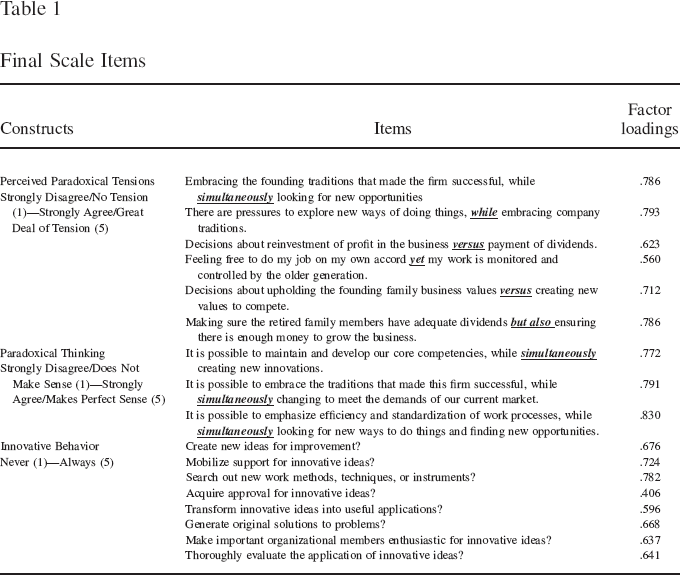
To assess the validity and reliability of the scales (which had been refined via the expert panel feedback), we conducted a pilot study of 63 family business executives from 19 firms. Initially, exploratory factor analysis (EFA) in SPSS 21.0 was used to examine factor loadings, followed by (CFA) in AMOS 19.0 to validate the psychometric properties of the measures. Using EFA, we examined the Kaiser–Myer–Olkin (KMO) measure of sampling adequacy and Bartlett's test of sphericity (BTS). Both were acceptable (KMO > .50, BTO p < .001) for all three constructs, hence factor analysis was deemed appropriate. Next, we examined the eigenvalues, scree plots, and factor loadings for all three constructs. For the paradoxical thinking measure, the eigenvalues and scree plot suggested a two–factor solution. Within the factors, items were retained if their loading was greater than .40; identifying three items for potential removal (EFA factor loadings = .291, .390, .314). After removal, a one–factor solution accounted for over 56% of the variance with EFA factor loadings ranging from .637–.880. Perceived paradoxical tensions initially produced a two–factor, EFA solution; however, one item accounted for the second factor, and that factor loading was .306. Hence, this item was removed. After removal, perceived paradoxical tensions displayed an EFA one–factor solution with loadings ranging from .532–.764, accounting for 48% of the variance. Finally, innovative behavior demonstrated a one–factor solution, accounting for 59% of the variance, with EFA factor loadings ranging from .529–.905.
Next, to further test scale items before final removal, all items were assessed using CFA to gauge overall model fit and individual model parameters. AMOS output suggested fit was poor because of low factor loadings < .30, supporting the EFA findings. AMOS output Modification Indexes (MI) and the standardized residuals were then examined to guide model re–specification. Modification was based upon the following criteria: factor loading/coefficients < .40, standardized residuals > 2.58 and AMOS modification indices (Byrne, 2001). Based on EFA and CFA results and revisiting the literature, we found statistical and theoretical justification to remove five items.
After eliminating five items, we re–specified the models, and the measures displayed alphas > .70, factor loadings > .40, and standardized residuals in appropriate bounds between 2.58 and −2.58 (Byrne, 2001). Bootstrapped confidence intervals indicated measurement items have a 95% certainty that the true values lie between the lower and upper bounds, reconfirming the factor loadings. Therefore, after modification, the individual parameters in the models displayed fit. Specifically, convergent validity was confirmed with the CFA factor loadings for perceived paradoxical tensions ranging from .532 to .764 (alpha = .751), paradoxical thinking ranging from .462 to .906 (alpha = .732), and innovative behavior ranging from .535 to .774 (alpha = .831). Moreover, discriminant validity was confirmed as the chi–square difference tests of paired constructs hold for all factors; hence, there was a significant chi–square difference in the unconstrained and constrained models (Anderson & Gerbing, 1988). Therefore, all three constructs were distinct. In addition the CFA for the novel latent constructs displayed appropriate fit after modifications: perceived paradoxical tensions and paradoxical thinking CFA: χ2 (24.074, dof = 32, p = .345), TLI (.958), CFI (.974), GFI (.910), and RMSEA (.043).
Sample
To confirm measurement validity and reliability and test the hypotheses, data were collected via an online survey of family firm executives. Executives were sought to provide the greatest and broadest insight into paradoxical tensions and innovative behavior, as well as into the executives’ own capacity for paradoxical thinking. E–mails requesting participation were sent to executives recruited from a family business center at a major urban research university. Overall, 178 family business executives, representing 125 distinct family firms, completed the survey. To determine if the firms with multiple executive responses could be aggregated, we calculated agreement coefficients per firm using two indices of interrater agreement (IRA): (rwg(j)) and ICC. Based on these results, 15 firms (50 individual executive responses) were removed as they did not meet the recommended cut–off for inclusion (ICC < .70; (rwg(j)) < .50), and six firm responses (24 individual executive responses) were aggregated with ICC estimates ranging from .71–.93 and (rwg(j)) from .7–.78. In addition, we screened for sample inclusion by asking “what percentage of the business is family owned?” and “how many employees does your firm have?” Specifically, two firms’ (two individual executive responses) responses were removed for not meeting family ownership criteria of at least 50%, and 14 firms (14 individual executive responses) were removed because they had fewer than five employees and one firm (one individual executive response) for having 50,000 employees. After removals, our final sample consists of 93 family firm executives, representing 93 family firms. Profile data showed that the responding executives were 86% male and 13% female; 34.4% second generation, followed closely by first generation (25.8), then 17.2% third generation, and 12.9% fourth generation; had an average tenure of 23 years; 89% were related to the founders; and most were CEOs (30%), presidents (26%) or vice presidents (12%). Firm profiles showed an average firm age of 55 years, average size of 375 employees, and the average ownership for executive respondents was 97%. Furthermore, respondents self–identified as family firms and held majority controlling interest in the firm; therefore, were deemed to be representative of the family firm population.
Final Measure Validity Assessment
To assess the measures validated through the expert panel and pilot study (see Table 1 for final scales), CFA with AMOS 19.0 was conducted to test a three–factor model (perceived paradoxical tensions, paradoxical thinking, and innovative behavior). Table 2 presents the descriptive statistics, correlations, and reliabilities of the latent constructs. Overall, in this final stage, there were 17 items predicted to form three factors that required 38 parameters to be estimated. However, the sample size (n = 93) “fell short” of the recommended five observations to one parameter (Bentler & Chou, 1987). Therefore, we conducted individual factor analyses for each latent construct. This approach reduced the number of parameters required for estimation, ensuring statistical rigor. The constructs displayed adequate fit. First, the measures of perceived paradoxical tensions and paradoxical thinking were validated, displaying significant factor loadings, >.40 and reliabilities of .7 or greater, indicating convergent validity. Additionally, bootstrapping confidence intervals indicated that the true parameter estimate value lies between acceptable ranges (no natural zero), suggesting that the items were loading onto the correct factor. Specifically, factor loadings (See Table 1) for perceived paradoxical tensions ranged from .560–.793 (alpha .84), paradoxical thinking from .772–.830 (alpha .84), and innovative behavior from .406 to .782 (alpha .804), confirming reliability and convergent validity. To ensure discriminant validity, the average variance extracted (AVE) for each construct should be larger than the squared correlations between each pair of constructs (Fornell & Larcker, 1981). All three constructs’ AVEs were greater than the paired shared variance. We then used chi–square difference in paired constructs test (Anderson & Gerbing, 1988) with innovative behavior and paradoxical thinking, innovative behavior and perceived paradoxical tensions, and paradoxical thinking and perceived paradoxical tensions. All models demonstrated discriminant validity as the unconstrained model fit better than the constrained model, and the chi–square value significantly decreased in the unconstrained model.
Final Scale Items
Descriptive Statistics, Correlations, and Scale Reliabilities for Constructs (on the Diagonal)
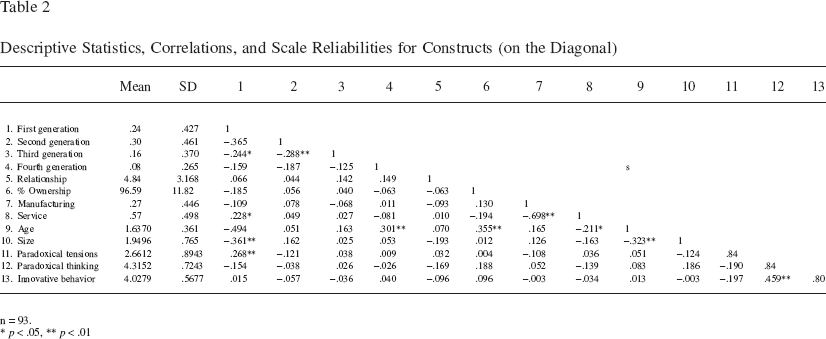
n = 93.
p < .05,
p < .01
The overall fit of the model was assessed using multiple indices (Bollen & Long, 1993). The CFA model for perceived paradoxical tensions and paradoxical thinking displayed good to moderate fit: χ2 (20.591, df = 19, p = .360), Tucker–Lewis index (TLI) (.990), comparative fit index (CFI) (.995), goodness of fit index (GFI) (.954), root mean square error of approximation (RMSEA) (.030). The model for perceived paradoxical tensions and innovative behavior displayed good to moderate fit: χ2 (88.033, df = 72, p = .096), TLI (.955), CFI (.964), GFI (.874), RMSEA (.049). Finally, the model for paradoxical thinking and innovative behavior displayed good to moderate fit: χ2 (38.709, df = 38, p = .437), TLI (.997), CFI (.998), GFI (.930), RMSEA (.014).
Constructs and Final Measures
Perceived Paradoxical Tensions
Paradoxical tensions denote contradictory elements (demands, practices, feelings) that exist simultaneously. Given their highly abstract nature, items were created to provide specific examples pertinent to family firms, seeking to gauge respondents’ perceptions of paradoxical tensions within their firm. Six items were created to measure the level of tensions leaders perceive, using the three predominant paradoxes identified in family business literature as examples (alpha = .84) (see Table 1). The 5–point Likert–type scale ranges from strongly disagree—no tension (1) to strongly agree—a great deal of tension (5). An illustrative item is “There are pressures to explore new ways of doing things, while embracing company traditions.”
Paradoxical Thinking
Paradoxical thinking signifies the ability to juxtapose contradictory but interrelated ideas. Paradoxical thinking was assessed with three items (alpha = .84) (see Table 1). The 5–point Likert–type scale response ranges from strongly disagree—does not make sense (1) to strongly agree—makes perfect sense (5). An example item is: “It is possible to maintain and develop our core competencies, while simultaneously creating new innovations.”
Innovative Behavior
While innovation research often examines antecedents (e.g., R&D investment) or outcomes (e.g., patents) of innovation, this research sought to gauge the impact of paradoxical tensions and paradoxical thinking on innovative behavior—efforts spanning the innovation process to fuel the generation, promotion, and realization of novel ideas. Therefore, innovative behavior was measured with eight items adapted from Janssen (2000) (alpha = .80) (see Table 1). This scale draws from Kanter's (1998) stages of innovation, which were further developed by Scott and Bruce (1994). The first three items correspond to idea generation, the next three represent idea promotion, and the final two refer to idea realization. The 5–point Likert scales range from never (1) to always (5). A representative statement is that this family firm “mobilizes support for innovative ideas.”
Control Variables
To assess the possible influence of other variables, we included four control variables often posited to impact a firm's innovative behavior: firm age, firm size, industry, and generation. Firm age and size, transformed by the natural logarithm, have been shown to both positively and negatively impact innovation (Camison–Zornoza, Lapiedra–Alcami, Segarra–Cipres, & Boronat–Navarro, 2004; Scott & Bruce, 1994). The category of industry was identified to gauge whether industry norms, practices, and environments impact innovation (Damanpour, 1996). The industry category was assessed by creating two dummy variables: manufacturing sector and service sector, including construction. These sectors were chosen because of the 16 potential industries respondents could select; only these two categories of industries had a significant number of respondents. Finally, to account for specific familial effects we controlled for percent of company owned, relationship to founder, and generational influence. The current ownership's generation was controlled for with four dummy codes.
We took several steps to ensure that multi–collinearity and common method bias were not present. First, the variance inflation factor was less than 2.13; hence, multi–collinearity was not an issue (Hair, Anderson, Tatham, & Black, 1998). Next, we took several actions to mitigate common method bias. For instance, we utilized different scale endpoints for the independent and dependent variables (Podsakoff, MacKenzie, Lee, & Podsakoff, 2003). Then we conducted a recommended post–hoc test of common method bias (Podsakoff & Organ, 1986). Both Harman's single–factor test and CFA indicated that common method bias was not likely influencing results. Harman's single–factor test showed no concern, and the fit of the method factor model was worse than the CFA.
Results: Hypotheses Testing and Predictive Validity
In addition to confirming the new measures, we sought to test the hypothesized relationships between perceived paradoxical tensions, paradoxical thinking, and innovative behavior in family firms, ensuring the predictive validity of our new measures. Using hierarchical multiple regression analysis in SPSS 21.0, four models were created (see Table 3). First, all control variables were entered. In model 2, perceived paradoxical tensions were entered. For model 3, paradoxical thinking was entered. Finally, model four included the interaction term between perceived paradoxical tensions and paradoxical thinking.
Hierarchical Multiple Regression Analysis
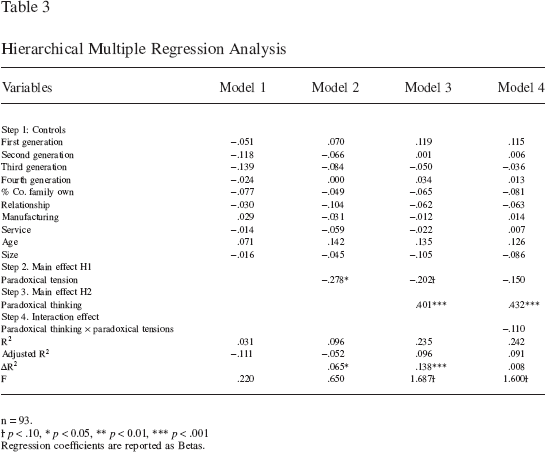
n = 93.
p < .10,
p < 0.05,
** p < 0.01,
p < .001
Regression coefficients are reported as Betas.
The controls in model 1 were not significant (R2 = .031, ns). Model 2 which regressed perceived paradoxical tensions on innovative behavior was significant (ΔR2 = .065*), providing support for hypothesis 1 that paradoxical tensions negatively impact innovative behavior (β = −.278*). Model 3 regressed paradoxical thinking on innovative behavior and was significant (ΔR2 = .138***). Therefore, hypothesis 2, proposing that paradoxical thinking is positively related to innovative behavior, was supported (β = .401***). Model 4, examining the moderating role of paradoxical thinking, was then tested by the interaction term of perceived paradoxical tensions × paradoxical thinking (ΔR2 = .008, ns) and was not significant. Therefore, hypothesis 3 was not supported (β = −.110, ns).
Implications, Limitations, and Future Research
This study contributes measures of perceived paradoxical tensions and paradoxical thinking for use in investigating paradoxes and innovative behavior in family firms. Despite growing interest in these issues in both family business and organizational paradox literatures, lack of valid, reliable measures has inhibited empirical study. This work begins to fill this gap.
In addition to developing new measures, our findings provide a basis and motivation for future research. First, our study demonstrates that paradoxical tensions permeate family firms, as reported by a majority of the sampled executives. Moreover, we find that such tensions negatively impact innovative behavior. Yet our findings also suggest that paradoxical thinking enhances innovative behavior, confirming the importance of this leadership capability. These results offer empirical support for such claims in family business literature (e.g., Schuman et al., 2010; Ward, 2009) and paradox theory (e.g., Lewis, 2000; Smith & Lewis, 2011). This study, however, also illustrates the paradox of knowledge—the more we know, the more we know we do not know. For example, paradoxical thinking was not found to moderate the relationship between paradoxical tensions and innovative behavior. Expanded studies may deepen insights into this complex relationship. For instance, we explored whether paradoxical thinking alters or moderates this relationship, but it is also plausible that a mediated relationship exists. We encourage large sample research, with greater statistical power, as well as with added contextual variables or contingencies, to unpack the role of paradoxical thinking in family firms.
Although this study validated two measures of important paradox constructs and confirmed their predictive validity, as with any construct development, subsequent research is needed to refine the measures and expand upon research insights. In addition, limitations to this study, such as sample size, cross–sectional focus, and non–comparative design, suggest research needs. Indeed, as an exploratory study, its insights and limitations raise further questions and the need for more comprehensive studies. In particular, our work offers an entry into challenging issues surrounding the management of family business paradoxes. As Irava and Moores (2010, p. 139) argued, in family firms “paradoxes need to be managed to optimize strategic advantage.” Paradoxical thinking offers one tool that can help leaders tap the positive potential of paradox. The organizational paradox literature also suggests other, more tactical strategies. For example, Smith and Lewis (2011) stressed the need for paradoxical thinking, but also noted the value of differentiation or splitting strategies that pull tensions apart to enable separate but simultaneous focus on divergent demands, and integration strategies, providing overarching goals and coordination practices that build synergies between efforts.
Likewise, managing paradox may vary by the nature of different tensions and the generation of firm leaders. In this study, we gauged leaders’ awareness of tensions in their firm, using the three predominant tensions identified in family business research as examples. Yet Smith and Lewis (2011) noted that paradoxes of performing, learning, belonging, and organizing may spark varied opportunities and challenges, requiring different management strategies. Future studies could investigate additional tensions noted in family business literature, such as individual versus collective (Berent–Braun & Uhlaner, 2012), exploration versus exploitation, and short–term versus long–term orientation (Zahra et al., 2008). Likewise, we found that the first/founding generation recognized and reported paradoxical tensions more than later generations. Further work, qualitative and quantitative, might examine whether and why founders focus more on paradoxical tensions. Similarly, we sampled current leaders of family firms, but scholars stress that paradoxes pervade firms and persist over time (e.g., Andriopoulos & Lewis, 2010). We suggest the benefit of research that examines how various individuals perceive and respond to paradoxical tensions throughout the firm and across generations.
This study also surfaced the need for more comprehensive research to deepen understandings of perceived paradoxical tensions, paradoxical thinking, and innovation in family businesses. In particular, we envision research that examines innovation further, compares family with non–family firms, leverages longitudinal designs, and provides qualitative insights. For instance, we examined innovative behavior, yet related, dependent variables such as R&D investment (Block, 2012), may enrich our understanding of how paradoxical thinking impacts creativity and innovation. Comparative studies of family and non–family firms would empirically test claims that the exceptionally paradoxical nature of family business intensifies the need for paradoxical thinking (e.g., Ward, 2009). Third, to enhance generalizability and better gauge causality, longitudinal studies could examine the interplay of paradoxical tensions, paradoxical thinking, and innovative behavior over time. Finally, qualitative research could deepen insights into these relationships. For instance, how do family firm leaders leverage and communicate their paradoxical thinking to encourage innovative behavior? Why does paradoxical thinking shift the view of paradoxes from barriers to energizing opportunities, and how is this shift experienced by those beyond the current leader?
Conclusion
This study examined the interplay between paradoxical tensions, paradoxical thinking, and innovative behavior in the family firm. Results contribute valid and reliable measures for future research. Findings highlight the importance of paradoxical thinking, helping leaders tap the energizing and creative potential of paradox to foster innovation. Given the challenges of paradoxes in family business and the rising importance of innovation, we hope this study offers a basis for ongoing and deeper insights that may aid management in this complex setting.