







Abstract
Family business and human resource management scholars suggest that firms whose leaders experience affective commitment are more likely to achieve their goals. Building on self–determination theory, we propose a model in which parent–founders promote affective commitment in child–successors by supporting their psychological needs for competence, autonomy, and relatedness within the family business. We conclude by exploring the ethical implications of different parenting approaches in encouraging intrafamily succession.
Introduction
Intrafamily succession is the most prevalent research topic within the family business literature (Benavides–Velasco, Quintana–García, Guzman–Parra, 2013; Debicki, Matherne, Kellermanns, & Chrisman, 2009; Sharma, Chrisman, & Chua, 2003) and the defining feature of the field (Yu, Lumpkin, Sorenson, & Brigham, 2012). Intrafamily succession, however, is rare. Only about 30% of family firms that survive the first generation retain family ownership into the second generation, and less than 10% of those firms retain family ownership into the third generation (Beckhard & Dyer, 1983). Some family firms transfer ownership and management of the firm from parent to child, but this shift in responsibility does not necessarily entail commitment and satisfaction on the part of all parties involved—the successor in particular (Sharma & Irving, 2005). Family members who experience affective commitment to the family firm are more likely to pursue a career within it and to be satisfied in their role as successor (Dyck, Mauws, Starke, & Mischke, 2002; Handler, 1989). Thus, they are attractive succession candidates to parent–founders seeking willing and committed successors (Barach & Ganitsky, 1995; Le Breton–Miller, Miller, & Steier, 2004; Sharma, Chrisman, Pablo, & Chua, 2001).
Despite the fact that (1) succession has been widely recognized as a critical event in family business research and practice, (2) a family firm's goals cannot be met without a successor who maintains firm performance and retains control of the family firm, and (3) successor commitment has been identified as an important predictor of a successor's decision to pursue a career in the family firm and his or her performance in the successor role (Sharma & Irving, 2005), surprisingly little research and theory has been directed toward understanding successor commitment and the role that the parent generation can play in encouraging it. Although researchers have attributed failure in succession to a lack of proper succession planning (Handler, 1994), a lack of successor motivation (Cabrera–Suárez, De Saá–Pérez, & García–Almeida, 2001), or a poor relationship between the parent and successor (Lansberg & Astrachan, 1994), each of which are subject to the influence of parent–founders, the mechanisms and process through which this influence occurs remain unexamined within the family business literature. Consequently, Long and Chrisman (2014), in a recent review of succession in family business, called for theoretical development regarding the multi–level relationships in succession and for theory that moves beyond the “what” of family business succession to explain the “why” and the “how” (pp. 249–250).
This article seeks to address these identified gaps by proposing a multi–level model of family firm succession that is built upon the assumption that family business founders who intend to pass the business on to the next generation wear two hats: that of parent and that of founder. These roles come into conflict when the parent wants the child 1 to be the successor of the family firm, but the child has other plans. However, to the extent that a child's interests and abilities (nature) can be developed over time (nurture) through opportunities and feedback provided by the parent–founder, we suggest that it is possible through early succession planning to influence not only the child's ability to become the successor of the firm, but also his or her desire to do so. Thus, we ask, “Can a parent–founder raise a child to want to be the successor of a family firm, and if so, how?” We do not, however, confuse “can” with “should.” Because encouragement can take place in ways that are inconsistent as well as consistent with a healthy parent–child relationship, an ethical question emerges about the parameters under which such influence is appropriate, begging the more normative question: Should a parent–founder raise a child to want to be the successor of the family firm, and if so, under what conditions?
Through our model, we aim to make three contributions to the topic of succession within the family business literature. First, we address the call for more research regarding intergenerational motivation in family firms (Sharma, Chrisman, & Gersick, 2012). By synthesizing a number of disparate succession studies, our model offers an examination of how parent–founders, with discretion and desire to appoint a successor, can groom a second–generation family member to be not just willing, but eager to take the reins of the family firm. Second, we introduce self–determination theory (SDT; Deci & Ryan, 1985) (a) to explain why successor autonomy influences the likelihood of this succession, the type of commitment experienced upon succession, and the firm's goals after succession; (b) to describe the constituents and antecedents of successor autonomy; and (c) to suggest how parent–founders can influence these antecedents. Third and finally, we answer the call for a better understanding of the nonfinancial goals of family firms (Chrisman, Kellermans, Chan, & Liano, 2010; Sharma et al.) by modeling how parent–founders can encourage children to integrate family business activities, behaviors, and tasks into their own identity (Gagné & Deci, 2005). In other words, our model identifies the conditions under which children internalize the attitudes, values, and regulatory structures of extrinsic motivation such that they initiate and maintain family business activities through autonomous motivation. As a result, continued pursuit of the firm's nonfinancial goals would no longer require the presence of costly or inefficient external contingencies, such as parental control, but instead would result from the child–successor's affective commitment to the family firm.
The remainder of this article proceeds as follows. First, we provide an overview of our model by introducing SDT, upon which it is grounded. Second, we explain why parent–founders prefer to be succeeded by child–successors experiencing affective commitment to the family firm. Third, we explain why autonomous motivation is important to affective commitment and explore the antecedents of autonomous motivation, emphasizing the relationship between autonomous extrinsic motivation and the satisfaction of people's psychological needs for competence, autonomy, and relatedness. Fourth, we discuss how parent–founders can support need satisfaction by providing opportunities that facilitate either the child–successor's internalization of external regulations or his experience of intrinsic motivation within the family firm. Finally, we consider ethical implications such as emotional manipulation that can occur whenever grooming a successor takes precedence over nurturing one's child. We conclude by identifying directions for future research.
Model Overview and Introduction to SDT
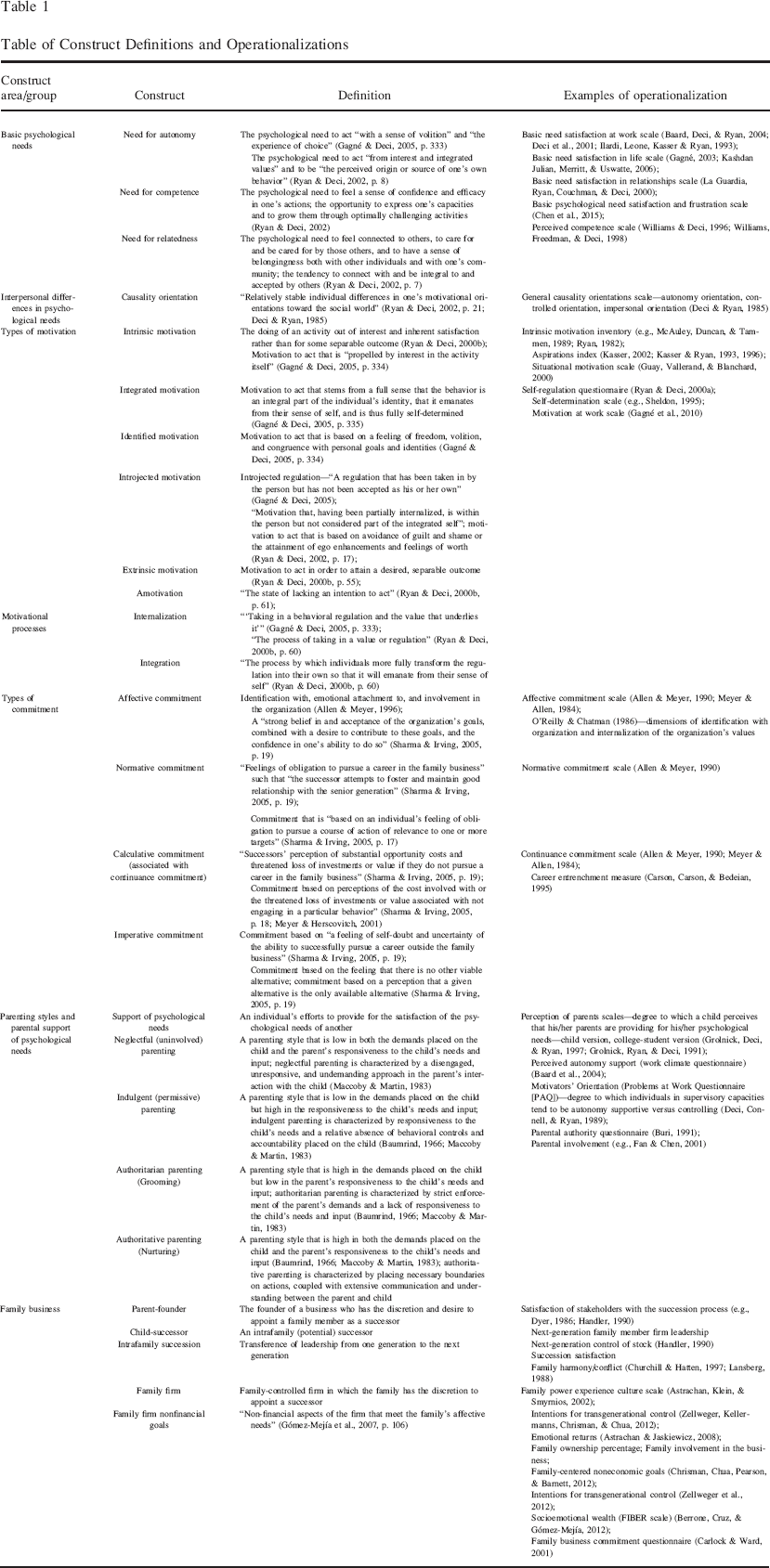
As pictured in Figure 1, our model concludes with child–successor commitment to the continued pursuit of the family firm's nonfinancial goals. 2 Because the parent–founder values the nonfinancial goals of the family firm, he seeks a successor who will choose to pursue these goals even after he relinquishes any power or influence that he might have as a result of his current authority within the firm. Such autonomous commitment to the family firm's nonfinancial goals, we propose, is more likely for successors who experience affective commitment—identification with, emotional attachment to, and involvement in the organization (Allen & Meyer, 1996). (See Table 1 for a list of construct definitions used in our model.) Affective commitment is more common among people experiencing (1) forms of autonomous motivation in which a high degree of self–determination exists (Gagné & Koestner, 2002) and (2) satisfaction of their basic psychological needs for competence, autonomy, and relatedness (Greguras & Diefendorff, 2009), needs that have been shown to be “nutriments” of both intrinsic motivation and variants of extrinsic motivation (Gagné & Deci, 2005).
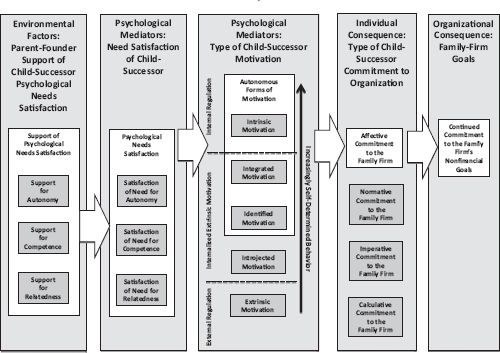
Autonomous Motivation Model of Family Business Succession
Table of Construct Definitions and Operationalizations
According to SDT, a highly regarded psychological theory of human motivation, satisfaction of the psychological needs for competence, autonomy, and relatedness encourages intrinsic motivation and thus self–regulated behavior (Deci & Ryan, 1985, 2000). Behaviors that are intrinsically motivated are “prototypically autonomous” because they are “propelled by people's interest in the activity itself” (Gagné & Deci, 2005, p. 334); thus, intrinsic motivation is characterized by internally regulated and fully self–determined behavior. However, most activities, behaviors, and tasks that occur in work settings are to some extent externally regulated—initiated and maintained by contingencies external to the person (Gagné & Deci, p. 334). When externally regulated activities are not interesting, extrinsic motivation is required for their continued performance (Porter & Lawler, 1968). Though some behaviors are fully controlled, as described by classic notions of extrinsic motivation (e.g., Skinner, 1953), SDT has proposed (Ryan & Deci, 2000a), and empirical studies have found (e.g., Moran, Diefendorff, Kim, & Liu, 2012), that a continuum of extrinsic motivations exists, varying in degree of self–determination.
People can be encouraged through external regulation to engage in activities that they already find interesting or they can internalize the attitudes, values, or regulatory structures that originally served as external contingencies, such that they come to consider the behavior important for personal reasons (Gagné & Deci, 2005). The extent to which people internalize the attitudes, values, or regulatory structures of external regulation yields variants of internalized extrinsic motivation (Ryan & Deci, 2002). The least internalized of these is introjected motivation, or introjection, a motivational state in which behavior is externally regulated by compulsion, avoidance of guilt, or anxiety, and a sense that one “should” or “ought to” complete a behavior (Deci & Ryan, 1995; Koestner & Losier, 2002; Ntoumanis, 2002; Wang & Biddle, 2001). For example, a successor who accepts that she is in control of her behavior but feels internally compelled to engage in family business–related activities in order to feel a sense of worth is experiencing introjection. Slightly more internalized and self–determined than introjection is identified motivation, or identification. Identification regulates behavior whenever individuals see extrinsically motivated actions as personally important to the advancement of their own goals and as consistent with their identity (Koestner & Losier; Ryan & Deci). People acting based on identified motivation do so because they “want” to, as opposed to feeling that they “ought” to, as in introjected motivation (Wang & Biddle). Last is integrated motivation, or integration, which is fully internalized such that people have a full sense that the behavior is an integral part of who they are, emanating from their sense of self such that they experience an internal personal locus of control and consider the behavior to be fully self–determined (Gagné & Deci).
Both integration and intrinsic motivation are fully self–determined and thus forms of autonomous motivation, but the two remain distinct. When experiencing integration, people value and accept the reasons for a behavior. That, however, does not necessarily mean that they find the behavior inherently fun or interesting. Because integrated motivation is characterized not by the person's interest in the activity, but instead by the activity being instrumentally important for personal goals, it is still a form of extrinsic motivation, albeit an autonomous one (Gagné & Deci, 2005). It is joined by identified motivation, which is relatively autonomous, as these two forms of autonomous extrinsic motivation are distinct from both introjection, which is more controlled than self–determined, and external regulation, which is fully controlled. Thus, autonomous motivation includes the following types of motivation: intrinsic, integrated, and identified (Sheldon & Elliot, 1998).
The aforementioned variants of internalized extrinsic motivation (i.e., introjection, identification, and integration) are encompassed by SDT, which suggests that the satisfaction of basic psychological needs for competence, autonomy, and relatedness is necessary for both intrinsic motivation and internalization (which in its fullest form is integration) (e.g., Baumeister & Leary, 1995; Reis, Sheldon, Gable, Roscoe, & Ryan, 2000). The need for competence refers to the psychological need to have a sense of confidence and efficacy in one's actions and the opportunity to express one's capacities (Ryan & Deci, 2002). It encompasses the need to grow and develop competence through optimally challenging activities as well as the belief that one is capable of performing a task. The need for autonomy refers to the psychological need to act “with a sense of volition and having the experience of choice” (Gagné & Deci, 2005, p. 333) or “acting from interest and integrated values” and “being the perceived origin or source of one's own behavior” (deCharms, 1968; Deci & Ryan, 1985; Ryan & Deci, 2002, p. 8). Finally, the need for relatedness refers to the psychological need to feel connected to others, to care for and be cared for by those others, and to experience a sense of belongingness both with other individuals and with one's community (Baumeister & Leary; Ryan, 1995; Ryan & Deci, p. 7). It reflects the desire to connect with others and to be accepted by them, and emanates as a “psychological sense of being with others in secure communion or unity” (Ryan & Deci, p. 7).
When engagement in a particular behavior satisfies the needs for competence and relatedness, people tend to internalize the behavior's value and begin to self–regulate it (Angyal, 1965; Deci & Ryan, 1985, 2000; Schafer, 1968). Satisfaction of the need for autonomy, however, is what determines whether identification or integration, as opposed to introjection, occurs (Gagné & Deci, 2005). Supports for this need for autonomy fall within two general categories: (1) specific factors in the social context, such as choice and meaningful positive feedback, and (2) interpersonal ambience, such as organizational climate and managers’ interpersonal styles (Gagné & Deci). We suggest that parent–founders can use both categories of support to promote autonomous motivation, be it intrinsic motivation or autonomous extrinsic motivation, in child–successors, but there are notable differences between factors that maintain intrinsic motivation and those that facilitate internalization. Children do not necessarily require structures, limits, or contingencies to maintain intrinsic motivation; however, such structures, and so forth, influence whether behaviors are integrated and which values they internalize over time. In addition, explicit or implicit endorsement of behaviors by significant others plays little role in maintaining intrinsic motivation, but it is important in facilitating internalization. This distinction between intrinsic and autonomous extrinsic motivation may matter to family firms because autonomous extrinsic motivation has been shown to be better than intrinsic motivation at predicting engagement in, persistence at, and successful completion of simple behaviors that are not interesting as well as complex behaviors that require discipline and explicit effort (Koestner & Losier, 2002), behaviors which managers are often required to perform.
In addition to supporting the child's need for autonomy, parent–founders can provide opportunities within the family firm that support satisfaction of the child's needs for both competence and relatedness. These opportunities need not be solely focused on facilitating internalization. Indeed, child development of affective commitment may actually be more successfully encouraged by focusing first on helping the child discover ways in which the activities that she finds intrinsically motivating are also valued by the firm, thereby encouraging a perceived fit between firm demands and the child's ability (Greguras & Diefendorff, 2009). However, research shows that it is possible to facilitate the integration of activities that a child may not find interesting but that a firm demands or requires to succeed. This can be achieved, for example, by emphasizing the task's significance or the child's unique ability to complete it successfully (Hackman & Oldham, 1975). Such influence does not encourage intrinsic motivation, but it does reduce perceived discrepancies between situational demands and personal abilities, contributing to satisfaction of the child's need for competence and facilitating internalization of extrinsic motivation such that the child experiences identification if not integration.
Finally, parent–founders may seek to support the child's satisfaction of the need for relatedness within the family firm by focusing, for example, on social support (Campion, Medsker, & Higgs, 1993). This reduces potential that the child may perceive a discrepancy between herself and the family firm. Indeed, the more attractive the group to an individual, the faster the internalization of the value of the activities that the group is seeking to encourage through extrinsic motivation (Deci & Ryan, 2000).
Thus, our model proposes that parent–founders who wish to ensure that a family firm continues to pursue nonfinancial goals can nurture a successor with affective commitment to the family firm by satisfying the child's needs for competence, autonomy, and relatedness within the family firm. This can be done either by helping her find intrinsically motivating activities that also happen to be valued by the firm or by facilitating integration of activities that are valued by the family firm, such that they become valued by the child as well, either because of their instrumental importance or because they become inherently interesting to the child over time, thereby encouraging intrinsic motivation.
The Outcome—Fulfillment of a Founder's Dream
Founders’ Nonfinancial Goals for the Family Firm
There may be no context in which the influence of nonfinancial goals is more pronounced than in family business where they are often considered on par or even more important than the creation of financial value as the primary objective of the firm (Berrone, Cruz, Gómez–Mejía, & Larraza–Kintana, 2010; Gómez–Mejía, Haynes, Núñez–Nickel, Jacobson, & Moyano–Fuentes, 2007; Zellweger & Astrachan, 2008). Family firms’ nonfinancial goals often include “fulfilling needs for belonging, affect, and intimacy; continuation of family values through the firm; perpetuation of the family dynasty; preservation of family firm social capital; discharge of family obligations based on blood ties; ability to act altruistically toward family members using firm resources (Gómez–Mejía et al., 2007); and social status (Zellweger & Astrachan, 2008)” (as cited in Zellweger et al., 2012, pp. 852–853). Indeed, the founder's purpose for creating the family firm is often expressed by, and communicated through, the nonfinancial goals he or she establishes for the family firm. The more congruent these nonfinancial goals are with the family's values and each family member's personal values, the more likely it is that family members will endorse these nonfinancial goals and expect likewise from the firm's successor.
Seeking Intrafamily Succession to Ensure Commitment to the Family Firm's Goals
Family firms maintain commitment to their goals by identifying successors who retain the founder's commitment to advancing both the firm's financial and nonfinancial goals. Identifying a successor with the willingness and ability to run a firm successfully is difficult for any business, but this may be even more challenging in a business that is determined to appoint an intrafamily successor. Because of the larger talent pool from which they are selected, nonfamily successors may be more capable of helping the family firm achieve its financial goals, but they are also less likely to find the family firm's nonfinancial goals to be as compelling as a family member might. This can limit the applicant pool to a handful of children at most, only to have them lack the ability or the desire to work in, much less lead, the family business. Although intrafamily succession may preserve family ownership and leadership, it does not ensure that the family firm will remain committed to the family's values as represented by the firm's nonfinancial goals. Even when they are family members, successors can still seek to maximize the firm's financial returns while neglecting the founder's nonfinancial goals for the family firm. Equally problematic is the child–successor who is not as competent or committed as other viable candidates. In such instances, intrafamily succession may indeed ensure short–term preservation of the family firm's nonfinancial goals but at the expense of its chances of successfully reaching the third generation.
Therefore, succession from a founder to an intrafamily, second–generation successor is difficult and made more so when the successor is expected to retain commitment to any nonfinancial goals the founder and family may have for the family business. In the first generation, the founder tends to design the firm around the satisfaction of his or her own needs such that the firm offers a unique blend of rewards, some financial and others nonfinancial. For example, the desire to leave a personal legacy through one's business by building a family dynasty is but one aspect of socioemotional wealth (Gómez–Mejía et al., 2007), a nonfinancial goal that requires a family member to be committed not just to the pursuit of a career in the family business but also to the continued pursuit of the founder's nonfinancial purposes for creating the family firm.
Child–Successor Commitment to the Family Firm's Goals
Commitment to the family firm's goals on the part of the potential successor is integral to the success of the family firm because commitment encourages (1) whether intrafamily succession is likely to occur at all—that is, whether the second generation will accept leadership of the firm—(2) how many resources (time, talent, and treasure) the second generation invests in the firm, and (3) the degree to which others perceive the second generation as committed to the family firm (e.g., extending the family dynasty). Whereas increasing investments of resources tend to reflect commitment (Meyer, Allen, & Smith, 1993), others interpret these investments as symbolic actions communicating the successor's motives as well (Pfeffer, 1981; Smircich & Morgan, 1982). To the extent that these motives are interpreted as prosocial, they are also likely to inspire commitment to the family firm by observers (Bass, 1996; Dawson, Irving, Sharma, Chirico, & Marcus, 2014).
Sharma and Irving (2005) identify four types of successor commitment ranging from most autonomous to least autonomous: affective, normative, calculative, and imperative, each of which holds different implications for a successors’ commitment to the goals of the family firm. Affective commitment refers to a “strong belief in and acceptance of the organization's goals, combined with a desire to contribute to these goals, and the confidence in one's ability to do so.” Normative commitment refers to “feelings of obligation to pursue a career in the family business” such that “the successor attempts to foster and maintain good relationships with the senior generation.” Calculative commitment refers to “successors’ perceptions of substantial opportunity costs and threatened loss of investments or value if they do not pursue a career in the family business.” Finally, imperative commitment refers to “a feeling of self–doubt and uncertainty of the ability to successfully pursue a career outside the family business” (Sharma & Irving, p. 19).
Even though potential successors may experience any one of these types of commitment (Sharma & Irving, 2005), the most desirable from the viewpoint of both the first and second generation is affective commitment. As the most autonomous form of commitment, affective commitment reduces the need for the family firm or the parent–founder to control the child–successor's behavior because her “emotional attachment to, identification with, and involvement in the organization” (Meyer & Allen, 1991, p. 67) suggests that she has already internalized the attitudes, values, and regulatory structures that the family firm would otherwise use to encourage an employee to initiate and maintain firm–desired behaviors. Such external incentives are relatively costly and inefficient. A child–successor experiencing affective commitment, by contrast, requires no such incentives because she finds the same goals and behaviors valued by the family firm and the parent–founder to be personally important. Thus, affective commitment is crucial to the achievement of the family firm's nonfinancial goals (Meyer, Stanley, Herscovitch, & Topolnytsky, 2002).
Because continued pursuit of the family firm's nonfinancial goals is likely to require a successor who is a family member capable of managing the family firm to achieve its financial goals while remaining committed to its nonfinancial goals, it is fortunate that affective commitment is likely to have positive financial as well as nonfinancial consequences for the family business. Affective commitment to the family firm manifests as time and energy that the successor puts into managing the family firm (Sharma & Irving, 2005). To the extent that this is observed by others, it is likely to evoke social contagion (Wild & Enzle, 2002), in which employees either reciprocate the successor's interest by matching her abnormal effort or express a degree of understanding and tolerance of successors who ask more of them than is normal (Cellar & Wade, 1988). As a result, affective commitment contributes to improved firm performance by encouraging both the successor and employees to engage in discretionary behavior—going beyond the call of duty (Meyer et al., 2002; Organ, 1988). Thus,
The Commitment: Intergenerational Adoption of the Dream
Succession is not fully up to the parent–founder; it requires adoption of the dream by the child–successor. To maximize the likelihood of the family firm's continued commitment to its nonfinancial goals, the child must not only serve as the new patriarch or matriarch, but also experience affective commitment in the role. Such affective commitment requires the autonomy that characterizes more self–determined variants of extrinsic motivation (Gagné & Deci, 2005). How, then, might the founder encourage the child to choose the role of successor and enthusiastically at that?
To answer this question, we must explore the motivation behind affective commitment because this motivation has implications for subsequent effectiveness, effort, and firm performance (Sharma & Irving, 2005, p.15). Family members who experience affective commitment to the family business have been shown to be more likely to continue their involvement in the business and to be more satisfied with the succession process (Dyck et al., 2002; Handler, 1989, 1990), but there are many possible motivations behind the decision to work at the family firm and become its successor, not all of which result in affective commitment.
Affective commitment's psychometric properties, as described by Allen and Meyer (1996) and as applied to family business succession by Sharma and Irving (2005), are congruent with the psychological needs that contribute to autonomous motivation. For example, a “strong belief in and acceptance of the organization's goals” is congruent with satisfaction of the need for relatedness, whereas “a desire to contribute to these goals” is congruent with satisfaction of the need for autonomy, and finally, “the confidence in one's ability to do so” is congruent with satisfaction of the need for competence.
Empirical evidence supports a link between affective commitment and satisfaction of these needs as well. Greguras and Diefendorff (2009) found that satisfaction of competence, autonomy, and relatedness needs positively and individually relate to employee affective commitment. They note that “working in an organization that enables one to feel self–determined in one's activities, to feel competent in those activities, and to have positive social ties all enhance organizational commitment in a similar manner” and that “the satisfaction of any one of these three needs may be enough to enhance affective commitment” (p. 474). Although their findings clearly link satisfaction of psychological needs with affective commitment, Greguras and Diefendorff failed to examine whether this relationship was mediated by motivation, choosing instead to relate psychological need satisfactions directly to affective commitment. They acknowledge this direct effect as a limitation of their study and point to laboratory research by Grouzet, Vallerand, Thill, and Provencher (2004) that supports the notion that autonomous motivation mediates the relations between psychological needs and outcomes. Thus, autonomous motivation appears to mediate the effect of psychological needs satisfaction on affective commitment as SDT suggests.
Empirical evidence provides additional support for this claim by confirming the link between autonomous motivation and affective commitment. In their review of research examining SDT's relationship with organizational commitment, Gagné and Deci (2005) point out that “the type of organizational commitment that encompasses accepting the organizational goals, being committed to the organization, and feeling engaged with and attached to the organization appear to be facilitated by autonomous motivation” (p. 345). They highlight a study by Gagné, Boies, Koestner, and Martens (2004) that confirmed a pattern of correlations of intrinsic, identified, introjected, and external motivation with affective commitment found by Gagné and Koestner (2002). Gagné and Koestner drew from an alternative but overlapping conception of organizational commitment, consisting of three dimensions: “identification with the organization,” “internalization of the organization's values,” and “compliance” (see O'Reilly & Chatman, 1986). They found that the first two dimensions correlated with intrinsic motivation and identified motivation (r's ranged from .46 to .58), and less strongly with introjected motivation (r's = .36 and .39). Neither of the dimensions correlated with external regulation, and integrated motivation was not examined. The researchers then combined the four subscales to form a relative autonomy index (see Ryan & Connell, 1989) and found that relative autonomy at Time 1 predicted commitment (the combination of identification and internalization) at Time 2 using cross–lagged correlations. Thus, Gagné and Deci (2005) concluded that whether conceptualized as “affective commitment” or the “identification with the organization” and “internalization of the organization's values,” the patterns of correlation tell the same story: more autonomous forms of extrinsic motivation have been shown to better predict affective commitment (Gagné & Deci; Gagné & Koestner; Gagné et al.).
Because continued pursuit of the family firm's nonfinancial goals requires not only the postsuccession viability of the business, but also the satisfaction of relevant stakeholders with the succession process (Le Breton–Miller et al., 2004), and because these outcomes are more likely when the successor experiences greater autonomy (Sharma & Irving, 2005), both the motivation and commitment of the child are critical to the occurrence of succession, the financial performance of the business following succession, and the degree to which the successor maintains the family firms’ commitment to its nonfinancial goals.
The more that tasks associated with an organizational role, such as patriarch or matriarch of the family firm, are intrinsically motivating to a potential successor, the less the extrinsic motivation required to encourage him or her to accept the role. As intrinsic motivation decreases, however, increases in external reward may still be sufficient to entice an individual to become successor. Such a trade–off between intrinsic motivation and extrinsic motivation exists in most jobs and is likely to influence one's commitment to the job, but the greater the intrinsic motivation, the more committed an individual is likely to become to performing that job well. Thus, motivational states in which less internalization of extrinsic motivation has occurred (i.e., introjected regulation and external regulation) require increasingly more extrinsic motivation to compensate for the child's lack of either interest in the task (intrinsic motivation) or belief that the activity, behavior, or task is instrumentally important to their goals or identity (autonomous extrinsic motivation).
Such arguments imply that the child is engaged, prior to succession, in activities that are similar to those that he will be performing after completing the succession process, such that the psychological need satisfaction that he attributes to past and current experiences working in the family firm are expected to be somewhat indicative of those he will have as successor. In other words, the child is effectively deciding (albeit unconsciously) to work in the family firm each day and is committing his time and talent as a result, but the gestalt of that experience is likely to change when responsibility is transferred from parent–founder to child–successor. To the extent that this transfer is punctuated by a discrete event in which the child must consciously decide whether to assume greater responsibility as successor, the child may also become aware of the increased investment of time and dedication to the family firm implied by such a decision. Thus, even if the child–successor's family business–related activities are not expected to change radically after succession, the responsibility associated with them may be expected to increase significantly. To the extent that the child exercised self–determination in choosing a career in the family firm, this increased responsibility may be welcomed; however, the opposite is likely to be true among children whose choice to work in the family firm was less autonomous and who are experiencing less self–determined motivational states. Thus,
The Choice: A Child's Pursuit of a Career in the Family Firm
Successors in family businesses experience different types of commitment as a result of engaging in various activities associated with succession. But what stimulates the choice to start and continue working in the family business? After all, a child–successor cannot experience autonomous motivation and affective commitment to the family firm if he or she will not first choose to work in the family business, even if only as a whim (e.g., part–time job or trial to placate a parent). This occupational choice is largely a matter, first, of expectations about whether his or her psychological needs will be satisfied and, second, about reflections on his or her experiences such that the child weighs the satisfaction of psychological needs via working in the family business against expected need satisfaction outside the family firm (Handler, 1994; Rogal, 1989).
SDT proposes that people experience intrinsic motivation when engagement in a behavior satisfies their psychological needs for competence, autonomy, and relatedness (Deci & Ryan, 2000), as opposed to passive enactment or behavior motivated primarily by external influences, truly autonomous behavior, which is self–determined and thus self–regulated, emanates as “an expression of the self” (Ryan & Deci, 2002). Thus, people rarely require encouragement to engage in intrinsically motivating behavior because it is inherently interesting to them such that the experience of engaging in the behavior is considered a reward in itself.
Everyone experiences intrinsic motivation, but the activities that individuals find inherently interesting vary, as do the relative importance that individuals place (whether consciously or unconsciously) on the three psychological needs that these activities satisfy (Deci & Ryan, 1985). These “relatively stable individual differences in one's motivational orientations toward the social world” are known as the individual's causality orientation (Ryan & Deci, 2002, p. 21; Deci & Ryan). For example, some individuals experience an autonomy orientation, basing their regulation of behavior primarily on internal awareness of interests and needs (Ryan & Deci, 2000a). As a result, they require greater support for their psychological need for autonomy than others, who, being more strongly control–oriented, evaluate reward and punishment contingencies in their social contexts, to initiate and regulate their behavior (Ryan & Connell, 1989). Such control–orientation may encourage greater emphasis on satisfying the needs for relatedness or competence (rather than the need for autonomy) with external rewards such as social or financial approval. Satisfaction of each need can also vary in priority across cultures, with the need for relatedness playing a bigger role in collectivist or family–oriented cultures (Hofstede, Hofstede, & Minkov, 1997; Kagitcibasi, 2005). Finally, the relative importance that individuals place on these needs can differ as a function of various background and demographic variables, including gender, number of family members, birth order, and age (Hornaday & Aboud, 1971; Kasser & Ryan, 1996). Thus, the relative importance of satisfying each psychological need varies across individuals, cultures, and nations. Moreover, because cultural and national factors can also vary in their support of these needs, they can influence succession by expanding or limiting a child's opportunities to satisfy his or her psychological needs outside of the family firm, suggesting that satisfaction of psychological needs may vary within individuals across nations and cultures as well.
In addition to intrinsic motivation, satisfaction of these three psychological needs plays an important role in autonomous extrinsic motivation. Research on SDT in work contexts has shown that autonomous motivations (e.g., intrinsic, integrated, or identified) and factors known to enhance autonomous motivation (e.g., autonomy–supportive environments) enhance well–being and effectiveness better than controlled motivations (e.g., external or introjected; Baard et al., 2004; Bono & Judge, 2003; Deci et al., 2001; Greguras & Diefendorff, 2009; Ilardi et al., 1993; Kasser, Davey, & Ryan, 1992).
SDT has long recognized that satisfaction of the psychological needs for autonomy, competence, and relatedness are necessary for optimal functioning and for the integration of social norms and values in various life contexts (Deci & Ryan, 2000). Whether it is a hobby, a relationship, school, work, or some other domain of life in which a person is engaged, adequate support to satisfy the needs for autonomy, competence, and relatedness has been empirically demonstrated to encourage people to experience autonomous motivation for participating in that domain (Milyavskaya & Koestner, 2011). For example, Grolnick and Ryan (1989) found that parental support for these psychological needs is positively associated with children's autonomous motivation for schoolwork, and Williams and Deci (1996) showed that teachers’ support of these needs is linked to more autonomous motivation in medical students. In the sports domain, motivation has been shown to partially mediate the link between need satisfaction and a variety of outcomes including affect, effort, further participation intentions, and drop–out rates (Ntoumanis, 2002; Sarrazin, Vallerand, Guillet, Pelletier, & Cury, 2002). In the relationship domain, Patrick, Knee, Canevello, and Lonsbary (2007, study 3) tested a mediation model where relationship motivation mediated the path from need satisfaction within the relationship to relationship satisfaction and commitment after disagreements; they found evidence for full mediation. In turn, autonomous motivation has been associated with numerous positive outcomes, including greater creativity (Koestner, Ryan, Bernieri, & Holt, 1984), persistence at school (Vallerand, Fortier, & Guay, 1997), healthier lifestyles and eating behavior (Pelletier, Dion, Slovenic–D'Angelo, & Reid, 2004), and positive psychotherapy outcomes (Zuroff et al., 2007). Thus, there is “ample evidence suggesting both that need satisfaction leads to autonomous motivation, and, in a separate set of studies, that autonomous motivation leads to positive outcomes” (Milyavskaya & Koestner, 2011, p. 388).
Despite this growing consensus, debate remains concerning the prevalence and effects of intrinsic and extrinsic motivations at work (e.g., Sansone & Harackiewicz, 2000). Some researchers suggest that the work context, because of its inherent focus on compensation and recognition (e.g., Baard, 2002), is less likely than other domains (e.g., hobby, sport) to engender intrinsic motivation and posit that extrinsic motivation may even undermine intrinsic motivation if extrinsic rewards are highly contingent upon task performance (Ryan & Deci, 2000a). Other researchers point out that extrinsic rewards issued independent of task engagement (e.g., salaried positions) do not necessarily undermine intrinsic motivation (e.g., Deci, Koestner, & Ryan, 1999).
Despite such attempts to pit controlled motivation against autonomous motivation, recent research finds that controlled motivation is not harmful for psychological need satisfaction as long as an employee is autonomously motivated (Moran et al., 2012). A behavior that is desired by or influenced by another does not necessarily thwart satisfaction of the need for autonomy as long as the individual personally endorses the behavior and is not merely acting out of compliance or conformity (Ryan & Deci, 2002). Moran et al. point out, “if a person identifies with his/her work or truly enjoys the job, it may not matter for need satisfaction that he/she is also motivated because of pay. However, for job performance it seems that having both autonomous and controlled motivation is linked to better supervisor evaluations” (p. 362). They found that psychological need satisfaction is positively and significantly correlated with all three internalized forms of extrinsic motivation, as well as intrinsic motivation, but not extrinsic motivation. Thus it appears that, for behavior to be perceived as self–determined, some degree of psychological needs satisfaction is necessary.
Although few studies have yet to investigate the relationship between satisfaction of individual basic psychological needs and forms of autonomous extrinsic motivation within work settings (see Moran et al., 2012, for an exception), there is reason to believe that the link between psychological needs satisfaction and autonomous motivation may be even stronger within a family business context than it is in other work settings. Compared to the needs for competence and autonomy, the need for relatedness is often believed to play a more distal role in influencing the self–determination of behavior (Deci & Ryan, 2000). In family business succession, however, the need for relatedness is likely to play a crucial role owing to the inherently relational nature of the succession process and the fact that parents are the most important advisors in their children's career planning (Dietrich & Kracke, 2009; Schröder & Schmitt–Rodermund, 2013).
Moreover, the need for relatedness plays a key role in the process of self–determination because integration often begins with an example of the behavior being performed by a salient referent (Deci & Ryan, 2000). Behaviors that are not inherently interesting to the individual typically require extrinsic motivation. Such behaviors are often performed because they are “prompted, modeled, or valued” by significant others to whom the individual feels (or wants to feel) attached or related (Deci & Ryan, 2000, p. 73). In this sense relatedness plays a critical role in the child's integration of potentially uninteresting family business–related activities and, in turn, the internalization of family values that encourage such activities. Thus,
The Dilemma: A Parent–Founder's Influence
Until now, we have focused on the conditions that make a child–successor more likely to pursue a career in the family firm and to accept the opportunity to succeed the parent–founder as an affectively committed patriarch or matriarch of the family firm. This path of child succession began with the satisfaction of three basic psychological needs—competence, autonomy, and relatedness. Because the founder is also the child's parent, he or she has substantial influence over whether and how each of these needs is nurtured. Thus, it is important to consider the relationship between the parent and child to understand whether and how succession from first–generation to second–generation leader transpires in family firms and the implications of this relationship for successor commitment (Davis, 1989; Patrick, 1985).
Nurturing and Grooming
Parent–founders can vary in their approaches to rearing children and preparing them for succession as a result of their parenting style. These range from neglectful to indulgent, depending on the demands made of the child and the parent's attentiveness and responsiveness to the child's needs and development (Baumrind, 1966; Maccoby & Martin, 1983).
Parent–founders who take a hands–off approach and play a minimal role in their child's development use a parenting style commonly referred to as “neglectful parenting.” Low in demands and responsiveness, this approach is disengaged, unresponsive, and undemanding (Maccoby & Martin, 1983). Neglectful parents may completely fulfill the child's physical needs yet fail to satisfy the child's psychological needs for competence, autonomy, and relatedness. Parent–founders who are fully engrossed in their business may have little time to focus on their child's growth, directing their attention instead toward working in the family business to meet the family's material needs and their own goals. Though neglectful, this approach allows children freedom and individualism, with minimal parental influence or restriction on their choices.
At the other extreme is indulgent parenting, which involves a relative absence of behavioral controls on the child. Indulgent, or “permissive,” parents demonstrate warmth and responsiveness toward their children, but fail to hold them accountable (Baumrind, 1966; Maccoby & Martin, 1983). Given that children lack the regulatory capacity of adults, indulgent parenting can result in behaviors that are associated with “brattiness” and impulsive behavior.
In between these extremes lie authoritarian and authoritative parenting styles used by parent–founders who dream of passing the reins of the family firm on to their children. Which parenting approach manifests, however, is likely to be determined by which role—founder or parent—takes priority in how the parent relates to the child. If satisfaction of the child's needs for competence, autonomy, and relatedness is viewed as instrumental to ensuring that the firm has a family member as successor, then “grooming” is occurring, and the parent is likely wearing his or her founder hat, whereas if satisfaction of those psychological needs is an end in itself, then “nurturing” is occurring, and the role of parent is taking precedence over that of founder.
Parents who consciously prepare their children to become successors by “grooming” them to become patriarch or matriarch tend to expect and enforce strict compliance to their wishes (Brownlee, 2007). They also tend to be less responsive to the children's psychological needs and more likely to engage in an “authoritarian” style of parenting (Baumrind, 1966; Maccoby & Martin, 1983). Because the act of passing on the business to the subsequent generation can promote feelings of pride and legacy in the parent–founder, the desire to maintain family management and control of the firm has the potential to cloud the parent–founder's judgment during succession planning, especially when the child–successor does not share the parent's enthusiasm for running the family firm. Thus, in grooming the child for the position, the parent–founder may assume that he knows what is best for the child, despite the child expressing contrary desires. This approach to parenting is highly paternalistic and susceptible to error, using subjective personal experiences in the family firm and life in general to form normative beliefs considered equally valid for the child–successor, despite the fact that the child–successor's causality orientation may differ from the parent's.
Conversely, parent–founders can take a “nurturing” approach to their children's development, also known as “authoritative parenting” (Baumrind, 1966; Maccoby & Martin, 1983). When nurturing the child, a parent is highly attentive and responsive to the child's psychological needs, placing necessary boundaries on actions, coupled with extensive communication and understanding between the parent and child. For nurturing, authoritative parents, the role of “parent” takes precedence over the role of “founder,” such that the psychological needs of the child are put ahead of the interests of either the family firm or founder. Parents with an authoritative approach are high in both the accountability they place on the child and in their responsiveness to the child's psychological needs (Baumrind; Maccoby & Martin). Emphasizing the importance of individual choice, authoritative, nurturing parents support the satisfaction of the child's psychological needs, striving for mutual respect and understanding. In doing so, they affect the child's commitment and the succession process (Dyer & Handler, 1994; Handler, 1992). Thus, McClelland (1961) suggests that nurturing parents can stimulate entrepreneurial desires in their children.
A parent–founder's support of his or her child's psychological needs can occur within or outside of the context of the family firm. If it occurs within the family firm, a tension exists for the parent–founder: is the parent–founder primarily acting as (1) an agent of the child, representing the child's best, long–term interest by ensuring protection of his or her autonomy; (2) an agent of the firm, seeking to ensure that the firm has a competent successor; or (3) an agent of the family, seeking to ensure continued pursuit of the family firm's nonfinancial goals? Regardless of their motives, parent–founders are capable of influencing whether and how the child's psychological needs are satisfied. But before questioning the motives behind such attempts at influence, we illustrate how parent–founders support their children's needs for competence, autonomy, and relatedness within the context of the family business to facilitate internalization and succession based on affective commitment.
Parent–Founder Support of a Child–Successor's Need for Competence
For the child–successor to integrate family business activities into his or her identity, the activities required to run the business must satisfy his need for competence. Parent–founders can facilitate internalization and integration by supporting satisfaction of this need for competence through positive verbal feedback, experience and education, and responsibilities in the business.
Positive Verbal Feedback
Positive performance feedback increases perceived competence while negative performance feedback can reduce these feelings (Vallerand & Reid, 1984). Parents using negative feedback to correct their children's behavior may decrease feelings of competence and, consequently, decrease autonomous motivation. Therefore, positive performance feedback should satisfy the child–successor's need for competence, provided that the child perceives the feedback as authentic (Deci & Ryan, 1985).
Experience and Education
Experience and education relevant to the family firm can also satisfy a child's need for competence. Providing opportunities for the child to gain work experience within (Goldberg, 1996) or outside of the family business (Barach, Ganitsky, Carson, & Doochin, 1988; Dyer, 1986) has been found to prepare competent and committed successors, satisfying the child's need for competence, and having significant implications for the firm's financial health postsuccession. As a child's experience in the family business grows, so does the satisfaction of her need for competence and her positive association of need satisfaction with the activities and values of the family business.
Parent–founders have also sought to satisfy their child's need for competence via formal education that is also intended to increase postsuccession performance (Morris, Williams, Allen, & Avila, 1997). Child–successors are then encouraged to return to employment in the family firm only after gaining an education and outside experience. For example, the Haas family has encouraged family members to get an MBA before returning to management in the Levi Strauss family firm (Dyer, 1989). To the extent that the child associates the psychological need satisfaction from this opportunity with the family business, it is likely to encourage a willing return to the family firm. Upon their return, child–successors often have a distinct advantage over other potential candidates for succession because they are more likely to have an “insider's view” of the firm, making them not only feel more competent, but actually be more competent as a result of the tacit knowledge they acquired by growing up in the family business (Cabrera–Suárez et al., 2001). Thus, formal education combined with the firm–specific knowledge that children gain through extensive involvement in the family business, often from a quite young age, can facilitate integration and internalization by satisfying the child–successor's need for competence while also proving valuable for the firm's financial performance.
Responsibilities in the Business
Holding responsibilities in the firm can also help to satisfy a child's need for competence and contribute to the development of affective commitment, especially if the tasks and responsibilities assigned to the child are reasonably challenging (Ryan & Deci, 2002), provide an opportunity for the child to succeed (Grouzet et al., 2004), and match the abilities and interests of the child–successor (Greguras & Diefendorff, 2009). Experiencing success in an activity has been found to satisfy the needs for both competence and autonomy, which taken together influence self–determination, concentration, and persistence in the activity (Grouzet et al.). Such opportunities are necessary for children to develop, or at least maintain, interest in the firm and feel that work activities in the family business satisfy their need for competence.
By delegating tasks to the child–successor, parent–founders can satisfy the child's need for competence while passing on their firm–specific knowledge, but if delegation is executed in a controlling manner, child–successors are unlikely to satisfy their needs for competence and autonomy, instead developing a mistrust of the parent(s) (Barach & Ganitsky, 1995). Parent–founders who have become ego–involved in the family business (i.e., their feelings of worth and achievement are associated with business behaviors and outcomes) often find it difficult to delegate at all, much less provide opportunities for children to satisfy their psychological needs within the family business. Similarly parents who are ego–involved with their children (i.e., they feel as though their self–worth is contingent on their children's performance) have been shown to engage in more controlling behaviors. This failure to support the child's need for autonomy contributes to negative outcomes, such as poor academic performance (Grolnick, Gurland, DeCourcey, & Jacob, 2002). Thus,
Parent–Founder Support of a Child–Successor's Need for Autonomy
Although satisfaction of the need for competence may influence whether the child–successor feels capable of running the family business, satisfaction of a child's need for autonomy may be even more important. Support for autonomy has been tied to a number of positive outcomes, including motivation to put effort into work (Van den Broeck, Vansteenkiste, De Witte, Soenens, & Lens, 2010), interest in activities and learning (Grolnick & Ryan, 1987), and self–determination and assessments of competence (Grolnick & Ryan, 1989). To maximize the interests of both the child–successor and the family firm, a potential successor must answer, “Yes,” not only to the question, “Am I capable of running the family business?” but also “Do I want to run the family business?”
Motivations for succession such as appeasing the parent–founder or financial gain show a lack of autonomy and are, therefore, unlikely to last, especially given the dynamic and hostile environments that many family firms face. Indeed, parental control has been shown to lead to a host of negative outcomes, such as depression, anxiety, and indecisiveness, while failing to influence significantly the likelihood of succession (Schröder & Schmitt–Rodermund, 2013). For example, motivation that is controlled has been shown to encourage individuals to look for the shortest, most direct path to the desired outcome (Little, Hawley, Henrich, & Marsland, 2002), whereas autonomous motivation has been found to promote creativity, problem solving, performance, positive emotions, and a sense of well–being (Deci & Ryan, 2000). Consequently, the need for autonomy may be the most important psychological need, strongly influencing the self–determination of behavior (Deci & Ryan).
Because running a family firm presents an extremely stressful environment (Dyer & Handler, 1994), parent–founders may find it difficult to focus on satisfying the psychological needs of their children. This places a strain on the parent–founder's ability to devote the time and effort necessary for autonomy–supportive parenting. Studies have shown that parents who face more stress tend to be more controlling than those who face less stress (Grolnick & Apostoleris, 2002). Imposition of goals (Mossholder, 1980) and surveillance (Lepper & Greene, 1975) can drastically hinder the satisfaction of the child–successor's need for autonomy in the family business. Indeed, any influence that the child–successor interprets as controlling is a threat to his or her need for autonomy, but that does not mean that autonomy implies a lack of influence or connectedness. Quite the contrary, a strong sense of relatedness and interdependence between parent–founder and child–successor can be coupled with satisfaction of the child's need for autonomy if the child–successor feels a sense of volition or personal locus of control of behavior (Gagné & Deci, 2005). Supporting autonomy may lead the child to explore career opportunities outside of the family business, but without such autonomy, the child is less likely to integrate family business–related activities into his or her identity. Integration indicates that, like the parent–founder, the child–successor personally values family business activities, internally regulates their initiation and maintenance, feels a sense of self–determination in working in the family business, and thus, exhibits the affective commitment necessary for continued pursuit of the parent–founder's goals for the family business.
To promote succession based on affective commitment, parents can also encourage connections between the child–successor's intrinsic motivations and the business. Such connections can emerge by (1) linking the child–successor's role in the family firm to activities for which she has already demonstrated intrinsic motivation, or (2) exposing the child–successor to various activities within the family business to help him discover family business activities that he finds inherently interesting. As with other work contexts, many family business–related activities will not be inherently interesting and intrinsically rewarding to the child–successor. However, research shows that acknowledging this fact while providing a meaningful rationale for why the behavior is important nevertheless emphasizes choice rather than control (Deci, Eghrari, Patrick, & Leone, 1994). This can allow parent–founders to support the need for autonomy while still encouraging the child to engage in extrinsically motivated tasks that are important to the family firm. In addition, parent–founders can encourage important tasks while simultaneously satisfying the need for autonomy by providing opportunities for child–successors to make decisions and by acknowledging that involvement in the business is the choice of the child–successor. Therefore, provided that the needs for competence, autonomy, and relatedness are satisfied through performance of family business activities, even tasks that are not inherently interesting to the child can become integrated into a child–successor's identity over time such that the child performs the activity because he considers it to be important to his own goals and identity as well as to the goals of the family firm (Deci & Ryan, 2000; Jacobs & Eccles, 2002). Thus,
Parent–Founder Support of a Child–Successor's Need for Relatedness
Given the familial—and therefore, relational—nature of family business, relationships are of critical importance. In fact, the quality of the family relationship has been found to be a better predictor of intrafamily succession than succession planning or grooming of the child–successor (Morris et al., 1997). Thus, we propose that parent–founders can support this need for relatedness by emphasizing family participativeness, family harmony, and a shared vision for the family firm.
Family Participativeness
Engaging in a participative strategy (Covin, Green, & Slevin, 2006; Dess, Lumpkin, & Covin, 1997) can support a child–successor's need for relatedness. For example, holding frequent family meetings and making collective decisions where the input of the child is valued and used in firm decisions can encourage children to feel like important caretakers who are connected to the family and cared for by it. Thus, to the extent that the parent–founder can provide mentorship without infringing on the need for autonomy, he or she may use family participativeness to satisfy all three of the child–successor's psychological needs.
Family Harmony
Taking measures to improve family harmony (Churchill & Hatten, 1997; Dyer, 1986; Malone, 1989; Potts, Schoen, Engel Loeb, & Hulme, 2001a, 2001b) and to reduce potential sources of family conflict (Beehr, Drexler, & Faulkner, 1997; Danes, Zuiker, Kean, & Arbuthnot, 1999; Lee & Rogoff, 1996; Memili, Zellweger, & Fang, 2013) can also support a child's need for relatedness. By engaging in nurturing activities such as caring, helping, supporting, giving advice, and providing encouragement and freedom in career decisions (Ryan & Deci, 2000a), parent–founders can support a child's need for relatedness while respecting the child's need for autonomy. For example, Graves, Cullen, Lester, Ruderman, & Gentry (2015) found that, by supporting need satisfaction, increased supervisor support, and decreased politics significantly predict desirable outcomes, and in turn, self–determination and affective commitment.
Shared Vision
To promote continued affective commitment, the parent–founder and child–successor must hold a shared vision, with the “aspirations of both senior and junior generations … woven together into a shared, collective dream” (Lansberg, 1999, p. 5). Such superordinate goals can be embraced by multiple generations, binding the family together (Dyer, 1986, p. 133). As a shared vision emerges, the parent–founder, child–successor, and the family business as a whole reap the benefits of unity of purpose and direction. For example, Greguras and Diefendorff (2009) found that the degree to which employees feel like they fit with the culture and values of the organization and their coworkers significantly predicts their affective commitment, with perceived psychological need satisfaction playing a mediating role. Thus,
A Matter of Perceived Support?
Children who feel that their need for relatedness is being satisfied engage in more exploratory behavior (Ryan & Lynch, 1989). If this need for relatedness is associated with the family business, then this exploratory behavior is likely to encourage succession. However, a parent–founder could support a child's need for relatedness without providing a salient link to the family business. In such cases, exploratory behavior might encourage the child to consider career opportunities that offer support of her psychological needs outside the family firm. Such exposure could reduce the likelihood that the child would choose to pursue a career in the family firm, effectively precluding succession. Conversely, such exploratory behavior could help prevent succession that is not motivated by affective commitment, succession that could harm the performance of the family firm and the development of the child.
This tension highlights the fact that parents must distinguish between their own needs and the psychological needs of their children if they hope to support the child–successor's needs. As parent–founders provide opportunities in the family business to satisfy the child–successor's psychological needs, the child–successor is more likely to become optimistic about the family business as a place where she can continue to satisfy her psychological needs and enjoy a sense of well–being. Activities, behaviors, and tasks that are supportive of the needs for competence, autonomy, and relatedness from the perspective of the parent–founder may not always be interpreted as such by the child–successor. It is the perceptions of the child–successor, however, not the beliefs of the parent–founder that determine whether the psychological needs of the child–successor will be satisfied within the family business. Thus, parents who have difficulty perceiving differences in their own needs compared to those of their children are likely to have difficulty taking the child's perspective and acting in the best interest of their child (Grolnick & Apostoleris, 2002). As a result, they are unlikely to realize their goals for the family firm.
Parent–founders who excel in taking the perspective of the child–successor when providing opportunities to satisfy their psychological needs within the family business are likely to be perceived as more nurturing and less controlling. Not only will this encourage the child–successor to pursue a career in the family firm, it is also likely to result in a more favorable view of the parent. In comparison, as a parent–founder's interest in grooming the child–successor increases, the parent–founder is more likely to view the child–successor instrumentally, such that the child–successor may feel like a means to a parent–founder's firm–related end. Consequently, increases in the parent–founder's tendency to view the child–successor as a successor to groom, as opposed to as a child to nurture, is likely to be off–putting, such that the child–successor is not only unlikely to experience autonomous motivation when choosing a career in the family business but also unlikely to view the parent favorably. Thus,
Discussion
Ethical Implications
To the extent that parent–founders understand that succession depends on the autonomous motivation of child–successors and that this autonomous motivation depends on the child believing that his needs for competence, autonomy, and relatedness can be satisfied by working in the family firm, the potential emerges for parents to seek to influence these beliefs in selfish and manipulative versus selfless and transparent ways. Through their resources, parents can provide their children opportunities to satisfy their needs for competence, autonomy, and relatedness. Some of these might lead the child toward the decisions the parent would have them make while others might lead the child away from what the parent would have the child do.
Sometimes, however, what the parent would have the child do is not what the child may have been born to do. It is right for the parent to want what is best for the child and in many instances to believe that he or she knows what that is better than the child, but eventually an issue emerges concerning whether the parent truly cares about accurately assessing the child's needs when making such decisions. Trading off intrinsic motivation for increases in extrinsic motivation has both financial and nonfinancial consequences for the individual and the family firm that should be disconcerting to any parent who values the self–actualization and subjective well–being of his or her children. If a child is making the decision to accept leadership of the family firm because of pressure by the parent, then the parent is in effect arresting the child's development—that is, preventing full actualization of his or her potential. Thus, good paternalistic instincts would seem to involve concern about what kind of person the child will become (i.e., character development) not necessarily what the child will do for a living (i.e., professional development) as long as the child is making an informed career choice.
Not all parents are worried about arresting the development of their children. First, some parents are neglectful or narcissistic and simply do not care about the self–actualization of their children. Second, some parents do not understand their children because of differences in identity and personal values. For example, the parent may consider family preferences to be more important than individual preferences, whereas the child prioritizes individual preferences over those of the family. This is not an uncommon occurrence among immigrants from more collectivist cultures who raise their children in highly individualistic cultures (Kwak, 2003). This problem can be further exacerbated for parents who also lack skill in perspective–taking. Third, parents exhibiting little paternalism may view the child as an adult that should be capable of rejecting the opportunity of working in or leading the family firm if they do not want to do so. Ironically, some may even extend such arguments as they engage in attempts to emotionally manipulate their children to make decisions that align with the parent–founder's own interest. Fourth, parent–founders enjoying integration or intrinsic motivation from the activities required of him or her by the family business may be oblivious to the fact that working in the family firm could require the child–successor to make a trade–off that they themselves did not have to make. This last scenario is highly likely to be the case in family business where the first generation founder often creates the firm around his or her own passions.
If, however, a parent–founder seeks to preserve the firm's commitments to its goals by encouraging a child–successor to become the firm's patriarch or matriarch upon the parent–founder's retirement, resignation, or death, it would appear advantageous to prioritize the role of parent over founder, seeking first to encourage the child's satisfaction of his or her needs for competence, autonomy, and relatedness. Only to the extent that such satisfaction within the context of the family firm can be achieved in the spirit of nurturance does it seem ethical for the parent to also assume the role of founder and turn attention to grooming the child as his or her successor. Failure to proceed in this order may jeopardize not only the family firm, but also more importantly, the parent–child relationship.
Limitations and Future Research
Although we have sought to provide an explanation of how intrafamily succession can be encouraged, our model is not without limitations. We assume that the parent–founder and other family firm stakeholders have both the desire and the discretion to appoint an intrafamily successor. Although this is the case for a good share of family businesses, the American Family Business Survey (MassMutual & Raymond Institute, 2003, p. 13) shows that only 55% of family business incumbents and 42% of the next generation “very much” want the business to stay in the family. Some families may not have a potential successor that is deemed competent to take over ownership or leadership of the firm. In such cases, parent–founders seeking continuance of the family firm may be better off establishing a family foundation or trust to focus on nonfinancial goals while having the business managed by nonfamily managers. Alternatively, they could separate assets into actively managed ones that focus on financial goals and passively managed assets that focus on nonfinancial goals. 3
Our model also assumes a single, identified child–successor who is raised by the parent–founder and who is involved in the family business from an early age, but many families have multiple potential intrafamily successors, some of whom may not be raised by the owners of the family firm. Multiple potential child–successors could strain the parent–child relationship by further dividing attention and responsibilities and potentially result in “in–group” and “out–group” children (Eddleston & Kidwell, 2012).
We also focus our model on succession from the founder to the second generation, but many aspects of our model may extend to subsequent successions. Indeed, future research may wish to test empirically the relationships we propose. Compared to the needs for competence and autonomy, the need for relatedness, for example, has been relatively neglected by the self–determination literature (Ryan & Deci, 2002). Given that the need for relatedness appears to be central to family firms, empirical examination of our model has the potential to contribute not only to family business research but also back to the psychology of self–determination.
Conclusion
Parents that allow adolescents to choose and support the child's initiatives contribute significantly to the child's development of autonomous motivation (Grolnick & Ryan, 1989). In addition, parental support of their children's needs for relatedness and competence significantly influences their children's autonomous motivation and, consequently, their likelihood of succession (Schröder & Schmitt–Rodermund, 2013). Such support is essential for parents to help their children develop as individuals. To the extent that these needs and interests can be nurtured, they can be cultivated within limits to align with the interest of both the parent–founder and family firm. Through our proposed multi–level model of family succession, we hope to have revealed not only how the parent–founder can promote affective commitment within the child–successor, but also the dangers of encouraging succession without significant concern for the child–successor's autonomy. Thus, by supporting the child–successor's satisfaction of his or her needs for competence, autonomy, and relatedness, we believe that parent–founders can encourage intrafamily succession that simultaneously benefits the child–successor, the parent–founder, the family, and the family firm.
Footnotes
1.
We use the term “child” relationally (as opposed to literally or derogatorily) to denote the social and possibly biological relationship between the parent–founder and the successor. For example, the child–successor could be middle–aged when he or she becomes the patriarch or matriarch of the family firm.
2.
We explain this focus on nonfinancial goals later in the article.
3.
We wish to thank Jess Chua for this insight.