







Abstract
This study focuses on a particular form of family businesses—businesses with at least two unrelated founding families—and how their organizational form of a multifamily business persists over several generations. Using an inductive approach to study five multifamily cases, we discovered that these firms did not meet complexity with complex structures and processes. Instead, four cases developed and utilized simple rules imprinted by the founders and pulled through to current generations, enabling effective mutual monitoring and persistence of the multifamily organizational form. The lack of simple rules development is associated with one multifamily business to abandon this organizational form.
Introduction
Extant family business research typically works from the assumption that a single family, consisting of a homogeneous group of blood–related individuals, is involved in business (e.g., Chua, Chrisman, & Sharma, 1999; Litz, 1995). However, there are many instances where two or more founders come together to found a new enterprise, typically with support from their families (Aldrich & Cliff, 2003; Astrachan, Zahra, & Sharma, 2003; Morris, Allen, Kuratko, & Brannon, 2010; Ruef, Aldrich, & Carter, 2003). We know little about these businesses, but expect them to be less persistent due to the inherent complexity with the presence of multiple families and potential conflict. For this research, we define a multifamily business as an organization that was founded by at least two nonrelated families who shared ownership and strategic control and self–identify as a multifamily business (Chua et al.). Specifically, we focus on those cases from founding to two or three subsequent generations.
Single–family businesses are complex entities in that they must accommodate family and commercial logics in a single organization (Jaskiewicz, Heinrichs, Rau, & Reay, in press; Kepner, 1983), which may result in friction and conflict with potentially harmful consequences for both family and business (Danes, Zuiker, Kean, & Arbuthnot, 1999; Eddleston & Kellermanns, 2007). The potential for this conflict tends to increase as more generations become involved in the business due to divergent goals, preferences, and attitudes across generations (Davis & Harveston, 2001; Eddleston, Otondo, & Kellermanns, 2008). Multifamily businesses are even more complex in that goals, preferences, and attitudes likely differ between nonrelated founding families from the outset (Pagliarussi & Rapozo, 2011), which may widen the divergence of goals, preferences, and attitudes across generations even further, thereby increasing the potential for harmful conflict and, ultimately, the demise of the business.
The heightened level of complexity faced by multifamily businesses provides an ideal context in which to explore strategies employed by families for managing complexity and maintaining their multifamily organizational form. Thus, our initial research question is “How does a multifamily business persist?” Given our interest in understanding this process, we undertook an inductive qualitative study of five businesses with multiple nonrelated families involved that self–identified as a multifamily firm. Surprisingly to us, these multifamily businesses employed relatively simple rules to manage complexity. Simple rules emerge from “a small number of strategically significant processes” recognized in a company (Eisenhardt & Sull, 2001, p. 109); managers use these agreed–upon rules to manage complexity for organizational growth and survival. This counterintuitive finding of responding to complexity with simplicity led us to ask why and how this was the case. Through a grounded theory approach, we discovered two distinct rules, namely with regard to executive team formation and clear decision–making boundaries, that were similar in structure, yet different in content across four of the five cases. Furthermore, we found that the simple rules were imprinted on the organization in the founder generation through distinct founder characteristics. The simple rules, in turn, allowed for more effective mutual monitoring of business and family decisions across multiple generations in the family business.
Our research makes three contributions to the literature. First, we develop how simple rules are used in mature, multifamily businesses to manage complexity and identify how they emerge from founder characteristics. Thereby, we inform the research on simple rules and heuristics that has primarily focused on nascent firms and has not yet fully explored where simple rules come from (Loock & Hinnen, 2015). Second, by investigating how these specific management processes came into existence, we contribute to the emergent literature on imprinting in entrepreneurship and family business (e.g., Jaskiewicz, Combs, & Rau, 2015; Mathias, Williams, & Smith, 2015). We address how organizational imprints created in the founder generation (Eddleston, 2008; Nelson, 2003; Schein, 1983) are carried forward and affect structures and processes in subsequent generations. Third, we contribute to a better understanding of the heterogeneities and differences that exist among family firms (Chua, Chrisman, Steier, & Rau, 2012; Gedajlovic, Carney, Chrisman, & Kellermanns, 2012) by studying a specific type of family business and discussing implications for single–family businesses. Next, we provide a brief overview of the key theories related to our research.
Theory Overview
Two primary streams of literature inform our underlying research questions. First, the research on “simple rules” provides insights on how organizations can deal with complexity. Instead of responding to complexity with elaborate strategies, a “strategy of simple rules” has been found a more effective approach that provides direction without confining it (Eisenhardt & Sull, 2001). Simple rules can manifest themselves in organizations both as tacit heuristics or more codified guidelines (Heimeriks, Bingham, & Laamanen, 2014). Heuristics are “articulated and often informal rules–of–thumb shared by multiple participants within the firm” 1 (Bingham, Eisenhardt, & Furr, 2007, p. 31), and provide a “common structure for a range of similar problems, but supply few details regarding specific solutions to address them” (Bingham & Eisenhardt, 2011, p. 1439). 2 Bingham and Eisenhardt (2014, p. 1699) state that while heuristics share a common structure, their content is unique and firm specific because each firm develops its own idiosyncratic content that constitutes their distinctive set of simple strategies. Simple rules have been found to shape organizational processes, such as internationalization or acquisitions (Bingham, 2009; Bingham & Eisenhardt, 2011, 2014; Bingham et al.).
Simple rules heuristics do not merely reduce the amount of effort, but result in greater accuracy in strategic decisions than more elaborate approaches (Mousavi & Gigerenzer, 2014), making it an ecologically rational strategic choice (Bingham & Eisenhardt, 2011). Prior empirical research further suggests that heuristics improve performance, especially in entrepreneurial firms and unpredictable environments (Bingham et al., 2007; Davis, Eisenhardt, & Bingham, 2009). A strategy of simple rules also creates value by facilitating coordination (Brown & Eisenhardt, 1997; Vuori & Vuori, 2014) and enabling efficient communication among various stakeholder groups (Eisenhardt & Sull, 2001). Consequently, a strategy of simple rules involving a few heuristics may be viable in predictable environments and essential in unpredictable ones (Davis et al.), such as under contexts of heightened complexity.
Despite the important accomplishments of this stream of research, there are a few aspects pertaining to simple rules and heuristics that require more attention. First, previous research on heuristics has focused primarily on relatively young and smaller firms (Loock & Hinnen, 2015), typically those in turbulent environments. In fact, Bingham and Eisenhardt (2014) argue that heuristics are especially valuable when experience is limited, such as in young or nascent firms. What remains less understood is whether and how heuristics provide value to more mature organizations. With our research, we attempt to contribute to the literature by studying a range of established organizations; specifically, multifamily businesses in their first to third generation and of different size and competing within different industry sectors. Second, we do not fully understand where simple rules come from. Eisenhardt and Sull (2001) suggest that simple rules grow out of experience, mistakes in particular, and that in nascent firms with no experience to draw from, executives rely on their experience gained at other firms to formulate simple rules. Building on this, Bingham and Haleblian (2012) develop a framework describing how organizations learn heuristics. Despite the merits of this framework, there is a need for more insights into how simple rules emerge (Loock & Hinnen). With our research we aim to address this gap. To find initial answers to this question, and provide an initial foundation for subsequent theorizing, we turn to the emergent research on organizational imprinting.
In essence, the fundamental idea behind imprinting goes back to Stinchcombe's (1965) notion and can be defined as “a process whereby, during a brief period of susceptibility, a focal entity develops characteristics that reflect prominent features of the environment, and these characteristics continue to persist despite significant environmental changes in subsequent periods” (Marquis & Tilcsik, 2013, p. 201). As such, imprinting has been used to explain how a variety of historical conditions and characteristics are imprinted on the organization and effect organizational and individual outcomes (Simsek, Fox, & Heavey, 2015). 3 The majority of research on imprinting has focused on elements that are imprinted at the stage of founding, and the processes through which these elements persist in nascent firms (Marquis & Tilcsik). What remains less clear is how imprinted characteristics and processes affect and imprint on new organizational members who were not part of the founding event or immediately affected by the founding team (a process Marquis and Tilcsik called “second–hand imprinting”).
In family business, imprinting has been used to elucidate the role of the founder in creating organizational culture (Eddleston, 2008; Schein, 1983), and to explain the mechanisms through which senior generations imprint the family's entrepreneurial legacy on the next generation (Jaskiewicz et al., 2015). The latter article is particularly relevant to the present study in that it sheds light on how second–hand imprinting occurs between organizational members across generations. Despite the noteworthy contributions of this study, we do not fully understand to what extent the findings are transferrable if we change the focus from an individual to an organizational or a process level. Specifically, how does second–hand imprinting affect structures and processes (instead of individuals)? Apart from these positive outcomes, imprinting has also been related to negative outcomes in family business. For instance, empirical research has found that the continued presence of the senior generation, in particular that of the founder (labeled “generational shadow”), is related with organizational conflict in subsequent generations (Davis & Harveston, 1999).
Taken together, we know from prior literature that development and utilization of simple rules are effective in dealing with complexity. What has not been fully understood, however, is where simple rules originate and whether they provide value to more mature organizations. The emergent research on imprinting provides initial clues on the former question, namely by indicating that under certain conditions, characteristics can be shaped and persist into the future. Yet, we still remain unclear what or who imprints simple rules on the organization, how the simple rules are carried forward, and how they provide value as the organization becomes more mature over time. To provide initial answers to these questions, we conducted a qualitative study of five multifamily businesses of varying sizes, ages, and industries.
Methodology
To address our research question, we chose a grounded theory approach (Glaser & Strauss, 1967) to develop fresh insights into this research area. Grounded theory employs an iterative process of data collection and data analysis through which theoretical insights are developed in a nonlinear fashion by constantly comparing emerging insights among the data and with previously established findings. The result is theoretical insights that are grounded in empirical observations. We employed the Gioia approach (Gioia, Corley, & Hamilton, 2013; Langley & Abdallah, 2011) to induce codes from the raw (interview) data, which were linked to categories and finally folded into relationships among broader themes.
Case Selection
The multifamily businesses participating in this study were identified by various methods that included personal acquaintances, assistance from a university–based family enterprise center at a Southeastern university, and networking with other family business centers and family business researchers in North America. In keeping with purposive sampling, we selected cases that differed in firm age and size to enhance contemporary insights from those firms with many generations in their firm (e.g., DistCo) as well as firms closer to their founding (e.g., BrickCo). Executives interviewed at each company self–identified as a multifamily firm (per our definition) at the time of the initial interviews.
Table 1 provides a description of family members in each company, industry, or sector in which each company participates; the latest generation currently employed; and the approximate size of the company (i.e., number of employees). Table 2 provides background information on the interviewees, their assigned aliases to protect their anonymity, and the duration of each interview. Each interviewee is described in terms of the connection to a founding family (and generation) or a nonfamily executive.
Case Details
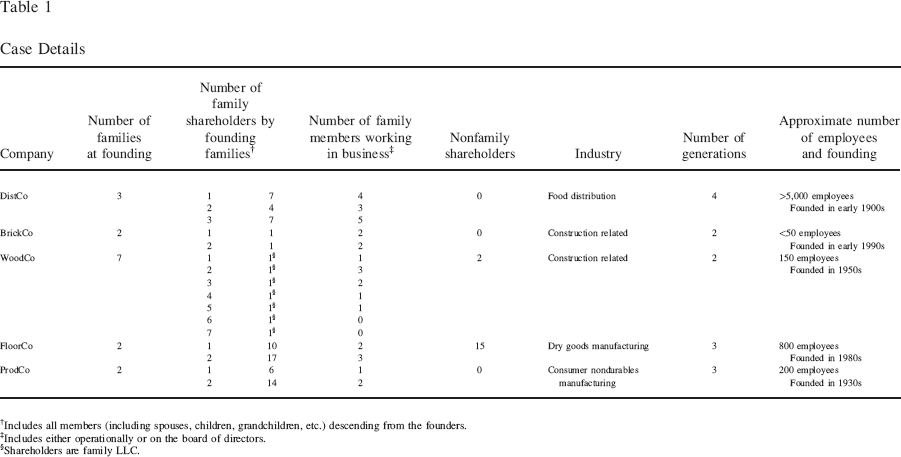
Includes all members (including spouses, children, grandchildren, etc.) descending from the founders.
Includes either operationally or on the board of directors.
Shareholders are family LLC.
Interviewee Description
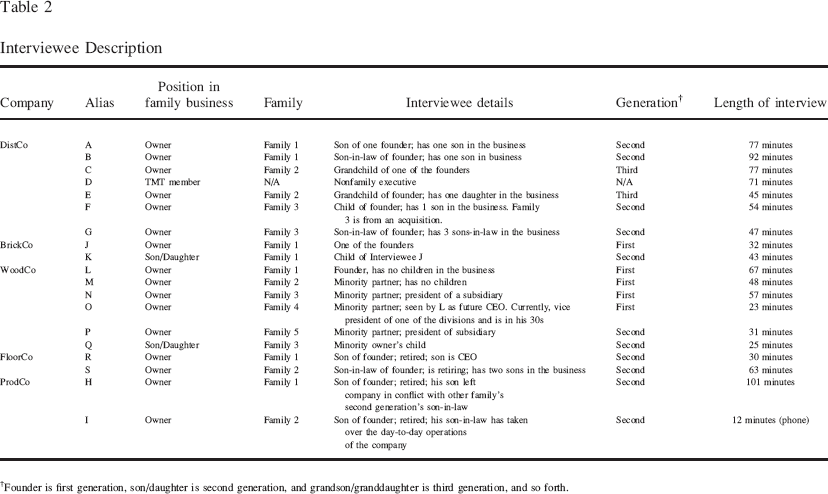
Founder is first generation, son/daughter is second generation, and grandson/granddaughter is third generation, and so forth.
Data Collection
The data for this research were collected through a series of face–to–face interviews. Prior to each interview, the researchers reviewed websites and/or public press reports to obtain an understanding of the business and respective industry. All interviews were conducted at the company headquarters (except for one telephone conversation, Interviewee I) and typically behind closed doors in the interviewee's office. Furthermore, the same researcher conducted all interviews (with the exception of one, Interviewee A); emerging insights from case visits were discussed with a family business researcher and consultant. Later, another, outside researcher without familiarity with the phenomenon or the interviewees joined the project.
The interviews started with company DistCo in February 2010 and finished with company FloorCo in January 2011. The interview focus was how multifamily businesses persisted across generations of ownership with multiple probes related to understanding conflict that might lead to dissolution; management processes that enhance persistence; and the continuance of the multifamily status instead of devolving into a single–family business form, acquired by another entity, or broad ownership without concern for the founding families. Given the sensitive nature of topics, confidentiality was a prominent concern.
Data Analysis
In total, this study produced over 400 pages of single–spaced transcripts. We used qualitative data analysis software to manage the case data. There were two coding efforts—the interviewer created an initial set of codes and another set was created by a researcher who was blind to the initial coding effort and an outsider to the project. Codes were compared through an iterative process that merged similar codes with each other and identified emerging categories that grouped together several codes (Glaser, 2011). This process continued as we compared categories across the five cases for consistent patterns.
In comparing the codes, we found that one company, ProdCo, was substantially different from the other four firms in terms of conflict and decision–making processes. To substantiate this insight, we returned to a former ProdCo board member (who was still an equity owner) 4 years after the initial interview. From this follow–up interview, we were surprised to learn that this owner no longer considered the firm to be a multifamily enterprise, rather one where founding heritage and multifamily status had been substantially erased. 4 According to this interviewee in 2015, “There is no evidence of it being a family business anymore and the families are no longer actively involved in the business.” We identified ProdCo as a “negative case” 5 to emerging theoretical patterns from the other four cases. The emergence of a negative case is not unusual in grounded theory and helps to sharpen theoretical insights (Holton, 2007).
By constantly reviewing and comparing these codes, we gradually reduced the final list of codes, which were merged into broader categories; these categories were further aggregated into overarching themes (Clark, Gioia, Ketchen, & Thomas, 2010; Corley & Gioia, 2004). Rich quotes linked to these codes are provided in the Findings section. Theoretical contributions emerged from relationships among the themes. We considered connections to several theoretical domains and assessed “the extent to which each theoretical template contributes to a satisfactory explanation” (Langley, 1999, p. 698). We found the best fit with imprinting and simple rules to explain longevity as a multifamily organizational form.
Efforts to Enhance Trustworthiness
Trustworthiness in qualitative research includes credibility, transferability, dependability, and confirmability of findings (Krefting, 1991; Lincoln & Guba, 1985; Wallendorf & Belk, 1989). We highlight several actions undertaken in our research to enhance trustworthiness of our findings. In data collection, cases were selected purposively based on their size and age to enhance understanding of the multifamily phenomena. Informants were selected based on their knowledge of the firm's history, role as executive and/or owners, and contemporary understanding of key organizational processes. Accordingly, some companies had many informants, and other, mostly smaller companies had fewer opportunities, and thus fewer interviews. Respondents were remarkably frank in their comments about their company, executives, and family members (with some displaying a surprising level of candor about politics and religion as well as profanity). Frank discussion of conflict was noted in each case, but it was usually about a business issue in which several parties had differing viewpoints. Only in one case (ProdCo) was conflict discussed as more affective and destructive. All interviews were recorded and transcribed verbatim in a timely manner (typically the next day).
In data analysis, having an outsider not involved in the research design, interviews or the initial coding is a luxury few qualitative studies employ. An outsider drawn into a research project provides another (perhaps more objective) review of the research process and previous coding. The outsider had limited knowledge of family business research, but brought qualitative experience and a fresh perspective to developing codes, categories, and themes (Saldaña, 2012, p. 12). All four researchers in this project were involved in conceptual connections to larger theoretical contributions, which were an iterative process and achieved through ongoing and extensive conversations. Through several cycles of reviewer input, we iterated between codes to themes to theoretical insights, ever tightening our contributions in a process resembling a “hermeneutic spiral” (Mischen, 2007, p. 545). Having a negative case (ProdCo) also helps to further refine theoretical connections (Wallendorf & Belk, 1989). Research insights were shared with all interviewees. The dense description of each case, related to the trustworthiness issue of transferability, “allows others to assess how transferable the findings are” (Krefting, 1991, p. 220). Triangulation of investigators and testing of several theoretical connections (i.e., alternate templates) further enhances our findings and contributions from this study. Overall, we undertook substantial efforts to enhance the four elements of qualitative research trustworthiness.
Findings
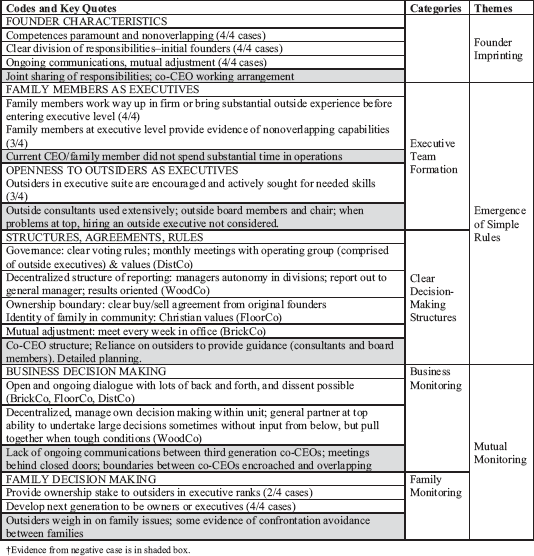
The key findings are summarized in Figure 1. To understand why and how the four multifamily firms persisted, we identify that they developed simple rules to use in managing their businesses. We identify two types of simple rules that emerged: those related to executive team formation and boundaries for decision–making. It is the development and use of these rules that was similar across these four firms, although we were surprised at the similarity of the executive team formation rule content for the four multifamily firms. We discuss the simple rules that developed in these firms below. Then, we step back to consider where the rules emerged, and how the rules were manifested in ongoing processes, which we label as mutual monitoring. In ProdCo, complex processes, not simple rules, were created to manage complexity.
Connections Among Codes, Categories, and Themes†
Emergence of Simple Rules
In four of the five cases in our study, two types of simple rules emerged: executive team formation and decision–making boundaries. In executive team formation, four of the five cases provided similar rules: evidence of clear competence fit among top managers as opposed to family relationships and recruiting top executives from outside the family was connected with the three older multifamily businesses. The other simple rule is clear decision–making boundaries, which is directly connected to their ongoing monitoring of business and family issues. While we flesh out the content of these simple rules below, it is the development of these rules and subsequent use (i.e., mutual monitoring) that differentiates these firms from ProdCo's approach to managing complexity. Certainly, the content of simple rules that we discuss below are particular to this setting and group of multifamily firms.
Simple Rule: Executive Team Formation
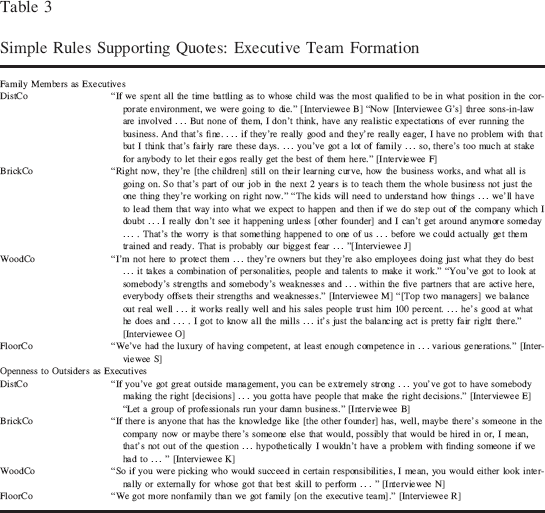
The content of this simple rule was identified across the four multifamily cases and includes two features: family member skills and openness to outsiders. Supplemental quotes related to the content of this simple rule are found in Table 3.
Simple Rules Supporting Quotes: Executive Team Formation
Family Member Skills
Family employment decisions were based on proven skills from outside work
or working their way up the organization. WoodCo founder Interviewee N
made clear the need for creating a rule about family in executive ranks: The problem [at other family firms] is they don't
This concern for employment based on competencies and skills was also clearly articulated by BrickCo cofounder (Interviewee J) discussing founder children entering the business, “If they do come here, then that will be a challenge … how do they fit in and where will they help us.” Interviewee S, from Family 2 of FloorCo stated, “We have had the fortunate ability that competence has been in place with family members and the interest has been there.” DistCo Interviewee D stated, “For someone [in the families] to move into senior management, they have to work their way up to at least running a [large division], if not more.” DistCo's Interviewee E explained, “I made my daughter go from the beginning all the way from the street [the bottom].” Interviewee R of FloorCo explained about his grandson's possibility of entering the business but who was currently doing yard work at the company in his summers.
Conversely, instead of talking about specific skills and rising through
the firm, Interviewee H at ProdCo did not identify the emergence of
simple rules in general or top team formation in particular. He spoke
abstractly about family members fitting a mold. The current CEO (a
family member) did not spend time, similar to the second–generation
executives, in the operations: [The current CEO] would go out in the plant and work with
somebody for a while and half day … it wasn't for him. … We felt
that it was important if you were going to be part of this
operation to understand the process, not that you're going to
work in there for a year but at least to spend 2 weeks over a
period of 2 or 3 months in each of these areas to understand
what goes and get to know the people. Because … it was a family
business atmosphere … a first name basis … and [second
generation of executives from two founding families] were both
very much out in the plant.
The decision to appoint the next generation led to a power struggle at ProdCo, which created rifts in both the business and the respective families.
Openness to Outsiders in Leadership
The second feature of the executive team formation rule was an openness
to outsiders in leadership, which was identified in three of the four
family firms that persisted. DistCo's Interviewee E made the connection
between outside leadership and executive team formation based on competencies. The outside management helps because what happens when you
started getting these other generations—you get individuals that
aren't qualified, you have a real difficult time telling them …
outside management almost tempers that.
The highest ranking outside executive at DistCo (Interviewee D) described the family rationale for bringing him into executive leadership, “Their logic was simply that for them to be able to relate as two separate families in the complex world that we were evolving into because of the supplier demands and because of the opportunities to acquire other companies, they wanted someone like me.” A WoodCo owner (Interviewee N) explained further, “You have to pick the best ones [of the family members] and put them in the best spots and if they don't work, you bring them in from outside … . let somebody run the company and pay them for it.”
Simple Rule: Clear Decision–Making Boundaries
In the four firms in which the multifamily form persisted, a simple rule about boundaries for decision making emerged, although with different manifestations within the four firms. This simple rule was related to broad boundaries, not detailed planning or reliance on outsiders, to solve problems, which was a process seen within ProdCo. Below, we identify some of these boundaries.
One firm (DistCo) had clear voting rules within the board, which was
comprised of six representatives from three family owners. DistCo board
members meet monthly with the top executives (mostly from outside the
families) to engage in decision making. Interviewee G from DistCo described
these rules: Our agreement takes a super majority … we even defined it further in
our corporate charter. … If 5 people say [yes]—only one says [no] …
then it happens. If 2 people [say no] and 4 [say yes]—then it
doesn't happen until we have consensus.
Another DistCo owner C stated, “We have a governance model, we stick by it.” DistCo's Interviewee A described their boundaries, “So we have a whole set of rules laid out: the process that has to be taken before a family member gets promoted and so forth, pay scales, etc. and so forth … it's a lot cleaner right now than it was.” The nonfamily executive of DistCo (Interviewee D) elaborated, “The core value that goes into a board meeting is that a decision isn't made until we've all thoroughly talked about it and are in general agreement.” Another important DistCo boundary was the approval of their suppliers who held tremendous sway in this industry.
Clear values and ownership rules were articulated by FloorCo interviewees. One second generation FloorCo owner, Interviewee R, stated the overriding goals, “We wanted to build a company that would be a good place for a lot of people to work and to grow and to be known within the community as a good contributor to this community and I think it has been and those are the goals.” As well FloorCo had developed very specific rules about ownership shares with only family members able to pass shares to other members or to create new members. WoodCo has created a structure in which the reporting is clear—a holding company with 11 separate subsidiaries with their own management. The decision making is not centralized; rather, each unit reports out its own performance. Explained further by WoodCo Interviewee Q, “Here's your deal [subsidiary], take it and run with it … you can do whatever you want to do. If you think it's going to be profitable, make us money. If you think it's a good idea, run with it.” This divisional structure provided autonomy for the executives in charge of each unit, but many interviewees noted that the WoodCo owner with largest equity share can take unilateral actions. The CFO who is an owner explained that the CEO has ultimate authority within the decentralized structure, “He's got the final … it's his final decision. And we knew that going in … and it's fine.”
BrickCo had few rules given its small size and the founders were still in charge. They met regularly, expressed by Interviewee J, one of the founders, “Yea, we talk every day though. I mean, we talk every day. … When he [other founder] is here we usually will go over job costs, reports and start talking about it. If there's something worrying me or bothering me about what's going on, we'll talk about it and it's the same thing with him.”
Yet, why and where did these simple rules emerge for these four firms? We identify that development and the content of these simple rules are linked to the imprint left from the founders from the original families.
Founding Conditions
Because we were able to interview some of the founders as well as managers and generations connected to the founders, the link between the founding conditions and development of simple rules used was evident. Specifically, the founders explained the rationale for the creation of the multifamily firm—the joining of distinct competences valued to be successful in the industry. In all four firms, a clear demarcation of responsibilities by functional expertise and regular ongoing communications were significant features of the founding years.
The conditions underlying the foundation of the multifamily businesses included
in our research show several similarities. The individuals who were prominent in
founding had complementary, nonoverlapping skillsets, competences needed to be
successful in that industry. For example, in the case of DistCo, the two
founders offered distinct yet complementary skills—sales and finance needed in a
distribution business. This was described by Interviewee D: [One founder] was great at the … sales side. He was a salesman … he had a
great sales personality and style … relationships with the suppliers …
[the other founder] … was a man that had run businesses so he was very
good financially with real estate with the practical aspects of
business. … One was an introvert and one was the extrovert but you kind
of get the sense that they were and both made a great team.
In WoodCo, their first employee (Interviewee M) described the founders, “They had different talents and there wasn't … competition between them … we need the banking talent … we needed the purchasing talent.” FloorCo founders also had different competences as explained by Interviewee S, “[One founder] was the consummate salesman, could care less about administration. [The other founder] was a very good administrator but also a very good technically competent person. … [One founder]'s out here basically building relationships in the field and [the other founder] is back here basically making good product.” At BrickCo, this same field/office division is seen in the comment of the son of the founder Interviewee K, “[The other founder] is so experienced out in the field … and can answer any problem or anything and my dad in the office on the business side of it.” The founders not only brought different competences but a process whereby they deferred to each other's competence and areas of responsibilities. Interviewee N from WoodCo summarized the founders’ influence, “They each had their areas and it was very successful and different personalities but they blended and it worked extremely well … it fit and it made sense and the company prospered.”
This distinction of founder competences was imprinted on these firms and noted in some interview comments. WoodCo Interviewee M noted that the two rising family members currently in the firm had the “same parallel” as the founders with their distinct skillsets and strengths. In DistCo Interviewee G noted that “several of us [sons of the founders] reap the rewards of nepotism and we're under very strong people that were forceful and dynamic” who imprinted their values onto the firm. Building on the early delineation of lines of responsibility, FloorCo Interviewee S noted that “In the 1980s and early 1990s, we all literally deferred to each other amazingly well and it all worked.” Clearly, the contemporary approach to executive team formation had close connections to founder distinct competences.
Several boundary conditions for decision making were established early on by the founders. For instance, FloorCo Interviewee R noted that the buy/sell agreements were formalized at the outset with the company; he explained how the company was valued each quarter and key man insurance in place in case one of the founder died while running the company. As expected, founder values were still referenced in many of these cases, such as: DistCo (“preservation of capital is what it is all about”) and FloorCo (“common values,” “place in community,” and “Christian values”). These values created boundaries within which decision making took place.
Mutual Monitoring
While we were not privy to meetings, the interviewees provided examples and rich quotes about their monitoring processes. Business decisions were characterized by open communications (with the potential for open dissent); family decisions reflected a concern for the continuance of the organization as a multifamily enterprise; by a focus on the next generation; and, in some cases, offering an equity stake to outstanding nonfamily executives.
DistCo executives discussed at length the series of mergers in the last few
years. Most mergers were with other strong family firms who had similar values
and whom they had known in the industry. Interviewee A stated, “The guys that we
did this deal with I've known for almost my entire time in the business and
we've been friends, and you know, they're good people and they have values.”
Interviewee E at DistCo noted that these mergers had been successful and with
the outcome benefitting their decision making: You now have more families but now you're dealing on a board basis and it
[is] almost better … if you have anything weak inside, you have a much
bigger group to sort out problems—turn it down, control it. So, …
because before when it was just a couple of you, you get a lot of crazy
things going. When there are six of you … it settles down a little.
The meetings to discuss business decisions included the top three executives
(from outside the families) and the six owners on the board. The current CEO
Interviewee D explained the give and take and tough questioning of business decisions: All of the presentations are led by us [top executives]. So there will be
an agenda of topics and one of us is taking them through that … . they
ask a lot of questions and challenge and sometimes send us back for
further explanation. … I attribute that not so much to the personalities
of the people as it is to say, “This is my business. I need to know the
details.”
Interviewee D described a level of openness and transparency in DistCo (as compared with a large company where he worked before); decisions are made at the meeting, not behind closed doors.
WoodCo's business decision making was less of an open, group process as compared
with DistCo. Because of its decentralized structure, the top executive and owner
of WoodCo would unilaterally make decisions, as explained by Interviewee P, “You
know, he … as a majority owner of the company … he rules. So we kind of go along
with that but then again … [we] handle our part of the business and it's
respected that way so I think that's one of the reasons why we don't clash too
much.” The CEO Interviewee L noted that he does make some unilateral decisions,
but identified how the owners and executives pulled together to face recent
tough years in the construction industry, “We're a group of families on a ship
sailing and there's always going to be a leak and one of us, whoever can, knows
how to fix the leak, fixes the leak and if we all don't know how to fix the
leak, then we get together and fix it together.” The outcome of business
decisions within the decentralized units—whether managed by an executive who was
an owner or not—was closely scrutinized on a regular basis, as explained by
Interviewee N: Now, I don't care who you are, if you're not doing your job, you know,
I'll bite your ass or whatever else or we will talk about whatever those
challenges are and they don't try to one up saying “well, you know, I
have more authority” and this and that or whatever else, they all have
their jobs, they all have their place, they all do what they're supposed
to do and so then it never comes into question. … they all have certain
very important levels of authority within the operation that they're
responsible for.
As far as family issues, the CEO was concerned that two rising executives needed an equity stake in the firm whereby he “guaranteed their loans and they became partners.”
At FloorCo, a give–and–take approach similar to the current founders at BrickCo
was noted. Interviewee S at FloorCo, a son of one founder, described their
approach to business decisions, “You get down to any one transaction, you know,
if [son of other founder] felt strongly about it and I felt strongly the other
way, we'd talk about it … there was always the dialogue.” Interviewee R at
FloorCo discussed a specific decision to hire his father's (founder) partner's son–in–law: The choice was given … the invitation to join the company … which he
responded favorably to without any pre–set conditions. We need some help
here and he came in as a director of administration or something like
that and after a period of time became a vice president of
administration, financial administration … he had a financial background
as well as a legal background so he brought great administrative
background to the job.
Similar to WoodCo, FloorCo managers extended options to key officers to become shareholders in the firm to recognize their contributions to the success of the multifamily firm.
BrickCo, the youngest and smallest of the four firms, provided evidence of a
monitoring process similar to DistCo and FloorCo. One founder, Interviewee J noted: Well, usually I'm way too aggressive as far as doing work and wanting to
do more work and [other founder] is way more conservative because he
wants to … he would rather have one big job and take care of it and keep
control over it better so he's pulled me back a lot and I've pulled him
along a lot more though so I've easily stretched him into an
uncomfortable zone. He doesn't have a problem with it. But that's
probably our biggest … it's not really an argument … it's just our
philosophical differences.
Both founders had a child in the firm, but given that both children were still full–time college students, they had small jobs during breaks and in summers.
ProdCo Case: Meeting Complexity with Complexity
Evidence from ProdCo indicates that it did not develop simple rules to handle the
complexity stemming from their multifamily form. Rather, this firm utilized a
wide array of consultants for organizational functioning, outside board members
and chair, detailed planning, and overlapping executive responsibilities. This
complexity resulted in growing tensions, a split between third generation
executives, and an eventual change from a multifamily form. Coordinating with a
variety of outsiders across organizational boundaries (as compared with internal
coordination in the upper echelons of the other four firm) was evident in
ProdCo. In the second generation, ProdCo increasingly used outside consultants,
even to the extent of relying upon them to access the readiness of the third
generation to govern. As Interviewee H described, an external consultant was
hired and “saw no reason why it [co–CEOs] wouldn't work. So we went ahead and
did it. … [The consultant] was definitely effective in coming to that decision.”
As ProdCo Interviewee H stated: We struggled on an issue or in an area … we were equipped to recognize
there was expertise on the outside to help us … we'd bring them in.
Whether it was a banker or an attorney. … [We] brought in a chap to
basically do a management training thing.
The board was primarily comprised of outsiders because, as explained by ProdCo's Interviewee I, an outside board could “be a little more objective, you know, and be able to handle things rationally rather than emotionally.” When there were tensions within executive team, an outside CEO, as suggested by Interviewee H, was not considered. While the above four firms created distinct boundaries (i.e., internal agreements, structures, values, and rules within which their decision–making processes took place) as a simple rule, ProdCo relied increasingly on outside consultants and invested in detailed strategic planning.
Simplicity can also be associated with creating unambiguous lines of responsibility and clear rules, but this again was not evident at ProdCo. The second generation representatives of both families operated as co–CEOs (but “without the moniker”), according to Interviewee H. According to Interviewee H, “We shared responsibilities … yes, we had some bumps in the road. And when we did, we looked outside to get a hand.” This structure was carried over to the third generation in the firm, but without clear lines of responsibilities, which led to problems.
One reason for the lack of simple rules could be ProdCo's founding. The two ProdCo founders did not clearly separate tasks and responsibilities based on individual skills and competences. In the third generation (in charge at time of initial interviews), the co–CEO structure of joint sharing was continued when a son of one family and son–in–law of the other family were appointed. In this case, the overlapping responsibilities became a source of friction, leading the son to leave the firm, a move led by outside board members. Interviewee H noted that the two CEOs were “not getting along very well … they just weren't communicating … they were each going to do their own things … they weren't talking to each other about. They were both hearing about things from others … you know what he did … what this guy did?” Twice, Interviewee H expressed regret that he did not confront his former partner, but he did not openly discuss the issues with him. These approaches to monitoring—relying on outsiders to provide input on key business and family decisions, poor communication between co–CEOs, and not speaking up—are associated with the eventual buyout of the son who left the company and movement away from a multifamily organizational form. Overall, ProdCo does not appear to have developed a set of simple rules to guide its organization over the generations.
Discussion
We now discuss the connections and relationships among these constructs and integrate them into an overall framework, shown in Figure 2. We will use this model to guide the development of three propositions that connect the various components of our emergent theory.
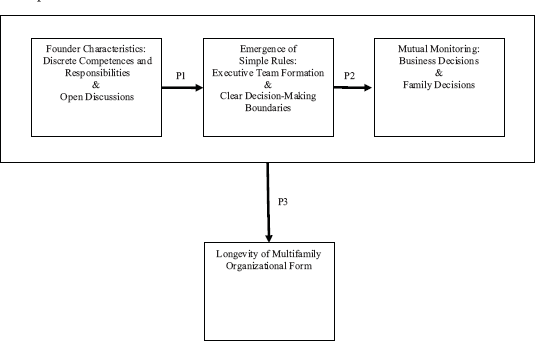
Conceptual Model
Conceptual Model and Research Propositions
The results of our study suggest that the multifamily businesses in our research developed and used a concise set of specific and relatively simple principles and rules; these rules referred to executive team formation and clear decision–making boundaries. While the emergence of simple rules was consistent across the four cases, each multifamily business developed its own idiosyncratic content within the identified rules (Bingham & Eisenhardt, 2014), providing the families direction for appointing family members into leadership positions and instilling boundary rules for effective decision making without confining it (Eisenhardt & Sull, 2001). We recognize that it is the emergence and utilization of the simple rules that differentiate these four firms from ProdCo, a firm that met complexity with a more complex structure and approach. Further, we do not argue that the content of the simple rules that we found in our study would apply to other settings; it is rather the development of simple rules to utilize in managing complexity.
Multifamily businesses are relatively more complex entities than single–family businesses due to the very fact that they must accommodate two or more nonrelated families in the family business texture in addition to dealing with the “normal” complexities encountered by single–family businesses (Pagliarussi & Rapozo, 2011). In addition to these internal complexities, four of the five multifamily businesses in our study also faced considerable industry changes. Specifically, three companies were dealing with recession–related construction downturn (BrickCo, FloorCo, and WoodCo) and one with massive industry changes (DistCo), increasing the level of complexity by orders of magnitude. Instead of responding to complexity with complexity, four of the five multifamily businesses in our sample adhered to a strategy of simple rules enabling them to manage their complexities effectively, an approach that has been found advantageous in prior research (Bingham & Eisenhardt, 2011; Bingham et al., 2007; Brown & Eisenhardt, 1997; Davis et al., 2009).
Given the emergence and importance of simple rules for the management and governance of these multifamily businesses, the next question is “how did these simple rules emerge?”, a question that has remained widely unaddressed in the literature. The results of our qualitative study suggest that the founding conditions underlying these multifamily businesses left an imprint on the organization and the families involved, and manifested themselves in the simple rules found in subsequent generations. We typically think of path dependencies as straightjackets in which managerial decisions must be made, thereby inhibiting managerial choice (Stinchcombe, 1965; Sydow, Schreyögg, & Koch, 2009). Accordingly, prior family business research has found the presence of a generational shadow, in particular that of the founder, to negatively affect subsequent generations (Davis & Harveston, 1999). Contrary to this notion, in four of the five multifamily businesses included in our study, the founding conditions appeared to have a positive impact in that they provided rules and boundaries for the effective management processes in subsequent generations. These founding conditions explain the subsequent “adoption of particular structures, as well as certain premises that guide decision–making” (Baron, Hannan, & Burton, 1999, p. 532). Specifically, these companies benefited by having two distinct sets of nonoverlapping competencies related to the two founding families that enabled them to complement each other while jointly sharing ownership in the business and ultimately prevented arguments and disagreements about roles and responsibilities.
Our research supports the logic that founder influence can persist well into the
life of the firm, complementing extant literature on organizational imprinting
(Baron et al., 1999; Mathias et al., 2015; Schein, 1983; Simsek et al., 2015).
In particular, the results of our study inform the emergent research on
second–hand imprinting (Jaskiewicz et al., 2015) by showing that founders can
leave an organizational blueprint through particular firm–level decision–making
processes long after the founder has left the organization. This finding fits
with the primary role of the founder in creating organizational culture
(Eddleston, 2008; Schein). Based on this discussion, we propose the following:
The results of our research suggest that simple rules provide a set of succinct,
straightforward, hard–and–fast rules that define direction without confining it
(Eisenhardt & Sull, 2001). We have also seen that the simple rules provide
the families with greater ease in monitoring each other. While we consider the
simple rules as more static, we see the mutual monitoring as the dynamic
implementation or ongoing enactment of these rules. The simple rules assign
clear roles and responsibilities to the leadership team and thereby reduce the
amount of ambiguity or room for misinterpretation, all of which can undermine
accountability (Guidice, Mero, & Greene, 2013). Furthermore, we found that
mutual monitoring referred to both business and family decisions, providing
oversight at both levels. In fact, prior research suggests that family
businesses that put equal emphasis on governing both the family and the business
are more successful than those who unilaterally favor one over the other (Basco
& Rodríguez, 2009). In some of the cases in our sample, the simple rules
even allowed the companies flexibility to hire outsiders into leadership roles
when there was no suitable family member, adding yet another layer of external
monitoring to the picture. Based on the previous discussion, we propose the following:
Having looked at the various dimensions of our findings, namely founding context, simple rules, and mutual monitoring, how can they altogether explain the persistence of the multifamily business as an organizational form over several generations? We believe the answer to this question lies in the enactment of the simple rules (Eisenhardt & Sull, 2001) by the leaders of these multifamily businesses. The enactment of the simple rules on a regular basis allowed them to effectively manage the complexities inherent to this type of organization and defy the odds of premature family business demise. For instance, prior research found that adoption of simple rules is associated with competitive advantage (Bingham & Eisenhardt, 2011). Indeed, two of the multifamily businesses in our study, DistCo and FloorCo, undertook a series of mergers, which significantly increased their respective levels of complexity. However, both companies strived throughout the process and defied the odds of poor performance or organizational decline that many mergers face (e.g., Bergh, 2001). One can speculate that the adherence to and implementation of simple rules enabled these companies to manage their increased complexity. One can further speculate that the mindset of using a strategy of simple rules may have also enabled four of the five multifamily businesses to respond to changes in their external environments more flexibly and quickly than the one with the more complex structure (ProdCo). Ironically, ProdCo, the company with the least complexity in terms of industry pressures, created the most complex solutions to family employment (co–CEOs), the most reliance on outsiders to work through issues, and the most detailed strategic planning that coincided with meeting complexity with parallel complexity. This lack of simple rules may have been a catalyst for discord between the families and the conflict experienced at ProdCo.
However, simple rules are not necessarily a panacea. Miller (1993) cautions that
while simple rules may be beneficial in the short term, they hold the risk of
creating internal blinders and a resulting narrowing of organizational focus,
hurting long–term performance. We believe that the mutual monitoring in terms of
task conflict helped to counter the emergence of inertia by allowing the
families to challenge each other's perspectives and underlying assumptions, and
keep each party open to alternative options, resulting in better decisions. The
enactment of the simple rules, imprinted by the founders, and their interaction
with mutual monitoring creates a self–reinforcing, nondiscreet management and
governance process that likely sustains the long–term survival of the
multifamily business. Hence, we propose the following:
Research Implications
The results of our study inform the literature on simple rules in two ways. First, by providing insights derived from more mature organizations (first to third generation) than the more nascent ones that are typically studied in this context (Loock & Hinnen, 2015). Second, by providing clues as to where simple rules come from, namely the founding conditions underlying these multifamily businesses and the imprinting that carries these conditions forward and lets them manifest in organizational processes in subsequent generations. The latter point ties into implications for imprinting research; specifically second–hand imprinting (Marquis & Tilcsik, 2013). Our findings suggest that second–hand imprinting not only affects individuals, but also structures and processes across generations, thereby extending prior literature on imprinting in entrepreneurship and family business (Jaskiewicz et al., 2015; Mathias et al., 2015).
Practical Implications
Family businesses are complex entities, given the overlap of family and business spheres. Multifamily businesses are even more complex than single–family businesses given the involvement of several, nonrelated families. The results of our study suggest that matching complexity with complex management structures (seen in ProdCo) may lead to suboptimal results. Instead, simple rules and well–understood processes (Eisenhardt & Sull, 2001) are associated with better outcomes. Furthermore, the findings suggest that what happens early in the founding of a multifamily business sets the path that is hard to break and can last for generations, long after the founders are gone. This finding implies that single–family business owner–managers and founding teams should spend more time deciding on divisions of authority, leadership, and ownership up front, even when they do not know if the organization will survive. Furthermore, a set of simple rules combined with a system for problem identification (monitoring, in part) and solution development and resolution are necessary to prevent potential inertial tendencies that may sometimes result from an adherence to simple rules. Family businesses who do not have such structures in place may want to think about alternative mechanisms for problem identification, solution development and problem resolution, such as involving a team of trusted advisors or counselors who can provide objective advice and challenge the owning family's assumptions.
Outlook and Conclusion
Like other studies, our research is not without limitations. First, our study is exploratory to understand the emergence of simple rules to manage complexity; further research is needed in other contexts about the development and use of simple rules. Second, our study focused on top teams (managers and owners) and did not look at strategies or operational issues lower in the organization to explain differences among the multifamily businesses. Third, the data underlying our research were gathered at one point in time. However, family relations are not static, but change considerably over the course of time (Richlin–Klonsky & Bengtson, 1997). Therefore, the information obtained through single (nonrepetitive) interviews may represent only a snapshot moment in these families’ lives and development. Fourth, the industries in which most of the multifamily businesses operated went through substantial change and turmoil (construction and distribution). Hence, it could be that the patterns may be attenuated in more stable industries. Fourth, our study relied on only five cases. However, we did have variety among four cases—including fairly young firms with founders still in control (BrickCo) and other firms with the third generation involved (DistCo).
These limitations open up a series of future research opportunities. Using a qualitative approach, future studies could flesh out the insights gained from our research by applying a longitudinal or ethnographic design (Stewart, 1998), allowing the researcher to spend an extended period of time studying and analyzing the relationships both within and between the families of one or a few multifamily businesses in greater detail. As well, biographies of family business owners could be analyzed to support and further insights into relationships identified in our research. Using a quantitative approach, future researchers may deploy a survey to a larger sample of multifamily businesses to determine various other antecedents to simple rules, and look at short– and long–term effects on firm performance and survival. Another interesting and important research opportunity consists of a more in–depth study of multifamily businesses that morphed into single–family businesses or ultimately failed (importantly we need to determine the extent to which they had simple rules in place). This could be done, for instance, through a matched–case analysis of multifamily businesses in the same industry or of similar size.
Through these multifamily cases, we identify a set of simple rules to manage complexity, trace their origins and describe their consequences for mutual monitoring, and highlight the implications for the maintenance of the multifamily organizational form in the long run. We believe that these processes can be evaluated in further contexts as well as considered by family businesses. We look forward to more fleshing out of our findings in future family business research.
Footnotes
1.
Consistent with the research in strategic management and organization theory (Loock & Hinnen, 2015), we focus on heuristics at the organizational/collective level, and not at the individual level.
2.
Heuristics are different from organizational routines, in that routines prescribe a detailed, almost automatic response to specific problems that, as a result, may not be viewed as problems (Cohen et al., 1996).
3.
The bulk of extant literature, including the present study, focuses on imprinting on the organization. For a study investigating the imprinting process for individuals, see Mathias et al. (2015).
4.
Pictures of the founders which had been hanging in the executive hallways for almost a century were taken down by the current CEO. A second generation owner/executive did not identify ProdCo as a multifamily firm, stating, “Today, the families are not visible in the business anymore.”
5.
This “negative case” is not a reflection of the performance of ProdCo. Rather this nomenclature from qualitative research indicates that this case is different from the main findings.
6.
Founder is first generation, son/daughter is second generation, and grandson/granddaughter is third generation, and so forth.
7.
Evidence from negative case is in shaded box.