







Abstract
Family firm scholars often reference the legacy concerns or intentions of families when explaining strategic decision making in family firms. Yet, the concept of family legacy is not clearly defined or delineated in the literature. As such, we define and explore the family legacy construct from the integrated perspectives of psychosocial development and sense–making literatures. We identify three forms of family legacy: biological, material, and social. Further, we present the family and family firm legacy orientations as unique constructs, offering a theoretical model that proposes the linkages from these distinct orientations to strategic decision making and behavioral outcomes in family firms.
Introduction
Pursuing a legacy is a mechanism for transmitting what an individual, a family, or a firm stands for (Hunter & Rowles, 2005). In the context of the family firm, interest in the family's pursuit of a legacy has grown along with the widespread acknowledgment that controlling families value many nonfinancial and family–related outcomes, suggesting that the family legacy can be a motivating form of socioemotional wealth (Chrisman, Chua, & Sharma, 2003; Jaffe & Lane, 2004; Miller, Steier, & Le Breton–Miller, 2003; Zahra, 2005). Accordingly, the shared intentions and preferences a family has toward its family legacy is often suggested as playing a role in guiding family firm behavior, influencing family firm decision making, and establishing both material wealth and values that may be passed down to future generations (Aronoff, 2004; Baker & Wiseman, 1998; García–Álvarez & López–Sintas, 2001; Lumpkin, Martin, & Vaughn, 2008; Salvato & Melin, 2008; Sharma & Manikutty, 2005; Steen & Welch, 2006).
While the term legacy, in one form or another (e.g., family legacy, family business legacy, founder legacy), is prevalent in the family firm literature (e.g., Aronoff, 2004; Baker & Wiseman, 1998; García–Álvarez & López–Sintas, 2001; Jaffe & Lane, 2004), it is also highly elusive. Family legacy, although rarely stated explicitly, has been conceptualized as a fluid construct which may be developed and preserved over time and is malleable across generations (Baker & Wiseman; García–Álvarez & López–Sintas; Sharma & Manikutty, 2005). Similar to other constructs (e.g., socioemotional wealth), family legacy is said to interact with contextual elements such as time, culture, and history (Staufer, 2011; Thompson et al., 2009). Nevertheless, family legacy is a construct that family firm scholars often use under the pretense that the term is fully understood and its conceptualization universally accepted (Chrisman et al., 2003; Miller et al., 2003; Zahra, 2005), leaving a void regarding its meaning and basic structure. This conceptual ambiguity makes it difficult to fully understand the pursuit of legacy, a key behavioral outcome that family businesses are striving toward, which, in turn, hinders the theoretical development of family business research (e.g., Chua, Chrisman, & Steier, 2003).
To address this ambiguity, we have several objectives. First, we endeavor to define family legacy, offering a theoretically derived explanation of the key artifacts and preferences that are linked to each. Derived from a sense–making perspective which posits that one develops a sense of understanding through retrospect and social interactions (Louis, 1980; Weick, 1995; Weick, Sutcliffe, & Obsfield, 2005), we propose that family legacy represents a collective or shared perception reflecting a unique and continuous stream of meanings associated with the family that are transferred to and shared most often, but not always exclusively, among generations of family members through a collection of legacy artifacts. Family legacy artifacts, in turn, exist as both tangible and intangible things by which the unique and continuous stream of meanings associated with the family are imprinted, transferred, and interpreted between and amongst generations (Dyer, 1988). Family legacy artifacts do not explain the existence of the family legacy, but rather represent a medium by which the family legacy information is coded and decoded over time (Hunter & Rowles, 2005). Family legacy artifacts may include a bloodline, familial status, or name (i.e., biological legacy artifacts); objects such as family heirlooms, land, money, property deeds, legal patents (i.e., material legacy artifacts); and shared family stories and values (i.e., social legacy artifacts; Hunter, 2007; Hunter & Rowles). Further, the pursuit and presence of these artifacts can vary independently, meaning that the collection of artifacts may represent all the family legacy forms (i.e., biological, material, social) or only a subset, being the result of either a purposeful choice or an environmental constraint (e.g., few or no offspring limit the ability to preserve a family bloodline).
As our second objective, we delineate family legacy from two distinct orientations: (1) the family legacy orientation and (2) the family firm legacy orientation. These distinctions emerge theoretically when sense–making is coupled with a strategic choice perspective, which posits that the guiding coalition 1 of a family firm evaluates its position relative to shared aspirations and goals to develop a set of strategic choices that are subsequently reflected in actions (Child, 1997). As our third objective, we go on to detail how the family legacy and these distinct orientations relate to one another and the implications this has on the family legacy and family firm, providing a basis for “more nuanced investigations” into constructs such that researchers can explore “how they are likely to lead to very different sets of firm behaviors and performance” (Zellweger, Kellermans, Chrisman, & Chua, 2012, p. 864).
Cyert and March (1963) contend that coalitions are formed among individuals within organizations to influence the goals that the firm will pursue where the guiding coalition represents the group exercising the most influence in the goal–setting process.
A clear explanation and understanding of family legacy has far–reaching implications that contribute significantly to family business scholarship. Hunter and Rowles (2005) maintained that legacy is a way in which key elements of identity are projected and shared across generations, describing legacy as a means to “transmit a resilient and enduring image of what we stood for” (p. 328). This transgenerational perspective resonates with family business scholars who have widely acknowledged that family firms represent a unique system that transmits “the essence” of the family (Chrisman et al., 2003; Jaffe & Lane, 2004; Miller et al., 2003; Zahra, 2005). Consequently, a well–defined family legacy construct coupled with an understanding of the key artifacts linked to the family legacy provides a lens with which to examine the family's essence, multigenerational bonds, and the long–term outcomes that emerge from these phenomena such as shared values and culture, shared memory, and shared meaning (Bengston, 2001; García–Álvarez & López–Sintas, 2001; Sharma & Manikutty, 2005; Zerubavel, 1996). Further, a comprehensive and specific conceptualization of family legacy that differentiates it from the family and family firm legacy orientations strengthens and extends our understanding of how specific nonfinancial concerns may influence strategic decisions in the family firm, exposing unique facets of the family and unseen challenges that may further differentiate family firms from nonfamily firms (Zellweger et al., 2012).
Legacy in the Family Firm Literature
Discussions of family legacy in the family business literature most frequently involve mere references to the concept (see Table 1), largely treating it as an important outcome pursued by family firm owners or as a causal antecedent guiding decision making. 2 Describing it as the former, Zellweger, Nason, Nordqvist, and Brush (2013) noted that “a strong intention to assure a continued family legacy can be seen as equivalent to the wish to make the family an enduring element of the firm” (p. 234). Others have honed in on the specific ways in which family legacy is manifested. Taraday (2013), for instance, states, “a family's legacy is the sum of valued accomplishments, traditions, assets, histories, experiences, lives, places, and memories that flow from the past through the present into the future” (p. 200). Similarly, Baker and Wiseman (1998) suggest that “legacy is what an individual leaves behind and how he or she is remembered when no longer working in the business” (p. 209). Moreover, the things left behind take the form of material wealth, the firm itself, other physical artifacts (with economic or sentimental value), shared values, names, genes, or bloodline (e.g., Cruz, Justo, & De Castro, 2012; Habbershon & Pistrui, 2002; Santiago, 2000; Ward, 1997; Zahra, Hayton, & Salvato, 2004).
The references made to legacy in 109 articles (from January 1995—February 2015) are presented in Table 1. Using Google Scholar, these articles were identified by searching the exact word “legacy” along with the phrase “family business” within the following journals: Family Business Review, Entrepreneurship Theory and Practice, Journal of Business Venturing, and Journal of Small Business Management.
Selected Review and Categorization of the Legacy Literature From Studies on Family Firms
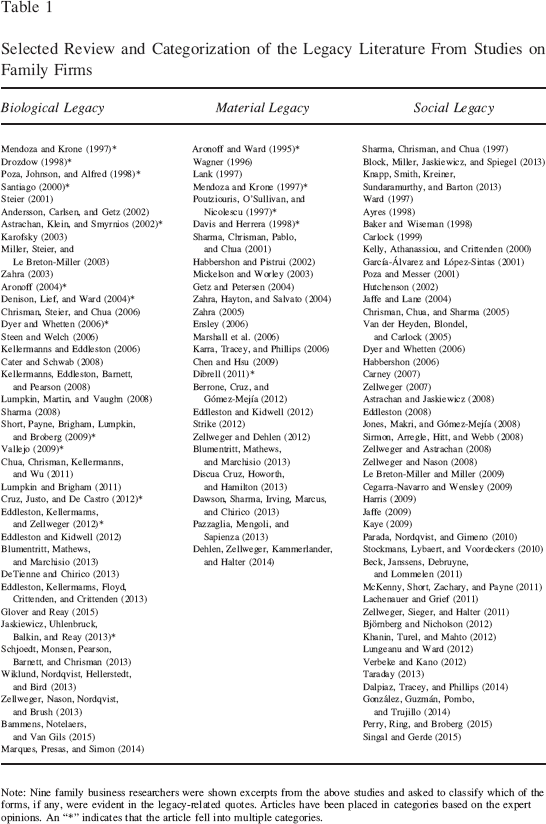
Note: Nine family business researchers were shown excerpts from the above studies and asked to classify which of the forms, if any, were evident in the legacy–related quotes. Articles have been placed in categories based on the expert opinions. An “*” indicates that the article fell into multiple categories.
Elsewhere, family legacy has been discussed as an influential driver of decision making and behaviors within family firms that is created through a process of family communication and interaction (e.g., Feliu & Botero, 2016). Kellermanns, Eddleston, Barnett, and Pearson (2008) maintain that the motivation of family firm leaders “to build a lasting legacy for their children” (p. 4) leads them to favor conservative strategies that avoid entrepreneurial endeavors posing a risk to the family's wealth. Stockmans, Lybaert, and Voordeckers (2010, p. 283) expressed similar thoughts claiming, “the founder and the founder's legacy are central to [a firm's] strategy setting and decision making” processes. This influential mechanism has been described as a positive influence that drives a desirable work ethic (e.g., Carlock, 1999) as well as a negative influence that mires the firm with excessively constraining traditions (e.g., Eddleston, Kellermanns, & Zellweger, 2012).
Three implicit assumptions underlie the broad use of the term: (1) family legacy is an important outcome that is pursued by families (often including values and beliefs, as well as elements of wealth); (2) family legacy is a driver of key decision–making processes within the family firm; and, (3) family legacy exists as a collective, family–level concept which is transferred through the ongoing interactions that take place within the family. Because of these broad assumptions, family legacy has become a “stretched” concept (Osigweh, 1989), with too many classes of things lumped together such that there is no precise understanding of its meaning nor its attributes, limiting the field's ability to meaningfully study its role within the family firm. Thus, there is a need to conceptualize family legacy in a precise, theoretically grounded way such that we can also avoid confounds where researchers are unable to differentiate between the concept of family legacy, its antecedents, and its outcomes (Osigweh; Suddaby, 2010). In the subsequent section, we articulate the theoretical boundaries that constrain family legacy, presenting a conceptualization of family legacy and the associated legacy artifacts. Following the discussion of artifacts, we differentiate family legacy from family legacy orientation and family firm legacy orientation that link this important construct to the specific domain of family business. We then present a theoretical model highlighting how family legacy has implications for the family firm through the distinct legacy orientations.
Theoretical Conceptualization of Family Legacy
Although our goal is to focus on family legacy, we acknowledge that legacy can be conceptualized as a multilevel construct occurring at the individual level (e.g., the family firm's founder) as well as the group level (e.g., the family; Morgeson & Hofmann, 1999). The introduction of legacy as an individual–level construct can be traced back to the theory of psychosocial development which outlines the stages of one's life (Erikson, 1963; Hamachek, 1990). The theory of psychosocial development posits that concerns regarding how to “make life count” become salient during the generativity stage such that people in this life stage will exercise either generativity or stagnation (Erikson). Generativity is characterized by the desire to create, leave, or pass on things that will result in positive contributions to others in the future (Erikson & Erikson, 1981; Hamachek; McAdams & de St. Aubin, 1992). Conversely, stagnation leads to a disinterest in passing anything on to future generations (Erikson & Erikson; Hamachek). Concerns for the next generation as well as commitment to the preservation of culture and society arise from altruistic attitudes and trigger expressions of generativity (Erikson & Erikson; Hamachek). The theory of psychosocial development, therefore, assumes that expressions of generativity represent selfless regard for the future and exhibit purity in action while displays of stagnation are egocentric or narcissistic (Erikson).
Hunter and Rowles (2005) argued that the assumptions regarding the motives behind generativity as compared to stagnation have led to a convoluted narrative, limiting the usefulness of generativity in explaining certain phenomena. Consequently, the concept of legacy was introduced to explain why passing things on to future generations is almost universally considered important regardless of the specific motives, removing any stigma of narcissism that has been applied to those who have a proactive desire to be and take comfort in knowing they will be remembered after death (Fox, Tost, & Wade–Benzoni, 2010; Hunter, 2007; Hunter & Rowles; McAdams & de St. Aubin, 1992). Hence, legacy has been more flexibly positioned such that those leaving things behind and those receiving what is left may benefit from the exchange, but do not necessarily have to.
Like many other constructs in family business research (e.g., socio–emotional wealth; Berrone, Cruz, & Gómez–Mejía, 2012), we contend that legacy also has properties at a higher level—the family—and a family legacy emerges through the complex social interactions and exchanges among individual family members (Erikson & Erikson, 1981; Hunter, 2007; Hamachek, 1990; Kotre, 1995; McAdams & de St. Aubin; 1992; Peterson & Stewart, 1993). While it is not our intent to review the large body of work that discusses how emergent states develop, sense–making theory describes how emergent properties of a group, which include attitudes, motivations, values, and cognitions, evolve as a group–level phenomenon based on a social interaction process and influence group outcomes (e.g., Weick, 1995). That is, people imprint meanings and develop an understanding of behavioral expectations through socialization and experiences such that similar and shared experiences will lead to similar expectations and understandings (Leaptrott, 2005; Louis, 1980). Language, history, symbols, and any other verbal or nonverbal communication can influence sense–making. Consequently, members of the same family likely share similar frameworks and patterns of understanding such that there is a tendency for family members to develop homogenous perceptions (Weick).
According to Jaskiewicz, Combs, and Rau (2015), family legacy would represent an emergent state whereby important features, values, and perceptions regarding the family, likely introduced originally by the founder or imposed by external conditions, have become “imprinted” on family members. These features, values, and perceptions emerge as shared ideas and may endure beyond the tenure of the founder or those who worked directly with the founder (Kammerlander, Dessi, Bird, Floris, & Murru, 2015). Consistent with this thinking, others have argued that memories and values can be transmitted to others and across generations through repeated interactions like storytelling such that shared patterns of understanding and collective behavioral norms provide the necessary conditions for a family–level legacy to emerge (Kellas, 2005; Kraus, 2006; Thompson et al., 2009; Zerubavel, 1996). Although we acknowledge that certain aspects of family legacy can only be passed from an older to a younger generation (e.g., genes and names are passed from older to younger generations), we, following the extant theory (Staufer, 2011), make no explicit assumptions suggesting a family legacy must be transferred from older to younger generations.
Forms of Family Legacy
To begin to understand the forms of family legacy, we draw on the work by Hunter and Rowles (2005), who suggest key facets of legacy (i.e., biological, material, and values) developed from a series of 14 qualitative interviews. Although this foundational work is insightful, the theoretical and precise development of constructs demands that the contextual circumstances under which a construct will or will not apply be clearly specified such that researchers can account for any unique nuances (Osigweh, 1989; Suddaby, 2010). Thus, we identify the aspects of family legacy by extending the foundational work of Hunter and her colleagues (Hunter, 2007; Hunter & Rowles) to address the unique characteristics of a shared legacy that emerges within a family first and then consider the conditions that arise when the family is involved with the management and operation of a firm.
The first form of family legacy, biological family legacy, refers to the particular form of family legacy that is transferred via legacy artifacts such as a bloodline, name, or particular family genes (Zacher, Rosing, & Frese, 2011). The second form of family legacy, material family legacy, is generally transferred via artifacts such as family heirlooms, land, money, property deeds, legal patents, or a plethora of other sentimental artifacts passed from one generation to the next (Hunter, 2007; Zacher et al.; Zellweger et al., 2012). The third form of family legacy, social family legacy, consists of the channels and the messages that are employed to transfer the unique set of values held by the family as well as their attitudes and beliefs (Hunter & Rowles, 2005). Formally defined, the family's social legacy is the network of meanings associated with the family transferred through the use of stories or broader social tactics (e.g., community involvement). Social family legacy concerns lead to the family developing strong social ties with other family members through demonstrations of helpful, loving, and forgiving behavior (Schwartz & Bilsky, 1990). Maintaining a positive standing in the community (Blumentritt, Keyt, & Astrachan, 2007) and being committed to the family immigrant heritage (Habbershon, 2006) are examples of behavioral outcomes associated with social family legacy concerns.
Legacy Orientations and Family Firm Behavior
While family legacy reflects shared meanings through a collection of artifacts, the legacy orientation reflects the shared intentions and preferences that the family has toward a collection of legacy artifacts. Within the family firm context, this orientation takes two distinct forms, namely, family legacy orientation and family firm legacy orientation. Family legacy orientation resides within the family and accounts for the varying or even equally strong desires of some families to leave a legacy of multiple forms. For example, a family may have a strong biological as well as social legacy orientation; desiring to preserve the family bloodline as well as maintain strong social ties to the community. Another family may focus on the biological and material forms of legacy; making sure that the family's material possessions are handed down to consanguineous persons. Consistent with sense–making theory, multigenerational interactions and the communication of behavioral expectations between family members establishes common belief structures, reduces intergroup heterogeneity and conflict, provides a framework of appropriate behavior, and promotes the development of cognitive schemes, “allowing the family to operate more as a team,” which facilitates the family legacy orientation (Arregle, Hitt, Sirmon, & Very, 2007, p. 77; Weick, 1995).
When families are involved with family firms, via family owners and managers, the family acts as the dominant social influence within the firm (Arregle et al., 2007; Miller & Le Breton–Miller, 2011; Shepherd & Haynie, 2009), leading to a unique family firm legacy orientation. Over time, since the family controls the guiding coalition in a family firm, the family's legacy orientation, again through processes consistent with sense–making, will evolve or develop into the family firm's legacy orientation. This is typically achieved through the influence of the family–guiding coalition, which consists of family members within the firm who are able to exert substantial influence over the goals and overall agenda of the business (Chua, Chrisman, & Sharma, 1999; Cyert & March, 1963).
The family–guiding coalition uses the business to pursue some or all of the family's legacy goals. These pursuits result in the imprinting of organizational paths such that routines, procedures, and strategies emerge focused on preserving and acquiring the legacy artifacts needed for the indefinite continuance of the family legacy (Kammerlander et al., 2015). The mix of family legacy artifacts that are pursued and acquired by family via firm strategies will depend on the relative importance and current stock of the different legacy forms—biological, material, or social. While the family legacy orientation resides in the family, the family firm legacy orientation resides in the firm and is represented by the shared intentions and preferences that the family–guiding coalition has toward a collection of legacy artifacts. These shared intentions and preferences will, however, be constrained by the power, legitimacy, legality, and resources of the guiding coalition to pursue the artifacts (Mitchell, Agle, Chrisman, & Spence, 2011; Sirmon & Hitt, 2003). In the next section, we discuss the family firm legacy orientations and specific firm strategies that may emerge when various forms of legacy are pursued through strategic decision making in a family firm. In the following sections, “legacy orientation” refers to the “family firm legacy orientation.”
Biological Legacy Orientation
The legacy orientation that represents the preference or intentions of the family–guiding coalition toward legacy artifacts such as a bloodline, family name, or particular genes is conceptualized as biological legacy orientation (Hunter & Rowles, 2005). By most definitions of family firms, a biological legacy (e.g., pool of familial potential successors) is necessary for a firm to stay a family firm. In order to maintain control over the vision of the firm, it is typically to their own biological legacy artifacts (i.e., family members) that the family–guiding coalition transfers ownership and/or managerial control of the firm (De Massis, Chua, & Chrisman, 2008). Mendoza and Krone (1997) highlight the attention given to protecting significant bloodlines and the business through prenuptial agreements used to ensure the family business is passed through the family's bloodline. Emphasis on these biological succession strategies is demonstrated through transfers that preserve the family name or bloodline by limiting ownership to members of a single or very few controlling families.
There is considerable evidence supporting a tendency for family firm leaders to make strategic decisions based on their biological legacy concerns (e.g., Gersick, Davis, Hampton, & Lansberg, 1997). For instance, parental altruism, which represents a trait linking the parents’ welfare to their children's welfare, is grounded in the notion that parents view their children as an extension of themselves. In turn, this inhibits their ability to make unbiased decisions regarding the children's involvement in the family firm (Lubatkin, Schulze, Ling, & Dino, 2005). Some children may be accepted as family members within the firm primarily because they are blood relatives to the owning family or families. Thus, a biological legacy orientation will lead to strategies that focus on continuing the family's legacy through the involvement of the family's younger generations in the firm.
Conversely, a tendency for a family to behave in the interest of preserving its biological legacy (e.g., family name) could result in inclusion barriers for certain members of the family. For example, female family members within a family firm who have married and changed their name may not be seen as acceptable artifacts if the family guiding coalition wishes to continue the presence of the family's name within the firm. Married female members of the family may be perceived as a “dead end” and inadequate for achieving the family's biological legacy goals. The notion that a biological legacy orientation may create conflict for female family members is supported by research findings on the increased tensions amongst family members as women were included in the family firm's decision making (Danes & Olson, 2003). Further research suggests that despite their contributions to both the family and the family firm, women are rarely acknowledged for their contributions and not likely to be considered as potential successors for leadership positions inside the family firm (Jimenez, 2009).
When the family–guiding coalition has a strong preference or orientation for biological legacy and their preference is tempered by the absence of qualified legacy artifacts, then the strategic decisions and behavioral outcomes related to a biological imperative will be determined by (1) the family–guiding coalition's ability to acquire the desired artifact(s), and/or (2) the family–guiding coalition's willingness to adapt to a biological legacy constraint in order to preserve its overall family legacy. For example, a recent study on Japanese family businesses found that in 10% of succession cases, control was passed to an adult male who was not biologically related, but rather he had been adopted into the owning family as a “non–blood heir” (e.g., adopted adult son–in–law). Non–blood heirs are chosen when families “either lack biological sons or desire better quality sons than nature provided” (Mehrotra, Morck, Shim, & Wiwattanakantang, 2013, p. 842). Thus in adopting a non–blood heir, the family has adapted to a biological legacy constraint and chosen to preserve their family legacy through the acquisition of the missing biological legacy artifact (i.e., adopted adult son–in–law).
Material Legacy Orientation
The legacy orientation that represents the preference or intentions of the family–guiding coalition toward legacy artifacts such as money or property rights is conceptualized as material legacy orientation. A material legacy orientation is particularly salient when the family and the firm become inseparable financially, which is often the case as the family and the firm become intertwined and the material wealth of the family becomes accessible to the firm. When material legacy is preferred, families with a high proportion of their wealth in the family firm may tend to focus heavily on risk minimization, stability, and firm survival (Chen & Hsu, 2009).
Goals will be pursued through strategies focused on preserving the transferability and the survival of the family's material legacy artifact(s) (Getz & Petersen, 2005). Thus, the family–guiding coalition will likely be risk averse and disinclined to distribute ownership to nonfamily members (i.e., ownership concentrated within the family). In fact, risk aversion seems to be a very salient outcome of the family's concern for their material legacy. As Chen and Hsu (2009) note, family managers tend to be risk averse, emphasizing stability and survival over other opportunities, which further supports claims from the literature regarding how family firm leaders “become conservative in their decisions” due to “their fear of losing family wealth” (Kellermanns et al., 2008, p. 4).
Likewise, concern for the material legacy may influence succession decisions in a family firm. The firm itself is likely to represent the repository of the material legacy for the owner(s). As such, a material legacy orientation will lead to succession strategies that maximize the utility from the family's material legacy. An endowment effect is likely to cause owners to value the firm at a premium compared to market valuation (Zellweger et al., 2012). The premium value attached to ownership of the firm by family members increases the perceived loss to material legacy that the family would suffer should ownership be transferred to nonfamily members at market price. That is, even if family owners were offered compensation for the financial and sentimental value the family attaches to their ownership of the firm, the family would still suffer a loss with respect to its material legacy because the physical existence or ownership control of the firm itself is a large part of the material legacy. Therefore, given the existence of potential successors within the family, the family–guiding coalition may choose intra–family succession such that the family preserves an important artifact of their material legacy (i.e., the family firm). The desire to preserve and grow the material legacy of the family is likely to lead to the undiversified ownership common in family firms (Anderson, Mansi, & Reeb, 2003).
Social Legacy Orientation
The family legacy orientation that represents the preference or intentions of the family–guiding coalition toward legacy artifacts such as shared histories, deep social ties within the broader community, and strong identification with certain beliefs is conceptualized as social legacy orientation. Specific pursuits based on the family firm's social legacy orientation and the family–guiding coalition's desire to preserve and transfer the family's social legacy have generally been conceptualized within the family firm literature as “reflected by an interest in noneconomic goals such as a focus on family legacy, environmental sustainability, or socioemotional wealth” (McKenny, Short, Zachary, & Payne, 2011, p. 2). As such, research suggests that a “family firm's priorities may be more reflective of the lifestyle the family wants to follow rather than rational business principles” (Gupta & Levenburg, 2010, p. 158) with the family–guiding coalition emphasizing very specific values and beliefs such as commitment to the family (Aronoff & Ward, 1995), history of the family (Mendoza & Krone, 1997), identity (Carney, 2007; Khanin, Turel & Mahto, 2012), traditions (Zellweger & Astrachan, 2008), philanthropy (Feliu & Botero, 2016), and entrepreneurial attitudes (Jaskiewicz et al., 2015).
Projecting the family's own beliefs into the everyday environment of the firm enables the family–guiding coalition to preserve and transfer the family's social legacy as stories are told of the family's involvement. By doing this, the family–guiding coalition creates deeper and longer lasting social ties not only with each other, but with key stakeholders through local community projects and long–term partnerships (Cennamo, Berrone, Cruz, & Gómez–Mejía, 2012; Feliu & Botero, 2016; Gómez–Mejía, Haynes, Nuñez–Nickel, Jacobson, & Moyano–Fuentes, 2007; Shepherd & Haynie, 2009). In essence, a salient social legacy may increase harmony amongst family members, strengthen ties with the community, and lead to strategies focused on the continuity of the family's history and the preservation of the family's values where the binding social ties among family, the firm, and other stakeholders contribute to the perception that the family is a live presence within the firm.
Theoretical Research Questions Emerging from Family and Family Firm Legacy Orientations
We propose that family legacy and the family and family firm legacy orientations are multifaceted and complex phenomena that are formed and transferred over time through the family's interactions with and evaluations of their legacy through collections of artifacts. As depicted in Figure 1, this general model of family legacy and the key orientations provides a framework to develop legacy–related research questions from a variety of theoretical perspectives. From a prospect theory perspective (Kahneman & Tversky, 1979), for instance, we do not yet know definitively if families wish to protect or gain each of the three forms of legacy (e.g., biological, material, and social). Further, however implicit our assumptions may be, we have made no explicit claims with respect to how legacy preferences of the family–guiding coalition may influence their framing of choices as potential losses or gains to their family legacy (Wiseman & Gómez–Mejía, 1998). Thus, future development of the legacy orientation perspective may benefit from concepts within the behavioral agency and prospect theory literature. Identity theory may be another valuable theoretical lens to explore the influence of legacy because it specifically pertains to “who we are” and “how we want to be remembered.”
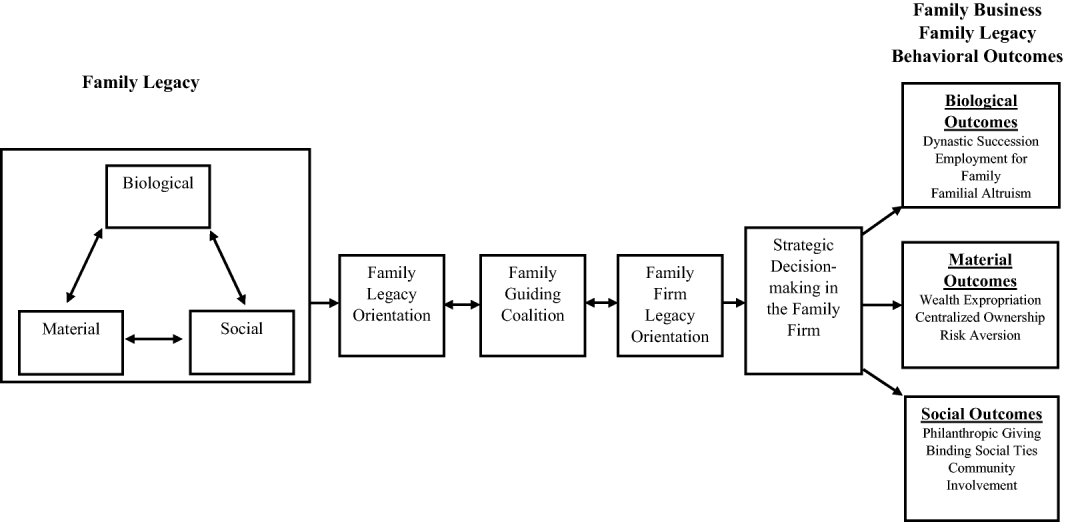
Model of Family Legacy Orientation in the Family Firm
From a social capital perspective (Coleman, 1988), family legacy orientation could be explored from the processes that generate intentions for family legacy. If the family has strong internal bonds and necessary closure, emerging relational social capital may create a greater consensus among family members toward forms of legacy and the legacy orientation of the family–guiding coalition. Alternatively, without strong internal social capital, would the relationship between the family and family firm legacy orientations deteriorate or splinter over generations, as individual family members or subsequent generations no longer support the original family firm legacy orientation? From an upper echelon perspective (Hambrick & Mason, 1984), research questions emerge regarding consensus on the forms and preferences for legacy among the family–guiding coalition. Without consensus within the family–guiding coalition, affective conflict could emerge among the leadership group members. Affective conflict on strategic issues can limit the firm's ability to successfully navigate and implement strategic choices (Amason, 1996). Therefore, both a social capital perspective and the upper echelon perspective may provide useful lenses for studying the level of group consensus, both within the family and the family–guiding coalition needed to sustain preferences for and desires to pursue each of the three forms of legacy.
While the model of family and family firm legacy orientations is conceptualized as a group–level construct, the model can also be used to potentially explore heterogeneity of family firms through the examination of individual family and nonfamily members who do not support the family or the family firm legacy orientation. In general, threats to group consensus, or alternative individual mental models, may impact the strategic consensus of the family–guiding coalition and perhaps weaken the influence of family legacy orientation on firm behaviors (e.g., Knight et al., 1999), or require increased monitoring to assure that components of family legacy orientation are maintained. Family legacy indifference may also provide an interesting avenue for research. Not all families share a disposition toward wanting to leave a legacy. In fact some, rather than being legacy oriented, appear to be indifferent at times and do not particularly care whether or not they are remembered. That is not to say that a legacy–indifferent family cannot or will not leave a lasting mark on the world, but only to say that the legacy transfer will be an unintended result of their social interactions with others. Further, it is very unlikely that a family will be completely indifferent with respect to legacy. It is also impossible for family members to live a life uninfluenced by the phenomenon of legacy; the existence of family offspring, at the very least, makes a legacy artifact of their parents. The resulting strong/intentional or indifferent/stagnant preferences toward legacy forms can be used to explore differences among family firms.
Founder preferences toward the family legacy likely have a tremendous influence on future generations. Strong family leaders make the initial endorsement for family legacy orientation. The founder's initial beliefs and intentions may become the salient and more resilient forms of legacy in the firm over time. For example, Kelly, Athanassiou, and Crittenden (2000) propose that succeeding generations often refer to the founder's vision and principles as they lead the firm and make key strategic decisions. Therefore, “a founder effect” may provide behavioral provisions for the family members long after the founder is gone while simultaneously constraining the family guiding coalition's ability to pursue alternative strategies. An interesting question then becomes how can families adjust their sense–making messages in ways that preserve the memory of a founder while allowing the family firm to evolve and diverge from past strategies?
Family firm advisors’ perspective on legacy forms and preferences could also provide a useful lens in furthering our understanding of family and family firm legacy orientations (Reay, Pearson, & Dyer, 2013). Advisors often help protect and grow assets (material legacy), strategize for intra–family succession (biological legacy), or carefully integrate family values into the firm (social legacy) that are important to the family (Strike, 2012). Researchers have suggested, but not tested, the assertion that family businesses may even intentionally select advisors who will not threaten the family legacy (Perry, Ring, & Broberg, 2015). A better understanding of legacy intentions and preferences in the family could assist in advising efforts catered to particular family and family firm legacy orientations.
Conceptualizing family legacy as a goal could contribute and benefit from perspectives on goal setting and goal orientation. When the family–guiding coalition is using the firm for family legacy pursuits, they are essentially attempting the goal of achieving immortality for the family through the firm. From this point of view, it becomes very difficult for the family–guiding coalition to set the types of goals (e.g., Locke & Latham, 2002) that have been shown to lead to higher performance (Latham, 2012). Thus, gaining a deeper understanding of the family and the family firm's legacy orientation through a goal–setting perspective may provide opportunities for researchers to further explore the performance of family firms relative to their unique goals. Finally, the temporal nature of family and family firm legacy orientations needs more attention. Legacy intentions form over time, over generations, and can and will change over time. Yet, Ensley (2006) suggests that the legacy intentions of family firms are what sustain “strategy over a long period of time” (p. 752)—a compelling, yet untested notion.
Discussion
The field of family business research has a “quagmire” of important, yet loosely construed definitions and interpretations of wide–ranging legacy issues, as noted in the family firm literature from more than one hundred articles summarized in Table 1. Legacy–related issues are often proposed (yet not tested) to be theoretically linked to important family firm behaviors. Further, while legacy is an important topic to family firm researchers, none of the studies reviewed included a theoretical basis for legacy–related issues, nor an empirical test. To further demonstrate both the importance, yet conceptual murkiness of legacy–related issues in family firm literature, in the recent review article on family firm philanthropy, legacy is viewed as both an antecedent of philanthropy practices in family firms and an outcome (Feliu & Botero, 2016). Our attempt to clarify this “quagmire” begins with theoretical grounding in the sense–making literature, integrated with psychosocial development. We heed the guidance of Reay and Whetton (2011) on theoretical contributions in family firm research providing a theoretically grounded model of family and family firm legacy orientations so that “theory can advance science by providing cohesion, efficiency, and structure…” (p. 106) to what is a wide–ranging, and loosely defined, yet important topic in our field.
Identifying the three specific forms of legacy—biological, material, and social—allows for a more nuanced examination of how family preferences and intentions influence strategic decision making and firm behavior. For example, when a family–guiding coalition has a strong preference for a biological legacy, they may limit the pool of talent considered for key firm positions to protect the family's heirs. Alternatively, when biological legacy is not as strongly preferred, the family–guiding coalition may be willing to select on skills and abilities. These types of strategic decisions have often been assumed but not directly linked to a specific motivation (i.e., biological legacy orientations; De Massis et al., 2008) nor have they been tested in family firm research. Identifying and measuring specific forms of legacy and the preference for each may result in finding patterns of strategic decision making in family firms.
By identifying the specific forms of family legacy, we have begun to disentangle the quagmire of legacy definitions and broad ideas referencing legacy across multiple fields of research. We believe that the current project makes several significant contributions to the literature. First, a framework for classifying the types of objects (i.e., legacy artifacts) that family firms pursue and transfer across generations adds an additional point of differentiation between family and non family businesses. Second well–defined family legacy and family firm legacy orientation constructs provide a lens with which to examine multigenerational transfers and various outcomes of these relationships such as shared values, interdependence of family and firm social systems, a sense of common fate, shared memory, and shared meaning (Bengston, 2001; García–Álvarez & López–Sintas, 2001; Sharma & Manikutty, 2005; Zerubavel, 1996).
Limitations
There are limitations to our model of family and family firm legacy orientations. First, the concepts and relationships that we have presented are theoretical and have yet to be tested empirically. There are no established scales that measure family legacy nor the specific orientations we have introduced. Therefore, an important first step is to present a cohesive framework for classifying the various things that families pass between generations. Future research efforts should focus on developing a family legacy scale for each of the three forms of legacy, namely, biological, material, and social. The “binding ties” subscale as presented in the FIBER model of socioemotional wealth may be related to the social legacy construct (Berrone et al., 2012); however, modifications would be needed to properly align the items with the domain of the construct.
Further, the orientation or preference for each form of legacy must also be measured. For measuring family preference toward material or wealth legacy items, the emerging work in measuring feelings and preferences about wealth and money (e.g., Ford, Baptist, & Archuleta, 2011) may provide an example on which to build. The creation and validation of measurement tools for the forms of family legacy will provide researchers with the means to begin assessing family and family firm legacy orientation and the associated outcomes. Thus, research may be advanced by empirically differentiating between the family and family firm legacy orientation, testing the links between the two legacy orientations, and determining how the two influence specific strategic decisions in the family firm. Moreover, we have implicitly assumed that the family legacy orientation will be imprinted onto the firm and evolve, relatively unchanged, into the family firm legacy orientation via the family–guiding coalition. Therefore, research that explores the alignment of the family legacy and family firm legacy orientations over time may be beneficial in identifying when family firms may be exposed to dynamics such as organizational path dependence (Sydow, Schreyögg, & Koch, 2009).
While our model of family and family firm legacy orientation is a preliminary attempt to address the quagmire of inferences about legacy–related ideas in the family firm literature, it provides a more nuanced look at family legacy and family firm legacy orientations than currently exists, and it strengthens and gives credence to the arguments that legacy concerns influence family firm behavior. Thus, a better understanding of family legacy and the legacy orientations exposes unseen challenges and unique strategies that further differentiate family firms from their nonfamily counterparts.