







Abstract
Dear editor,
Sporadic cerebral small vessel disease is perhaps the most common pathology in the ageing brain (1). It can be manifested clinically as symptomatic ischemic stroke, intracerebral haemorrhage, cognitive impairment (including interacting with neurodegeneration), or having few or no symptoms (2). Features seen on clinical neuroimaging, now recognized as biomarkers of small vessel disease-related injury, include lacunes, white matter hyperintensities, perivascular spaces, cerebral microbleeds, and brain atrophy (3). There is an enormous interest in research aiming to understand the mechanisms, improve diagnosis, and management of the spectrum of small vessel disease and associated disability.
We have recently demonstrated that mapping the landscape of cerebral amyloid angiopathy (a common small vessels disease type) research over time using informetric analytic techniques is valuable to understand how this field is evolving (4). We suggest that a similar approach might be useful for all different small vessel disease MRI manifestations. To this end, as a first step, and to demonstrate the potential of this approach, we have used core bibliometric techniques to explore the research output in the field of cerebral microbleeds over the last 14 years, including productivity and medical subject headings (MeSH) terminology analysis.
We have systematically identified microbleeds-related publications and their associated MeSH terms from PubMed, covering the period from 2000 to 2014. Our analysis revealed a considerable increase in cerebral microbleeds research output during this period (Fig. 1a). We have also focused on three prespecified clinically relevant themes defined according to MeSH subclassifications: intracerebral haemorrhage, cognitive impairment/dementia, and antithrombotic drugs. By analyzing publication rates by research theme on a year-by-year basis, not surprisingly, we identified a growing focus in studies investigating cognitive impairment and antithrombotic drugs, two major clinical questions in the field (Fig. 1b). During the same period, there was a trend for a decreased rate in studies related to intracerebral haemorrhage, presumably due to the relatively established role of microbleeds in the risk of bleeding.
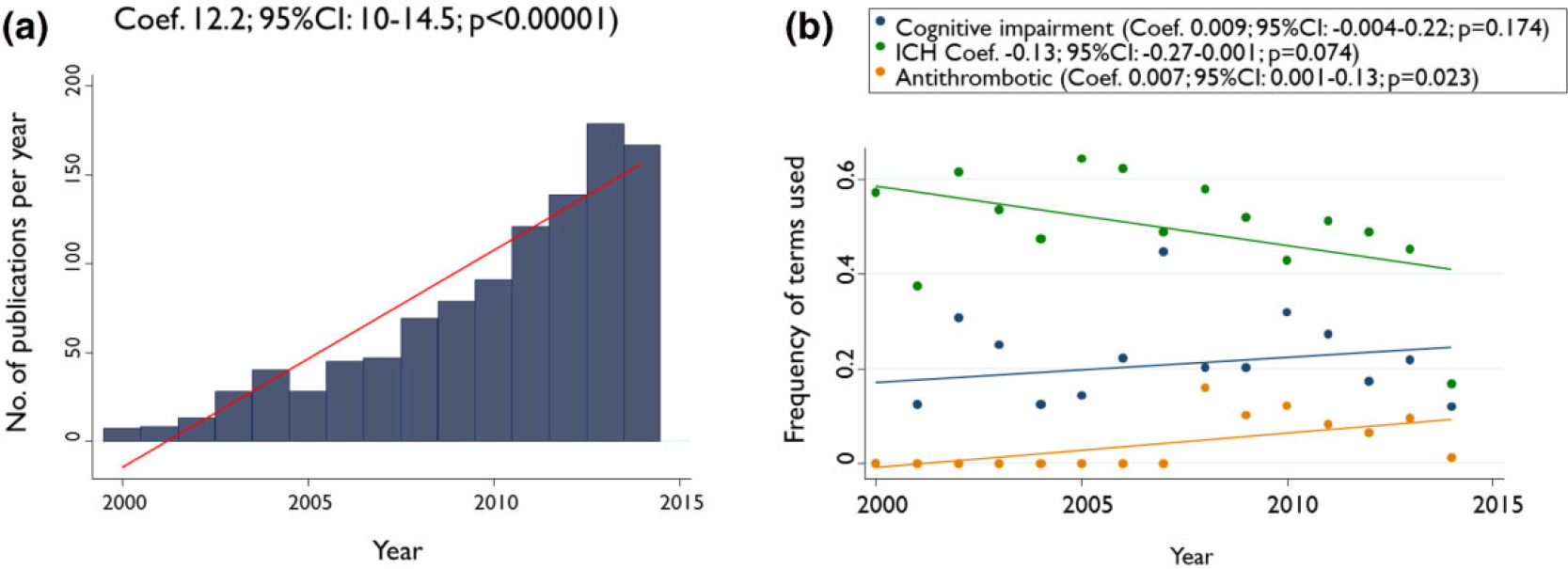
(a) Total number of publications calculated on a year-by-year basis, with data fitted to a linear regression line from 2000. (b) Changing frequency of publications in the microbleeds field based on three MeSH-defined themes, between 2000 and 2014. Year-by-year data were fitted into linear regression models. Publication counts under each theme were divided by the total number of microbleeds articles for each year. For both analyses, PubMed was used to identify all relevant publications on microbleeds (without language restriction) with a combination of search terms. Linear regression analyses were carried out using
Advances in informetric (including bibliometric) techniques now make it possible to gather even larger amount of quantitative data which might have importance for grasping different aspects of the rapidly developing field of small vessel disease in its entirety (5). In 2013, an international working group from the Centres of Excellence in Neurodegeneration published consensus STandards for ReportIng Vascular changes on nEuroimaging (STRIVE v1) in an effort to encourage a more consistent approach for research efforts in the field (3). Big data from informetric/bibliometric projects have the potential to reveal trends in major themes and provide methods and baseline measures to monitor the impact of such initiatives and inform the development of international collaborations. This paradigm has already been applied in Alzheimer's disease, including the Alzheimer's disease center program (6–8).