






Abstract
Applying latent class analysis to a unique data source of 3,500 Polish migrants in Western Europe, we develop a new typology of Polish migrants under “free movement” following the 2004 expansion of the European Union. We characterize these diverse migrant types in terms of their premigration characteristics and link them to varied early social and economic integration outcomes. We show that alongside traditional circular and temporary labor migration, European Union expansion has given rise to new migrant types who are driven by experiential concerns, resulting in a more complex relationship between their economic and social integration in destination countries.
Introduction
Nearly two decades ago, Portes (1997) highlighted that the existing wealth of empirical, data-driven analyses of migration did not necessarily lead to the development of generalizable theories of immigration. Instead, he argued that there was a need for mid-range theory that advanced theoretical propositions which could be tested across national contexts. Although writing about US migration scholarship, Portes’s injunction remains highly salient today for the phenomenon of intra-European migration following the expansion of the European Union (EU). In 2004, 10 new countries acceded to the EU including eight from former Eastern Europe (the “A8” nations), of which the largest was Poland in terms of both national population and migrant flows. The resulting population movement from the A8 was massive in scale, amounting to several millions of people. While recent east-to-west European migration is conventionally analyzed from the perspective of wage differentials between the “old” and “new” member states, there are several new contextual factors at play (Favell 2008).
Most importantly, European enlargement represents an exception to the century-long, essentially worldwide trend toward increased control of international movement. The expansion dramatically reduced or eliminated legal barriers to live and work in Western European countries for citizens of the new EU member states. Restrictions for Sweden, the UK, and Ireland were lifted in 2004 with interim arrangements in other countries persisting until 2007 (e.g., the Netherlands) or 2011 (e.g., Germany), at which point movement across Europe was unconstrained. Concurrently, technological innovation has lowered the social and financial costs of international movement, with transnational lives and networks cheaply and easily maintained through information and communication technology and low-cost air travel. The sheer scale of the movement further distinguishes it from other migration systems, and there were large flows of migrants to countries that had no established history of Eastern European migration, in addition to those with existing links.
This greater ease of movement allows more diverse motivations and settlement intentions to guide the migration decision, opening up migration as an opportunity to a wider range of individuals (Ryan et al. 2009; Burrell 2010; Cook, Dwyer, and Waite 2011; Krings et al. 2013). Increased movement, greater migrant diversity, and more heterogeneous motivations could be expected to lead to more varied migration trajectories than in other contexts. There are a huge number of qualitative studies addressing post-2004 Polish migration (for a review see, e.g., Burrell 2010 for the UK). These studies suggest distinctive forms of migration and new integration patterns, but we still lack a systematic, cross-national account of “new” migration types and a test of their relationship with particular integration trajectories.
Using a unique, harmonized cross-national data set of over 3,500 Polish migrants in four European countries — Germany, the Netherlands, the UK, and Ireland — surveyed in 2011 within 18 months since migration (Gresser and Schacht 2015), our article provides such a first systematic account. In particular, unlike existing studies of the “new migration,” we separate the migration decision and the characteristics of diverse migrant types from early integration outcomes. We first use latent class analysis to identify six migrant types based upon their migration motivations and intended duration of stay. Second, we demonstrate how the pre-migration characteristics of these types differ. Third, we conduct a validation of our types, demonstrating their independent association with variation in early social and economic integration. We find that traditional circular and short-term labor migration patterns continue in this new migration system. However, we also identify four additional discrete, less studied migrant types, who combine mixed motivations as well as wider international orientations. These less common types tend to be more urban and educated, and show a greater representation of women than the labor migrants that garner the majority of research attention. Their social and subjective well-being is also less strongly tied to labor market outcomes.
To the best of our knowledge, this is the first multi-destination, quantitative characterization of the east-to-west European migration stream, allowing the development of a more complete typology of the key — and novel — features of migrant diversity under free movement in the EU. Our data enable us to control for many potentially confounding pre-migration characteristics in our regressions, and to evaluate integration outcomes that follow closely on the act of migration itself. Thus, we are better able to isolate the relationship between our typology and early integration from variation in demographic composition and return migration probabilities across our types. To factor out origin country contextual factors, we focus on internal differentiation within Polish migrants. Nevertheless, the relationships we establish in this article lay themselves open for testing with other A8 countries and in other contexts of relatively low-cost international movement.
Background
New Migration: Diverse Motivations, Diverse Backgrounds
The number of Polish citizens living across Western Europe has increased dramatically in response to accession in 2004. Figure I illustrates this increase in flows of Polish migrants for each of the destination countries covered in this article, with acceleration most pronounced in the UK. Although flows of arrivals fell during the recession, they have since stabilized and numbers remain high from 2009 onwards.
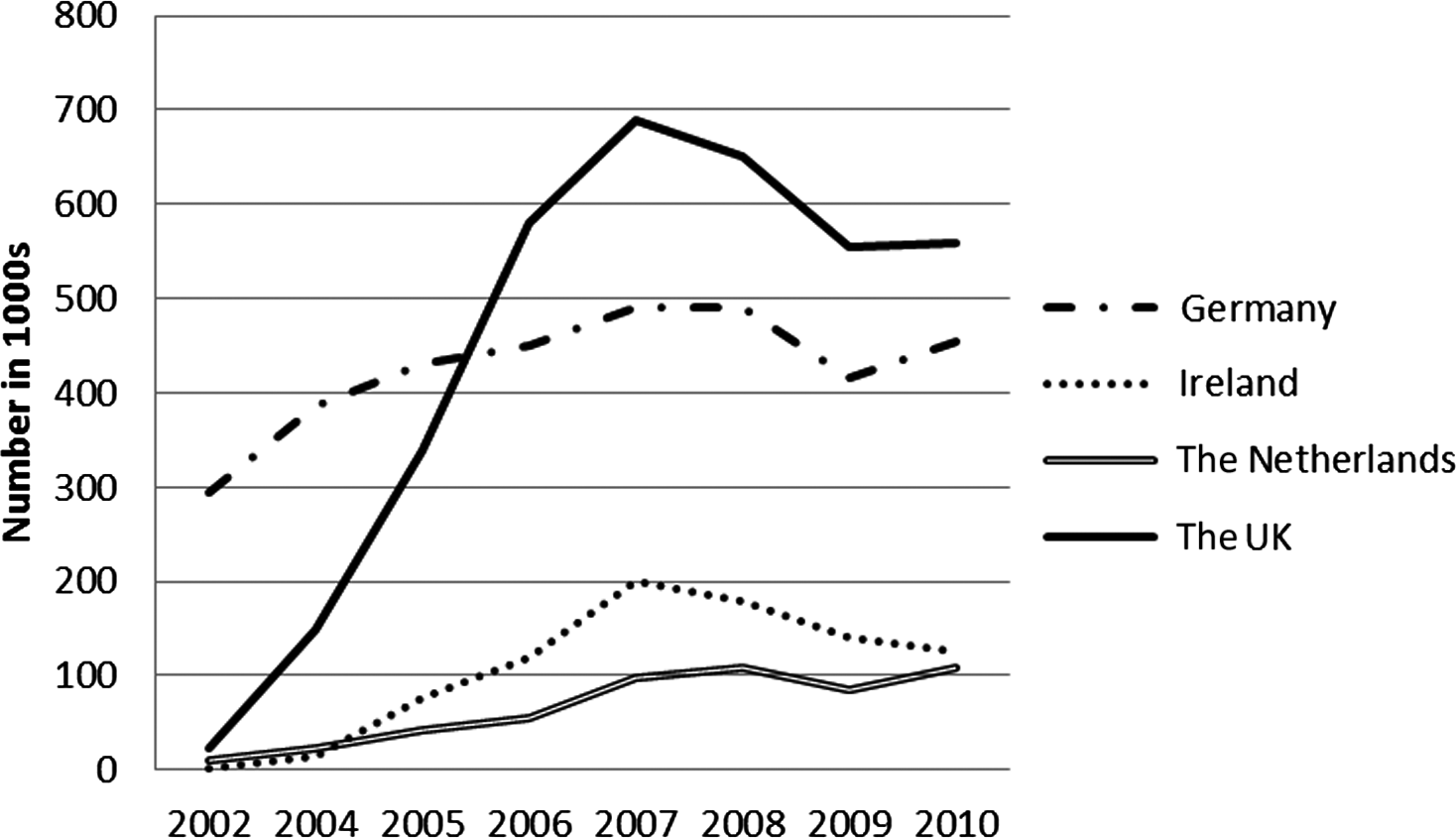
Number of Polish Citizens Living Abroad for Four Months or More, by Destination Country, 2011.
Research documenting the size and distinctiveness of A8 migration to Western Europe is expanding dramatically. On the one hand, much quantitative work draws on existing models of economic migration (Massey et al. 1999), which frame international migration as a household risk diversification strategy, with family members sent abroad to work where wages are high and remittances sent home for consumption where the cost of living is low (Drinkwater, Eade, and Garapich 2009). Movement to and from EU destination countries is relatively cheap and easy, and the greater ease of communication afforded by cell phones and Skype (Dekker and Engbersen 2014), not to mention cheap flights (Williams and Baláž 2009), should also result in a rich web of transnational ties, providing information and social and economic support to the potential migrant (Kalter 2011). This in turn enables straightforward transfer of remittances, as well as the easier maintenance of transnational family and caring responsibilities, thereby encouraging the cumulative causation central to the new economics of labor migration framework. In this perspective, the 2004 expansion can be understood as facilitating “more of the same” labor migration.
On the other hand, a parallel body of primarily qualitative research has emerged, which provides empirical detail on novel types of migration flows under free movement (Favell 2008). This literature argues that there is now more diversity in the demographic characteristics of the migrants, their motivations, and their economic and social experiences in the destination country (Ryan et al. 2009; Burrell 2010; Cook, Dwyer, and Waite 2011; Krings et al. 2013). As migration is no longer constrained to state-defined legal categories (or the shadows of illegality), we see more migration for non-economic aims such as love, adventure (Favell 2009), or self-development (Cook, Dwyer, and Waite 2011). Moreover, we may see a combination of varied aims among migrants who are no longer restricted to the rules of existing visa categories (that prohibit, for example, longer term settlement, or work among students). Rather than a primary motivation, immediate economic returns may be seen as contingent and part of a “pathway” (Parutis 2014) to the eventual desired destination, with return — and even multiple attempts — being a viable option should the progression not immediately materialize.
With lowered economic and social costs of migration, new opportunities for non-economic — or mixed — migration can thus be pursued by Poles, who are more privileged than the labor migrants of the past but also less advantaged than the typical “skilled migrant.” In contrast to 2001, when over half of Polish emigrants had only elementary qualifications, in 2011 a quarter of them had degree-level qualifications (Polish CSO 2013). These more highly skilled migrants are often overqualified in Western European labor markets and exhibit high levels of occupational segregation (Barrett and Duffy 2008; Campbell 2013), despite some evidence of occupational and earnings mobility (Mühlau 2012; Parutis 2014). This is likely to be linked to the fact that this is not a conventional high-skilled migration, where entry is conditional on skills or qualifications and appropriately matched job offers are required. In addition, those with high skills do not necessarily select into contexts with the best economic returns, but may factor in non-economic amenities as well (Drinkwater, Eade, and Garapich 2009), according to their migration motivations.
As is true of many newly available experiences, the more transient, spontaneous, and less economically motivated opportunities for migration under free movement appear to be taken advantage of by younger and more highly educated individuals. New migrants include larger numbers of very young men and women who have recently finished (or are completing abroad) their education as well as older, more traditional migrants, with family members back home. The gender distribution of Polish migrants has shown a complex pattern. The immediate post-2004 migration was predominantly male, as is typical of “pioneer” movements, particularly to the new destination of Ireland, where the economic boom fueled massive demand for construction workers. However, in more recent years the distribution has become more balanced. Given less favorable gender norms in Poland (Coyle 2007), there are emerging signs that women are more likely to take advantage of the new migration pathways than the traditional working paths historically dominated by men (Klüsener et al. 2015).
Polish Migration to Germany, the UK, the Netherlands, and Ireland
While Polish migration following EU enlargement in 2004 was a pan-European phenomenon, the size and composition of the migrant flows varied according to historical migration patterns as well as cross-national differences in the implementation of free movement following accession. Before 2004, Germany was the main European destination for Polish migrants. Due to geographical proximity, Germany has long attracted migrants to low-skilled jobs (illegal work) and for seasonal agricultural work. There was also substantial migration of Poles with German ethnicity, who were able to move to Germany as ethnic Germans (Aussiedler) and were granted immediate residential and citizenship rights. In contrast to the other countries in our study, Germany opted to restrict migration from the accession countries until May 2011, and so Poles in our German sample still required visas for nearly the entire duration of fieldwork.
After Germany, the UK had the largest numbers of pre-accession Polish. Although the vast majority of Polish immigrants arrived since 2004, over 150,000 Poles settled in London following WWII and into the 1980s. These settled migrants began an ethnic economy that was later expanded by undocumented and self-employed Polish migrants arriving under the auspices of the 1994 Europe Agreement (Pollard, Latorre, and Sriskandarajah 2008, 16). Alongside Ireland and Sweden, the UK was also one of the few countries to allow immediate labor market access to A8 migrants in 2004. Unlike Germany and the UK, Ireland and the Netherlands had little former experience of Polish migration. In the Netherlands, in the 1990s there were low levels of seasonal migration, migration of Poles possessing German passports, illegal migration, and some marriage migration (Karczemski and Boer 2011). In Ireland, there was a numerically small migration of refugee supporters of the Solidarność movement, and the Irish economic boom attracted some economic migrants and some seasonal migration during the 1990s (Grabowska 2003). Yet in both these countries, numbers were low until accession. Ireland, like the UK, also opened its borders immediately following accession, whereas the Netherlands placed restrictions which were lifted on May 1, 2007.
Migration Motivations and Migration Types
Responding to rising Polish migration to both established and new destinations, a number of typologies have been proposed to characterize the specific features of the “new migration” in Western Europe. Both Eade, Drinkwater, and Garapich (2007) and Düvell and Vogel (2006) have created typologies for the UK, distinguishing migrants by duration of stay and locations of family members. The two typologies both identify permanent migrants intending to settle, those who plan to return home, circular migrants, and a smaller fourth category of “searchers” or “nomads” with uncertain future plans. Drawing on emigration data of Poles across Europe, Grabowska-Lusińska and Okólski (2009) also identify four types, based on duration of stay. Another quantitative study of Poles in the Netherlands applies cluster analysis to sort migrants across two dimensions of social and economic contact with the sending and receiving society (Engbersen et al. 2013). This study further demonstrates how clusters of transnational ties are associated with background characteristics such as education and age, as well as occupation and employment in the receiving country.
These initial typologies help to encapsulate the key characteristics of current Polish migration, namely diversity in intended duration of stay and links to the country of origin. Yet they primarily constitute small single-country studies of settled labor migrant populations, populations shaped by selection into specific receiving countries as well as by return migration in ways that are difficult to investigate. While implicitly presented as a comprehensive overview of Polish migration, such single-country studies are unable to address whether the typology was a highly localized one with only partial coverage of potential migrant types.
In these studies, the most transient migrants are lost or highly underrepresented. For example, the average migrant in the Engbersen et al. study had already lived in the Netherlands for 2.5 years. We know that migrants’ orientations change with time to become more permanent (Friberg 2012); this implies that types derived from more settled migrants will themselves reflect elapsed duration in the destination country (Bijwaard, Schluter, and Wahba 2011). Our own data contain, for the Netherlands, a subsample that is resident for longer than the 18 months used in our analytic sample. Comparison between shorter and longer stayers clearly reveals that the longer stayers (median duration 38 months) were much more likely to want to settle in the Netherlands, were more likely to have migrated for work, and were less likely to be joining family than the most recent arrivals. 1
The existing literature therefore leaves space for developing a more comprehensive, pan-European typology of the new migration from Poland to Western Europe. Our study utilizes an inclusive definition of migrant, namely all Poles who identify themselves as immigrants (rather than visitors or tourists) in London and Dublin and who, in Germany and the Netherlands, register with the local authorities (as required by law). By surveying close to the point of arrival, we are able to capture those who are destined to be only temporary or highly mobile as well as the settlers who dominate other studies. Including Poles migrating to four different countries with very different migration histories, we aim to cover the full range of migrant diversity, part of which will be reflected in the selection of country itself. We illustrate the distribution of our migrant types across the different countries and test our “European” typology against analysis based on the individual countries in our sample to substantiate this claim.
Migrants’ Early Integration Outcomes
After establishing our set of migrant types, we explore the consequences of migration, using our typology to link outcomes with migration motivations conditioning on antecedents and country of settlement. A number of studies have demonstrated poor economic outcomes among Polish workers in Western Europe (Clark and Drinkwater 2008; Pollard, Latorre, and Sriskandarajah 2008; Campbell 2013). At the same time, we have little information on how economic performance may vary according to migration intentions, nor the relative significance of these labor market “penalties” for social integration as well as attitudes toward the receiving country and general well-being. Recent research shows that subjective evaluations of life in the receiving country such as life satisfaction are strongly associated with duration intentions and civic and social integration, but that satisfaction can be negatively associated with human capital (Massey and Akresh 2006).
Based on the current literature, we expect early social and economic integration outcomes to vary depending on the migration motivation — for work, family, or experiential reasons — and intended duration of stay. Among labor migrants, for those migrating to accumulate resources in a short period, employment and pay are likely to be critical to their well-being, and they will have less cause to invest in the destination society (Dustmann 1999). Hence, employment, of whatever kind, is likely to be highly salient, while social and subjective integration may not be. Workers migrating for the long term in contrast will have more invested in developing social relationships in the receiving society and may wait to take up a well-fitting, rather than any, job.
The literature on “tied” (family) migrants demonstrates their worse labor market outcomes as compared to “primary” (work) migrants (Adsera and Chiswick 2007). In standard migration systems, family migrants do not undergo the same selection process on labor market relevant characteristics as their spouses on employment visas. At the same time, the dichotomy between primary and tied migrants is an oversimplification of the potential interconnectedness of family and work migration (González-Ferrer 2010). In a context of free movement, multiple aims can be realized without stringent definitions of family or employment or visa constraints. Potential migrants are free to follow family members’ trails more speculatively, without formal sponsorship or aims of family formation, or, indeed, commitment to remain. We may therefore expect some economic participation among migrants following partners and kin, but we expect that its absence will be less strongly associated with social integration and attitudes toward the receiving country.
Formal students are often explicitly excluded from studies of immigrant labor market integration. However, in countries like the UK a significant share (16%) of EU citizens are students (Benton and Petrovic 2013) and their right to work enables intra-EU students to combine both employment and educational aims. Those migrating for education or more generally for skill acquisition, such as language or cultural learning, may appear less successful (overqualified) in the labor market if they take lower wage jobs or are unemployed; yet, they may still be fulfilling their migration purpose if they achieve higher levels of social integration (Parey and Waldinger 2011). As those migrating for education are generally more highly skilled, however, we may expect them to have higher expectations and thus have lower levels of satisfaction with the receiving country (Tolsma, Lubbers, and Gijsberts 2012).
Finally, those documented as migrating for more general experiences (King 2002) are typically considered only tourists or a privileged minority. In the context of free movement, however, they may occupy a place of greater numeric and substantive importance. Such “searchers” may be relatively satisfied with “getting by” economically and eager to engage more widely socially. Seeing their migration projects through flexible experiential lenses may make them less interested in integrating into the destination society, but also less concerned about how they fare.
From this overview, we develop specific hypotheses relating to economic (e.g., labor market participation, nature of job) and social (e.g., contact with and exposure to destination country society) integration. We also address subjective assessments of well-being and attitudes toward to host country, allowing an assessment of the migration project on the migrant’s own terms. Our contribution is to elaborate hypotheses which link variation in migration motivations and expectations — a key feature of the “new migration” — to variation in economic and social integration as well as subjective outcomes. We outline how integration outcomes are hypothesized to vary with migration motivations and expectations for their duration of stay, as outlined schematically in Figure II. These general hypotheses are amenable to being tested for other diverse migrant flows. We propose that expected duration will have different meanings for economic and non-economic migrants with implications for investment in social contact and emphasis on economic returns.
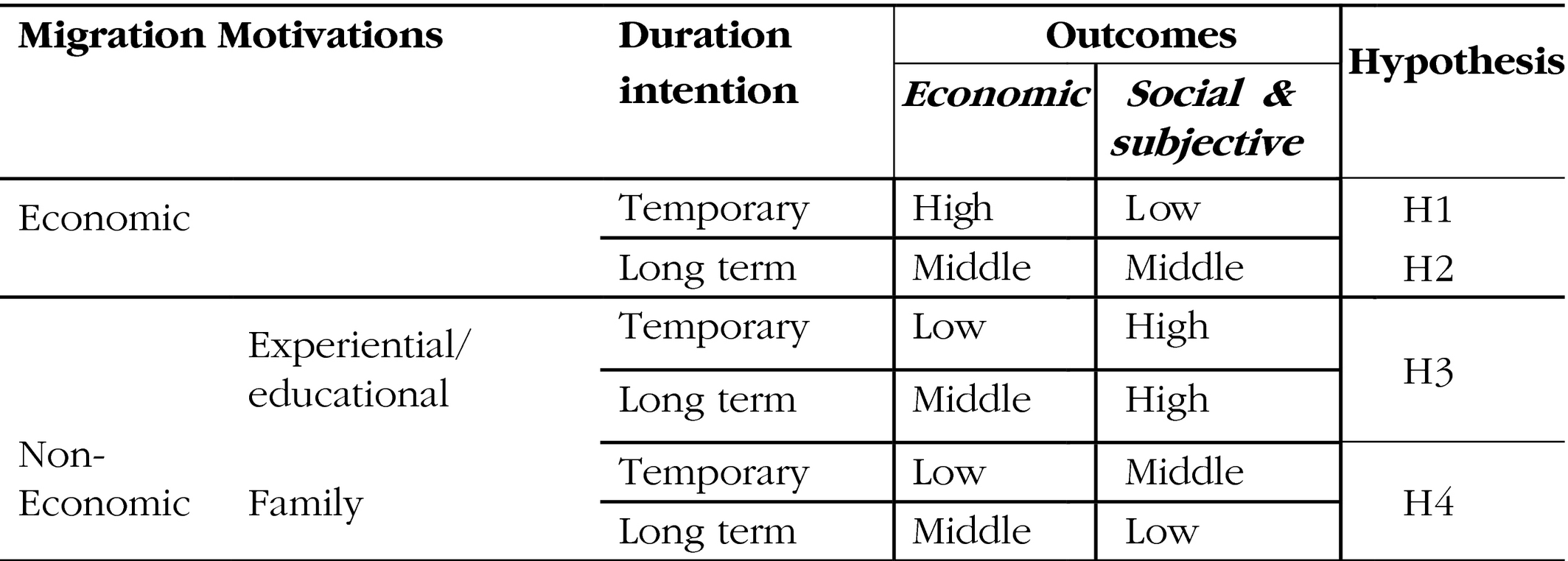
Schematic Representation of Hypotheses
First, we anticipate that, net of pre-migration characteristics, those who migrate for work will have higher levels of labor market integration, but lower levels of social integration and subjective assessments than those with mixed or non-economic motivations (H1). Among economic migrants, those who have long-term migration projects may appear, in the short term, to be less economically integrated than short-term migrants, but will be more socially integrated and will have positive attitudes toward the country of settlement (H2). Among migrants with multiple or non-economic motivations, we expect the opposite: Those with more temporary outlooks will display even lower economic integration than non-economic migrants with more permanent settlement plans (H3). Fourth, we expect that those migrants who are following family members, rather than motivated by their own educational or experiential goals, are likely to be less socially integrated and less positively disposed toward the settlement context, than other non-economic migrants (H4).
Additionally, we expect that (pre-migration) motivations and intentions for settlement will not only influence the extent of integration but also interact with how it is experienced. We anticipate that social integration and attitudes toward the host country will be more strongly conditioned by economic integration for labor migrants than for non-economic migrants (H5).
Data and Analysis
Data
We use the data deriving from the cross-national project on the Causes and Consequences of Early Socio-Cultural Integration Processes among New Immigrants in Europe (SCIP). These data cover migrants to four countries, who were first surveyed within 18 months of migration in 2010–2011 using a harmonized cross-national questionnaire (see further Gresser and Schacht 2015). The SCIP survey is unique in the scale of coverage of 3,631 Polish respondents (Germany: 1,468; the Netherlands: 334 2 ; the UK: 777; Ireland: 1,052), in the breadth of measures included, and particularly for its emphasis on linking pre- and post-migration trajectories. Most important for our analysis are questions covering the following: reasons for migration, previous visits, prior contacts, friendships, economic position, settlement/return migration intentions, well-being/life satisfaction, language skills, and demographics. The SCIP survey thus represents the only possible source to address our questions of interest.
Different sampling frame availability resulted in different geographical coverage across the four countries. Respondents were sampled from population registers of four major cities in Germany: Berlin, Hamburg, Munich, and Cologne. In the Netherlands, population registers were used to access a sample from across the country. In the absence of population registers in the UK and Ireland, respondent-driven sampling (Heckathorn 1997) and non-random searching techniques (advertising, social networks, approaching individuals in Polish shops and cultural centers) were used in the capitals of each: London and Dublin, respectively (see further Platt, Luthra, and Frere-Smith 2015). It is therefore impossible to establish probabilities of inclusion for the UK and Irish samples, and not straightforward for the other countries. Hence, standard errors and other measures of statistical significance in this article should be interpreted cautiously. Validation exercises using census, Labor Force Survey, and governmental data sources revealed that the age, sex, and employment distributions of recently arrived Poles in our data were roughly aligned with other sources, with the exception of somewhat higher unemployment rates (Gresser and Schacht 2015; Platt, Luthra, and Frere-Smith 2015). However, given the different geographical coverage across countries, we do not offer direct cross-national comparisons of the Polish migrant experience in this article (although see, e.g., Röder and Lubbers 2015; Gijsberts and McGinnity 2016; Koenig, Maliepaard, and Guveli 2016 for comparative analyses using these data). At the same time, we describe variation across countries, and test for cross-country variation, while controlling for country in multivariate analyses.
Endogeneity is also an issue in any data where migration intentions and integration patterns are gathered simultaneously. Observing intentions very early in the integration process helps to reduce some of the reverse causality between integration and intentions to stay, but we cannot make causal claims about observed relationships between migration types and integration outcomes. This is particularly true for movers within the EU, where, in contrast to those limited by visa restrictions, preferences for stay can be immediately updated and acted upon in accordance with early experiences in the receiving country. 3 In this way, the outcomes we observe are, effectively, a validation of the typology rather than estimated as a consequence of it.
Measures
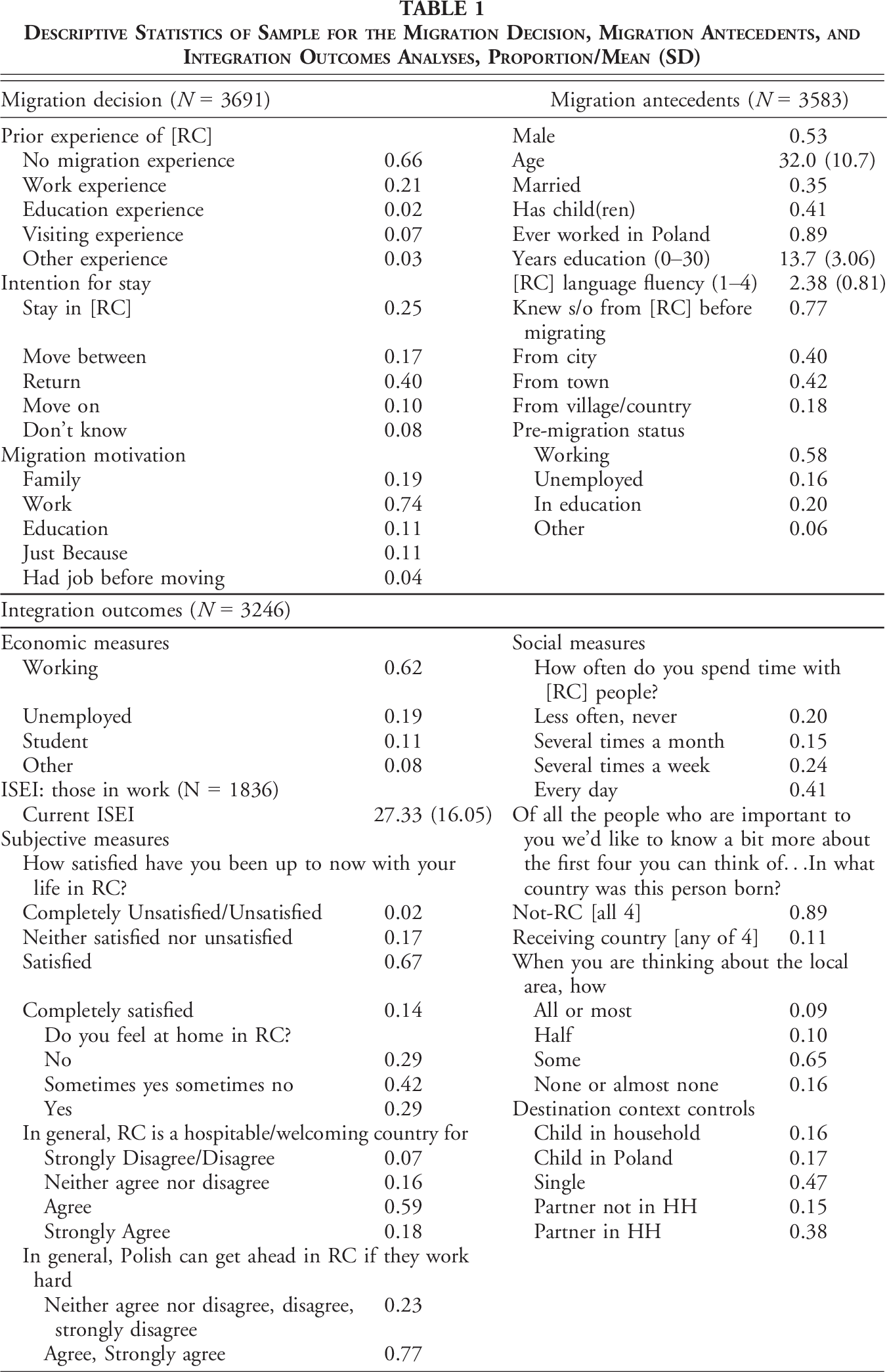
We use three sets of measures: those associated with the type of migration; characteristics of migrants prior to migration; and measures of current integration. Descriptive statistics are provided in Table 1.
Descriptive Statistics of Sample for the Migration Decision, Migration Antecedents, and Integration Outcomes Analyses, Proportion/Mean (SD)
Migration Types
As far as we are able, we attempt to restrict the indicators of migrant types to those which form the current migration decision and are most likely to (immediately) precede arrival in the receiving country. We thus conceptualize migration type as the interaction between previous international migration experience, current duration intentions, and current expressed reason for migration. We based this decision on our review of the previous typologies and literature on Polish migration above. Essentially all existing (qualitative) literature on post-accession Polish migration to the UK emphasizes two main characteristics: the migration motivation, in particular the combination of work and family obligations in international movement (Ryan, Louise, and Rosemary Sales 2013; Klüsener et al. 2015); and the importance of intended duration of stay (Grabowska-Lusińska and Okólski 2009). Migration motivations and intended duration are seen as key determinants of decisions to invest in local social networks (White and Ryan 2008) or more actively pursue work opportunities which are properly aligned with the level of training and longer term career goals (Parutis 2014; Drinkwater and Garapich 2015).
Migration motivations are measured by the answer to the question “There are different reasons for moving to [the receiving country]. Why did you move?” Multiple answers were allowed, and the responses were coded to encompass four possibilities representing the main choices in migration trajectory afforded by EU free movement: “work,” “family,” “education/schooling,” and “just because.” The first three reasons are commonly discussed in the literature. The fourth, “just because,” is critical to this migration stream, given the ability of EU migrants to enjoy mobility as “unconditional European citizen(s)” (Favell 2013, 57). To allow for multiple and mixed migration motives, we include separate measures for each.
Future intentions of stay are measured by the question “What best describes your current situation or which comes closest?,” with the following options: (1) “I expect to stay in [the receiving country] to live”; (2) “I expect to move between [the receiving country] and Poland on a regular basis”; (3) “I live here now but I expect to return to Poland to live there in the future”; (4) “I live here now but I expect to live in another country in the future”; and (5) “I don’t know.” This question provides no specific time span, referring generally to the future. It aimed to identify specific migrant types identified in both the classical and new migration literature — target earners and “birds of passage” (Piore 1979; Dustmann and Weiss 2007), “circular” migrants (Constant and Zimmerman 2007; Kalter 2011); and the historical minority, those who arrive intending to settle permanently. We also include “don’t know” responses (selected by around eight percent of our sample) as being meaningful in their own right, indicating strategic uncertainty about future intentions, which has been documented to be one of the features of new intra-EU migration (see the formulation of “intentional unpredictability” in Eade, Drinkwater, and Garapich 2007).
Previous migration experience is reported as either having no previous migration experience in the receiving country, having work experience, having education experience, having experience with visits to family or friends, or “other” experience. We also include an indicator for respondents who had secured a job prior to migrating to the receiving country. Interestingly, this was the case for very few, highlighting a distinctive feature of free movement: the ability to move legally to seek work on site.
Integration Outcomes
Our measures of economic integration are current labor force status, and for those employed, the occupational status of the current job as indicated by Ganzeboom and Treiman’s (1996) International Socio-Economic Index (ISEI) score. For current labor force status, respondents chose their main activity from a list of possible answers: “Are you currently working, unemployed, in education, retired, long term sick or disabled, looking after the home or children, on maternity or paternity leave, or anything else?” Hence, our measure of unemployment is not limited to active job searchers and provides a higher estimate of unemployment than standard definitions. Our analysis of occupational status is restricted to those currently employed.
We have four broad attitudinal measures of the respondent’s relation to the country of residence. We designate these as “subjective integration” measures, and they comprise life satisfaction, feeling at home, perceived hospitality for Poles, and perceived opportunities for Poles.
Finally, we have three measures designated “social integration” outcomes. These comprise time spent with people of receiving-country origins, whether the respondent has a close friend who was born in the receiving country, and the proportion of Polish people in the respondent’s local area of residence.
The questions and answer categories for each of these measures are consistently coded with the most “integrated” outcome as the highest category, and the question wording and possible responses are reported in Table 1.
Pre-Migration Indicators and Controls
To better isolate the relationship between migration type and integration, we include controls for pre-migration characteristics. These comprise respondent’s sex, age, years of completed education, and self-estimated proficiency in the destination country language: a scale constructed as the average fluency score of four four-category variables on the respondent’s ability to read, write, understand, and speak the language of the receiving country at the time of the survey.
Additionally, we include whether or not the respondent is married and/or has at least one child; lived in a city, in a town, or in a village/in the countryside prior to migration; and, to capture social network effects, whether the respondent knew someone in the receiving country prior to migrating.
We further cover several pre-migration economic indicators: whether the respondent had ever worked before in Poland, and the respondent’s labor force status prior to migration: in employment, unemployed, in education, or “other” which includes looking after children or illness/disability.
We control for all of these pre-migration variables in the models estimating the relationships between migrant type and early integration. In addition, we include additional controls for the current household context. A present partner or child is an important component of social and subjective context (relative to none or an absent one); and those with partners or children outside of the household are likely to show rather different patterns. All integration analyses additionally control for country of destination.
Methods
First, for defining migrant types, we employ latent class analysis (LCA), a data reduction technique that has been successfully used to characterize immigrants in both the United States (Bean et al. 2011; Nieri et al. 2011) and the Netherlands (Rooyackers, de Valk, and Merz 2014). We choose to use latent class analysis, rather than simply interacting migration motivation and intended duration of stay, to create greater parsimony in summarizing discrete migrant types and to allow multiple responses for migration motivation and the inclusion of previous migration experience. Latent class analysis assumes conditional independence of the indicators used to identify classes intended duration of stay and migration motivation are orthogonal to one another, resulting in 20 viable cells when the two are interacted (Table S1, available in the online version of the article). We therefore allow these to enter the model independently, and as we will see below, they are strong identifiers of the latent classes, as we would expect from existing qualitative typologies. We estimate two kinds of latent class analysis model parameters: the class probability parameters and the item parameters (Nylund, Asparouhov, and Muthén 2007). The latent class probability is the likelihood that a migrant belongs to a specific class. It is used to determine the number of classes and relative size of each class. The item parameters correspond to conditional item probabilities and provide information on the probability for an individual in that class to score positively on that item. These are comparable to a factor loading in factor analysis in that values closer to 1.0 indicate that that characteristic better defines the class (Nieri et al. 2011).
We estimate mixture models in Mplus 7.0 (Muthén and Muthén 2013), to identify groups with distinctive patterns of migration experience, current migration motivations, and migration intentions. 4 To determine the optimal number of classes, we rely on three tests which have been shown to perform well in simulated studies (Nylund, Asparouhov, and Muthén 2007): Bayesian information criterion (BIC), the Lo–Mendell–Rubin adjusted likelihood ratio (LMR) test, and the parametric bootstrapped likelihood ratio (PBLR) test.
Given that the entropy level for our preferred model is very high (0.959), we then assign each observation the most likely class membership. This has been found to be the best performing method for assigning class membership, with good coverage and power in simulated studies (Clark and Muthén 2009).
We next characterize our migrant types in terms of pre-migration characteristics and country of settlement. This illustrates the ways in which “newer” forms of migration aims are being differentially taken up by population sectors previously less associated with traditional forms of migration, and are more likely to go to “newer” destinations.
Finally, we use the assigned class membership as an independent variable to predict the various measures of subjective, social, and structural integration. Three of our integration measures are ordered categorical variables (satisfaction with life, feeling at home, agreeing that the receiving country is hospitable), for which we estimate ordered logistic regression models. For labor force status, we estimate multinomial logistic regression models. Agreeing that Poles have opportunities and having a close friend from the destination country are binary response variables and are modeled using binary logistic regression. OLS is used for occupational status. Alongside our key independent variable of migration type, we also control for pre-migration characteristics, country of destination, and family situation. Moreover, for models of subjective and social outcomes we also control for current employment status. We carry out these analyses in Stata version 13 (Stata Statistical Software: Release 13. College Station, TX: StataCorp LP).
Results
Latent Migration Classes
Our latent class model allocated respondents to a latent class migration type variable with six outcome classes. Model fit was assessed with all three measures: The decline in BIC (a smaller BIC indicates a better fit) is sharpest as we move from two to four classes and then begins to level off. Extending the number of classes to five, six, and seven decreases the BIC statistic but much more marginally. The corresponding LMR and PBLR tests also show improving model fit up to six classes, at which point, according to the LMR, we can no longer reject at the five percent level that six classes is preferable to seven (see Table S2). We therefore choose to keep the number of classes at six, and also find six classes more readily interpretable.
We allocated summary names to each of the six classes, based on the combinations of conditional item probabilities on the 13 observed variables for each class. These names are also consistent with the characteristics that distinguish the migrants, as we subsequently discuss. Table 2 shows summary names (“traditional circular,” “short-term accumulators,” “committed expats,” “followers,” “living and learning,” and “adventurers”), the proportion of the sample allocated to each class, and the conditional item probabilities for each class, as well as the distributions of the migration decision variables across the sample as a whole. The typology includes two types — the traditional circular and short-term accumulators — which are most frequently discussed in the literature as well as four newer migration forms.
Characteristics of Migration Types from Latent Class Analysis
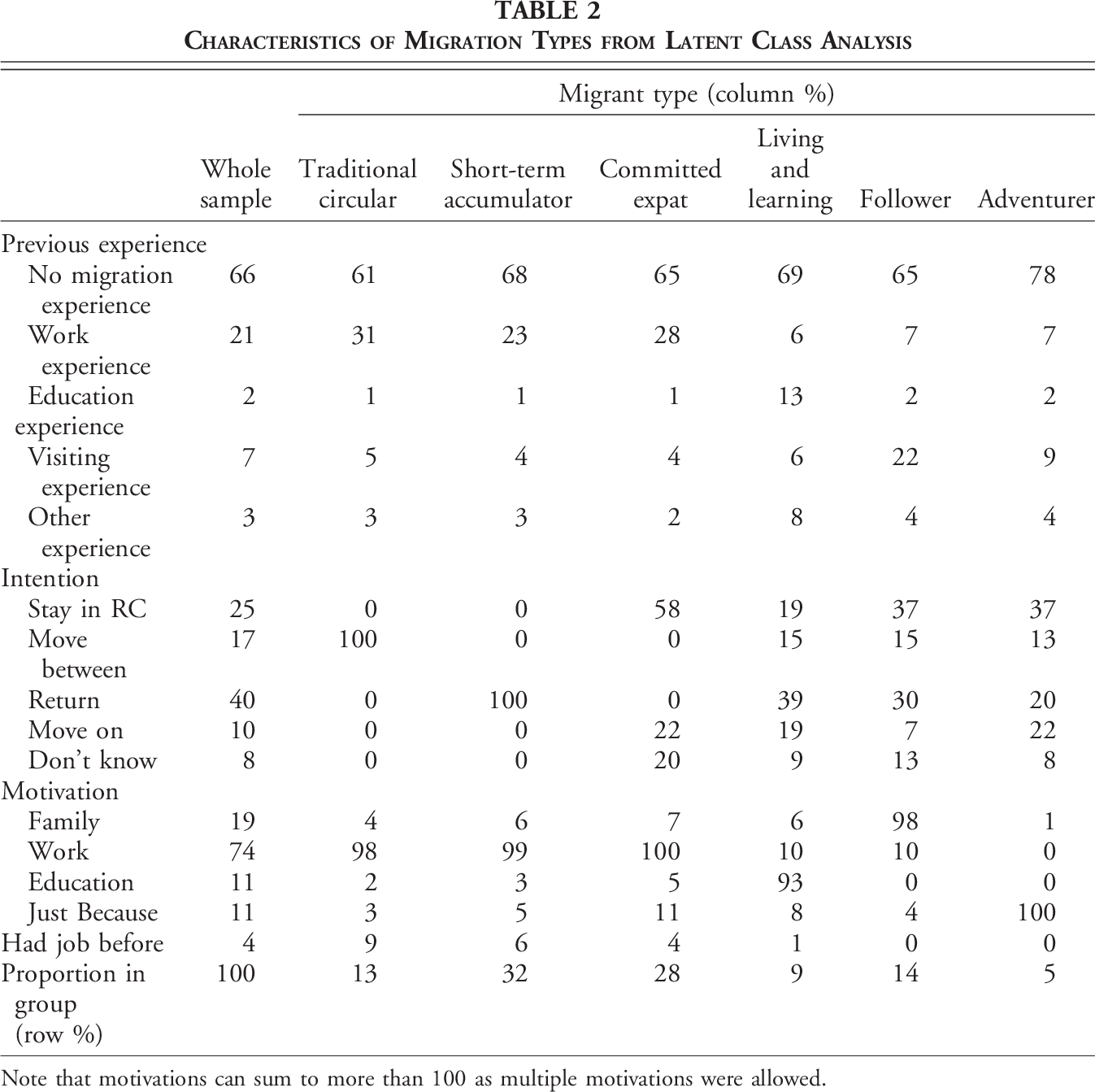
Note that motivations can sum to more than 100 as multiple motivations were allowed.
The first two types represent classic forms of the new economics of labor migration perspective. The “traditional circular” type retains strong connections to Poland, while undertaking repeated spells of work in Western Europe. They have often worked in the country of destination before and are more likely than any other group to have secured a job in advance. They sort completely on their intention to migrate back and forth between the receiving country and Poland. This is the classic Piore (1979) bird of passage, and the most prevalent form of earlier migration between Poland and neighboring Germany (Kaczmarczyk 2005). Important to note is that this “traditional” migration type comprises only 13 percent of our total sample. Similarly, “short-term accumulators” also follow the model of working where wages are high to spend where costs are low: They all come for work; however, they all plan to return to Poland after their current sojourn. They are also likely to have previous work experience in the receiving country, although less likely than traditional circular migrants.
The newer types we identify however show greater variation in motivations and settlement aims. “Committed expats” also tend to report work as their primary motivation, but they are slightly more likely to report moving “just because” or for family or education as well. They have a high probability of wanting to stay in the receiving country, although a sizable minority, 22 percent, also expect to move on to a third country. These migrants are committed to an international life from the very onset of their migration, including the recently noted “stepwise” migration pattern for achieving goals through staged or multiple moves (Paul 2011; Bell 2012).
The remaining three groups do not have work at the center of their migration decision. “Followers” sort strongly on their migration motivation for family reasons, and have an over 20 percent likelihood of previous visits to the receiving country to visit friends or family members. Although these “tied” migrants are commonly discussed in the literature, the migration intentions revealed here show combinations of work and family more recently described (González-Ferrer 2010). In addition, approximately a third plan to stay in the receiving country, but a further third plan to return to Poland.
“Living and learning” express education as their reason for migrating, although they also report migrating for work or just because as well. As we discussed (and will show), those migrating for education may still contribute to the economically active Polish population in countries of destination, and indeed, that may be part of the way in which they meet their educational aims. This group is relatively more likely than the other non-economic migrant groups to want to return to Poland, suggesting they may be looking to pick up valuable skills and experience; but they are also relatively likely to want to move to another country, reflecting the greater “transnational” opportunities for the highly skilled.
Finally, “adventurers” are the smallest proportion of our sample but are perhaps unique to free movement conditions and remain an unstudied group. All of them report migrating “just because,” and they represent a range of intentions for their longer term plans. However, strikingly only 13 percent plan to return to Poland.
These six groups show varying migration motivations and settlement intentions in the presence of “free movement.” Despite the fact that the entire sample has resided abroad for less than 18 months, only 40 percent intend to return to Poland, a low starting orientation given that return intentions generally decline with time since migration (Dustmann 2003). The ability to combine education, family, and work is also noteworthy. With easy contact (Dekker and Engbersen 2014) and lack of legal restrictions on stay, migrants may be more international even at the onset of their migration. Moreover, we highlight transnational or “stepwise” migration patterns that have been associated with both disadvantage and privilege in the previous literature (Paul 2011; Rezaei and Goli 2011).
Compositional Variation
Table 3 provides a descriptive summary of compositional differences in pre-migration characteristics across the types. As noted above, we expected to find more women, more higher educated individuals, and more cosmopolitan individuals represented among the less traditional, more experientially motivated types.
Composition of Migrant Types

Note: Means and percentages by class. Each variable predicts latent class membership at the 0.05 level within a multinomial logistic model including all covariates.
As expected, younger migrants are more likely to move for education, whereas older migrants follow more traditional labor migration patterns. For instance, the average age of the living and learning group in our sample is 24, as compared to 34 for traditional circular migrants. Furthermore, men are more likely to migrate as working migrants, and women are more likely to be followers. As hypothesized by Klüsener et al. (2015), we demonstrate that a distinctive element of this migration system is women’s overrepresentation among the particularly experiential newer migrant types: They comprise nearly three-fourths of the living and learning type and six out of ten of the adventurers. Women thus appear to be availing themselves more of the new opportunities offered by European membership, even as men continue to have higher prevalence as labor migrants.
We also anticipated that advantaged individuals would have more resources to pursue non-economic migration enabled by open borders. And indeed, we see that this is the case, as the newer living and learning and adventurer migrant types are privileged with higher levels of human capital and greater receiving-country language fluency, and are more likely to hail from urban areas. Unemployment is also clearly a weaker driver of migration for the non-economic migrants, further suggesting that for the newer migrant types, migration may reflect lifestyle choice rather than economic constraint.
Finally, we expected the distribution of these migrant types to vary across our four countries both as a result of underlying differential migrant selection and due to sampling variation implied by our data collection strategies. We see the effect of long-standing migrant links between Poland and Germany in the greater prevalence of circular, family and student migrants there; the migration restrictions that were still in place there during the course of our fieldwork are also likely to have influenced the smaller proportion of labor migrants intending to settle in Germany. As the newest destination, Dublin hosts the largest proportion of explicitly temporary workers, whereas Polish workers in the Netherlands and London are more likely be “committed expats.” The appeal of global cities in the Netherlands and of London also attracts more “adventurers” to these destinations. Nevertheless, all types are represented across all countries.
Economic, Subjective, and Social Integration of Migrant Types
We estimated a series of regression models with each of the measures across our three domains of integration. We are most interested in the association between migrant type and each outcome, using traditional circular as the reference category. We controlled for all pre-migration characteristics, as well as current household context, country of destination, and (for the subjective and social measures) current economic status.
The full model results are provided in the online version of the article, Tables S3 (for structural integration) and S4 (for subjective and social integration). For ease of interpretation, we illustrate the results for each migrant type with the predicted probabilities based on average marginal effects for the most integrated/positive outcome. These are shown in Tables 4 (structural integration) and 5 (social integration and subjective assessments).
Predicted Probabilities and Values of Economic Integration Outcomes
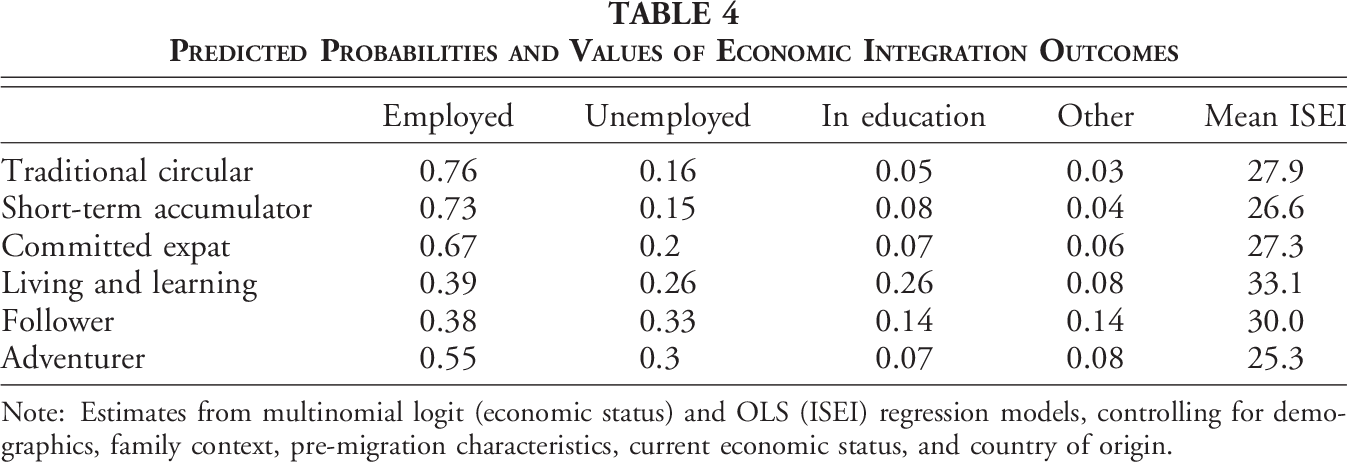
Note: Estimates from multinomial logit (economic status) and OLS (ISEI) regression models, controlling for demographics, family context, pre-migration characteristics, current economic status, and country of origin.
Predicted Probabilities of Subjective and Social Integration Outcomes
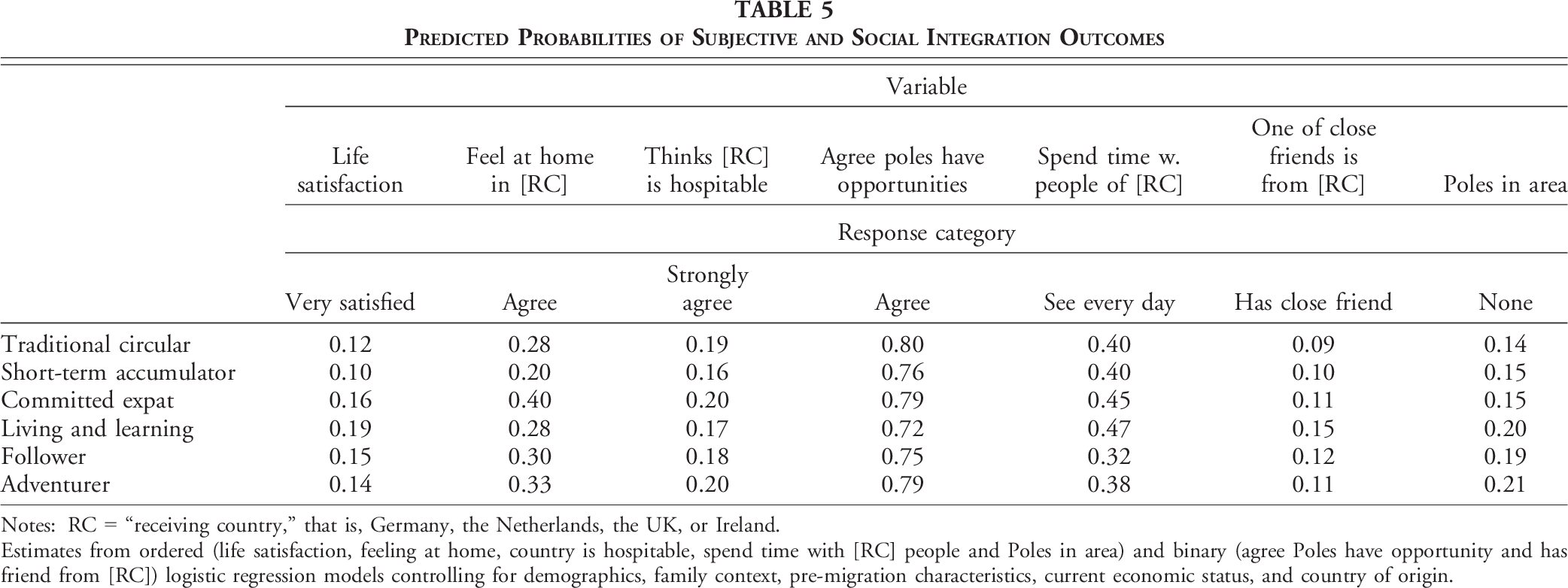
Notes: RC = “receiving country,” that is, Germany, the Netherlands, the UK, or Ireland.
Estimates from ordered (life satisfaction, feeling at home, country is hospitable, spend time with [RC] people and Poles in area) and binary (agree Poles have opportunity and has friend from [RC]) logistic regression models controlling for demographics, family context, pre-migration characteristics, current economic status, and country of origin.
First, we look at standard measures of structural integration — employment status and occupational status. Although Polish workers generally reported low unemployment rates following accession (Drinkwater, Eade, and Garapich 2009), during our sampling period in the great recession recently arrived Polish workers were experiencing much higher unemployment, for instance with rates of 10 percent in London in 2011 (ONS England and Wales Census 2011, Table CT0487). We find, however, that hard times impacted each migrant type in different ways, largely in line with our hypotheses. Our first hypothesis (H1) was that the working migrant types would show stronger signs of economic integration relative to non-economic migrants, even after controlling for compositional differences. Looking at Table 4, we see that this is the case: The three worker types are more likely to be employed and less likely to be unemployed than adventurer and follower migrants. And as anticipated in hypothesis H2, among economic migrants, the short-term accumulators and traditional circular workers with less permanent intended durations of stay have the lowest probabilities of being out of work. Unsurprisingly, the living and learning and follower types are more likely to be in education or pursuing other main activities. Yet even those with who have migrated with the express purpose of education have fairly low enrollment rates of only one in four: In contrast to those on official student visas, those “living and learning” under free movement are not restricted to the pursuit of formal education.
Turning to occupational status, we see evidence of the familiar story of economic constraint: Although less likely to be unemployed, labor migrant types are more likely to work in lower status jobs. By contrast, living and learning and follower migrants who are employed find higher status work, even after controlling for their higher levels of education and better language ability. As predicted in hypothesis H3, those non-economic migrants with more tenuous relationships to the receiving country, namely adventurers, have the lowest status jobs.
Turning to the subjective and social integration outcomes in Table 5, we see that consistent with hypothesis H1, short-term accumulators and traditional circular migrants face the lowest levels of life satisfaction and are also least likely to feel at home or be socially integrated in the destination country. As expected in H2, workers with a more temporary intended duration of stay report lower social and subjective integration. Even though all the migrants in our sample have only resided in the destination country for 18 months or less, with the majority being very recent arrivals, short-term accumulators are already less invested: They report only a 20 percent predicted probability of agreeing that they feel at home in the receiving country, eight percentage points lower than the next least at home group (traditional circular), and report lower levels of life satisfaction and assessments of receiving-country hospitality than either traditional circular or committed expats.
In contrast, more experiential migrants generally report more favorable opinions of the receiving country, although with some differentiation across types. For instance, followers and living and learning have higher satisfaction and report the most integrated living arrangements, with nearly one in five reporting residence in a neighborhood with no other Poles. They are both, however, slightly less likely to agree that Poles have opportunities or, in the case of followers, to actually spend time with receiving-country nationals on a daily basis. Social integration is driven by opportunity as well as choices, which may explain the higher social integration among the living and learning group, in particular their greater likelihood to have a close receiving-country friend. But, as noted, it may also be part of their migration aims. The adventurer group has levels of social and subjective integration in line with expectations: They are similar to followers and living and learning in their perceived residential integration, and are generally subjectively well disposed toward the receiving country, reporting feeling at home and agreeing that Poles have opportunities. However, perhaps due to their lack of ties in the receiving country, they are not as active socially as the other non-economic migrant groups, and they do not differ significantly from traditional circular on any social integration measure except for residential integration. Hence, the expectations of H4 are only partially borne out, as the more “constrained” family migrants do indeed report lower levels of some social integration measures, but the most unconstrained group of all, the adventurers, do not report the higher levels of social and subjective engagement we expected.
We then considered our final hypothesis H5 that the relationship between economic status and subjective and social outcomes may vary by migrant type. We re-estimated the subjective and social integration models interacting migration type with economic status. While tests on the inclusion of the interaction suggested that overall they were non-significant at conventional levels, some were marginally statistically significant and in addition individual interactions between migrant type dummies and economic status did seem to indicate variation in relationships. Specifically, as illustrated in Figures III and IV, we see that there were different impacts of unemployment on subjective well-being and on having a close friend depending on migrant type. Note that we chose “satisfied” (category 3) rather than “very satisfied” (category 4) as the basis of our interaction model probabilities as it is the most numerous category.
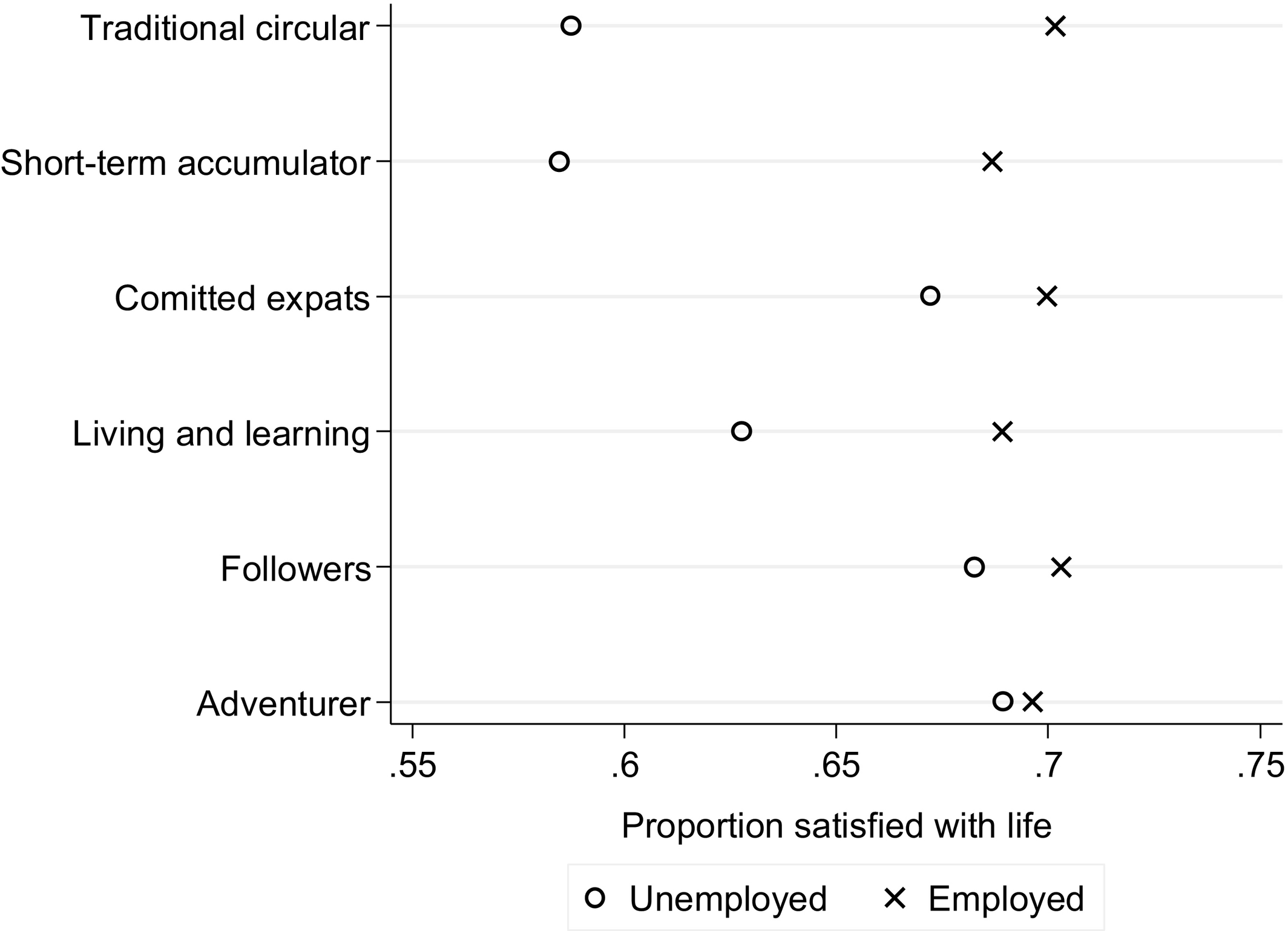
Impact of Unemployment on Probability of Being Very Satisfied with Life by Migrant Type
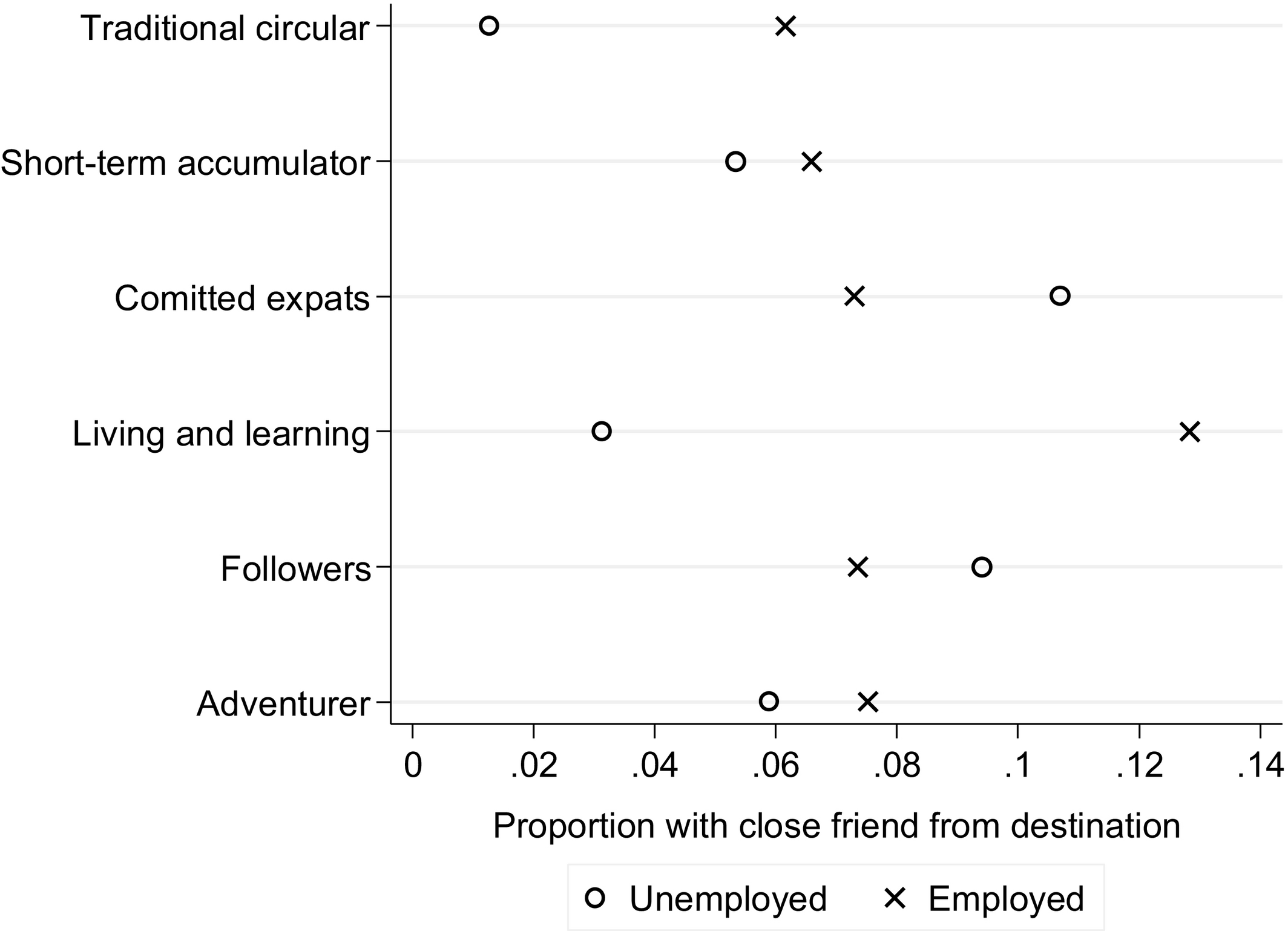
Impact of Unemployment on Probability of Having a Close Friend from the Destination Country by Migrant Type
While unemployment reduced life satisfaction for traditional circular and short-term accumulators, for whom work and accumulation are critical, it did so only marginally for the other migrant types, whose motivations and temporal perspectives were more varied and complex. In relation to having a close friend from the destination country, unemployment had a negative impact for most of the classes but not significantly for followers — whose routes to friendship may come through family and kin-based networks, nor for adventurers, for whom friendships may be part of their experiential aims, rather than a side-product of work-based contact. Interestingly the living and learning group did seem to be less satisfied, and less socially integrated, when unemployed. In line with their low enrollment rates, those who state education as a motivation for migrating are clearly also vulnerable to economic imperatives.
In additional exploratory analysis, we tested the assumption that the relationship between early integration patterns and migrant types are similar across countries. Of the nine indicators we examined, there were significant interaction effects across four outcomes showing rather less variation in integration outcomes across the migrant types in London and Dublin, and rather more across the types in the Netherlands. 5 This may indicate certain contextual or migrant selection influences that differ between the countries, which could benefit from future investigation. But it may be driven in part by the different sampling strategies in each country resulting in national coverage in the Dutch sample and city-based samples in the UK and Ireland. More detailed investigation is beyond the scope of this article, which set out to characterize the new migration as a cross-national phenomenon. But in future work, further leverage on how specific destination factors may shape integration trajectories of new migrant types could be gained through restricting comparison to the more comparable capital cities of Amsterdam and London.
To summarize, the integration patterns of the traditional circular and short-term accumulator types align with predictions of the new economics of labor migration theory, commonly applied in quantitative studies of A8 migration. These migrant types appear to follow an income diversification strategy, taking any job where wages are high and intending to return home to spend or invest where cost of living is lower. These (predominantly male) workers are motivated by the economic opportunity afforded to them in the receiving country even as their life satisfaction and social integration remain low, given their orientation of earning with the goal to return home.
In contrast, the remaining types present early integration configurations that are less well explained by prevailing models. The existing qualitative literature on A8 free movement, combined with our typology developed above, helps explain the decoupling of economic and social and subjective outcomes among immigrants. Free movement has provided more advantaged potential migrants, who can afford to move for preference or self-development without immediate economic returns, the opportunity to realize their migration aims. Freed from visa constraints and state selection mechanisms, these experiential, transnational, or long-term motivated migrants who aim to make international living a way of life can enjoy sojourns in Western Europe even as they are unemployed or in low-skilled occupations, and can entertain uncertain or multi-step migration plans. Such plans particularly suit young and highly educated women, who are taking advantage of new opportunities in Europe at disproportionately high rates, perhaps also as a means of resistance and escape from a more gender conservative society (Coyle 2007). It is these migrants who represent the novelty of the new migration, and which require a broader theorization of their migration decision and early integration that goes beyond economic imperatives.
Conclusions
In this article, we set out to formulate the key features of the migration process in a situation of low information and travel costs and low or no legal barriers to entry. We argued that the absence of receiving state restrictions post-accession would enable greater diversity in migration motivations and intentions than in other migration systems and that these would be consequential for early integration.
Using a large, cross-national sample of recent Polish immigrants to Western Europe in 2010/2011, we were able to identify both more traditional labor migrant forms, but also newer forms of migrant with more educational and experiential concerns. These newer migrant forms were also more diverse in their pre-migration characteristics, showing less gender differentiation, a younger and more urban profile, and a higher level of skills than traditional migrants. Those with settlement intentions were also more positively selected than circular and short-term migrants.
When investigating whether there were, as hypothesized, differential integration outcomes across the different types, we paid attention to both the economic and social and subjective measures of integration. While the “success” or “failure” of post-accession migration is typically framed in purely economic terms, hostility toward European migrants is often based more around concerns about social and cultural difference, than job threat (Card, Dustmann, and Preston 2012). Hence, from both a migrant and a receiving country perspective it is important to consider both economic and social dimensions of engagement and the relationship between the two. Moreover, we explored these relationships controlling for the individual characteristics of migrants (sex, age, family status, education), to identify the ways in which migration type was independently associated with particular outcomes, rather than through the differential selectivity associated with the type.
We found that all types were less likely to be in employment than the traditional circular and short-term accumulators, but were also likely to have a slightly higher occupational status when they were in work. Socially, living and learning and follower types were more integrated than traditional circular migrants. Migrant workers who planned to stay tended to be particularly embedded within and positive toward their local receiving country contexts, while short-term accumulators had lower levels of subjective and social well-being across the range of measures. Capturing the post-migration experience and intentions at an early stage, our sample includes migrants with the most temporary aims and shows that migration duration intentions and motivations are closely related to both socioeconomic and social and subjective integration. While we cannot establish the direction of causality in this relationship, our work suggests that under free movement preferences are more strongly linked to outcomes than under international movement which is restricted by visa controls. Our findings also suggest that the newer forms of migration facilitated by free movement are linked to greater contact with and positive orientation toward receiving societies. They also highlight the relevance of evaluating integration outcomes against motivations and intentions.
A limitation of our study is that we cannot measure whether the types we identify will be consequential in the long term. We specifically surveyed migrants at a period that was as close as possible to the migration decision, while allowing for some experience in the destination country. Identifying the extent to which motivations and intentions are consistent over time will be an important next step for analysis. Longitudinal studies of migrants, particularly newly arrived migrants, are challenging and tend to identify the least mobile, but additional data collection rounds may enable some light to be shed on subsequent outcomes. Such analysis could also aim to explore the extent to which common migrant types follow different pathways according to national context.
A second next step will be to extend — and empirically evaluate — our framework and hypotheses to explain migration from other A8 accession countries with rather different historical relations to Western Europe (such as Hungary, Lithuania, and the Czech Republic). Moreover, with the changing profile of migration worldwide, and the ever-decreasing costs of travel and information (although not necessarily of barriers to entry), other migration flows which share many of the preconditions of the “new migration” could serve as test beds for our hypotheses.
Third, our article has illuminated the role of motivations and intentions and characteristics, among those who migrated in the post-2004 era, but, other than in the increased volume of migration, we were unable to compare these directly with the implicit counterfactual of pre-2004 migration. Identifying opportunities where the stylized features of the new European migration can be directly compared with an earlier migration system would be a valuable complement to the theoretical and empirical claims made in this article.
Notwithstanding these shortcomings, our article extends current qualitative and quantitative research on post-2004 intra-EU migration. Building on Portes’s (1997) emphasis on the role of typologies in the understanding of migration, not simply as a descriptive tool but also as a means to illuminate the differential consequences and causes of contrasting responses to a common context, we aim to have provided not only a set of extensible and convenient summary types, but also a broader base of testable hypotheses based around those types.
Supplemental Material
Supplemental Material, imre12293-sup-0001-TableS1-4 - Types of Migration: The Motivations, Composition, and Early Integration Patterns of “New Migrants” in Europe
Supplemental Material, imre12293-sup-0001-TableS1-4 for Types of Migration: The Motivations, Composition, and Early Integration Patterns of “New Migrants” in Europe by Renee Luthra, Lucinda Platt, and Justyna Salamońska in International Migration Review
Footnotes
Notes
References
Supplementary Material
Please find the following supplemental material available below.
For Open Access articles published under a Creative Commons License, all supplemental material carries the same license as the article it is associated with.
For non-Open Access articles published, all supplemental material carries a non-exclusive license, and permission requests for re-use of supplemental material or any part of supplemental material shall be sent directly to the copyright owner as specified in the copyright notice associated with the article.
