






Abstract
Scholars argue that institutional arrangements shape migrants’ economic integration trajectories, and yet few studies empirically substantiate this. This study identifies employment institutions in Japan that affect skilled foreign workers. We demonstrate that practices ostensibly introduced to benefit these workers are associated with lower pay, after adjusting for human capital and firm characteristics. High levels of gender inequality also severely disadvantage female skilled migrants. These findings demonstrate that in the Japanese case, detrimental employment institutions often cancel out skilled foreign workers’ returns to human capital. The results may explain why Japan has failed to attract and retain more skilled migrants.
Introduction
Worldwide, skilled migration has ballooned rapidly, increasing by over 70 percent since only 2004 (OECD 2014, 36). Because skilled migrants are thought to stabilize countries’ fiscal bases by paying more in taxes than they consume in social services (Batalova, Fix, and Creticos 2008, 1), bring valuable technical, language, and cultural skills to their host economies (Orrenius and Zavodny 2007; Regets 2007, 9–10), and integrate more smoothly than their less educated counterparts (e.g., Alba and Nee 2003; Nee and Holbrow 2013), governments across the developed world now eagerly court highly educated migrants in what some call a global “race for talent” (Shachar 2013). This desire to attract skilled migrants is nearly universal: Even Japan, which has one of the most restrictive policies toward low‐skilled migration of any OECD country and one of the lowest shares of foreign residents, has jumped on the bandwagon, seeking to increase inflow and settlement of skilled migrants through new policy measures and preferential visa treatment (Akashi 2009; Oishi 2012).
But how do skilled migrants fare in new migration destinations such as Japan? Do they meet with similar levels of economic success as their counterparts in traditional immigration destinations? Do they provide the same fiscal benefits?
Theories of integration strongly suggest that institutional arrangements of all kinds — in law and policy, in education, in the labor market, and in social attitudes and norms — play a key role in migrants’ successful or unsuccessful economic incorporation (Reitz 1998; Portes and Rumbaut 2001; Alba and Nee 2003; Nee and Holbrow 2013). In other words, we cannot expect that skilled migrants’ integration trajectories will be constant in different national and local contexts. As a case in point, some scholars argue that skilled migrants to Japan in fact experience “negative assimilation” with earnings that do not grow, or in some cases even decline, with time in the country (Takenaka, Ishida, and Nakamuro 2015), in contrast to the largely successful outcomes observed for skilled migrants in other destinations.
But despite widespread acknowledgment that institutions matter for migrant integration, with a few rare exceptions (e.g., Lewin‐Epstein et al. 2003; Kogan 2006), scholars have been unable to make direct measurements of any correspondence between institutions and migrant outcomes. While few scholars would deny that migration trajectories depend on institutional context, we lack more specific theory or data about why migrants’ trajectories vary within or between countries after adjusting for individual‐level differences (Höhne and Koopmans 2010).
Japan presents a fascinating research site in which to identify the mechanisms that generate these national differences. Like many other countries, Japan has liberalized its immigration policy to promote skilled migration. Compared to other countries, however, the policy overhauls have produced only lackluster results and failed to attract and retain skilled migrants in large numbers (Oishi 2012; Törngren and Holbrow 2017). Why has migration policy been so ineffective in the Japanese case? We address this puzzle through our analysis of the 2008 Survey of Foreign Graduates Employed in Japanese Companies, a unique matched dataset of foreign graduates of Japanese tertiary education and their employers. These data allow us to examine the economic attainment of those migrants to Japan who might reasonably be expected to perform the most successfully in the Japanese labor market (Arbeit and Warren 2013): foreign graduates of Japanese universities. The linked employer data also permit us to examine relationships between employer practices and outcomes for migrants, documenting how particular institutions help or hinder the economic integration of skilled migrants and shape their trajectories. In doing so, we not only provide novel information about the fate of skilled migrants in Japan, but also supply some of the first empirical evidence in support of theoretical links between institutional context and migrant outcomes.
Studies of migrants in various destinations have often compared skilled migrants’ outcomes to those of migrants with lower levels of education (Chiswick 1978; Borjas 1999). These studies conclude that skilled migrants enjoy relatively positive integration outcomes; even if skilled migrants experience an initial wage gap with natives, this gap is much smaller than for those with lower education levels (Chiswick, Lee, and Miller 2005; Akresh 2006), and narrows with time migrants spend in the host country (Lubotsky 2007; Kaushal 2011). 1 These well‐replicated findings have fueled the “talent race” by making skilled migrants’ economic integration appear inevitable, regardless of host community characteristics and institutions.
However, even if skilled migrants economically outperform their unskilled counterparts, potential variation in well‐educated migrants’ economic integration and the causes of this variation are nonetheless worthy of attention. If labor markets (or other institutions) sometimes block integration trajectories of skilled migrants, this calls into question the almost reflexive focus governments place on attracting skilled migrants (Reitz 2012), and suggests a need for greater attention on facilitating skilled migrants’ integration after arrival.
Skilled Migrants in Japan
The current study, following the OECD (Chaloff and Lemaitre 2009, 11), defines high‐skilled migrants as adults who have completed a tertiary education program and live outside their country of origin. Like many other developed countries, Japan is eager to attract and retain more skilled migrants, and has used a two‐pronged strategy to bring in more foreign university students (Takenaka, Ishida, and Nakamuro 2015) and more skilled foreign workers (Fuess 2003). The movement to attract more skilled workers began in 1989, when the Diet approved changes to migration law, adding over 10 new categories of occupational visas for skilled workers (Akashi 2009). More recently, in 2012, the government once again revised immigration law to promote the entry of highly skilled foreign professionals through the adoption of a point system, which provides a fast track to permanent residency for skilled workers with the requisite scores for high income, Japanese language proficiency, and so on. These policy changes have to some extent borne fruit — as Figure I shows, populations of both foreign students and workers on skilled visas doubled between 1992 and 2000, and doubled again between 2000 and 2010. 2
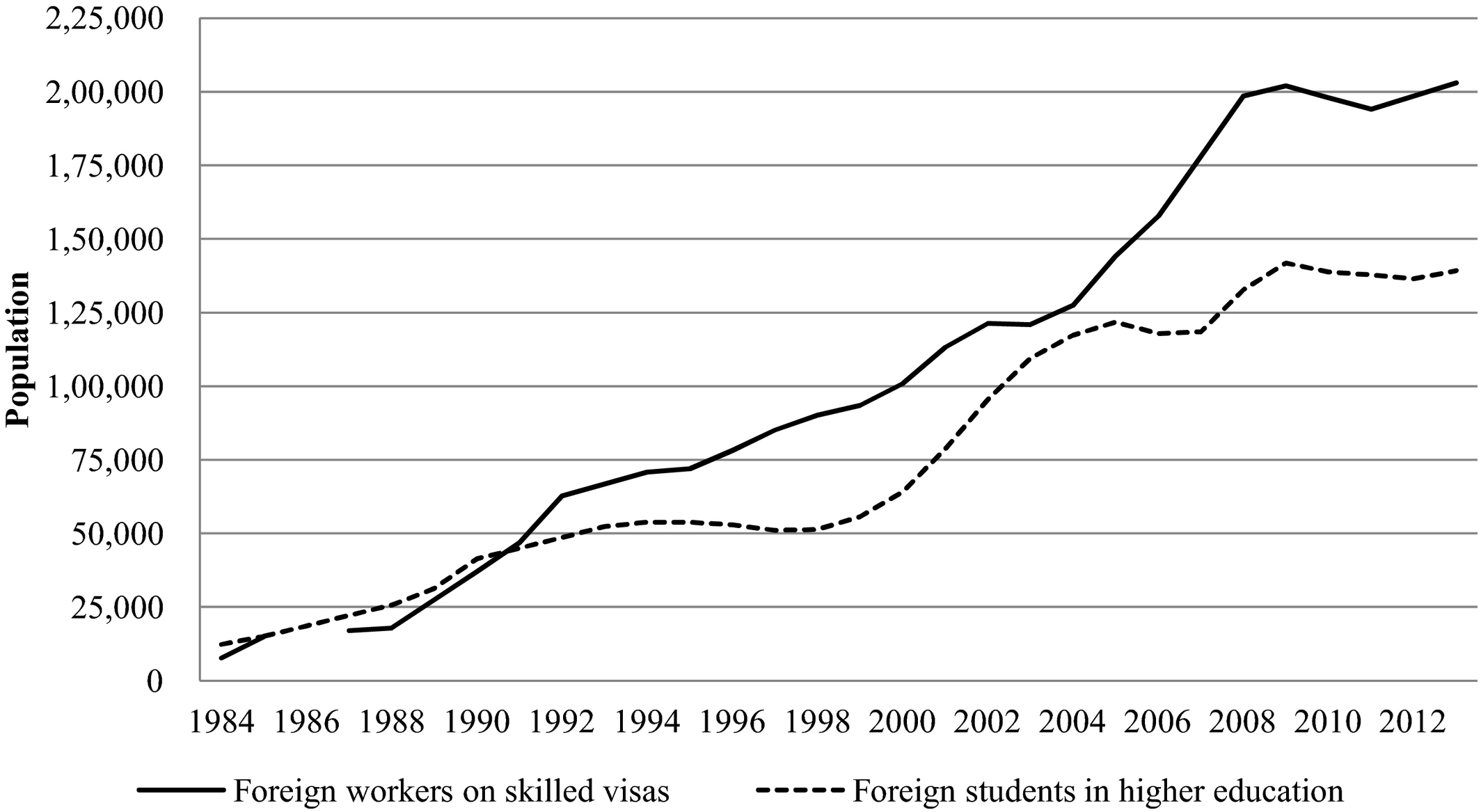
Japan’s Population of Skilled Foreign Workers and Students, 1984‐2013
However, despite the rapid increase in skilled migration, in comparative perspective Japan still lags behind other countries in attracting and retaining skilled migrants (Tsukasaki 2008; Oishi 2012). As a percentage of total population, for example, skilled migrants make up an estimated 0.2–0.4 percent of Japan’s population, compared to about 6.5 percent of Australia’s population and 2.1 percent of Sweden’s. 3 This failure to attract more skilled migrants to Japan is of particular policy concern because as a country with lowest‐low fertility, Japan’s population and labor force are shrinking at an increasing pace (Oishi 2012).
Relationships between Japanese Firms’ Practices and Skilled Migrants’ Integration
As yet, however, few studies examine the emerging phenomenon of skilled migration to Japan. Fuess’s overview of policy and government statistics (2003) and qualitative studies by Tsukasaki (2008), Liu‐Farrer (2009, 2011), and Oishi (2012) present rare exceptions. These authors conclude that skilled foreign workers face many barriers to economic integration and lack opportunities for career mobility. This raises questions about whether skilled migrants to Japan in fact experience earnings growth over time as they adapt to the Japanese labor market (Takenaka, Ishida, and Nakamuro 2015), and what labor market institutions inhibit or promote their economic integration and career mobility. Our study (n = 710) makes use of the largest available dataset on skilled foreign workers in Japan and sheds new light on these questions. We draw on a growing body of literature on how organizational practices affect outcomes for women and minorities, as well as qualitative studies of the Japanese case to develop our hypotheses.
The first labor market institution of interest is some Japanese firms’ tendency to pigeonhole foreign workers by assigning them to jobs that deal primarily with their home countries (Tsukasaki 2008; Liu‐Farrer 2011), or to narrow technical roles. 4 We characterize these types of job assignments as an informal tracking system for foreign employees. Traditionally, the path to upward mobility for white‐collar workers in larger Japanese organizations has been to experience rotations in a wide variety of job functions and business areas (Jacoby 2005). This type of job rotation is thought to create well‐rounded generalists with the broad vision necessary to be successful company managers (Brinton 1993). But the concentration of foreign workers in particular occupational categories even in large organizations (Tsukasaki 2008) suggests that firms take a different approach to human capital development of their foreign employees, and have effectively created separate career tracks for them, as has long been the case for female employees in Japanese firms (Brinton 1993).
There are several reasons why this type of job assignment may disadvantage foreign employees. Firstly, in the US context, firms’ pigeonholing of minority employees into racialized or ethnicized jobs appears to limit opportunities for advancement (Bielby 2012; Skrentny 2014). Secondly, the tracking systems for male and female employees adopted by many Japanese firms have most often relegated women to jobs with lower pay, less training, and few opportunities for advancement (Brinton 1993; Mun 2010). Motivated by the belief that foreign workers are more likely to quit than native workers (Liu‐Farrer 2011), firms may use tracking systems for foreign employees to reduce their investment in foreign workers’ career development. These considerations suggest our first hypothesis: H1a: Informal tracking systems for foreign workers are associated with lower earnings for skilled foreign employees.
On the other hand, we cannot assume out of hand that tracking is disadvantageous. For one, in recent years Japanese firms have diversified tracks for all employees, reducing the value placed on generalized firm‐specific human capital and increasing that placed on specialization within one occupation or business area (Imai 2011). Tracking for foreign employees may be an example of this general trend, rather than a parallel to the gendered tracking system. Moreover, Japanese firms are becoming increasingly reliant on foreign rather than domestic business as Japan’s population contracts, and tracking may create opportunity structures that help foreign employees take advantage of these growing business opportunities. This is in contrast to pigeonholed native minority employees at US firms, whose opportunities are reduced because they are expected to handle business in “niche” markets outside the firms’ “mainstream” business portfolio (Skrentny 2014). If tracking recognizes and rewards foreign workers’ unique skills or allows them to take advantage of burgeoning sales abroad, it is possible that: H1b: Informal tracking systems for foreign workers are associated with higher earnings for skilled foreign employees.
Next, we consider the effects that Japan’s low levels of diversity may have on foreign workers. With a few rare exceptions at large multinationals, most Japanese firms hire skilled foreign workers only in very small numbers, if at all. For example, in the survey from which we draw our data, only 15.8 percent of firms report employing any foreign workers as full‐time, regular employees at the time of the survey (JILPT 2009, 18). Of these firms, 77 percent employ between one and four foreign workers in regular positions, and a mere 3 percent employ 20 or more. In effect, this means that virtually all foreign workers employed at Japanese firms experience “token” status (Kanter 1977) at the firm level, the workplace level, or both (Oishi 2012).
This phenomenon alone is not evidence of discrimination, but rather reflects the fact that, in spite of the rapid increase in skilled foreign workers, their share of the total workforce remains very small. But although numbers alone do not necessarily disadvantage foreign workers (indeed, they may allow foreign workers to command higher wages because of the scarcity of their skills), there are ways in which their scarcity may nonetheless work against them. Even without discrimination, the small numbers of foreign skilled workers mean that foreign managers are even rarer than regular foreign employees (JILPT 2009, 17). In the United States, female managerial presence has been strongly linked to better outcomes for non‐managerial female employees. A larger share of female managers has been associated with reduced gender wage inequality in cross‐sectional data (Cohen and Huffman 2007), and decreased male–female segregation in longitudinal data (Huffman, Cohen, and Pearlman 2010; Kurtulus and Tomaskovic‐Devey 2012).
5
Similar analyses have not been conducted for racial minorities, although Maume (2012) found that having a direct minority supervisor is not associated with higher earnings. Thus, although there is no evidence that minority managers affect outcomes for their minority subordinates, we take into account the findings on manager gender and consider the hypothesis: H2: The presence of foreign managers in the firm is associated with higher earnings for non‐managerial skilled foreign employees.
Thirdly, we examine the relationship between merit pay systems and outcomes for foreign workers. This is of interest because Japanese firms have traditionally emphasized seniority pay rather than merit pay. However, since the 1990s, many firms have increased the proportion of employees’ pay that is determined by merit evaluations. According to one firm survey (Roumu Gyousei Kenkyujo 2004), the proportion of firms with a purely seniority‐based wage system fell from 54.3 percent in 1995 to 37.7 percent in 2003. During this period, the proportion of firms with merit‐based bonus pay increased from 17.7 to 41.2 percent. Originally, the argument for merit pay in Japanese firms centered on efficiency (e.g., Nakajima, Matsushige, and Umezaki 2004), but in recent years consultants have also suggested that merit pay may make Japanese firms more attractive to highly skilled foreign workers, because it provides greater short‐term rewards (JILPT 2009, 2013, 19). Moreover, in the United States, human resource officers and managers have for many years promoted formalized merit evaluations and merit pay as a way to improve organizational efficiency as well as to reduce gender and racial inequality (Dobbin 2009; Castilla and Benard 2010; Stainback, Tomaskovic‐Devey, and Skaggs 2010, 230). Merit evaluations are thought to reduce inequality because they place compensation decisions on a more explicit and presumably objective basis, giving employers less leeway to make pay determinations based on ascriptive characteristics. This suggests that merit evaluations may benefit foreign employees by giving them an opportunity to overcome firms’ low expectations and have their contributions recognized and rewarded quickly. We thus hypothesize that: H3a: Greater emphasis on merit pay is associated with higher earnings for skilled foreign employees.
On the other hand, there is also evidence that supposedly meritocratic systems can cloak or legitimize inequity. For example, in one case study, Castilla (2008) found although the employer had formalized the performance evaluation process, managers still exercised discretion about how to act on the results of employees’ performance evaluations. This disadvantaged minorities, who received smaller raises than similarly performing native‐born, white Americans. These findings suggest that merit pay practices in Japanese firms may in fact penalize foreign employees, because they introduce more managerial discretion than the seniority wage system, in which wages are determined automatically by objective measures such as tenure. Thus, we also hypothesize that: H3b: Greater emphasis on merit pay is associated with lower earnings for skilled foreign employees.
Finally, we examine the effects of firm‐level diversity training. Diversity training for managers has diffused fairly widely among US firms (Kalev, Dobbin, and Kelly 2006, 598–99; Dobbin 2009), and is becoming more popular in Japan as well. And yet, in the United States there is little evidence that diversity training improves outcomes for minorities or women — indeed, it may even have negative effects. Kalev, Dobbin, and Kelly (2006) found, for example, that after firms introduced diversity training, they tended to reduce their share of black managers. Experimental evidence also suggests that diversity training and other HR programs related to increasing employees’ consciousness and attention to diversity issues can “create an illusion of fairness” (Kaiser et al. 2013, 504; Dover, Major, and Kaiser 2014) that blinds majority group members to actual discrimination. Thus, we hypothesize that the growth of these types of training in Japan may ironically suppress highly skilled migrants’ compensation: H4a: Diversity training is associated with lower earnings for skilled foreign employees.
On the other hand, in a setting where homogeneity has been held up as a source of competitive advantage and skepticism of the benefits of diversity is pervasive, firms that actively reject these views by adopting diversity training may be deeply committed to treating foreign workers well. We therefore also consider the possibility that: H4b: Diversity training is associated with higher earnings for skilled foreign employees.
Data
In our analysis, we use the matched employer–employee Survey of Foreign Graduates Employed in Japanese Companies, conducted in 2008 by the Japanese Institute for Labor Policy and Training (JILPT). For this study, JILPT mailed survey forms to 10,349 firms with more than 300 employees, a sample which covers about 81 percent of large Japanese firms. 6
JILPT requested that a human resource officer at each firm complete the company questionnaire and distribute the employee questionnaire to up to six foreign employees who had graduated from Japanese higher‐education institutions. 7 In all, 3,018 companies and 902 employees responded to the questionnaire, for firm‐level response rate of 29.2 percent. Among the responding firms, only about 18 percent (538 companies) had ever hired a foreign worker, and some of these no longer had foreign employees. We exclude from our analysis firms that did not have any valid employee surveys, firms that reported fewer than 300 employees, and employee observations with missing data on the variables of interest. This results in a final sample size of 710 foreign graduates of Japanese educational institutions, working in 331 firms. Given the comprehensive sample, we assume that the responding firms are representative of large firms that hire foreign graduates of Japanese higher education.
Descriptive statistics for these firms appear in Table 1, 8 including data on the prevalence of the employment institutions under study. About 45 percent of firms use tracking (H1), either intending to use foreign employees primarily as executives overseas, or as specialists in technical work or international business. Approximately one‐third of firms have foreign managers (H2). Performance pay (H3) is widespread, present in some form in 90 percent of firms, while diversity training (H4) is relatively uncommon, used in only 16 percent of firms.
Descriptive Statistics
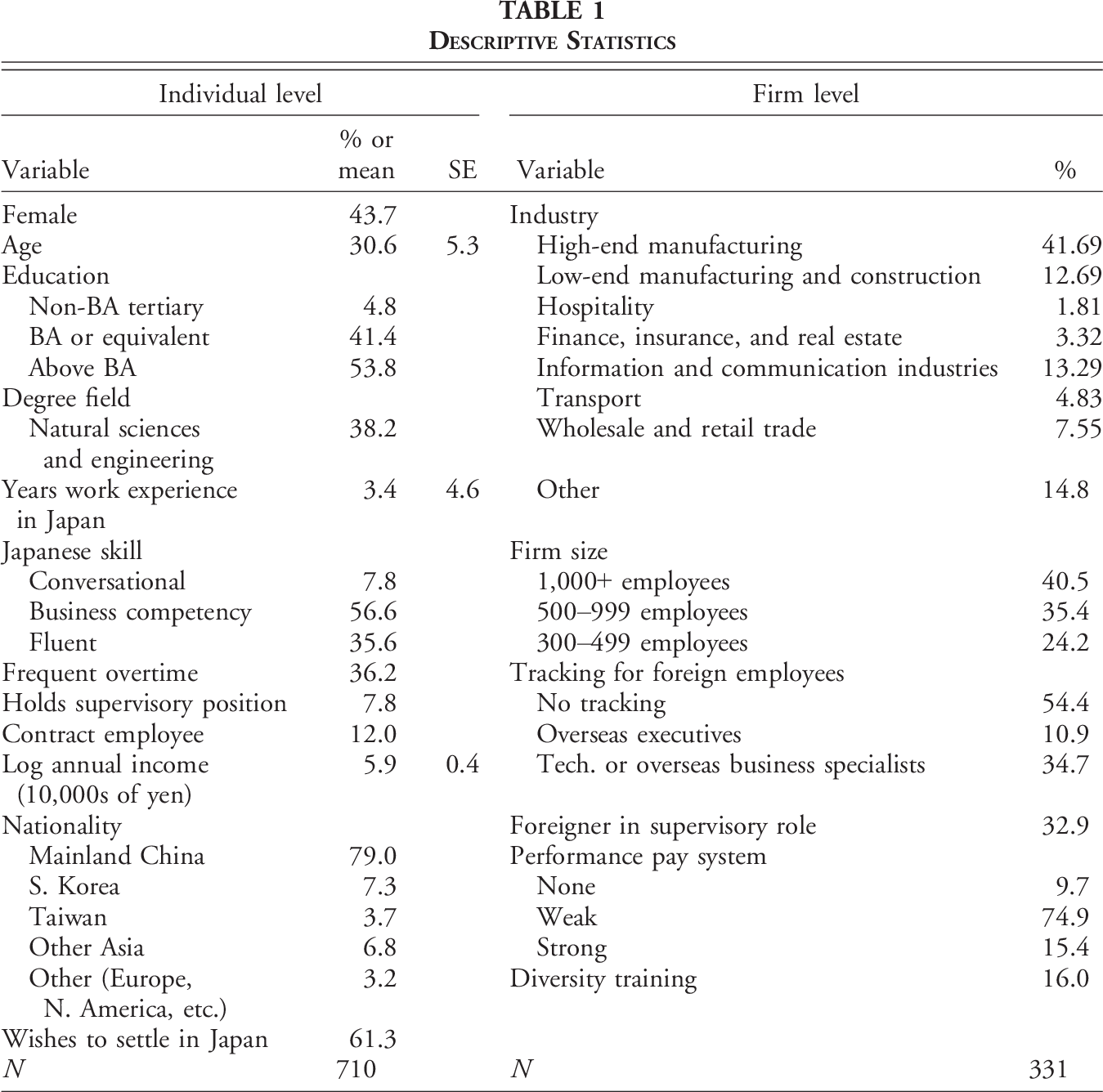
Table 1 also displays information about the individual respondents. They are a relatively young group, with an average age of 30 and just over three years of work experience in Japan. About 61 percent plan to settle in Japan for the long term, suggesting that the majority of respondents wish to integrate, and are not simply working in Japan to gain experience that will help them build careers elsewhere.
How well does the worker sample represent the population of interest? Because the survey does not include foreigners educated abroad, our findings can only be generalized to foreigners educated in Japan, and we concentrate our attention on the sample’s coverage of this group. 9 Census data on foreign workers do not include information about their visa status and educational level, so we use the best available data — Ministry of Justice statistics on students who change their visa status from student to worker (hereafter “visa changers”). We evaluate our sample by comparing its composition to that of the 2003 visa changers, because this is around the time when a typical respondent to our survey would have entered the Japanese workforce.
On a nationality basis, the worker sample reflects this underlying population of skilled foreigners educated in Japan with reasonable fidelity. In 2003, 94 percent visa changers were from Asian countries (Ministry of Justice 2015a). This is similar to the proportion of Asians in our sample, 97 percent. In our sample, however, Chinese (including Taiwanese) students are more prevalent and Korean students are less prevalent than among the 2003 visa changers, where they made up about 64 and 19 percent of the total, respectively. This does not necessarily suggest a biased sample, however. Chinese students may be more likely to stay in Japan long‐term than Koreans, and may thus appear more frequently in worker samples.
From a human capital standpoint, our sample is more elite than the broader population of skilled migrants educated in Japan. Because the sampling frame excludes small firms, all respondents are those who were able to win employment at the more prestigious and higher paying large firms. 10 The education statistics also illustrate this elite bias. About 54 percent of our sample hold degrees above the BA level, compared to 45 percent of the 2003 visa changers (Ministry of Justice 2015b).
The advantage of a sample skewed toward the most elite foreign students is that it allows for a conservative test of our argument that even for migrants with high human capital, employment institutions matter for their integration trajectories. A weakness of the sample is that it precludes generalizations to foreigners educated outside Japan and to foreigners employed in small and medium firms.
Analytic Strategy
To examine the relationship between various workplace institutions and foreign workers’ income, we use a series of hierarchical linear models (HLMs). HLMs are appropriate when data take a nested structure (Heck and Thomas 2000) as does our dataset of individuals clustered within firms.
We use respondents’ logged annual earnings 11 as the outcome variable, with adjustment variables at the individual and firm levels. All models assume fixed slopes: Although we allow the intercept to vary by firm, we restrict relationships between income and individual characteristics such as gender or company characteristics such firm size to remain constant across firms. 12
At the individual level, we include adjustment variables that are frequently used in analyses of income, including sex, education level, type of degree, age and number of years working in Japan, 13 frequency of overtime work, and whether the respondents hold a contract (keiyaku) position or a regular (seishain) job. To account for women’s and men’s divergent earnings trajectories in the high gender inequality context of Japan, we also add interaction terms for sex and age.
Because of small sample size for non‐Chinese migrants, the dataset is not well suited to examine nationality differences in pay. Hence, we omit nationality from the main analyses, but include it in the supplementary models which appear in Appendix S2.
At the firm level, we include adjustment variables for industry and firm size. In the main analyses, we consolidate industry into two categories, manufacturing and non‐manufacturing. We supplement these with analyses using finer‐grained industrial categories in the appendices.
We begin our analysis with a null model, adding first individual‐level controls and then firm‐level controls. These initial models test whether our choice of HLM is justified, and whether respondents’ income variation is largely explained by the control variables. After these checks, we test our hypotheses by adding firm‐level variables for two types of informal tracking, the presence of foreign managers, the type performance pay system (no performance pay, weak performance pay system, or strong performance pay system), and the presence of diversity training. 14 Because the stratifying effects of performance pay may differ by tenure, particularly in a system where seniority‐based wages represent a large share of employees’ total compensation, we also run an additional cross‐level model in which we interact respondents’ years of work experience in Japan with the performance pay system variable.
Results
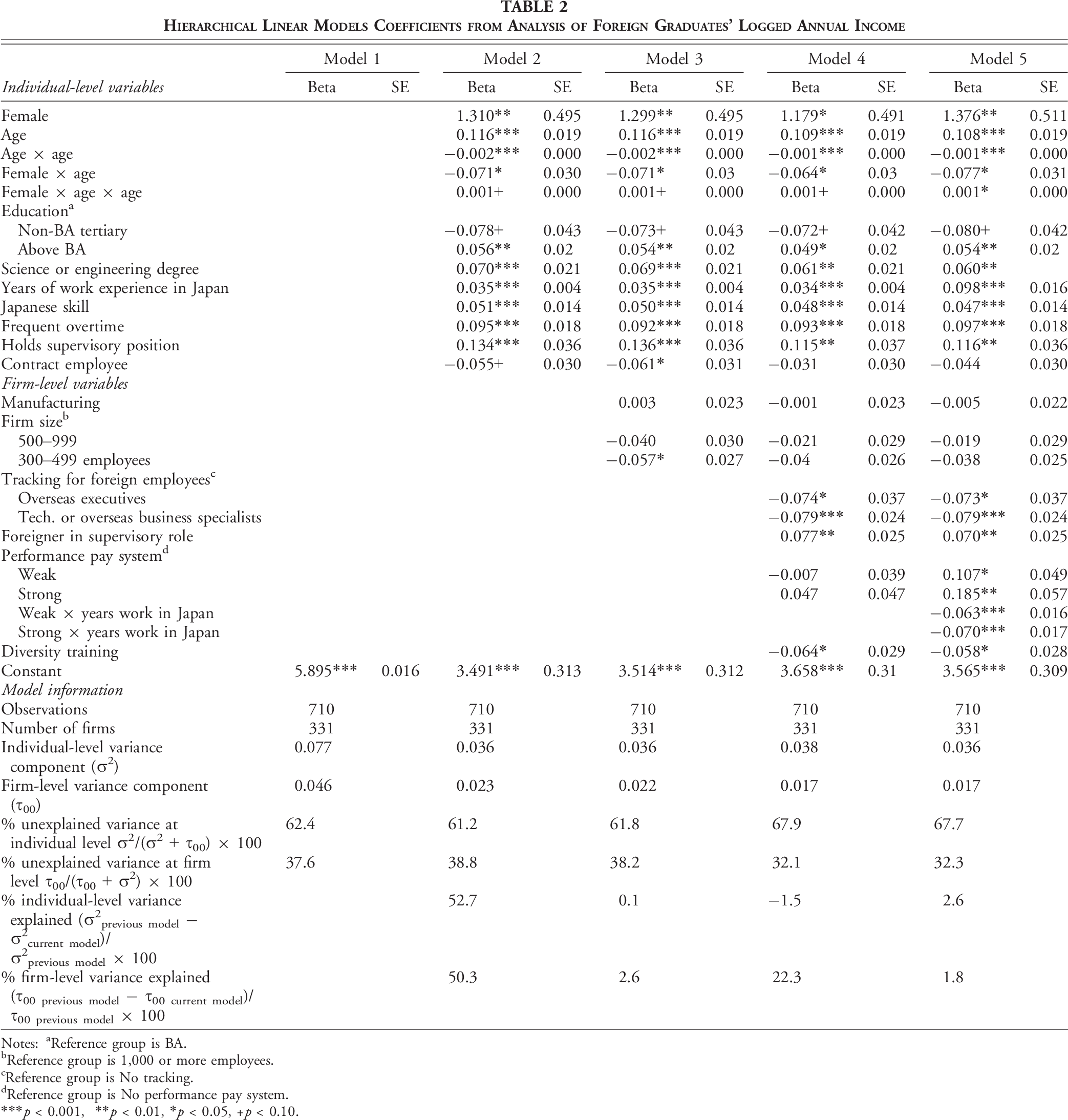
Table 2 shows the result of the hierarchical linear analysis. Model 1 is a null model, which includes only the intercept. According to the model, 37.6 percent of variance in earnings comes from between‐firm differences. The large proportion of variation occurring at the firm level justifies our decision to use a multilevel model.
Hierarchical Linear Models Coefficients from Analysis of Foreign Graduates’ Logged Annual Income
Notes: aReference group is BA.
bReference group is 1,000 or more employees.
cReference group is No tracking.
dReference group is No performance pay system.
***p < 0.001, **p < 0.01, *p < 0.05, +p < 0.10.
Next, we briefly examine the results for the model with only individual‐level controls. Here, we observe that the coefficient for female employees is positive and significant, but that the female interaction with age is significant and negative. This means that while younger women earn more than men, their earnings advantages lessen (and in fact reverses) with age. These relationships are plotted in Figure II, where we find that foreign women are not exempt from Japan’s highly institutionalized levels of gender inequality.
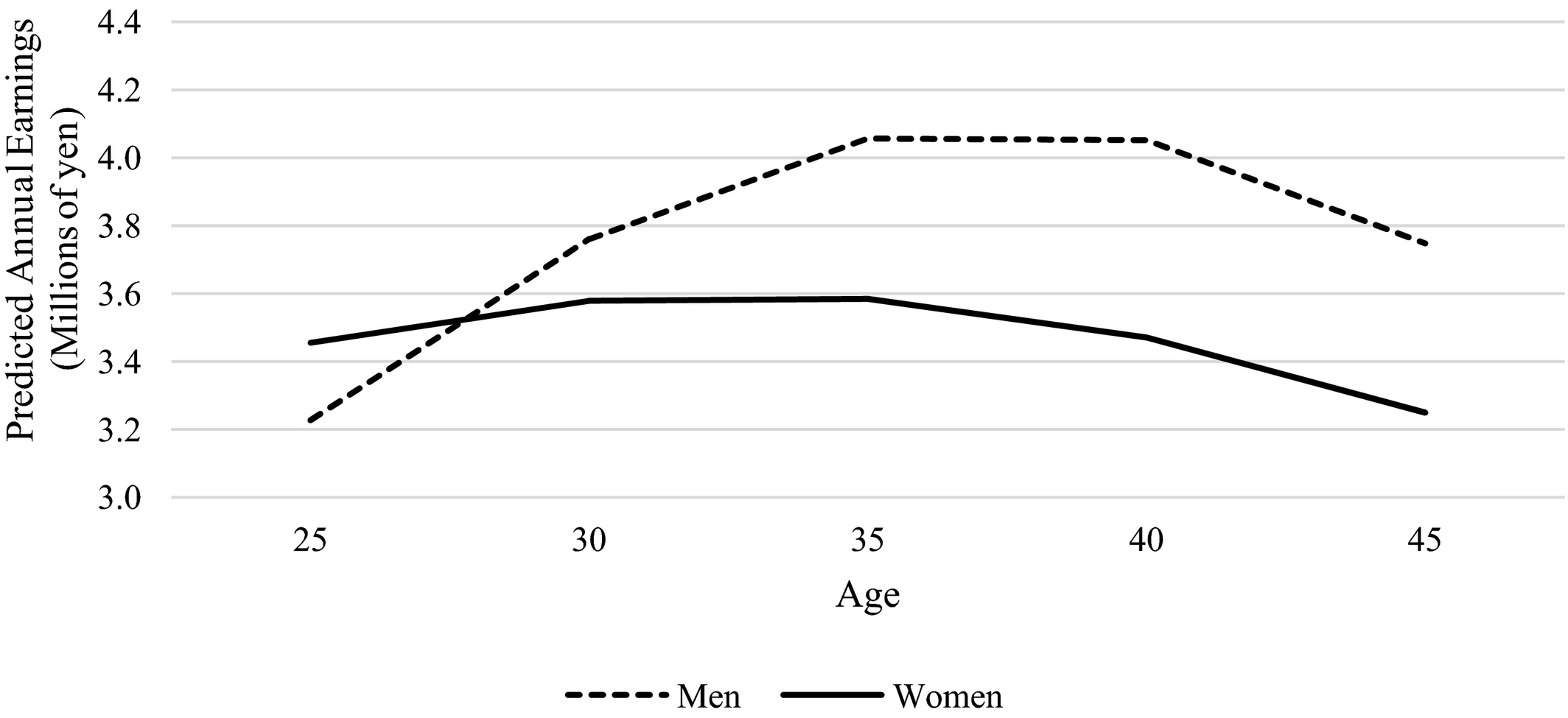
Predicted Earnings by Age and Gender (Based on Model 2)
The other individual‐level coefficients show effects consistent with skilled migrants’ integration trajectories in other national contexts. Male migrants’ wages increase curvilinearly with age, and wages for both sexes rise with work experience in Japan. Better educated migrants, migrants with science and engineering degrees, migrants who work more overtime, and migrants who hold supervisory positions also have higher compensation.
In Model 3, we add adjustment variables for firm characteristics — industry and firm size. Industry is not significant. For firm size, the reference category is firms with 1,000 or more employees. Coefficients for firms with 500–999 employees and firms with 300–499 employees are negative, but only the coefficient for 500–999 employees is significant. Because there are fewer firms in the sample with 300–499 employees, the non‐significant coefficient probably represents the lack of statistical power, not that pay at the smallest firms is equal to pay at the largest firms in the sample. Overall, these firm‐level variables do not have a great deal of explanatory power, and only reduce unexplained variation at the firm level by 2.6 percent.
In Model 4, we test our hypotheses by adding firm‐level variables for the policies of interest. Adding these variables significantly improves the model and explains 22.3 percent of the unexplained firm‐level variance in Model 3. This strongly supports our claim that the employment institutions in question significantly influence migrants’ economic integration.
We turn first to the results for Hypotheses 1a and 1b regarding informal tracking of foreign workers. Our results show that foreign workers in firms with informal tracking receive lower wages. 15 Setting other variables to their means, we can calculate that when firms want to use foreign workers as technical or overseas business specialists, their average annual earnings are ¥3.63 million, and when they want to use foreign workers as executives abroad, their average earnings are ¥3.65 million. However, in firms that say they plan to use foreign workers in the same way as Japanese workers, average wages are ¥3.92 million, about ¥0.29 million ($2,900) and ¥0.27 million ($2,700) higher per year than the other groups, respectively. Because the coefficients for both types of tracking are significant and negative, Hypothesis 1a is supported.
The coefficient for foreign employees in supervisory roles tests Hypothesis 2. This coefficient is significant and positive, indicating that employees who work in firms that employ foreign managers earn more than similar workers in other firms. Holding other variables to their means, we calculate a predicted income of ¥3.96 million for employees in firms with foreign management, and ¥3.66 million for employees in firms without. All else being equal, in firms with foreign managers, employees earn about ¥0.3 million ($3,000) more annually.
Next, we examine the results relating to Hypothesis 3 on the role of performance pay. The coefficients from Model 4 are non‐significant. However, when we add the interaction term between performance pay and years of work experience in Model 5, we observe significant, negative interactions between years of work experience and performance pay systems, whether weak or strong. In combination with the positive coefficient for years of work experience, this suggests that although foreign employees with short work histories in firms with merit pay may receive higher salaries than their counterparts in firms without merit pay, for employees with longer work histories in Japan, the opposite is true. Figure III visualizes the predicted incomes by years of work experience.
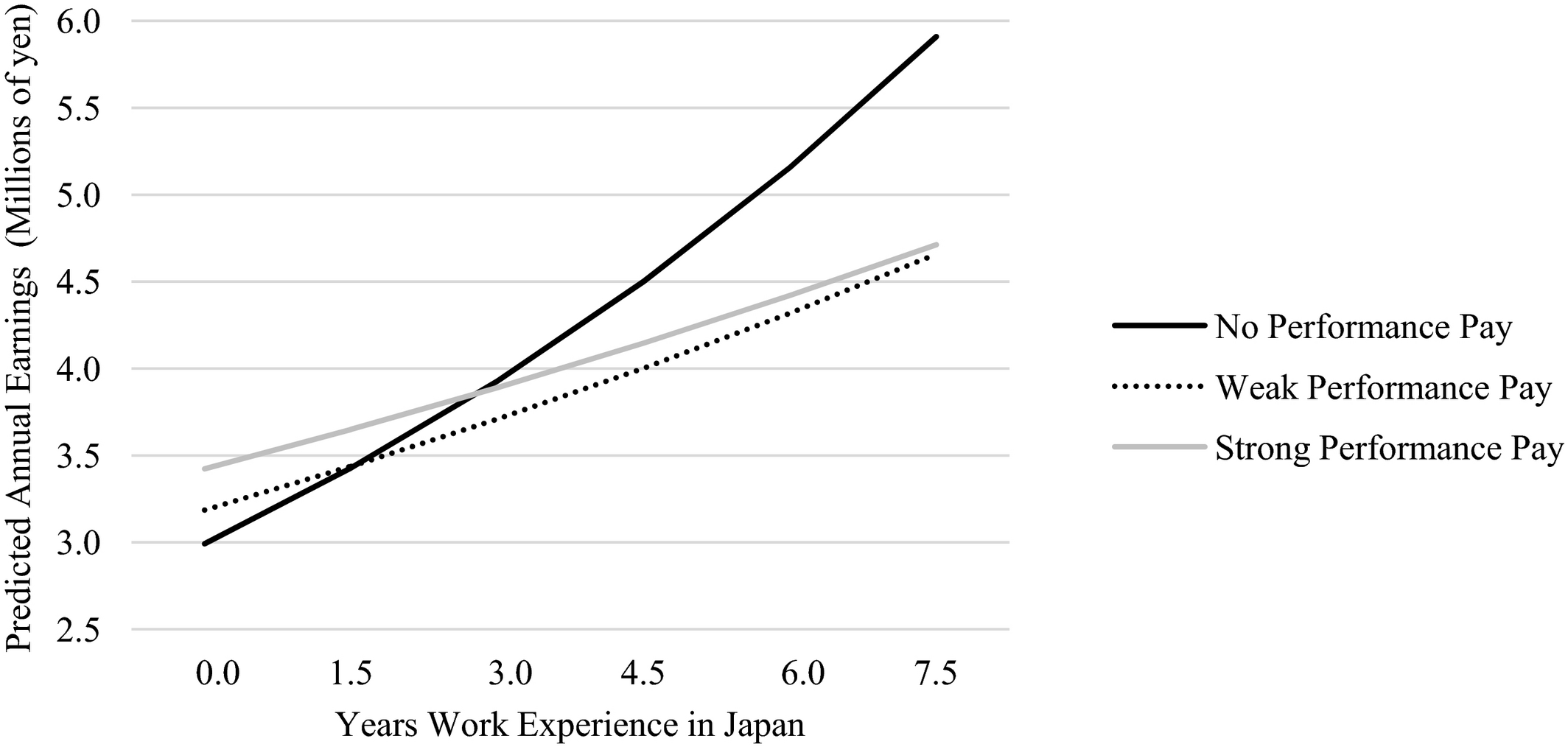
Predicted Earnings by Performance Pay Type and Work Experience (Based on Model 5*, not shown)
To avoid extrapolating outside the range or our data, we base Figure III on an additional model (not shown) which is identical to Model 5 except that years of experience has been top‐coded at 7.5, the highest category at which we have observations for all three configurations of performance pay. We see here that although pay for employees with work experience of three years or less is roughly similar regardless of merit pay, workers with more experience earn higher salaries when employed in firms without merit pay systems. For workers who have six years of experience, those working in firms without merit pay have a predicted annual earnings advantage over ¥8.4 million, or $8,400. These results support Hypothesis 3b, at least when we look beyond the short term: Performance pay is associated with lower salaries for foreign skilled workers. 16
Next, we return to Model 4 to test Hypotheses 4a and 4b. The coefficient for diversity training is significant and negative, indicating that, ironically, skilled foreign workers in firms that have implemented diversity training earn lower wages than those who work in firms that do not. Holding other variables to their means, the model predicts that workers in firms with diversity training earn ¥3.6 million annually, compared to ¥3.84 million for workers in firms without these policies, for a difference of about ¥0.24 million ($2,400). This finding supports Hypothesis 4a. 17
Finally, we conduct two additional sets of tests to further interrogate whether the relationships we capture here between wages and employment institutions are robust. First, we examine whether the results hold when we use finer‐grained measures of nationality, degree field, and industry (see Appendix S2). Then, we test the effects of tracking, foreigners in supervisory roles, and diversity training individually within all industries (Appendices S3.1.1–S3.3.2) and firm sizes (Appendices S4.1–S4.3) in which we observe at least 10 employees in firms with and without the focal institution. 18
Inclusion of finer‐grained measurements in Appendix S2 does not change the findings above. All coefficients for the focal institutions retain similar magnitudes and statistical significance. In Appendices S3.1.1–S4.3, statistical power is reduced because of lower n within industries and firm sizes. Thus, not all coefficients reach statistical significance. However, all but three of 31 coefficients for the focal institutions (tracking, foreigners in supervisory roles, and diversity training) take the same sign as in the models above, and none of the coefficients with unexpected signs reach significance. These tests heighten our confidence that the observed relationships between wages and employment institutions are robust across industries and firm sizes and that our findings do not reflect omitted variable bias due to the absence of nationality, industry, and degree field controls in the main analyses.
Discussion
Looking at human capital alone, our findings paint a rather positive picture of male skilled migrants’ integration in Japan and do not support claims that skilled migrants experience “negative assimilation.” For example, education, managerial status, age, and work experience in Japan all benefit skilled foreign workers, indicating a payoff for human capital investments and positive economic integration over time.
We also show for the first time how female skilled migrants’ trajectories compare to those of men. Although qualitative accounts (e.g., Liu‐Farrer 2011) have suggested that foreign women may be exempt from some of the institutional penalties that Japanese women face, we find that employment practices reproduce high levels of gender inequality among skilled foreign workers.
Of course, our results cannot be fully generalized to the entire population of skilled migrants in Japan. Our sample includes only foreign graduates of Japanese universities employed at large firms. As such, the respondents represent an elite, ethnically homogeneous group, whom we might expect to have the most positive integration outcomes. Future research comparing outcomes for groups of different educational and regional backgrounds is still necessary to sharpen scholarly understanding of migration to Japan. Workers at smaller firms and foreigners from non‐Asian countries may, for example, have different economic trajectories than workers in this study. 19
Despite these limitations, our elite sample presents a unique opportunity to investigate whether institutions matter to the economic trajectories of migrants with the skills and resources to, potentially at least, make their integration almost seamless. Our results indicate that even for this elite group, employment institutions play a large and important role. Informal tracking for foreign workers is negatively associated with migrant wages (H1a), as is diversity training (H4a). Merit pay also has a negative relationship with income (H3b), although not for workers with lower levels of work experience. Work for a firm with at least one foreign supervisor or manager, on the other hand, is associated with higher pay (H2).
The results on tracking support the findings of earlier qualitative research (e.g., Tsukasaki 2008) that tracking disadvantages foreign workers. We identify two potential mechanisms which could produce this disadvantage. Firstly, firms with tracking may initially place foreign workers in lower paid positions. Although many Japanese companies set uniform entry‐level wages for all regular workers with the same qualifications (e.g., college diploma), others offer slightly different starting wages for different job areas. Employers that use tracking for foreign workers may disproportionally place non‐Japanese in lower paid entry‐level jobs. These lower wages would persist even if foreign workers rotate to higher paid (often technical) jobs, because employers calculate subsequent wage increases as a percentage of current salary.
A second possibility is that tracking depresses wages for foreign workers by restricting their options for job rotation. Japanese firms place a high value of firm‐specific human capital that extends beyond one narrow business area. Employees being groomed for management roles may thus experience job rotations in business areas where they do not have specialized training. Particularly favorable job rotations give promising employees opportunities to work closely with top management and receive recognition from company leaders for their general skills. Tracking may categorically limit foreign workers’ access to the very rotations that are most important to career advancement and wage growth in Japanese firms. Our data do not allow us to determine which of these mechanisms is more influential in generating the tracking effect. While we expect that the latter mechanism exerts greater influence over the life course, given the low average tenure of this sample, we suspect that the former mechanism is important as well. In either case, our results suggest that tracking limits opportunities for skilled migrant workers, as pigeonholing does for minority workers in the United States and for female workers in Japan. 20
We also found that merit pay arrangements, although touted as a way to attract foreign workers, are associated with lower wages for foreigners with longer tenures. This finding is, however, less robust than our other results — the paucity of workers with long tenures and the widespread diffusion of performance pay made it impossible to test whether it holds across industries and firm sizes. As the number of foreign employees with long tenures grows, further research should investigate whether this pattern persists.
If the effect of merit pay is robust, why do workers in firms without performance pay earn more? On the one hand, companies that use merit pay may provide lower compensation to all their workers, Japanese and foreign alike, thus potentially achieving greater business efficiency. Alternatively, it may be that foreign workers are at a relative disadvantage to their Japanese counterparts because they perform more poorly on average. Finally, because bias can creep into the evaluation process in ways that it cannot in a purely tenure‐based system (Castilla 2008), foreigners may receive lower wages even when their performances match those of their Japanese colleagues. Given that firms report that they struggle to properly manage and evaluate foreign workers’ performance, we suspect that at least some of the wage penalty is due to foreigners’ relative disadvantage in a merit‐based system. Moreover, for Japanese native workers, the effects of merit pay on earnings over the life course are ambiguous (Nakajima, Matsushige, and Umezaki 2004; Mitani 2010). The large effects we observe for foreign workers thus suggest either bias against foreign workers or relative underperformance among foreign nationals, although we cannot confirm this using a dataset that excludes Japanese workers.
Another institution often thought to benefit foreign workers is diversity training for Japanese employees. However, once again our data do not show any advantage to working in firm with such a policy. In fact, foreign workers in firms with diversity training actually receive lower wages. It seems likely that, as predicted by social psychological experiments, such policies can activate negative stereotypes or disguise and deemphasize real inequities (Kaiser et al. 2013, 504; Dover, Major, and Kaiser 2014). However, an alternative explanation for lower wages in these firms is that companies with the most severe inequities are also the most likely to introduce diversity training. With cross‐sectional data, we cannot rule out this possibility, but given previous research showing that diversity training in the United States is associated with lower representation of blacks in management even in longitudinal data (Kalev, Dobbin, and Kelly 2006), we argue that a causal relationship is more likely in this case as well.
We also hypothesized that foreign workers may be disadvantaged because of small numbers of foreign managers. As predicted in Hypothesis 2, foreign workers employed in this minority of firms do receive higher wages. There are several possible mechanisms that could explain this finding. Firstly, the relationship may be causal, if foreign managers have fewer biases against foreign workers, or act as mentors and advocates for them within the organization. In this case, as foreign managerial staff increase over time, we can expect integration outcomes for foreign workers to improve. On the other hand, the presence of foreign managers may be a proxy for other underlying organizational characteristics, such as lower prejudice among Japanese employees. In this case, any future increase in foreign managers will be concentrated in firms that already employ foreign supervisors, and fortunes of foreign workers in other organizations will change more slowly.
Our analysis also demonstrates these institutional effects are significant at a practical level as well as a statistical one. Migrants are disadvantaged when they work in firms with informal tracking ($2,900 penalty), performance pay ($8,400 penalty after six years), and diversity training ($2,400 penalty), and when their firms do not employ foreign managers ($3,000 penalty). A majority of the respondents are exposed to at least two of these adverse conditions: 41 percent of the firms in the sample use performance pay and one other unfavorable practice (penalty of $10,800 to $11,400 depending on which other practices are used in addition to performance pay), an additional 27 percent use performance pay and two other unfavorable practices (penalty of $13,700 to $14,300), and 6 percent use all four practices that work to foreign employees’ disadvantage (penalty of $16,700).
Compare these to the effects of human capital: Workers in this sample receive a $4,300 annual premium for an advanced degree (relative to those with a two‐year associates degree), a $2,300 premium for a science and engineering major (relative to all other majors), and a $3,400 premium for fluency in Japanese (relative to beginners). If workers are advantaged on all three axes, they receive a total premium $10,000. But in 74 percent of sample firms with performance pay and at least one unfavorable practice, the institutional penalties cancel out the human capital premiums for even the most accomplished migrants.
Further research is required to determine whether these penalties reflect pay gaps between foreign and Japanese workers; if they do, this calls into question the positive picture of migrants’ economic integration we see when examining human capital alone, and may explain in part why Japan lags behind other countries in the race for global talent. Understandably, if employers use wage setting practices that produce large inequalities between similarly qualified foreigners and natives, skilled foreign workers likely to take their talents elsewhere, cutting short the complex intergenerational process of economic, social, and cultural integration. But even if the institutions studied here do not disproportionately disadvantage foreign workers relative to Japanese workers, the finding that employment institutions create varied trajectories for skilled migrants highlights the promise of an institutional approach to understanding integration.
Research on integration has long emphasized the role of institutions and “context of incorporation” in shaping migrants’ trajectories (Reitz 1998; Portes and Rumbaut 2001; Alba and Nee 2003; Nee and Holbrow 2013). However, there is relatively little scholarship to empirically back this assumption. Here, we have demonstrated large, significant effects of employment institutions on economic integration that rival or even surpass the effects of human capital, even for the most privileged migrants.
Studies demonstrating the importance of human capital to successful migrant integration (e.g., Chiswick 1978; Borjas 1999) have spurred the “race for talent” between developed countries (Shachar 2013). However, our research indicates that governments and scholars alike would do well to pay greater attention to what happens after skilled migrants arrive, and why. Governments that wish to benefit from skilled migration must look beyond simply luring migrants to their shores, and craft institutions to ensure that these skilled migrants can effectively use the human capital in their new homes.
Supplemental Material
Supplemental Material, imre12295-sup-0001-AppendixS1-S5 - Economic Integration of Skilled Migrants in Japan: The Role of Employment Practices
Supplemental Material, imre12295-sup-0001-AppendixS1-S5 for Economic Integration of Skilled Migrants in Japan: The Role of Employment Practices by Hilary J. Holbrow, and Kikuko Nagayoshi in International Migration Review
Footnotes
Notes
SUPPORTING INFORMATION
Additional supporting information may be found in the online version of this article at the publisher’s web site:
References
Supplementary Material
Please find the following supplemental material available below.
For Open Access articles published under a Creative Commons License, all supplemental material carries the same license as the article it is associated with.
For non-Open Access articles published, all supplemental material carries a non-exclusive license, and permission requests for re-use of supplemental material or any part of supplemental material shall be sent directly to the copyright owner as specified in the copyright notice associated with the article.
