







Abstract
Metaphors linking spatial location and affect (e.g., feeling up or down) may have subtle, but pervasive, effects on evaluation. In three studies, participants evaluated words presented on a computer. In Study 1, evaluations of positive words were faster when words were in the up rather than the down position, whereas evaluations of negative words were faster when words were in the down rather than the up position. In Study 2, positive evaluations activated higher areas of visual space, whereas negative evaluations activated lower areas of visual space. Study 3 revealed that, although evaluations activate areas of visual space, spatial positions do not activate evaluations. The studies suggest that affect has a surprisingly physical basis.
The association of affect with vertical position is a frequent occurrence in mainstream culture. Objects that are up or high are often considered to be good, whereas objects that are down or low are often considered to be bad. In the Bible, for example, the righteous go “up” to Heaven, whereas sinners go “down” to Hell. In the media, movie critics give good movies “thumbs up” and bad movies “thumbs down.” Popular slang is also replete with these associations. For example, people who smoke marijuana “get high,” but when the euphoria diminishes, they “come down,” and happy people feel “up” whereas sad people feel “down.”
Although few experimental studies have corroborated the association between affect and vertical position, some evidence for the association exists. Wapner, Werner, and Krus (1957) found that participants who just received an A on a midterm exam exhibited an upward bias when horizontally bisecting a luminous square. However, participants who just received an F on a midterm exam exhibited a downward bias on this task. In related work, Fisher (1964) found that participants experiencing a great deal of (vs. less) sadness had a downward bias when tracing the path of an autokinetic cue and adjusting a luminous rod to a horizontal position. Considering body posture, Stepper and Strack (1993) found that participants felt more pride when they were successful on a task if they assumed an upright posture (vs. a slumped-down posture) when receiving task feedback. Although there are a number of differences between the foci of these studies and ours (e.g., emotional experience vs. word affect), the prior results are nevertheless consistent with the idea that affect (good, bad) and spatial location (up, down) may be associated in subtle, but pervasive ways.
AFFECT AND METAPHORS
One account that explains why affect is related to physical representation (e.g., vertical position) is based on the developmental perspective of Piaget and Inhelder (1969). According to this view, human cognition develops through sensorimotor experiences. Young children think and reason about things that they can taste, touch, hear, see, and smell. As children age, they develop the ability to think and reason using abstract thought processes. This development, however, is built upon earlier sensorimotor representations. For example, eating sweet foods leads to a pleasant taste (sensory experience) and positive affect (abstract feeling state). In adulthood, this pairing of sensory and abstract representations may give rise to a physical metaphor (e.g., a sweet person is a pleasant person) that continues to exert subtle effects on representation and evaluation.
In a provocative book, Lakoff and Johnson (1999) contended that abstract thought is not simply aided by physical metaphors, but is instead based on physical metaphors. Metaphor allows people to think abstractly because it links abstract concepts (e.g., affect) to concrete sensory experiences. Without such links, concepts would lack reference to the physical world and be difficult to communicate to other people. Although abstract concepts are built on concrete sensory experiences, people are generally unaware of this sensory grounding. In this sense, metaphors guide thought in a hidden way that is generally underappreciated. Although Lakoff and Johnson's (1999) ideas are controversial, most psycholinguists do seem to agree that physical metaphors are useful in the representation of abstract concepts (e.g., Gibbs, 1992; Glucksberg, 2001).
In a recent series of studies, we sought to demonstrate this grounding of affect by showing that a manipulation of stimulus brightness (white vs. black font) either facilitated or delayed evaluation latencies for positive and negative words (Meier, Robinson, & Clore, 2004). As expected, positive words were evaluated faster and more accurately when presented in a white font, whereas negative words were evaluated faster and more accurately when presented in a black font. People had, in other words, fallen prey to a metaphor linking stimulus brightness to valence despite the fact that the brightness manipulation was orthogonal to the valence of the words.
OVERVIEW OF STUDIES
Existing results provide evidence that mood state may bias visual perception in an upward (happy; Wapner et al., 1957) or downward (sad; Fisher, 1964) manner. However, these studies used methods very different from those of the present studies, which were based on choice reaction time (CRT). CRTs should be useful for revealing whether the translation from vertical position to affect is obligatory at encoding.
Study 1 used a paradigm similar to that of our previous work on stimulus brightness and affect (Meier et al., 2004), this time in the context of vertical position and affect. In Study 1, positive and negative words were randomly assigned to higher versus lower positions on a computer monitor, and participants' task was to evaluate the words as quickly as possible. Because of the random assignment of words to spatial positions, spatial position was an irrelevant cue to word valence. However, we expected that if associations between valence and vertical position are obligatory, positive words would be evaluated more quickly when in the higher (vs. lower) vertical position, whereas the opposite would be true for negative words.
Studies 2 and 3 extended our analysis. Rather than presenting compound stimuli with both factors (valence and position) varied simultaneously, we used a continuous priming paradigm. In Study 2, participants were first asked to evaluate a positive or a negative word presented at the center of the computer screen (prime trial), and then a spatial discrimination task appeared in either a high or a low position on the screen, with the position determined at random (target trial). If evaluations are made partially on the basis of physical metaphor, then residual activation should influence spatial discriminations. Specifically, we expected that after participants made a positive evaluation, their spatial discriminations would be faster in the “up” position than in the “down” position; by contrast, after a negative evaluation, participants' spatial discriminations would be faster in the down position than in the up position. Such results would suggest that areas of visual space are activated simply by making positive or negative evaluations. Such results, if they occurred, would be rather stunning evidence for the activation of spatial metaphor by evaluations.
Lakoff and Johnson (1999; also Piaget & Inhelder, 1969) maintained that perceptual-conceptual associations are asymmetrical. Specifically, they argued that conceptual thought is based on sensory experience, but sensory experience is not based on conceptual thought. Development is consistent with this idea in that sensorimotor achievements occur before abstract thought does (rather than vice versa; Piaget & Inhelder, 1969). We examined the asymmetrical nature of the association between valence and spatial position in Study 3 by reversing the sequence examined in Study 2. In Study 3, participants were first asked to respond to a spatial probe that appeared at the top or bottom of the screen, so that “up” or “down” would be activated (prime trial). Subsequently, participants evaluated words presented at the center of the screen (target trial). We did not expect priming in Study 3 because one can make spatial discriminations without activating affective metaphors. Together, Studies 2 and 3 examined potential asymmetries of the association between affect and vertical position.
STUDY 1
We conducted Study 1 to determine if affective judgments are facilitated when they are congruent with metaphors related to vertical position. Participants evaluated 100 words as having either a positive (e.g., hero) or negative (e.g., liar) meaning. We randomly varied the vertical position of the words on the screen (top or bottom), so that valence and position were orthogonal. We expected that the positive words would be evaluated faster if they were presented at the top of the computer screen, but that the negative words would be evaluated faster if they were presented at the bottom of the computer screen. 1
Method
Participants
Participants were 34 undergraduates who received extra credit.
Procedure
Prior to the presentation of each word, a fixation cue (+++) was presented at the center of the screen for 300 ms. Following this central cue, a subsequent fixation cue (+++) was flashed for 300 ms 1.5 in. either above or below (determined at random) the central cue. Then, so that participants would fixate near the location where the word would appear, a third fixation cue (+++) was flashed for 300 ms 3 in. either above or below the central cue (in the same vertical direction as the second cue). The word then appeared 4 in. above or below the central cue (in the same vertical direction as the third cue). The spatial cues were not intended to prime locations, although they may have done so. Rather, the spatial cues were intended to direct attention to the spot of the word's appearance (thereby reducing random spatial exploration and its addition of error variance).
Words appeared in white, centered horizontally on the screen. Participants were instructed to evaluate each word as quickly and as accurately as possible. They used a response box (<1 ms error) to make these evaluations (1=positive, 5=negative). If the response was inaccurate, the word “INCORRECT” appeared in a red font for 1.5 s. Accurate trials were separated by a blank screen for 500 ms.
Results
Inaccurate trials were dropped from the analysis. Latencies were then log-transformed to normalize their distribution (Ratcliff, 1993). Next, we replaced trials that were 2.5 SDs below or above the grand latency mean (i.e., across trials and participants). A 2 (valence: positive vs. negative)×2 (position: top vs. bottom) repeated measures analysis of variance (ANOVA) was performed on the transformed latencies. The main effect of valence was significant, F(1, 33)=10.13, p=.003, indicating that participants were faster to evaluate the positive words (M=855 ms) than the negative words (M=902 ms). The main effect of position was not significant, F(1, 33)=1.96, p=.171. Of most importance, the Valence×Position interaction was significant, F(1, 33)=6.11, p=.019. As shown in Figure 1, participants were faster to evaluate positive words when presented at the top (vs. bottom) of the screen, whereas they were faster to evaluate negative words when presented at the bottom (vs. top) of the screen. Identical analyses were conducted on accuracy rates. All effects were nonsignificant (Fs<1).
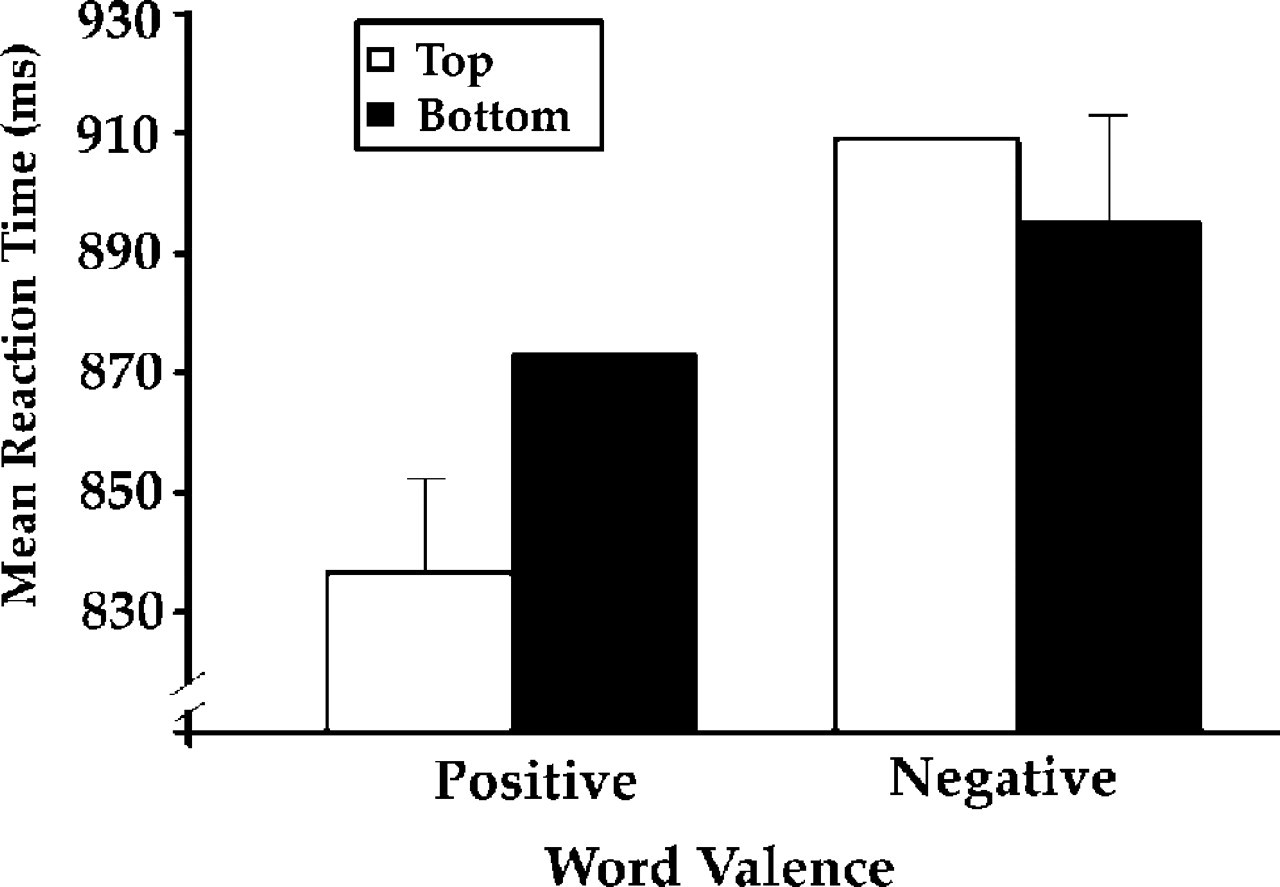
Mean evaluation latency as a function of word valence and word position in Study 1. Error bars show the standard error of the difference between adjacent bars.
STUDIES 2 AND 3
Our interpretation of the Study 1 results is as follows. Evaluations activate spatial metaphors in part because evaluations are made on the basis of physical metaphors (Lakoff & Johnson, 1999). If the evaluation-linked spatial metaphor (e.g., “up” for good words) is consistent with the actual position of a word, evaluation is facilitated. If there is a mismatch, evaluation is delayed.
The results of Study 1 are consistent with this account. However, there are some ambiguities. First, word valence and spatial position were varied jointly in Study 1. The manipulation may have increased the salience of spatial position, leading to a stronger reliance on metaphor. In Study 2, we therefore sought to show that the mere act of evaluating words, without a concurrent manipulation of vertical position, activates spatial attention. To examine this question, we used a sequential priming paradigm. Participants in Study 2 evaluated the same 100 words used in Study 1 by vocally responding “positive” or “negative.” Immediately following this verbal evaluation, participants responded to a nonvalenced target (q or p) that appeared either near the top or near the bottom of the computer screen, with the position determined at random. If evaluations activate spatial attention, then participants would be expected to discriminate q from p targets in the up position faster following positive words than negative words, but to discriminate q from p targets in the down position faster following negative words than positive words.
Another ambiguity of Study 1 involved the spatial (+++) cues. Because they appeared before the word appeared, it is plausible that they activated a metaphor-consistent evaluation (e.g., priming “good” in the case of up cues). However, our reading of the literature is that metaphors are asymmetrical. People can use their senses to determine whether an object is up or down, white or black. There is no need to borrow metaphor to achieve an understanding of vertical position. Because of these considerations, we view it as unlikely that physical cues, in the absence of an evaluative context, activate evaluations.
To investigate the asymmetrical nature of affective metaphor, in Study 3 we reversed the sequence examined in Study 2. Specifically, participants first determined if a spatial prime (+++) was “up” or “down” on the computer screen. These responses were made vocally. Immediately following this discrimination, participants evaluated words that were presented at the center of the computer screen. We did not expect the spatial primes to facilitate or interfere with target evaluations. That is, we expected to find an asymmetrical pairing such that affective judgments would activate spatial attention (Study 2), but spatial attention would not prime evaluations (Study 3).
Method
Participants
Participants were 82 undergraduates (28 in Study 2 and 53 in Study 3) who received extra credit.
Procedure
Participants wore headphones with a boom microphone. In Study 2, the 100 words were presented at the center of a computer screen (one at a time). Participants were told that when a word appeared, their task was to determine as quickly and as accurately as possible if the word has a positive (say “positive”) or negative (say “negative”) connotation. Immediately following the evaluation (no preset delay), the letter q or p was randomly presented at the top or bottom of the computer screen. Participants were instructed to quickly and accurately press the “p” key on the keyboard if p was presented and to press the “q” key on the keyboard if q was presented. If participants were inaccurate, the word “INCORRECT” appeared in red font for 1.5 s. Correct trials were separated by a blank screen for 500 ms.
In Study 3, a spatial probe (+++) was randomly presented at the top or bottom of the computer screen. Participants were told that when a probe appeared, their task was to determine as quickly and as accurately as possible if the probe was at the top (say “up”) or bottom (say “down”) of the computer screen. Immediately following this discrimination (no preset delay), participants were randomly shown 1 of the 100 words at the center of the computer screen. Participants were told that when the word appeared, their task was to determine as quickly and as accurately as possible if the word has a positive or negative meaning. They responded by pressing the 1 (positive word) or 5 (negative word) button on a response box. If participants were inaccurate, the word “INCORRECT” appeared in red font for 1.5 s. Correct trials were separated by a blank screen for 500 ms.
Results
In Study 2, inaccurate CRT trials were dropped from the analysis. We then dropped trials involving verbal evaluations with latencies 3 SDs below or above the overall latency mean, as these likely reflect the triggering of the voice key by erroneous responses (e.g., a cough) or lapses of attention. 2
Mean spatial discrimination latency as a function of target position and valence of the prime word in Study 2. Error bars show the standard error of the difference between adjacent bars. CRT=choice reaction time.
CRT latencies were then log-transformed to normalize their distribution (Ratcliff, 1993). Next, we replaced trials that were 2.5 SDs below or above the grand CRT latency mean. A 2 (valence: positive vs. negative)×2 (position: top vs. bottom) repeated measures ANOVA was performed on the transformed latencies. Neither of the main effects was significant: F(1, 27)=2.28, p=.142, for valence and F(1, 27)=2.73, p=.110, for position. As expected, however, the Valence×Position interaction was significant, F(1, 27)=8.07, p=.008. As shown in Figure 2, discriminations for letters in the up position were faster following a positive word on the prime trial, whereas discriminations for letters in the down position were faster following a negative word on the prime trial.
In Study 3, we dropped inaccurate evaluations from the analysis. We then dropped trials involving verbal latencies that were 3 SDs below or above the overall mean, as these likely reflect voice-triggering mistakes. 3 Word evaluation latencies were then log-transformed to normalize their distribution. We next replaced evaluation latencies that were 2.5 SDs below or above the overall latency mean. A 2 (valence: positive vs. negative)×2 (position: up vs. down) repeated measures ANOVA was performed on the transformed latencies. The main effect for valence was significant, such that participants evaluated positive words (M=1,087 ms) more quickly than negative words (M=1,120 ms), F(1, 52)=5.90, p=.019. The main effect for position was also significant, such that participants evaluated words faster if the preceding spatial probe was up (M=1,085 ms) as opposed to down (M=1,122 ms), F(1, 52)=4.05, p=.049. Of primary importance, however, the Valence×Position interaction was not significant, F<1.
Identical analyses were conducted on accuracy rates for Studies 2 and 3. All effects were nonsignificant, Fs>1.
GENERAL DISCUSSION
In a series of three studies, we sought to determine if the association between affect and vertical position is obligatory. In Study 1, affective judgments of words were faster when word valence and vertical position were congruent (i.e., up-positive, down-negative) rather than incongruent. In Study 2, we extended these results by showing that evaluations bias spatial attention in a metaphor-consistent direction (e.g., “good” activates “up”). By contrast, Study 3 showed that the activation of areas of visual space does not prime evaluations (e.g., “up” does not activate “good”).
Stroop-Like Interference?
The results of Study 1 could be interpreted in terms of a Stroop-like effect. The Stroop effect typically occurs when irrelevant stimuli (e.g., the word red) co-occur with relevant stimuli (e.g., the color green) in both space and time (MacLeod, 1991). Our manipulation in Study 1 varied spatial position and word valence simultaneously, thus potentially creating the optimum conditions for a Stroop-like effect.
A study by Clark and Brownell (1975) is in fact compatible with a Stroop-like spatial effect. In this study, on each trial participants were presented with an up (↑) or down (↓) arrow that was randomly assigned to a lower or higher spatial position within a rectangle. The task was to indicate whether the up or down arrow appeared. Participants were faster to respond when the spatial position of the arrow was congruent with the direction of the arrow (i.e., ↑ in the top position, ↓ in the lower position) than when it was not. Similarly, in Study 1, spatial position influenced response latencies such that metaphor-congruent (up-good, down-bad) evaluations were faster than incongruent evaluations.
However, Study 1 was quite different from these prior studies in one important respect. In the Stroop task, irrelevant information (e.g., the word red) is directly related to one of the responses (e.g., the color red; MacLeod, 1991). In Study 1, however, spatial position was not obviously related to making evaluations (i.e., positive or negative). In this sense, the fact that spatial positions did influence evaluation latencies is impressive evidence for the importance of spatial metaphor in affective representation. On the basis of these results, we gain appreciation for the results of Stepper and Strack (1993), who found that people felt more pride when seated in an upright position than when sitting in a slouched position. Indeed, sensorimotor manipulations have been proposed as treatments for depression (Teasdale, 1993). The premise of such treatments is that an upright posture is incompatible with “feeling down” (see also James, 1890).
Spatial Priming by Evaluations
Studies 2 and 3 moved beyond the suggestion that the association between affect and vertical position is Stroop-like. In Study 2, we did not present compound (Valence×Position) stimuli, but rather simply asked people to make evaluations and then determined whether spatial attention was primed. The reasoning behind Study 2 was more specifically that if affective judgments are based on physical metaphors, then making an evaluative judgment should prime or activate attention to areas of visual space. The results of Study 2 offered striking confirmation of this hypothesis.
The Study 2 results are compatible with prior results showing that affective states bias visual perception (Fisher, 1964; Wapner et al., 1957). Representations of goodness, that is, activate higher areas of visual space, whereas representations of badness activate lower areas of visual space. Can abstract thoughts activate concrete perceptions? Such an idea is certainly consistent with James's (1890) ideomotor principle. It is also consistent with recent arguments concerning the physicality of conception (Lakoff & Johnson, 1999). We certainly hope that after reading this report, people find themselves staring at the ceiling rather than the floor.
Conclusions
The results of our studies provide evidence for an automatic association between affect and vertical position. These findings suggest that, when making evaluations, people automatically assume that objects that are high in visual space are good, whereas objects that are low in visual space are bad. The results of these studies extend prior work (e.g., Damasio, 1994; Lakoff & Johnson, 1999; Neumann, Forster, & Strack, 2003) in suggesting that affect is grounded in sensorimotor perception.
Footnotes
1One hundred words were selected such that half had a positive meaning and half had a negative meaning. The number of letters was similar for positive and negative words, F<1; the positive words (M=7.46) were rated as significantly more positive than the negative words (M=2.42), F(1, 98)=1,040.44, p=.000; and the absolute difference between the valence rating of each word and the neutral midpoint was equal for positive and negative words, F<1.
The positive words were as follows: active, agile, ambitious, baby, brave, candy, champion, clean, cordially, devotion, dream, earnest, ethical, faith, festival, garden, generous, genius, gentle, gracious, heaven, hero, justice, kiss, leisure, love, loyal, mature, mercy, neat, nurse, polite, power, pretty, prompt, radiant, reliable, righteous, satisfying, sensible, sincere, sleep, studious, sweet, talented, trust, truthful, victory, wise, and witty.
The negative words were as follows: aimless, argue, beggar, bitter, cancer, cheat, clumsy, crime, critical, crooked, crude, cruel, danger, dead, defeat, delay, devil, diseased, divorce, enemy, fickle, foolish, fraud, greedy, hostile, insane, insolent, liar, mediocre, mosquito, nasty, neurotic, obnoxious, poison, pompous, profane, rude, sarcastic, shallow, sloppy, sour, spider, steal, stingy, theft, touchy, ugly, unfair, vain, and vulgar.
2When the data from these trials were included, the results were exactly parallel to those reported here.
3When the data from these trials were included, the results were exactly parallel to those reported here.
Acknowledgments
Research in this article was supported by a dissertation fellowship from North Dakota EPSCoR (Experimental Program to Stimulate Competitive Research, sponsored by the National Science Foundation) to Brian P. Meier and by a grant from the National Science Foundation (SBR 981764) to Michael D. Robinson.