







Abstract
Because of counterfactual comparisons, good outcomes that could have been better (i.e., disappointing wins) and bad outcomes that could have been worse (i.e., relieving losses) elicit relatively middling ratings on bipolar emotion scales. We conducted two experiments with gambles to examine whether such outcomes elicit neutral emotions, sequentially mixed emotions of positive and negative affect, or simultaneously mixed emotions. In Experiment 1, static unipolar measures of positive and negative affect revealed that disappointing wins and relieving losses elicit mixed emotions, rather than relatively neutral emotions. In Experiment 2, participants provided continuous unipolar measures of positive and negative affect by pressing one button whenever they felt good and another button whenever they felt bad. Results revealed that disappointing wins and relieving losses elicit positive and negative affect simultaneously, rather than in alternation.
How does it feel to receive a raise when an even larger raise had been expected? Though the raise itself may be enjoyable, the accompanying dashed expectations may be disappointing (Ortony, Clore, & Collins, 1988). The smaller-than-expected raise illustrates how emotional reactions are determined not only by an event's objective outcome, but also by counterfactual comparisons with readily imagined outcomes that “might have been” (McMullen, Markman, & Gavanski, 1995; Roese & Olson, 1995).
To explain the effects of counterfactual outcomes, Mellers, Schwartz, Ho, and Ritov (1997; Mellers & McGraw, 2001) proposed decision affect theory (DAT). According to DAT, the balance of pleasure and pain increases with utility of obtained outcomes, but decreases with utility of unobtained outcomes. By this account, a smaller-than-expected raise should elicit a middling emotional reaction, with the raise itself increasing the balance of pleasure and pain, but the comparison with the unobtained, larger raise having the opposite effect. Mellers et al. obtained results consistent with this prediction: Individuals enjoyed winning $16 when the alternative outcome was a loss, but gave less extreme, more middling ratings to winning $16 when the alternative was an even larger win of $32. 1 One question that DAT leaves unanswered, however, is whether such middling ratings reflect neutrality or mixed emotions. In other words, do the pleasure and pain cancel each other out, or can they be experienced simultaneously?
Following Russell and Carroll's (1999) hypothesis that such polar opposite emotions as happiness and sadness are mutually exclusive in experience, one explanation for the findings of Mellers et al. (1997) is that disappointing wins elicit relatively neutral emotional reactions characterized by little positive or negative affect. In contrast, the evaluative-space model (ESM; Cacioppo & Berntson, 1994; Cacioppo, Gardner, & Berntson, 1999) proposes that positivity and negativity represent separable and partially distinct components of the affect system and thereby allows coactivation of positive and negative affect. In a test of the ESM (Larsen, McGraw, & Cacioppo, 2001), we had participants complete Russell and Carroll's strictly unipolar measures of emotion during emotionally complex situations. After their own graduation ceremony, for example, undergraduates were asked whether they felt happy and, if so, how happy they felt on a 6-point scale. Sadness and other emotions were measured in an analogous fashion. Results were consistent with the ESM in that few undergraduates felt both happy and sad during a typical day on campus, but 50% felt both happy and sad on graduation day. These findings suggest that rather than eliciting relatively neutral emotions, disappointing wins may instead elicit mixed emotions of positive and negative affect.
Though they afford strong tests of mixed emotions, Russell and Carroll's (1999) measures provide only static indices of positive and negative affect. Therefore, they may be insensitive to rapid changes in affective reactions to disappointing wins. In light of Kahneman's (1992) suggestion that disappointing wins elicit positive and negative affect in rapid alternation, a complete understanding of affective reactions to disappointing wins may require more temporally precise measures. To that end, we report two studies investigating the structure and time course of emotional reactions to disappointing wins and relieving losses (i.e., negative outcomes that could have been worse). In Experiment 1, we used Russell and Carroll's measures of positive and negative affect to examine whether mixed outcomes (i.e., disappointing wins and relieving losses) elicit neutral or mixed emotions. In Experiment 2, we introduced continuous unipolar measures of positive and negative affect to examine whether mixed outcomes elicit positive and negative affect simultaneously or in rapid alternation.
EXPERIMENT 1
Method
Participants
Twenty Ohio State University undergraduates participated for course credit.
Stimuli
Participants played 16 binary gambles. Half the gambles involved a 50–50 chance of winning either of two amounts; the remaining gambles involved a 50–50 chance of losing either of two amounts. Disappointing wins were wins of $5 when the alternative was a $6, $9, or $12 win. There was a single outright win in which participants won $5 instead of $3. Losing gambles were constructed by reversing the signs of the outcomes. This resulted in relieving losses of $5 when the alternative was a $6, $9, or $12 loss, and a single outright loss of $5 instead of $3. So that participants would not wonder why the obtained outcome was always a gain or loss of $5, we also included 8 filler gambles formed by swapping obtained and unobtained outcomes (e.g., filler wins were wins of $3, $6, $9, or $12 instead of $5). Although instructions indicated that outcomes would be random, they were predetermined and presented in one of two random orders.
Procedure
Participants were told that they would play a series of card games for real money, then given $5 cash and told that their wins and losses would determine whether they would win additional money or lose the endowment.
Each gamble consisted of a sequence of three 3-s periods: baseline, stakes, and payoff (see Fig. 1). During the baseline period, two cards appeared facedown on the computer screen. During the stakes period, the gamble's stakes (e.g., win $5, win $9) appeared above the cards. During the payoff period, the cards turned over to reveal their values, and a red border designated the card containing the obtained outcome. The obtained outcome randomly appeared in the left or right card.
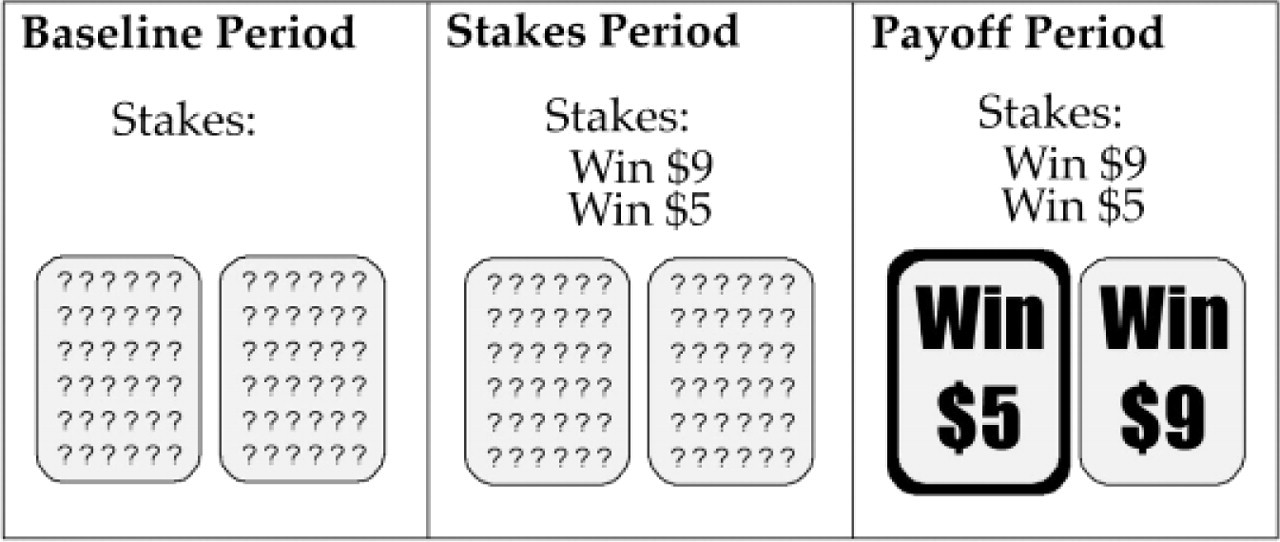
Illustration of a trial sequence. During the baseline period, two cards appeared facedown on the computer screen. At the beginning of the stakes period, the trial's stakes appeared at the top of the screen. The cards then turned over at the beginning of the payoff period. Each card's value was printed on the face of the card, and the card with the obtained outcome was signified by a red border as shown. In the example shown here, the participant received a disappointing win of $5 instead of $9.
Measures
After each trial, participants were asked whether they felt good and whether they felt bad about the outcome. The questions were asked in a random order. If participants endorsed the dichotomous (i.e., yes/no) question, they then rated the intensity of the feeling on a 6-point scale anchored by the labels slightly (1) and extremely (6). An initial response of “no” was assigned a rating of 0. Following Russell and Carroll (1999), we included the dichotomous questions in an attempt to prevent participants from mistaking the unipolar measures of affect for bipolar measures.
Results
Positive and Negative Affect
Ratings of positive and negative affect are shown in Figure 2. We examined whether disappointing wins and relieving losses elicit both positive and negative affect by submitting ratings to a 2 (trial order: A, B) × 2 (domain: wins, losses) × 4 (unobtained outcome: $3, $6, $9, $12) × 2 (valence: positive affect, negative affect) mixed-model analysis of variance (ANOVA) in which trial order was a between-subjects variable. The ANOVA revealed a significant Domain × Unobtained Outcome × Valence interaction (see Fig. 2), so we conducted separate analyses on wins and losses. 2 For $5 wins, positive affect decreased and negative affect increased as unobtained outcomes got better (see Fig. 2, top panel). For $5 losses, positive affect increased and negative affect decreased as unobtained outcomes got worse (see Fig. 2, bottom panel). Planned contrasts comparing average ratings of the three disappointing wins with ratings of the outright win revealed that disappointing wins were not only less pleasant than the outright win (Cohen's d=0.54), but also more unpleasant (d=0.81). 3 Moreover, relieving losses were not only less unpleasant than the outright loss (d=0.59), but also more pleasant (d=0.81).
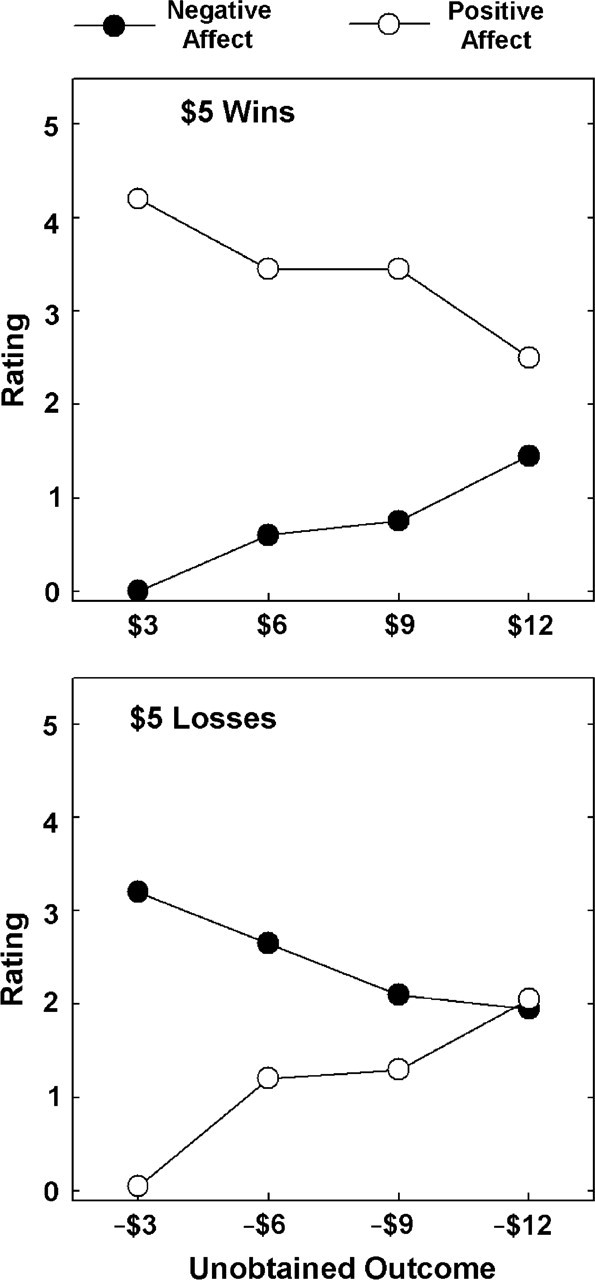
Positive and negative affect ratings as a function of unobtained outcomes for $5 wins (top) and $5 losses (bottom) in Experiment 1. Higher ratings indicate more intense affect.
Mixed Emotions
Though disappointing wins and relieving losses elicited both positive and negative affect on average, participants may have felt good about some mixed outcomes and bad about others, but never both good and bad about any particular outcome. To directly examine whether individual mixed outcomes elicited greater mixed emotions than outright outcomes, we computed each participant's minimum rating for each outcome (i.e., minimum[positive affect, negative affect]). Such ratings provide a graded index of mixed emotions (Schimmack, 2001). Outcomes rated as neutral, exclusively pleasant, or exclusively unpleasant receive MIN (i.e., minimum) ratings of 0, but outcomes rated as both pleasant and unpleasant receive higher MIN ratings. For example, outcomes rated as extremely pleasant (positive affect=6) and not at all unpleasant (negative affect=0) receive MIN ratings of 0; outcomes rated as extremely pleasant (positive affect=6) and moderately unpleasant (negative affect=3) receive MIN ratings of 3.
Average MIN ratings are shown in Figure 3. To examine whether disappointing wins and relieving losses elicited more mixed emotions than outright wins and losses, we submitted MIN scores to a 2 (trial order: A, B) × 2 (domain: wins, losses) × 4 (unobtained outcome: $3, $6, $9, $12) ANOVA. Only the main effect of unobtained outcome was significant (see Fig. 3), and a subsequent planned contrast revealed that whereas outright outcomes elicited no mixed emotions, mixed outcomes elicited significantly greater mixed emotions, d=0.75. The majority of participants (60%) showed this pattern, and none showed the opposite pattern.
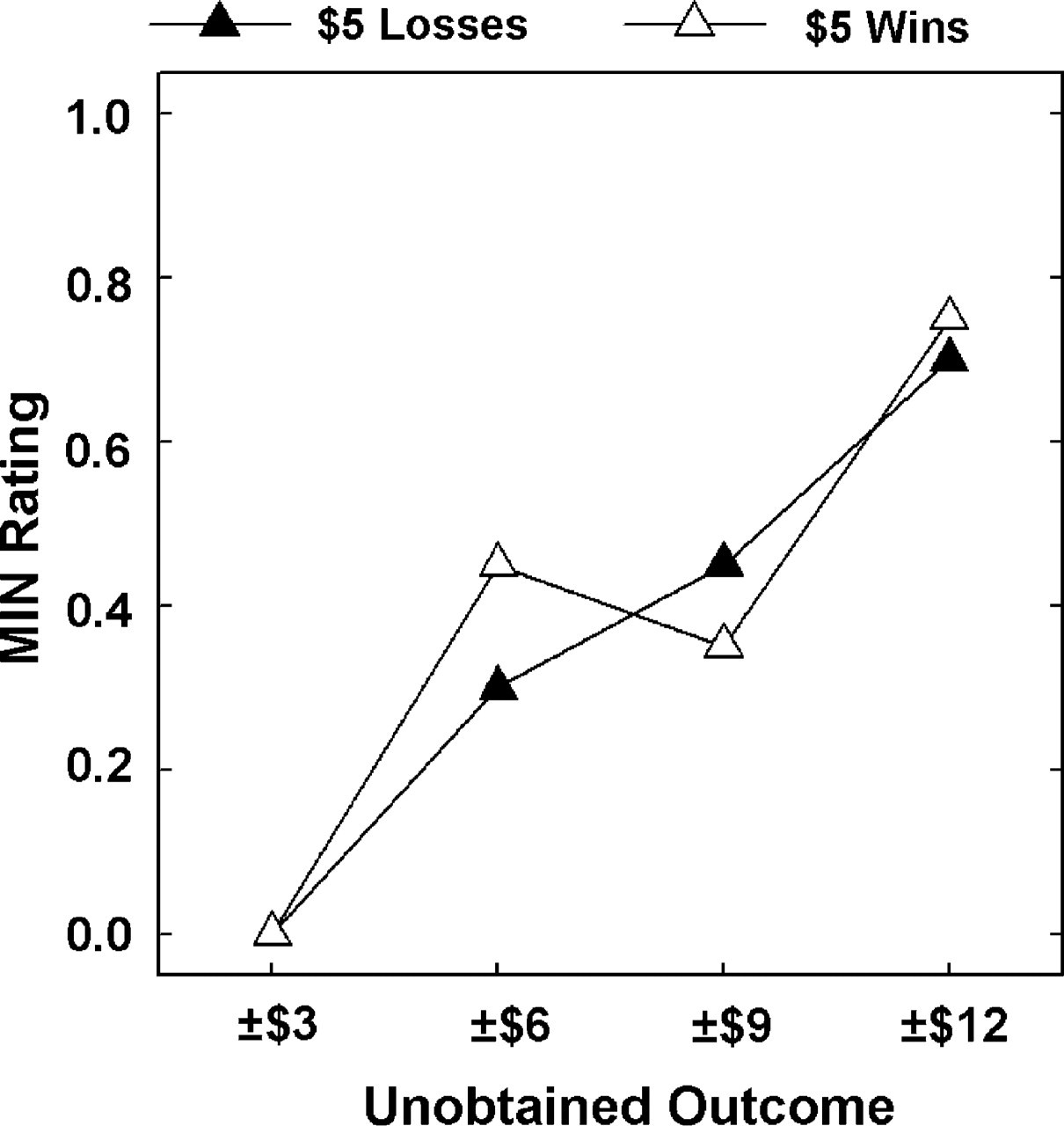
Minimum (MIN) ratings as a function of unobtained outcomes for $5 wins and $5 losses in Experiment 1. For $5 wins, unobtained outcomes were wins. For $5 losses, unobtained outcomes were losses. MIN ratings are taken as the minimum of the positive and negative affect ratings to each outcome and can range from 0 to 6; MIN ratings greater than 0 indicate mixed emotions.
EXPERIMENT 2
Experiment 1 shows that disappointing wins are not merely less pleasant than outright wins and that relieving losses are not merely less unpleasant than outright losses. Rather, disappointing wins and relieving losses often elicit mixed emotions of positive and negative affect. What Experiment 1 does not address is whether disappointing wins and relieving losses elicit mixed emotions in a simultaneous or sequential fashion. One possibility, for example, is that participants' emotions vacillated between feelings of positive and negative affect during the 3-s payoff period (see Kahneman, 1992).
To examine whether mixed outcomes elicit positive and negative affect simultaneously or sequentially, in Experiment 2 we obtained continuous measures of momentary positive and negative affect as each trial unfolded. Participants were instructed to press one button whenever they felt good and to release the button when they no longer felt good. They were instructed to press another button whenever they felt bad. Participants were also instructed to press neither button if they felt neither good nor bad and both buttons if they felt both good and bad. If mixed outcomes elicit positive and negative affect sequentially, participants would be expected to alternate between the good and bad buttons during the payoff period. However, if mixed outcomes elicit positive and negative affect simultaneously, participants would be expected to press the good and bad buttons simultaneously. Ochsner and Feldman Barrett (2001) suggested that complex emotional responses may develop gradually rather than immediately; if so, mixed emotions may take time to develop. To investigate this possibility, we extended the duration of the payoff period from 3 to 9 s.
Method
Twenty undergraduates participated. The stimuli and procedure were identical to those in Experiment 1 with two exceptions. First, participants were instructed to operate two computer buttons (with different fingers) to indicate their momentary positive and negative reactions to the gambles, as just described. Second, to examine both immediate and delayed affective reactions to the gambles' outcomes, we extended the 3-s payoff period to 9 s and partitioned it into three 3-s periods.
Throughout each trial, the state of the two buttons (on/off) was recorded every 200 ms, yielding 15 measures during each 3-s period. As each button provided a dichotomous (i.e., yes/no) rather than graded unipolar measure of affect, our analyses focused on duration rather than intensity of positive and negative affect. Durations of positive and negative affect were computed as the amount of time that the respective buttons were pressed during each period. Duration of mixed emotions was taken as the amount of time that the two buttons were pressed simultaneously.
Results
Positive and Negative Affect
Figure 4 shows the duration of positive and negative affect during the stakes and three payoff periods, with separate panels for wins and losses. 4 Duration data from the stakes period, when participants knew whether they were going to win or lose but not how much, are presented at the left of each panel. These data were submitted to a 2 (trial order: A, B) × 2 (domain: wins, losses) × 4 (unobtained outcome: $3, $6, $9, $12) × 2 (valence: positive affect, negative affect) mixed-model ANOVA in which trial order was a between-subjects variable. Unsurprisingly, the ANOVA revealed a significant Domain × Valence interaction such that pending wins elicited positive affect and pending losses elicited negative affect (see Fig. 4).
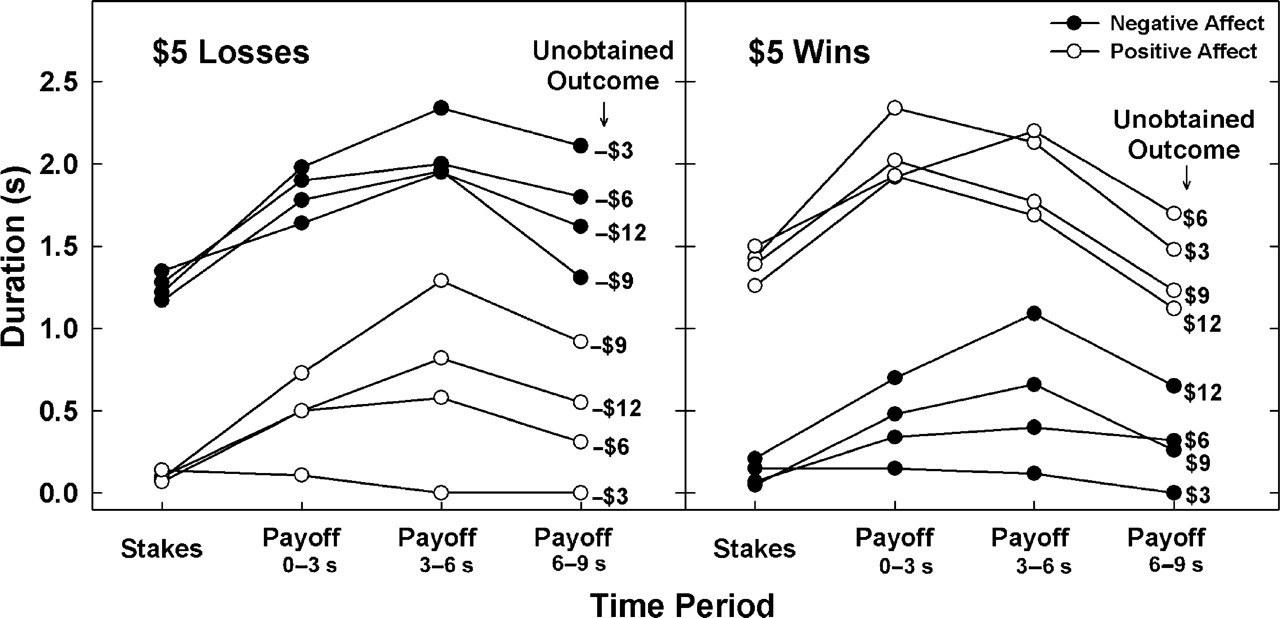
Duration of positive and negative affect as a function of unobtained outcomes for $5 wins (right) and $5 losses (left) during the stakes and payoff periods in Experiment 2. Data are aggregated across the 15 samples collected during each period and can range from 0 to 3 s.
Duration data from the first period show initial affective reactions to the payoffs (see Fig. 4). A significant Domain × Valence interaction was qualified by a three-way interaction with unobtained outcome, but further analysis revealed little evidence that initial affective reactions were sensitive to counterfactual comparisons. For wins and losses, there were no simple main effects of unobtained outcome on duration of positive and negative affect.
Consistent with Ochsner and Feldman Barrett's (2001) hypothesis that complex emotions develop gradually, duration data from the second payoff period show stronger evidence of comparison effects on affective reactions (see Fig. 4). Analysis of these data revealed a Domain × Unobtained Outcome × Valence interaction, as well as Unobtained Outcome × Valence interactions for both wins and losses. For wins, unobtained outcomes had a selective effect on the duration of negative affect, such that disappointing wins were more unpleasant than the outright win, d=0.62 (see Fig. 4, right panel). Conversely, for losses, unobtained outcomes had a selective effect on duration of positive affect, such that relieving losses were more pleasant than outright losses, d=0.90 (see Fig. 4, left panel).
Inspection of Figure 4 indicates that positive and negative affective reactions began to wane during the third payoff period. These data nonetheless revealed another Domain × Unobtained Outcome × Valence interaction, and subsequent analysis revealed Unobtained Outcome × Valence interactions for both wins (p=.06) and losses. Planned contrasts replicated results from the third payoff period. Disappointing wins elicited longer periods of negative affect than did outright wins, d=0.73 (see Fig. 4, right panel). Similarly, relieving losses elicited longer periods of positive affect than did outright losses, d=0.70 (see Fig. 4, left panel).
Mixed Emotions
To investigate whether disappointing wins and relieving losses elicited simultaneously mixed emotions of positive and negative affect, we examined the amount of time that participants pressed the two buttons simultaneously (see Fig. 5). 5 As participants typically experienced either positive or negative affect during the stakes period, these data reveal little evidence of mixed emotions. A 2 (trial order: A, B) × 2 (domain: wins, losses) × 4 (unobtained outcome: $3, $6, $9, $12) mixed-model ANOVA on these data revealed no effects. In addition, despite some evidence of comparison processing in the duration of positive and negative affect during the first payoff period, the mixed-emotions data revealed no significant effect of unobtained outcome (see Fig. 5). During the second and third payoff periods, however, main effects of unobtained outcome and subsequent planned comparisons revealed that participants spent more time pressing both buttons in response to mixed outcomes than in response to outright outcomes, d=0.67 (second payoff period) and 0.82 (third payoff period; see Fig. 5). Thus, mixed outcomes elicited greater mixed emotions than outright outcomes. The majority of participants (70%) showed this pattern, and only 1 (5%) showed the opposite pattern.
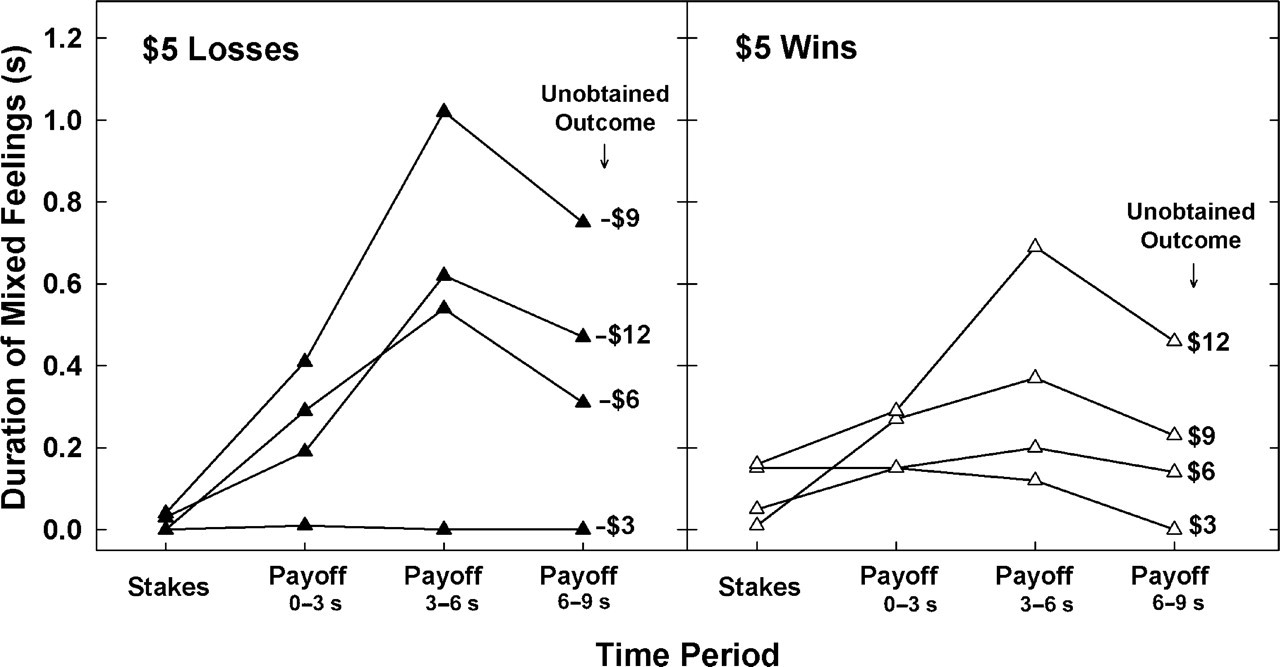
Duration of mixed emotions as a function of unobtained outcomes for $5 wins (right) and $5 losses (left) during the stakes and payoff periods in Experiment 2. Duration of mixed emotions was computed as the amount of time that the “good” and “bad” buttons were pressed simultaneously and can range from 0 to 3 s.
The results suggest that disappointing wins and relieving losses elicited simultaneously mixed emotions. One possibility, however, is that participants vacillated between positive and negative feelings but inadvertently pressed the two buttons simultaneously as they alternated between them. If this were the case, one would expect instances of mixed emotions to be numerous and short-lived, but this was not the case. There were never more than three instances of mixed emotions on any one trial, and the average duration of each instance of mixed emotions was 3.3 s (SD=2.3 s).
General Discussion
The results of these two experiments indicate that disappointing wins and relieving losses are given middling ratings on bipolar emotion scales not because they elicit neutral emotions, but because they elicit mixed emotions of both positive and negative affect. These results extend DAT (Mellers et al., 1997) by demonstrating that the balance of pleasure and pain elicited by uncertain outcomes does not necessarily reflect the magnitudes of pleasure and pain making up that balance. Though a disappointing win and a trifling outright win (e.g., of $1) may both be rated as mildly pleasant on bipolar scales, such outcomes elicit different emotional reactions. The present results also extend our previous work (Larsen et al., 2001) by demonstrating that mixed emotions can be elicited not only by such dramatic events as one's own graduation day, but by simple games of chance as well. Thus, these results provide further evidence that positive and negative affect are better conceptualized as bivariate than as bipolar and are therefore consistent with the ESM (Cacioppo et al., 1999).
The continuous measures of positive and negative affect in Experiment 2 also extend our previous results (Larsen et al., 2001) by providing more direct evidence for simultaneously mixed emotions. 6 Consistent with the notion that it takes time for complex emotional reactions to develop (Ochsner & Feldman Barrett, 2001), the results of Experiment 2 also indicate that mixed emotions emerged only after several seconds. Although it is plausible that individuals' emotions alternate faster than they can operate two buttons, our continuous measures nonetheless offer far greater temporal resolution than other contemporary measures of momentary affect (e.g., Russell & Carroll, 1999; Watson, Clark, & Tellegen, 1988). Indeed, whereas affective neuroscience has begun to clarify the time course of rapid physiological reactions to emotional stimuli (e.g., Bradley, Cuthbert, & Lang, 1993; Davidson, 1998), little attention has been paid to the measurement of rapid changes in subjective emotional reactions. Thus, continuous measures like ours may become indispensable as theorists come to conceptualize emotions as fluid processes rather than stable states (e.g., Mayne & Ramsey, 2001).
Consider again how it would feel to receive a raise when an even larger raise had been expected. Although one traditional approach would be to ask whether a smaller-than-expected raise elicits either positive or negative affect, our results indicate that either answer might be only partially correct. Indeed, contemporary static measures reveal that disappointing wins and relieving losses elicit mixed emotions, and, perhaps more important both conceptually and methodologically, new continuous measures indicate that they elicit simultaneously mixed emotions.
Footnotes
1Whereas research has generally confirmed DAT's prediction that counterfactual comparisons elicit affective contrast, counterfactual comparisons can result in affective assimilation under certain conditions (e.g., process accountability; Markman & Tetlock, 2000).
2Unless noted, reported effects were significant at the .05 level (two-tailed) with Huyn-Feldt corrections where appropriate.
3Cohen's d (Cohen, 1977) is provided for paired comparisons as a measure of effect size and was calculated as the mean difference score divided by the standard deviation of difference scores; ds of 0.2, 0.5, and 0.8 are interpreted as small, medium, and large effects, respectively.
4Participants experienced little positive or negative affect during the baseline period, and no effects were significant.
5Although Figure 5 largely conveys unique information, some information about the duration of mixed emotions can be inferred from values in Figure 4. For example, the shorter of the measures of positive and negative affect duration provides the upper limit for duration of mixed emotions.
6One alternative explanation is that participants reported their implicit theories about how they ought to feel rather than their actual feelings. Evidence for outcome and comparison effects with indirect measures of emotion, however, suggests that self-reports reflect actual feelings more than implicit theories. In a striking demonstration of comparison effects, for example, Medvec, Madey, and Gilovich's (1995) analysis of athletes' facial expressions indicated that bronze-medal winners were happier than silver-medal winners.
Acknowledgments
Preliminary investigations of the ideas presented here were included in Jeff Larsen's doctoral dissertation at Ohio State University. We thank cochair Richard Petty and committee member Philip Tetlock for feedback. This research was supported by National Science Foundation Grant SES-0119444 and National Institute of Mental Health Grant P50 MH52384-01A1.