







Abstract
When children ask, “What is it?” are they seeking information about what something is called or what kind of thing it is? To find out, we gave 2-, 3-, and 4-year-olds (32 at each age) the opportunity to inquire about unfamiliar artifacts. An ambiguous question was answered with a name or with functional information, depending on the group to which the children were assigned. Children were inclined to follow up with additional questions about the object when they had been told its name, but seemed satisfied with the answer when they had been told the object's function. Moreover, children in the name condition tended to substitute questions about function for ambiguous questions over the course of the session. These results indicate that children are motivated to discover what kinds of things novel artifacts are, and that young children, like adults, conceive of artifact kinds in terms of their functions.
The questions that children address to other people who are more expert than they are surely serve as an important way for them to gain knowledge. Yet the questions children ask have received relatively little systematic research attention. The current study focused on the inquiries that young children make about artifacts, the human-made objects that pervade our species-typical environment.
Early in the course of language production, children begin to ask questions, such as “What is this?” or “What is it?” with respect to the objects they encounter (Gopnik & Meltzoff, 1997). Perhaps because the onset of such questions seems to be correlated with a rapid rate of acquiring words for things, a common intuition is that these questions constitute requests for object names. And, indeed, they may. However, it is revealing to note that the questions are really ambiguous. When children ask, “What is it?” it is unclear whether they are requesting information about the name of the thing or about the kind of thing the object is (or possibly both). For artifacts, an object's kind is intimately related to its intended function, at least in the adult mind (Bloom, 2000; Dennett, 1987; Hall, 1995; Keil, 1989; Kemler Nelson, Frankenfield, Morris, & Blair, 2000; Miller & Johnson-Laird, 1976; Rips, 1989).
In recent years, there has been accumulating evidence that young children also appreciate that functional information plays a central role in concepts of artifacts. Some of this evidence shows that children understand artifacts to be for some function (German & Johnson, 2002; Keil, 1994; Kelemen, 1999; Matan & Carey, 2001). There is debate as to whether or not, in young children, such a conception is specific to artifacts as opposed to natural kinds, as well as to whether or not design function takes precedence over current functional status in determining what an object is (or what it is for). These controversies notwithstanding, there is widespread agreement that children adopt the so-called teleological stance toward artifacts.
Another source of evidence that object function plays a critical role in children's concepts of artifacts comes from recent studies suggesting that children generalize the name of a novel artifact to objects that are alike in function rather than objects that are more perceptually similar but lack the same function (Diesendruck, Markson, & Bloom, 2003; Kemler Nelson & 11 Swarthmore College Students, 1995; Kemler Nelson, Frankenfield, et al., 2000). These findings converge with proposals that young children's lexical categorization involves attention to properties deeper than appearance (Bloom, 2000; Booth & Waxman, 2002; Gelman & Bloom, 2000; Gelman & Markman, 1986, 1987; Gopnik & Sobel, 2000; Keil, 1994; Mandler, 1993).
Still, there are many reports that perceptual information dominates over functional information in young children's categorization (Gathercole, Cramer, Somerville, & Jansen op de Haar, 1995; Gathercole & Whitfield, 2001; Gentner, 1978; Graham, Williams, & Huber, 1999; Keil, 1989; Landau, Smith, & Jones, 1998; Merriman, Scott, & Marazita, 1993; Smith, Jones, & Landau, 1996; Tomikawa & Dodd, 1980). We have suggested that many of these studies underestimate children's attention to function by constructing experimental objects that are not plausibly designed with the intention to function in the designated way (Kemler Nelson, Frankenfield, et al., 2000; Kemler Nelson, Herron, & Morris, 2002; see also Bloom, 2000). When the structure of the objects is well explained by a designer's intention to create objects with the function in question (as everyday objects typically are), even 2-year-old children can be shown to privilege function as a basis for generalizing names (Kemler Nelson, 1999; Kemler Nelson, Russell, Duke, & Jones, 2000).
The positive findings concerning function-based lexical categorization raise the expectation that when young children ask other people about what an artifact is, they may be at least as concerned about what kind of object it is—that is, what it was intended to be for—as about what it is called—that is, what its name is. Indeed, a finding consistent with this hypothesis would help to support the emerging view (but see Nelson, 1974, for a much earlier and related proposal) that children's concepts of artifacts are intimately tied to object functions. According to this account, being told only a name for an artifact without knowing its function would be unsatisfying for a child.
In order to probe the meaning behind children's ambiguous questions about artifacts (e.g., “What is it?” or “What's this?”), we arranged a laboratory situation that might prompt children to make such inquiries. In one experimental condition, we treated such inquiries as if they were requests for names, and in another condition, we treated them as if they were requests for functional information. The idea was to measure children's satisfaction with the responses their questions elicited. We reasoned that if children were not content with the feedback they received, they might follow up their initial question with further inquiries about an object. Furthermore, over the course of the session, they might begin to abandon ambiguous questions in favor of more directed questions about objects' names (e.g., “What's it called?”) or about objects' functions (e.g., “What's it for?”).
On the possibility that the intent behind children's “What is it?” questions about artifacts might change over the course of early childhood, we included groups of 2-year-olds, 3-year-olds, and 4-year-olds in the study.
Method
Participants
The participants were thirty-two 2-year-old children (mean age: 30.6 months; range: 24–36 months), thirty-two 3-year-old children (mean age: 41.9 months; range: 37–47 months), and thirty-two 4-year-old children (mean age: 53.6 months; range: 49–59 months). There were approximately equal numbers of boys and girls in all three groups. In addition, twelve 2-year-olds, two 3-year-olds, and one 4-year-old were eliminated from the study because they did not ask any questions about the objects.
Materials
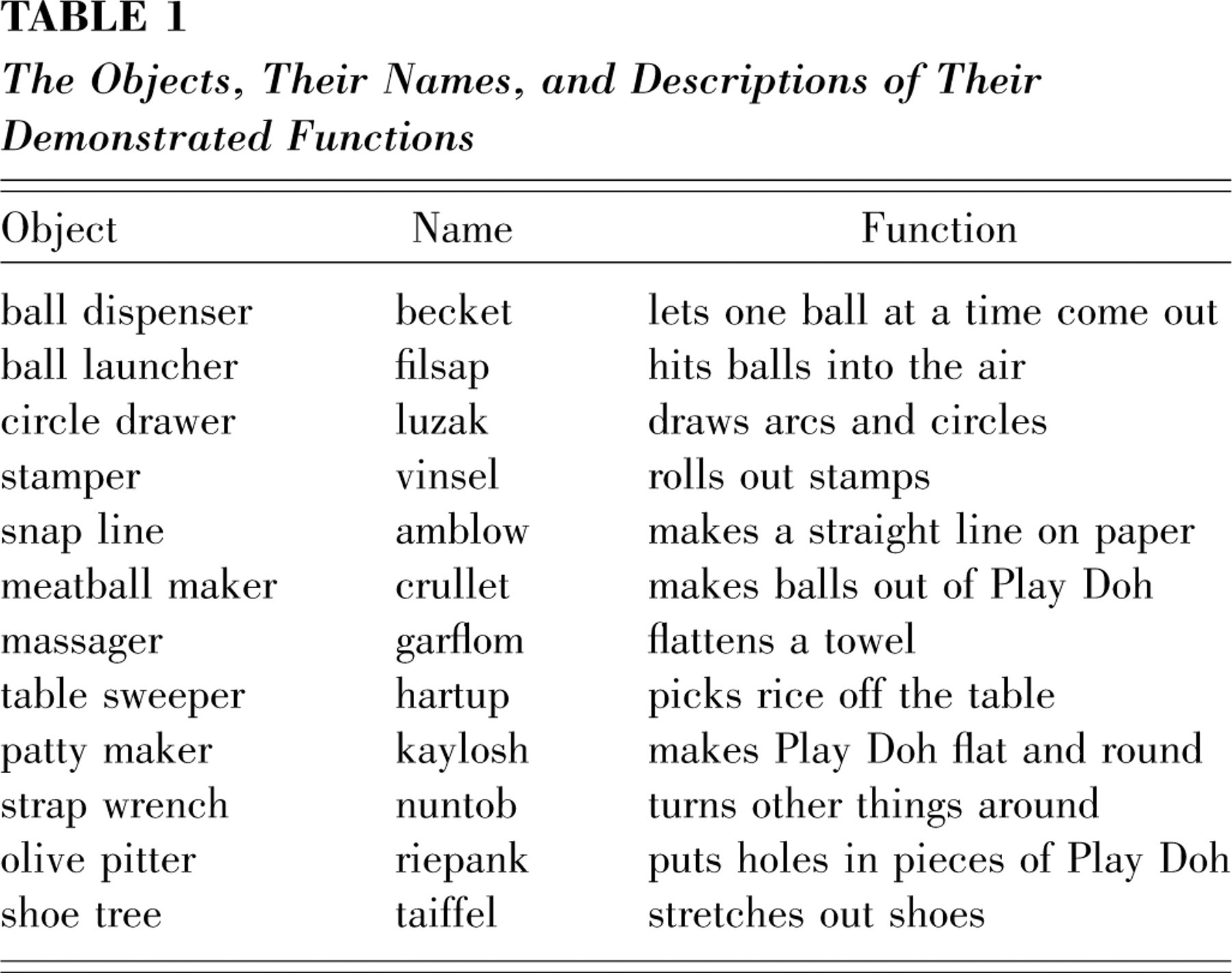
Twelve unfamiliar test objects were used. Four of these objects had been created for experimental studies in our laboratory (Kemler Nelson, Frankenfield, et al., 2000; Kemler Nelson et al., 2002). An additional eight objects were purchased at retail stores. For experimental purposes, the conventional functions of some of these store-bought objects were modified to be appropriate for children to carry out, but the new functions provided reasonably plausible accounts of the objects' structural characteristics. (See Kemler Nelson, Frankenfield, et al., 2000, for the importance of this consideration.) Each object was assigned a novel name. The names and functions of the objects are provided in Table 1. In addition, four objects were used in the warm-up phase: a fanciful pen, a Slinky, a Crazy Straw, and a yo-yo.
The Objects, Their Names, and Descriptions of Their Demonstrated Functions
Experimental Design
Sixteen children in each age group were randomly assigned to the name condition, and 16 were assigned to the function condition.
Procedure
To encourage the child to ask questions, we began each session with a warm-up phase involving a hand puppet that resembled a dog. The child was told that Mike had lived for a long time in a doghouse, and wanted to know about the things that were in people's houses. The warm-up items were then presented sequentially to the dog, who appeared to whisper into the experimenter's ear. Each time, the experimenter reported to the child that “Mike has never seen one of these before. He just asked me, ‘What is it?’” The experimenter responded to Mike by providing either the name (N) of the object or a brief description and demonstration of the function (F) of the object. Regardless of the child's experimental condition, a name was offered on two trials and a function was offered on the other two, equally often in the orders NFFN and FNNF.
After the warm-up, the experimenter alerted the child that there were some new things for the child to see along the perimeter of the room, and that the child could go get something and bring it back to the experimenter. The experimenter said she knew a lot about the objects in the room, and would be happy to answer any questions the child had. For each child, the 12 test objects were arranged around the room in an independent random order, but the child was free to select objects in any order. Whenever a child brought an object to the experimenter, she first remarked on it with a brief comment that did not reveal its function or its name (e.g., “My uncle gave this to me”). The purpose of this comment was to invite the child to ask about the object.
The procedure that followed depended on the child's condition only if the child asked an ambiguous question (e.g., “What is it?” or “What's this?”). If the child specifically asked for the object's name (e.g., “What's this called?” or “What's its name?”), or for the object's function (e.g., “What does this do?” or “What's it for?”), the experimenter answered the question appropriately without regard to the experimental condition. However, the experimenter always answered an ambiguous initial question about an object by giving only the object's name to children in the name condition and only its function (by verbal description and physical demonstration) to children in the function condition. If a child did not ask any questions about an object that had been selected, the experimenter prompted the child, “Is there anything you want to know about this thing?”
The child established the pace through the objects. Thus, the child was free to follow up an initial question about an object (either immediately or later in the session) with a further probe. If that follow-up question was ambiguous, the experimenter responded in line with the child's condition, but if the child repeated the question again, the experimenter provided whichever kind of information (name or function) had not yet been offered about the object. Unambiguous follow-up questions (about names or functions) were answered like unambiguous initial questions—by providing the information the child requested, regardless of condition.
Follow-up questions were encouraged by asking the child, after his or her initial query about an object, “Is there anything else you want to know about this thing?” If the child did not pursue further information or had already learned about both the object's name and its function, the experimenter encouraged the child to move on to a different object. The session for each child lasted about 20 min, and ended when the child did not offer any more questions.
Results
Virtually all the questions that children asked fell into one of three categories. Questions classified as ambiguous included “What is it?”“What's this?” and “What's this thing?” as well as close variants that used the full form instead of a contraction or substituted “that” for “this.” Questions classified as specific requests for names included “What's this called?”“What's its name?” and “What's this thing's name?” as well as close variants. Questions classified as specific requests for functions included “What does this do?”“How does this work?”“What do you do with this?” and “What's it for?” (almost always asked about whole objects, but on a few occasions about object parts), as well as close variants. Fewer than 2% of all questions fell outside these categories; such inquiries included “Where's this from?”“Is this yours?” and “Why's this blue?” These exceptional questions were always answered in a way that was uninformative about the object's name or function and, in every case, were followed by the child asking a question of one of the three main types. Only questions that were ambiguous or constituted specific requests for names or functions were considered in the counts and analyses that follow.
Initial Questions
To examine the nature of children's initial inquiries about the objects, we counted the number of initial questions that were ambiguous or specifically asked about the object's function or name. Figure 1 shows the mean number of initial questions of each type for each age group and condition. These numbers were submitted to an analysis of variance (ANOVA) with age and condition as between-subjects variables and type of question as a within-subjects variable. Only ambiguous and function questions were included in the analysis because the number of name questions was very small for all ages and conditions. The analysis yielded a main effect of age, F(2, 90)=8.63, p<.025, and a main effect of question type, F(1, 90)=7.78, p<.01. No other effects approached significance. The age effect was due to older children asking more questions than younger children. The effect of question type reflected the tendency for children to ask ambiguous questions more frequently than questions specifically about function. Only 7 children (almost evenly distributed over age groups and conditions) failed to ask any ambiguous questions, and 11 or more children in each combination of age group and condition asked at least 4 ambiguous questions.
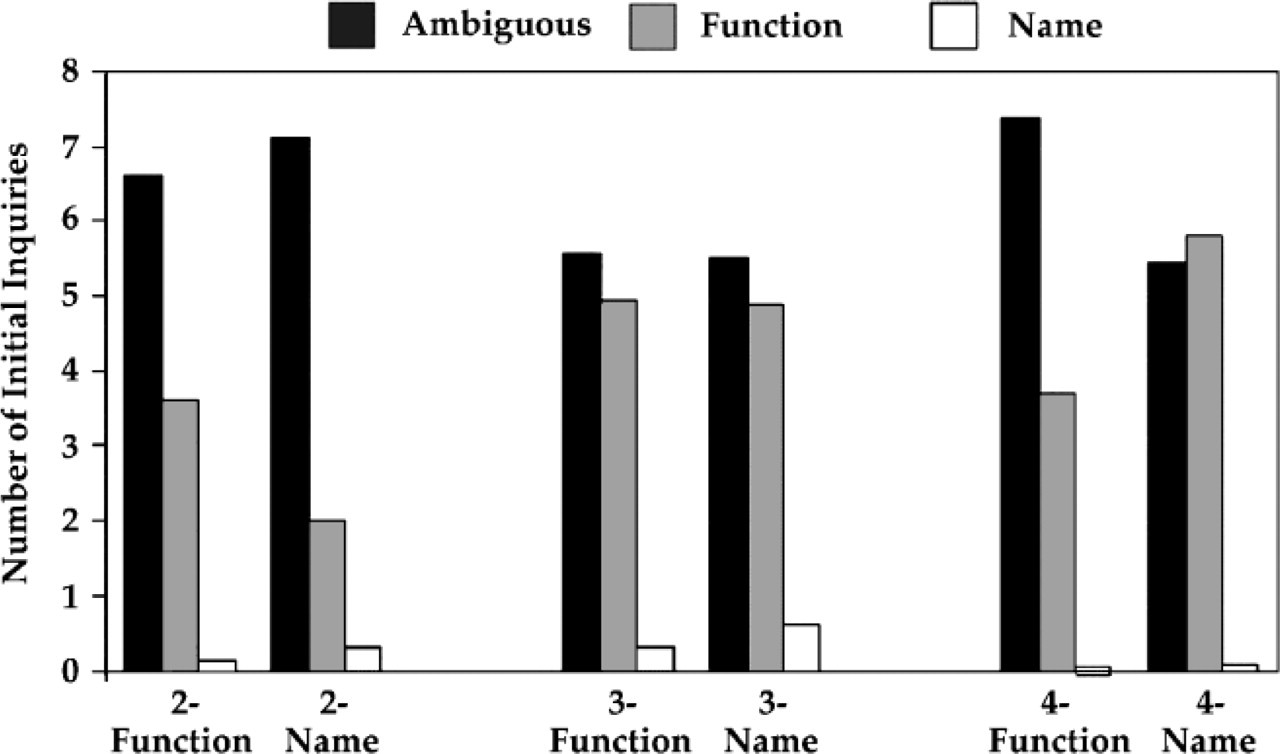
Mean number of initial questions of each type (ambiguous, function, name) in each age group and condition.
Overall, at all ages, children who asked questions tended to ask something about a substantial number of objects. Of 12 possible objects, the mean number of objects queried by the children was 9.4 for the 2-year-olds, 10.9 for the 3-year-olds, and 11.2 for the 4-year-olds.
Follow-Up Questions
Of particular interest was whether or not there was a differential tendency of children in the name and function conditions to follow up after their initial inquiries. The top panel of Figure 2 shows the number of follow-up questions asked by the three age groups in the two conditions. At all ages, the condition in which children were given names in response to ambiguous questions resulted in a more substantial tendency to ask further about the object than the condition in which children were given functional information.
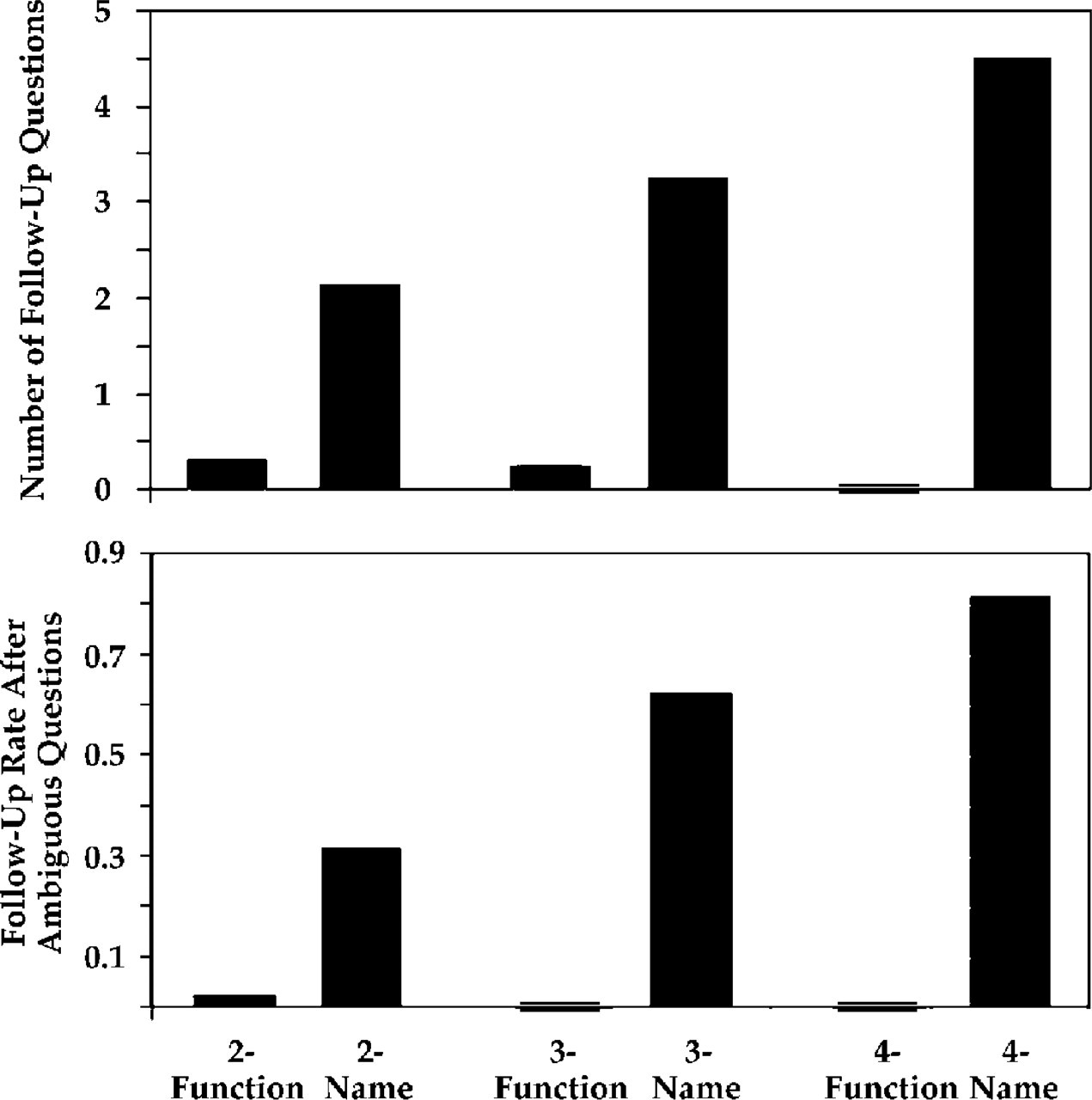
Mean number of follow-up questions (top panel) and mean proportion of ambiguous questions followed up (bottom panel) in each age group and condition.
Most of the follow-up questions were asked after children had begun with an ambiguous inquiry. Of all follow-ups, 87%, 88%, and 94% came after ambiguous questions for the 2-year-olds, 3-year-olds, and 4-year-olds, respectively.
In order to submit the follow-up tendencies to statistical analysis, we calculated a difference score for each child based only on questions following ambiguous initial questions: the total number of objects eliciting a follow-up question minus the total number of objects eliciting no follow-up. Thus, a child who tended to ask additional questions earned a positive score, and a child who tended not to follow up earned a negative score. Note that this difference score corrects for the differential tendency of children at different ages to ask more or fewer initial questions, and that it specifically reveals children's satisfaction or dissatisfaction with the answers they got after ambiguous questions, which were answered differently in the two conditions. The ANOVA of these difference scores revealed a marginal effect of age, F(2, 90)=2.88, .05<p<.10; a main effect of condition, F(1, 90)=47.32, p<.001; and an interaction between these two variables, F(2, 90)=4.69, p<.025. Although the disposition to follow up more often in the name condition than the function condition was larger for the older children, even the 2-year-olds had a marginal tendency to show it, F(1, 30)=3.42, .05<p<.10.
The use of difference scores rather than proportional scores (the proportions of ambiguous initial questions that were followed up) allowed us to include in the overall analysis the 7 children who never asked ambiguous initial questions. However, the proportional scores give a more dramatic portrayal of follow-up behavior. These mean proportions, shown in the bottom panel of Figure 2, clearly indicate the differential follow-up rate for the name and function conditions. In fact, among the 3- and 4-year-olds, none of the ambiguous initial queries in the function condition was ever pursued further.
Trends Over the Session
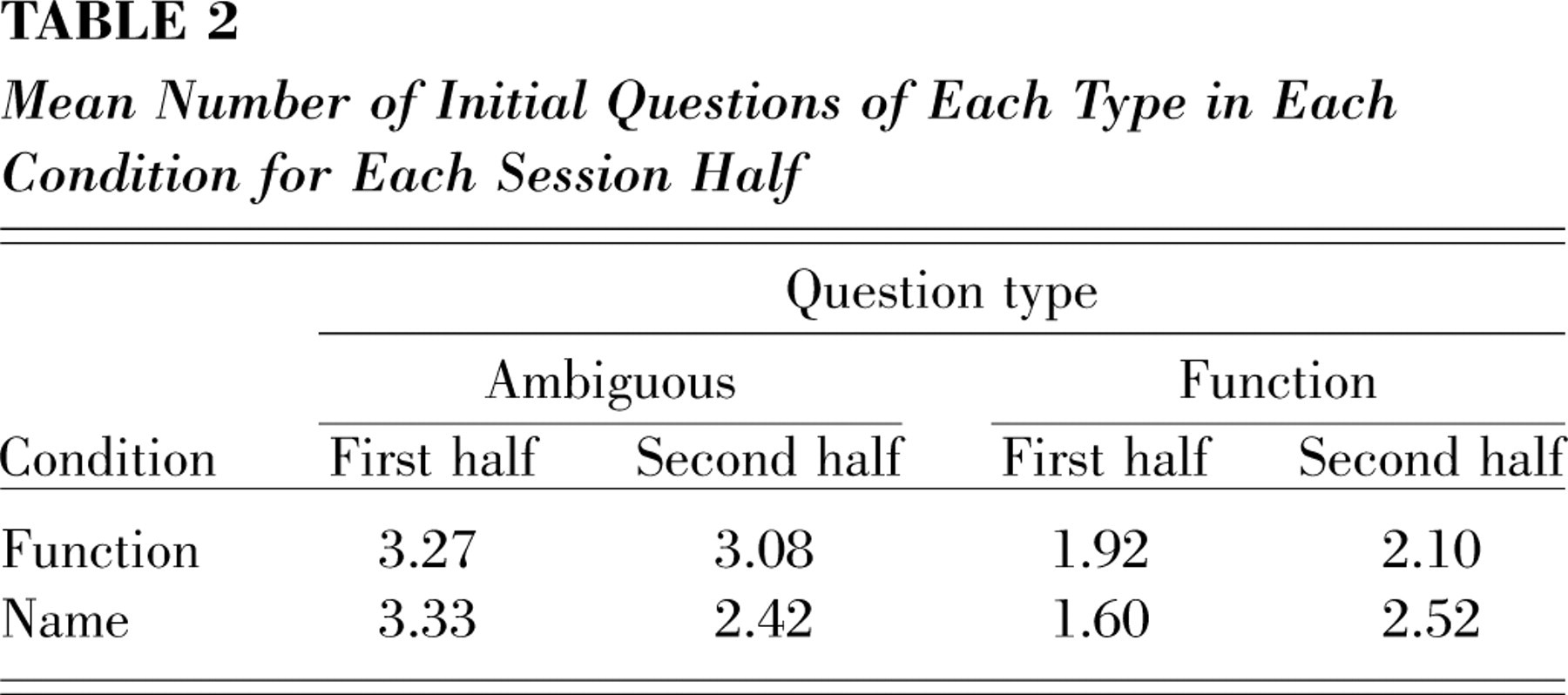
A final interesting issue is whether, over the course of the session, children changed the form of the initial questions that they asked. The series of each child's initial questions was divided at the median into earlier trials and later trials, and the numbers of ambiguous and function questions were counted in each half. An ANOVA was performed for a design with age and condition as between-subjects variables and type of question and half as within-subjects variables. Like the earlier analysis of initial questions, this analysis yielded a main effect of age, F(2, 90)=4.42, p<.025, and a main effect of type of question, F(1, 90)=6.94, p<.025. It also revealed an interaction between type and half, F(1, 90)=11.56, p<.005, and a three-way interaction between type, half, and condition, F(1, 90)=5.04, p<.05. Table 2 depicts the three-way interaction. In the function condition, ambiguous questions outnumbered function questions, apparently by the same amount in the two halves. In an analysis of this condition separately, there was only a main effect of type of question, F(1, 45)=4.33, p<.05. However, in the name condition, ambiguous questions declined in frequency and function questions increased in frequency from the first half to the last. An independent analysis of this condition showed no main effect of type of question, F(1, 45)=2.65, p>.10, but a reliable interaction between type and half, F(1, 45)=32.79, p<.001.
Mean Number of Initial Questions of Each Type in Each Condition for Each Session Half
Discussion
The findings of this study show that when young children ask “What is it?” with regard to a novel artifact, they are more concerned with knowing what kind of thing it is—that is, what its intended function is—than what it is called. Two findings support this conclusion. First, having asked an ambiguous question such as “What is it?” children are more likely to seek additional information about an object if the respondent initially provides only the object's name than if the respondent provides only its function. Second, although children begin inquiring about a series of artifacts by asking ambiguous questions, they tend to modify their initial questions to directly inquire about the functions of objects over the course of a session, but they do so if and only if their ambiguous questions were consistently answered with objects' names. Although both these tendencies appeared to be more marked in 3- and 4-year-olds than in 2-year-olds, there were indications that they also obtained in the younger group of children.
These results provide new evidence that preschool children's concepts of artifacts are intimately tied to the functions of objects. Accordingly, they converge with some findings deriving from a method quite different from the current one—tests of novel-name extension (Kemler Nelson, 1999; Kemler Nelson et al., 1995; Kemler Nelson, Frankenfield, et al., 2000; Kemler Nelson, Russell, et al., 2000). This convergence is notable in light of the ongoing debate concerning whether or not young children pay attention to functional information when they extend new artifact names. Here, we have presented evidence, from a very simple and rather different paradigm, that when young children encounter a novel artifact, the primary information they are motivated to learn is what the object is used for. A highly plausible implication is that functional information, when it is available, also plays a role in determining what other artifacts children believe to be of the same kind.
Smith et al. (1996) have suggested, however, that there is a dissociation between the processes children use in naming in particular and the processes they use to evaluate nonlexical similarity. Because names were not provided to children in the function condition of the present experiment (so that the condition could be construed as a nonlexical context), Smith et al. might not be surprised by the finding that children in that condition were satisfied with the information initially provided to them about the artifacts. Still, the finding that children in the name condition so often persisted in seeking functional information should be more puzzling, given the account of Smith et al. If it were true, as they argued, that young children primarily attach names to salient properties of objects or to properties of objects to which they already have learned associations, then it would seem to follow that, given a novel name for a novel three-dimensional object, children should be content to map the name to the rich perceptual information available from seeing and handling the object. Functional information should be superfluous.
On the basis of our findings, we have concluded that when young children ask “What is it?” or “What's this?” with respect to an unfamiliar artifact, they are more likely to be inquiring about what the object is for than about what the object is called. There is a suggestion in the findings that this conclusion applies even to 2-year-olds, and the evidence is certainly clear that it applies to older preschoolers. At none of the ages we tested did children show any hint that they were more interested in finding out the names than the functions of our objects. Does this mean that when children ask “What is it?” outside our laboratory, they are rarely interested in learning an object's name? Such an inference is not justified by our evidence. The objects that we made available to the children in our study were all deliberately unfamiliar to them. Casual observation suggests that these are not the only kinds of objects that elicit “What is it?” from young children. Rather, children also sometimes seem to ask the question with regard to objects that they have interacted with a lot or that they have observed others interacting with. There is an important difference between a child asking “What is it?” of a familiar artifact and a child asking the same question of an unfamiliar artifact because in the first instance, the child is likely to already have a concept of the object—to be knowledgeable about the function of the object—and to be seeking simply to map that concept to a name. It is even possible that asking the question about familiar objects is the modal situation, rather than the exception, early in a child's acquisition of vocabulary, and that a shift occurs later in development. We are currently in the process of testing this hypothesis. The present study encourages us to believe that continuing investigations of the questions children ask about things (and the kinds of answers those questions elicit) will lead in promising directions for understanding language learning and conceptual development.
Footnotes
Acknowledgements
This research was supported by a sabbatical award from Swarthmore College to the first author and by Joel Dean Summer Research Assistantships to the second and third authors. We thank the children, parents, and staff of the preschools, day-care centers, and summer day camps that participated in the study, including Swarthmore Presbyterian Nursery Day School, Trinity Cooperative Day Nursery, and Swarthmore Friends Meeting Nursery School. Our appreciation goes also to Natania Kremer, who collected some pilot data.