







Abstract
The idea that music makes you smarter has received considerable attention from scholars and the media. The present report is the first to test this hypothesis directly with random assignment of a large sample of children (N = 144) to two different types of music lessons (keyboard or voice) or to control groups that received drama lessons or no lessons. IQ was measured before and after the lessons. Compared with children in the control groups, children in the music groups exhibited greater increases in full-scale IQ. The effect was relatively small, but it generalized across IQ subtests, index scores, and a standardized measure of academic achievement. Unexpectedly, children in the drama group exhibited substantial pre- to post-test improvements in adaptive social behavior that were not evident in the music groups.
Current interest in associations between music and intelligence stems from two independent areas of research (Schellenberg, 2003). One focuses on short-term effects of simple listening to music. The so-called Mozart effect refers to the finding that passive listening to music composed by Mozart produces temporary increases in spatial abilities (Hetland, 2000b; Rauscher, Shaw, & Ky, 1993). Subsequent studies indicate, however, that the Mozart effect is difficult to replicate (Chabris, 1999; Steele, Bass, & Crook, 1999; Steele, Dalla Bella, et al., 1999). When evident, it can be attributed to differences in arousal and mood generated by the different testing conditions (Husain, Thompson, & Schellenberg, 2002; Nantais & Schellenberg, 1999; Thompson, Schellenberg, & Husain, 2001). Compared with sitting in silence for 10 min, listening to Mozart induces more positive moods and relatively optimal levels of arousal, which lead to higher levels of performance on tests of spatial abilities.
The focus of the present report is on a separate line of research, which examines whether music lessons have collateral benefits that extend to nonmusical areas of cognition. Such transfer effects (see Barnett & Ceci, 2002) could be unique to children who take music lessons for extended periods of time because their experiences differ substantially from those of other children. Music lessons involve long periods of focused attention, daily practice, reading musical notation, memorization of extended musical passages, learning about a variety of musical structures (e.g., intervals, scales, chords, chord progressions), and progressive mastery of technical (i.e., fine-motor) skills and the conventions governing the expression of emotions in performance. This combination of experiences could have a positive impact on cognition, particularly during the childhood years, when brain development is highly plastic and sensitive to environmental influence (Huttenlocher, 2002).
Previous findings are consistent with the hypothesis that music lessons promote intellectual development. For example, musical aptitude is associated with literacy (Anvari, Trainor, Woodside, & Levy, 2002; Lamb & Gregory, 1993) and general intelligence (Lynn, Wilson, & Gault, 1989). Presumably, music lessons would increase musical aptitude, as well as the nonmusical abilities associated with aptitude. Indeed, correlational and quasi-experimental studies reveal that music lessons have positive associations with verbal memory (Ho, Cheung, & Chan, 2003), spatial ability (for review, see Hetland, 2000a), reading ability (Hurwitz, Wolff, Bortnick, & Kokas, 1975), selective attention (Hurwitz et al., 1975), and mathematics achievement (Cheek & Smith, 1999). Nonetheless, the most parsimonious explanation of these diffuse associations is that they stem from a common component, such as general intelligence. Put simply, children with high IQs are more likely than other children to take music lessons because better educated and more affluent parents tend to provide music lessons for their children (Orsmond & Miller, 1999). To conclude that music lessons have a causal association with IQ that is specific to music, one must rule out potentially confounding factors such as prior IQ, socioeconomic status, and education (Ceci & Williams, 1997) and demonstrate that nonmusical, extracurricular activities (e.g., sports, drama) do not have comparable effects on IQ.
Because experimental studies have typically compared children taking music lessons with children taking no additional lessons of any kind (e.g., see review by Hetland, 2000a), it is unclear whether the observed associations stemmed from musical training or from structured, extracurricular activities (see Schellenberg, 2003). The results were positive in some instances (Gardiner, Fox, Knowles, & Jeffrey, 1996; Hetland, 2000a; Rauscher, 2002) and transitory in others (Costa-Giomi, 1999). For example, Costa-Giomi assigned children to piano lessons or no lessons for 3 years and tested their cognitive abilities after each year. The music group outscored the no-lessons group on a subtest of spatial abilities after the first and second years but not after the third year. Gardiner et al. compared two classes of first-grade children receiving a test arts program that included Kodály instruction in vocal music with two other classes receiving standard arts programs. The Kodály method emphasizes singing, hand signs, clapping, and other sequenced activities. Initially, children in the test-arts classes had poorer academic achievement than the other children, but after 7 months of the experimental program, they performed better on tests of reading and arithmetic. Nonetheless, the source of the effect is unclear because Kodály pedagogy differs markedly from standard musical instruction, and the test-arts classes also received a specialized program in visual arts. Moreover, assignment of entire classes (rather than individual children) to the test and standard programs made it impossible to control for differences in group dynamics and teacher efficacy.
The present experiment provided a direct test of the hypothesis that music lessons enhance IQ. It included random assignment of a large sample of children to four different groups, two of which received music lessons (standard keyboard, Kodály voice) for a year. The other two were control groups that received instruction in a nonmusical artistic activity (drama) or no lessons. Drama instruction was chosen as a comparison activity because, like music, it is an artistic activity with a primary auditory component. Both types of lessons involve practice and rehearsal, memorization, learning new scripts or pieces, expressing emotion, and so on. The use of two music groups made it possible to assess the generality of possible effects of music instruction and whether nonmusical aspects of Kodály instruction accounted for the effect reported by Gardiner et al. (1996).
The primary outcome measure was the Wechsler Intelligence Scale for Children–Third Edition (WISC-III; Wechsler, 1991). The WISC-III is the most widely used test of intelligence in childhood, with a variety of subscales that examine particular subsets of intellectual abilities. Hence, it allowed an evaluation of the claim that music lessons improve a limited subset of cognitive tasks, specifically, those requiring verbal memory (Ho et al., 2003) or spatial-temporal or mathematical reasoning (Hetland, 2000a; Rauscher, 2002). A standardized test of educational achievement was also administered to examine whether observed changes in IQ are accompanied by improvements on more applied measures. Finally, a test of social functioning (with measures of adaptive and maladaptive behavior) was included to evaluate whether music lessons affect some aspects of development (i.e., intellectual functioning) but not others. All tests were administered before and after the lessons.
METHOD
Participants
An advertisement in a local, community newspaper offered free, weekly arts lessons for 6-year-olds. Recruitment was limited to children whose 6th birthday fell between January and October; the lessons began in September. Six-year-olds were selected because music and drama instructors consider children of this age to be sufficiently mature for formal lessons, and because plasticity declines in older children. For example, absolute (perfect) pitch is evident primarily among individuals who begin taking music lessons before the age of 7 (Takeuchi & Hulse, 1993). Families were interviewed on the telephone and then again at their homes to verify that each had a keyboard with at least four octaves of full-sized keys and to assess their willingness to participate regardless of the condition to which their child was assigned. The sample included 144 children who were assigned randomly to one of four groups. Two groups received either standard keyboard lessons or Kodály voice lessons for 1 year. Two control groups received either drama lessons or no lessons. Children in the no-lessons group received keyboard lessons the following year. Twelve children (8.3%) discontinued taking lessons and did not complete the second round of IQ testing (keyboard: 6, voice: 4, drama: 2). Thus, analyses of pre- to postlessons changes included data from 132 children.
Measures and Procedure
The lessons were taught for 36 weeks at the Royal Conservatory of Music (Toronto), the oldest and most prestigious music conservatory in Canada. In each lessons group (keyboard, voice, drama), two different instructors taught three classes each; each class had 6 children. The instructors were trained, female professionals whose primary source of income came from teaching music or drama. Each was an “associate” of the conservatory, having completed the requirements for teaching-level (i.e., highest) certification in music or in speech and drama.
The WISC-III (Wechsler, 1991), the Kaufman Test of Educational Achievement (K-TEA; Kaufman & Kaufman, 1985), and the Parent Rating Scale of the Behavioral Assessment System for Children (BASC; Reynolds & Kamphaus, 1992) were administered initially during the summer months before the onset of music or drama lessons (and before the children entered first grade at school). The only exceptions involved 23 children born in September or October, who were tested soon after they celebrated their 6th birthday. (The WISC-III does not provide norms for children under 6 years of age.) These slightly younger children were distributed evenly across the four groups. The tests were readministered the following summer. Trained, female research assistants administered the WISC-III and the K-TEA. Test administrators were unaware of the conditions to which the children were assigned.
Outcome measures from the WISC-III that were subjected to statistical analysis included full-scale IQ, the four index scores (Verbal Comprehension, Perceptual Organization, Freedom From Distractibility, and Processing Speed), and the 12 subtests (Picture Completion, Information, Coding, Similarities, Picture Arrangement, Arithmetic, Block Design, Vocabulary, Object Assembly, Comprehension, Symbol Search, and Digit Span). The K-TEA has five subtests (Mathematical Applications, Reading Decoding, Spelling, Reading Comprehension, and Mathematical Computation) that were examined separately. The Parent Rating Scale of the BASC provides separate composite measures of maladaptive and adaptive social functioning: Six subtests measuring maladaptive behavior (Hyperactivity, Aggression, Anxiety, Depression, Atypicality, and Attention Problems) are combined to form the Behavioral Symptoms Index, and three subtests measuring adaptive behaviors (Adaptability, Social Skills, and Leadership) form an Adaptive Composite Score. Both measures were used in the statistical analysis.
RESULTS
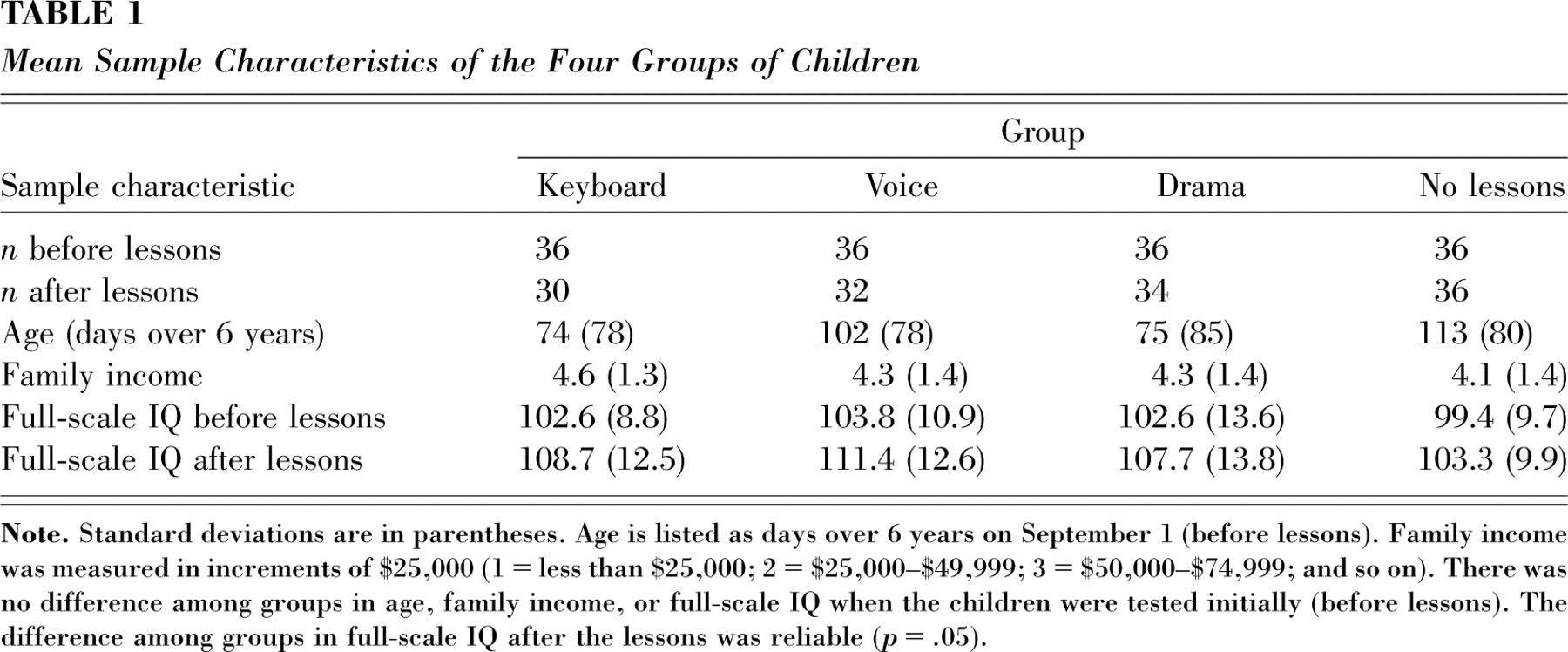
Descriptive statistics are provided in Table 1. Increases in full-scale IQ from before to after the lessons are illustrated in Figure 1. All four groups had significant increases in IQ, ps<.005. This finding is most easily attributed to the increase in IQ that is known to be a usual consequence of entering grade school (Ceci & Williams, 1997). The two music groups had increases of similar magnitude despite differences in teaching style (p>.8). The two control groups also had similar increases (p>.7), which indicates that drama instruction is not an extracurricular activity associated with notable increases in intellectual development.
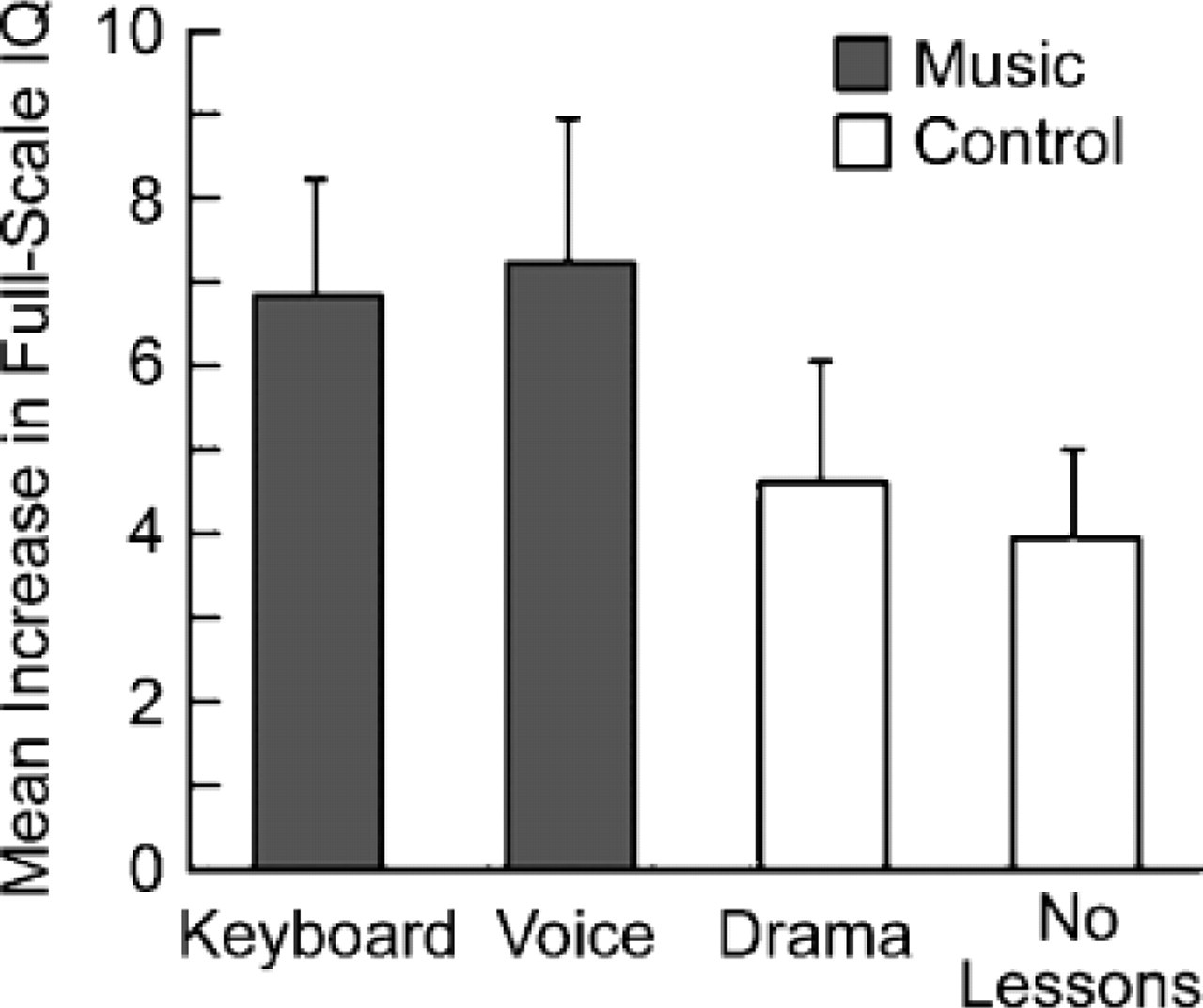
Mean increase in full-scale IQ (Wechsler Intelligence Scale for Children–Third Edition) for each group of 6-year-olds who completed the study. Error bars show standard errors.
Mean Sample Characteristics of the Four Groups of Children
Similarities between the two music groups and the two control groups justified collapsing the data across groups in order to maximize power in tests of the central hypothesis. Compared with the control groups, the music groups had reliably larger increases in full-scale IQ, t(130)=1.99, p<.05. The size of the effect (d=0.35) was midway between effects considered small (0.2) and medium (0.5) by Cohen (1988). Children in the control groups had an average increase in IQ of 4.3 points (SD=7.3), whereas the music groups had an average increase of 7.0 points (SD=8.6).
Additional analyses examined increases on the four index scores. A two-way mixed-design analysis of variance confirmed that such increases were larger for the music groups than for the control groups, F(1, 130)=6.88, p<.01 (medium effect size, d=0.46). Some index scores (Freedom From Distractibility, Processing Speed) had larger increases than others (Verbal Comprehension, Perceptual Organization), F(3, 390)=30.19, p<.0001, but the advantage for the music groups was similar across indices (i.e., two-way interaction, p>.7). In fact, on all but 2 of the 12 subtests (Arithmetic and Information), the music groups had larger increases than the control groups, p<.05 (sign test).
Examination of scores on the five subtests of the K-TEA revealed no reliable differences between groups in pre- to postlessons improvement. Nonetheless, the music groups had larger increases on each of the five subtests, a pattern that was statistically reliable in a sign test (p<.05). In short, the results provide evidence of relatively modest but widespread intellectual benefits from taking music lessons.
Changes in social behavior (as measured by the BASC) told a different story. Improvements in adaptive social behavior were evident in the drama group, t(33)=4.00, p<.0005, but the two music groups and the no-lessons group did not change from before to after the lessons (ps>.15). The drama group had a significantly larger improvement than the other groups, t(129)=2.88, p<.005 (medium effect size, d=0.57), which did not differ from each other. Similar analyses of changes in maladaptive behavior revealed no pre- to postlessons differences in any group and no differences among groups.
DISCUSSION
The findings indicate that music lessons cause small increases in IQ, but comparable nonmusical activities do not have similar consequences. By contrast, drama lessons had favorable effects on social behavior that were not evident in the music groups.
How can one explain the association between music lessons and IQ? It is well established that simple attendance at school raises IQ (Ceci & Williams, 1997), and that school instruction is particularly effective when classes are small (Ehrenberg, Brewer, Gamoran, & Wilms, 2001). Music lessons, taught individually or in small groups, may provide additional boosts in IQ because they are like school but still enjoyable. Moreover, music lessons involve a multiplicity of experiences that could generate improvement in a wide range of abilities. From this perspective, extracurricular activities (other than drama lessons) with similar properties (e.g., chess lessons, programs in science or reading) may confer similar benefits. Testing this hypothesis could pose difficulties, however, in recruiting or attrition rates.
In their review of transfer effects, Barnett and Ceci (2002) made a distinction between near and far transfer. Near transfer occurs between highly similar contexts and domains, whereas far transfer occurs between domains that have less in common. A demonstration of relatively near transfer (Thompson, Schellenberg, & Husain, 2004) showed that music lessons promote the ability to decode prosodic cues in speech. Keyboard lessons were as effective in this respect as drama lessons, which focus specifically on the use of paralinguistic cues (e.g., pitch, stress, rate) to express emotion. The present data point to far transfer, from music lessons to IQ, which is relatively rare. As Barnett and Ceci noted, however, widespread belief in far transfer is central to Western concepts of education. Formal education is promoted not only for gaining literacy and numeracy skills, as well as specific knowledge in various domains, but also for developing the capacity for reasoning and critical thinking. Extracurricular experiences such as music lessons appear to play a role in this process.
Footnotes
Acknowledgements
This work was supported by the International Foundation for Music Research. The keyboard and voice lessons were taught in the Royal Conservatory of Music Community School. The conservatory also provided rooms for the drama lessons. Jane Campbell served as project coordinator. The IQ tests were administered by Khush Amaria, Erica Barbuto, Jane Campbell, Navneet Dhami, and Gavrielle Geller. Helpful comments on earlier versions of the article were provided by Denis Burnham, Isabelle Peretz, Patty Pliner, Marla Sokolowski, Kate Stevens, Bill Thompson, and Sandra Trehub.