







Abstract
Biases in reasoning can provide insight into underlying processing mechanisms. We demonstrate a new bias in children's belief-desire reasoning. Children between 4 and 8 years of age were told a story in which a character was mistaken about which of three boxes contained some object. The character wanted to go to one of the boxes, but only if it did not contain the object. In this scenario, the character would be expected to avoid the box where she falsely believed the object to be, but might go to either of the remaining boxes. Though the character was equally likely to go to either box, children were biased to predict that the character would go to the box that contained the object. In a control task, the character had the same desire but did not have a false belief; in this case, children showed no bias, choosing the two correct answers equally often. The observed pattern of bias was predicted by a developmental model of belief-desire reasoning. Competent belief-desire reasoning depends on a process of selection by inhibition in which the best belief content emerges from a set of candidates.
Competent social interaction depends on the ability to recognize and reason about people's mental states (what Premack & Woodruff, 1978, termed “theory of mind”). One cardinal component of this ability is the prediction of another person's action from that person's beliefs and desires. Key advances in investigating this ability were the development of the false-belief (FB) task (Wimmer & Perner, 1983) and the discovery that belief-desire reasoning is well established by 4 years of age (Baron-Cohen, Leslie, & Frith, 1985). In a standard version of the FB task, children are told about a girl, Sally, who sees a frog under a red box, but is absent when the frog moves to under a blue box. Following basic control questions, children must answer either a think question, about where Sally thinks the frog is, or an action question, about where Sally will look for the frog. Both questions have the same answer: Sally did not see the frog switch locations, so she mistakenly thinks that it is still under the red box and will look for it there. We refer to the red box as the false-belief location (FB location) because by indicating this location, the child correctly attributes a false belief to Sally. We refer to the blue box as the true-belief (TB) location because by indicating this location, the child incorrectly attributes a true belief to Sally. A large number of studies have consistently shown that at age 3 years, most children fail both questions (by indicating the blue box), but at age 4 years, most children pass (see Wellman, Cross, & Watson, 2001, for review).
Most investigations of children's performance on the FB task have sought to identify the age at which children first attribute false belief, and until recently there has been little concern for discovering the processing mechanisms underlying successful performance. However, proposals that success on the FB task might require inhibition (Leslie & Thaiss, 1992; Russell, Mauthner, Sharpe, & Tidswell, 1991) have led researchers to investigate the relationship between inhibitory processing and belief-desire reasoning (e.g., Carlson, Moses, & Breton, 2002; Perner, Lang, & Kloo, 2002; Roth & Leslie, 1998). In the present study, we tested between two detailed models of how inhibitory processing leads to success in FB tasks. Both models hold that success on FB tasks involves selecting between representations of alternative belief contents by inhibiting competitors.
Young children engage in belief-desire reasoning when their general knowledge and general reasoning powers are still severely limited. The contrast in the level of development of these abilities has led to the suggestion that the early capacity for belief-desire reasoning has an automatic, heuristic basis. Specifically, Leslie and his colleagues have proposed that the young brain is equipped with a specialized theory-of-mind mechanism (ToMM) that enables mental states to be attended to and learned about (Leslie, 1987, 2000). This proposed mechanism has a degree of neural specialization (C.D. Frith & Frith, 1999; U. Frith, Morton, & Leslie, 1991; Gallagher & Frith, 2003; Gallagher, Jack, Roepstorff, & Frith, 2002) and is present in children independently of general intellectual level (Leslie, 1987). Impairment of this mechanism may occur in certain complex genetic disorders, such as autism, with severe impact on social development (Baron-Cohen, 1995; Leslie, 1987; Leslie & Frith, 1990).
In the FB task, the role of ToMM is to guess plausible and relevant beliefs that might be attributed to Sally. ToMM may make more than one guess, but one of these guesses should be that Sally believes what is true (where “true” reflects one's own belief). This may be a useful heuristic because people's beliefs about mundane things usually are true. But solving an FB task requires one to ignore one's own true belief. In order to ignore this belief, one must inhibit it, allowing the appropriate false belief to be selected for attribution. The process of selection by inhibition is referred to as selection processing (Leslie, 2000; Leslie & Thaiss, 1992; Roth & Leslie, 1998).
In a standard FB task, Sally wants to approach the object (e.g., she wants to find the frog). In an avoidance-desire FB task, Sally wants to avoid the frog and will, therefore, avoid the box in which she falsely believes it to be (the FB location) and mistakenly go to the location where the frog actually is (TB location). Cassidy (1998) found that an avoidance FB task was much more difficult than a standard FB task. Four-year-olds who passed the standard task failed the avoidance FB task, performing like 3-year-olds. Leslie and Polizzi (1998) obtained very similar results and proposed two models of selection processing, either of which could account for the results. We now briefly describe the two models of selection processing and then describe how we tested between them.
TWO MODELS OF BELIEF-DESIRE REASONING
The basic idea behind both models is that, in attributing beliefs to other people, an unconscious ToMM automatically provides a small set of belief contents that might plausibly be attributed. Then, an attentional-decision process in the brain—selection processing—selects the most plausible content from this set. These ideas are reminiscent of certain approaches to the role of inhibition in visual attention (e.g., Klein, 1988; Posner & Cohen, 1984; Watson & Humphreys, 2000).
The selection process can be visualized as involving a mental pointer, or index, which is attracted to the currently most salient content. Both models share the following assumptions:
The salience of contents varies by degree, and contents can have their salience decreased by inhibition.
Among the contents, there is always one that is true, the TB content. Initially, the TB content is most salient.
For success in an FB task, the TB content must be inhibited so that its salience falls below that of the FB content; otherwise, a true belief will be attributed.
Predicting the behavior of a character with an avoidance desire requires first identifying (indexing) the target to be avoided and then inhibiting that target so that it will be avoided.
In both models, predicting a character's behavior requires one inhibition in approach FB tasks, but two inhibitions in avoidance FB tasks. The models differ from one another in three main respects: first, in whether selection is done serially or in parallel; second, in how many selection indexes are used; and third, in how the desire and belief inhibitions combine when action in an avoidance FB task is predicted.
In Model 1, “inhibition of inhibition,” there is only a single index, and inhibitions apply in parallel. When predicting where Sally will go in an avoidance FB task, the model first indexes the target of true belief (and approach desire)—the TB location. Because Sally's belief is false and her desire is to avoid the frog, two inhibitions are required, and they are applied such that they cancel out by inhibiting each other. The end result is that the TB location remains indexed and is correctly selected as the location where Sally will go. Figure 1a depicts the operation of Model 1.
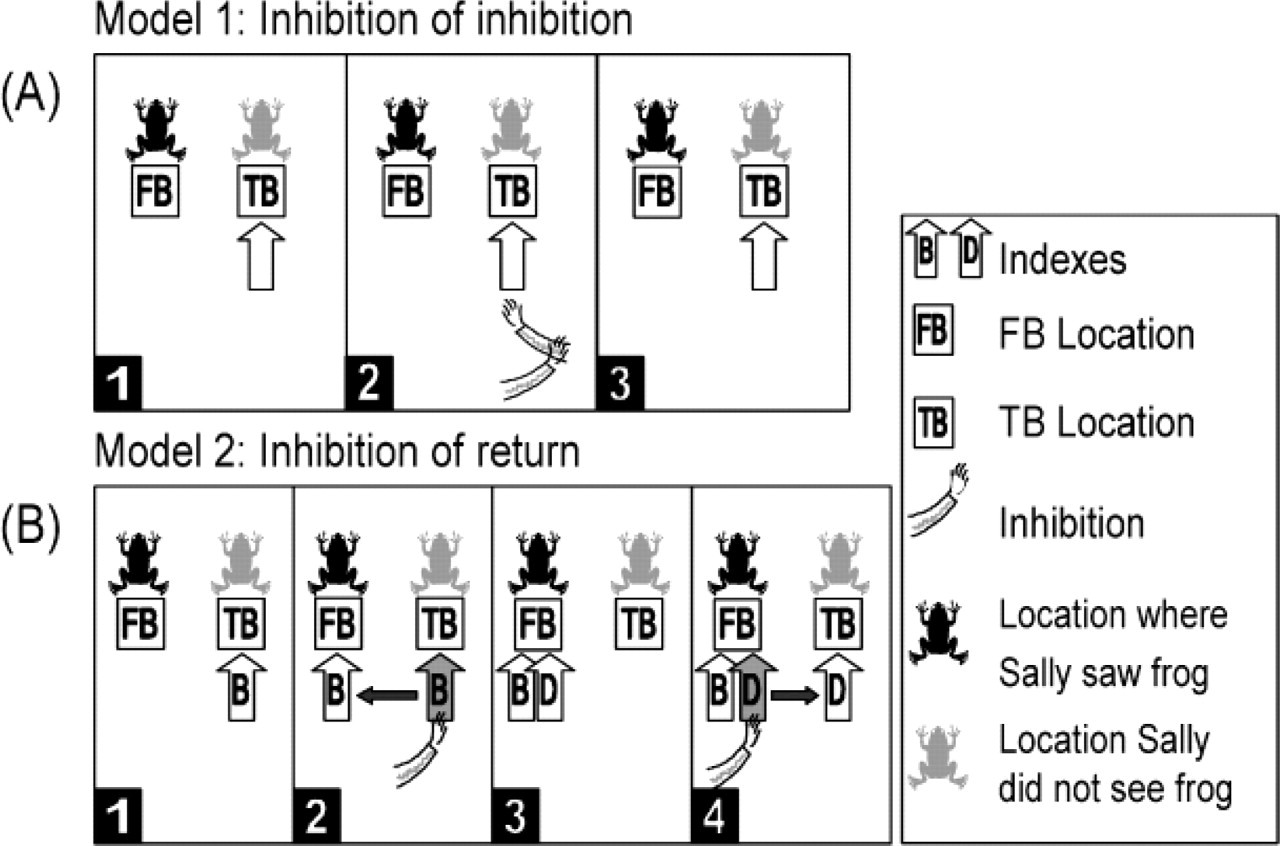
Two competing models of selection by inhibition in a two-location avoidance false-belief task (see the text for details). In both models, the true belief (TB) is initially more salient than the false belief (FB) and attracts an index. In Model 1 (a), inhibitions for belief and desire cancel out, leaving the true belief to be selected as the target of action. In Model 2 (b), the belief inhibition is applied to the true belief, causing the false belief to become the more salient and to attract the belief index (B). A desire index (D) is then applied to the false-belief location and subsequently inhibited, causing the index to move back to the true-belief location.
In Model 2, “inhibition of return,” two indexes are used, one for belief and one for desire. Furthermore, inhibitions are applied serially, with belief inhibitions applied first and desire inhibitions second. To predict where Sally will go in an avoidance FB task, the model again indexes the target of true belief initially. Because Sally's belief is false, the first of the serial inhibitions is applied, causing the belief index to move to the FB location. Next, the target of desire is identified, its index being attracted to the FB location (because it is more salient). However, because Sally's desire is to avoid the target, the desire index must be inhibited. For a successful prediction, the desire inhibition must be sufficient to lower the salience of the FB location below even that of the previously inhibited TB location. Figure 1b depicts the operation of Model 2.
Testing between the models
These models were developed to account for two-location tasks, in which there is a single correct answer. Avoidance FB tasks, however, can be devised to have two (or more) equally correct answers by having three (or more) locations. If Sally believes (falsely) that the frog is in one box and she wants to avoid it, she might equally well go to either of two remaining locations, one of which contains the frog and the other of which does not. When we examined the models in the context of this three-location task, we found that they made opposite predictions about which correct answer would be preferred. That is, for Model 1, the addition of a third, neutral location makes no difference; Sally will choose the TB location because, as in the case of the two-location task, the belief and desire inhibitions cancel each other out so that the initial index does not move from the TB location (Fig. 2a). For Model 2, however, the addition of a third, neutral location means that there is a correct answer that does not require the index to move to a previously inhibited location; assuming that a target that has never been inhibited will be more salient than targets that have, Sally will choose the location without the frog because the inhibition of the belief index and then the desire index will make the TB and FB locations, respectively, less salient (Fig. 2b). Thus, we can use a three-location task to test the models.
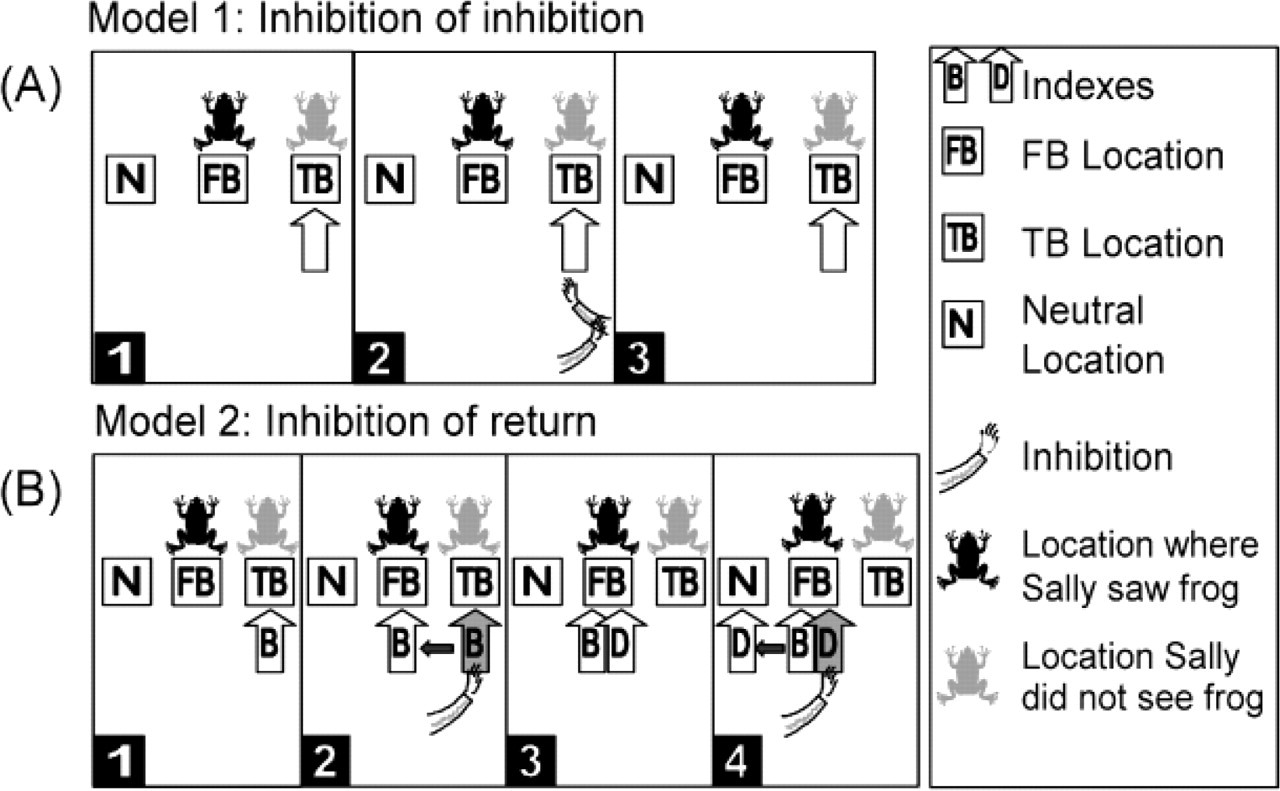
Two competing models of selection by inhibition in a three-location avoidance false-belief task (see the text for details). In Model 1 (a), the introduction of a third, neutral location makes no difference to the outcome compared with the two-location task (see Fig. 1a), because the belief and desire inhibitions again cancel out, leaving the true-belief (TB) location selected. In Model 2 (b), the third, neutral location attracts the index because in the end it is the only uninhibited location: Inhibition applied to the true belief causes the belief (B) index to move to the false-belief (FB) location. A desire (D) index is then attracted to the false-belief location, and inhibition applied to this index causes it to move to the neutral location. A three-location task provides a way to distinguish between models because each model predicts a different bias.
In a task with two equally correct answers, subjects might choose the two answers equally often, or they might show a systematic bias toward one of the answers. Biases in reasoning can be used to probe underlying processing mechanisms (e.g., Tversky & Kahneman, 1974). In the case of the three-location avoidance FB task, Model 1 and Model 2 would both be refuted if subjects choose the two correct answers equally often; if, however, subjects systematically select one of the answers, this would refute one model and support the other.
Experiment
Note that the predictions we just outlined are for successful performance only. Therefore, to test these predictions, we studied children who could pass an avoidance FB task. Pilot studies indicated that 6-year-olds can have a high rate of success with avoidance FB. In the experiment, one group of children was given an avoidance FB task involving three locations (with two correct answers). Model 1 predicted that children who passed the three-location task would be more likely to answer the action question by referring to the TB location than by referring to the neutral location. Model 2 predicted that children who passed the three-location task would prefer the neutral location over the TB location. A third possibility was that children would show no bias and would either choose both of the correct locations or each of them half the time.
It was critical that we control for the falseness of the attributed belief. We therefore used a second task in which the character also wants to avoid the frog, but her belief about the frog is true. However, there is a second frog that the character does not know about. We gave this avoidance partial-knowledge (control) task to another group of children. In this control task, Sally sees a dirty frog under one box (TB location) but is absent when another dirty frog goes under a second box (ignorance location). A third location (neutral location) remains empty. In this task, too, the action question has two equally correct answers: Sally might go to the ignorance location (because she does not know there is a frog there) or to the empty neutral location. Neither model predicts a bias in this task because there is no false belief to generate a belief inhibition, leaving action to be determined by the desire inhibition alone. In the case of Model 1, for example, the desire inhibition is not canceled out and so applies to the TB location, causing the index to move away to either of two equally salient alternatives (see Fig. 3).
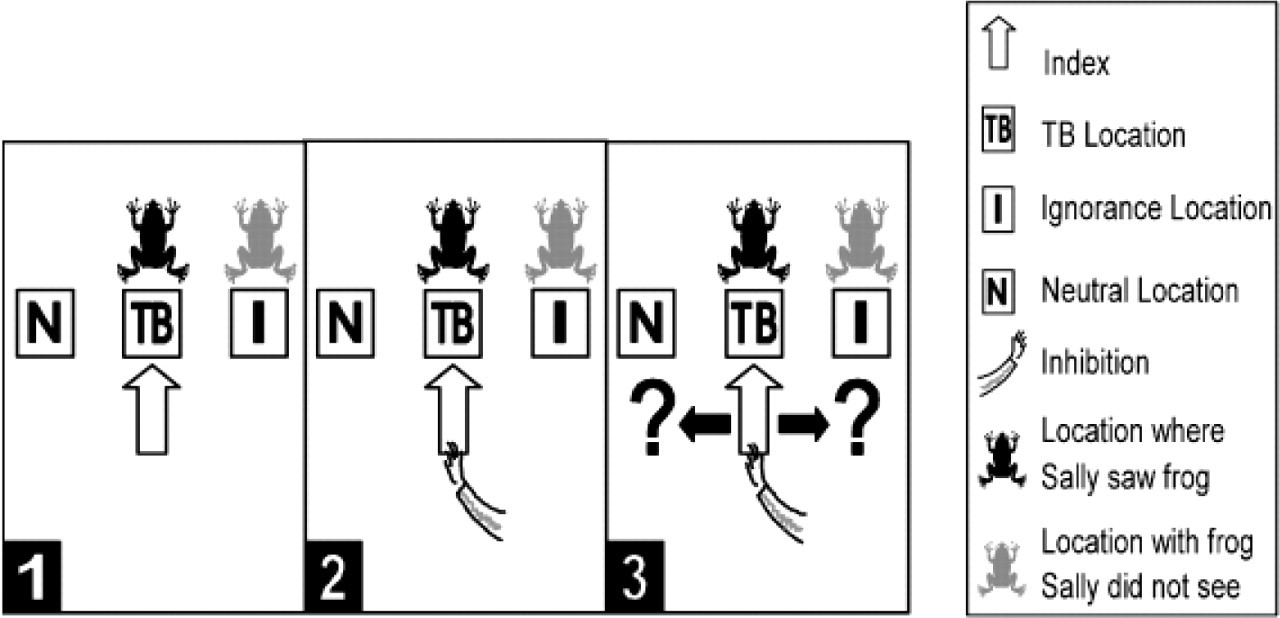
Model 1 applied to an avoidance-desire task in which a character knows about a frog under one box but does not know about another frog under another box, the ignorance location. As in a two-location task, the true-belief (TB) location attracts an index, which is then inhibited. In this case, however, there are two equally correct locations that might attract the index. Model 1 predicts no bias in selecting either of these two answers.
Prior findings supporting Model 1 led us to expect the bias predicted by Model 1 in the avoidance FB task. A striking feature of the difficulty of avoidance FB tasks is that 4-year-olds typically fail the action question even if they have just answered the think question correctly. For Model 1, even after belief has been correctly calculated for the think question, it must be recalculated along with desire in order to answer the action question. Recalculation is necessary because Model 1 calculates belief and desire in parallel. For Model 2, recalculation is not necessary because belief and desire are calculated serially; belief can be calculated once in response to the think question, and then for the action question, desire identification is simply added to that result. The recalculation of belief in Model 1 suggests that it would be possible to help children pass the test by using an easier version of the action question, but in the case of Model 2 there is no recalculation of belief and therefore no reason to expect that an easier version of the action question would improve children's performance (Leslie, German, & Polizzi, in press). Thus, the prior study tested the models by investigating whether it was possible to help children pass the task by using an easier version of the action question: “Where will Sally look first?” (This question is considered easy because 3-year-old children perform better with this action question than with the standard question in the approach FB task; Siegal & Beattie, 1991; Surian & Leslie, 1999.) Results showed that 5-year-olds indeed performed much better with this question than with the standard question (Leslie et al., in press), suggesting that after they responded correctly to the think question, they recalculated belief along with desire. This effect is predicted by Model 1, but not by Model 2.
Method
Materials
Both tasks made use of a foam-board stage; dolls and props were used to enact the stories. All props, except for the stage, were changed between screening and experimental tasks.
Procedure
Children who passed a standard FB screening task received either the avoidance FB task or the control task. Both tasks concerned Sally, who wanted to put a clean hat under a box, but not a box with a dirty frog. In the avoidance FB task, Sally saw a frog under the middle (FB location) of three boxes, but was absent when the frog moved to another location (TB location). In the control task, Sally saw a frog under the middle (TB location) of three boxes, but was absent when a second frog went under one of the other boxes (ignorance location). The appendix contains the protocols for both tasks.
In both tasks, the side of the locations was counterbalanced across subjects, and children were asked the same action question, “Which box will Sally go to with her clean hat?” This question had two equally correct answers.
We examined responses to the action question only for children who first passed a series of control questions presented in fixed order. In the avoidance FB task, the control questions were
Memory: “In the beginning, where did Sally see the dirty frog?”
Reality: “Where is the dirty frog now?”
Think: “Where does Sally think the dirty frog is?”
In the control task, the control questions were
Know 1: “Does Sally know that there is a dirty frog under the blue box [the box the second frog moved under]?”
Know 2: “Does Sally know that there is a dirty frog under the yellow box [the box the first frog was under]?”
Subjects
Thirty-two out of 41 children passed a standard FB task and were randomly assigned to receive either the avoidance FB task or the control task. To be included in the analysis, children were also required to pass all the control questions. Two children in the avoidance FB task failed the think question and were rejected for that reason. The remaining 30 children ranged in age from 4 years 8 months to 8 years 7 months (M=6 years 7 months, SD=1 year 5 months). Data for the avoidance FB task came from 16 children ages 4 years 9 months to 8 years 7 months (M=6 years 6 months, SD=1 year 6 months), and data for the control task came from 14 children ages 4 years 8 months to 8 years 7 months (M=6 years 7 months, SD=1 year 6 months).
Results
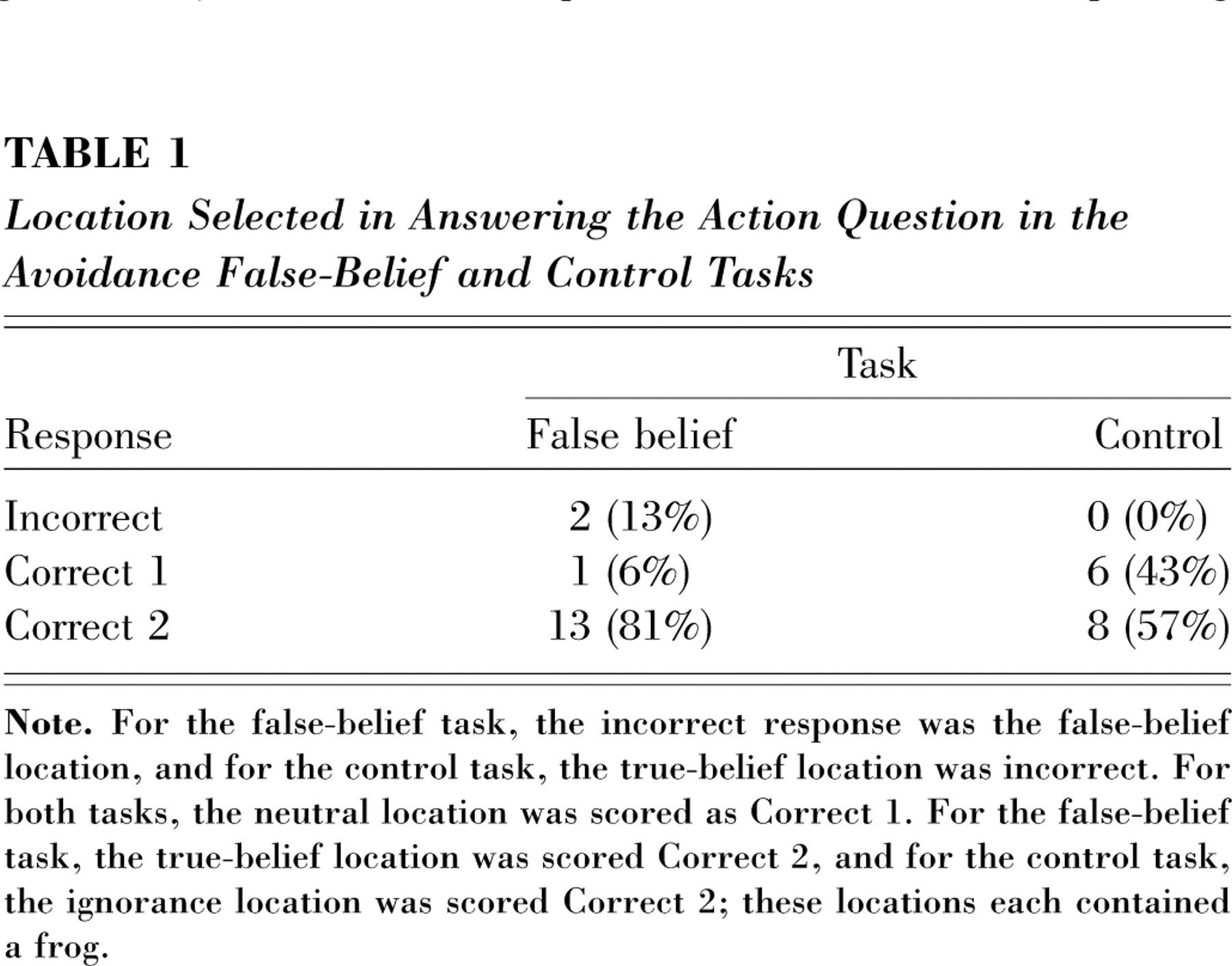
Because our predictions concerned only successful performance, the responses of children who passed the action question are of greatest interest. In the avoidance FB task, children were biased toward one of the correct answers, namely, the TB location. Two children chose the (incorrect) FB location. Of the 14 children who passed this task, 13 (93%) said Sally would go to the TB location, and 1 indicated she would go to both the TB location and the neutral location (we conservatively scored this child as having chosen the neutral location; binomial, N=14, x=1, p<.002, two-tailed). All children passed the control task, 7 (50%) indicating Sally would go to the neutral location, 6 (43%) choosing the ignorance location, and 1 child indicating Sally would go to both the neutral and the ignorance location (we conservatively scored the latter child as choosing the ignorance location). In this task, there was no difference between the frequencies of children choosing the two locations (binomial, N=14, x=6, p=.4, n.s.). Table 1 shows responses for the two tasks. Responding across the two tasks differed significantly (Fisher's exact, p=.038, one-tailed). Although the children were free to choose both correct answers, only 7% did so.
Location Selected in Answering the Action Question in the Avoidance False-Belief and Control Tasks
Discussion
Using a task with two equally correct answers, we found a bias in children's belief-desire reasoning. In approach FB tasks, there is a single correct answer because the character has a desire to approach the target of false belief. Tasks in which the character wishes to avoid the target of false belief can have two (or more) equally correct answers. In the three-location task we used, subjects might have chosen the two correct locations equally often or responded with both correct answers, but instead children who succeeded were biased to select the TB location. Responding could not have been related to the side of the TB location because this was counterbalanced across subjects. The bias the children demonstrated was predicted by Model 1, but was opposite to that predicted by Model 2.
We included a control task to investigate alternative explanations for a Model 1 bias. Suppose children simply prefer to select a location that currently contains an object over a correct but empty location (an “object” bias). Or suppose children prefer to select a correct location that thwarts the character's desire over a correct location that satisfies the character's desire (a “failure” or “irony” bias). Either of these biases, like Model 1, favors the TB location. However, these other biases would also operate in the control task. The control task was very similar to the avoidance FB task in that it also had two equally correct answers to the action question, namely, one location that contained a dirty frog and would defeat the protagonist's desire and one location that was empty. Again, the object bias and the failure or irony bias predicted that the children would favor the box containing a frog over the empty box. However, children in the control task showed no bias, picking the two correct answers equally often.
In contrast to the object and failure or irony biases, the Model 1 bias is sensitive to the character's epistemic state. Model 1, therefore, makes differing predictions for the two tasks: a TB-location bias in the FB task and no bias in the control task (see Fig. 3 for the Model 1 mode of operation in the control task). To identify where Sally will go, the model first indexes the target of true belief and approach desire—the TB location. A desire inhibition (for avoidance) is then applied to the TB location, causing the index to shift to either the ignorance or the neutral location. Because neither of these locations has been inhibited, they should be selected with equal probability.
We observed bias only in the avoidance FB task and not in the avoidance control task, despite their similarity. The bias appears, therefore, to be related to the story character's epistemic state and not to extraneous biases. For children who succeed on avoidance FB tasks, attributing a false belief to a character creates a preference for predicting one course of action over another, even though both are in fact equally likely. This finding is new, is unexpected, and, whatever one's theoretical perspective, needs to be explained.
From our perspective, belief-desire reasoning is a process of selecting contents for beliefs and desires from among plausible alternatives. Selection of false-belief contents first requires inhibition of a default true-belief attribution. When desire attribution also requires inhibition, the two inhibitions interact, making the task difficult for young children (Leslie & Polizzi, 1998; Leslie et al., in press). We have now shown that this interaction also leads to a selection bias in a three-location task. These findings converge with those of Leslie et al. in supporting the inhibition-of-inhibition model of selection. Competent reasoning about beliefs depends on the development of inhibitory control.
Footnotes
Acknowledgements
We thank Ellen Winner, Sara Baker, Bobbie Spellman, Angeline Lillard, and three anonymous reviewers for a careful reading of and helpful comments on an earlier draft. This work was supported by National Science Foundation Grant BCS-0079917 awarded to A.M.L.
Protocol For The Avoidance False-Belief And Control Tasks
The following story opening was read to all children and illustrated with props:
The story was then continued differently depending on the condition to which the child had been assigned. In the avoidance false-belief condition, the story continued as follows:
In the control condition, the story continued as follows: