







Abstract
Problem solving can be inefficient when the solution requires subjects to generate an atypical function for an object and the object's typical function has been primed. Subjects become “fixed” on the design function of the object, and problem solving suffers relative to control conditions in which the object's function is not demonstrated. In the current study, such functional fixedness was demonstrated in a sample of adolescents (mean age of 16 years) among the Shuar of Ecuadorian Amazonia, whose technologically sparse culture provides limited access to large numbers of artifacts with highly specialized functions. This result suggests that design function may universally be the core property of artifact concepts in human semantic memory.
Converging lines of evidence suggest that cognitive systems underwriting the acquisition and representation of knowledge about artifacts are distinct from those for natural kinds (e.g., Caramazza & Shelton, 1998; Keil, 1989; Levin, Takarae, Miner, & Keil, 2001; Martin, Wiggs, Ungerleider, & Haxby, 1996). Recent work addressing the nature and origin of the human capacity to understand artifacts (see, e.g., Laurence & Margolis, in press) indicates that a critical determinant of adult understanding of an artifact's category or function (or both) is information about the artifact's design, and that children's conceptions of artifact function become more sensitive to information about design over the first years of life (Bloom, 1996; Kelemen & Carey, in press).
The earliest knowledge of artifact function is likely based on integration of information from different core knowledge systems specialized for reasoning about (a) objects' mechanical properties and (b) the goals of the agents that use objects (Leslie, 1994). By approximately age 6, children come to possess artifact concepts that embody the function the artifact was designed to perform as a core property (German & Johnson, 2002; Kelemen, 1999; Matan & Carey, 2001). This developmental pattern is supported by evidence that older but not younger children demonstrate functional fixedness, that is, are slower to solve a problem by using an artifact for an atypical purpose when the design function is primed immediately prior to the problem presentation than when the design function is not demonstrated (Defeyter & German, 2003; German & Defeyter, 2000).
Is organization of artifact concepts in terms of their design function a universal property of mature human semantic memory? To date, all investigations of the conceptual representation of artifacts have been undertaken in technologically sophisticated cultures, where artificial objects with highly specific functions are common (e.g., cultures with such items as olive pitters, bookends, and staple guns; Tomasello, 1999). Artifact concepts embodying design function at their core may therefore reflect a technologically promiscuous cultural context rather than a universal organizing feature of semantic memory. Would similar artifact representation be observed among people exposed to fewer artifacts that are technologically simpler (e.g., that have few moving parts and are unpowered) and that are pressed into a greater variety of uses than is typical in an industrialized society? In technologically sparse societies, some tools (e.g., machetes) have a wide number of variable but conventional functions, an observation that might lead one to expect less fixedness on design functions in such cultures.
A related idea, captured by the notion of “bricolage” (Lévi-Strauss, 1962), also suggests that people in nonindustrial societies may enjoy more technological flexibility than people in industrial societies, precisely because they are less constrained by narrow conceptions of what an artifact or object is for. Lévi-Strauss described the bricoleur 1 as “someone who works with his hands and uses devious means compared to those of the craftsman” (p. 16); according to Gardner (1973), “faced with the task, say, of repairing a faulty machine, [the bricoleur] looks over the materials at hand and improvises a solution…” (p. 139). A key idea is improvisation—constraints are placed only by the physical properties of the materials at hand, not by how those properties interact with the individual's prior knowledge of function. Nevertheless, such improvisation is observed to occur frequently in nontechnological cultural settings (Berry & Irvine, 1986).
Here, we report a study assessing whether individuals from a non-Western, nonindustrialized, technologically sparse culture (the Shuar of Ecuador) show evidence of representing artifacts in terms of their core design properties, as indexed by susceptibility to functional fixedness. That is, we asked, will individuals in this culture be slower to generate an atypical use of an object in solving a problem when the design function of the object is demonstrated than when there is no such demonstration? Functional fixedness is an especially suitable candidate phenomenon for testing this hypothesis; overcoming fixedness involves flexible problem solving covered by the term bricolage, and also provides an index of whether design is represented as a core property of an artifact concept (German & Defeyter, 2000). To our knowledge, no attempt to measure functional fixedness outside a technologically sophisticated industrial culture has ever been reported.
METHOD
Subject Population
The Shuar are hunter-horticulturalists of the Amazon region of Ecuador, whose primary means of subsistence is slash-and-burn horticulture and hunting. Some industrially manufactured artifacts, such as machetes, axes, cooking pots, nails, shotguns, and fishhooks, have been present among the Shuar for many decades. Other artifacts are manufactured from forest materials (e.g., baskets, ceramics). However, many artifacts familiar to people in industrialized societies, ranging from advanced technology (e.g., vehicles) to specialized devices (e.g., olive pitters, corkscrews, saws), have never been present in Shuar communities. In general, Shuar people are exposed only to a small set of manufactured artifacts, and the set of artifacts to which they are exposed tends to be “low-tech.”
Subjects
The participants were 29 adolescent children and young adults (15 boys, 14 girls; age range: 12–25 years) from two Shuar villages in Morona Santiago and Pastaza provinces, Ecuador. All participants were Spanish-Shuar bilinguals. Because birth records were unavailable for some subjects, ages were recorded to the nearest year. Subjects were randomly assigned to the function-demonstration condition (7 males, 9 females; mean age = 16.0 years) or baseline condition (8 males, 5 females; mean age= 15.4 years).
Tasks and Materials
The materials for the problems were artifacts with which the subjects would be familiar, despite the fact that, as a whole, their culture has less access to technology than Western cultures. The box task (after German & Defeyter, 2000) required subjects to create a tower high enough to reach a perch on which a story character's friend was trapped. The materials included a cardboard box (9 in. by 12 in. by 5 in.), six Styrofoam cubes (3 in. on a side), a battery, a pencil eraser, and a rubber ball. The solution was to use a target object—the cardboard box—as a platform on which to build a tower from the other objects. The character to be rescued was placed on a wooden peg, affixed to a wall at a height that a tower constructed using the Styrofoam blocks alone could not reach. A tower constructed with the Styrofoam blocks on top of the cardboard box would exactly reach the height of the perch.
In the spoon task, participants were required to create a bridge for a story character to cross a river. The materials for the spoon task included a target object—a spoon (7.5 in. long), which was the only object long enough to reach between two of the Styrofoam blocks (described in the preceding paragraph) representing the sides of the river. The other items were a cup filled with rice, a smaller plastic cup, a lollipop stick, a Ping-Pong ball, and an eraser.
The full story text for each task appears in the appendix. 2
Procedure
Subjects were interviewed individually in a quiet room. They were first asked a series of warm-up questions, including their name and age. For all subjects, problems were then presented in a fixed order, the box problem followed by the spoon problem.
Instructions were identical for the function-demonstration and baseline conditions; the conditions differed only in how the materials were presented. For the box problem, in the baseline condition, the cardboard box was presented alongside the other items (see Fig. 1a), whereas in the function-demonstration condition, all items were presented inside the cardboard box (Fig. 1b). For the spoon problem, in the baseline condition, the spoon was presented alongside the cup, along with all of the other items (see Fig. 1a), whereas in the function-demonstration condition, the spoon was presented inside the plastic cup full of rice, with the other objects alongside (Fig. 1b).
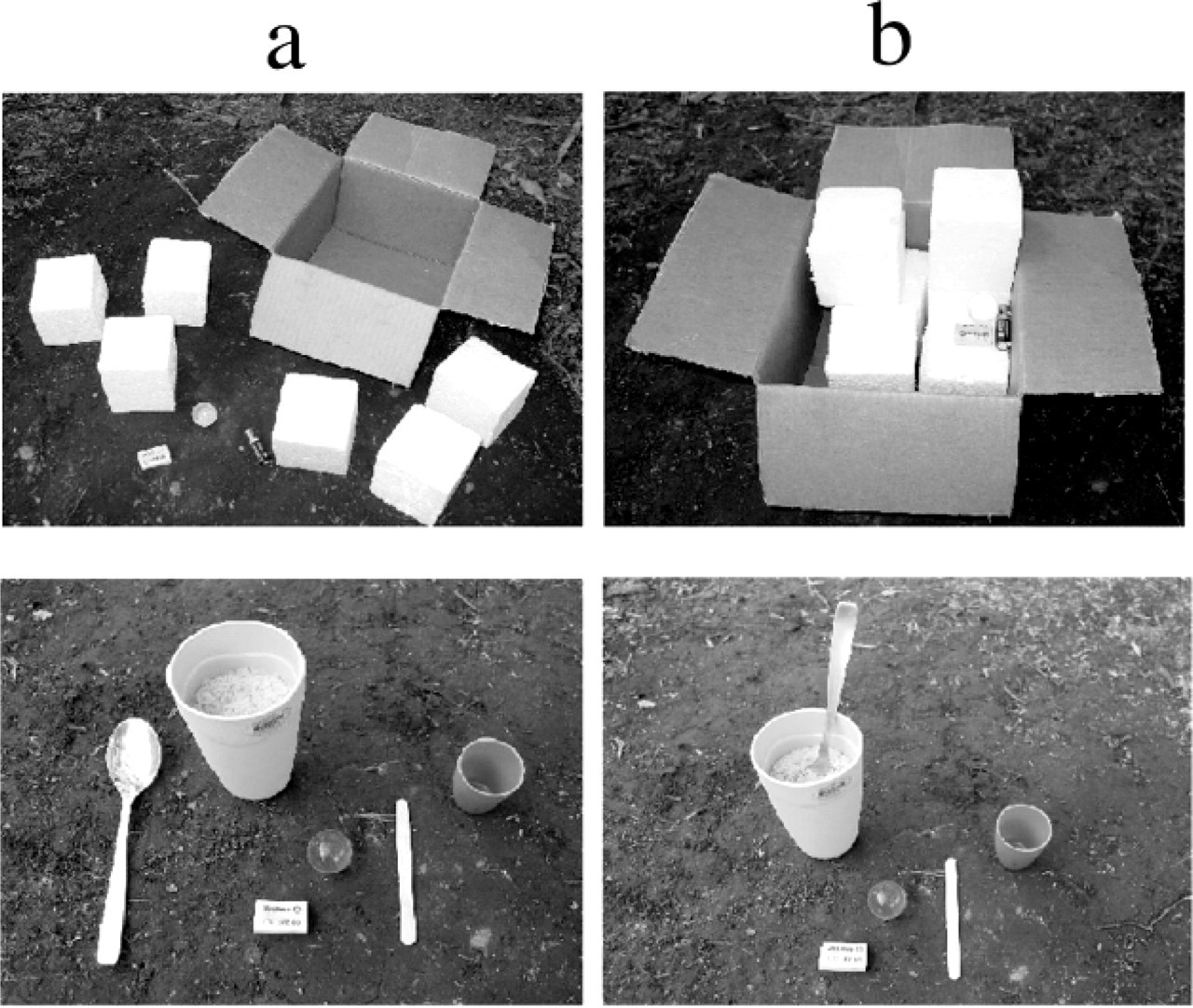
Layout of objects for the box problem (top row) and spoon problem (bottom row) in the (a) baseline and (b) function-demonstration conditions.
Subjects were allowed as much time as necessary to complete each task. If they asked whether a particular item could be used, or if a particular solution would be considered legitimate, they were told yes or no.
The acceptable solution for the box task was to reach the perch by building a tower including the cardboard box, and the solution for the spoon task was to bridge the river with the spoon. If any other solution was proposed, subjects were asked to search for an alternative solution.
All interviews were videotaped and coded by a research assistant who was blind to the hypotheses under test.
RESULTS
The solution time for each task and the time to select the target object in a solution attempt were recorded (see Table 1). Selection time has been argued to be a cleaner measure of fixedness, because it is not contaminated by the time taken to execute the problem once any fixedness on the design function (as measured by delay in selecting the object) has been overcome (Defeyter & German, 2003, p. 139).
Mean Solution Times and Mean Times to Select the Target Object (in Seconds)
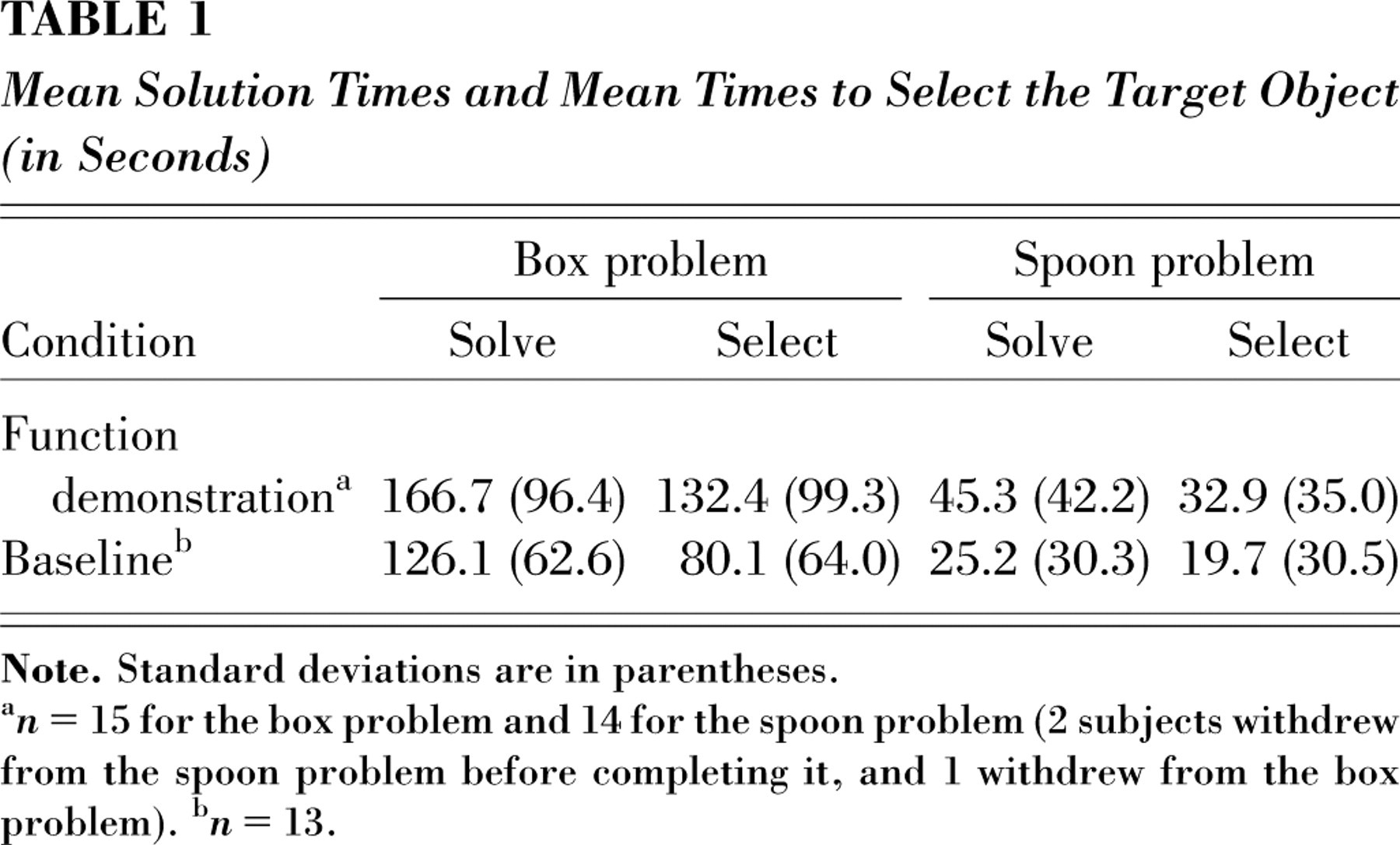
n = 15 for the box problem and 14 for the spoon problem (2 subjects withdrew from the spoon problem before completing it, and 1 withdrew from the box problem).
n = 13.
For the box task, participants in the function-demonstration condition were slower to select the box than were participants in the baseline condition (U = 63, p =.056, one-tailed); however, there was no difference between conditions in the solution-time measure for this task (U = 71.5, n.s.). For the spoon task, participants were slower both to select the target object and to complete the task in the function-demonstration condition compared with the control condition (U = 51.0 and U = 47.5, ps<.05, one-tailed, for selection time and solution time, respectively). 3
DISCUSSION
Subjects in this nonindustrial, technologically sparse culture were susceptible to functional fixedness; they were faster to use an object for an atypical purpose when the design function of the artifact was not primed during the problem presentation than when the design function was primed. This pattern occurred despite the facts that (a) individuals in this culture are exposed to a smaller set of manufactured artifacts than people in industrialized cultures and (b) the artifacts that they use are typically pressed into multiple uses.
This study is the first systematic attempt to evaluate function-based problem solving in a technologically sparse culture under experimental conditions. The results provide no support for the idea that improvisation is enhanced, or that individuals are constrained only by the physical properties of the materials at hand, as a result of this feature of their culture, as might be expected given the accounts of bricolage (Berry & Irvine, 1986). Instead, knowledge of the design function of the target object, when primed, constrains the attempt to find a solution, just as it does in more technologically rich settings (Adamson, 1952; Duncker, 1945).
To the extent that susceptibility to functional fixedness is an index of an organization of semantic memory in which artifact concepts embody design information as a core property (e.g., Defeyter & German, 2003; but see also Kelemen, 2004), the current results can be taken as preliminary evidence that such cognitive architecture is universal; it does not depend on access to and exploitation of prolific technology, or on a cultural environment with numerous function-specific artifacts.
This conclusion would be bolstered by evidence that the emergence of functional fixedness during development among the Shuar follows the same pattern observed in industrial, technologically rich cultures (Defeyter & German, 2003; German & Defeyter, 2000). Further, adults and older children in technologically sparse cultures ought to demonstrate further indices of a design stance in their reasoning about artifact concepts, such as categorization based on design rather than current use (e.g., German & Johnson, 2002; Kelemen, 1999).
Footnotes
1
Literally, this term translates as “one who engages in bricolage.” There is no precise equivalent in English; the term can be roughly glossed as “handyman” or “jack of all trades.”
2
These tasks demonstrate design function via context (Duncker, 1945). Functional fixedness also occurs when the function of a key object is explicitly demonstrated prior to problem presentation (e.g., Glucksberg & Danks, 1968). We decided to use context tasks because tasks that set up fixedness via explicit demonstration are open to concerns with pragmatics (see Defeyter & German, 2003, for discussion).
3
Functional fixedness is directional, defined as faster solution in the baseline condition than in the function-demonstration condition. Hence, one-tailed probabilities are reported. The selection and solution-time measures for the spoon task yielded test statistics with two-tailed probabilities of .033 and .054, respectively. Cross-cultural studies, in which participants are unused to testing scenarios, often result in measures with high variance, as observed here.
Acknowledgements
We give special thanks to the people of Centro Shuar Chinimpi, Morona Santiago, Ecuador, for their participation in this project, and to Elizabeth Pillsworth and Eric Schniter for their assistance in the field. We would like to thank Rob Boyd, Leda Cosmides, Daniel Fessler, Deb Kelemen, Carlos Navarette, and Francis Steen for valuable discussion of the issues raised here. T.P.G. was supported by a grant from the University of California, Santa Barbara, Academic Senate.
APPENDIX
Following are the English translations of the stories for the box and spoon problems, which were presented to the subjects in Spanish.