







Abstract
There are conflicting results as to whether preschool children categorize artifacts on the basis of physical or functional similarity. The present study investigated the effect of the relative distinctiveness of these dimensions in children's categorization. In a physical-distinctive condition, preschool children and adults were initially asked to categorize computer-animated artifacts whose physical appearances were more distinctive than their functions. In a function-distinctive condition, the functional dimension of objects was more distinctive than their physical appearances. Both conditions included a second stage of categorization in which both dimensions were equally distinctive. Participants in a control condition performed only this stage of categorization. Adults in all conditions and stages consistently categorized by functional similarity. In contrast, children's categorization was affected by the relative distinctiveness of the dimensions. Children may not have a priori specific beliefs about how to categorize novel artifacts, and thus may be more susceptible to contextual factors.
A central debate in the categorization literature revolves around whether to characterize human categories as based primarily on computations of similarity or on theoretical beliefs about kinds (Sloman & Rips, 1998). This polarity is also manifested in the literature regarding the development of artifact categories. Researchers inspired by a similarity view of categorization claim that early in development, artifact categories are defined by “superficial” properties such as objects' physical appearances (Smith, Jones, & Landau, 1996). In contrast, researchers inspired by a theory view of categorization claim that young children's artifact categories—much like adults'—are determined by conceptually “deeper” properties such as objects' actual or intended functions (Bloom, 1996; Keil, 1989).
To address this question of which object properties determine people's artifact categorization, researchers have often confronted participants with a direct choice between verbally categorizing objects on the basis of their physical or functional similarity. Although the results with adults have consistently demonstrated a preference for extending object names by functional similarity, results with children have been mixed. A number of studies found that even 5-year-old children extend labels to artifacts on the basis of physical similarity (Graham, Williams, & Huber, 1999; Landau, Smith, & Jones, 1998; Merriman, Scott, & Marazita, 1993; Smith et al., 1996; Tomikawa & Dodd, 1980). In contrast, other studies found that children as young as 2 years of age extend labels to artifacts on the basis of functional similarity (Kemler Nelson & 11 Swarthmore College Students, 1995; Kemler Nelson, Russell, Duke, & Jones, 2000).
Lately, a number of researchers have proposed various factors that might account for the disparity in the findings with children. For instance, it has been argued that the task, the time allowed children to examine the objects, the availability of the functional information, and the intentional character of objects' functions may all affect children's categorization strategy (Deak, Ray, & Pick, 2002; Diesendruck, Markson, & Bloom, 2003; Kemler Nelson, Frankenfield, Morris, & Blair, 2000; Sloman & Malt, 2003). The present study addresses a basic cognitive mechanism that might explain this disparity on the basis of the sheer characteristics of the tasks commonly used in the previous studies.
In these tasks, participants had to decide which of a number of test objects—similar to the target either in their function or in their physical appearance—belonged to the same category (e.g., had the same name) as the target object. Essentially, these tasks required participants to determine which dimension was more relevant, and participants' choices were typically interpreted as evidence for the absolute value of one or the other dimension. An alternative analysis of this type of task is that it assesses not so much the absolute relevance of object dimensions, but rather their relative relevance given the particular comparison at hand (Gentner & Namy, 1999; Medin, Goldstone, & Gentner, 1993). That is, participants' categorization selections could result not from a priori preferences toward a particular dimension, but instead from the relative perceived salience of a dimension within a given object and dimensional configuration. In fact, it was found that when children were not forced to make an either-or categorization decision, their choices were influenced equally by the functional and physical similarity between artifacts (Diesendruck, Hammer, & Catz, 2003).
This analysis resonates with ideas developed in the field of psychophysics. A number of studies have shown that the physical differences between stimuli—that is, their distinctiveness—affect people's attention toward stimuli, and consequently their ability to discriminate between stimuli or to perceive them as similar (Pastore, 1987; Theeuwes, 1994). Analogously, a basic theme in Tversky's contrast model is that in comparisons of objects, the relative weights of features might change as a function of the particular objects being compared (Gati & Tversky, 1984; Tversky, 1977; Tversky & Gati, 1978; see also Goldstone, Medin, & Halberstadt, 1997, for similar ideas). For example, Tversky (1977) demonstrated that the relative distinctiveness of countries' properties (i.e., political vs. geographic standing) varied as a function of the particular countries being compared, thus affecting their classification. More recently, Merriman (1999) discussed how feature distinctiveness affects children's extensions of names to objects.
Inspired by the idea that feature or dimensional distinctiveness affects similarity judgment and categorization, and by the disparate findings in previous artifact-categorization studies with children, we undertook the current research to evaluate the role of dimensional distinctiveness in children's and adults' artifact categorization. For this purpose, we used an experimental setting similar to the settings used in previous studies, but we deliberately manipulated the relative distinctiveness of the to-be-classified objects' dimensions—particularly, their function and physical appearance. Moreover, in order to assess participants' learning of the relevance of the distinctive dimensions to the particular categories, we included two stages in the study. In the first stage, participants had to classify objects in which either function or physical appearance was clearly the more distinctive dimension. In the second stage, the relative distinctiveness of the dimensions was more evenly balanced.
Arguably, when people have clear knowledge—or theories—about the nature of particular categories, the determination of what dimension is most relevant for categorizing objects follows directly from these notions, and is therefore not too susceptible to contextual factors (Heit, 1994; Medin et al., 1993). The findings reviewed earlier suggest that adults believe that functions are what define artifact kinds (but see Malt & Johnson, 1992). Thus, our prediction was that, compared with children, adults would be less affected by the manipulation of dimensional distinctiveness in either stage of the study. In turn, the disparate findings on children's artifact categorization may indicate that children do not have definite notions about the nature of such categories, and thus may be more susceptible to the relative salience of dimensions within particular object configurations. We therefore expected that in the first stage, children would extend names on the basis of the more distinctive dimension in the particular object configuration to which they were exposed. Moreover, to the extent that they learn about the relevance of dimensions from earlier experiences with similar objects, the relative distinctiveness of dimensions experienced in the first stage would continue to affect children's categorization decisions in the second stage.
METHOD
Participants
Thirty-two adults (mean age = 24.6 years, range = 18–40) and 42 children (mean age = 5.1 years, range = 4.0–6.0) participated in the experiment. Approximately the same number of males and females participated. Eleven additional adults provided judgments of the stimuli. All participants were Israeli native Hebrew speakers. Prior to the study, signed consent was obtained from the adult participants and from parents of all participating children.
Materials
To control optimally the distinctiveness of object dimensions, we used computer-animated objects as stimuli. This enabled us to adjust the distinctiveness of each dimension in the objects per se, thus allowing participants to make categorization decisions with little interference by the experimenter. Three sets of computer-animated objects were created for the experiment (Fig. 1 depicts Object Set A) by using common three-dimensional animation software. They were presented on a 13.1-in. IBM ThinkPad® laptop computer screen. Each animation ran for 10 s and occupied 390 × 290 pixels on the computer screen.
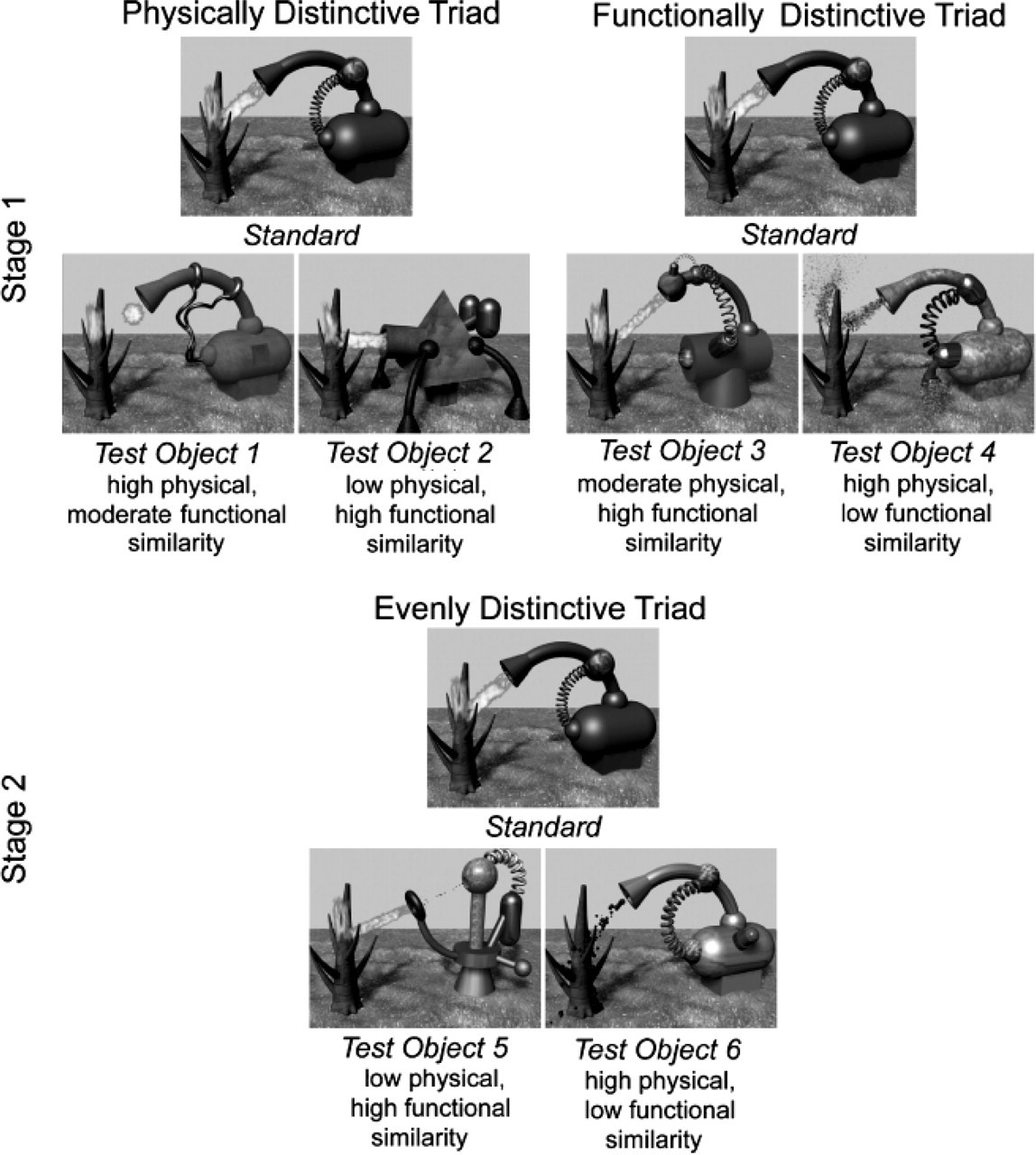
Gray-scale examples of Object Set A.
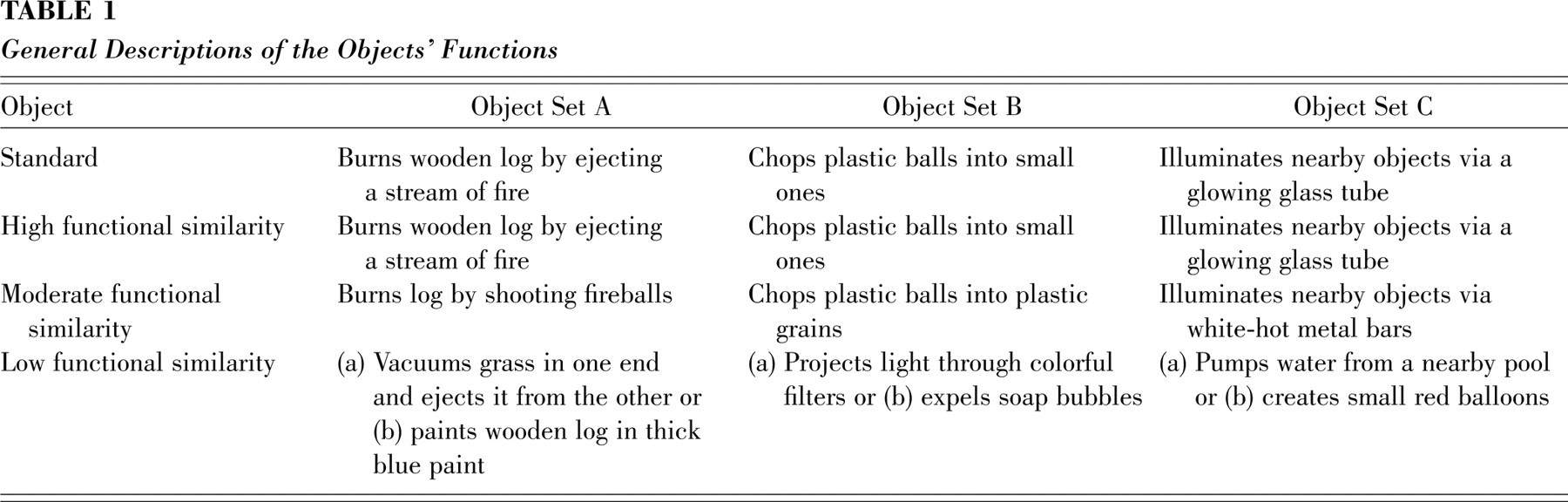
Each object set consisted of a “standard” and six other test objects, organized in three triads. In each triad, the same standard was presented together with two test objects. In the functionally distinctive (FD) triad, one of the test objects had high physical similarity but low functional similarity to the standard, whereas the other test object had moderate physical similarity but high functional similarity to the standard. That is, the greater difference between the two test objects was their functions. In the physically distinctive (PD) triad, one of the test objects had low physical similarity but high functional similarity to the standard, whereas the other test object had high physical similarity but moderate functional similarity to the standard. In this case, the greater difference between the test objects was in their physical appearance. In the evenly distinctive (ED) triad, one of the test objects had high physical similarity but low functional similarity to the standard, whereas the other test object had low physical similarity but high functional similarity to the standard (see Table 1 for descriptions of all objects' functions). For convenience sake, in each triad we refer to the object with more functional similarity to the standard as the functional match and to the object with more physical similarity to the standard as the physical match.
General Descriptions of the Objects' Functions
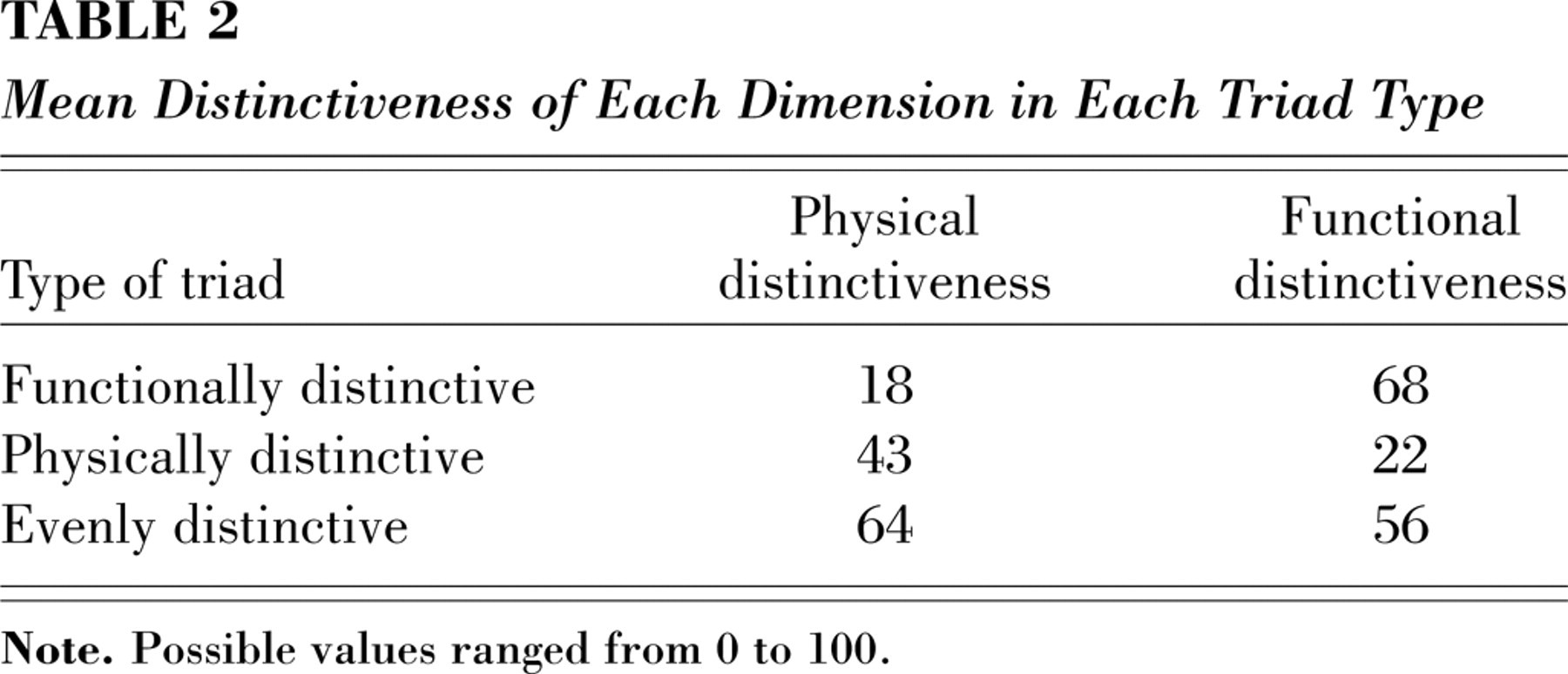
To verify the constitution of the triads, we asked 11 adults to evaluate them in two separate ways. First, participants were asked to evaluate separately the degree (0–100) of physical and functional similarity between each standard and its corresponding test objects. Distinctiveness was defined as the absolute value resulting from subtracting the similarity between the standard and one of the test objects in a triad on a particular dimension from the similarity between the standard and the other test object in the triad on that same dimension. Thus, the higher the absolute value, the higher the distinctiveness of that dimension in that triad. As can be seen in Table 2, in the FD triads, the mean functional distinctiveness was higher than the mean physical distinctiveness, t(10) = 10.02, p<.001, d = 6.34; in the PD triads, the mean physical distinctiveness was higher than the mean functional distinctiveness, t(10) = −4.28, p<.005, d = −2.71; and in the ED triads, the mean distinctiveness of function and mean distinctiveness of physical appearance were not significantly different, t(10) = −1.43, n.s. These results confirm that the triads exhibited the expected relative distinctiveness of the dimensions.
Mean Distinctiveness of Each Dimension in Each Triad Type
Second, so that we could assess whether the dissociation between objects' function and physical appearance was balanced for the purposes of categorization, we asked the adult judges to determine which test object in each triad was the same kind as the standard, taking into consideration only the objects' function or only their physical appearance. We recorded the number of times that participants selected the functional match. The maximum possible score was 9, given that overall there were three triads for each of the three object sets. We found that when asked to refer only to function, participants almost always selected the functional match (M = 8.46, SD = 0.52). In contrast, when asked to refer only to the objects' physical appearance, participants almost never selected the functional match (M = 0.45, SD = 0.52; i.e., they tended to select the physical match), t(10) = 49.75, p<.001, d = 31.46. A set of chi-square tests revealed that this pattern of object selection was similar in each triad separately, indicating that it was independent of the relative distinctiveness of the dimensions.
Design
Participants from each age group were randomly divided into two experimental conditions (FD or PD) and a control condition. There were 14 children and 10 adults in the FD condition, 14 children and 11 adults in the PD condition, and 14 children and 11 adults in the control condition. Both the FD and the PD conditions involved two stages that were repeated for all three sets of objects. In the FD condition, participants saw an FD triad from a given set in the first stage and the ED triad of that set in the second stage. In the PD condition, participants saw a PD triad from a given set in the first stage and the ED triad of that set in the second stage. The control condition involved only one stage, in which participants saw only the ED triads of the three sets. In all conditions, object sets were presented in one of two orders, counterbalanced across participants.
Procedure
Children were tested individually by a female experimenter in a quiet area of their preschool. Adults were tested individually by the same experimenter in a university laboratory. In the two experimental conditions, the experimenter first activated the animation of the set's standard for about 30 s (three iterations) and labeled it three times using the same novel Hebrew-sounding name (e.g., “This is a Bargovan”; the other two meaningless novel names used in the other sets were “Tirpal” and “Dorgan”). The experimenter then activated the animations of the two test objects in that triad—either an FD or a PD triad according to the participant's condition—allowing the animation of the three objects together to run for about 30 s. While the animations were running, the experimenter asked the participant, “Which of these two [pointing to the test objects] is also a [Bargovan/Tirpal/Dorgan]?” The test object to which the participant pointed was recorded as his or her selection.
After the participant's responses to the FD or PD triad in the first stage, the experimenter presented the set's ED triad. The experimenter reminded the participant of the name of the standard, pointed out that it now appeared with two other test objects, and asked, “Which of these two [pointing to the test objects] is also a [Bargovan/Tirpal/Dorgan]?” After the participant completed the two stages for an object set, the next set was presented in the exact same way.
The procedure and stimuli in the control condition were identical to the procedure and stimuli in the second stage of the experimental conditions. The right/left placement of the test objects in each triad was counterbalanced across stages and sets.
RESULTS
The main goal of the study was to evaluate whether children and adults have different vulnerability to variations in the relative distinctiveness of artifacts' dimensions. Consequently, the main analyses had to do not so much with absolute differences between children's and adults' general response patterns (i.e., main effects), but rather with differential condition effects across ages (i.e., an interaction effect). The dependent measure used was the number of times participants extended the name of a triad standard to the functional match in each stage. Given that there were three object sets, this measure ranged from 0 to 3. Preliminary analyses revealed no effect of gender, object set, or presentation order of an object set on this measure, and therefore these factors were excluded from subsequent analyses. Separate analyses were conducted for each stage.
First Stage
The first stage assessed the effect of immediate dimensional distinctiveness on categorization. An analysis of variance (ANOVA) with age (adults vs. children) and condition (FD vs. PD) as between-subjects factors revealed that adults extended the standard's name to the functional match more times (M = 2.14, SD = 1.01) than did children (M = 1.32, SD = 1.12), F(1, 45) = 10.22, p<.005, ηp 2 = .18. The ANOVA further revealed that participants in the FD condition extended the standard's name to the functional match more times (M = 2.24, SD = 2.24) than did participants in the PD condition (M = 1.08, SD = 1.10), F(1, 45) = 17.26, p<.001, ηp 2 = .28. Most important, the ANOVA revealed a significant interaction between condition and age group, F(1, 45) = 5.41, p<.05, ηp 2 = .11 (see Fig. 2a).
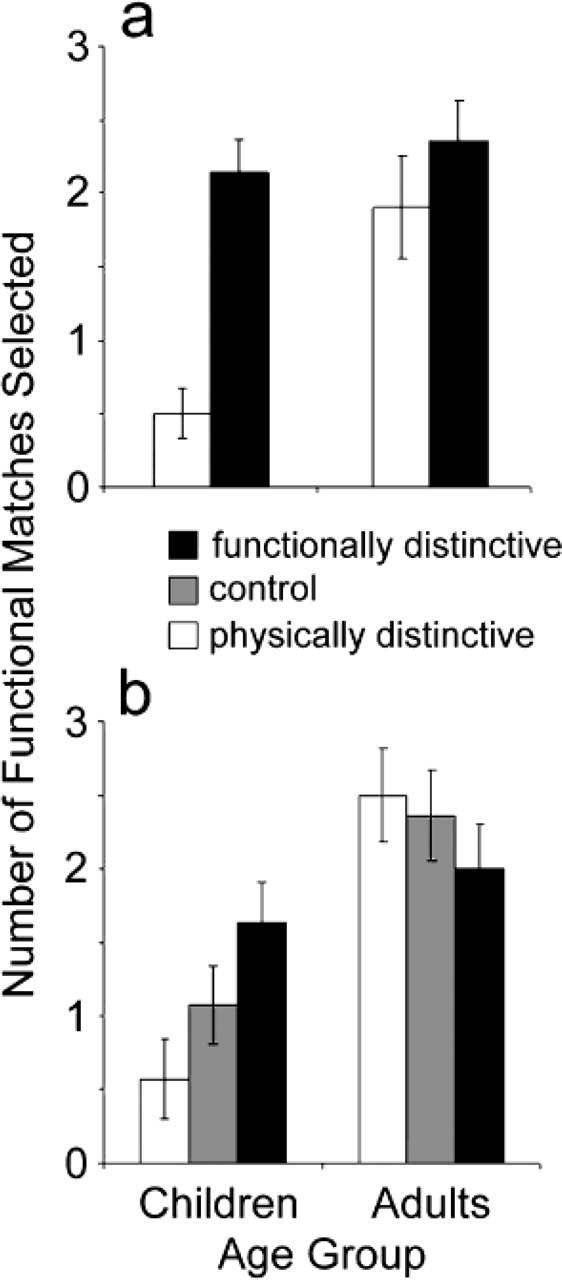
Mean number (with standard error) of functional-match selections by condition and age, in the first (a) and second (b) stages of the experiment.
To analyze this interaction, we conducted t tests on the effect of condition within each age group separately. These tests showed no significant difference between conditions in adults' tendency to select the functional match, t(19) = 1.05, n.s. In contrast, children in the FD condition were more likely to extend the standard's name to the functional match than were children in the PD condition, t(26) = 5.68, p<.001, d = 2.23. These results indicate that children, but not adults, were affected by the immediate relative distinctiveness of dimensions in their categorization decisions. The complementary t tests comparing age groups within each condition also revealed an important finding: Although in the PD condition children were less likely than adults to select the functional match, t(22) = 3.91, p<.005, d = 1.67, in the FD condition there was no effect of age t(23) = 0.61, n.s. Thus, it was not the case that the children were consistently more biased toward artifacts' appearances than were the adults.
Second Stage
The second stage allowed us to evaluate the extent to which prior experiences with biased dimensional distinctiveness influenced subsequent categorization in an unbiased dimensional configuration. Recall that in the second stage, participants from the two experimental conditions were exposed to the exact same object triads (the ED triads).
An ANOVA with age (children vs. adults) and experimental condition (FD vs. PD) as between-subjects factors showed that adults extended the standard's name to the functional match more times (M = 2.24, SD = 0.94) than did children (M = 1.11, SD = 1.03), F(1, 45) = 18.96, p<.001, ηp 2 = .30. The effect of condition, however, was not significant, F(1, 45) = 1.18, n.s. Most important, there was a significant interaction between condition and age group, F(1, 45) = 8.96, p<.005, ηp 2 = .17 (see Fig. 2b).
Subsequent t tests comparing the two experimental groups within each age revealed no effect of condition among adults, t(19) = 1.23, n.s. In contrast, children in the FD condition were more likely to extend the standard's name to the functional match than were children in the PD condition, t(26) = 3.81, p<.005, d = 1.49. That is, children's, but not adults', categorization strategy in the second stage varied as a function of the manipulation of dimensional distinctiveness to which they were exposed in the first stage. As in the first stage, complementary t tests revealed that although in the PD condition children were less likely than adults to select the functional match, t(22) = 5.47, p<.001, d = 2.33, in the FD condition there was no effect of age, t(23) = 0.92, n.s. This finding reinforces the notion that the difference between children and adults was primarily in their susceptibility to contextual variations.
To evaluate the extent to which the distinctiveness manipulation affected participants' categorization strategy in the second stage relative to their presumed default strategy, we compared performance in the experimental conditions to performance in the control condition. For each age group, we ordered the conditions from manipulation of physical distinctiveness (PD condition), to no manipulation (control condition), to manipulation of functional distinctiveness (FD condition). Nonparametric correlation tests revealed that this distinctiveness-manipulation ordering positively correlated with children's tendency to select functional matches, ρ(42) = .44, p<.005, but not with adults', ρ (32) = −.29, n.s. These results confirm that the distinctiveness manipulation in both directions indeed affected children's, but not adults', categorization strategy.
DISCUSSION
The goal of the current study was to assess the effect of dimensional distinctiveness on children's and adults' artifact categorization. We hypothesized that dimensional distinctiveness would affect children's categorization strategy more than adults'. The results support this hypothesis.
Our results are consistent with those of earlier studies (Graham et al., 1999; Kemler Nelson et al., 1995; Landau et al., 1998; Merriman et al., 1993; Smith et al., 1996) in that we found that adults' artifact categorization was mostly based on functional similarity, even under conditions in which the artifacts' physical properties were more distinctive. Unlike adults, children were affected by the relative distinctiveness of artifacts' dimensions. Specifically, in the first experimental stage, when the objects' functions were more distinctive, children extended the standard object's name to the functionally more similar test object. In contrast, when the objects' physical appearances were more distinctive, children extended the standard's name to the physically more similar test object. Strikingly, even though in the second stage children from the two experimental conditions saw exactly the same sets of objects, they nonetheless responded differently, depending on their immediate previous experience with similar objects. This finding further suggests that in the first stage, children indeed differentiated between the functional and physical dimensions of the artifacts.
These results suggest that the disparity in the findings of the earlier studies, in which children were given a dichotomous categorization task, might have derived from differences in stimulus composition. Specifically, it could be that in studies in which physical appearance prevailed (e.g., Landau et al., 1998; Smith et al., 1996), physical features were more distinctive than functional features, whereas the opposite was true in studies in which function prevailed. For instance, Diesendruck, Markson, and Bloom (2003) found that children's tendency to extend an object's name to a functionally similar object varied systematically with the amount of information they were provided about the functions of the objects. Presumably, the less information children have about a particular dimension, the less that dimension can be perceived as distinctive. In contrast, providing children with the opportunity to manipulate and try out an object's function—as done in some of Kemler Nelson's studies (e.g., Kemler Nelson, Russell, et al., 2000)—arguably increases the salience of functional information and consequently its potential distinctiveness.
Recently, Merriman (1999) proposed an attention-based model of word learning with ideas similar to the ones we raise here. According to Merriman, differences in relative feature distinctiveness are responsible for drawing attention to the subset of object features that most clearly differentiate objects. This idea is consistent with children's behavior in the first stage of the current experiment. Dimensional inertia, described by Merriman as a tendency to continually attend to a recently attended dimension, is consistent with the idea that children's differential attention in the second stage resulted from their previous experiences with differentially distinctive dimensions. Finally, adults' supposed knowledge of the importance of function to artifact categorization may explain the dimensional dominance of this dimension in their name extensions, regardless of its relative distinctiveness.
To the extent that these developmental changes regarding the effect of distinctiveness in the categorization of artifacts reflect differences in children's and adults' knowledge of artifacts, these differences in children's and adults' categorization performance might be analogous to the differences between two attention mechanisms that are recruited to different extents in unfamiliar versus familiar contexts. According to Koch and Ullman (1985), in unfamiliar contexts, a bottom-up mechanism directs people's attention to nonspecific eye-catching features or objects. The inner representation of the salient features is consequently enhanced, thus progressing through the cortical hierarchy for higher-level processing. In familiar contexts, however, a top-down mechanism involving prior knowledge and goals can also affect visual attention (Itti, Braun, Lee, & Koch, 1999) and categorization (Heit, 1994; Spalding & Murphy, 1996). This mechanism enables extraction of object features that were informative for discriminating between objects on previous occasions (Itti et al., 1999).
The present findings do not rule out the possibility that other factors (e.g., the intentional character of functional information; see Diesendruck, Markson, & Bloom, 2003; Kemler Nelson, Herron, & Holt, 2003) can affect children's categorization of artifacts. The point here was to examine children's artifact categorization under circumstances in which interference from human agents was substantially reduced and in which physical information and functional information were available through the same medium and for the same duration. The implication of this discussion of attentional mechanisms is that, whether guided by bottom-up (e.g., perceptual distinctiveness) or more top-down factors (e.g., expectation-driven inferences), the direction of attention affects feature weighting, which subsequently influences perception of similarity and categorization (Nosofsky, 1988; Shepard, 1987).
This conceptualization might also shed light on the theoretical debate regarding children's artifact categories. Specifically, the findings do not support accounts stipulating that from early on children consistently categorize artifacts on the basis of a particular a priori dimension. Similarity-based views need to accommodate the fact that under certain circumstances—for example, when encountering novel objects—people may be equally likely to attend to physical and functional properties (see Goldstone & Barsalou, 1998). Functional properties might not be a priori conceptual and abstract. The implication of the present results for theory-based views is that 5-year-old children might not have definite beliefs about the specific nature of artifacts' core dimension—at least, they may not have beliefs definite enough to allow a clear conception of computer-animated artifacts. Function might not be a priori the core dimension of artifacts (e.g., Keil, 1989; see also Defeyter & German, 2003; Malt & Johnson, 1992). Rather, children might have a vaguer belief that artifacts have some essential core dimension—as in Bloom's (1996) notion of creator's intent—and when children encounter novel artifacts, the relative distinctiveness of dimensions is one of the cues by which they may decide what that essential dimension might be.
Footnotes
Acknowledgements
We thank The Israel Foundations Trustees (Special Fund for Post-Doctoral Research Grants) for financial support, Matar Ferrara for help with data collection, and all participating teachers, parents, and children.