







Abstract
In prior work, we developed a computational model of how episodic associations between words are formed. Simulating associative learning, the model indicated that strongly associated semantically unrelated words facilitate the episodic association of other exemplars included in their semantic neighborhoods. This prediction was supported empirically by the present study. First, the incidental formation of strong associations between unrelated words, such as dog and table, improved cued recall of weak associations formed incidentally between semantic neighbors, like cat and chair. Second, deciding that two words were semantically unrelated was facilitated by forming strong associations between other words in their respective semantic neighborhoods, even if the tested pair was not presented at study. Together with the computational model, the present results demonstrate that forming episodic associations between words can implicitly mediate the association of other exemplars from the same semantic categories and reveal a mechanism by which the semantic system contributes to the formation of new episodic associations.
Associations are established incidentally between items that frequently co-occur. Whereas such episodic factors are, by definition, major contributors to the associative process, we have recently demonstrated that words are easier to associate if they are semantically related than if they are semantically unrelated (Prior & Bentin, 2003; Silberman, Miikkulainen, & Bentin, 2001; Silberman, Prior, & Bentin, 2004). A possible mechanism by which semantic relationship between words can contribute to their episodic association has been recently implemented in an artificial neural network model (Silberman et al., 2001). The model was based on human cued-recall performance and accurately simulated characteristics of associative learning in human participants.
According to the network architecture, semantically similar concepts are represented in our model by nodes that are close to each other on a two-dimensional semantic map (cf. Ritter & Kohonen, 1989). The semantic organization of the map is implemented in the network by node-to-node connections, which are weighted in inverse proportion to the geometric distance between them. Within the same network, episodic associations are represented as lateral, direct, unidirectional, weighted connections among the nodes (Miikkulainen, 1992). The weight of each connection is proportional to the number of previous episodes of conjoint activation of the two concepts. A “wave” of activation among nodes within this architecture spreads in parallel along both semantic and associative connections. Although semantic and episodic connections can exist independently, when both exist, their activation has a cumulative effect. 1 Inspired by the notion of Hebbian learning (Hebb, 1949), we posit that the association between two conjointly activated nodes is strengthened, at each episode, in proportion to the overall sum of intersections (overlap) between the activation spreading from one node and the activation spreading from the second. Because the spreading activation decays with distance from its source, the closer two concepts are on the semantic map, the greater the overlap between their activations. This architecture explains why episodic associations are formed more easily between semantically related words than between unrelated words. 2
These very same dynamics entail that, regardless of semantic relationship, an existing episodic association between two words (e.g., wine-pen) should facilitate forming an episodic association between two other conjointly activated words in their close semantic neighborhoods (e.g., beer and pencil, respectively). This is because each of the new (to-be-associated) words activates its own semantic neighborhood, including the previously associated words. The preexistent episodic association mediates the spread of activation between the new conjointly presented exemplars, thus enhancing the overlap of their activations (see illustration in Fig. 1).
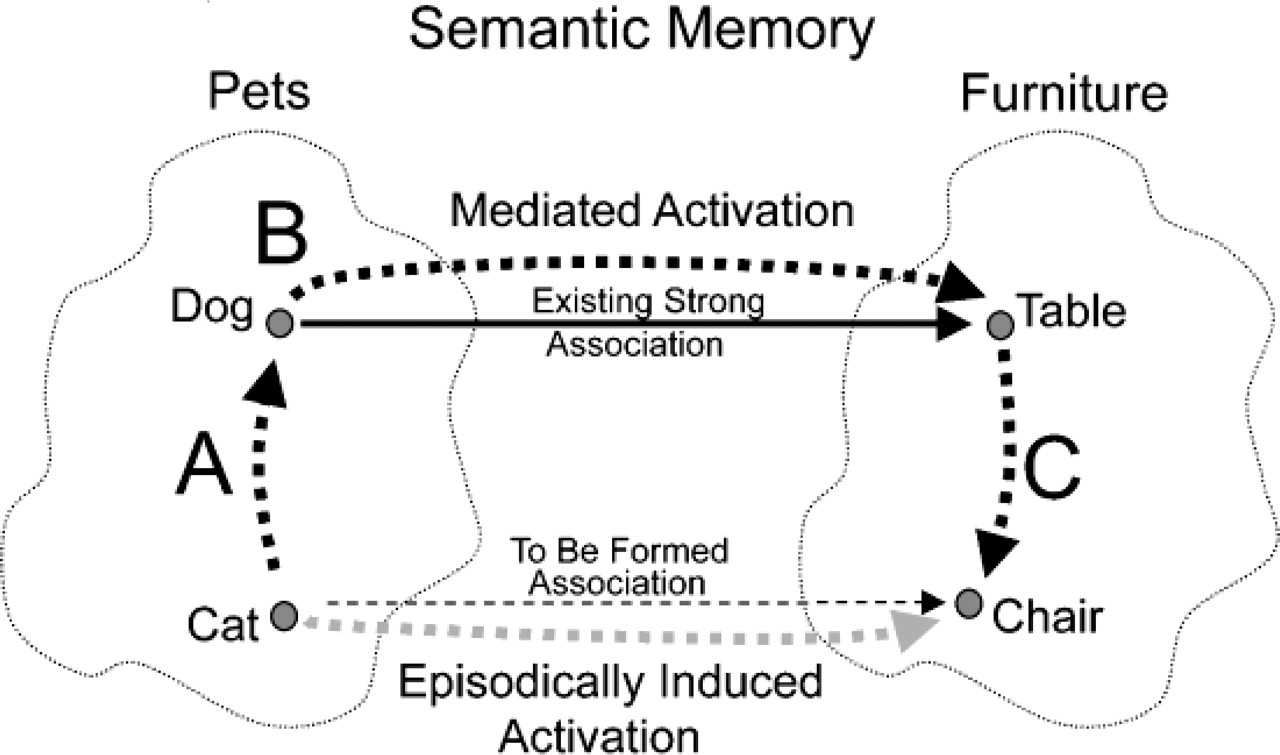
Illustration of the mechanism by which an existing strong association between dog and table reinforces the formation of a new association from cat to chair. The model assumes that the strength of the formed association is proportional to the amount of overlapping activation spreading from the two words. As shown, the activation spreading from cat to its semantic neighbors (A) reaches dog, and because a strong association between dog and table exists, activation spreads efficiently to table (B). Activation then spreads from table to its semantic neighbors (C), thus increasing the amount of overlapping activation surrounding chair.
In the present study, we tested this prediction of the computational model in two experiments with human participants. Both experiments included a study phase in which pairs of unrelated words were repeatedly presented while an orientation task required comparing the meaning of the words in each pair along various dimensions. The repeated conjoint activation instigated the formation of episodic associations between the words in each pair, as evidenced by cued recall. In an immediately following test phase, the impact of these incidentally formed associations on ease of associating their semantic neighbors was tested explicitly, by cued recall (Experiment 1), or implicitly, using a semantic decision task (Experiment 2).
EXPERIMENT 1
Method
Participants
The participants were 33 undergraduates who were paid a nominal fee or received course credit for their participation. They were all native Hebrew speakers with normal or corrected-to-normal vision.
Stimuli and Design
The stimuli in this experiment consisted of 48 Hebrew nouns, exemplars of 24 well-defined base-level semantic categories (2 words per category). These nouns were used to form a study list of 24 semantically unrelated and unassociated word pairs. Twelve of the 24 pairs were randomly repeated 30 times during the study phase in order to establish strong episodic associations between the words in each pair. The other 12 pairs were randomly repeated only 3 times in order to establish weak episodic associations between the words in each pair. All 24 semantic categories were represented by 1 exemplar in the strongly associated pairs and 1 exemplar in the weakly associated pairs. Thus, each word in a weakly associated pair had a semantically related correspondent in a strongly associated pair. The weakly associated pairs were equally distributed between two conditions based on these semantic relationships: In the same condition, the words of each weakly associated pair were exemplars of the same semantic categories in one of the strongly associated pairs and were presented in the same order as in that pair. For example, the weakly associated pair “CAT-CHAIR” would be in the same condition if the word list included “DOG-TABLE” as a strongly associated pair. In the different condition, the weakly associated pairs were formed by recombining the semantic categories represented by the words in strongly associated pairs. For example, the weakly associated pair “CAT-CHAIR” would be in the different condition if the word list instead included the strongly associated pairs “DOG-SUN” and “DAISY-TABLE.” The weakly associated pairs tested in the same and different conditions were counterbalanced across two lists, so that with half of the participants assigned to each list, all 12 pairs were presented an equal number of times in the two conditions.
Procedure
The 36 trials in which the 12 weakly associated pairs were formed followed the presentation of the 360 trials during which the 12 strong associations were formed, concluding the study list. There was no marked distinction between the two types of trials.
Each trial in the study phase started with a fixation mark exposed for 200 ms. The paired words were simultaneously presented for 500 ms immediately following the offset of the fixation mark, centered to the right and left of its location. A question word was presented 300 ms following the words' offset and remained on the screen for 1,500 ms, during which time a response was expected. Six single-word questions (e.g., “Bigger?”“Softer?”) were randomly presented across trials, and the participants had to answer each question by relating the word on the right to the word on the left. 3 Because the participants could not know in advance which question would be asked, they had to keep both words conjointly active in working memory for at least 800 ms.
Immediately following the study phase, an unexpected cued-recall test was administered. In this test, the first (right) nouns of all the studied pairs were presented in random order, and the participants were requested to respond by providing the second (left) word of each pair. Weakly and strongly associated pairs, as well as pairs in the same and different conditions, were randomly mixed at test, each subject receiving a different randomization. No time constraints were imposed. Note that according to the model, same pairs would have an advantage in associative learning over different pairs only if, indeed, a strong association existed between the other exemplars of the corresponding semantic categories. Therefore, in addition to analyzing the data from the entire group of participants, we analyzed separately the performance of 18 participants who successfully recalled at least 80% of the strongly associated pairs.
Results and Discussion
As expected, cued-recall accuracy was considerably higher for strongly than for weakly associated pairs. Furthermore, cued recall was not significantly different between strongly associated words that were the basis of the same condition and strongly associated words that were the basis of the different condition (indeed, performance on these two kinds of pairs was practically identical in the selected group of 18 participants; Fig. 2). However, the most important result was that cued-recall accuracy for weakly associated pairs was significantly higher in the same than in the different condition, t(32) = 1.70, p<.05. Moreover, as the computational model predicted, this effect was more conspicuous when the 18 participants who passed the a priori criterion for strong associations were analyzed separately, t(17) = 2.13, p<.025.
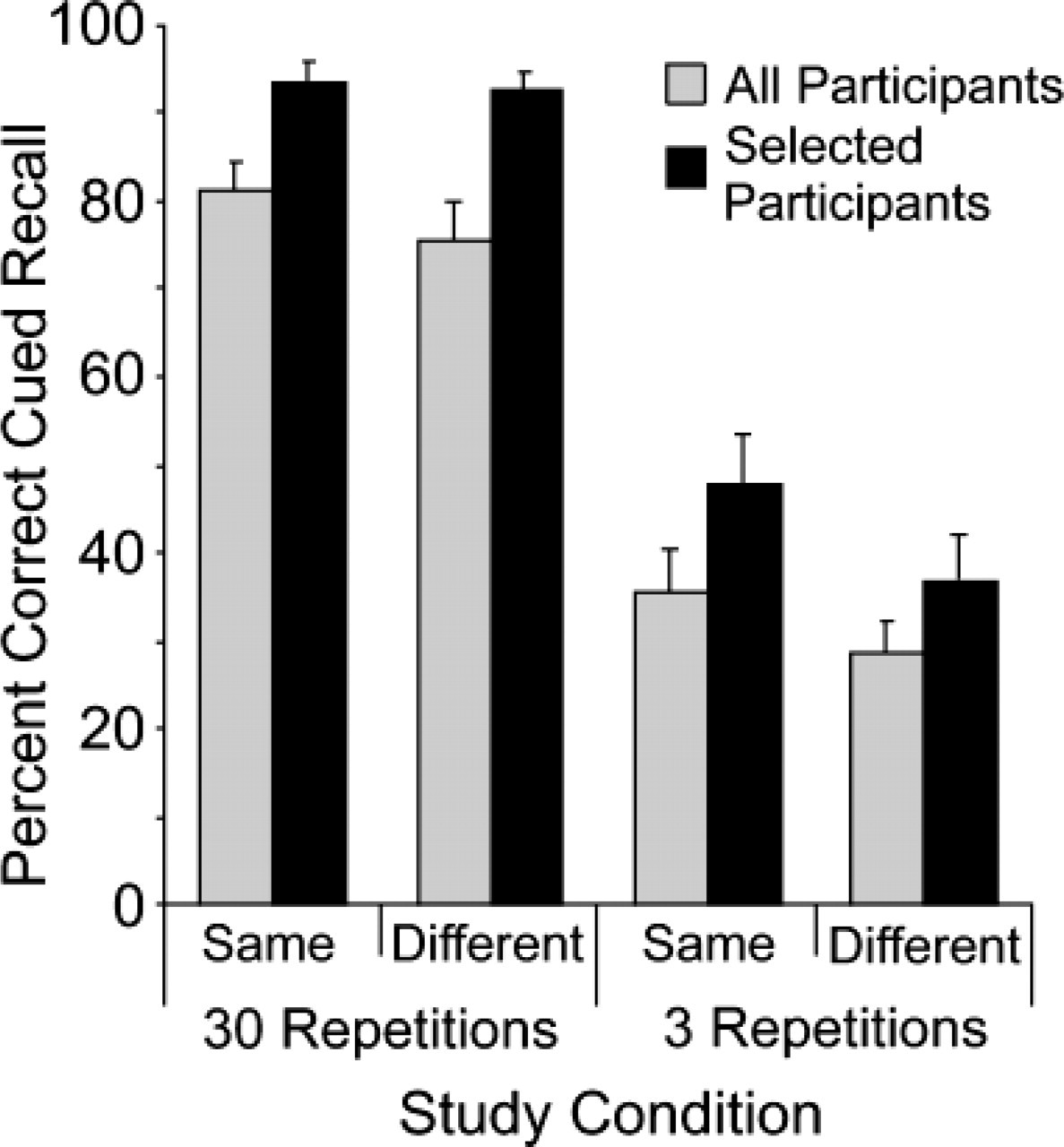
Percentage of correct cued recall for strongly formed associations (30 repetitions) and weakly formed associations (3 repetitions) in the same and different target-pair conditions. Results are shown separately for the entire group of participants and for the 18 selected participants who successfully recalled at least 80% of the strongly associated pairs. Error bars show standard errors of the means.
The high cued-recall accuracy for pairs that were repeated 30 times (79% for the entire sample and 93.5% for the selected participants) and the considerably lower accuracy for pairs that were repeated only 3 times (32% for the entire sample and 42.5% for the selected participants) indicated that, indeed, strong and weak associations were formed during 30 and 3 repetitions, respectively. This pattern conforms to the associative-learning mechanism implemented in the computational model (Silberman et al., 2001). Recall that, according to that model, the strength of an association is determined by the sum of overlapping activity spreading from each node across time. The significantly higher cued-recall accuracy for weakly associated pairs in the same condition compared with the different condition, which occurred despite an equal number of repetitions, suggests that the amount of overlapping activation during conjoint processing of the two words was larger in the former than in the latter condition. The spreading of activation between the conjointly activated unrelated words was probably facilitated in the same condition by the preexistent lateral connections between other words in the respective semantic neighborhoods. In the different condition, no such associations preexisted, so many more episodes of conjoint activation were necessary to establish an association (see Fig. 1).
Although the outcome of this experiment was predicted by the computational model, there are alternative accounts that should be considered. One is that preexisting associations influenced cued-recall performance during retrieval rather than incidental study. In essence, according to this account, when a weakly associated cue was presented, the corresponding semantically close neighbor was activated and pointed to its strongly associated paired word, which then hinted the correct response. Another alternative account is that when weakly associated pairs were presented during the study phase, the participants noted the resemblance of the same pairs to the corresponding previously (strongly) associated pairs. This extra attentional boost might have given the same pairs the cued-recall advantage over the different pairs. Whereas the latter account is similar to our account in assuming that the effect is due to a more efficient process of forming the new association at study (rather than due to a retrieval process), the two accounts differ in the proposed mechanism producing this effect.
Note that the retrieval-based alternative account is valid only as long as associative learning is tested by cued recall, and the attention-based account requires that the weakly associated pairs be presented at study. Therefore, if performance differences between same and different weakly associated pairs persist when these pairs are not studied and no explicit retrieval is required, both alternative accounts can be discarded. To this end, in Experiment 2, we used a semantic decision task, instead of cued recall, to test whether forming strong associations between words could implicitly induce associative connections between their unstudied semantic neighbors.
EXPERIMENT 2
Previous studies demonstrated that associative learning can be tested implicitly by exploring whether repetition priming effects are found for word pairs that keep the studied association intact but not for word pairs that are recombined (Carroll & Kirsner, 1982; Dagenbach, Horst, & Carr, 1990; McKoon & Ratcliff, 1979; Moscovitch, Winocur, & McLachlan, 1986; Neely & Durgunoglu, 1985; Schacter & McGlynn, 1989). Studies focused on learning conditions found that new associations between words can be formed incidentally in a laboratory setup, at least if the orientation task at study forces the participant to relate the two concepts to one another (Bowers & Schacter, 1990; Graf & Schacter, 1985; Schacter & Graf, 1989; Schacter & McGlynn, 1989). In all of these studies, however, associations were formed between words that were actually seen in pairs, leading some authors to conclude that repetition priming for newly formed associations is perceptually based (Goshen-Gottstein & Moscovitch, 1995a). Hence, evidence for associations formed without actually seeing the associated words would not only address the results of Experiment 1, but also shed additional light on the general characteristics of associative learning.
The present experiment differed from Experiment 1 in two important aspects. First, the target pairs (formerly labeled “weakly associated pairs”) were not presented during the incidental-study phase. Thus, evidence for an incidentally formed association between the unrelated words composing a target pair could result only from the association formed between the other two exemplars of their semantic categories. Second, the same-different effect was assessed by requesting the participants to determine as quickly as possible whether two words presented in a trial were semantically related. Hence, although conjoint processing of the target pair was necessary at test, the task did not require retrieving one word when cued by the other.
Method
Participants
The participants were 20 naive undergraduates 4 who were sampled from the same population as the participants in Experiment 1. None of them had participated in the previous experiment. They either were paid or received course credit for participation.
Stimuli and Design
The relevant stimuli were 96 Hebrew nouns from 32 base-level categories (3 words per category). Thirty-two words (1 per category) were used to form a study list of 16 unrelated word pairs. Those pairs were randomly repeated 30 times during the incidental-study phase. The remaining 64 words were used to form a test list of 32 semantically unrelated target pairs, equally subdivided between the same and different conditions. Each of the studied categories was represented once in each of the test conditions (by different exemplars). In the same condition, the pairing of the categories in the studied pairs was preserved at test. For example, following the study pair “DOG-TABLE,” the same target pair was “CAT-CHAIR.” In the different condition, the categories were recombined. For example, following the study pairs “DOG-TABLE” and “SUN-TULIP,” the different target pairs were “HAMSTER-DAISY” and “MOON-BED.” The pairs used to induce each test condition were counterbalanced between two study lists, so that across all participants, each pair appeared an equal number of times in the two experimental conditions. Note that regardless of condition, all the relevant pairs comprised semantically unrelated words. Therefore, 32 additional semantic categories were used to compose filler pairs of semantically related words, yielding an equal probability for each semantic-relatedness decision.
Procedure
The incidental-study phase was similar to that described for the previous experiment. The test phase was unexpected and immediately followed the study phase. A pair of words was presented in each trial, and the participants were instructed to indicate with a button press whether the words were semantically related or not. Speed and accuracy were emphasized equally by the instructions. The instructions made no reference to the previously presented pairs, and, indeed, postexperimental debriefing revealed that all participants considered the two phases to be independent.
A test trial began with a fixation mark, followed 200 ms later by a pair of words presented simultaneously, centered right and left of fixation until a response was given. An intertrial interval of 1,500 ms separated the response from the onset of the next trial. Reaction times (RT) were measured at 1-ms accuracy. Following the semantic-decision test, the associations formed between the words presented as pairs in the study phase were tested by cued recall.
Results and Discussion
The discrimination between related and unrelated pairs was almost perfect, and equally high for same and different pairs (95%). However, the participants' mean RT to pairs in the same condition was significantly shorter than the RT to pairs in the different condition (937 ms, SD = 31, and 958 ms, SD = 33, respectively), t(18) = 1.93, p<.05. The mean cued-recall performance for the presented pairs was 86%, suggesting that reliable associations were formed between the words in each pair during the incidental-study phase.
The significant difference between the RTs in the two conditions confirmed that processing a pair of unrelated words is facilitated by the existence of a strong association between other exemplars of the words' respective semantic neighborhoods. The design of this experiment enabled us to reject the retrieval- and attention-based accounts for this effect. Recall that the target pairs were not presented during the study phase. Furthermore, the semantic decision did not require explicit retrieval of cued words from memory. Hence, the obtained difference between the same and different pairs cannot be explained by either attention modulation at study or retrieval-dependent processes. Finally, because the studied categories were represented equally in the two conditions, single-item category-repetition effects (cf. semantic priming) cannot account for the observed effect either. Therefore, our model's account of the semantic mediation of associative learning, based on conjoint processing of exemplars of the same semantic categories during a previous study phase, seems to be the most reasonable explanation.
GENERAL DISCUSSION
The goal of the present study was to provide empirical evidence for semantically mediated contributions of existing associations to the formation of new episodic associations, as predicted by our computational model. The two experiments demonstrate that strong episodic associations between two unrelated words facilitate the incidental formation of new associative connections between semantic neighbors of the strongly associated words. Experiment 1 shows that weak associations are reinforced when the associated words represent semantic categories that are already connected via a strong association between other exemplars. Experiment 2 shows that strong episodic associations between exemplars of different semantic categories facilitate the conjoint processing of other word pairs from the same categories, leading to faster semantic decisions, even if the target pairs have not been presented at study. Hence, Experiment 2 demonstrates that the semantic-mediation effect on formation of new episodic associations is not confined to retrieval processes and does not result from differential allocation of attention between the two pair types.
Our computational model accounts for these effects by assuming that an existent episodic connection between exemplars of two (unrelated) semantic categories provides an efficient channel via which activation can spread from one category to the other. Hence, when two previously associated words are activated (by within-category spreading of activation among semantic neighbors), the amount of overlapping activity during conjoint activation generated by a new pair of unrelated words is larger than if no such channels exist (Fig. 1). The dynamic of the process of forming new associations has not been implemented in other computational models. The majority of previous attempts to model semantic memory activation focused on processes based on already established associations (Masson, 1995; Moss, Hare, Day, & Tyler, 1994; Plaut, 1995). Indeed, Plaut's model (1995) suggests a distinction between the ways in which semantic and episodic relations are formed. However, that model provides no description of the actual process by which associations are formed and does not indicate how the strength of existing semantic connections, among other factors, affects this process.
Experiment 2 provides an additional interesting insight into the associative process and at the same time points to a more general functional organization of semantic and associative (episodic) connections in memory. Counterintuitively, the existence of an episodic association between unrelated exemplars of two semantic categories facilitated (rather than inhibited) subsequent decisions that exemplars of these two categories are not related. This unexpected direction of the observed difference suggests that the formation of episodic connections linking two specific words does not directly influence the organization of the semantic map.
Indeed, two possible mechanisms could account for the pattern observed in Experiment 2; both are based on the model's assumption that the repeated conjoint activation of the two semantic neighborhoods during the learning phase facilitated the conjoint processing of the target exemplars. One of these accounts is that, although the target pairs had not been presented at study, pairs of words in the same condition were implicitly activated together, and this implicit conjoint activation facilitated the conjoint perception of the two words. As we explained earlier, the implicit conjoint activation could have been mediated by automatic spreading of activation among semantic neighbors while the strong association between other exemplars was being formed. Note that it is the conjoint (rather than individual) activation that matters, because, indeed, words forming pairs in the different condition had also been activated by spreading of activation, but had not been activated together.
The second account is similar in essence but focuses more on decision processes. According to this account, when a target pair was presented and the participant had to make a decision regarding the words' semantic relatedness, the respective semantic neighborhoods were activated and compared. A decision that the words were unrelated was easier, and resulted in a shorter RT, for pairs whose neighborhoods were already conjointly activated during the intensive learning than for other pairs. The observed facilitation in RT was similar in nature to association-specific repetition priming (Goshen-Gottstein & Moscovitch, 1995b), but in the current case, it was the repetition of the specific semantic categories (rather than specific pairs of words) that facilitated the performance of the task at test. Because the priming effects in the present study were obtained without exposing the target pairs at study, they suggest that Goshen-Gottstein and Moscovitch's (1995a) results suggesting a perceptual basis of association-specific repetition effects were probably idiosyncratic to repetition priming paradigms.
In conclusion, the results of the present study validate an a priori prediction of our computational model and provide strong empirical evidence for the semantically mediated mechanism of association formation suggested by this model and its architecture.
Footnotes
1
Although we were aware of the possible complex interaction between semantic and episodic connections, for the sake of computational simplicity, we considered their effect to be additive.

3
Hebrew is read from right to left.
4
Data from 1 participant were discarded because of chance performance in the semantic-relatedness task.
Acknowledgements
This study was supported by German-Israeli Science Foundation Grant I-771-250.4/2002 and by National Institute of Child Health and Human Development Grant 01994 to S. Bentin through Haskins Laboratories, New Haven, Connecticut. We are thankful to Fergus M. Craik and Morris Moscovitch for useful comments and suggested alternative accounts for the results of Experiment 1.