







Abstract
We tested whether informing women about stereotype threat is a useful intervention to improve their performance in a threatening testing situation. Men and women completed difficult math problems described either as a problem-solving task or as a math test. In a third (teaching-intervention) condition, the test was also described as a math test, but participants were additionally informed that stereotype threat could interfere with women's math performance. Results showed that women performed worse than men when the problems were described as a math test (and stereotype threat was not discussed), but did not differ from men in the problem-solving condition or in the condition in which they learned about stereotype threat. For women, attributing anxiety to gender stereotypes was associated with lower performance in the math-test condition but improved performance in the teaching-intervention condition. The results suggest that teaching about stereotype threat might offer a practical means of reducing its detrimental effects.
Research on stereotype threat suggests that women and minorities underperform on mathematical and intellectual tests, in part because of a concern that their performance might confirm negative stereotypes about their group (see Steele, Spencer, & Aronson, 2002, for a review). Studies have shown that anything that reminds women or minorities of their stigmatized identity can reduce their performance on a stereotype-relevant task. In fact, simply knowing that a test is meant to be diagnostic of one's abilities in a stereotype-relevant domain is often enough to trigger stereotype threat (Steele & Aronson, 1995). The potential consequences of this phenomenon extend beyond just test performance; stereotype threat may also reduce motivation to achieve in stereotype-relevant domains (Davies, Spencer, Quinn, & Gerhardstein, 2002).
The robustness of these effects and the potentially profound implications for stigmatized individuals' success has led to a pronounced interest in how to combat stereotype threat. Existing research has provided some solutions. Exposure to positive role models (Marx & Roman, 2002; McIntyre, Paulson, & Lord, 2003), testing in same-sex environments (Inzlicht & Ben-Zeev, 2000), and instructions to view intelligence as a malleable trait (Aronson, Fried, & Good, 2002) are three strategies that increase the academic performance of stigmatized individuals. Research has also shown that stereotype threat is reduced when individuals are given a situational explanation for arousal or poor performance (Brown & Josephs, 1999; Stone, Lynch, Sjomeling, & Darley, 1999). Although these studies provide insight about the nature of stereotype threat, it is not clear how to translate some of these manipulations into practical interventions. For example, it is difficult to imagine a test administrator cuing test takers to misattribute their arousal as a means of undermining the stereotype just prior to a test.
The present study was designed to test the efficacy of a more practical approach to reducing stereotype threat. Specifically, we examined whether teaching women about stereotype threat was sufficient to ameliorate group-based performance deficits. The vast majority of introductory social psychology textbooks now include a discussion of stereotype threat. Given that these findings are being widely disseminated to students, it is important to test whether this newfound knowledge actually empowers those who are targeted by negative stereotypes or could unintentionally place an added burden upon them. Indeed, it is possible to develop contrasting predictions for the effect that knowledge of stereotype threat might have on a target's performance.
On the one hand, teaching about stereotype threat might exacerbate the very problem it describes. For instance, research on automatic social behavior (Bargh & Chartrand, 1999) suggests that mere stereotype activation can produce stereotype-consistent behaviors (Wheeler & Petty, 2001) and that the potential for stereotype-consistent behavior increases as construct activation increases (Dijksterhuis & van Knippenberg, 1998). Thus, teaching women about stereotype threat could intensify performance decrements by priming women with thoughts of gender stereotypes whenever they perform a math-related task. In addition, if stereotype threat is caused by a concern that one's performance might be seen by other people as confirming negative group stereotypes, then learning about any factor that debilitates one's performance (even if it is stereotype threat) might only increase that concern.
On the other hand, one can develop a more optimistic prediction about the effect of learning about stereotype threat. Given past research demonstrating that situational attributions can alleviate stereotype threat (e.g., Brown & Josephs, 1999; Stone et al., 1999), learning about the effects of stereotype threat might provide individuals with an external attribution for their anxiety during a stereotype-relevant task. This attribution might release stereotype-threatened individuals from assuming that the increased arousal they are feeling indicates they do not have the ability to do well. Thus, teaching students about stereotype threat might inoculate them against its effects.
We tested this idea by having female and male undergraduates complete a difficult math test under one of three conditions. In one condition, the test was framed as a nondiagnostic problem-solving exercise. Participants in a second condition were told that the test was a measure of mathematical aptitude and that their performance would be used to make gender comparisons. The third condition was identical to the second, but participants were also given a brief description of stereotype threat, and women were offered this phenomenon as an explanation for anxiety they might experience while completing the test. If the mere salience of negative stereotypes automatically leads to lower performance or increases feelings of threat among the stereotyped targets, any pretest instructions that prime negative stereotypes should lower the targets' performance. However, our hope was that teaching women about stereotype threat would free them from its effects.
METHOD
Participants and Design
Participants were 144 introductory statistics students who volunteered for extra credit. We randomly assigned participants to one of three conditions in a 2 (gender) × 3 (test description: problem solving, math test, or teaching intervention) factorial design. We analyzed the performance of White participants only because of evidence that gender differences in math performance exist only among Caucasian students (Hyde, Fennema, & Lamon, 1990). This led to the exclusion of 27 participants, leaving a final sample of 75 women and 42 men. 1
Materials and Procedure
Sessions were run in mixed-gender groups by a male or female experimenter. 2 The experimenter played an audio-recorded description of the study ostensibly delivered by a male researcher. In the problem-solving condition, the researcher informed participants that they would be asked to complete a problem-solving exercise for a study of general aspects of cognitive processes. In the math-test condition, participants were told that they would be completing a standardized test for a study of gender differences in mathematics performance. In the teaching-intervention condition, participants were given the same instructions as in the math-test condition. In addition, the researcher described stereotype threat and suggested to women that “it's important to keep in mind that if you are feeling anxious while taking this test, this anxiety could be the result of these negative stereotypes that are widely known in society and have nothing to do with your actual ability to do well on the test.”
Participants were given 20 min to work on 30 multiple-choice word problems taken from the Graduate Record Examination (GRE). Participants in the math-test and teaching-intervention conditions were asked to mark their gender on the test. After the test, participants completed a questionnaire, which included two manipulation checks: Using 7-point scales, participants rated their perception of the extent to which the male researcher thought gender stereotypes could reduce performance on the test (1 =not at all, 7 = a lot) and their perception of how the researcher expected men and women to perform relative to one another (1 = men will score better than women, 4 = men and women will score the same, and 7 = women will score better than men). To assess attributions, we asked participants to rate their perceptions of whether gender stereotypes contributed to any anxiety they experienced while taking the test (1 = not at all, 7 = a lot). Finally, participants reported their quantitative Scholastic Assessment Test (SAT) score, were debriefed, and were thanked. 3
RESULTS
Manipulation Checks
We first analyzed participants' perceptions of the researcher's expectations in order to assess the success of the stereotype-threat manipulation and confirm that the teaching-intervention condition did not inadvertently reduce stereotype threat by making women feel that they were in a safe environment with a researcher who was rooting for their success.
Analysis of the extent to which participants thought the researcher expected gender stereotypes to hurt performance revealed the expected main effect of test description, F(2, 111) = 34.45, p < .01. Simple effects analysis indicated that participants in the teaching-intervention condition (M = 5.42) were more likely to perceive that the male researcher thought negative gender stereotypes could hurt performance than were participants in the math-test condition (M = 4.06) and the problem-solving condition (M = 2.18), ps < .01; ratings in the latter two conditions differed significantly from one another, p < .01. There was also a significant main effect of gender, with women rating the role of gender stereotypes higher (M = 4.25) than men (M = 3.53), F(1, 111) = 4.64, p < .05.
Analysis of participants' perception of how the researcher thought men and women would perform relative to each other also produced a main effect of test description, F(2, 108) = 6.10, p < .01. Simple effects analysis indicated that participants in the teaching-intervention condition (M = 2.67) were somewhat more likely to think the researcher expected men to outperform women compared with participants in the problem-solving condition (M = 3.73), p < .01, and in the math-test condition (M = 3.22), p = .09. This result is not surprising given that only participants in the teaching-intervention condition were explicitly told that the researcher's interest in gender differences concerned women's underperformance in math. A main effect of gender indicated that women (M = 2.86) were more likely than men (M = 3.59) to think the researcher expected men to outperform women, F(1, 108) = 8.39, p < .01.
Math Performance
Test performance was analyzed using the number of items correct divided by the number of items attempted (i.e., accuracy; Inzlicht & Ben-Zeev, 2000; Schmader & Johns, 2003). Accuracy scores were submitted to a 2 (gender) × 3 (test description) between-subjects factorial analysis of covariance, controlling for quantitative SAT score. 4 This analysis produced a main effect of gender, F(1, 103) = 4.75, p < .05, and the predicted interaction, F(2, 103) = 5.35, p < .01, η p 2 = .10 (see Fig. 1). Replicating the results of past research, simple main effects revealed that in the problem-solving condition, women (M = .58) and men (M = .53) were equally accurate, F < 1, whereas in the math-test condition, women (M = .36) were less accurate than men (M = .64), F(1, 103) = 13.21, p < .01, d = 1.35. However, women in the teaching-intervention condition (M = .53), who were informed about the negative effects of stereotype threat, performed equally to men in the same condition (M = .56) and to women in the problem-solving condition, both Fs < 1, and outperformed women in the math-test condition, F(2, 103) = 5.57, p < .01, d = 0.82. There were no significant effects of test description or gender on number of items attempted. 5
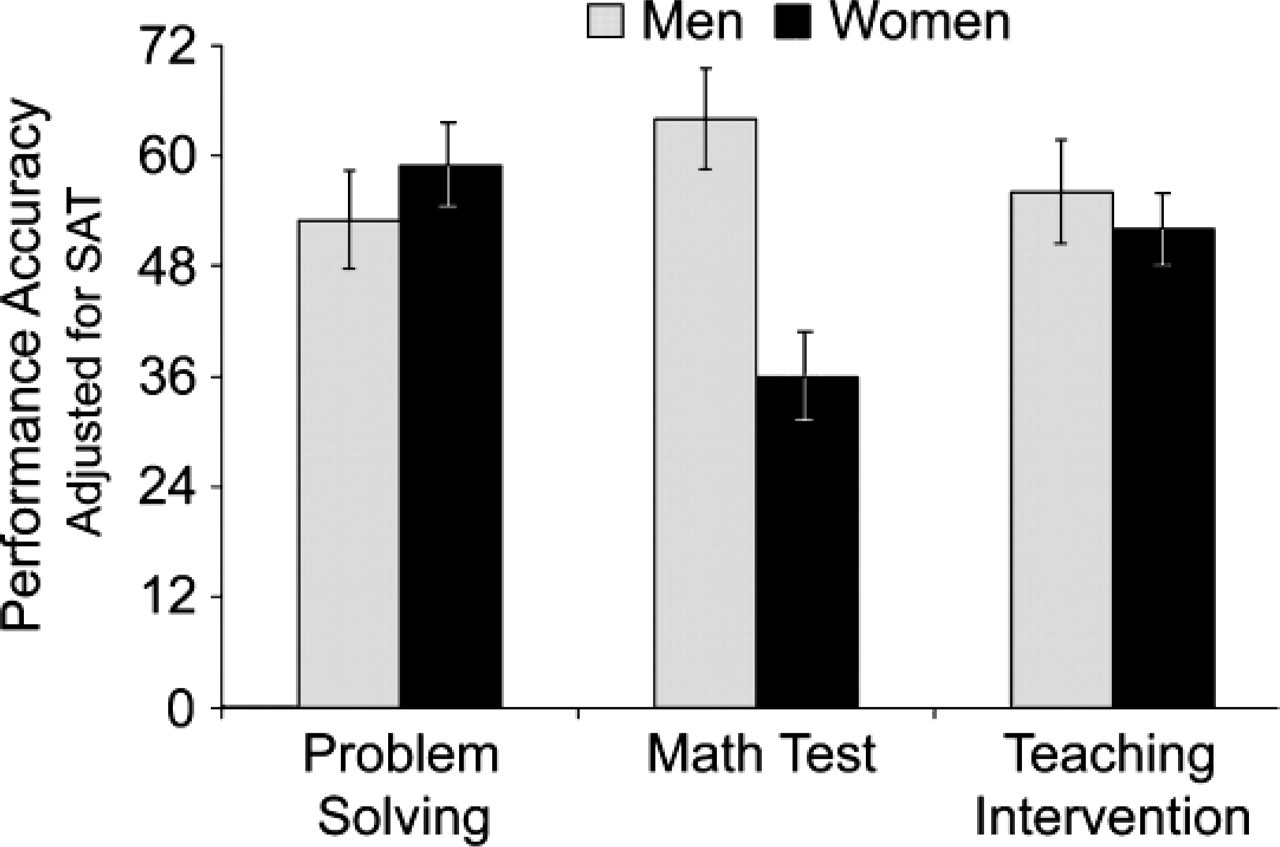
Women's and men's accuracy scores (adjusted for quantitative Scholastic Assessment Test, or SAT, scores) on the math test as a function of the test description. Error bars represent standard errors.
Attribution to Gender Stereotypes
Analysis of how much participants thought gender stereotypes contributed to their experience of anxiety during the test also revealed a main effect of test description, F(2, 111) = 5.92, p < .01. Participants in the teaching-intervention condition (M = 2.64) and the math-test condition (M = 2.30) were equally likely to report that gender stereotypes contributed to their anxiety, and these ratings were significantly higher than those of participants in the problem-solving condition (M = 1.33), ps < .01. There was also a main effect of gender; women (M = 2.35) were more likely than men (M = 1.52) to think that gender stereotypes contributed to their experience of anxiety, F(1, 111) = 9.84, p < .01. Though the interaction was not significant, F(2, 111) = 2.13, p = .12, simple effects analyses showed that women were more likely to report that gender stereotypes led to their anxiety in the teaching-intervention condition (M = 3.07) and the math-test condition (M = 2.88) than in the problem-solving condition (M = 1.37), F(2, 111) = 11.22, p < .001. Men, however, did not see a link between stereotypes and anxiety in any condition (Ms = 1.27, 1.64, and 1.69 in the problem-solving, math-test, and teaching-intervention conditions, respectively), F < 1. These data suggest that making gender explicit in the context of a math test increased women's belief that gender stereotypes contributed to their anxiety.
Furthermore, within-cell correlations revealed that women's belief that gender stereotypes contributed to their anxiety tended to be negatively correlated with performance in the math-test condition (r = −.42, p = .11), but was positively correlated with performance in the teaching-intervention condition (r = .38, p < .05), Z = −2.46, p < .05. The same attribution was uncorrelated with performance in the problem-solving condition (r = .07, n.s.).
DISCUSSION
This study reveals that informing members of stereotyped groups about the effects of stereotype threat can buffer their performance on stereotype-relevant tasks. Although women performed worse than men when they thought they were taking a diagnostic math test, women who learned about stereotype threat and the anxiety it might cause did not show this impairment. Teaching about stereotype threat improved women's performance despite the fact that they were highly aware of the stereotype deprecating women's math ability and believed that the researcher expected men to outperform women. The results are consistent with our hypothesis that knowledge of stereotype threat improves performance by providing a means of externalizing arousal. Women's math performance in the teaching-intervention condition tended to increase the more they attributed their anxiety to gender stereotypes. In contrast, women in the math-test condition tended to perform worse the more they connected their experience of anxiety to gender stereotypes.
This work provides initial evidence that teaching stigmatized individuals about stereotype threat might be a simple approach to counteracting the detrimental effects that negative stereotypes have on performance. Although previous research has shown that attributing arousal to external factors reduces stereotype threat, our goal was to translate our knowledge of this process into a simple and practical approach to undermining the effects of negative stereotypes on performance. Traditional misattribution cues are, by definition, confined to the immediate situation. Teaching, however, provides an attribution cue that should transfer beyond the immediate testing situation. This makes teaching an especially attractive option for providing stigmatized individuals with psychological tools to cope with stereotype threat. Concurrent research by Aronson and Williams (2004) indicates that teaching about stereotype threat can also improve the performance of African Americans; these results bolster our confidence that teaching is a practical strategy for reducing the influence of stereotype threat.
Certainly, as scientists and educators, we hope that our work will help better people's lives or, at the very least, not have unintended negative consequences. The present data speak against the possibility that learning about stereotype threat further impairs performance and provide important evidence that teachers do a service to their students by providing them with, not a misattribution, but perhaps a real attribution for the added stress that stereotype threat can cause.
Footnotes
1Including all participants weakened the primary performance results somewhat, but the mean performance pattern paralleled the pattern for White participants.
2There were no effects of experimenter on any measure.
3Anxiety was also assessed, but analysis on this measure revealed only that across conditions, women (M = 3.94) reported more anxiety than men (M = 3.00), F(2, 103) = 7.90, p < .01.
4There were fewer degrees of freedom for the performance analysis than for the manipulation checks because 7 participants failed to provide their SAT scores.
5Analysis of the number of items answered correctly adjusted for guessing produced a marginal interaction, F(2, 103) = 2.69, p = .07, that mirrors the results for accuracy.
Acknowledgements
We would like to thank Terry Daniel, Elizabeth Krupinski, and Jim Cassandro for allowing us to recruit students from their statistics classes.