







Abstract
Research on skilled memory has focused on organizational processes to the exclusion of item-specific processes, although theories of skilled memory do acknowledge the importance of both kinds of processes. Using the isolation methodology, we presented lists of American football team names to participants who had either a high or a low level of knowledge about American football. An isolation effect (greater recall of the target in the isolate list than in a homogeneous control list) was observed only with high-knowledge participants. When standard lists were used, an isolation effect was observed with both groups. These findings empirically validate the importance of both organizational and item-specific processing as the basis of distinctive processing underlying skilled memory performance.
Individuals with a high level of knowledge (HK) within a domain are capable of amazing memory feats when learning new domain-relevant information. For example, chess grandmasters accurately reproduced the location of 25 chess pieces from a real in-progress chess game after viewing the game for only 5 s (Chase & Simon, 1973; deGroot, 1966), and a college student, SF, used his extensive knowledge of track-and-field to accurately recall a string of 82 rapidly presented digits (Chase & Ericsson, 1982).
Whether HK individuals are learning chessboard configurations, strings of digits, dinner orders (Ericsson & Polson, 1988), architectural drawings (Akin, 1980), or computer program code (McKeithen, Reitman, Rueter, & Hirtle, 1981), their extensive domain knowledge is believed to provide organized retrieval structures that facilitate memory. The role of knowledge in creating organizational structures for the efficient use of memory by HK individuals is well accepted, and these organizational structures are central to several current theories of expert and skilled memory (e.g., Ericsson & Kintsch, 1995, 2000; Gobet, 2000; Vicente & Wang, 1998).
In fact, research with experts and HK individuals has focused almost exclusively on the use of organizational structures in skilled memory performance. In stark contrast, scant memory research has investigated how HK individuals discriminate information within organizational structures. For example, when SF learned a rapidly presented string of 82 digits, he organized subsets of digits into running times, ages, or years. One often-cited digit sequence, 3-4-9-2, was encoded as “3 minutes, 49.2 seconds, a near world-record mile time” (Chase & Ericsson, 1982, p. 10). Other sequences of digits were encoded in a similar manner, and each sequence was integrated into an organizational structure (Chase & Ericsson, 1982; Ericsson & Kintsch, 1995). When SF attempted to retrieve the entire sequence of digits, he reported navigating the organizational structure to recall the individual subsets of digits in the order presented. However, given extensive knowledge of running times, the cue “near world-record mile time” could produce many legitimate digit sequences. To accurately recall this particular list item, SF had to discriminate 3:49.2 from other valid, but not presented, running times within the same category, as well as from any other near-world-record mile times presented in the list. Organizational processes alone cannot support memory for a particular item because the organizing category does not uniquely specify a particular member of that category. Accurate memory for a particular item also requires item-specific processing of information that is diagnostic of a particular item within the organizational structure. Chase and Ericsson clearly understood this issue, and SF reported encoding similar digit strings so as to differentiate them more effectively during retrieval. Although Ericsson and Kintsch (1995) emphasized the importance of both organizational and item-specific processes in their long-term working memory framework, current skilled-memory research continues to focus almost exclusively on organizational factors.
The literature on nonexperts' memory shows that the combination of organizational and item-specific processing yields better memory than either process alone (Einstein & Hunt, 1980; Hunt & Einstein, 1981) and that, in some cases, the combination of the two processes yields near-perfect recall (Smith & Hunt, 2000). According to Hunt (2003, in press), distinctive processing is defined as the simultaneous processing of organizational and item-specific information. The organizational processing specifies, at least, the context defining an event, and the item-specific processing specifies unique properties of a particular item within the event. The combination of the two types of processing results in highly diagnostic information regarding a particular item—the item is processed distinctively.
Thus, we suggest that the superior domain-specific memory of the expert, or skilled individual, is enabled by the combination of organizational and item-specific processing, which is distinctive processing. According to this perspective, which is consistent with that of Ericsson and Kintsch (1995), experts possess not only categorical knowledge, but also item-specific knowledge, and are thus more capable of processing categorical and item-specific information in their domain of expertise than are nonexperts.
The purpose of the present research was to examine the role of distinctive processing in skilled memory. To do so, we used the isolation paradigm, a technique long used for the study of distinctive processing (Calkins, 1894; Hunt, 1995; von Restorff, 1933). An essential feature of this methodology is that a target item is presented in a list of other to-be-learned items that either differ from the target along a critical dimension (an isolate list) or are similar to the target along this dimension (a homogeneous control list). For example, individuals' memory for a two-letter string (the target) when it is presented in an isolate list that contains 9 two-digit numbers might be compared with their memory for the target when it is presented in a homogeneous control list that contains the target plus 9 other two-letter strings. The standard finding is that memory performance for the target is greater when it is presented in the isolate list than when it is presented in the homogeneous control list.
We adapted the isolation methodology by developing lists of items from a particular knowledge domain (i.e., American football) and then presenting these lists to individuals who were either HK or low in knowledge (LK) with respect to this domain. The isolate list contained professional football teams and one college team (the target), whereas the homogeneous control list contained only college teams (the target plus other college teams). Assuming that the HK participants possessed the categorical distinction of different leagues, as well as item-specific information about the particular teams, including their category membership, we expected that this knowledge would allow them to process differences among the teams in the context of categorical similarity. Because most teams in the isolate list shared the categorical similarity of being professional teams, the one college team would be processed differently in the context of that category similarity. As the result of this distinctive processing, the college team (the isolated target) would be well remembered. Assuming LK individuals did not possess either the categorical or the item-specific knowledge necessary to support distinctive processing, we expected they would show no isolation effect. To demonstrate that these effects were specific to the domain-relevant stimuli, we also tested both groups on standard isolation lists, for which we expected an isolation effect for both HK and LK participants.
METHOD
Participants
Participants indicated prior to the start of the experiment if they had “extensive knowledge of football.” If so, then they were assigned to the HK group; otherwise, they were assigned to the LK group. Participants who scored between 18 and 30 out of 30 on a knowledge test were retained in the HK group (M= 23.1), and those who scored between 0 and 11 were retained in the LK group (M= 6.0). Data from individuals who scored outside these ranges were not analyzed further. Also, data from participants who lived or attended school in Texas (the location of the target) were excluded from the analyses (see Materials and Procedure). One hundred twenty-six undergraduates participating for credit in introductory psychology courses were thus retained. Of the 60 LK participants, 31 received the isolate team list, and 29 received the homogeneous control list. Of the 66 HK participants, 34 received the isolate team list, and 32 received the homogeneous control list.
Materials and Procedure
The isolate team list consisted of the nine professional football teams and one college team (Texas Longhorns, hereafter referred to as the target). The homogeneous control team list consisted of the target along with nine other college teams. Each team name consisted of the city or state in which the team was located and the mascot (e.g., Seattle Seahawks, Texas Longhorns). In both lists, the target was presented in the fifth serial position (Dunlosky, Hunt, & Clark, 2000).
After participants read the instructions, a brief warning signal sounded, and then team names were presented one at a time on a computer screen for 3 s each. Next, all participants performed a 10-min distractor task. LK participants were then given a free-recall test for the team names. HK participants were excused and returned 2 days later to take the test. Neither group was told about the memory test in advance. Different delay intervals were used to avoid possible scale-dependent interactions (Loftus, 1978).
After completing free recall of the team names, all participants were presented with a second list for study. Half of the participants in each knowledge group received an isolate list consisting of 9 two-digit numbers and one letter (the target), and half received a homogeneous control list consisting of the target along with 9 other letters. The target appeared in the fifth serial position in both lists. The method of list presentation was the same as for the team lists.
For both groups, the retention interval after study of the letter or number list was filled as follows. First, a football knowledge test was administered (e.g., “In total, how many teams are in the NFL?”). Each of the 30 multiple-choice questions had five alternative answers, including “I don't know.” Participants were then asked to indicate in which states they had lived or attended school. Next, all 19 football teams whose names were used in the experiment were presented one at a time, and participants were asked (a) to indicate whether each team was a college or a professional team and (b) to rate their familiarity with the team using a scale from 1 (not familiar) to 7 (expert level of knowledge). 1 A final filler task was then administered so that the retention interval lasted 10 min, and this task was followed by a free recall test of the letter or number list.
RESULTS
We computed the proportion of participants in each group who recalled the target in the team list. These proportions are presented in the left panel of Figure 1. We also computed the proportion of other (background) teams recalled. Two analyses of variance (ANOVAs) were computed, one for the target and another for the background items, with knowledge level (HK vs. LK) and list type (isolate vs. control) as between-participants factors.
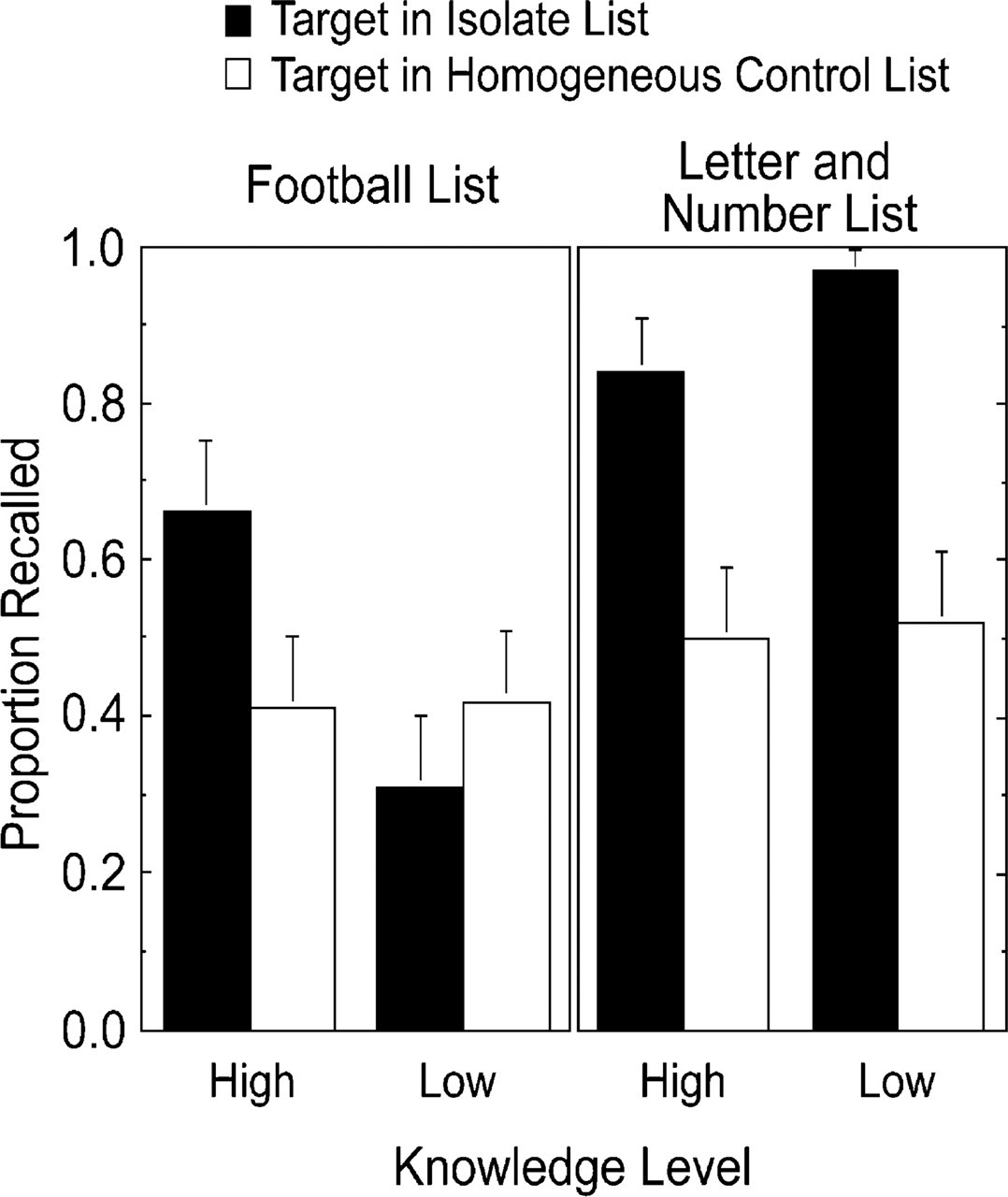
Proportion of target items recalled as a function of knowledge level and list type.
For target recall, the main effect of knowledge level was marginally reliable, F(1, 122) = 3.75, p= .055, and the main effect of list type was not reliable, F < 1. Most important, the interaction was reliable, F(1, 122) = 4.10, p < .05. As is evident from the left panel of Figure 1, HK participants showed an isolation effect, t(64) = 2.02, p < .05, Cohen's d= 0.51, whereas LK participants did not, t(58) < 1. For recall of background items, only the effect of knowledge level was reliable, F(1, 122) = 7.5, p < .01, with a greater proportion of teams recalled by HK than LK participants (Ms = .35 and .24, respectively).
To rule out the possible interpretation that HK participants simply had better memory than LK participants, we computed an ANOVA for recall of the target letter in the letter or number list; knowledge level and list type were between-participants factors. The effect of knowledge level was not reliable, F < 1, but the effect of list type was reliable, F(1, 122) = 28.87, p < .0001, with recall being greater when the background items were numbers (M= .91) than when they were letters (M= .51; right panel of Fig. 1). The interaction was also not reliable, F < 1, indicating that HK and LK participants showed a comparable isolation effect with standard materials.
DISCUSSION
Although leading theories of expert or skilled memory have focused almost exclusively on the role of organizational processes (e.g., Ericsson & Kintsch, 1995), few studies of expertise have evaluated empirically the role of item-specific processes in skilled memory. The present study is among the first to demonstrate that domain-relevant knowledge supports distinctive processing (i.e., item-specific and organizational processes): When to-be-learned materials consisted of the names of football teams, only participants with a high level of knowledge of football demonstrated an isolation effect. These results cannot be readily explained if knowledge benefited organizational processes alone, because isolation effects occur when the target item is processed as different from the background items along a dimension that is shared by the background items—that is, distinctive processing must occur (Hunt, 1995, 2003, in press; Hunt & McDaniel, 1993). To identify critical differences between the target item and the other items, one must have sufficient knowledge about the target and other items. In the present case, although there were many differences between the target team and the other teams, there was one critical difference, namely, the league (college or professional) in which the teams play. Only HK participants would have been likely to have the domain-relevant knowledge necessary to identify this critical difference.
Results from the standard isolation list rule out the uninteresting possibility that memory operated differently for the HK and LK participants, because both groups demonstrated the isolation effect for the domain-irrelevant list. In this case, both groups had the knowledge necessary to identify the differences between the two types of verbal stimuli (letters vs. numbers), and hence their memory for the target could benefit from distinctive processing.
In conclusion, the present research empirically validates the importance of both organizational and item-specific processing as the basis of distinctive processing underlying skilled memory performance.
Footnotes
1Because of space limitations, we do not report these results here, but they are available from the first author.
Acknowledgements
This research was funded, in part, by a postdoctoral fellowship from the University of Maryland, Department of Psychology; a National Institute of Mental Health Ruth L. Kirschstein National Research Service Award (F32 MH070964-01); and a National Science Foundation graduate research fellowship.