







Abstract
In development, children often use gesture to communicate before they use words. The question is whether these gestures merely precede language development or are fundamentally tied to it. We examined 10 children making the transition from single words to two-word combinations and found that gesture had a tight relation to the children's lexical and syntactic development. First, a great many of the lexical items that each child produced initially in gesture later moved to that child's verbal lexicon. Second, children who were first to produce gesture-plus-word combinations conveying two elements in a proposition (point at bird and say “nap”) were also first to produce two-word combinations (“bird nap”). Changes in gesture thus not only predate but also predict changes in language, suggesting that early gesture may be paving the way for future developments in language.
Young children communicate using gestures before they are able to speak. Children typically produce their first gestures between 9 and 12 months, usually pointing to indicate objects in the environment (Bates, 1976; Bates, Benigni, Bretherton, Camaioni, & Volterra, 1979). Even after children begin to talk, they continue to produce gestures in combination with words (e.g., pointing at cup while saying “cup”; e.g., Greenfield & Smith, 1976), and these gesture-plus-word combinations generally precede production of two-word combinations. Gesture development thus predates language development. The question we address here is whether gesture is fundamentally tied to language development.
The gestures that children produce early in language development provide a way for them to communicate information that they cannot yet express verbally. For example, pointing gestures (e.g., point at cup) offer children a technique for referring to objects before they have words for those objects. Moreover, gesture-plus-word combinations offer children a technique for communicating two pieces of information within a single utterance before they can produce two-word utterances (e.g., point at cup while saying “mine”; Butcher & Goldin-Meadow, 2000; Capirci, Iverson, Pizzuto, & Volterra, 1996; Goldin-Meadow & Butcher, 2003). The fact that gesture allows children to communicate meanings that they may have difficulty expressing verbally raises the possibility that gesture serves a facilitating function for language learning. If so, changes in gesture should not only predate but also predict changes in language.
We tested this hypothesis by examining gesture production in relation to lexical and syntactic development in the early stages of language development. We asked (a) whether children's use of gesture to refer to specific objects is related to the emergence of verbal labels for those objects and (b) whether children's production of gesture-plus-word combinations is related to the emergence of two-word utterances.
METHOD
Participants
Ten typically developing children (5 males, 5 females) participated; all were from middle- to upper-middle-class monolingual English-speaking families. The children were followed longitudinally between the ages of 10 and 24 months. We focus here on sessions between the onset of one-word speech (range: 10–14 months) and the emergence of two-word combinations (range: 17–23 months). On average, each child was observed 8 times (range: 5–12).
Procedure
The children were videotaped monthly for approximately 30 min. The taping took place in the home, during play with a primary caregiver and during a snack or mealtime. Toys were provided by the experimenter, but the children were also free to play with their own toys.
Coding
We focused on gestures and speech used communicatively. The child had to make an effort to direct the listener's attention (e.g., through eye gaze, vocalization, postural shift) for a behavior to be considered communicative. A communicative behavior could be gesture on its own, speech on its own, or gesture and speech produced together.
Coding Gesture
Two additional criteria were used to ensure that a gesture was functioning as a communicative symbol (see Butcher, Mylander, & Goldin-Meadow, 1991; Goldin-Meadow & Mylander, 1984): First, the gesture could not be a direct manipulation of some relevant person or object (i.e., it had to be empty-handed; Petitto, 1988). All acts performed on objects were excluded, except for instances in which a child held up an object to bring it to another person's attention, an act that serves the same function as pointing. Second, the gesture could not be a ritual act (e.g., blowing a kiss to someone) or game (e.g., patty-cake).
Each gesture was classified into one of three categories: deictic gesture, conventional gesture, or ritualized reach. Deictic gestures indicate referents in the immediate environment. Children produced three types of deictic gestures: (a) showing, holding up an object in the listener's potential line of sight; (b) index point, extending the index finger toward a referent; and (c) palm point, extending a flat hand toward a referent. The referent of a deictic gesture was assumed to be the object indicated (or held up) by the hand. 1 Conventional gestures have a form and meaning that are either culturally defined (e.g., nodding the head “yes”) or specified in the context of particular caregiver-child interactions (e.g., smoothing the hands over the hair to mean “pretty”). Ritualized reaches are arm extensions toward an object, usually accompanied by repeated opening and closing of the palm.
Coding Speech
We coded all communicative, meaningful vocalizations; these consisted of either English words (e.g., “dog,”“hot,”“walking”) or patterns of speech sounds consistently used to refer to a specific object or event (e.g., [ba] for “bottle”).
Coding the Relation Between Gesture and Speech
All instances in which a gesture was produced co-temporally with speech were classified as gesture-plus-word combinations and divided into two categories based on the relation between the information conveyed in the two modalities. One category included gestures that complemented speech by singling out the referent indicated by the accompanying word (e.g., pointing to flowers while saying “flowers” to indicate flowers on the table). The second category included gestures that supplemented speech by providing a different but related piece of information about the referent (e.g., pointing to a picture of a bird while saying “nap” to indicate that the bird in the picture is sleeping).
Reliability
Reliability between two independent coders was assessed for 10% of the 80 sessions. Agreement between coders was 93% (N= 639) for isolating gestures and 100% (N= 52) for classifying gesture-plus-word combinations as complementary or supplementary. Cohen's kappa statistics for these coding decisions were .92 and 1.0, respectively. Agreement was 100% (N= 242) for assigning meanings to gestures and 91% (N= 463) for assigning meanings to words.
RESULTS
Object Reference in Gesture and Early Lexical Development
Do the early gestures that a child produces have any relation to the words that the child subsequently utters? For these analyses, we identified all instances in which children referred to an object 2 and classified them into three categories: speech only (i.e., using only a word to refer to an object), gesture only (i.e., using only a gesture to refer to an object), or speech and gesture (i.e., using both a word and a gesture, not necessarily at the same time, to refer to an object). Intercoder reliability for this decision was 92% (N= 119), κ= .85. Because we were interested in examining developmental change in the number of different items in children's verbal and gestural repertoires, this analysis was based on types (a traditional measure of vocabulary growth) within a session. For example, if a child only pointed at a ball (one or more times) during the session, ball was counted as one type in the gesture-only category. If the child only said “ball” (one or more times) during the session, ball was counted as one type in the speech-only category. If a child produced the word “ball” and also pointed at a ball in the same session (whether simultaneously or at different times), we counted ball as one type in the speech-and-gesture category. We then calculated the proportion of items (summed across sessions) that each child produced in each of the three categories.
The children relied extensively on gesture to refer to objects: Approximately half of each child's object references across sessions occurred in gesture only (M= .50, SD= .16), with another quarter occurring in both speech and gesture (M= .22, SD= .06). Only a fourth of the object references that each child produced occurred in speech only (M= .28, SD= .18). But gesture did become less important over time. At the initial session, 9 of the 10 children produced a majority of object references in gesture only, whereas none did at the final session, χ2(1) = 12.93, p < .001.
Gesture thus appears to provide a way for children to refer to objects at a time when they are not producing words for those objects. If gesture serves a facilitating function in lexical development, one might expect an individual lexical item to enter a child's repertoire first in gesture and then, over time, transfer to speech. To explore this possibility, we identified lexical items that a child used in multiple sessions and classified them into four categories 3 according to whether they (a) appeared initially in speech and remained in speech, (b) appeared initially in gesture and remained in gesture, (c) appeared initially in speech and transferred or spread to gesture, or (d) appeared initially in gesture and transferred or spread to speech. Items that appeared initially in both speech and gesture were excluded from this analysis.
Table 1 presents the mean proportion of items that fell into each category. Modality had a clear impact on lexical development. Significantly more items were produced initially in gesture than in speech, F(1, 9) = 12.33, p < .01, η2= .578. Moreover, a significant proportion of the items either switched or spread from one modality to the other (as opposed to staying in one modality), F(1, 9) = 8.05, p < .03, η2= .472. However, there was a significant interaction between the two factors, F(1, 9) = 20.37, p < .002, η2= .694: Items were more likely to move from gesture to speech than from speech to gesture (p < .001, Newman-Keuls). On average, children produced a gesture for a particular object 3.0 months (SD= 0.54, range: 2.3 to 3.9 months) before they produced the word for that object. Thus, the results are consistent with the gestural-facilitation hypothesis, as we were able to predict a large proportion of the lexical items that eventually appeared in a child's verbal repertoire from that child's earlier gestures. Because the relation between a deictic gesture and its referent is more transparent than the arbitrary relation between most words and their referents, gesture can provide children with a temporary way to communicate about objects, allowing them to circumvent difficulties related to producing speech (Acredolo & Goodwyn, 1988; Werner & Kaplan, 1963). Gesture may thus serve as a transitional device in early lexical development.
Categorization of Lexical Items According to Modality of First Appearance and Developmental Trajectory
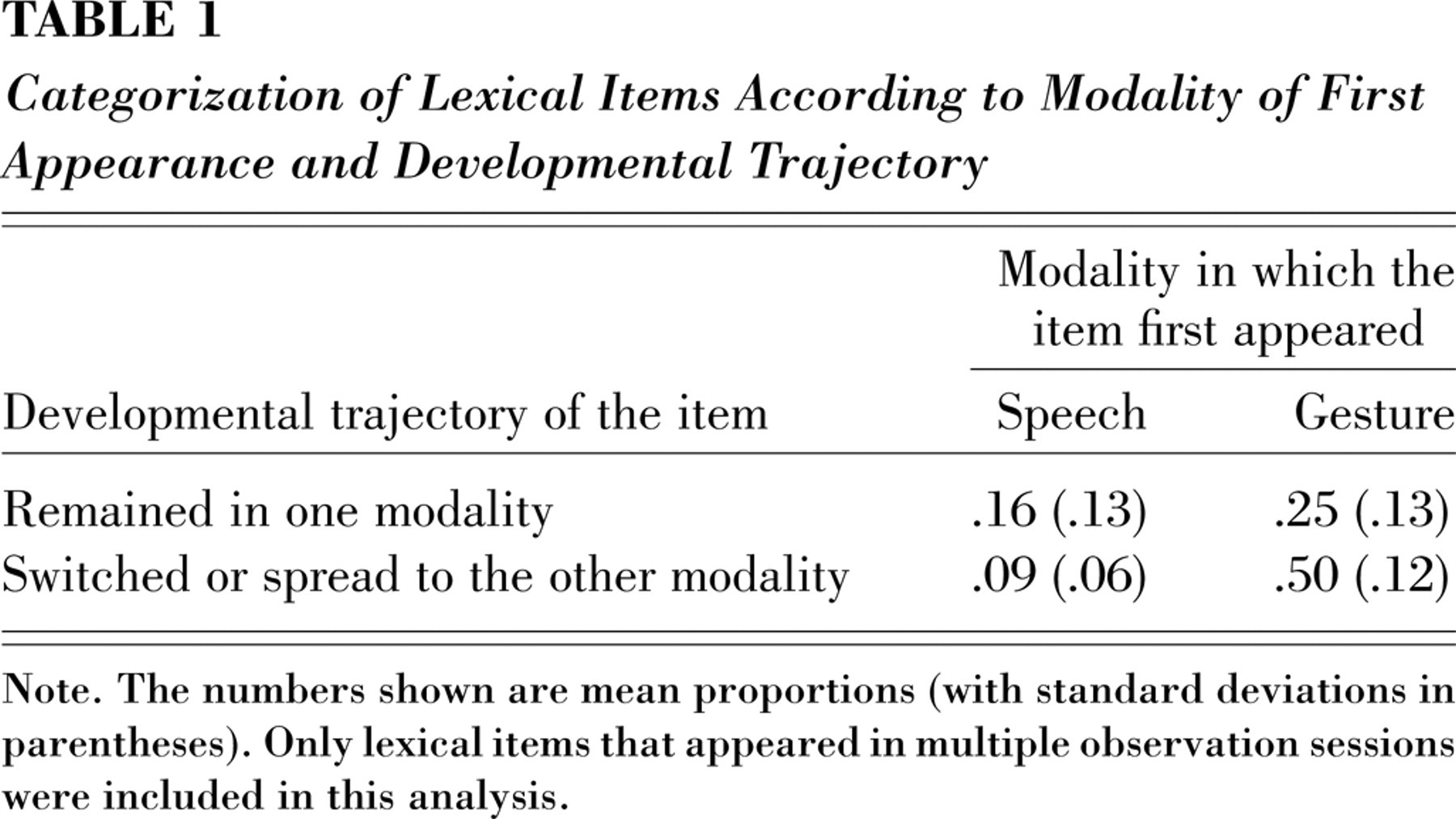
Note. The numbers shown are mean proportions (with standard deviations in parentheses). Only lexical items that appeared in multiple observation sessions were included in this analysis.
Gesture-Plus-Word Combinations and the Transition to Two-Word Speech
All 10 children combined single gestures with single words and did so several months before producing two-word utterances. Moreover, all 10 children produced both supplementary (point at bird while saying “nap”) and complementary (point at bird while saying “bird”) gesture-plus-word combinations before the onset of two-word utterances (“bird nap”). The mean interval between the onset of supplementary gesture-plus-word combinations and onset of two-word utterances was 2.3 months (SD= 1.66); the corresponding interval between the onset of complementary gesture-plus-word combinations and the onset of two-word combinations was 4.7 months (SD= 2.2). 4
Note that like two-word combinations, supplementary gesture-plus-word combinations communicate two semantic elements within a single communicative act. If gesture facilitates the emergence of early speech combinations, one might expect children who produce supplementary gesture-plus-word combinations to be the first to make the transition to two-word speech. And indeed, we found a significant correlation between age of onset of supplementary gesture-plus-word combinations and age of onset of two-word combinations (Spearman r s= .94, p < .001, two-tailed; see Fig. 1).
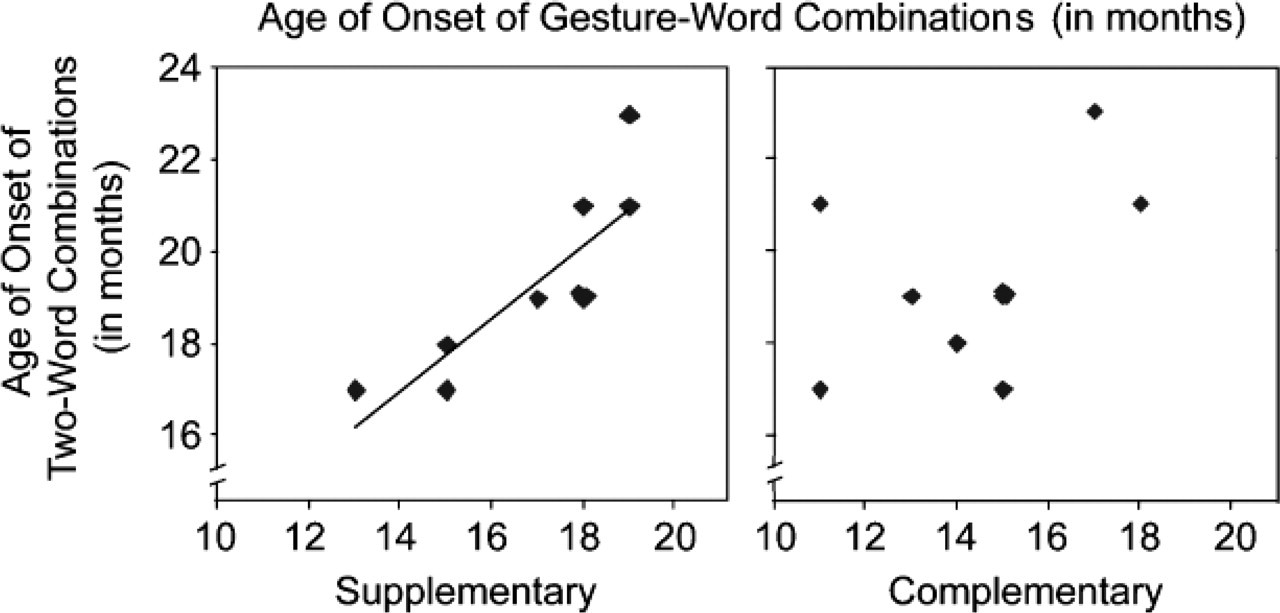
Scatter plots displaying the relation between age of onset of supplementary gesture-plus-word combinations and age of onset of two-word combinations (left) and between age of onset of complementary gesture-plus-word combinations and age of onset of two-word combinations (right).
Unlike supplementary gesture-plus-word combinations, complementary combinations convey a single semantic element. One therefore would not expect the onset of this type of gesture-plus-word combination to predict the onset of two-word utterances, and, indeed, it did not. The correlation between age of onset of complementary gesture-plus-word combinations and age of onset of two-word combinations was low and not reliable (Spearman r s= .24, n.s.; see Fig. 1). Thus, it is the ability to combine two different semantic elements within a single communicative act—not simply the ability to produce gesture and speech together—that predicts the onset of two-word speech.
DISCUSSION
We have found that gesture both precedes and is tightly related to language development. At the lexical level, items found initially in children's gestural repertoires subsequently appeared in their verbal lexicons. At the sentence level, the onset of gesture-plus-word combinations conveying two elements of a proposition predicted with great precision the onset of two-word combinations. Our findings are thus consistent with the hypothesis that gesture plays a facilitating role in early language development.
What might gesture be doing to facilitate language learning? One possibility is that gesture serves as a signal to the child's communicative partner that the child is ready for a particular kind of verbal input. Consider a child who points at his or her father's hat while saying “dada.” The child's caregiver might respond by saying, “Yes, that's daddy's hat,” in effect “translating” the child's gesture-plus-word combination into a two-word utterance and providing the child with timely verbal input. Indeed, adults have been found to alter their input to older children on the basis of the gestures that the children produce (Goldin-Meadow & Singer, 2003), providing them with instruction that leads to learning (Singer & Goldin-Meadow, 2005).
Gesture may also play a role in language learning by affecting the learners themselves. Although gesture and speech form a single integrated system, gesture exploits different representational resources than does speech (McNeill, 1992). Meanings that lend themselves to visuospatial representation may be easier to express in gesture than in speech. Indeed, children on the cusp of mastering a task often produce strategies for solving the task in gesture before producing them in speech (Church & Goldin-Meadow, 1986; Perry, Church, & Goldin-Meadow, 1988).
In addition to relying on a different representational format, gesture lessens demands on memory. Pointing at an object is likely to put less strain on memory than producing a word for that object. Moreover, gesturing while speaking has been found to save speakers cognitive effort (Goldin-Meadow, Nusbaum, Kelly, & Wagner, 2001; Wagner, Nusbaum, & Goldin-Meadow, 2004); consequently, it may be cognitively less demanding to express a proposition in a gesture-plus-word combination than in two words.
Gesture may thus provide a way for new meanings to enter children's communicative repertoires. It may also give children a means for practicing these new meanings, laying the foundation for their eventual appearance in speech. There is, in fact, evidence that the act of gesturing can itself promote learning (Wagner & Goldin-Meadow, 2004).
In sum, our findings underscore the tight link between gesture and speech, even in children at the earliest stages of language learning. At minimum, gesture is a harbinger of change in the child's developing language system, as it is in other cognitive systems later in development (Goldin-Meadow, 2003). Gesture may even pave the way for future developments in language.
Footnotes
1It is possible that, at times, children used deictic gestures to refer to events rather than objects (e.g., “cat sleeping” rather than “cat”). Our results, however, do not support this possibility. When points were assumed to refer to objects, children's pointing gestures predicted subsequent entries in their spoken vocabularies, and onset of children's supplementary gesture-plus-word combinations predicted onset of two-word utterances; our results thus provide indirect support for coding points as references to objects. If we misattributed the referents of pointing gestures, this would only have weakened our results and reduced the likelihood that they would support the gesture-facilitation hypothesis.
2Only nouns and deictic gestures were included in the lexical analyses. Pronouns were infrequent and thus omitted; in analyses including pronouns, the results were unchanged.
3Lexical items appearing in multiple sessions accounted for .41 (range: .29–.49) of each child's repertoire.
4Age of onset for complementary, supplementary, and two-word combinations was defined as the child's age at the session in which he or she first produced at least two instances of the respective kind of combination.
Acknowledgements
This research was supported by grants from the National Institute of Child Health and Human Development (Grant R01 HD 41677 to J.M.I. and Grant P01 HD 40605 to S.G.-M.) and by a grant from the March of Dimes Foundation to S.G.-M.