







Abstract
Previous research has suggested that Blacks like White interaction partners who make an effort to appear unbiased more than those who do not. We tested the hypothesis that, ironically, Blacks perceive White interaction partners who are more racially biased more positively than less biased White partners, primarily because the former group must make more of an effort to control racial bias than the latter. White participants in this study completed the Implicit Association Test (IAT) as a measure of racial bias and then discussed race relations with either a White or a Black partner. Whites' IAT scores predicted how positively they were perceived by Black (but not White) interaction partners, and this relationship was mediated by Blacks' perceptions of how engaged the White participants were during the interaction. We discuss implications of the finding that Blacks may, ironically, prefer to interact with highly racially biased Whites, at least in short interactions.
There is a strong contemporary social norm in the United States that it is no longer acceptable to behave in a prejudiced manner toward Blacks. Some individuals have internalized this norm and have a sincere distaste for acting in prejudiced ways. Others have not internalized the norm, but, because it is so prevalent, they are concerned about portraying a nonprejudiced image. Interracial dyadic interactions are particularly likely to trigger concerns about the expression of prejudice (Vorauer, Hunter, Main, & Roy, 2000). Regardless of their actual level of prejudice, therefore, many individuals are concerned about behaving in a nonprejudiced way during interracial interactions (Dunton & Fazio, 1997; Plant & Devine, 1998; see also Crandall & Eshleman, 2003, for a review). For instance, during interracial interactions, individuals carefully monitor and control their thoughts and behavior in order to combat the expression of stereotypes and negative attitudes that are often activated automatically and unintentionally (Devine, 1989; Monteith, 1993; von Hippel, Silver, & Lynch, 2000).
Engaging in self-regulation to combat the expression of prejudice may be especially critical to the successful negotiation of interracial interactions by individuals with relatively high levels of racial bias. Indeed, recent research suggests that the extent to which individuals engage in self-regulation during interracial interactions varies as a function of racial bias (Richeson et al., 2003; Richeson & Shelton, 2003). For instance, analyses of White individuals' nonverbal behavior during an interracial interaction revealed that participants with higher scores on a measure of automatic racial bias controlled their behavior to a greater extent (e.g., moved their body less, looked around the room less, moved their hands less) than participants with lower levels of racial bias (Richeson & Shelton, 2003). Furthermore, employing functional magnetic resonance imaging technology, we (Richeson et al., 2003) found that White individuals' automatic-racial-bias scores predicted the neural activity of a brain region known to subserve executive control (i.e., including self-regulation) when participants were exposed to photographs of Black individuals, but not photographs of White individuals. In other words, in reaction to Black individuals, individuals with higher racial-bias scores activated brain regions associated with self-regulation to a greater extent than individuals with lower racial-bias scores.
Recent research on the effects of evaluative concerns during intergroup interactions also suggests that individuals with higher levels of racial bias may rely on self-regulation during interracial interactions more than individuals with lower levels of racial bias (Vorauer & Turpie, 2004). Specifically, Vorauer and Turpie found that when concerns with appearing prejudiced were high, low-prejudice Whites engaged in fewer positive behaviors during an interracial interaction than an intraracial interaction. The opposite, however, was found for high-prejudice Whites; that is, when concerns with appearing prejudiced were high, high-prejudice Whites engaged in more positive behaviors during an interracial interaction than an intraracial interaction. Taken together, the research suggests that, relative to individuals with lower levels of racial bias, more racially biased individuals expend greater self-regulatory effort in order to negotiate interracial dyadic interactions—a context especially likely to trigger concerns about appearing prejudiced.
Surprisingly, there has been little research on whether individuals' engagement in self-regulation in order to avoid appearing prejudiced during interracial interactions influences interpersonal outcomes of those interactions. For instance, do Black individuals differentially perceive White individuals who engage in different amounts of self-regulation during interracial interactions? And, furthermore, if high-bias White individuals regularly engage in self-regulation more than low-bias White individuals during interracial interactions, do Black interaction partners perceive high- and low-bias Whites differently? The purpose of the present study was to investigate this question.
Previous literature on intergroup relations is equivocal regarding how Blacks might differentially perceive high- and low-bias Whites during interracial interactions. Some work suggests that Whites' racial attitudes are likely to leak through nonverbal aspects of their behavior and, thus, be detected by their interaction partners (e.g., Dovidio, Kawakami, & Gaertner, 2002; Fazio, Jackson, Dunton, & Williams, 1995; McConnell & Leibold, 2001). For instance, Whites' racial-bias scores have been found to be negatively correlated with how positively they are perceived by Black experimenters (Dovidio et al., 2002; Fazio et al., 1995; McConnell & Leibold, 2001; Sekaquaptewa, Espinoza, Thompson, Vargas, & von Hippel, 2003). However, this work is primarily based on the perceptions of Black experimenters who interacted with a number of White participants, rather than the perceptions of naive Black individuals after a single interracial interaction.
Given the aforementioned research suggesting that high-bias Whites are especially likely to regulate their behaviors during interracial interactions in order to avoid revealing prejudice (Richeson et al., 2003; Richeson & Shelton, 2003; Vorauer & Turpie, 2004), it is also possible that Black interaction partners perceive high-bias Whites more positively than low-bias Whites. In other words, high-bias Whites' efforts to regulate their behavior may not go unrecognized, and may even be rewarded, by Black interaction partners. In a study consistent with this latter possibility (Shelton, 2003), Whites who were instructed to “try not to appear prejudiced” during an interaction with a Black participant, fidgeted less than Whites who were not given this instruction. Moreover, Blacks evaluated Whites who were instructed to try not to appear prejudiced more positively than they evaluated Whites who were not given this instruction. Taken together, this research leads to the prediction that effort to control the expression of negative racial attitudes may result in the ironic effect of Blacks forming more favorable impressions of high-bias Whites than of low-bias Whites.
To investigate this possibility, we conducted a study in which Whites with varying levels of racial bias interacted with either a Black or a White interaction partner. After the interactions, the Black and White interaction partners rated how favorable their perceptions of the White participants were, as well as how engaged they believed the White participants were during the interaction. We sought to examine two primary questions. First, we considered whether Black individuals perceive White interaction partners with higher levels of racial bias more positively than White interaction partners with lower levels of racial bias. Second, we examined whether differences in Blacks' evaluations of high- and low-bias White interaction partners could be attributed to the partners' differential engagement in self-regulation (Richeson & Shelton, 2003; Vorauer & Turpie, 2004). In other words, we examined whether high-bias White individuals' self-regulatory efforts result in their Black interaction partners forming more favorable impressions of them. On the basis of previous research, we predicted that Whites' automatic-racial-bias scores would be positively correlated with how positively they were perceived by Black interaction partners and, furthermore, that this (ironic) effect would be attributable to how engaged Blacks perceived their White partners were during the interactions.
METHOD
Participants and Procedures
Ninety-six students from Princeton University participated in the study for payment ($8). The sample consisted of 29 Blacks and 67 Whites. There were 29 same-sex pairs (11 male and 18 female) in the White-Black condition and 19 same-sex pairs (8 male and 11 female) in the White-White condition.
The experimenter 1 met with each participant individually and said that he or she would work on several tasks during the experimental session. She then explained that the first task was a word-categorization task to be performed on the computer. This task was actually the racial-attitude Implicit Association Test (IAT; Greenwald, McGhee, & Schwartz, 1998). The experimenter prepared the participant to complete the IAT and left the room. Each participant completed this test alone.
After two participants completed the IAT, the experimenter returned to their rooms and provided them with information about the next task. Specifically, the experimenter informed them that a graduate student was conducting her dissertation on first impressions, and that they would participate in this student's research during the next part of the study. The experimenter then provided the participants with a new consent form to complete to help bolster the cover story that the task to follow was part of a new study. She also informed each participant that in the new study he or she would have a brief, 10-min conversation with another participant and then answer a few questions about the interaction. Next, the experimenter led the two participants to a different room for the interaction. The room was equipped with two chairs facing one another, and the experimenter asked the participants to select a chair. At this point, the experimenter indicated that in order to facilitate the discussion, participants should select a conversation topic from a basket. Unbeknownst to the participants, all the topics were the same: “Discuss your opinions about race relations (e.g., Discuss your attitudes about racial profiling. How do you feel about affirmative action? How do you feel about the immigration laws in America?).” We used a topic that directly focused on racial issues to increase the salience of an interracial interaction. The experimenter then left the room for 10 min. Upon her return, she led the participants to two separate rooms and asked them to complete a brief questionnaire about their interaction.
After completing the brief questionnaire, participants completed an unrelated task, then were thanked, thoroughly debriefed, and paid.
Measures
IAT
The IAT is a measure of automatic associations and has been used to measure unconscious evaluations of social categories in numerous studies (see Greenwald et al., 1998). The version of the IAT we used required participants to categorize White names, Black names, pleasant words, and unpleasant words as quickly as possible by pressing one of two marked response keys. Racial bias was assessed by performance on two critical blocks of trials. In one block of 40 trials, White names (e.g., Josh) and pleasant words shared a response key, and Black names (e.g., Jamal) and unpleasant words shared a response key (White-pleasant/Black-unpleasant phase). In another block of 40 trials, the associations were reversed (White-unpleasant/Black-pleasant phase). We counterbalanced the order of these two critical blocks across participants. The difference between response latencies in the two phases provided an index of the degree to which participants held biased evaluations of Blacks relative to Whites.
Prior Relationship With Partner
Participants indicated whether or not they knew their interaction partner prior to the study. If they knew their partner, they were further instructed to indicate how well they knew him or her on a scale from 1 (a little) to 7 (a lot).
Favorability Index
We used six items to assess how favorably participants perceived their partner (e.g., “How much do you like your partner?”“How likely is it that you would become friends with your partner?”). Participants made their ratings on a 7-point scale from 1 (not at all) to 7 (very much). We combined these six items such that higher scores indicated a more positive evaluation.
Perceived Engagement of the Partner
Participants completed two questions regarding how engaged they perceived their partner to be during the interaction (i.e., “How involved was your partner during the interaction?” and “How much during the interaction did your partner elaborate on his/her thoughts about the topic of conversation?”). Participants made their ratings on a 7-point scale from 1 (not at all) to 7 (very much). We combined these items to create a composite score for perceived engagement.
RESULTS
Preliminary Analyses
We recoded all IAT latencies under 300 ms and over 3,000 ms in a manner consistent with the procedures of Greenwald et al. (1998), log-transformed the latencies, and then calculated the average for each phase for each participant. Next, we subtracted each White participant's mean log-latency for the White-pleasant/Black-unpleasant phase from his or her mean log-latency for the White-unpleasant/Black-pleasant phase in order to create a score for the participant's automatic racial bias. 2 Greater values reflect greater racial bias against Blacks.
Following the strategy of Vorauer and Kumhyr (2001), our data-analytic strategy required the identification of an “actor” and a “partner” in each dyad. For the White-Black pairs, the White participant was considered the actor, and the Black participant was considered the partner. For the White-White pairs, we randomly selected one participant to be the actor and the other to be the partner. Thus, all actors were White, whereas partners were either White or Black.
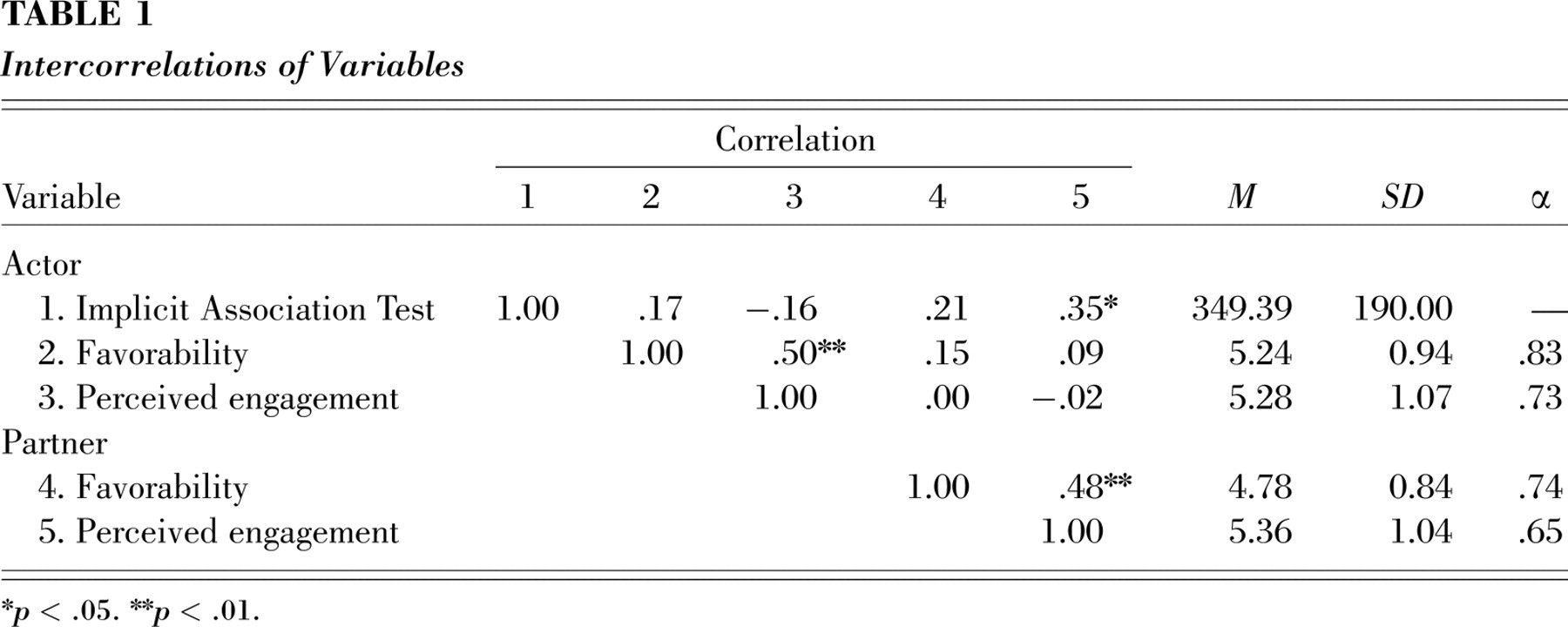
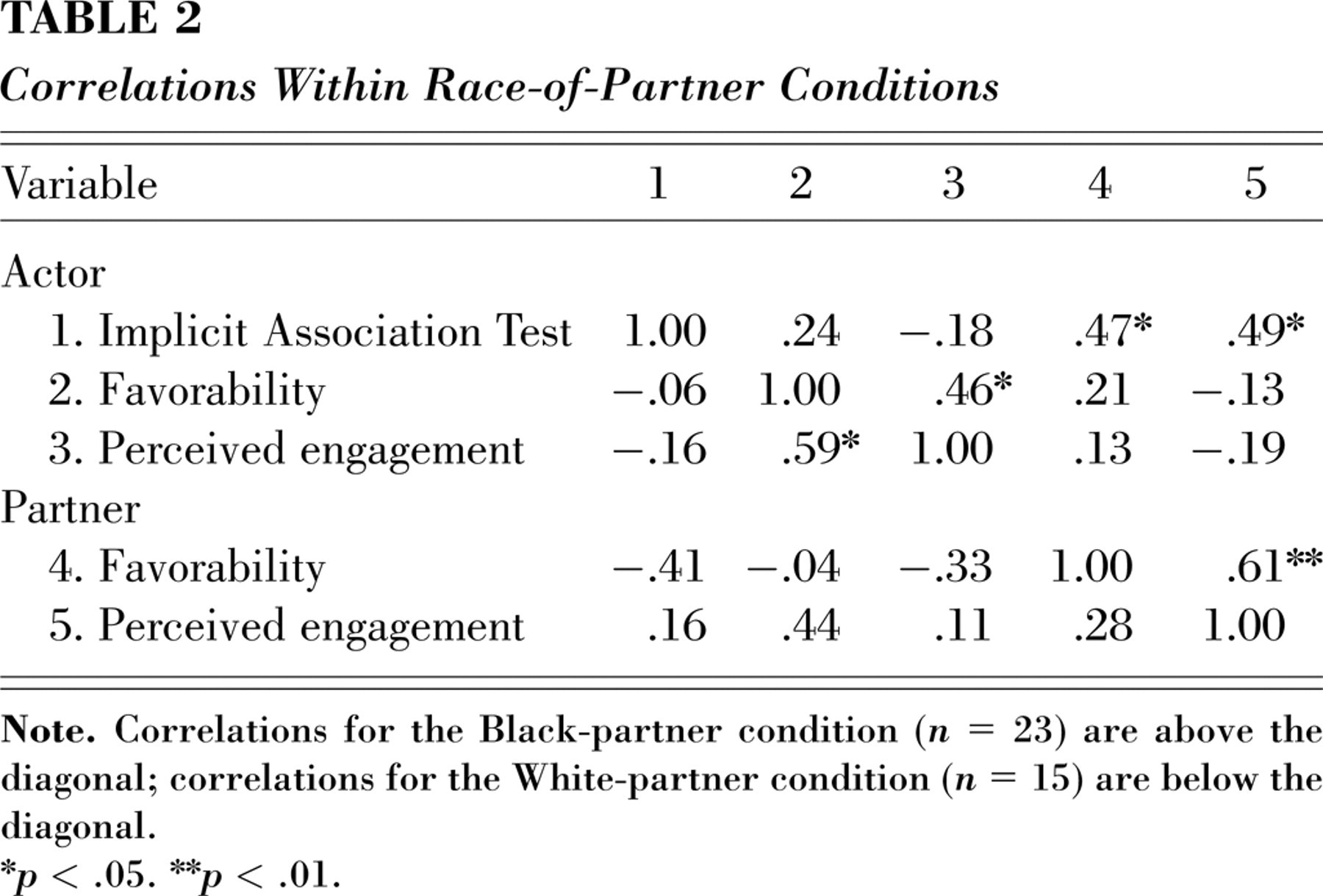
Seven of the pairs indicated that they knew one another prior to the study. In addition, 3 of the White actors' IAT scores were unobtainable because of computer errors. We removed these pairs from the study, which left us with a sample of 23 White-Black pairs and 15 White-White pairs. Table 1 provides descriptive statistics and reliabilities for all variables, together with their correlations. Table 2 shows the correlations for all variables within each race-of-partner condition.
Intercorrelations of Variables
p < .05.
p < .01.
Correlations Within Race-of-Partner Conditions
p < .05.
p < .01.
Primary Analyses
We analyzed our results with a regression analysis in which the predictors were White actors' level of automatic racial bias (centered), partner's race (Black =−1, White = 1), and the interaction between the two. 3 We first used the favorability composite scores to determine how positively White and Black partners viewed the White actors. The only significant result of this regression analysis was the two-way interaction, β=−.46, p= .01, Cohen's d= 0.87 (see Table 3 for mean values). As predicted, the higher the White actors' automatic-racial-bias scores, the more positively Black partners perceived them, β= .47, p= .02, Cohen's d= 1.09. The White actors' automatic-racial-bias scores were not significantly predictive of White partners' favorability ratings, β=−.41, p= .12, Cohen's d= 0.90. Furthermore, White actors with IAT scores above the mean (i.e., participants with relatively high automatic-racial-bias scores) were perceived more positively by Black partners than by White partners, β=−.62, p= .006, Cohen's d= 1.59. White actors with IAT scores below the mean were perceived similarly by Black and White partners, β= .33, p= .15, Cohen's d= 0.70.
Mean Favorability and Perceived-Engagement Ratings
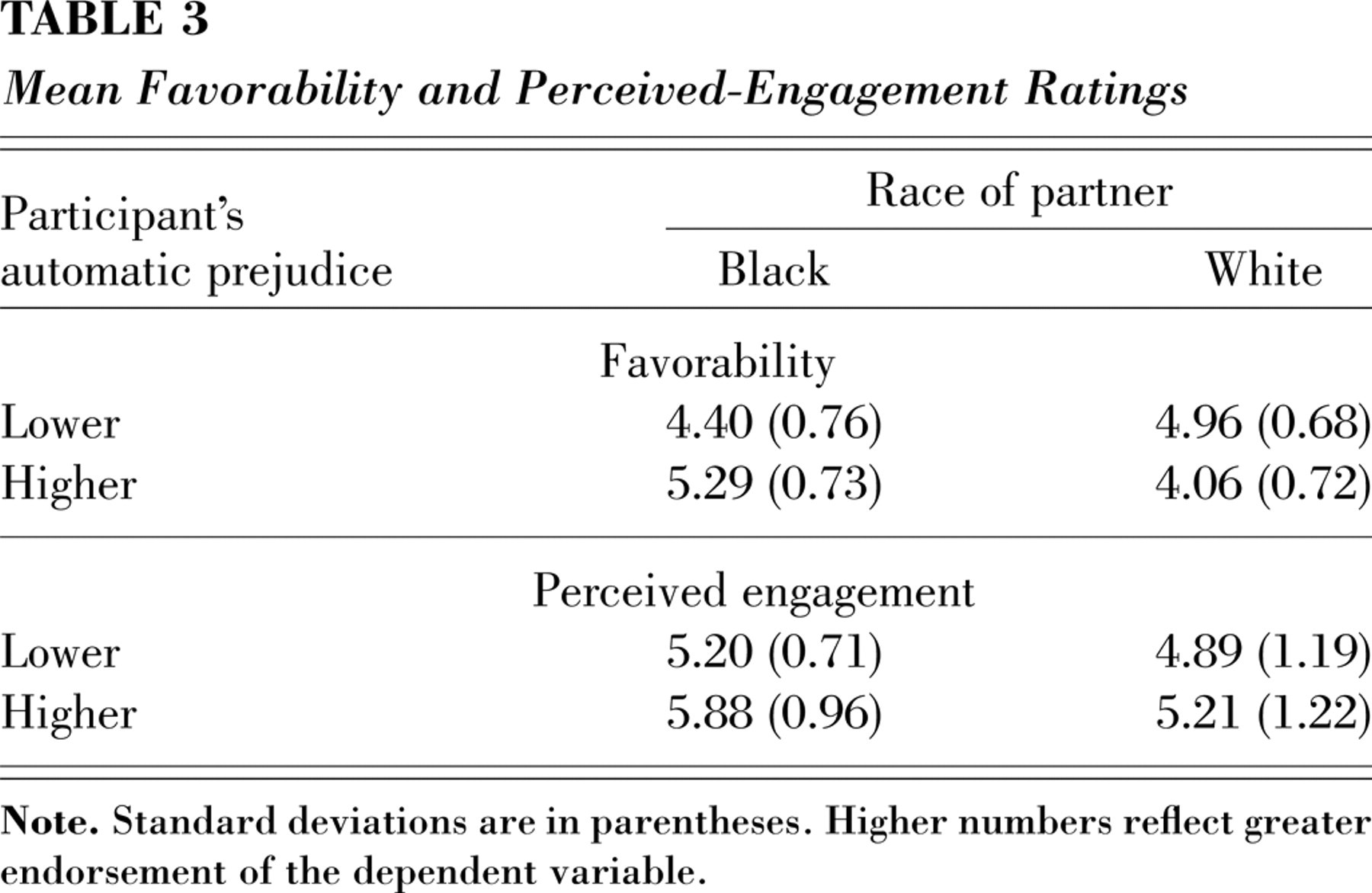
Next, we assessed whether engagement in the interaction might account for why Black partners perceived Whites with higher automatic-bias scores more positively than Whites with lower scores. Specifically, we assessed the extent to which Black partners' perceptions of how engaged the White actors were during the interaction mediated the tendency for Black interaction partners to evaluate Whites with higher bias more favorably than Whites with lower bias. Regression analyses revealed that White actors' automatic-racial-bias scores predicted Black partners' perceptions of how engaged they were during the interaction, β= .49, p= .018, Cohen's d= 1.11 (see means in Table 3). Additionally, the more Black partners perceived the White actors as being engaged during the interaction, the more positively they evaluated them, β= .61, p= .002, Cohen's d= 1.56. Moreover, when we entered both White actors' automatic-racial-bias scores and Black partners' perceived-engagement ratings as predictors of favorability scores in a regression, automatic-racial-bias scores were no longer significant (β= .23, p= .24, Cohen's d= 0.42), whereas perceived engagement remained reliable (β= .50, p= .018, Cohen's d= 0.97). In other words, Black individuals' perceptions of how engaged White individuals were during the interaction mediated the relation between White actors' automatic racial bias and how favorably they were perceived by Black interaction partners.
DISCUSSION
The external pressure not to appear prejudiced during interracial interactions is quite high in American society. For Whites with relatively high levels of racial bias, this pressure can be quite challenging because it is in direct conflict with their propensity to activate stereotypical thoughts (Wittenbrink, Judd, & Park, 1997) and, perhaps, behave in prejudiced ways. Previous research has found negative consequences associated with high-bias individuals' attempts to regulate their thoughts and behavior during interracial interactions (e.g., Richeson & Shelton, 2003). That is, self-regulation during interracial interactions has been found to be cognitively depleting, undermining performance on tasks that require self-regulation.
In contrast, the present study suggests that there are also benefits afforded to high-bias Whites who may try not to behave in prejudiced ways during interracial interactions. Our results revealed that Black participants evaluated Whites with higher automatic-bias scores more positively than Whites with lower automatic-bias scores. More important, this ironic effect stemmed from Black interaction partners' perception that high-bias Whites were more engaged during the interaction than low-bias Whites. The fact that race was made salient, as a function of the discussion topics, most likely made external concerns with appearing prejudiced extremely high. Thus, we suspect that Whites with higher levels of automatic racial bias were more engaged in the interaction because they were attempting to regulate their behavior so as not to appear prejudiced. Because Whites with lower levels of automatic racial bias can be less concerned with expressing prejudice, they may have been more relaxed during the interaction and, as a consequence, perceived as relatively less involved. It is important to note, however, that although we suspect that self-regulation associated with prejudice was a key factor in our results, there are questions remaining regarding the precise process underlying the effects obtained. Answering these questions will require research that manipulates concerns with appearing prejudiced and distinguishes among the effects of different types of engagement (e.g., genuine interaction engagement vs. engagement out of concern with appearing prejudiced) on the resultant perceptions formed by Black partners.
We have placed some emphasis on the possibility that Whites with higher levels of automatic racial bias, relative to Whites with lower levels of such bias, were likely to be more engaged during the interracial interactions in order to appear nonprejudiced. It is equally worthwhile to consider the possible reasons why Whites with lower levels of automatic racial bias were perceived as being less engaged. It is possible that because of their genuine positive attitude toward Blacks, Whites with lower levels of automatic racial bias did not believe that it was necessary to explicitly communicate to their partners that they were not prejudiced. Furthermore, perhaps an illusion of transparency was involved: Low-bias Whites may have thought it would be obvious to their Black partners, and anyone else, that they were not prejudiced (Vorauer, 2004).
In addition, Whites with lower levels of automatic racial bias may have appeared less engaged during the interactions as a result of their own efforts to regulate their behavior. That is, Whites with lower levels of automatic racial bias may have been concerned (perhaps because of internal reasons) with saying the wrong thing during a racially sensitive discussion. As a result, they may have held back during the interaction compared with Whites with higher levels of automatic racial bias, who might have been more willing to engage in a debate about racial issues. This interpretation is more consistent with Vorauer and Turpie's (2004) choking-under-pressure explanation for why low-prejudice Whites behave less positively during interracial than intraracial interactions. Nevertheless, one implication of the present work is that in order to be perceived positively, it may be necessary for Whites to appear engaged during interracial interactions, irrespective of their level of racial bias.
One disturbing implication of our results is that detecting who is and is not prejudiced against one's group during brief social interactions can be quite difficult for Blacks (cf. Vorauer & Kumhyr, 2001; Vorauer & Turpie, 2004; but see also Richeson & Shelton, in press). Ironically, there are situations in which Whites with higher levels of automatic racial bias may appear less threatening than Whites with lower levels of automatic racial bias. This could lead Blacks to make the unfortunate decision to avoid future contact with low-prejudice Whites. It is unclear, however, to what extent our findings would generalize to interactions that last longer than 10 min and do not involve race-related topics. Given that self-regulation requires emotional, mental, and physical energy (Muraven & Baumeister, 2000), it is possible that biased individuals can put forth the effort required to appear unbiased for only a short period of time. Thus, in longer interactions, high-bias Whites may be perceived more negatively than Whites with lower levels of automatic racial bias.
Furthermore, it is important to consider the context of the present work and the use of a rather subtle measure of racial bias. The participants in this study were drawn from a relatively liberal college in which the majority of individuals hold egalitarian values and have low levels of explicit forms of racial bias. Our results are likely to have been influenced by these larger contextual features; participants with higher levels of explicit racial bias, for instance, may not attempt to regulate their expression of bias during interracial interactions and, thus, may be unlikely to be perceived more positively than individuals with low levels of explicit racial bias. Nevertheless, the results of the present study reveal an important interpersonal benefit of Whites' engagement in self-regulation during interracial interactions, and this effect must be considered in tandem with the intrapersonal consequences of self-regulation during interracial contact (i.e., cognitive depletion).
Footnotes
1One African American female, one White female, and one biracial (White-Hispanic) female served as the experimenters for the study.
2Blacks' IAT scores are not relevant to the analyses in this article and are therefore not reported.
3Preliminary analyses revealed that participant's sex did not moderate any of the effects reported here, and, thus, it was excluded from all analyses.
Acknowledgements
The authors gratefully acknowledge Bonnie Burlingham, Leigh Poretzky, and Lisa Pugh for their assistance with data collection.