







Abstract
The role of perspective taking in affective decision making was studied in children at two ages (3 and 4 years) using a delay-of-gratification paradigm in which children chose between an immediate reward of lower value and a delayed reward of higher value. Half the children chose for themselves (self condition), and half chose for the experimenter (other condition). Three-year-olds chose delayed rewards in the other condition but made impulsive choices in the self condition. Compared with 3-year-olds, 4-year-olds performed better in the self condition and worse in the other condition. Results suggest that 3-year-olds took either a subjective, first-person perspective (for self) or an objective, third-person perspective (for other). Four-year-olds integrated these perspectives, considering a third-person perspective in the self condition and the experimenter's subjective perspective in the other condition (i.e., her desire for immediate gratification). This integration allowed reason to be tempered by emotion, and vice versa.
It is no small discipline and preparation of the intellect on its road to final “objectivity” to see things for once through the wrong end of the telescope. …
—Nietzsche (1887/1956, p. 255)
Young children are notoriously egocentric, and although there are clear limits to rationality and perspective taking even in adulthood (e.g., Kahneman, 2003), it has long been recognized that development is characterized by prominent increases in the likelihood that children will consider alternatives to their own current perspective on a situation (e.g., Baldwin, 1897; Inhelder & Piaget, 1959/1964). More recently, egocentrism has been a focus of research on children's developing theory of mind (e.g., Astington, 1993). Research on theory of mind has shown clearly that whereas 3-year-olds often have difficulty appreciating discrepant points of view (e.g., their own and other people's false beliefs), 4-year-olds are more likely to do so (Wellman, Cross, & Watson, 2001). In addition, this research has shown that changes in children's theory of mind are correlated with increases in cognitive control (studied under the rubric of executive function; Perner & Lang, 1999). Relative to 3-year-olds, who often act impulsively and exhibit cognitive inflexibility, 4-year-olds are better able to represent multiple aspects of a problem, formulate a plan, keep the plan in mind, and act on it deliberately (Zelazo & Müller, 2002). It is probably no coincidence that both theory of mind and executive function depend importantly on the integrity of prefrontal cortex, which grows considerably during childhood (e.g., Matsuzawa et al., 2001).
Efforts to understand the link between egocentrism and poor executive function have converged on the suggestion that the same cognitive changes that allow children to coordinate multiple perspectives also underlie the development of executive function (e.g., Carlson & Moses, 2001; Frye, Zelazo, & Palfai, 1995; Perner & Lang, 1999; Zelazo, 2004). For example, according to the levels-of-consciousness model (Zelazo, 2004), there are age-related increases in the extent to which children can reflect on what they know. When reflection is interposed between a stimulus and a response, this brings about a cognitive separation of the child from the exigencies of the situation—psychological distance (e.g., Sigel, 1993)—and this separation permits both increases in the variety of perspectives that may be considered and increases in executive control (e.g., via the formulation of complex rules for regulating behavior). Other accounts emphasize different cognitive changes, such as increases in working memory and inhibition (Carlson & Moses, 2001), but all of these accounts imply that in order to understand children's egocentrism and the eventual development of perspective taking, it will be useful to investigate the cognitive bases of executive function.
Research on the development of executive function has traditionally emphasized its more cognitive, “cool” aspects (Zelazo & Müller, 2002; cf. Metcalfe & Mischel, 1999)—for example, children's ability to follow arbitrary rules (Zelazo, Müller, Frye, & Marcovitch, 2003). Recently, however, there has been growing interest in the more “hot,” affective aspects of executive function, such as affective decision making, or decision making that requires appraisals of the motivational significance of stimuli (e.g., their potential for rewards; Zelazo & Müller, 2002). Kerr and Zelazo (2004), for example, used a simplified version of the Iowa Gambling Task (Bechara, Damasio, Damasio, & Anderson, 1994) in which children chose between (a) cards that offered more rewards per trial but were disadvantageous across trials because of occasional large losses and (b) cards that offered fewer rewards per trial but were advantageous overall. On later trials, 4-year-olds made more advantageous choices than expected by chance, whereas 3-year-olds made fewer.
One well-established paradigm for studying affective decision making is delay of gratification (Metcalfe & Mischel, 1999; see Mischel, Shoda, & Rodriguez, 1989, for review), in which children choose between an immediate reward of lower value (the “impulsive” choice) and a delayed reward of higher value (the “rational” choice). Early studies found that older school-age children were less likely than younger school-age children to choose impulsively (e.g., Mischel & Metzner, 1962), but few age differences were observed within the preschool range (e.g., Schwarz, Schrager, & Lyons, 1983). However, Thompson, Barresi, and Moore (1997) used a modified paradigm and found an increase between 3 and 4 years of age in children's tendency to choose delayed rewards.
Choosing to delay gratification is clearly an index of cognitive control (vs. impulsivity), but it also has the potential to reveal the role of perspective taking in the development of executive function. In order to exercise cognitive control in this task, children may need to disengage from their subjective desire for immediate gratification and consider the fact that, from a more objective perspective, the delayed reward is the better option. Barresi and Moore (1996) offered a useful framework for thinking about the development of perspective taking. According to these authors, 3-year-olds take a first-person, present-oriented perspective on their own behavior (e.g., “I want candy now”) and a third-person perspective on the behavior of other people—seeing that behavior from the outside, as it were. Because simultaneous consideration of first- and third-person perspectives is required for a representational understanding of mental states, 3-year-olds have difficulty with theory of mind—for both self and other (Wellman et al., 2001). With development, however, children are better able to adopt a third-person perspective on their own behavior, imagine a first-person perspective on the behavior of others, and coordinate these perspectives into a single schema.
Barresi and Moore's (1996) account predicts that 3-year-olds' performance on a delay-of-gratification task should vary depending on whether they are choosing for themselves or another person. When choosing for themselves (self condition), 3-year-olds should have difficulty disengaging from their current (first-person) perspective—their desire for immediate gratification—and hence should choose impulsively. In contrast, when choosing for someone else (other condition), 3-year-olds should adopt a strictly third-person perspective—unencumbered by an appreciation of the other person's desire for immediate gratification. This third-person perspective should lead 3-year-olds to choose larger (delayed) rewards in this condition. The two conditions should be comparable for 4-year-olds, however, because of increases in both the likelihood that they will consider a third-person perspective in the self condition and the likelihood that they will consider the experimenter's subjective perspective in the other condition. Considering a third-person perspective in the self condition should make 4-year-olds more likely to choose delayed rewards; considering a first-person perspective in the other condition should make 4-year-olds less likely to do so (potentially resulting in an age-related decline in performance in this condition). If this account is correct, then a comparison of these two conditions in 3- and 4-year-olds should reveal how the integration of first- and third-person perspectives is involved in the development of cognitive control as measured by the delay-of-gratification paradigm.
METHOD
Participants
Participants were 64 children at each of two ages, 3 years (M= 3.42 years, range = 3.01–3.93) and 4 years (M= 4.47 years, range = 3.95–4.99). Half of the children at each age were boys. Informed parental consent was obtained for all children.
Materials, Design, and Procedure
All children were tested individually, in a quiet room, by a female experimenter using a modified delay-of-gratification task (Thompson et al., 1997). Equal numbers of boys and girls at each age were randomly assigned to each condition (self or other). Children in both conditions were first allowed to sample each of the rewards. In the other condition, the experimenter also sampled the rewards. The children were then told that a number of cards would be presented, and that each card would require them to decide whether a reward should be consumed immediately or saved until after the experiment. Each of nine trial types, created by crossing three types of reward (stickers, pennies, candies) and three types of choice (one now vs. two later, one now vs. four later, one now vs. six later), was depicted graphically on a separate card (14 cm × 11 cm).
Two demonstration trials were then presented. In each of these trials, the experimenter randomly selected a test card, read the choices aloud, and made a choice herself. For each trial, the choice was explained verbally and visually by placing the two reward options in separate piles (i.e., immediate pile vs. delay pile). To illustrate both options, the experimenter chose the immediate reward on the first trial and delayed rewards on the second trial, and she demonstrated the consequences (for herself) in both cases. For the immediate reward, she ate the candy, placed the sticker on the piece of paper, or dropped the penny in a jar. Delayed rewards were placed in an envelope and set aside. Children in the self condition were then told that it was now their turn to choose. In the other condition, children were told that they now needed to help the experimenter choose.
Nine test trials, one of each trial type, were presented in a random order. Test trials were presented in the same fashion as demonstration trials. However, in the other condition, the experimenter asked, “What do you think I should do?” and in the self condition, she asked, “What do you want to do?” The experimenter provided no feedback regarding the wisdom of children's choices, apart from administering the consequences (i.e., dispensing the rewards to children or to herself, depending on the condition). Each child's score was the number of times he or she chose to delay (i.e., a delay score).
RESULTS
Preliminary analyses revealed no effects of type of reward or type of choice, and performance did not differ across trials. We first examined performance on the first trial (Fig. 1, top panel). A 2 (age) × 2 (sex) × 2 (condition: self vs. other) analysis of variance (ANOVA) revealed a main effect of condition, F(1, 120) = 8.57, p < .004, η p 2= .07, qualified by a Condition × Age interaction, F(1, 120) = 4.82, p < .03, η p 2= .04. Bonferroni-corrected t tests (α < .05) revealed that 3-year-olds chose to delay more often in the other condition than the self condition (Cohen's d= 0.96), whereas this difference was not significant for 4-year-olds (d= 0.12).
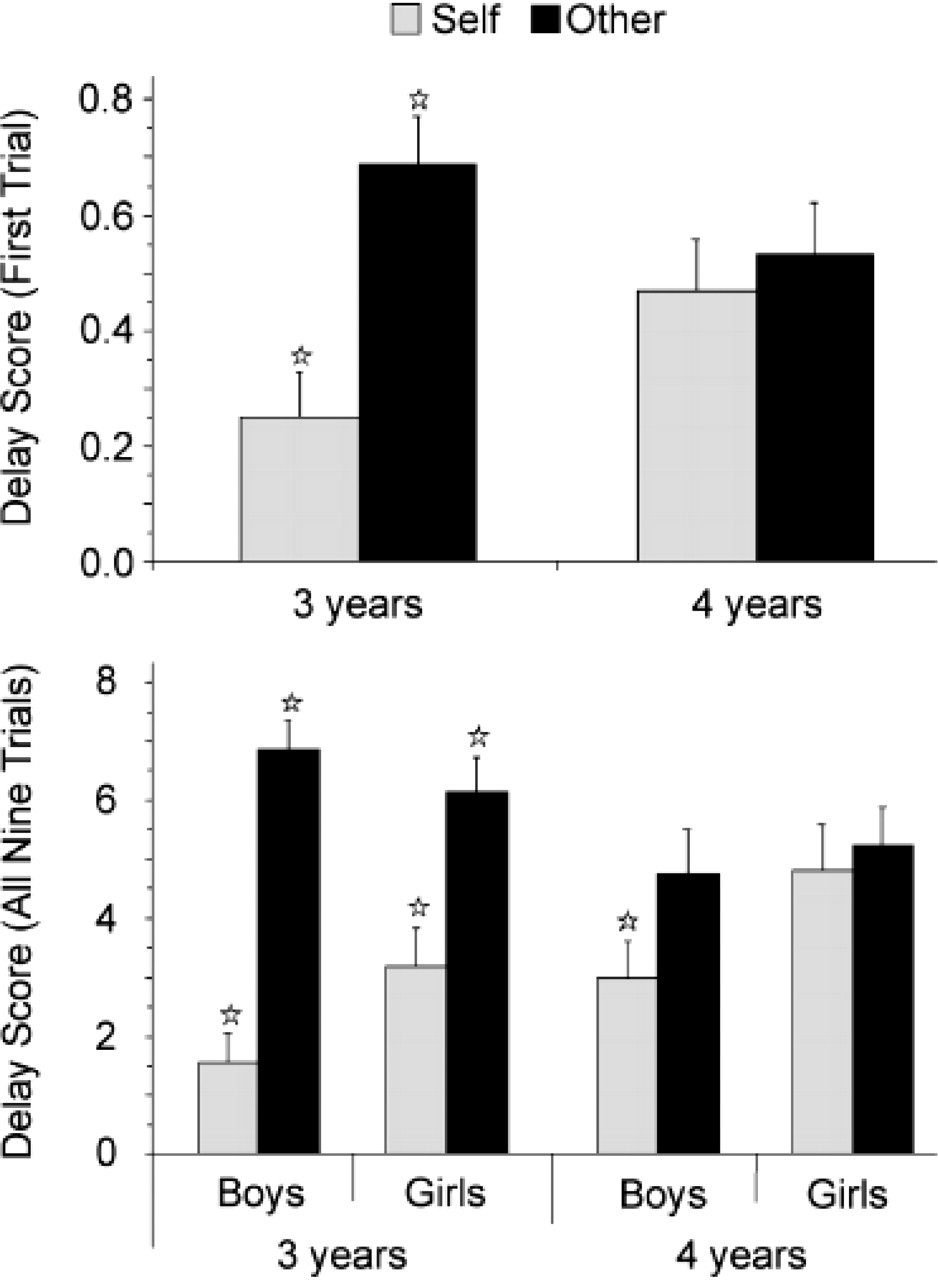
Mean (plus one standard error) delay score on the first trial, as a function of age and condition (top panel), and mean (plus one standard error) delay score out of all nine trials, as a function of age, sex, and condition (bottom panel). Stars indicate means that differ significantly from chance (p < .05).
Scores were also compared with chance responding (i.e., a mean of .5 delay choices) using the t distribution. These tests, conducted separately for each combination of condition and age, showed that 3-year-olds performed worse than chance in the self condition but better than chance in the other condition; 4-year-olds' performance did not differ from chance in either condition (Fig. 1, top panel).
We next reran the analyses using data from all nine trials, to obtain a more reliable estimate of children's behavior in this task (Fig. 1, bottom panel). These analyses revealed a main effect of condition, F(1, 120) = 33.34, p < .0001, η p 2= .22, qualified by two interactions: Condition × Age, F(1, 120) = 11.25, p < .001, η p 2= .09, and Condition × Sex, F(1, 120) = 4.16, p < .05, η p 2= .03. Three-year-olds chose to delay more often in the other than the self condition (Cohen's d= 1.79), but the difference between conditions was not significant for 4-year-olds (d= 0.38); performance in the other condition declined between ages 3 and 4 (d= 0.60), but performance in the self condition improved (d= 0.57). Collapsing across ages, the effect of condition was significant for both boys and girls, but stronger for boys (d= 1.39 vs. d= 0.62). Girls had higher scores than boys in the self condition (d= 0.65) but not the other condition (d= 0.05). Means differing from chance (4.5 delay choices) are shown in Figure 1 (bottom panel).
DISCUSSION
Perspective taking was manipulated in a delay-of-gratification paradigm by asking children to choose for themselves or for the experimenter. Whereas 3-year-olds typically chose impulsively for themselves, they usually chose to delay for the experimenter. When performance was considered across all nine trials, 4-year-olds chose to delay more often than 3-year-olds in the self condition but less often than 3-year-olds in the other condition. Results were robust across three types of reward and delay.
The effect of condition at age 3 years was striking, and it suggests that children at this age may know that it is better to delay but have difficulty doing so in the self condition (i.e., a knowledge-action dissociation; e.g., Carlson, Davis, & Leach, in press; Zelazo, Frye, & Rapus, 1996). The Condition × Age interaction, predicted on the basis of Barresi and Moore's (1996) model of the development of perspective taking, points to the role of perspective taking in overcoming this difficulty. In terms of this model, 3-year-olds may have made impulsive choices in the self condition because they took an exclusively first-person, present-oriented perspective on their own behavior and had difficulty adopting a more objective, third-person perspective from which the delayed reward seemed the better choice. In contrast, 3-year-olds may have chosen delayed rewards in the other condition because they took an exclusively third-person perspective and had difficulty appreciating the experimenter's subjective perspective (i.e., her desire for immediate gratification). However, age-related improvements in children's ability to integrate first- and third-person perspectives may have made the two conditions comparable for 4-year-olds. That is, considering a third-person perspective in the self condition (in addition to a first-person perspective) may have made 4-year-olds more likely than 3-year-olds to choose delayed rewards; considering a first-person perspective in the other condition (in addition to a third-person perspective) may have made 4-year-olds less likely to choose delayed rewards. The Condition × Age interaction moves beyond earlier demonstrations of correlations between discrete measures of theory of mind and executive function (e.g., Carlson & Moses, 2001; Frye et al.,1995), and begins to reveal how perspective taking may be integrally involved in the development of cognitive control (Kirkham, Cruess, & Diamond, 2003; Perner & Lang, 1999; Zelazo, 2004).
The Condition × Sex interaction that emerged when performance was considered across nine trials can be interpreted in a similar fashion. Like 4-year-olds overall relative to 3-year-olds overall, girls seemed more likely than boys to consider a third-person perspective in the self condition. This finding is consistent with suggestions that girls outperform boys on some aspects of executive function (Bjorklund & Kipp, 1996), although sex differences observed in previous studies of delay of gratification have tended to be small (e.g., Silverman, 2003).
CONCLUSION
The current findings reveal the role of perspective taking in the development of affective decision making between the ages of 3 and 4 years, a period of rapid, correlated changes in theory of mind and executive function (Carlson & Moses, 2001; Frye et al., 1995; Perner & Lang, 1999). As they develop, children come to integrate first- and third-person perspectives on their own and other people's behavior, and they are more likely to approach motivationally significant decisions in a way that is neither wholly subjective nor wholly “objective,” in the sense of corresponding to a strictly third-person, disinterested stance (Barresi & Moore, 1996). This dynamic integration allows reason to be tempered by emotion, and vice versa.
Footnotes
Acknowledgements
This research was supported by the Natural Sciences and Engineering Research Council of Canada. We thank Wil Cunningham, Charles Helwig, and Li Qu for helpful comments, and the Ontario Science Centre for their cooperation.