







Abstract
It has been demonstrated that older infants (6- to 7-month-olds), but not younger infants (3- to 4-month-olds), use form similarity to organize stimuli consisting of X and O elements. We investigated whether utilization of form similarity is governed by maturation or experience by contrasting how infants perform when familiarized with a single exemplar versus multiple exemplars depicting a particular organization. In Experiment 1, 3- to 4-month-olds failed to organize alternating columns or rows of squares and diamonds or Hs and Is, respectively. In Experiment 2, same-aged infants familiarized with all three patterns (X-O, square-diamond, H-I) displayed evidence of organization. The results suggest that 3- to 4-month-olds can use form similarity to organize visual patterns in a concept-formation task. The findings imply that perceptual organization based on form similarity is learned through experience with multiple patterns depicting a common arrangement, rather than immediately apprehended in an individual pattern.
An important event in the development of visual cognition is the organization of the environment into coherent units. Although some theorists have emphasized that an extended period of perceptual learning of visual and motor associations is needed to determine the spatial arrangement of features that make up individual forms (Hebb, 1949; Piaget, 1952), others working in the traditional framework of Gestalt psychology, as well as the modern paradigm of cognitive science, have suggested that grouping of edge fragments into bounded structures begins early in life, and is aided by powerful constraints or organizational principles (Helson, 1933; Koffka, 1935; Kohler, 1929; Needham & Ormsbee, 2003; Palmer, 2003; Quinn & Bhatt, 2001; Spelke, 1982).
Evidence indicates that young infants adhere to some grouping principles when organizing visual patterns (Quinn, in press). Current debate centers on whether sensitivity to all organizing principles is present early in life, or whether sensitivity to different principles develops at different rates and is mediated by different factors (i.e., maturation vs. experience). Available data suggest that grouping principles such as common motion, lightness similarity, and good continuation are operational within the first 3 to 4 months of life (Farroni, Valenza, Simion, & Umilta, 2000; Johnson & Aslin, 1996; Kellman & Spelke, 1983; Quinn, Brown, & Streppa, 1997; Quinn, Burke, & Rush, 1993; Quinn & Schyns, 2003), whereas other principles, such as form similarity, may not be functional until age 6 to 7 months (Quinn, Bhatt, Brush, Grimes, & Sharpnack, 2002).
In the Quinn et al. (2002) investigation of organization by form similarity, 3- to 4-month-olds and 6- to 7-month-olds were familiarized with a pattern consisting of X and O elements, presented as columns or rows, as shown in Figure 1a. Each group was then tested on preference trials with horizontal versus vertical bars (bottom illustration in Fig. 1). Six- to 7-month-olds showed a preference for the novel organization, whereas 3- to 4-month-olds divided their attention between the novel and familiar organizations. Control experiments showed that the young infants' failure to organize by form similarity did not result from insufficient familiarization time, inability to discriminate between individual Xs and Os, or inability to generalize from element patterns to bars.
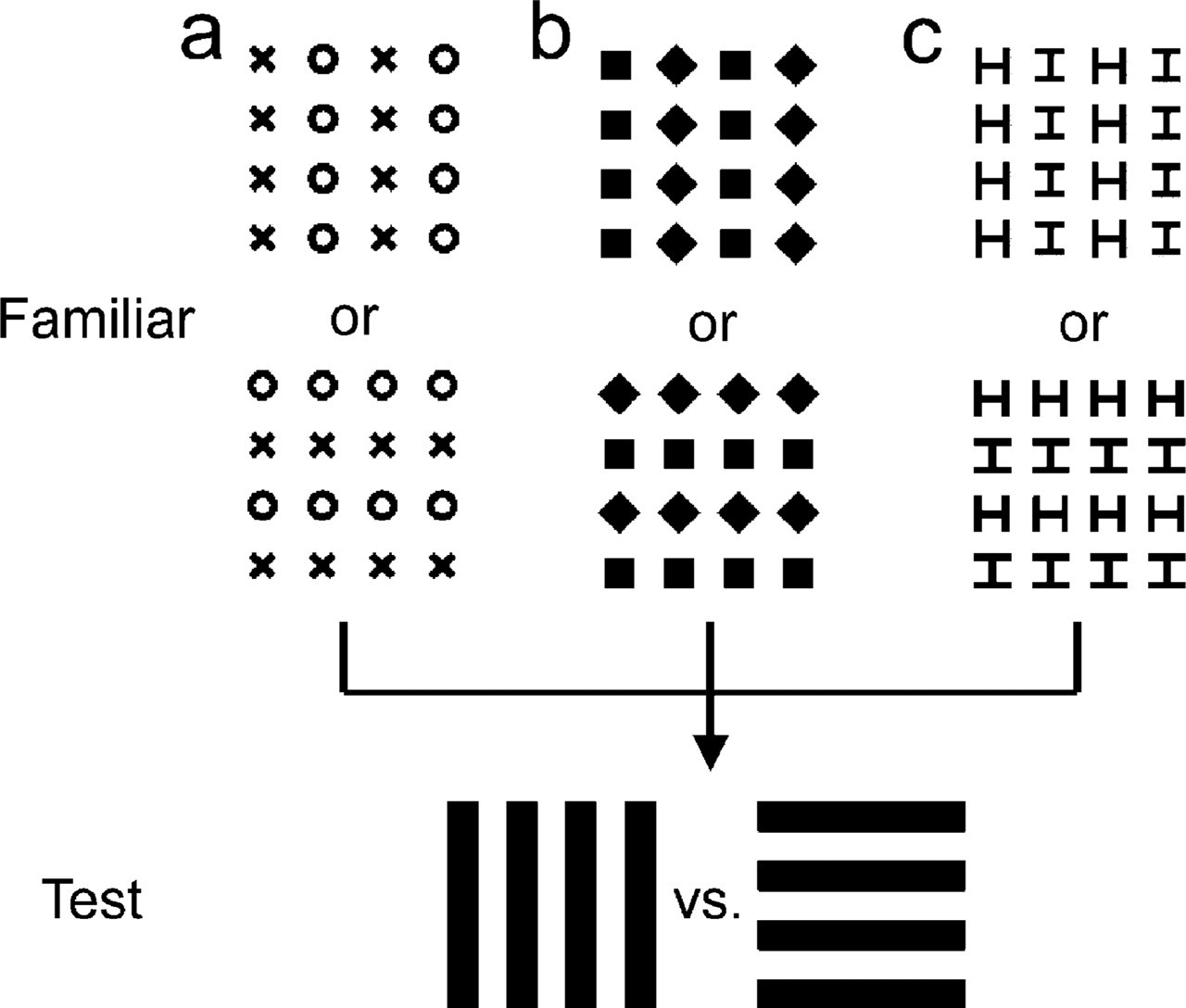
Familiarization (top) and test (bottom) stimuli used in Quinn, Bhatt, Brush, Grimes, and Sharpnack (2002) and in the present experiments. Quinn et al. used the familiarization stimuli illustrated in (a), and Experiment 1 used those illustrated in (b) and (c). Infants in Experiment 2 were familiarized with all three types of stimuli. The same test stimuli were used in Quinn et al. (2002) and Experiments 1 and 2.
The finding that only older infants can use form similarity challenges Gestalt claims that all organizational principles are automatically and equivalently applied from the first presentation of a particular pattern (Kohler, 1929). It is more consistent with models of the genesis of object perception that suggest that different Gestalt principles become functional over different time courses of development. In particular, the evidence could be interpreted to be in accord with Kellman's (1996) two-process model of unit formation, inclusive of (a) a primitive, edge-insensitive process that is available in the early weeks of life and responds to common motion (but see Slater et al., 1990) and (b) a later rich, edge-sensitive process that becomes functional at around 7 months and responds to form information. However, this interpretation is tentative, given that researchers do not know whether form similarity might be utilized by younger infants under different experimental conditions.
Given the theoretical importance of understanding the onset of infants' use of form similarity as an organizing principle for grouping visual pattern information, in the present experiments, we sought to determine whether the developmental emergence of form similarity is driven by maturation or experience by contrasting how infants perform when familiarized with a single exemplar versus multiple exemplars depicting a particular organization. As a starting point, we examined whether 3- to 4-month-olds could utilize form similarity with visual patterns composed of elements other than Xs and Os.
EXPERIMENT 1
Experiment 1 investigated whether young infants would organize displays consisting of alternating columns or rows of squares and diamonds or Hs and Is (depicted in Figs. 1b and 1c). Squares and diamonds differ in edge orientation—vertical and horizontal for squares, oblique for diamonds. Moreover, it is known that young infants are sensitive to main-axis (i.e., horizontal-vertical) versus oblique orientation differences in tasks measuring recognition memory, categorization, and visual pop out (Quinn & Bhatt, 1998; Quinn & Bomba, 1986; Quinn, Siqueland, & Bomba, 1985). In addition, 3- to 4-month-olds have been shown to discriminate square versus diamond elements (Quinn et al., 1993). For these reasons, square-diamond patterns seemed like potentially powerful enough displays of form similarity for the infants to succeed in grouping the elements into rows versus columns. Hs and Is offer advantages as contrasting elements in studies of form similarity because they are equated in terms of low-level factors such as size, number of lines, and line junctions. Elements of the H-I stimuli were identical except for a 90° rotation. Infants were familiarized with square-diamond or H-I arrays consisting of alternating columns or rows of contrasting elements and then given a novelty-preference test that paired horizontal and vertical bars (bottom illustration in Fig. 1). The square-diamond and H-I familiarization stimuli were constructed to match those in our previous study (Quinn et al., 2002), except that squares and diamonds or Hs and Is were used as individual elements instead of Xs and Os.
Method
Participants
Participants were 64 healthy 3- to 4-month-olds (32 females) with a mean age of 104.69 days (SD= 12.89 days). Six additional 3- to 4-month-olds were tested, but 5 failed to complete the procedure because of fussiness, and 1 was excluded from data analysis because of failure to compare the test stimuli. Participants were predominantly Caucasian and from middle-class backgrounds.
Stimuli
Familiarization stimuli were composed of 16 elements (8 of one type, 8 of another type) printed onto white cards in columns or rows. Square and diamond elements were 1.27 cm on a side (2.42°). For H and I elements, each line segment was 1.27 cm in length (2.42°) and 0.15 cm in width (0.29°). Center-to-center distance between elements in the horizontal and vertical planes was 2.54 cm (4.84°).
Test stimuli were composed of four black bars, each measuring 8.89 cm in length (16.50°) and 1.27 cm in width (2.42°), oriented horizontally or vertically on white cards. Center-to-center distance between bars was 2.54 cm (4.84°).
Apparatus and Procedure
We used the procedures and apparatus of our previous study (Quinn et al., 2002). Looking times to the stimuli were recorded by trained observers who were naive to the hypotheses under investigation. Two independent observers, one recording on-line and the other coding off-line from videotape records, had an average level of agreement of 93%.
Each infant was assigned to one of two groups. One group was familiarized with square-diamond elements, and the other with H-I elements. Familiarization lasted for six 15-s periods. Half the infants within each group were familiarized with columns and half with rows. For half the infants familiarized with columns, the left-most column was composed of squares (or Hs); for the other half, it was composed of diamonds (or Is). For half the infants familiarized with rows, the top row was composed of squares (or Hs); for the other half, it was composed of diamonds (or Is).
Immediately after familiarization, infants from both groups were administered the same preference test, with horizontal bars paired with vertical bars for two 10-s trials. Left-right positioning of the horizontal and vertical bars was counterbalanced across infants on the first test trial and reversed on the second test trial.
Preliminary analyses of looking times during familiarization and novelty-preference percentages during test trials as a function of familiar stimulus organization indicated that performance of infants familiarized with columns did not differ from that of infants familiarized with rows.
Results and Discussion
Familiarization Trials
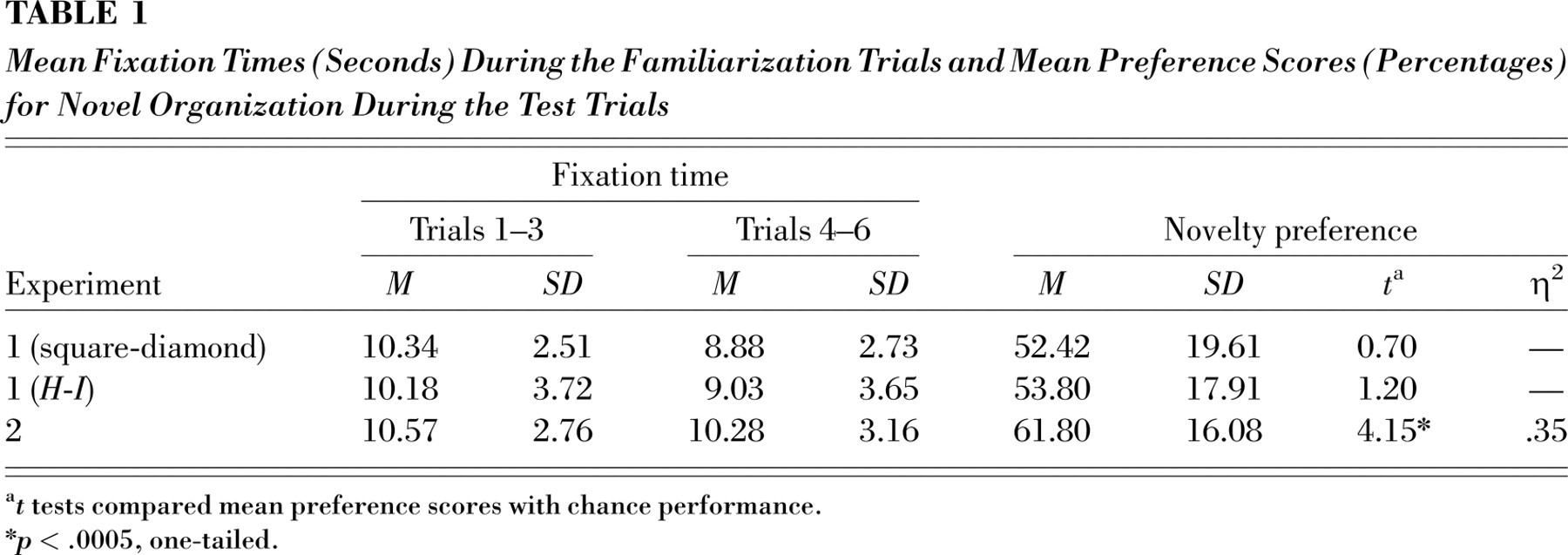
Individual looking times were summed over both stimuli on each trial and then averaged across the first and last three trials. Mean looking times are shown in Table 1. An analysis of variance (ANOVA), with factors of stimulus type (square-diamond vs. H-I) and trial block (1–3 vs. 4–6), performed on the individual scores, revealed only a significant effect of trial block F(1, 62) = 18.24, p < .001, η p 2= .29, indicating that looking time declined from the first to second half of familiarization, and suggesting that infants had habituated to the familiar stimulus information (Cohen & Gelber, 1975).
Mean Fixation Times (Seconds) During the Familiarization Trials and Mean Preference Scores (Percentages) for Novel Organization During the Test Trials
t tests compared mean preference scores with chance performance.
p < .0005, one-tailed.
Preference-Test Trials
Each infant's looking time to the novel stimulus organization was divided by the looking time to both test stimuli and converted to a percentage score. Mean preference scores are shown in Table 1. Comparison of the scores to chance (50%) revealed that neither group of infants looked reliably longer to the novel organization. Moreover, the two groups did not differ reliably from each other, t(62) = 0.29. Square-diamond and H-I patterns thus failed to elicit evidence of perceptual grouping via form similarity.
EXPERIMENT 2
In Experiment 2, we inquired whether a concept-formation version of the row-versus-column task would induce 3- to 4-month-olds to organize visual displays on the basis of form similarity. This manipulation was motivated by the report of Slater, Mattock, and Brown (1991), who observed that even newborns could represent the angular relation between simple line elements when familiarization trials presented an angle of a particular degree at varied spatial orientations. Extending this finding to the current situation, we asked whether variation in the patterns used to depict rows or columns during familiarization would enhance infants' performance in the form-similarity task. One may reason that pattern variation will facilitate performance because the invariant organization of the stimuli will be more easily detected against a changing background. In other words, variation might provide infants with the opportunity to form concepts of “rows” versus “columns.” To investigate this possibility, we repeated the form-similarity task, but in this case presented during familiarization three different patterns, each of which failed to produce organization when presented by itself—Xs and Os (Quinn et al., 2002), squares and diamonds (Experiment 1), and Hs and Is (Experiment 1).
Method
Participants
Participants were 32 healthy 3- to 4-month-olds (18 females) with a mean age of 109.84 days (SD= 9.11 days). Five additional infants were tested, but 3 failed to complete the procedure because of fussiness, and 2 were excluded from data analysis because of failure to compare the test stimuli (n= 1) and sibling interference (n= 1).
Stimuli
The X-O stimuli were those used by Quinn et al. (2002). All other stimuli were the same as those used in Experiment 1.
Procedure
Experiment 2 employed the design of Experiment 1, with the exception that during familiarization trials, each of three stimulus types (i.e., X-O, square-diamond, H-I) was presented twice and one group of infants saw a common row organization and the other group saw a common column organization across trials. When the column organization was presented, the left-most column was composed of squares or Hs or Xs on one trial, and diamonds or Is or Os on the other trial. When the row organization was presented, the top row was composed of squares or Hs or Xs on one trial, and diamonds or Is or Os on the other trial. Order of presentation of the six patterns was randomized for each infant.
Results and Discussion
Familiarization Trials
Mean looking times are shown in Table 1. A t test comparing looking times from the two blocks of trials did not reveal a reliable decrement from the first to the second half of familiarization, t(31) = 0.78. The lack of decline in looking time has been reported in previous studies of object and spatial concept formation by infants (Eimas & Quinn, 1994; Quinn, 1994), and suggests that the infants' attention was maintained by variation in the stimuli presented during familiarization.
Preference-Test Trials
Table 1 shows that the mean preference score for the novel organization was reliably above chance. Moreover, planned comparisons revealed that this score was reliably higher than that reported (a) with X-O stimuli in Quinn et al. (2002), M= 48.28, SD= 15.52, t(62) = 3.42, p < .01, η2= .16, and (b) with square-diamond stimuli in Experiment 1, t(62) = 2.09, p < .05, η2= .07, and was marginally greater than the mean preference for the novel organization exhibited with H-I stimuli in Experiment 1, t(62) = 1.88, p < .10, η2= .05. The results suggest that 3- to 4-month-olds are capable of using form similarity to organize elements if they are provided with varied examples with which to abstract the invariant arrangement of the elements.
GENERAL DISCUSSION
The results of the novelty-preference trials in Experiments 1 and 2 suggest that the developmental emergence of infants' use of form similarity as a Gestalt grouping principle is governed by experience rather than maturation. Specifically, performance of the 3- to 4-month-olds indicates that they can use form similarity to organize visual pattern information, provided they have sufficient exposure to varied exemplars that depict the organization (in this case, rows or columns). This finding is theoretically important because it demonstrates that the ability to use the principle does not have to wait until infants mature to 6 to 7 months of age (cf. Kellman, 1996).
An alternative explanation of the findings arises from the fact that infants in Experiment 2 did not display evidence of habituation during familiarization. Studies of perceptual organization with adults indicate that grouping by form similarity is more time-consuming and attention demanding than other manners of grouping, such as grouping by proximity (Ben-Av & Sagi, 1995). One could argue, therefore, that maintaining attention on the stimuli for a longer time (relative to Experiment 1), rather than experience with multiple patterns depicting an invariant organization, is what allowed infants to utilize grouping by form similarity in Experiment 2. This alternative explanation is, however, weakened by our previous finding (Quinn et al., 2002) that doubling familiarization time did not allow infants presented with X-O patterns to display sensitivity to organization by form similarity. Our previous results, in conjunction with the data reported here, suggest that the critical difference between Experiments 1 and 2 was the presentation of multiple exemplars displaying a common arrangement, rather than increased study time.
The findings suggest that the mind-brain system of young infants is not structured to organize stimuli via form similarity automatically upon initial presentation of a visual pattern (cf. Kohler, 1929). The evidence is more consistent with the view that learning may play a role in acquiring some aspects of perceptual organization (Goldstone, 2003; Spelke, 1982), and that even in young infants, grouping can operate at a high level of processing (Palmer, Brooks, & Nelson, 2003; Peterson & Gibson, 1994). “Teaching” 3- to 4-month-olds about the organization of visual patterns that could be grouped only via form similarity required variation in the stimuli depicting a consistent organization. A perceptual organization task was thus given a concept-formation component. Including diverse examples of patterns depicting a shared structure may have directed infants to extract the aspect of the stimuli that remained unchanged—the row- or columnlike organization of the elements.
Footnotes
Acknowledgements
This research was supported by National Institutes of Health Grants HD-42451 and HD-46526. We thank Marie Coffin, Victoria Simoshina, and Laurie Yarzab for their assistance, and James Cutting, Ruth Kimchi, and Alan Slater for comments on an earlier draft.