







Abstract
People spent 5 min before sleep at home writing their stream of thought as they suppressed thoughts of a target person, thought of the person, or wrote freely after mentioning the person. These presleep references generally prompted people to report increased dreaming about the person. However, suppression instructions were particularly likely to have this influence, increasing dreaming about the person as measured both by participants' self-ratings of their dreams and by raters' coding of mentions of the person in written dream reports. This effect was observed regardless of emotional attraction to the person.
Wishes suppressed during the day assert themselves in dreams.
—Freud (1900/1965, p. 590)
Freud's account of dreams is one of the most well known psychological theories. Most of us have heard a lecture—or given one—on dreams as the “royal road to the unconscious,” and through sheer familiarity we may have come to believe that thoughts avoided in waking return in dreams. Yet the logic of this theory is also famously complicated—involving repression, psychic wish fulfillment, interpretations of latent content, and more—leaving Freud's version largely untested (Erdelyi, 1985; Hobson, 1988). The present study tested an uncomplicated version of the idea: that thoughts that are suppressed in waking will recur in dreams.
Thoughts suppressed in waking do tend to return in waking. People asked to suppress an otherwise unremarkable thought have difficulty doing so, and show a subsequent rebound of that thought in self-reports of thinking (Wegner, Schneider, Carter, & White, 1987; Wenzlaff & Wegner, 2000). The suppressed thought “pops” to mind in intrusive recurrences, and measures of automatic activation show that the levels of accessibility induced by suppression even exceed those prompted by intentional concentration (Wegner & Erber, 1992; Wenzlaff & Bates, 2000).
This hyperaccessibility of suppressed thoughts in waking has been explained in terms of the theory of ironic processes of mental control (Wegner, 1994). In this view, intentional control of mental states is accomplished through the interaction of two processes—(a) a conscious and effortful operating process that attempts to create the desired mental state by searching for contents consistent with that state and (b) an unconscious and automatic ironic process that searches for mental contents indicating failure of control. For someone trying not to think about eating chocolate cake, for example, the operating process might involve effortful attempts to think of dieting, cholesterol, obesity, or, in fact, anything other than chocolate cake. The monitoring process, however, would search automatically for forbidden thoughts of chocolate cake. Suppressed thoughts become more accessible under mental load because load undermines the operating process while allowing the ironic process to continue unimpeded (Wenzlaff & Wegner, 2000). The automatic search for failures in mental control may, under conditions of mental load, function to create such failures.
Ironic-process theory suggests that suppressed thoughts might recur in dreams more than would other presleep waking thoughts. This inference follows from evidence that dream states (marked by periods of rapid eye movement, or REM) are accompanied by deactivation of areas of the prefrontal cortex that underlie executive and working memory functions in waking (Braun et al., 1997; Hobson, Pace-Schott, & Stickgold, 2000; Muzur, Pace-Schott, & Hobson, 2002). Such prefrontal areas could play a role in supporting the mental-control operating process (Mitchell, Heatherton, Kelley, Wyland, & Macrae, 2003). Their deactivation could allow greater influence by ironic processes, and hence, lead to increased accessibility of suppressed thoughts in dreams. So, although dreams sometimes contain “day residue”—direct echoes of prior waking experience (e.g., Cohen, 1972; Hartmann, 1968; Stickgold, Malia, Maguire, Roddenberry, & O'Connor, 2000)—they might be yet more likely to include residue of thoughts that have been intentionally suppressed.
Indirect evidence for the dream rebound of suppressed thoughts comes from dreams people report after experiences that naturally prompt thought suppression. People often suppress thoughts of traumatic events, for example, and such events are often reflected in dreams (Mellman, David, Bustamante, Torres, & Fins, 2001). Similarly, thought suppression is a common strategy for self-control, and people engaged in self-control often have dreams of the controlled item. Abstaining smokers report dreams of smoking (Hajek & Belcher, 1991), and crack-cocaine users report dreaming of drug use during abstinence as well (Reid & Simeon, 2001).
Emotional thoughts might also prompt suppression, so the abundance of emotional thought in dreams (Neilson, Deslauriers, & Baylor, 1991; Revonsuo, 2000) could be interpreted as supporting the idea that suppressed thoughts rebound in dreams. Topics of thought that return frequently to mind and that are associated with emotional experience have been called “current concerns” (Nikula, Klinger, & Larson-Gutman, 1993)—and these recur in dreams and are easily prompted in dreams by presleep suggestions (Nikles, Brecht, Klinger, & Bursell, 1998; Saredi, Baylor, Meier, & Strauch, 1997).
The evidence for a role of prior suppression in dreams remains indirect, however, because of the natural confounding of emotion and spontaneous suppression. We cannot be certain that it is suppression, and not emotion, that prompts the dream return of emotional thoughts, even though emotional thoughts may have been spontaneously suppressed, because emotion and suppression regularly co-occur. To disentangle these influences, this study tested whether instructed thought suppression (Wegner, 1989; Wenzlaff & Wegner, 2000) would orient dream content to the suppressed thought regardless of whether the thought was emotionally charged. Participants nominated an emotional thought (of a “crush,” someone to whom they were romantically attracted) and an unemotional thought (a “noncrush,” someone to whom they were not attracted; cf. Wegner & Gold, 1995).
Participants then engaged in one of three presleep thought exercises directed toward one of the targets: trying not to think about the target (suppression), thinking about the target (expression), or thinking about anything at all after noting the target's identity (mention). Expression was included to allow examination of the influence of focused presleep attention to the target, as in prior studies (e.g., Saredi et al., 1997). Mentioning was included as a comparison condition for examining the influence of minimal content priming of the thought without any intentional mental control (Wenzlaff & Wegner, 2000). Dream reports and ratings collected the next morning were examined for indications of thoughts about each target.
METHOD
Participants and Design
Undergraduates from the University of Texas at San Antonio (202 women and 128 men, mean age=20.36 years) participated for credit in an introductory psychology course. Each was randomly assigned to a condition of a 3 (instruction: suppression, expression, or mention)×2 (instruction target: crush vs. noncrush) design.
Procedure
Participants received the study materials in sealed envelopes and were asked to wait until they were ready for bed that night to open the envelope and begin. For the presleep task, participants were asked to think of two people in their lives, a “crush” and a “noncrush.” A crush was described as “a person you have never been in a romantic relationship with—but whom you have thought about in a romantic way,” a real person as opposed to someone famous or fantastical. A noncrush was described as “a person you feel fondly about, but to whom you are not attracted.” Participants identified each person by initials, rated their attraction to the person on a 7-point scale (from not at all attracted to extremely attracted), and then engaged in a thought task.
For the suppression task, participants were asked to suppress thoughts of one of the targets for 5 min: “Try
When participants opened the packet in the morning, they were asked to record all dreams from the night. They also rated how much they had dreamed and how much they felt they had dreamed about their crush and noncrush. Although 16 participants reported drinking alcohol the evening before (M=3 drinks), such reports did not differ by condition or interact when added to the design, so these participants were retained in the analyses. One of two raters blind to condition and the hypotheses coded the stream-of-consciousness reports and dream reports for number of mentions of the crush and noncrush, and also rated emotional intensity, valence, and eroticism of the dreams. The effective reliability of these codings and ratings was a minimum of .93 across all variables in a subsample of 19 participants.
RESULTS
Manipulation Effectiveness
Emotional response to the targets was assessed by ratings of attraction that had been gathered when the targets were nominated. A 3 (instruction)×2 (target) analysis of variance (ANOVA) indicated that participants rated their attraction to crushes (M=5.80 on a scale from 1 to 7) much higher than their attraction to noncrushes (M=3.14), F(1, 327)=407.13, p<.001, η2=.56.
The effectiveness of the presleep instructions was assessed by analysis of the number of check marks indicating target thoughts in the stream-of-consciousness reports. Check-mark frequency differed among instruction conditions, F(2, 327)=24.12, p<.001, η2=.13, with expression yielding more (M=5.39) than suppression (M=2.87) or mention (M=2.55), p<.05 in each case (Newman-Keuls); the suppression and mention conditions did not differ. References to the target in the stream-of-consciousness protocols showed a different pattern, F(2, 327)=6.48, p<.005, η2=.04, with more references prompted by mention (M=1.04) and expression (M=0.72) than by suppression (M=.27), p<.05 in each case. By both measures, though, suppression yielded relatively low levels of thought occurrence.
For all subsequent analyses, the inclusion of gender of participant and, when appropriate, rater as variables in the design yielded no significant effects, so these analyses are not presented.
Dream Self-Ratings
On a 5-point Likert scale, participants rated whether they had dreamed during the night (“I dreamed last night”). Responses of the 87.7% of participants who did not disagree with this statement (responding “neutral,”“agree,” or “strongly agree”) were retained for analysis.
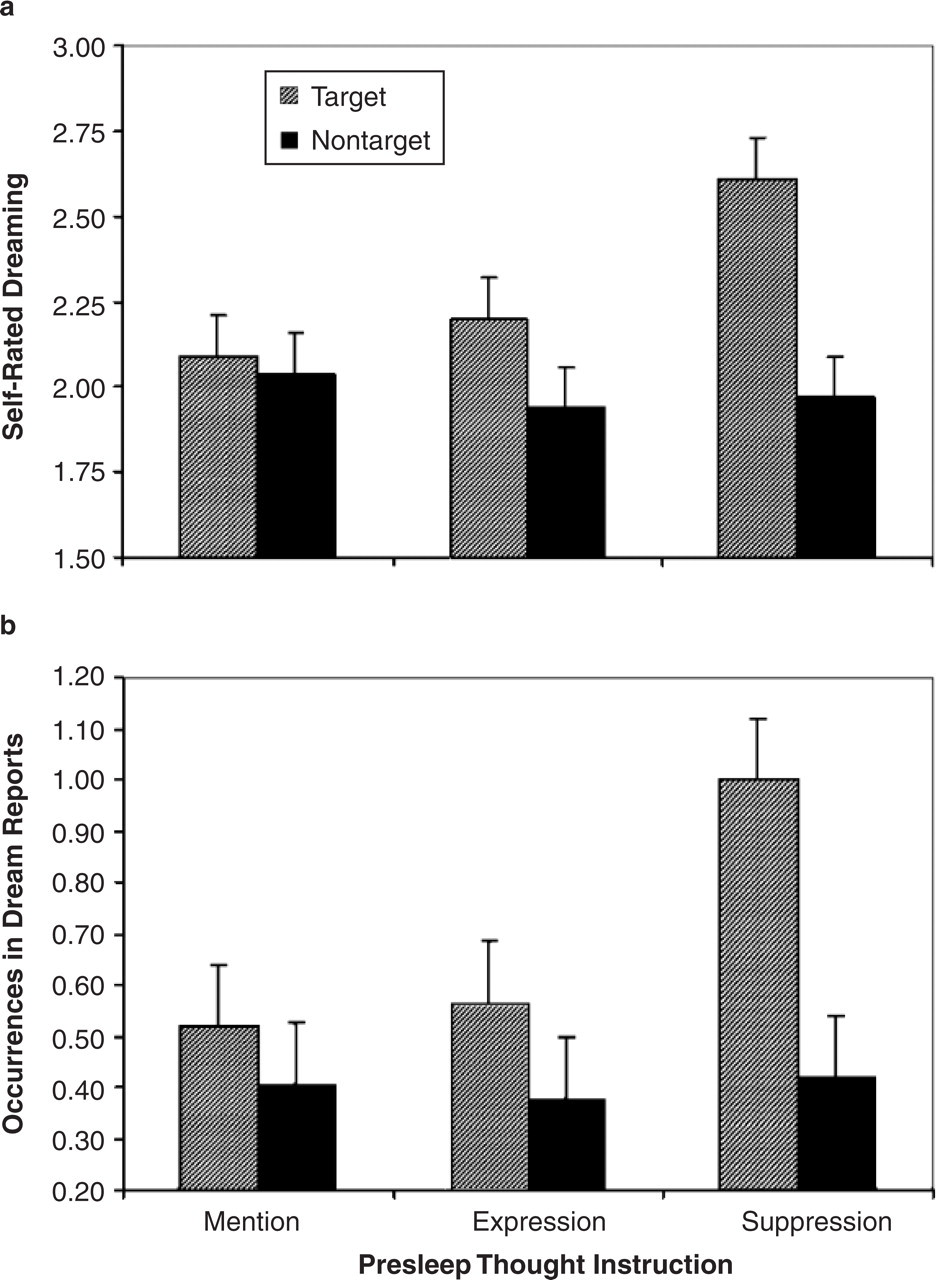
Dreaming about the target and nontarget persons as a function of presleep thought instruction: mean self-ratings (on a scale from 1 to 5) of whether the person appeared in the previous night's dreams (a) and mean number of coded mentions of the person in dream reports (b). Error bars show standard error.
Self-ratings of dream content showed a significant influence of presleep task. Five-point Likert ratings of “I definitely dreamed about my crush (noncrush)” were examined in a 3×2×2 ANOVA varying instruction condition (suppression, expression, mention) and instruction target (crush vs. noncrush), with repeated measures on person rated (instruction target vs. nontarget). There was an effect of person rated, with more reported dreaming about the instruction target (M=2.19) than about the nontarget (M=1.91), F(1, 290)=14.46, p<.001, η2=.05.
The special influence of suppression appeared in an interaction between instruction condition and person rated, F(2, 289)=4.23, p<.02, η2=.03 (see Fig. 1a). Simple effects analysis revealed that suppression increased rated dreaming about the target (M=2.61) compared with the nontarget (M=1.97), F(1, 289)=17.17, p<.001. Expression increased dreaming about the target (M=2.20) only marginally compared with the nontarget (M=1.94), F(1, 289)=3.58, p<.06, and mention had no significant effect. The simple effect of instruction was not significant for nontargets, F(1, 289)<1, but was significant for targets, F(1, 289)=4.79, p<.01. Individual contrasts indicated that the suppressed target (M=2.61) was dreamed about more often than the expressed target (M=2.20), F(1, 289)=4.77, p<.05, or the mentioned target (M=2.09), F(1, 289)=8.77, p<.005, but that rated dreaming for expressed and mentioned targets did not differ, F(1, 289)<1.
The only other effect in this analysis was an uninformative interaction of instruction condition and target, F(2, 289)=9.55, p<.002, η2=.03. It is noteworthy that the interaction of instruction, target, and person rated was not significant, F(2, 289)<1, indicating that the effect of presleep suppression on self-rated dreaming about the target did not occur differentially for the crush and noncrush. In sum, the emotional quality of the target did not impinge on the more general influence of suppression on dream rebound.
Dream Reports
Length of the dream reports averaged 85.9 words (SD=90.6), but did not vary reliably by condition. Coding for mentions of persons showed a significant influence of person coded, F(1, 269)=10.22, p<.002, η2=.04, with more references to the instruction target person (M=.68) than the nontarget (M=.39). There was also an interaction of instruction target and person coded, F(2, 269)=8.92, p<.005, η2=.03. Presleep tasks about a target increased dream references more when the target was the crush than when the target was the noncrush (Ms=0.88 vs. 0.51), whereas when the person being coded was not the target of a presleep task, the crush was noted less than the noncrush (Ms=0.31 vs. 0.49).
Finally, and pertinent to our hypothesis, there was a marginal interaction between instruction condition and person coded, F(2, 269)=2.38, p<.10, η2=.02. This interaction was expected, and paralleled that for self-ratings, so it was explored for simple main effects. Following suppression, dream reports included more references to the target person (M=1.00) than to the nontarget (M=0.42), F(1, 269)=10.25, p<.005 (see Fig. 1b). References to target and nontarget did not differ following expression or mentioning. References to the target also showed a significant simple effect of instruction, F(2, 269)=3.46, p<.05, and individual contrasts showed that a suppressed target (M=1.00) occurred in reports more often than an expressed target (M=0.56), F(1, 269)=4.02, p<.05, or a mentioned target (M=0.52), F(1, 269)=5.95, p<.02, but that number of references to expressed and mentioned targets did not differ, F(1, 269)<1. No simple effect of instruction was found for nontarget references. There was no interaction of instruction, target, and person coded, F(2, 269)<1, so suppression increased dream reports of the suppression target regardless of the target's emotional valence.
Overall, 28.8% of participants dreamed about the target, whereas 17.1% dreamed about the nontarget. Prevalence of target dreams was 34.1% following suppression, 28.2% following expression, and 24.3% following mentioning. Prevalence of nontarget dreams in these conditions, respectively, was 19.1%, 16.5%, and 15.8%.
Dream reports were also coded for emotional intensity, emotional valence, and eroticism. No significant effects were found for intensity or valence, but one interesting indication was observed in the analysis of eroticism—an interaction of instruction and target, F(2, 261)=3.14, p<.05, η2=.02. Although simple effects analyses indicated no specific significant differences, the means were arrayed such that suppression enhanced eroticism of dreams of the crush relative to the noncrush (M=1.20 vs. 1.05), whereas no enhancement occurred in the expression condition (Ms=1.06 vs. 1.15) or mention condition (Ms=1.01 vs. 1.07).
DISCUSSION
This experiment demonstrated that presleep references to a person prompted people to report dreaming about that person. However, instructions to suppress thinking about the person were particularly likely to have this influence, increasing dreaming about the person as measured both by participants' self-ratings of their dreams and by raters' coding of mentions of the person in written dream reports. Apparently, the enhanced accessibility of thoughts that results from thought suppression transfers even to dreams.
The influence of the emotional quality of the target person was muted. Although presleep focus on a target increased references to the target in dream reports more when the target was a crush than when the target was a noncrush, there was no main effect of emotional attraction to the target on dream self-ratings or reports. Such emotionality also did not interact with presleep instructions, suggesting that the influence of thought suppression on dream rebound was independent of emotional attraction to the target person. In this sense, Freud's hypothesis that suppressed wishes assert themselves in dreams is only partly true: Suppressed thoughts apparently assert themselves in dreams whether they are about wished-for targets or not.
The rebound of suppressed thoughts in dreams may be interpretable in terms of the influence of changes in brain activation during REM sleep on mental control processes. The relative deactivation of prefrontal areas associated with executive control that occurs during dreaming (Braun et al., 1997; Hobson et al., 2000; Muzur et al., 2002) could undermine the effectiveness of the suppression operating process, thereby releasing the ironic process to increase the accessibility of the suppressed thought (Wegner, 1994). This hypothesis is not without alternatives, however, as the multiple brain changes that accompany REM sleep could influence mental control processes in other ways. For example, the finding that weak semantic associations are generally more accessible during post-REM awakenings than at other times (Stickgold, Scott, Rittenhouse, & Hobson, 1999) suggests that brain activation in dreaming might enhance weak ironic monitoring processes independently of any attenuation of operating processes. Furthermore, anterior cingulate activation appears both to accompany operating-process functioning (Mitchell et al., 2003) and to be enhanced in REM sleep (Braun et al., 1997), suggesting that operating processes may not be fully disabled in dreaming. A full accounting of suppression influences on dreaming may involve more than the deactivation of the operating process.
Regardless of the eventual explanation of dream rebound, the influence of thought suppression observed in this study has key implications for theories of dream content. For example, Revonsuo (2000) has made a case for an evolutionary account of the function of dreaming. According to this threat simulation theory, the frequent and widespread occurrence of threatening themes in dreams might be the function of a system that rehearses threat-survival skills during sleep. This theory becomes less compelling, however, in view of the finding that suppressed thoughts return in dreams. It may be that the common practice of suppressing threatening thoughts during waking (Wegner, 1989) is sufficient by itself to introduce pervasive threat themes in dreaming. Any functional utility of threat dreams may be no more than a by-product of the pursuit of mental peace in waking.
The finding that suppression can influence dream content also suggests that a strong version of the activation-synthesis theory of dreaming (Hobson & McCarley, 1977) may need modification. This theory holds that dream content is created by brain processes attempting to interpret random activations, and that such content is thus not clearly traceable to prior events or cognitive processes. The present results pose an exception to such a generalization, and are more consistent with the updated theory—the activation-information-mode (AIM) model (Hobson et al., 2000)—which accepts some influence of information accessed during waking on the dream synthesis process. Although there remains much to be learned about how dreams are formed, the finding that suppressed thoughts rebound in dreams provides a bridge linking an early insight of psychoanalysis to the discoveries of cognitive neuroscience.
Footnotes
Acknowledgments
We thank Stephanie Keller, Jessica Bubenik, and David Luxton for their assistance, and Robert Stickgold for his helpful advice. The research was funded by National Institute of Mental Health Grant MH49127.