







Abstract
Where do social norms come from? Part of the answer must surely lie in such norms' ability to support individual adaptive success in local ecologies. This theme is dominant in analyses of social behavior by economic game theorists and behavioral-ecology researchers, but it has been neglected by psychologists. An illustration of the methods and advantages of the adaptationist approach to understanding the emergence of social norms is provided. Some surprising behavioral results from modern industrial societies that reflect social-sharing norms of modern hunter-gatherer societies are consistent with our adaptive analysis.
The concept of social norms is one of the most central theoretical constructs in the social sciences—including sociology, law, political science, anthropology, and increasingly economics (e.g., Axelrod, 1986). But its status in modern psychology has been less firm, and the notion of social norms has been criticized for not being able to predict behavior in some real, complex social contexts. We find the peripheral status allotted to social norms in psychology to be conceptually inappropriate. We want to return this venerable, fundamental construct to its proper central role in social-psychological theories.
We propose a general unifying theme for research on social behavior, one that is familiar in the other behavioral sciences (see Cosmides & Tooby, 1992, and Gigerenzer, Todd, & the ABC Research Group, 1999, for similar proposals in evolutionary psychology and in judgment and decision making): Most important social behavior can be understood as an adaptive response that achieves high levels of individual welfare (or an equilibrium accruing from self-interested individual strategic choices). This theme of adaptive functionality comes with a collection of theoretical methods—most notably, in the present application, game theory. The remainder of this essay describes an illustrative application of evolutionary game theory to explain the development of a social norm for communal sharing. This is a norm about social exchange, designating uncertain resources as common goods to be shared with other members of a social group. We conclude with some surprising manifestations of this norm in modern social life.
THE COMMUNAL-SHARING NORM IN HUNTER-GATHERER SOCIETIES
Sharing important resources, such as food, with non-kin associates is a general practice in human societies. Although a primitive form of food sharing is known in some primates (de Waal, 1996), no primates other than humans have broad social-sharing habits. Anthropologists have studied social exchange and sharing in various hunter-gatherer societies to explore its origins and early forms. Kaplan and Hill (1985) observed that food transfers among the Ache foragers, who live in subtropical eastern Paraguay, show markedly different patterns between hunted meat (e.g., peccary) and collected resources (e.g., vegetables). While some collected resources are shared with non-family members, hunted meat is much more likely to be the target of communal sharing (see Gurven, 2004, for worldwide ethnographic examples including forager-agriculturalists as well as hunter-gatherers). Because kin-sharing is a universal practice across many species (Hamilton, 1963), the central question here is why hunted meat is shared communally beyond the acquirer's direct kin and why different sharing norms apply to different resources within the same culture.
Kaplan and Hill (1985) explained these differences in terms of the degree of uncertainty involved in resource acquisition. While provision of vegetables and fruits is relatively stable and dependable, acquisition of meat is a highly variable, uncertain prospect. On average, there is a 40% chance that an Ache hunter will come back from a hunt empty-handed. It is essential for the Ache to manage the variance associated with meat acquisition, securing a stable supply of the precious resource. Storage by freezing or other preservation methods is not efficient in a hunter-gatherer situation. Kaplan and Hill (1985) argued that, instead, the sharing system functions as a collective risk-reduction device. By including many individuals in the risk-pooling group, the variance in meat supply decreases exponentially. Once established and maintained, the communal-sharing system can buffer the variance in the meat supply.
EVOLUTIONARY COMPUTER SIMULATIONS
Problem of Egoism
The risk-reduction hypothesis is a functional explanation; the communal-sharing system serves the survival of the whole group. Yet, from the adaptationist perspective that focuses on fitness outcomes to each individual, this explanation leaves one critical question unanswered: the problem of egoism in social dilemmas (Dawes, 1980). Hunted meat, especially when a large portion is acquired, is regarded as a common property in most hunter-gatherer societies; the process of meat distribution is treated as appropriation from the public domain. Then, what if some individuals behave as egoists who share in other people's acquisitions but are unwilling to share their own acquisitions with others? Such egoists might be better off in terms of individual fitness than are those who are loyal to the communal-sharing norm. If so, the Darwinian logic implies that such egoists would proliferate in a group, eventually dominating the group. The risk-reduction explanation is incomplete, because it is silent about how the proliferation of such egoists is suppressed.
Evolutionary Games
Social dynamics as illustrated above are analogous to biological competition for an ecological niche in that a behavioral trait that produces the highest fitness outcomes spreads and eventually dominates in a population. Biologists and economists have developed a mathematical tool, evolutionary game theory, for modeling such adaptive dynamics (Maynard Smith, 1982; Gintis, 2000). Evolutionary game theory is different from classical game theory in that it does not assume that players possess perfect information; instead, it represents various behavioral tendencies as strategies in a game and examines how each strategy performs against other strategies in terms of net profit. Even though a given strategy may be limited by players' information-processing capacity, it proliferates gradually in the population if it can perform better than the other strategies.
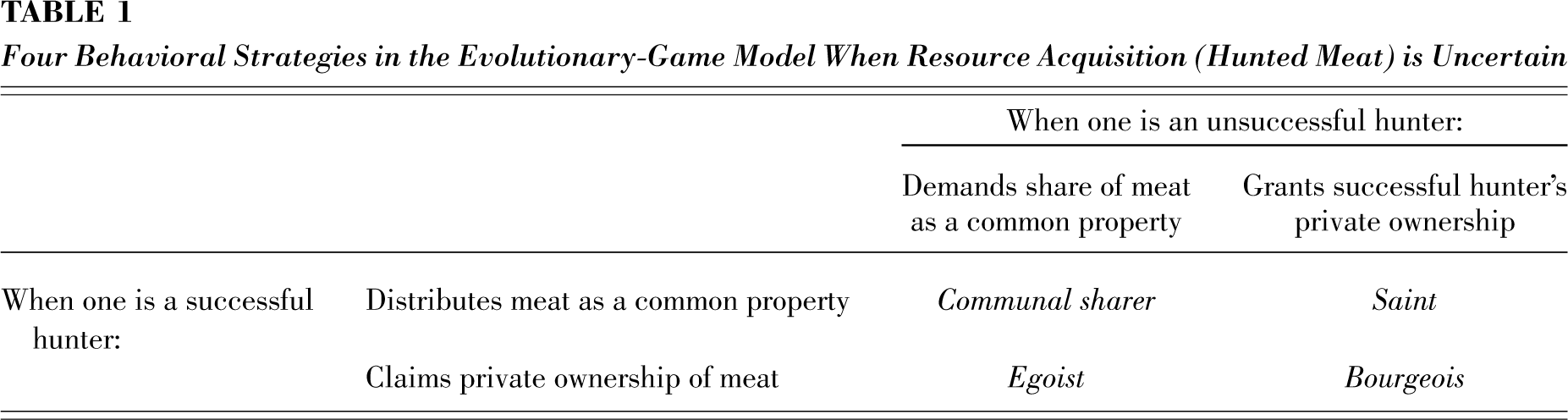
We (Kameda, Takezawa, & Hastie, 2003) developed an evolutionary-game-theory model for the emergence of communal-sharing norm when foraging under conditions of uncertainty. Our model assumed that, due to the highly uncertain nature of meat acquisition, an individual hunter constantly faces two kinds of decision problems: How to behave when successful and how to behave when unsuccessful. This analysis yields the four mutually exclusive and exhaustive behavioral strategies depicted in Table 1; each individual in a group is assumed to behave according to one of these strategies. The model also posited that, due to the highly uncertain nature of hunting, acquisition of meat by some members yields a large asymmetry in resource level between haves and have-nots (cf., the “twists of fate” situation as conceived of by Kelley et al., 2003). A hunter's attempt to monopolize the meat under such situations can lead to fights with other community members who demand communal sharing, incurring a cost to each loser. The theoretical question then becomes whether the “communal sharers,” the purest supporters of the sharing ideology (see Table 1), outperform other types of members (“egoists” in particular) in fitness. If communal sharers perform well, the evolutionary logic implies that they will proliferate and dominate in the group, resulting in the establishment of a communal-sharing system.
Four Behavioral Strategies in the Evolutionary-Game Model When Resource Acquisition (Hunted Meat) is Uncertain
Computer Simulations
A series of evolutionary simulations in which model parameters (group size, resource value, fighting cost) were varied systematically revealed the following results. First, even when communal sharers were introduced as a rare “mutant” strategy into an egoist-dominant group, they overcame the initial handicap in frequency and dominated the group rather quickly, within a few hundred iterations (“generations”). Second, once dominant, the communal sharers continued to outperform any other mutant strategies (egoists, saints, bourgeois; see Table 1) in fitness, thus blocking their intrusions into the group. In all simulation runs, the dominance of communal sharers continued over thousands of generations.
In terms of evolutionary game theory, these results imply that communal sharing is an evolutionarily stable strategy. The egoist strategy does not qualify as such, because egoists' attempts to defend their own acquisitions against many “have-nots” (including other egoists who were unsuccessful) tax them heavily in fighting costs. But how sensitive is this result to model parameters such as group size, resource value, and fighting cost? A sensitivity analysis, whereby we varied the parameters systematically, revealed that the communal-sharing strategy was indeed robust. For instance, except in rather unrealistic conditions in which the cost of potential injury accruing from a fight was essentially nonexistent (i.e., smaller than 0.3% of the resource value), the communal-sharing strategy always qualified as an evolutionarily stable strategy. In other words, the communal-sharing norm emerged and was sustained under a broad range of parametric conditions as a result of individual fitness maximization, while overcoming the problems of egoism and free-riding in norm enforcement (Axelrod, 1986; Yamagishi, 1986).
SOME REMARKABLE REFLECTIONS OF THE COMMUNAL-SHARING NORM IN INDUSTRIALIZED SOCIETIES
Resource-Specific Altruism?
Our arguments so far are ecological: An adaptive strategy (e.g., communal sharing) should emerge in response to a local ecology (e.g., a hunter-gatherer environment). However, given that uncertainty in resource supply was a recurrent adaptive problem in the environments in which the ancestors of modern humans evolved (Cosmides & Tooby, 1992), it is likely that human minds are equipped with evolved algorithms dealing with resource uncertainty and sharing. People's reactions to “windfall profits” may provide a case in point: People use windfall money, more often than money acquired by labor, for altruistic purposes such as treating friends or donating to charities. Although the fungible resource under consideration in both cases is the same (money), different habits seem to be triggered depending on how the resource is acquired. A common explanation for this phenomenon has been provided by a labor theory of value (“money earned without making effort has little value”). However, our evolutionary-game-theory analysis suggests the key factor triggering sharing may be the uncertainty associated with the acquisition of the resource, rather than the absence of effort. As Cosmides and Tooby (1992) noted, it may be the case that “information about variance in foraging success should activate different modes of operation of these algorithms, with high variance due to chance triggering a psychology of sharing” (p. 213).
We (Kameda, Takezawa, Tindale, & Smith 2002) tested this possibility by conducting vignette experiments in which the uncertainty factor was manipulated independently of the effort factor. Japanese and American participants were provided with a series of hypothetical scenarios in which they (or a friend) obtained some money, either (a) contingent on investing substantial effort, (b) unexpectedly but after investing substantial effort (i.e., low contingency between effort and outcome; chance was another key factor for success, yielding high outcome variance in the situation), or (c) unexpectedly with almost no effort. Participants were then asked to rate their willingness to share the money with a friend (or the extent to which they would demand some share from a friend). Both Japanese and American participants were more willing to share (and demand more sharing for) the unexpected money, even when the amount of effort invested was identical for expected and unexpected gains. More importantly, these differences were significant, even when personal ideologies about desirable distribution were controlled for. Endorsers of merit-based ideology and of egalitarian ideology were both affected by the uncertainty factor. This was also confirmed by a laboratory experiment (Study 4 in Kameda et al., 2002). After being paid for their work during the experiment, participants were solicited to donate some money to help participants in another, unrelated experiment. Even though they had received the identical amount of money for the identical amount of work, participants whose final rewards were determined in a random manner by using a roulette wheel of fortune made a greater donation than those who were rewarded in a deterministic manner. Notice that the modern notion of property rights makes no distinction between the legitimacy of entitled ownership between these two conditions.
Social-Class Differences
The game-theoretic analysis shows that the communal-sharing norm is adaptive in an uncertain environment, not only for the group but also for the survival of each individual. However, the relevance of such a communal-sharing norm may seem inconsequential to us, living in modern societies in which various buffers operate to manage uncertainty about resources (e.g., pension funds, health insurance). Yet, the availability of such buffers may differ across individuals within the same society, along with the availability of other defenses against uncertain fate (e.g., personal wealth, education). Compared to white-collar citizens, blue-collar citizens have less access to such buffers and are more susceptible to injury from various life uncertainties. An egalitarian system, based on a distributive ideology dictating equal allocation of resources regardless of members' different production levels, could buffer some of the direct damages that unexpected life events inflict on individual welfare (as argued by Kaplan and Hill, 1985) but may be endorsed differently by different groups. Specifically, preference for such a system should be stronger among blue-collar people than among white-collar people.
We conducted a survey to assess this hypothesis with students from seven Japanese universities, asking their personal endorsement of the egalitarian ideology over a merit-based ideology of resource allocation. The proportion of egalitarian-ideology endorsers differed substantially across the schools, ranging from 63% to 83%. How can we explain these differences? Although these universities differed along many dimensions, including urban versus rural, size of the student body, private versus public, and so on, only one factor was correlated with the differences in the proportion of egalitarians—the social rank of the university. Students in the less prestigious schools, who tended to be from the working-class families, endorsed the egalitarian ideology at higher rates. The correlation between the social rank of the university and the proportion of egalitarian-ideology endorsers was substantial (r=−.85). Although more rigorous follow-up is certainly needed, the preliminary result suggests that different distribution ideologies may evolve culturally, depending on availability of personal risk buffers.
CONCLUSION
Our analysis suggests that norms, such as those controlling social sharing, emerge as a function of individual fitness maximization. Although new to psychology, evolutionary or adaptive modeling can serve as a powerful theoretical tool to study how sociocognitive systems develop. Along with more traditional approaches that describe proximate psychological mechanisms of norm-related behavior (Cialdini & Trost, 1998), game theory can provide a complementary understanding of social behavior. For instance, evolutionary game theory should help us understand other social norms including those governing intergroup relations, marriage, group performance, and group decision making, just to name a few. Careful analysis of ecological conditions, including individuals' access to social information (e.g., reputation), social mobility, opportunities for sanctioning, and so on, will be important initial steps in such endeavor.
The more general message of this article is that many important social habits support adaptive responses to local ecologies. Given the fundamental fact that we are a group-living species, this metatheoretic perspective highlights the importance of examining interdependence structures that exist among people, including many variants across different task domains and cultures (Kelley et al., 2003). Game-theoretic reasoning, as we have employed it in this paper, will be an indispensable tool in such an endeavor, and perhaps these insights will be the basis for fruitful connections between psychology and the other social sciences.
Footnotes
Acknowledgements
Writing of this paper was supported by the Grant-in-Aid for Scientific Research 14310048 from the Ministry of Education, Culture, Sports, Science and Technology of Japan to the first author.