






Abstract
When do high-tech environments promote learning? The goal of this article is to offer one answer to this question by examining the classic distinction between media and method, in terms of their roles in promoting learning with technology. To this end, I first propose a cognitive theory of learning with media, from which a set of instructional design principles are derived. Then I review research in which the relative learning contributions of method and media are investigated, and I offer final reflections for future research.
All instructional technologies share a common purpose: to improve learning. However, until recently, there has been no theoretical or empirical framework to guide their design. The goal of this article is to provide such a framework by proposing a cognitive theory of learning with media (CTLM) and to review relevant research in support of such a theory. Due to the variety of technologies used in learning, a useful first step in examining their role is to make the classic distinction between media and methods (Clark, 1983). Whereas the former refers to the physical systems or vehicles used to deliver the information—such as face-to-face interaction, textbooks, or desktop computers—the latter refers to techniques that are embedded in different media to promote learning—such as multimedia or discovery methods. Consequently, media and methods can be combined in different ways. For example, some instructional technologies utilize identical methods but are delivered with different media. This is the case when using a multimedia method (i.e., combining words and pictures), which may be delivered in a textbook or a computer program. Similarly, there are technologies that use identical delivery media but vary in the type of instructional methods. For example, desktop instructional games may utilize direct-instruction or discovery methods.
What are the roles of media and method in instructional technology? Two conflicting hypotheses have been offered to answer this question (Moreno & Mayer, 2002). According to the media-affects-learning hypothesis, more advanced instructional technologies promote deeper learning, regardless of the instructional method. This hypothesis is consistent with 20th-century efforts to integrate newer technologies—such as motion picture, radio, television, and computers—into education and is based solely on the assumption that state-of-the-art technologies are more effective learning tools than older technologies are. Conversely, the method-affects-learning hypothesis states that as long as the instructional methods embedded in the media promote appropriate cognitive processing during learning, the type of media delivering the method does not matter. The next section presents a theoretical framework to help understand whether and in what ways methods and media affect learning.
A CTLM
The goal of this section is to describe the cognitive aspects of learning with media, based on empirical evidence and widely agreed-on principles in cognitive science. More specifically, the CTLM draws from the popular cognitive theory of multimedia learning (Mayer & Moreno, 2003) and is based on the following explicit learning assumptions: (a) Learning starts when information is processed in separate channels for different sensory modalities; (b) only a few pieces of information can be consciously processed at any one time in working memory; (c) long-term memory consists of a vast number of organized schemas; (d) knowledge may be represented in long-term memory in verbal and nonverbal codes; (e) after being sufficiently practiced, schemas can operate under automatic processing; and (f) conscious effort needs to be spent in selecting, organizing, and integrating the new information with existing knowledge (i.e., active processing). Figure 1 presents a model of explicit learning with media according to a CTLM.
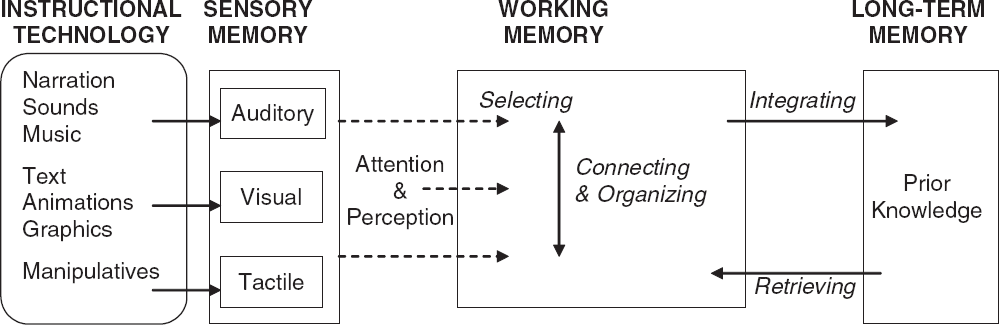
A cognitive theory of learning with media. Instructional media consist of verbal explanations (in speech or writing) or nonverbal information (e.g. visual, auditory, or tactile representations) entering the learner's sensory memory. Learners then perceive and attend to the multiple information sources within their working memory, the limited capacity and duration of which demands that they select only a few pieces of information at any one time for further processing. Working-memory limitations also force learners to make decisions about how to connect selected pieces of information with each other and how to organize and integrate this information with their prior knowledge. These processes are guided by information retrieved from long-term memory or by external guidance.
As shown in the figure, the instructional media may consist of explanations entering the learner's auditory or visual sensory memory, depending on whether the explanations are presented in speech or writing, respectively. In addition, the media may include nonverbal information in the form of tactile, acoustic, visual, or other-sensory knowledge representations. Once the different stimuli have entered the corresponding sensory channels, learners need to attend to the multiple information sources within a working memory of limited capacity and duration. That is, learners will only select a few pieces of information in their working memory at any one time for further processing. Working-memory limitations will also force learners to make decisions about how to connect selected pieces of information with each other and how to organize and integrate this information with their prior knowledge. These processes are guided either by information in long-term memory, which learners retrieve to make sense of the new information, or by external guidance. The outcome of active learning is the construction of a mental model of the system to be learned. Once the learned information is organized and integrated in learners' long-term memory, it can later be retrieved and used as a schema within working memory for further learning. Eventually, with sufficient practice, the new schema is retrieved automatically, thus requiring minimal working-memory resources.
EMPIRICALLY BASED PRINCIPLES OF INSTRUCTIONAL DESIGN
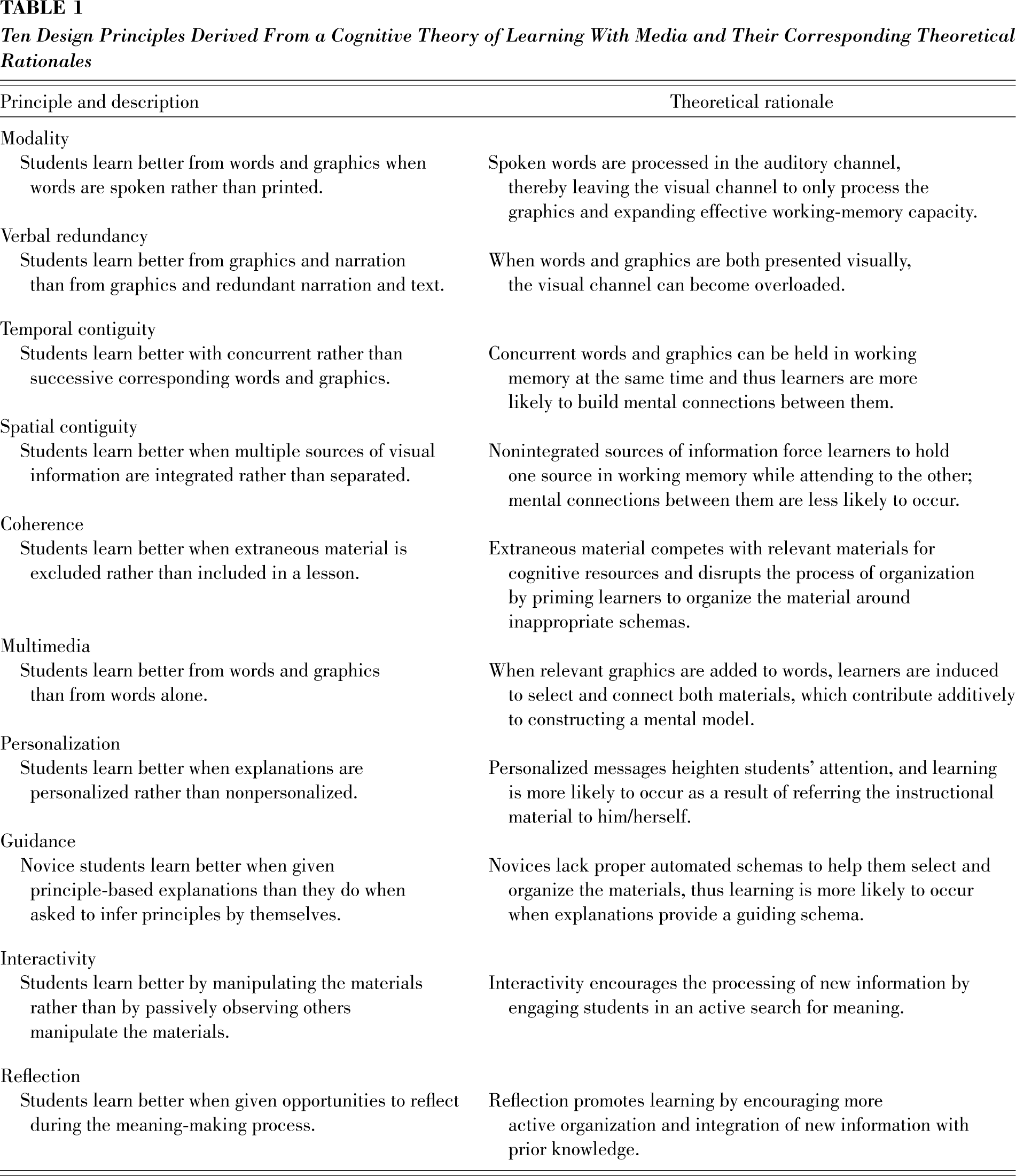
The CTLM presented here has been used to derive and test a set of principles of instructional design that are useful guidelines for designing high-tech learning environments and assessing the effectiveness of instructional technologies. Table 1 shows ten empirically based instructional-design principles derived from the CTLM, along with their corresponding theoretical rationales. The first five principles are methods used to reduce learners' extraneous processing—that is, processing of extraneous materials or cognitive activities that do not support learning. The last five principles are methods used to increase learners' essential processing—that is, processing necessary to support learning, such as selecting, connecting, and organizing new information; retrieving relevant information from long-term memory; and integrating the new information with prior knowledge.
Ten Design Principles Derived From a Cognitive Theory of Learning With Media and Their Corresponding Theoretical Rationales
Principles for Reducing Extraneous Cognitive Processing
One of the most common pitfalls of higher technologies is to present extraneous materials in a lesson or to design learning environments that force students to engage in extraneous cognitive processing. Because the cognitive resources available during the process of meaning making are limited, when students engage in large amounts of extraneous processing they may have insufficient remaining capacity to engage in the essential processing of the materials. The first five rows of Table 1 describe principles aimed at reducing extraneous cognitive processing.
According to the modality, redundancy, and temporal-contiguity principles, instructional technologies that include a combination of verbal explanations and nonverbal visual materials should present the explanations at the same time as the nonverbal materials and in the spoken modality alone (Moreno & Mayer, 1999). In applying these principles to teach the process of lightning formation, for example, one might combine a short animation depicting the causal chain of events leading to a lightning storm with a synchronized narrated explanation of each one of the events. When on-screen text is used instead of the narration, when the narration is not synchronized with the animation steps, or when subtitled text is added to the narration, learning is hindered by violation of the modality, temporal-contiguity, and redundancy principles, respectively.
The spatial-contiguity principle becomes relevant when presenting multiple sources of visual information that refer to one another and is challenged when instructional technologies fail to physically integrate these sources. For example, presenting explanatory words on one page of a textbook and the corresponding graphic on the next page violates this principle and hinders learning, as compared to a textbook that presents explanatory words integrated within the graphic. Finally, according to the coherence principle, instructional technologies should only include materials that are relevant to achieving the instructional objectives of the lesson. Violations of the coherence principle, or “seductive details,” abound and have been found across a large variety of materials. Examples include interesting text, graphics, or music added for the sole purpose of spicing up a lesson (Moreno & Mayer, 2000a).
Principles for Increasing Essential Cognitive Processing
Another common problem when using higher technologies in teaching is failure to include methods that induce the learner to actively process the instructional materials. The last five rows of Table 1 describe principles aimed at increasing essential cognitive processing during learning. Although all these principles rely on the active-learning assumption, they differ in the type of processing that is induced by each method. For example, the multimedia principle is aimed at promoting additive coding to increase the likelihood that information will be later retrieved from long-term memory; this principle is well represented in any science lesson that includes a description of the system to be learned with a corresponding diagram illustrating the system.
The personalization principle is aimed at creating stronger memories of the learning experience by means of a self-reference effect (Moreno & Mayer, 2000b; Moreno & Mayer, 2004) and can be applied by using a conversational style of communication during instruction rather than a monologue style. The interactivity principle supports the design of instructional technologies that engage students in hypothesis testing and manipulation of new information—for example, having students discover photosynthesis principles by conducting experiments with plants in different light conditions (Moreno, Mayer, Spires, & Lester, 2001).
Despite the ability to interact with the instructional materials (behavioral activity), learning may not occur if opportunities to obtain feedback and to reflect (cognitive activity) are absent. Therefore, the interactivity principle needs to be considered in combination with the principles of guidance and reflection. For example, novice students often become lost and frustrated and eventually resort to ineffective trial-and-error strategies when asked to discover scientific principles without guidance (Moreno & Valdez, 2005). Furthermore, in past research we found that inducing reflection within an interactive environment did not improve learning, presumably because interactivity already primes the cognitive processes of organizing and integrating the new information with prior knowledge (Moreno & Mayer, 2005). Taken together, the direct practical implication of these five principles is that instructional technologies promote meaningful learning when they include essential verbal and nonverbal materials and learners are allowed to interact or reflect about the relationships between them with the help of structured personalized guidance.
THE ROLE OF METHOD AND MEDIA IN LEARNING
The principles discussed in the prior section were derived from a theory based on sound cognitive research. Would they hold across a variety of media? In this section, I provide an empirical answer to this question by reviewing a set of studies in which the effectiveness of the modality method was investigated with three different media. An additional goal of this review is to test the media-affects-learning hypothesis by examining the learning effects of delivering instruction via an animated pedagogical agent (APA) and immersive virtual reality environments (VREs).
Multimedia Explanations
A multimedia explanation consists of a combination of a visual representation of a scientific system and a corresponding explanation in words of the principles underlying the system. In this study, we tested the modality principle by determining whether the words included in the multimedia explanation should be presented auditorily or visually to promote better learning. To this end, college students learned about a scientific system with either on-screen text explanations or a narrated explanation consisting of the identical words. After viewing the presentation, participants were given retention and transfer tests. The results revealed a modality effect on both learning measures, according to which students who learned with narrated explanations outperformed those who learned with on-screen text (Mayer & Moreno, 1998).
Agent-Based Multimedia Games
A newer technology that is becoming more and more frequent consists of using APAs within multimedia games. APAs are animated, life-like characters designed to facilitate learning in computer-based environments (Moreno, 2005). In this research, college students learned about botany with an APA named Herman. To test the modality effect, we varied whether the agent's words were presented as speech or as on-screen text. To examine the role of the APA media, we varied whether Herman's image appeared on the screen or not. Results showed that students performed better on tests of retention and transfer when words were presented as speech rather than on-screen text, producing a modality effect. On the other hand, the presence of the agent did not affect learning performance, and there were no interactions between modality and media (Moreno et al., 2001).
VREs
VREs have been claimed to offer great potential for promoting science learning by immersing students in the learning environment. Does the immersive characteristic of this media enhance learning? To answer this question, we asked college students to learn with the same botany game under three increasingly immersive media conditions: sitting at a desktop display; sitting at a computer station but navigating the environment with a head-mounted display (HMD); and wearing a HMD while navigating by walking in an empty room. To test the modality principle, half of the students learned with narrated explanations and half with textual explanations. The results revealed a modality effect for retention and transfer. On the other hand, although students who learned with HMDs reported a greater sense of presence in the learning environment than those who did not, there was no immersion effect on learning and there were no interactions between modality and media (Moreno & Mayer, 2002).
CONCLUSION
The findings from the previous section lend support to the method-affects-learning hypothesis. More specifically, an instructional method that proved to have learning benefits in a lower technology (multimedia explanations) also proved to help learning from higher technologies (APAs and VREs) and there were no learning benefits when the same information was delivered with higher technologies. Should we conclude that the media-affects-learning hypothesis is not warranted? To answer this question, one needs to first identify the distinctive characteristics of the technology at stake and determine whether such characteristics are relevant to the learning process.
For example, if the characteristics of an APA are central to the instructional objective of the lesson, learning effects may arise. This is the case with the 3-D virtual language tutor named Baldi, who produces visible speech via accurate lip movements to help deaf and hard-of-hearing children perceive and understand messages (Massaro, 1998), and with APAs that use gestures to guide learners' attention to relevant information displayed on a computer screen (Atkinson, 2002). Likewise, we may have found a significant media effect had we used a VRE where immersion has a specific learning function, as in a flight simulator, which promotes learning by adding psychomotor feedback to students' practice (Thurman & Russo, 2000).
In sum, a contribution of this review is to point out that the method-affects-learning and media-affects-learning hypotheses are not necessarily antagonistic. Quite to the contrary, it seems that the main advantage of high-tech learning environments lies in their potential to afford a variety of effective instructional methods. Therefore, our results support a media-enables-method hypothesis: Focusing on (a) what learning methods a particular technology affords and (b) how these methods are sensitive to the way that humans process information will enable researchers to discover instructional technologies that lead to deeper learning.
Lastly, it is important to note that the conclusions offered in this article are limited due to their focus on the cognitive aspects of individual student learning. To fully explain how high-tech environments promote learning would require extending the CTLM to include noncognitive factors and collaborative learning models. For instance, some methods and media may be perceived to be more interesting or supportive than others, therefore producing learning effects by affecting students' motivation, fear of failure, or self-efficacy. In addition, differences in learners' prior knowledge and characteristics such as age, gender, culture, and abilities may affect how much is learned with specific methods and media. Moreover, there is a growing tendency to use technology to enhance and promote the collaboration and cooperation among students. Therefore, a productive direction for future instructional-technology research is to systematically investigate the cognitive, noncognitive, social, and practical benefits of methods and media for different learning domains and a diversity of student populations.