






Abstract

Introduction
The Third World (and those scholars who have chosen to focus their efforts on understanding it) has long been of secondary importance in Anglo-American International Relations literature. The question that concerns us is: to what extent have any of the significant political and economic processes and events of the last decade led to a rethink of the role of the Third World in International Relations? How does the Third World or ‘South‘ figure in the contemporary International Relations discipline in the US and UK? Has the passing of the cold war and the related demise of the eastern bloc or Second World precipitated a change in the dominant approaches of the International Relations discipline to the Third World or South? Or has the march of corporate-led globalisation, with the related recent and ongoing socioeconomic polarisation at local, national, regional and global levels, made a difference to the study of the South in International Relations? Have the proliferation of domestic conflicts, or the significant humanitarian crises, or the events of September 11th prompted a constructive consideration of the problems facing the South?
This article suggests that the Third World continues to figure largely on the margins of the International Relations discipline in the US and UK. What lies behind this silence is the failure of the dominant theories of International Relations to engage with the global human condition on the basis of anything other than its impact on the G-8.
The article begins with a brief review of terminology, and then offers a sketch of the contemporary challenges that face 80 per cent of humanity and the overwhelming majority of states in the world. This is followed by an indicative profiling of current coverage of the Third World or South in leading International Relations journals, textbooks and prestigious monograph series. The next section offers a brief account and evaluation of International Relations theory, to help explain the marginalisation of study of the Third World. During the 1990s, debate within the discipline flourished, and several sub-fields emerged which touched on matters of concern to the South—albeit that was not usually their main focus. Importantly, however, there have been more direct attempts to bring the Third World back in over this period. Two theories are selected here for note: Marxism and post-colonial theory. In addition, significant contributions have been made by scholars adopting an as yet under-theorised human-security approach.
As we enter the 21st century, compared with a decade ago, the contemporary literature reveals that the International Relations discipline has more to offer those who are grappling to understand the challenges that face the Third World (for example, the collection edited by Thomas and Wilkin 1997). Engagement with other disciplines has contributed to this process (consider, for example, the influential multidisciplinary Post Development Reader, edited by Rahnema and Bawtree, 1997). However, it is too early to tell the extent to which the new focus on the South will have a lasting impact on the discipline.
What Do We Mean by Third World/South?
The idea of the Third World has, as with any significant political concept, been contested. Over the last 50 years there have been various debates about the meaning and utility of the term ‘Third World’, and questions have been raised as to whether a single concept could connect and identify a vast array of peoples with different cultures, beliefs and values (Ashcroft, Griffiths and Tiffin 1999, 232).
Looking back, it is interesting to see the different ways in which the term ‘Third World’ was used. Within the South, it was used in the immediate post-colonial period as a form of identity for a self-defining group of mostly post-colonial states with relatively low per capita incomes. Following the Bandung conference in 1955, these countries committed themselves to political independence through the Non-Aligned Movement (NAM), and later, as more Southern states began to gain political independence, the early political solidarity of the South was transferred to the economic arena. The ‘Third World’ served as a collective identity behind which the newly independent states could organise through a variety of international organisations from the Non-Aligned Movement to the Group of 77 (G-77) to the United Nations General Assembly. In this respect the term ‘Third World’ held a positive political meaning for the members of this group (Willets 1978). It is noteworthy that for many analysts and activists from these countries, it continues to do so today: hence, Third World Network and its publication, ‘Third World Resurgence’.
Within orthodox IR theory, however, the concept took on a marginal and secondary meaning and often had negative connotations. The post-colonial period was shaped by the cold war system that relegated the concerns of the post-colonial states and their populations (the vast majority of the world's population) behind the geopolitical interests and power structures of the eastern and western blocs. Thus, ‘Third World’ was used to distinguish non-industrialised countries, including China, from the industrialised countries of western Europe, North America, Japan and Australasia (First World) and the planned economies of the USSR and eastern Europe (Second World). In this system the very idea of an independent Third World or of Non-Alignment was problematic and this tended to be reflected in the orthodox IR literature, where post-colonial states were usually portrayed as being part of one sphere of influence or the other. There was no space for an independent Third World in either the geopolitics of the time or in the Anglo-American discourse of IR theory (Halliday 1989).
Over time, factors such as increasing economic differentiation within the Third World, the passing of the cold war, the sensitivities of (often ‘First World’) analysts and the recent globalisation of poverty, have prompted the emergence of an array of other terms. These include: developing countries, less developed countries, South, and most recently, global South.
At core, these terms reflect a common unifying experience shared by the majority of countries and people: a lack of voice or say in global affairs, a vulnerability to external forces beyond their control (such as commodity price fluctuations, G-7 (now 8)/IMF/World Bank decisions, capital movements), and human insecurity which characterises the lives of their citizens. Moreover, this grouping is not static. With the passing of the cold war, these characteristics are shared by a wider group of countries and people. The expectation was that the former Second World would join the ranks of the First, and the new global line-up would be the advanced northern economies and the rest—the Third World. In practice, many former Second-World states have more in common with the Third World countries, being characterised by a lack of voice or say in global affairs and widespread human insecurity and poverty (see below). Also, even those Third World states which have enjoyed great economic advances have failed to gain an effective seat at the table of global decision-making.
Here, Third World and South will be used interchangeably to refer to those countries and peoples that share some of the common problems of lack of voice or say in global affairs, a vulnerability to external forces beyond their control and the poverty and economic and physical insecurity which characterises citizens' lives.
Contemporary Challenges
Notwithstanding these core commonalities, over the last two decades economic differentiation has increased locally, nationally, regionally and globally. Material polarisation is arguably a more apt description than differentiation. While the 1980s are often described as a lost decade (particularly for Africa and Latin America), in the 1990s the situation deteriorated further or stagnated for many (especially Sub-Saharan Africa (SSA) and the Commonwealth of Independent States (CIS)). The UNDP (2003) notes that Indeed, despite the economic difficulties of the 1980s, human development indicators for that decade fell in only four countries, compared with 21 in the 1990s. The 1990s broke a long trend of gradual improvement. Sub-Saharan Africa has been particularly marginalised.
for many countries the 1990s were a decade of despair. Some 54 countries are poorer now than in 1990. In 21 a larger proportion is going hungry. In 14, more children are dying before age 5. In 12, primary school enrolments are shrinking. In 34, life expectancy has fallen. Such reversals in survival were previously rare.
Broad Picture of Regional Variations in the Third World/South
Source: Adapted from UNDP (2003); Milanovic (2003); Easterly (2002); World Bank (2003); World Bank Indicators 2003
When other factors are added to this stark picture of growing economic divides—such as global demographic trends, youthful population profiles in the South, technological divides, environmental problems and per capita availability of water and croplands—the future looks even more worrying (Kennedy, Messner and Nuscheler 2002; Rogers 2000).
In addition to the deepening material despair suffered by significant groups across the globe, physical despair is spreading, and sometimes the two are related. Material deprivation can prompt conflict, and conflict of course results in direct and indirect human costs ranging from physical violence, small arms proliferation, child soldiers, landmines etc, to loss of food, shelter, livelihoods etc. Complex humanitarian emergencies of the 1990s hit the headlines and engaged academics (Wayne Nafziger et al. 2000). Yet many of the military conflicts which beset so many Third World countries are relatively small scale, but carry a significant local human cost.
What we are facing is a complex human crisis of global magnitude, characterised by multiple interconnections and reinforcements between different problems (Bradshaw and Wallace 1996). The global governance architecture which oversees the unfolding of this scenario is not representative of most of the states or people most acutely affected by it.
Profiling Coverage of the Third World/South in Contemporary International Relations Scholarship
To what extent does mainstream International Relations scholarship engage with these issues? A very cursory analysis of the topics covered in five leading International Relations journals from January 1998 to November 2003—International Organisation, Foreign Policy, International Studies Quarterly, International Affairs and Review of International Studies—illustrates the current focus of research and interest.
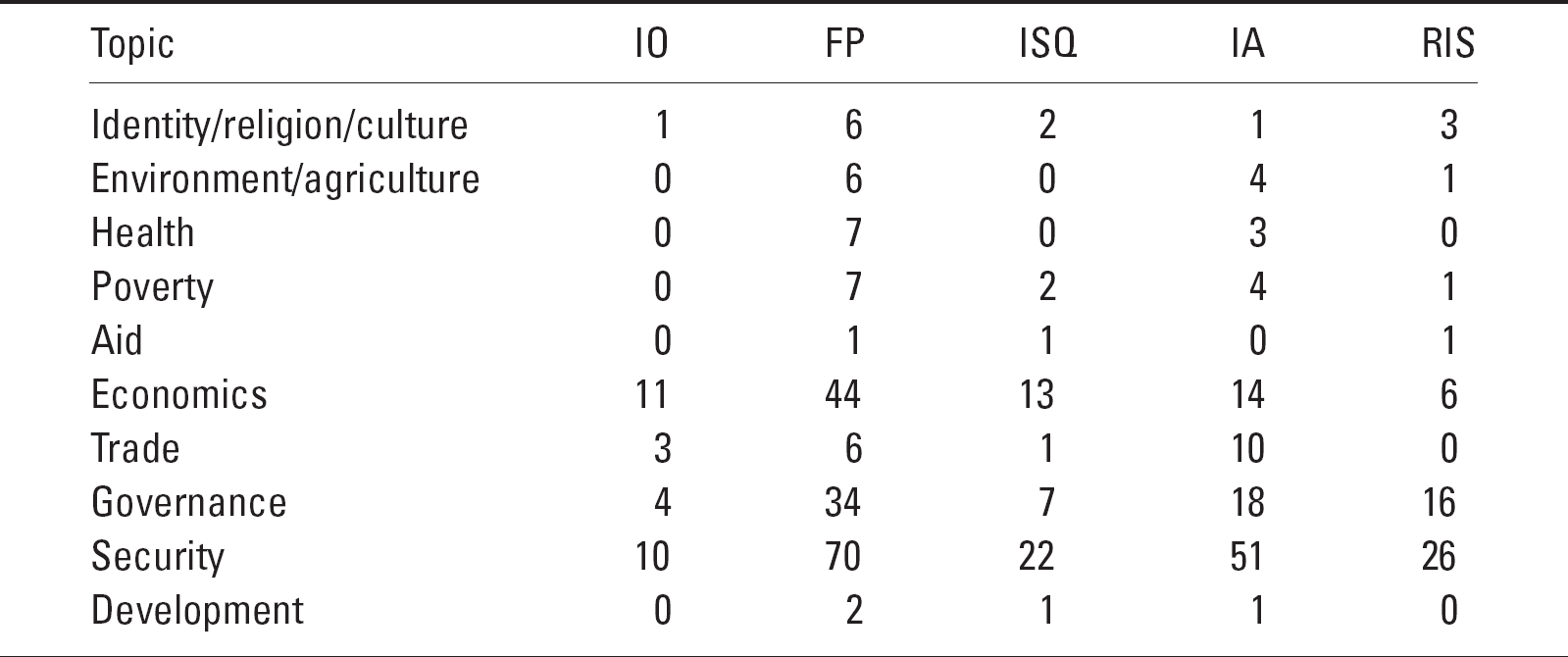
Where the Third World receives attention, it is debated not in its own terms but rather in those of others, and not for its own sake, but for theirs (Smith 2003). Thus, for example, recent interest in the Third World as a security issue is often a reflection of perceived threats to the north such as terrorism, migration and drug trafficking, and to northern interests such as natural resources and regime stability. It rarely stems from a concern to understand issues that matter to the South, such as poverty, identity, voice, livelihoods, under- and unemployment, inequality and violence in its many aspects. Similarly, interest in governance is rooted strongly in analysing corruption, failed and rogue states, crime, the progress of embedding liberal democracy, private property rights, public private partnerships and so forth. This contrasts with a possible alternative focus, which might explore the undemocratic and increasingly co-ordinated nature of global governance via G-8/WTO/IMF/World Bank, the deepening role of the private sector in global public policy, corporate governance and the need to encourage locally appropriate forms of representation. Likewise, interest in economics is routinely less to do with the constitution of global poverty and possible remedies, and more to do with issues perceived as potential threats to northern economies, such as financial crises. This results in an imbalance in regional coverage, with much attention being given to east Asia.
Consider perhaps the most widely read undergraduate textbook on International Relations in the UK since 2000, The Globalisation of World Politics. This collection, edited by John Baylis and Steve Smith, is soon to appear in its third edition. First published in July 2001, by the end of September 2003 just under 50,000 copies of the textbook had been sold. While a number of chapters touch on issues of relevance to the South, only one chapter out of 30 is devoted specifically to the South. Kegley and Wittkopf (1997) devote more space to Third World issues, but again largely through what tends to be a mainstream perspective. In addition, even prestigious monograph series, such as CUP's International Relations series, exhibit similar orientations.
Explaining Neglect and Bias: The Role of International Relations Theory
This section illustrates and explains the lack of engagement, and lack of relevance, of International Relations theory, for crucial questions pertaining to the Third World.
None of the major fields in the theoretical physical sciences is dominated by the investigations of only two countries. Hierarchy, however, seems to be a hallmark of international politics and theory. Most of the mutually acknowledged literature has been produced by scholars from only two of more than 155 countries: the United States and Great Britain. There is, in brief, a British-American intellectual condominium (Holsti 1985, 102–103).
Holsti's observation from 1985 is well taken and illustrates clearly the overarching reason why the Third World fails to register significantly in mainstream International Relations theory. There are a number of reasons why this is so, and in this section we will focus upon the key issues that have helped to constrain the focus of International Relations theory at the expense of the Third World.
What is most stark about Holsti's comment is that it cuts straight to the heart of the limitations of International Relations theory for any adequate understanding of the issues that confront global politics. The conclusion that it leads to is that the tradition of orthodox International Relations theory presents us with only a limited picture of global politics and fails either to ask or provide answers for the key questions that face the majority of the world's citizens.
Orthodox International Relations Theory and the Third World
In order to understand the marginalisation of the Third World in orthodox International Relations theory literature we need to set out a brief account of the intellectual framework that the Anglo-American tradition, as Holsti described it, provides.
The intellectual contribution of International Relations theory both to an understanding and to the construction of the modern world system is rooted in a debate between realists and liberals that in its current guise is often referred to as the neo-neo debate (Kegley 1995). According to its proponents, realism and liberalism provide us with theories that provide a framework for describing, explaining and perhaps predicting the trajectory of global politics. As universal theories, these two approaches provide us with narratives that are able to account for the central concerns of global politics by concentrating on what its proponents see as the key factors shaping world order. Although nominally in conflict with each other over such issues as the possibility of co-operation between states, the significance of the spread of democracy for global politics and the role of international organisations in global politics, what is most important about the framework of the neo-neo debate is what these two approaches share in common rather than what divides them. In setting this out it becomes clear why the Third World has been historically a marginal voice in International Relations theory and practice. In the neo-neo debate, a picture of International Relations emerges as follows.
Global politics is concerned with the relations between states in an anarchic world order. The insecurity (anarchy) generated by a lack of world government or overriding authority compels states to pursue power in order to make themselves secure. For realists in the neo-neo debate, the state as the central actor in International Relations has to pursue power in order to render itself secure. Power can take a number of forms but ultimately it is military power that is central to a state's survival, whether it is gained through alliances or the state's own military forces. In this model of International Relations there is a continual struggle for power between states that cannot be permanently transformed through co-operation (Mearsheimer 2003).
The liberal contribution shares many of these assumptions but argues that the state has to compete with other actors in International Relations, including international organisations and economic actors. As a consequence the world system has become more complex and the utility of military force rendered more problematic. Instead, rational states will seek security through co-operative arrangements with other states.
In the neo-neo debate all states possess certain characteristics regardless of history, culture or political ideology. In this respect the particular experience of the Third World and its peoples, its history of colonialism and imperialism, are subordinated in significance for realists and liberals alike. For realists the driving force of International Relations is the anarchic system; for liberals it is the unfolding of history towards freedom, best expressed in the form of liberal, capitalist democracy.
Ultimately the contributors to the neo-neo debate aim to provide a science of International Relations that can inform policy-makers' choices. This, in turn, will enable states to control the environment in which they operate. The claims to scientific expertise are very important to political scientists in general and no less so in International Relations theory. The model of science espoused puts forward a series of generalisable, universal assumptions about actors' motivations and their rationality, the role of power in political life, the nature of the world system and the key factors within it. From this its proponents claim to be able to offer a deductive framework that can describe, explain and predict the behaviour of actors in International Relations (Hay 2002). The central claim here is that these ‘scientific’ hypotheses can be tested empirically against the evidence provided by International Relations. Whilst this is a simplified overview of the neo-neo debate in International Relations theory, it does address the key issues that have shaped this Anglo-American discourse.
Challenges did emerge to the orthodoxy during the cold war period, of which the most prominent was what is often referred to as dependency theory. This sought to raise a series of issues that were central to the concerns of the Third World. Perhaps the key aim for dependency theory was to explain the persistent and deepening inequality that shaped relations between the north and South, or core and periphery, as they would describe it. For dependency and world systems analysis, the world was a single integrated system divided into a dominant core bloc of states and a subordinate periphery and semi-periphery. The structure of this world system meant that capital flowed to the core from the subordinate areas, whilst the core exercised various forms of power and control over the dependent periphery and semi-periphery (Hopkins, Wallerstein and Bach 1982).
Dependency theory had only a marginal influence in International Relations theory, as seen in the orthodox texts which tended to spend very little time and space engaging with the claims of dependency theory on the assumption that it was either not a truly systemic theory of the world system, as it claimed (Waltz 1979), or that it did not allow for economic development in the Third World and was an ideologically driven approach rather than a scientific one (Kegley and Wittkopf 1997, 122).
International Relations has been subject to a range of theoretical debates over the past two decades that have left the discipline in a much more fragmented, though intellectually healthier, state. These debates have enriched our understanding of the South; some directly, others indirectly. It is to this that we now turn.
Bringing the Third World Back In: Indirect Contributions from Sub-Sections of the Discipline
In this section we outline briefly some of the ways in which the Third World has begun to emerge in International Relations theory debates through interventions at the margins, or what are usually described as sub-sections of the discipline.
The flourishing of a variety of often interconnected sub-fields of International Relations, such as International Political Economy (IPE), Global Environmental Politics, Gender and the emerging Global Health Politics, has generated some important work on issues pertaining to the South. Yet the dominance of mainstream International Relations approaches has not been sufficiently dented to give confidence that as a discipline we are engaged systematically with understanding the major challenges facing the majority of humanity. Moreover, the potential of some of these sub-sections to progress our understanding is itself limited by the mainstream theories and biases which inform many of their exponents, and the way in which more critical voices get less air space or remain unconsidered, often existing outside the orthodox disciplinary boundaries. Writing in a collection on global environmental politics, Julian Saurin notes that when new issues have arisen in orthodox International Relations theory, they have tended to be tagged on to an existing framework of analysis. They never call into question the principles underpinning the orthodox approaches (Saurin, in Vogler and Imber 1996). An example in security studies would be the oft-cited recent work of Buzan, Waever and de Wilde (1998), in which so-called ‘new’ security issues are often simply added to the existing framework, rather than prompting the development of a framework based on different principles.
Similar tendencies are evident in IPE, where one might expect good coverage of the Third World. Gilpin's classic book The Political Economy of International relations (1987) devoted one chapter to the Third World. His more recent work, Global Political Economy (2001), has one chapter on the state and Third World development, and generally adopts the perspective of the G-8. Similarly, Grieco and Ikenberry's (2003) State, Power and World Markets similarly has one chapter specifically on the developing countries, though others touch on some issues of relevance. More promising is the third edition of Frieden and Lake's International Political Economy (1995), which significantly increased its coverage of the Third World, adding a whole new section containing five chapters on economies in development and transition, written by a broad range of authors. O'Brien and Williams' Global Political Economy (2003) offers more on the South and inequality.
The emerging field of global health politics may offer greater potential to kick the stranglehold of mainstream perspectives and focus attention on the challenges facing the South. From an early point in International Relations scholars' interest in global health, they have been blurring disciplinary boundaries as interests converge around global public policy issues. International Relations scholars such as Lee (2003) are centrally involved in this process, and work with people from an array of disciplines on specific health problems such as TB, tobacco etc. Specific health issues such as HIV/AIDS (Poku 2002), global intellectual property rights (Drahos and Mayne 2002; Heywood 2002), health inequalities under a global neo-liberal development regime (Kim et al. 2000) and corporate conduct (Richter 2001) are drawing together interdisciplinary groups in a very positive way. International Relations scholars are moving from issue-based interest in health to engagement from a critical theoretical perspective with the global governance of health (e.g. Thomas and Weber 2004). Here they are drawing on and extending work done by scholars in other fields, such as medics and social activists David Werner and David Sanders (1997) and Paul Farmer (1999 and 2003).
Direct Challenges to the Orthodoxy: Bringing the Third World to Centre Stage
The recent works of a small number of International Relations scholars who are engaging directly with the development challenge (and in some cases with the development studies discipline, which they regard as being dominated by a liberal orthodoxy—see Weber 2004), have the potential to become significant. In addition to the many empirical studies that have emerged, by scholars and activists of various hues, analysing the impact of structural adjustment, debt, trade, the structure and policies of the IMF and World Bank, multinationals etc. (e.g. Barratt Brown 1993; Green 1995; Andor and Summers 1998; Madeley 1999), the International Relations discipline is spawning more sophisticated theoretical critiques of the global development architecture (e.g. Saurin 1996; Weber 2002). However, this engagement is still at an early stage.
More sustained challenges to the orthodoxy and an associated rising of the profile of the South emanate from the contributions of two theories—Marxism and post-colonial theory—and from the as yet under-theorised human security approach. These are discussed below.
Marxism and the Third World
The key question to be asked here is: what role has capitalism played in the construction of the Third World?
The contribution of Marxist theory to the study of the Third World has been immense (Marx and Engels 1998; Lenin 1969), and in the contemporary writings of scholars such as Cox (1996), Rosenberg (1994) and Hardt and Negri (2000) it continues to provide an important counter to the common sense assumptions of orthodox International Relations theory. For Marxists, International Relations is a contentious idea in itself because it suggests that nations and states have primacy in the production of social relations, whereas for Marxists it is classes that shape the social order. Thus, Marxists tend to focus upon the primacy of capitalism in shaping global social relations. Out of this come the fundamental social divisions that serve to generate the concrete structures and institutions that organise social, political and cultural life.
Perhaps the major contribution of Marxism to an understanding of the Third World is through the concept of imperialism, now currently back in vogue in debates on so-called ‘new imperialism’ and empire. The key current debate amongst Marxists is the division between those who see the current world order as still structured by the actions of the major imperialist states (Callinicos 2003) and those who argue that classic imperialism has been replaced by what Hardt and Negri have termed ‘empire’ (Hardt and Negri 2000).
For the former, power remains firmly rooted in the hands of the world's core imperialist states and their ruling classes. Thus the G-8 effectively continues to exploit the South for the benefit primarily of the ruling classes rooted in the G-8. Power remains rooted in particular states and classes who have the capacity to exercise it in brutal fashion when necessary. Thus, for Callinicos the ongoing Anglo-American war against Iraq is a continuation of imperialism as carried out by the core capitalist states.
For the latter group, however, and following the insights of Foucault and other post-modern writers, in an age of globalisation power is said to be ‘deterritorialised’. By this they mean that power is dispersed everywhere throughout the ‘empire’ as a global system rather than being located in particular nation states. Old established concepts and boundaries are being replaced by new forms of identity, of racism, of communication and control. The empire accepts no boundaries so the implication is that the established categories of First World and Third World will increasingly be unable to describe or explain what is happening in global politics (Hardt and Negri 2000).
The importance of the Marxist contribution is that it illustrates the role that capitalist social relations have played in constructing the current world order and the very idea of a Third World. In addition it undermines the primacy of states and nations in explaining International Relations and instead says that these are things that need to be explained in themselves. Any adequate approach to global politics has to locate the problems faced by the Third World in their historical imperialist relationship with the core capitalist states. To ignore this is to fail to understand the historical and material factors that have shaped the institutions and structures of world order.
Marxism has a number of important strengths for helping us to understand the Third World. It provides an explanation of the way in which the ‘Third World’ has been created through imperialism to serve the interests of dominant capitalist classes primarily located in the core. It historicises the Third World and situates it in the context of the expansion of European imperialism. The resurgence of ‘new imperialism’; and empire has seen a revived interest in these ideas that has cut across the political spectrum, with the key argument here being the extent to which the globalisation of capital is leading to a different kind of empire.
However, there are a number of weaknesses with the Marxist approach. The persistence of nations and states in the Third World would appear to be a problem for Marxist theory as well as the failure, in practice, of socialist and Marxist-inclined governments in the Third World. Post-colonial critics would charge that Marxism has been insufficiently aware of its own Eurocentric prejudices (Said 1978).
Post-Colonial Theory and the Third World
The key question explored is: how has the experience of colonialism affected the colonisers and the colonised alike? The main authors include figures such as Edward Said, Franz Fanon, Partha Chatterjee and Gayatri Spivak.
Although there is no simple definition of post-colonial studies, it can perhaps be viewed as a general concern with the relationship between European nations and the countries they colonised in the modern period (Ashcroft, Griffiths and Tiffin 1995). The implication here is that this has had profound effects on our understanding of the meaning of the ‘Third World’ and ‘the west’ as the key signifiers in the construction of the modern world. As a consequence, post-colonial studies are concerned with the complexities of culture and identity and the way in which the production of knowledge has been intimately networked with relations of power in building the narratives that provide the common sense framework for understanding the modern world and the Third World within it (Chatterjee 1986; Fanon 2001).
The relationship between post-colonial theory and post-modern post-structuralist theory is fluid and important (Ashcroft, Griffiths and Tiffin 1995, Part IV; Keith 1997). This has been most famously developed in Edward Said's seminal work Orientalism (1978), in which he traces the way in which the idea of ‘the Orient’ constructed in western scholarship has been imbued with racist assumptions about the non-western world; in effect, the non-civilised world. The importance of these intellectual discourses cannot be overstated as they are central in providing the knowledge that helps to justify colonialism, imperialism, wars in the Third World and the assumption that it is a realm that needs to be contained and civilised, by overt force if necessary.
Perhaps the key concept developed in post-colonial theory is that of the ‘other’ (Spivak 1987). In International Relations the notion of the ‘other’ has been an implicit part of the literature of the orthodoxy when it attempts to divide the world into such categories as civilised uncivilised, terrorist, evil, barbarian, communist or immigrant (Achebe 1988). The ‘other’ is an explicit, and sometimes implicit, category embedded within the grand narratives presented by orthodox approaches to International Relations.
The realm of knowledge is an inextricable site of power in modernity, the realm in which our sense of identity is established. This is crucial because it is our sense of identity that provides us with our understanding of ourselves, the world and our place within it. Through this we establish our values, beliefs and ideas about what is good, true, false, just and immoral. These ‘grand narratives’ provide us with a simplified vision of the modern world that describes the actors within it, often in simple and racist binary terms (the rational west and the non-rational oriental mind, for example, has been a common theme in Anglo-American foreign policy), explains how ‘we’ and ‘they’ should and will act within it, and ultimately provides the criteria by which claims to knowledge about International Relations are to be judged.
Thus, the west has built an image of itself as the disseminator of enlightenment, progress and civilisation to the rest of the world (Habermas 1981; Malik 1996). Even when the actions of western states and companies contradict this self-image, such actions are always the exception to the rule. The a priori assumption is that the west strives to do good and occasionally errs. This is a benchmark assumption in the neo-neo debate. Eurocentrism is a term often used here to describe the assumption that western claims to knowledge are, a priori, the highest against which all others will be judged (Amin 1989; Ferro 1997). Thus, the alleged science generated in the Anglo-American neo-neo debate is the most authoritative account of international relations available to us. It serves as the discursive boundary for those wishing to enter legitimate debates about International Relations.
Post-colonial studies have drawn out the complexity of global social relations, the hybridity of social identity and the racist assumptions underpinning much western literature and social scientific scholarship in its portrayal of the Third World (Bhabha 1994). As such post-colonial studies has proven to be a fruitful area of research bringing to light hidden or marginalised voices in the Third World as a way of undermining the dominant western narratives that shape common sense understandings of history. Its relationship to International Relations theory has been at the margins but the flourishing of new ideas and approaches in International Relations theory over the past decade has seen more connections being established between them.
We can identity a number of strengths of post-colonial theory for progressing our understanding of the South. Its focus upon the production of knowledge and identity has served to unsettle and undermine radically the scientific pretensions of much western scholarship in the social sciences and humanities. It does so by drawing out the Eurocentric assumptions that underpin these allegedly scientific discourses. For example, the theme of ‘rogue states’ in orthodox Anglo-American IR theory locates these actors exclusively in the Third World. Even those within the orthodoxy who are critical of the utility of the concept share this assumption that it is the Third World that presents the problem (Litwak 2000). The rogue state is presented as a threat to an otherwise orderly and peaceful international environment. Rarely is there an attempt to situate these states in the context of their colonial past. Equally, it is beyond reasonable debate to suggest that any of the G-8 states could themselves be rogue states in terms of their capacity for breaking of international law and using force (Blum 2000). Post-colonial studies have helped to give voice to sections of the world's population (the majority) long ignored in International Relations.
Yet critics note a number of weaknesses. One is that post-colonial studies tend to lapse into a moral and political relativism, arguing that any and all cultural practices are equally valid and legitimate as they can only be judged within the context of their own particular discourse; that in effect the nature of our ideas or discourse determines the nature of the world around us. Marxists have noted that the emphasis of post-colonial studies on the realm of identity and culture fails to get to the heart of oppression in the world system, rooted as it is in the material conditions of human existence. Nowhere is this more acutely felt than by the impoverished millions of the Third World (Ahmad 1994).
The Human Security Approach
Human security is the most recent approach discussed here, and it is under-theorised to date. It appeared in the context of the post-cold-war world when it became clear that the passing of the cold war was leading neither to a peace dividend for development, nor to the absence of conflict (Suhrke 1999). The key question with which exponents of this approach are grappling is: how can we best understand and overcome the challenges facing human beings worldwide, individually and collectively, given the momentous global political and economic changes of the 1990s? People, rather than states, are the subject of evidence-based analysis (Nef 1999; Thomas 2000; Hampson 2002).
While an exclusive concern with the Third World is not the primary driver of this approach, it is particularly significant for the people of the South, where the twin challenges of freedom from want and freedom from fear are most pervasive (Thomas 2004). It is these two concerns that run through the human security literature. Fundamental to the human security approach is the idea that both freedoms are inextricably inter-related. The protection of the vulnerable via the reduction of risk is their common core, along with a holistic understanding of the constitution of vulnerability in our world.
The literature base of human security is flourishing. It has drawn together an eclectic range of politicians, academics, NGOs and activists, from those such as Jorge Nef (1999), who presents a clear model of human security and insecurity that draws some of its insights from world systems analysis, to those such as the Canadian foreign minister Lloyd Axworthy (2001), who focuses upon the role that middle-range governments can play in promoting human security primarily as freedom from fear (McRae and Hubert 2001). It gained attention in the UN from the early 1990s when the UNDP's Mahub ul Haq argued that for most global citizens, insecurity arises about daily worries such as health, income and jobs, rather than interstate conflict (UNDP 1994, 3). More recently it has been championed by UN Secretary General Kofi Annan in the context of HIV/AIDS (Annan 2000). The parameters of the human security discourse are still being established.
Human insecurity refers to a condition of vulnerability, in which human beings' physical or material well-being is threatened. Such threats may be due to natural disasters, such as cyclones or volcanic eruptions, or man-made disasters such as rising sea levels, mud slides, oil spillages, nuclear and chemical explosions etc. They may be due to political conflict within or between states. Also they may arise from the fundamental structure of the global economy in which decision-making power is concentrated in the core capitalist states, commodity producers are continually disadvantaged and billions of people live precariously on the edge where life is structured by lack of reliable access to material resources.
Particular events arising within the global economy (e.g. financial crises due to poor management, at levels from the global to the national) can cause instant havoc to the livelihoods of millions. For example, the collapse of the Argentine currency in 2002 has, according to the US-based liberal think tank, the Centre for Economic and Policy Research, led to the following:
GDP has declined at a record 16.3 per cent annual rate in the first quarter of 2002. Unemployment stands at 21.5 per cent of the labour force, and real monthly wages have declined by 18 per cent over the course of the year. Official poverty and indigent rates have reached record levels: 53 per cent of Argentines now live below the official poverty line, while 25 per cent are indigent (basic needs unmet). Since October 2001, 5.2 million Argentines have fallen below the poverty line, while seven out of ten Argentine children are poor today (http://www.wsws.org/articles/2002/sep2002/argi-s10.shtml).
The strengths of the human security approach lie in its explanatory and normative power. Regarding the former, a human security approach can enrich our understanding of the complex impacts of globalisation. Firstly, it reveals the different ways in which globalisation impacts on the relative vulnerability of real human beings and communities, rather than abstract states. It does so by requiring disaggregation of data to understand the lived human experience. Secondly, in a world facing enormous, complex, interconnected challenges, not least mutual vulnerability involving not simply weapons but diseases and financial instability, the concept of human security provides us with a starting point to think about global social crises and to construct appropriate policy and political responses. Consider for example the immense threat to millions of people posed by HIV/AIDS, not only in Africa but increasingly elsewhere—notably India, China and Russia. A human security approach encourages a holistic understanding of the problem and its place in cultural, social, economic, military and political structures, from local to global. This is necessary to the development of policies to decrease human vulnerability and thereby increase human security.
In addition to human security's explanatory power, the approach has normative power, based as it is on an inherently transformative agenda (Nef 1999). Human security is essentially a political project, distinguished by its commitment to the interests of a broad, rather than narrow, band of humanity. It has universal goals—freedom from want and freedom from fear—and sees these as indivisible in an integrated global system. Nef makes the point that global security is only as strong as its weakest link.
Three contrasting criticisms of the human security debate have emerged. Paris (2001) argues that the redefinition of the concept of security renders it incoherent. He suggests that there is a great danger in losing the significance of the concept if it is stretched beyond its traditional state-centric definition. Marxists have tended to view it as being a redrawing of familiar paeans to liberal humanitarianism that fail to address the fundamental social factors that generate the problems that human security addresses (Chandler 2002). Finally, Mark Duffield (2001 and 2004), a key figure in the emerging literature focusing upon global governance and the Third World, is concerned with the extent to which human security becomes part of a foucauldian strategy of bio-politics, whereby governing agencies, through a newly formed public-private relationship, are able to shape and control civil populations.
Conclusion
The 1990s have witnessed a growth of interest in the Third World South by a significant number of often younger scholars of International Relations. This is an encouraging trend, reflected in both theoretical and empirical studies. The extent to which this trend represents a substantive challenge to the limitations of orthodox International Relations is almost impossible to answer, as it is still gathering momentum. It is not unreasonable to speculate, however, that with the growth of ideas around globalisation and global justice shaping the local, national, regional and global political arena, the trend is likely to continue. Hopefully the days of the Third World being on the margins of the discipline of International Relations will soon be over.