







Abstract

Introduction
One might perhaps expect to find interpretive methodology occupying a strong and secure place in British political science. With its origins in philosophy and history (see Kavanagh 2003) British political studies never fully or exclusively embraced behaviourism or subsequent positivist methodologies. Interpretivism represents the major alternative for social science in which, as Weber declared, ‘we are concerned with mental phenomena the empathic “understanding” of which is naturally a task of a specifically different type from those which the schemes of the exact natural sciences in general can seek to solve’ (quoted in Giddens 1971, 146). But interpretivism does not have a secure footing in British political studies. 2 The systematic explication of political phenomena through interpretive concepts and methods, despite some notable attempts and a growing intensity of focus, is still at an early stage of development (see Carver and Hyvärinen 1997; ECPR 2002). In the academic study of contemporary British government interpretivism is not at all widespread.
Are things about to change? Recent methodological disputes in British political science map on to broader debates about how the structure and process of British government might or might not be changing (see, for example, Marsh and Smith 2001; Dowding 2001; Hay 2002). If we are in the midst of a shift from top-down ‘command and control’ to a looser framework of ‘governance’, then the time of interpretivism may well have arrived. But methodological arguments are always about more than method. They map on to and can define broader debates concerning what government is, how it works and whether or not it is changing. The publication of Mark Bevir and Rod Rhodes' Interpreting British Governance (2003), which advocates and demonstrates the analysis of governance using interpretive theories and methods, is a significant development in these debates.
Interpreting British Governance is an attempt to bring together some philosophically derived themes about context, agency and tradition with political science research into the conduct of governance in Britain today. As such it presents an opportunity to review the questions raised by interpretivism, put them into the broader contexts of methodological argument and assess the contribution this all makes to the analysis of British politics. In what follows Bevir and Rhodes begin by laying out the basics of their post-foundational approach to studying governance. They stress the significance of traditions in shaping actions, even as those traditions are reshaped by the ways in which people act. They use this to help make sense of a shift from government to governance: a revision of the ‘Westminster model’. Keith Dowding then questions this approach. He is concerned by the way that Bevir and Rhodes seem to give up on the possibility of establishing the truth of research findings. A self-declared ‘realist’, Dowding argues that the accounts agents give of their actions must be balanced by other sorts of evidence and that, while it may be difficult to deliver final and definitive accounts, we can nevertheless undertake some important work in that direction.
Colin Hay places interpretivism in the context of larger debates around the ‘ideational turn’ in political science. He welcomes the way Bevir and Rhodes challenge the epistemological assumptions of positivism, particularly that politics is a closed system, but disagrees with their separation of understanding and explanation. In criticising Bevir and Rhodes he outlines an alternative approach to the analysis of the causal role of ideas in politics. Then, I endorse interpretivism, if it is broadly defined, but argue for a more radical approach that opens on to the politics of culture and ideas as found across society and is not confined to a predefined political sphere; one that is led to ask meta-political questions in ways that, I argue, clarify the nature of our activity as political analysts. Finally Bevir and Rhodes respond to these analyses pointing out where they believe differences can be reconciled and where they are more substantive, restating the core claims of their work.
In proposing particular methodological procedures we also propose an epistemology. And with our theories of what can be known we also disclose what it is we would like to know and, perhaps, what we might like to believe. That is to say, our differing methodologies of politics perhaps represent differing ontologies of what politics is or might be. If that is so then perhaps it is only right that we seek to confront these issues in an open context such as a symposium, a gathering for discussion as opposed to a forum for the presentation of results we believe to be complete. And it is notable that, despite the quite wide differences that are manifest here, each of us makes very clear some shared goals: to increase our knowledge and understanding of politics as best we can and to remind ourselves and others of the contribution to the improvement of British politics that can be made by our discipline. These are goals that, in this forum at least, should require no further interpretation or, indeed, proof.
Interpreting British Governance
Introduction
Interpretive approaches start with the insight that to understand actions, practices and institutions, we need to grasp the relevant meanings, beliefs and preferences of the people involved. As John Stuart Mill (1969 [1840], 119–120) remarked, Bentham asked ‘Is it true?’ whereas Coleridge asked ‘What is the meaning of it?’. For Coleridge ‘the very fact that any doctrine had been believed by thoughtful men … was part of the problem to be solved’. We ask, after Coleridge, ‘what is the meaning of it’, where ‘it’ is British governance.
On Interpretation
In “Interpreting British Governance”, we use a post-foundational epistemology and an interpretive approach to understand changes in British government. We critically assess the claim that there has been a shift from government of a unitary state to governance in and by networks. We develop the argument that people can engage in a practice only because they hold certain beliefs or concepts. So, political scientists can explore that practice by unpacking the relevant beliefs and explaining why they arose. For example, when individuals vote for the Labour party, they may do so believing Labour will promote redistributive policies that are socially desirable and from which they will benefit. When political scientists interpret beliefs in this way, they provide insights into the behaviour of particular individuals. They describe the particular sets of reasons that led the relevant individual to act.
An interpretive approach moves back and forth between aggregate concepts and the beliefs of particular individuals. The distinction between aggregate and individual analysis is artificial. Whether we focus on aggregates such as traditions or on the beliefs of individuals will depend on the questions we seek to answer. The choice will depend on the topic to be studied. On the one hand, we argue that individuals are not autonomous, so they necessarily come to hold the beliefs they do within a social context that influences them. To explain the beliefs of a particular individual, we have to appeal to an aggregate concept, such as tradition, that evokes this social context. On the other hand, we argue, discourses, ideologies and traditions do not exist apart from in the contingent beliefs of particular individuals. To appeal to a tradition is always explicitly or implicitly to make claims about the beliefs and actions of particular individuals.
In “Interpreting British Governance”, we concentrate on an aggregate analysis of British political traditions. One of the dangers of such analysis is that we can neglect the differences in the beliefs of the individuals lumped together in a tradition. Recognition of this danger prompts us to decentre aggregate concepts such as tradition. To decentre is to highlight the diversity of an aggregate concept by unpacking the actual and contingent beliefs and actions of those individuals who fall under it. So, within the British political tradition, we distinguish Tory, Whig, liberal and socialist traditions. We could have gone on to analyse the beliefs of particular individuals. Yet we do not do so. Our aim is to trace briefly the patterns of thought informing British governance, and to do so we concentrate on the broader traditions informing general changes in the practices of British government (Bevir and Rhodes 2003 provides a more detailed analysis).
Our interpretive approach differs sharply from present-day practice in British political science. The Whiggish roots of British political science are weaker; the 19th century heritage exerts less influence. The attention given to pressure groups, elections and public policy analysis shows the vast influence of modernist empiricism and even a positivism more usually associated with American political science. The interpretive approach relies on an alternative epistemology to this modernist empiricism. It represents a challenge to this dominant or mainstream tradition.
Our criticisms focus mainly on the modernist empiricism, and even positivism, that informs much political science (see Bevir 2001). Positivism and modernist empiricism—from now on referred to as ‘positivism’—share a broadly similar epistemology. They postulate given facts divorced from theoretical contexts as the basis of legitimate claims to knowledge. In contrast, we reject explicitly the idea of given truths whether based on pure reason or pure experience: all perceptions, and so ‘facts’, arise within the context of a prior set of beliefs or theoretical commitments. As a result, we typically look suspiciously on any claim to describe neutrally an external reality. We stress the constructed nature of our claims to knowledge (Rorty 1980). Adherents of a positivist epistemology study political actions and institutions as atomised units, which they examine individually before assembling them into larger sets. They assemble such units into larger sets by comparing and classifying their similarities and differences. In contrast, post-foundationalism stresses that webs of beliefs informed by traditions construct political actions and institutions.
Although we defend an interpretive approach by appealing to a post-foundational epistemology, there are other reasons for doing so. We are sympathetic to the historical and philosophical approach to British politics found in the work of Samuel Beer (1965) and Anthony Birch (1964). More generally, constructivist theories of the human sciences also suggest that interpretation is ineluctable in these disciplines. For example, R. G. Collingwood (1993 [1946], 10–11) argues that historians ask questions and then answer them with stories that make sense out of ‘facts’, which in their raw form make no sense at all. He summarises his position by saying: ‘history should be (a) … an answering of questions; (b) concerned with human action in the past; (c) pursued by interpretation of evidence; and (d) for the sake of human self-knowledge.
Again, Collingwood insists knowledge is ‘created, not discovered, because evidence is not evidence until it makes something evident’ (Collingwood 1965, 99, original emphasis). This does not mean there are no ‘facts’, only that historians in part construct those facts. The human sciences are constructed and shaped by their concepts and theories. The resulting interpretations are always incomplete and always open to challenge. Such a view of the human sciences contrasts markedly with those commonly found in political science where the influence of models drawn from natural science is great (see for example, Kavanagh 1991).
On Governance
Although our interpretive approach resembles those of Beer (1965) and Birch (1964), we deploy it to study governance and to highlight the limitations of the Westminster model (and on the persistence of the Westminster model see Smith 1999). The term ‘governance’ signals that important changes have taken and are taking place. There are, however, many different accounts of these changes, each of which gives different content to the concept of governance. Governance can refer to a new process of governing, a changed condition of ordered rule, or the new method by which society is governed (see Rhodes 2000). One colleague described it as a ‘weasel’ word—slippery and elusive, used to obscure, not to shed light. He has a point. However, as authors, we do not seek to dictate what words mean. We do not believe that our account should be privileged because, as political scientists, we have a means of deciding which accounts are true, and which are false. Rather, our interpretive approach prompts us to explore governance through beliefs, traditions and dilemmas. So, we decentre the British tradition into various constituent traditions—Tory, Whig, liberal and socialist—showing how each of these understands governance differently. When we describe these beliefs, we retell their theories of governance. We analyse governance by unpacking its constituent ideas and locating them in traditions and dilemmas. In effect, we tell a story about other people's stories. Our story has three parts.
First, the starting point is the claim that there has been a shift from government by a unitary state to governance by and through networks. After 1979, the boundary between state and civil society changed. It can be understood as a shift from hierarchies, or the bureaucracies of the welfare state, through the marketisation reforms of the Conservative governments of Thatcher and Major, to networks. This emphasis on networks contrasts markedly with accounts of British government rooted in the Westminster model.
Second, we use our post-foundational approach, with its notions of tradition and dilemma, to decentre this governance story; that is, we identify the several ways in which individuals construct governance. History and ethnography are the best tools for constructing our story of other people's constructions of what they are doing; that is, thick descriptions of individual beliefs and preferences.
Finally, we argue that governance has arisen out of contingent and contested narratives. We present four narratives of governance: intermediate institutions, networks of communities, reinventing the constitution, and joined-up government. The actions of individuals are informed by their beliefs in one or other of these narratives. Contemporary British governance is an unintended effect of these actions and the competing narratives. These stories are summarised in Table 1.
Narratives of Governance
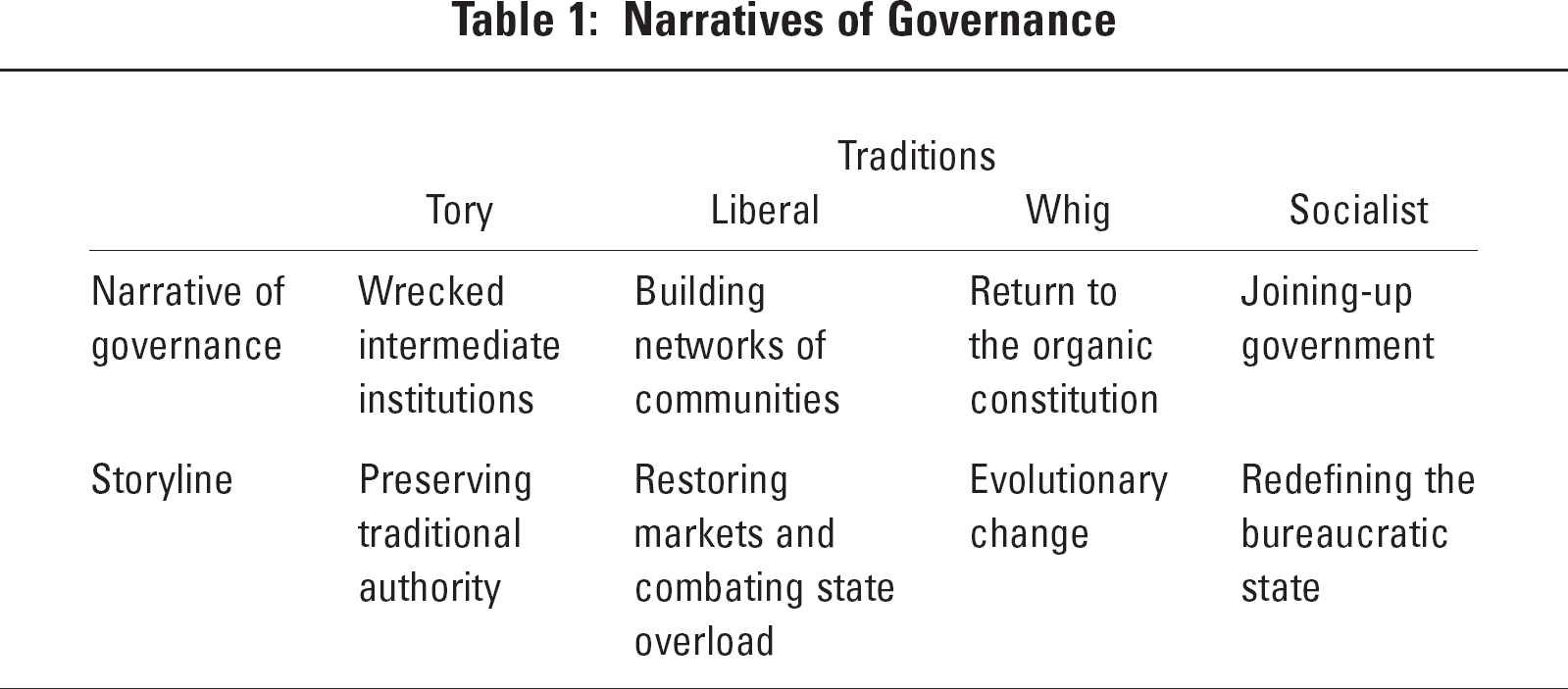
We give a brief example of how each tradition interprets governance. Inspired by the Tory tradition, (Ian Gilmour 1992, 198–224) portrays Thatcher's reforms as a ‘series of tactical battles’ that wrecked Britain's intermediate institutions, such as the monarchy, the church, the civil service, the judiciary, the BBC and local government. These ‘barriers between state and citizen’ were torn down, he argues, in the drive to create an enterprise culture and a free market state. Gilmour values the pluralism of intermediate institutions and wants to return to moderation in the exercise of power. The Conservative party encompasses the paternal statism of the High Tories and economic liberalism but during the 1980s and 1990s, the former became a submerged tradition.
For Liberals, the key to effective governance lay in market competition and bureaucratic reform. In her own words, (Margaret Thatcher 1993, 48) ‘preferred disorderly resistance to decline rather than comfortable accommodation to it’. But the Liberal zeal in refashioning the state was also married to the notion of community. (David Willetts 1992, 71) wants to claim the notion of an ‘overlapping network of communities’ as a core principle in the liberal tradition. So, liberalism reconciles markets and community with the idea of ‘micro-conservatism’ or ‘the particular network of communities which gives each individual life meaning’. The role of the state is to sustain ‘a political order in which this multiplicity of communities can survive’ (ibid., 105). Micro communities populate the boundary between state and civil society, an image with a close affinity to 19th-century notions of governance as private collectivism.
The Whig tradition lauds the capacity of British political institutions to incorporate and moderate changes. Its response to public sector reform, to use the example of Hennessy (1995), is ‘wherever possible’ to use ‘traditional and familiar institutions for new purposes’ and to ‘go with the grain of Westminster and Whitehall and their traditions’. Empathy with the British constitution leads to calls for a return to the organic constitution. In a similar vein (Lord Bancroft 1983, 8), a former head of the home civil service, argues ‘for organic institutional change, planned at a digestible rate’ so that reforms work with, and so perpetuate, all that is salutary in Britain's constitution and political practice.
New Labour rejects the command bureaucracy model of Old Labour with its emphasis on hierarchy, authority and rules. New Labour rejects municipal socialism and nationalisation and ‘does not seek to provide centralised “statist” solutions to every social and economic problem’ (Mandelson and Liddle 1996, 27). Instead New Labour promotes the idea of networks of institutions and individuals acting in partnerships held together by relations of trust. It favours joined-up government or delivering public services by steering networks of organisations where the currency is not authority (bureaucracy) or price competition (markets) but trust. It exemplifies the shift from the providing state of Old Labour and the minimal state of Thatcherism to the enabling state and the continuing socialist commitment to making the state work.
To tell stories about other people's stories, we have to recover their stories and explain them. Although we cannot separate the practices of understanding and explanation in this way, the analytic distinction highlights that we use two modes of inquiry. Understanding needs an ethnographic form of inquiry: we have to read practices, actions, texts, interviews and speeches to recover other people's stories. Explanation needs a historical form of inquiry: we have to locate their stories within their wider webs of belief, and these webs of belief against the background of traditions they modify in response to specific dilemmas. In our analysis of governance, we merge these two modes of inquiry, reading a wide range of texts in relation to traditions and dilemmas.
The notion of governance signals, therefore, change in British government but, in our account, the stress falls on how these changes arose out of competing webs of belief informed by different traditions. Governance refers to the informal authority of networks as constitutive of, supplementing or supplanting, the formal authority of government; to governing with and through networks. It points to a more diverse view of state authority as being located at the boundary of state and civil society.
Conclusion
We claim five main advantages for our interpretive approach and its governance narrative. First, our narrative identifies important empirical gaps in the Westminster model by identifying key changes in British government. The idea of governance, however constructed, undermines central notions in the Westminster model.
Second, our interpretive approach resolves theoretical difficulties that beset more positivist versions of the governance narrative. It decentres institutions, avoiding the unacceptable suggestion that they fix the behaviour of individuals within them rather than being products of that behaviour. It replaces unhelpful phrases such as path-dependency with an analysis of change rooted in the beliefs and preferences of individual actors. And yet it allows political scientists to offer aggregate studies by using the concepts of tradition and dilemma.
Third, our approach opens new research agendas. It poses distinctive questions about British government; for example, about reshaping the state through the beliefs and preferences of key actors. It also introduces distinctive techniques for addressing these questions. It points to ethnography as a means of capturing beliefs and actions, and history as a means of explaining such beliefs and actions.
Fourth, our interpretive approach identifies key theoretical issues that confront the understanding of policy-making and policy-implementation in the 1980s and 1990s; for example, the issues of pluralising policy-making and the mix of governing structures. It also lends some support to bottom-up forms of decision-making as appropriate means for addressing many of these issues.
Finally, we agree with (Richard Fenno 1990, 128) ‘that not enough political scientists are presently engaged in observation’ and our approach emphasises the importance of ethnographic methods (Rhodes 2002). Ethnographic research has two principal features as a source of data. First, it gets below and behind the surface of official accounts by providing texture, depth and nuance, so a story has richness as well as context. Second, it lets interviewees explain the meaning of their actions, providing an authenticity that can only come from the main characters involved in the story.
The governance narrative is a valuable corrective to the traditional Westminster model. It is an exercise in ‘edification’. The governance narrative offers the hope of finding ‘new, better, more interesting, more fruitful ways of speaking about’ British government (Rorty 1980, 360). It does so by decentring networks and exploring how their informal authority supplements and supplants the more formal authority of government. We use the notion of governance to develop a more diverse view of state authority in its relationship to civil society.
Interpretation, Truth and Investigation: Comments on Bevir and Rhodes
Interpretive approaches begin from the insight that to understand actions, practices and institutions, we need to grasp the relevant meanings, the beliefs and preferences of the people involved (Bevir and Rhodes 2003,1).
Few statements could be less controversial. Indeed many would say that to identify an action as the action it is one needs to understand the beliefs of the actor. 3 And certainly still, practices and institutions must be identified as the practices and institutions as understood by the participants. 4 But how much can we make of this insight?
In an earlier outing for the principles of interpretive approaches Bevir and Rhodes (1999) included the subtitle ‘Reconstructing the research agenda’. In that piece Bevir and Rhodes (hereafter B&R) seemed to be suggesting that British governance could not be understood without their interpretive approach. The suggestion there seemed to be that we needed to redirect research efforts in order to understand policy change and instability in British politics. Hints of that grand aim recur in their book, but now they more modestly hope their narrative approach is ‘edifying’. I am not sure that those who find beauty in formal models or get exhilaration from the intuitive insights of descriptive historians feel the need for spiritual uplift, though perhaps British political science could do with some moral improvement. Nevertheless, if the B&R project helps to provide understanding about why elite actors such as civil servants behave as they do, then surely they will add to our store of knowledge.
The basic claim of the book is that we can only understand the shifting patterns of policy change over time by considering the intellectual narratives or ideology of the elites involved. However the precise explanatory role these narratives are supposed to play is difficult to gauge. In their chapter ‘Narratives of Thatcherism’ we are given four traditions—Tory, liberal, Whig and socialist—through whose eyes we view Thatcherite ideology. But what are we to make of this discussion? Is it simply that depending on the ideology of the commentator, people take different views about Thatcherism? That seems plain enough, but how does this help to explain the phenomenon under discussion? Surely writers within each tradition may have stated truths about Thatcherism that help to explain it. The central focus of political science, as I see it, is to sift through competing claims to examine evidence both theoretically and empirically in order to distinguish true claims from false ones. I am not sure how bundling up purported explanations in terms of traditions helps that process.
At another level the traditions of which B&R write do seem to be causally invoked in explanations of phenomena such as ‘new managerialism’. And Rhodes' project of shadowing senior civil servants and querying what they think they are doing seems to be the empirical outcome of their interpretive approach. Here the argument seems to be that traditions, or ideologies (understood broadly), enter into the belief set of people. They then act as they do because of those beliefs. We need to interrogate their beliefs (through interviewing them), watch their behaviour and then slot them into our interpretation of the traditions we have identified. So far, so good. One problem here, though not one that with care cannot be avoided, is that our understanding of a tradition surely comes from the set of actions that constitute it. Yet we are also using that tradition to help explain the activities of given individuals. We might also query B&R as to their line when the verbal responses (or stated preferences) of the actors do not seem to measure up to the most reasonable interpretation of their actions (or revealed preferences). Allowing actors to do the interpretation for you can only go so far. For all sorts of reasons, we normally trust our own interpretations of those actions rather than actors' self-professed interpretation.
I will consider the B&R project under three headings: ‘interpretation’, ‘truth’ and ‘investigation’. I believe they make both too much and too little of interpretation; that they are ambiguous on the central question of truth; and I will suggest that their interpretive approach will at best provide only partial explanations which, if not used in conjunction with more familiar techniques from the political scientist's toolkit, may be seriously misleading.
Interpretation
How do we grasp actors' own interpretation of their actions, and the processes and institutions in which they are involved? Many types of evidence are possible— interviews with the actors themselves; interviews with their colleagues, friends, relations, enemies; elite-based questionnaires; mass-surveys; the use of contemporary reports in both official and non-official documents; contemporary newspaper reports; autobiographies, biographies and so on. The example of the method in chapters 8–10 of Bevir and Rhodes (2003) seems to privilege (indeed almost exhaustively entail) the actors' own contemporary interpretations of their own actions. There are dangers in such an exclusively agent-centred approach. Not only might actors deliberately deceive interviewers—not only for personal but also political or organisational purposes—they certainly will place their own gloss on their actions. 5 People tend to see their own actions in the best light. (Unless that is, they are clinically depressed in which case they may see their own actions in the worst possible light.) They may use justifications for actions produced in retrospect, or use handily available ideologies no matter what they really think about those justifications. Of course, this is not to say that such interviews should not be conducted, nor that their evidence should not be ‘trusted’—rather the evidence needs to be weighed along with other evidence. Indeed, the actors' own account of their actions needs to be interpreted.
B&R do not demur from that view. Indeed part of what they are trying to produce is to understand the hidden motivations of actors. They say:
there are reasons for insisting on a special role for interpretation in spelling out some features of social life. One obvious area is the ideology that political actors use to legitimate their actions irrespective of their real motivations. When politicians use human rights to justify a policy, we cannot understand that justification and its effectiveness irrespective of its truth, unless we grasp the content and role of ideas about human rights in the relevant society (Bevir and Rhodes 1999, 20–21, emphasis added).
But can we grasp that ideology simply by noting what is said in a series of interviews? Surely the other evidence-based approaches I have mentioned are also necessary. And so what exactly is wrong with bog-standard approaches that require the new interpretive stance? B&R give a curious example concerning the meaning of the term ‘marriage’, suggesting that we can only understand statistical changes in the marriage rate by ‘interpreting’ that term. At a basic level no statistician or econometrician would query that. Identifying and defining one's variables is the first step in any statistical analysis and must be carried out carefully if one's analysis is actually going to throw light on the questions one is asking. In the marriage case for example, one may need to draw on current changes in what is considered a marriage and attempt to see how we might measure such changes in the past. Marriage statistics might include at one point in time same sex marriage, or may include marriage only in recognised churches; or across states, differing tax liabilities may lead to the same type of ceremony being treated as marriage in one place but not in another. Certainly, certain sorts of questions might require statistics on marriage rates and cohabitation rates, which might be differentially available in different years and different countries. These sorts of interpretations are part-and-parcel of all statistical inference.
B&R seem to think that they are making some critical comments of quantitative methods with the example. Their ‘second premise’ (ibid., 19) is that it is impossible to use methods that seek to bypass beliefs by correlating actions with objective facts about people—such as class or social role. This is doubly wrong. Not only does such survey evidence require some interpolation of belief (how else can you interpret the statistics on ‘voting’ for example), but it may use some interpretation of peoples' ‘real motivations’ that would never be given in survey answers, nor, directly, in an in-depth interview. Let me illustrate this with a made-up story about changing rates of marriage.
I might have a materialist theory of human relations. This theory produces the hypothesis that the marriage rate over time is inversely correlated with the wealth of the median group in society. According to the materialist theory of human relations the ‘real reason’ people get married is for wedding presents. As society developed from communal living to nuclear families, young people found that there are advantages to publicly announcing their married state rather than simply quietly coupling off. As nuclear families took over from communal living, couples would need to set up a home. What better way to start than to hold a big party (which later took the name ‘wedding’) at which guests are expected to bring presents, usually of the sorts of goods needed to set up a home. Over time, rituals became associated with the party and as religions developed they took over the rites associated with matrimony. Weddings would also take on social significance by signalling wealth and social status to such an extent that for richer families more is spent on the party than is received in presents in return. Many testable hypotheses might be developed around the materialist model of marriage as part of a broader materialist model of human relations. One hypothesis is that as the wealth of the median group in society grew young couples no longer needed presents to set up home, and so the practice, and various rites associated with it becomes less important, hence marriage rates fall. Could we use interpretive methods to help test this hypothesis? We could interview people and specifically ask them about aspects of their decision to get married or to simply cohabit, and query them about their needs prior to the decision. We would not directly ask ‘was the receipt of wedding presents an important factor’ since that would probably receive a smiling negative retort, but their narrative might reveal the comparative importance of worldly goods. Their answers could then be correlated with the probability of getting married versus cohabitation. Narrative findings, however, would only be one piece of evidence useful in testing the wealth of hypotheses the theory might generate. Certainly, we would not expect any of the participants to narrate the theory itself. Interpretivism, as suggested by B&R, cannot on its own generate the theory, nor can it, on its own, test it.
In fact B&R seem to have a very narrow view of interpretation. Our narration of the physical world requires interpretation every bit as much as our narration of society. Explanations of the physical world utilise the patterns we find there. What are these patterns? Our interpretations of the data that we find predictively useful—not just for testing scientific hypotheses, but also for getting round the world (Gopnik et al. 1999). Understanding actions through interpretation requires what Daniel Dennett (1987; 1991) calls ‘folk psychology’. We all use folk psychology in order to predict what people will do next. It also enables us to understand and empathise with others, and to organise and interpret our own and others' emotions, memories and so on. Without folk psychology our own and others' behaviour would be baffling—which indeed it is to autistics (Baron-Cohen 1996). But what is the ontological status of the beliefs we ascribe to others—and to ourselves? Are they entities identical to or separate from the neurological activities of the brain? Dennett (1998) suggests we need choose neither alternative. We need not be eliminativist and suggest the interpretation of action can be reduced, eventually, to neuroscience; nor need we think they are, in some ill-defined sense, separate entities. Rather they are real with the same status as theoretical entities such as ‘the centre of gravity’. A centre of gravity is an abstract point definable in terms of physical forces and other properties that allow us to make predictions. We need concern ourselves no further about what they are beyond that. In this version of interpretivism, the narration of the actor has no special status above and beyond that of another interpreter. Both are useful in terms of prediction and hence understanding, explanation, empathy and so on. The interpretations we privilege in the end are the ones that provide the best predictions in precisely the same manner as our interpretations of the patterns we ascribe to the physical world.
Truth
Positivism is now a dirty word in British political science. Seemingly the starting point of attack of anyone who wants to write something about methodology (Hay 2002; Marsh and Stoker 2002), it is a shadowy target in B&R. There is no point in trying to breathe life into a man of straw that never saw the light of day. 6 But some things are worth defending. One of them is truth. Truth is a key issue. Either one is a realist or one is not. Realism comes in different varieties, but most basically we can say that either one believes that propositions or sentences have a truth-value, or one does not believe propositions have a truth-value. When I engage in political science I am attempting to discover truths about political institutions and processes. I try to explain what is ‘really happening’. I do not believe that there can be any ambivalence about this subject.
The commitment to realism does not entail any particular ontological or epistemological commitments. Different realists hold different ideas about the sorts of things that exist, and different views about how one goes about discovering that which exists. 7 Nor do realists need to take issue with the fact that people have different views about the world, and witnesses to the same incident may take irresolvably different views about that incident. 8 The fact that different people take those different views will colour their attitude and behaviour. Certainly myths can inspire people and peoples. In that sense myths exist. Their existence is given by the effects they have on human behaviour. However, to the extent that a myth, or any narrative, is composed of propositions about the world, those propositions will also have a truth-value. In other words (in B&R's example) either the ‘top brass’ of the Nazi regime acquiesced with Danes helping over 7,000 Jews escape from Denmark to Sweden in 1943 or they did not (or there was some Nazi official who helped, or … whatever.) Similarly, either there was a shot fired by an IRA supporter that helped cause Bloody Sunday, or there was not. There is a fact of the matter, whether or not or we can ever have enough evidence to decide the issue definitively. Of course B&R are right to suggest that myths and beliefs can motivate actors and we need to understand them in order to understand people's actions. B&R suggest we need to understand the operative theory of rights to understand why a civil servant might be motivated to act in some manner. That is surely true. But the material existence of a right is given by how that civil servant and others behave towards the rights-holder (and behave towards others given their behaviour towards the rights-holder), not by the civil servant's stated understanding of what a right means (Dowding and van Hees 2003). In other words, our understanding of the myths and beliefs of a society is gained by seeing how people behave. Whilst our understanding of these same beliefs and myths help us to explain their action, the interpretive process is two-way. Furthermore, investigating what really happened, often using evidence long after the actors' own interpretations have been lost, can help change myths and beliefs today. The scientific approach need not simply be about explanation, it can aid meritorious conduct too.
Investigation
Interpretive methods may help us to understand a variety of political behaviours and institutions. Often the starting point of investigation is based on accounts from the actors themselves. But actors can often be significantly wrong about what they think they are doing, and over what are the effects of their activities. Where the interpretive method discovers facts that are consistent with other stories (that is whilst they differ they throw new light on other findings without contradicting them) then we undoubtedly have gained knowledge. However, if interpretive methods challenge the truth of other findings, that is, they contradict them, we need to judge which narrative has to go. It is my belief that, as in the courtroom, we should be more wary of eyewitness accounts than of other scientific evidence. 9 Including eyewitness accounts of the ‘eyes’ themselves. Furthermore, interpretive methods are simply not appropriate for investigating certain problems, including some of the most central and important ones in political science.
We can draw inferences that lead us to a definitive account of historical accuracy even when the verbal evidence is contradictory. Al Gore received 202 more votes than George W. Bush in Florida on Election Day 2000, but Bush overcame that deficit with overseas absentee ballots that arrived and were counted after Election Day. The final official count gave Bush 537 more votes than Gore. The New York Times claimed, after six months' investigation, that 680 overseas ballots were illegally counted. Whether these illegally counted ballots would have made Bush rather than Gore a winner depends on the proportion of those illegally counted ballots that were for Bush rather than Gore. Kosuke Imai and Gary King (2003) provide a sophisticated statistical model to show under what conditions Gore would have been elected, and provide strong quantitative evidence of the effectiveness of the Republican efforts to get invalid ballots counted in Bush counties and not to count them in Gore ones. Interpretive methods would only allow us to collect stories about these effects. The quantitative evidence allows us to judge them.
John, Ward and Dowding (2004) provide quantitative evidence of the ‘English’ pork barrel (Ward and John 1999) where in some regions money from the Single Regeneration Budget Programme was diverted to ministers' parliamentary seats. The qualitative evidence from this project does not contradict the quantitative evidence, but the claim that pork-barrelling occurred could not be sustained by the interview evidence alone. Indeed, the civil servants involved might honestly state that they do not believe that any significant pork barrel politics occurred. The major use of the interpretive method given in Bevir and Rhodes (2003) is Rhodes' shadowing of senior civil servants. When the research is finally conducted and concluded we will be able to judge how much we learn from this exercise. I hope a great deal. But I doubt that it will tell us much about many of the important topics in modern political science, even those directly concerned with bureaucratic behaviour. 10
I conclude that definitive accounts of actions, practices or institutions are possible. Of course, accounts can be challenged, and new evidence (including new theoretical evidence) can overturn accepted beliefs. In one sense we only have interpretations. But our interpretations contain propositions with a truth-value and these truth-values can be known. Actors can be wrong about their own actions, the nature of their practices, institutions and so on. For that reason we need to query their interpretations, and collect evidence not available to those involved themselves. That evidence may lead us to discount the verbal evidence at least with regard to some questions we are interested in asking. Finally, evidence not based on participants' own interpretation is often far more important than actors' own interpretations in an assessment of the definitive account of the action, practice or institution. The Bevir and Rhodes project may add to our methodological toolkit, but let us not believe it is in any way critical of other methods. Let us not think it can replace other methods, if only for the reason that it can only ask and answer a limited range of questions about governance in Britain.
‘Taking Ideas Seriously’ in Explanatory Political Analysis
The publication of Mark Bevir and Rod Rhodes' Interpreting British Governance (2003) may well come to be seen as a landmark in the development of ideational and interpretive approaches to political analysis in Britain and beyond. Though it will no doubt also be seen as part of a broader ‘ideational turn’ in Anglophone political science, its contribution is nonetheless highly distinctive. It is certainly the case that an increasing number of largely US-based and largely comparative political scientists and political economists have sought to afford a rather greater role to ‘ideational variables’ in political explanation in recent years (see, for instance, Berman 1998; Blyth 2002; Goldstein and Keohane 1993; Hall 1989; McNamara 1998). Yet they have tended either to present such a move as epistemologically neutral—as having no significant implications for the status of the knowledge claims we might make about our chosen explanatory models—or to maintain a guarded silence on the issue. Whilst convenient for those wishing to convince a sceptical and largely positivist mainstream that there is nothing to fear from ‘taking ideas seriously’ (see, for instance, Wendt 1999), this confidence is misplaced as we shall see presently. It is, then, considerably to Bevir and Rhodes' credit that they have placed the epistemological implications, indeed predicates, of ideational/interpretive analysis at centre stage. Arguably, in so doing—and however inadvertently—they point to precisely the reason why Anglophone political science has dealt so reluctantly and so poorly with ideational variables until very recently.
In what follows my aims are threefold. In the first section I seek to establish that ‘taking ideas seriously’ is not epistemologically neutral and comes at a potentially high price for the much-cherished positivism of most Anglophone political science. Indeed, it violates the assumption, on which positivist political analysis is predicated, that political systems are closed systems. In the second section I suggest that despite this, there is no need to turn wholesale from ‘explanation’ to ‘understanding’ (verstehen1) on the grounds that explanation is synonymous with positivism, understanding with interpretation. Such a dualism is unhelpful. I explore the seemingly unresolved tension between explanation and understanding in B&Rs' own interpretivism, detecting precisely the same tendency to see explanation and understanding as orthogonal or incompatible modes of analytical inquiry. Finally, I outline and defend a variant of social constructivism (as distinct from a variant of interpretivism) capable of according a genuine causal role to ideas in an explanatory but post-positivist political analysis. I illustrate the applicability of such a perspective by considering the dilemmas facing social democratic parties in an era of assumed globalisation.
Epistemology
It is widely accepted that behaviouralism and rational choice have provided the two most influential approaches to political analysis in the post-war period. Both model themselves upon the natural sciences; both staunchly defend naturalism— the presumed unity of method between the natural and social sciences; and both hold out the prospect of a predictive science of politics based either on deductive or inductive reasoning. This provides the foundation of positivist political science today. It rests, in turn, on the shared assumption that political systems, unlike natural systems, are closed. Consequently, if appropriately armed methodologically, the analyst can take up an external and dispassionate gaze and one which is fully independent of the causal dynamics under scrutiny.
It is at this point, however, that behaviouralists and rational choice theorists part company, constructing their respective inductive and deductive modes of reasoning on one of two sets of additional assumptions.
For rational choice theorists it is assumed that actors' behaviour is rendered predictable by their preference function (or functions), the immediate context in which they find themselves (the game itself) and their assumed rationality in the furtherance of their preferences. Moreover, the preference function of the actor is assumed to be given by her/his position or role in the game. In short, the rules of the game and the actor's role in the game are assumed sufficient to predict an actor's behaviour.
For behaviouralists, and indeed for most self-styled ‘post-behaviouralists’, the assumptions are slightly different, though they perform a near identical function— to render supposedly closed political systems predictable given the appropriate methodology. Here it is assumed that the aggregate (invariably statistical) analysis of evidence of given instances of the phenomenon under consideration warrants the (probabilistic) drawing of causal inferences that apply to all other instances of that phenomenon (past, present or future). In both cases, the rules of the game (whether derived, assumed or inferred inductively) do not change with time, thereby availing themselves of aggregate statistical analysis or logical deduction to reveal common (generalisable) causal mechanisms.
Sadly, especially for positivists keen to be seen to take ideas seriously, such convenient assumptions are fundamentally compromised by the mere acknowledgement that ideas can exert an independent causal role. 11 And this may be reason enough, for some at least, to refuse to make such an acknowledgement—a point to which we shall return. For if it is conceded that actors similarly located contextually and similarly situated with respect to the ‘role’ they play in a given game scenario are likely to behave differently, by virtue of their differential understandings of both the context in which they find themselves and/or their role within it, and their normative orientation towards others and their environment, then their behaviour is no longer predictable (see also Hay 2004a). Similarly, if we concede that the ideas we hold about our environment are capable of influencing the rules of the game—for example, that the rules governing economic policy choice after Keynes are different than they were before—then causal generalisability from one instance to another and the closure of social systems are blown out of the water as assumptions.
Here the analogy between the natural and social sciences breaks down. Natural scientists can safely assume, without fear of contradiction, that all but the smallest of particles in a gravitational field have no choice other than to conform to Newton's three laws. However convenient it might be to make an equivalent assumption, the same is simply not the case in social and political systems, in which the very identification of a correlation or causal sequence may be sufficient to ensure that it is never replicated. Indeed, many policy-oriented interventions made by political scientists are designed precisely to ensure that the lessons of past policy failures are learnt, with the consequent effect that the rules of the game change with time.
As this would suggest, the move beyond a positivist epistemology is logically entailed by a recognition of the need to take ideas seriously. Yet the point is scarcely acknowledged in the recent proliferation of ideationally-sensitive institutionalism issuing largely from the US—it simply being assumed that the same epistemological standards apply to ideationally-sensitive and ideationally-insensitive political analysis alike. It is, once again, to B&Rs' considerable credit that they place the epistemological premises of the necessary post-positivist turn at the heart of their important contribution. It is to that contribution that we now turn directly.
Beyond Explanation Versus Understanding
Bevir and Rhodes defend an interpretivism that rests on an anti-foundational epistemology. Appropriately enough, they begin Interpreting British Governance by emphasising that interpretivism can be seen to follow ‘from the insight that to understand actions, practices and institutions we need to grasp the relevant meanings, belief systems and preferences of the people involved’ (Bevir and Rhodes 2003, 1).
This is an alluring claim and one for which I have deep sympathy. Yet, in its laudable attempt to rehabilitate subjectivity and meaning in political analysis, it tends to impose an unnecessary bracketing off of questions of causality and explanation from those of meaning and interpretation. Indeed, in this respect B&Rs' contribution, though informed by rather different epistemological assumptions, is reminiscent of Alexander Wendt's highly influential treatment of causal (explanatory) and constitutive (interpretive) logics as operating in different (and incommensurate) analytical domains (Wendt 1999). It also invites comparison with Anthony Giddens' equally unnecessary ‘methodological bracketing’ of structural and agential analysis (Giddens 1984). As a consequence of this bracketing, the causal significance of ideational variables, and the potential contribution to be made by constructivist/interpretivist perspectives to explanatory political analysis is never adequately considered by B&R.
To be fair to them, this is not their principal concern and it is perhaps understandable that in re-introducing interpretivism to British political science, they should choose to privilege the question of meaning and interpretation. Furthermore, it is certainly not the case that B&R fail to discuss such issues. My point is rather different: their discussion of interpretivist explanation is limited and in tension with other aspects of their text. It raises just as many questions as it answers.
The overarching concern of B&Rs' interpretivism, it seems, is to pose the question, ‘what is the meaning of it?’. It is then not surprising, perhaps, that we are halfway through the second chapter before the question of explanation receives its first mention. The issue is then dealt with in the space of a few pages, only to disappear from the text once more. Before and after, B&Rs' analytical attentions are focused consistently on questions of ‘interpretation’, ‘meaning’, ‘exploration’, ‘decentring’, ‘mapping’ and ‘description’. The language of explanation and causation is noticeable only by its absence—1indeed, it would seem, it is studiously avoided.
This makes what they do have to say about explanation (B&R 2003, 32–35) especially significant. Yet, sadly, it does not give us many clues as to how to operationalise interpretive insights in explanatory political analysis. The key explanatory concept in the interpretivist's theoretical armoury, it would seem, is that of tradition. Yet it is not at all clear how the emergence and development of traditions is itself accounted for, or how the appeal to traditions explains (rather than merely redescribes) the beliefs and preferences of actors, let alone the outcomes of their conduct. These difficulties are only compounded by a passage earlier in the text which implies that the interpretivist approach might supplement existing positivist research, rather than providing an alternative to it (ibid., 4). If interpretivism is, indeed, ‘necessary’ (ibid., 18) and necessarily premised upon an anti-foundationalist epistemology incommensurate with that of positivism (ibid., 3, 24–25), then it is difficult to see how such an additive approach can be defended. In particular, it is not clear why those wedded to a foundational epistemology should have any confidence in the inferences drawn by interpretivists who declare themselves anti-foundationalist. Nor is it clear how— from such an avowed anti-foundationalist position—interpretivists can demonstrate (or even claim to demonstrate) to the satisfaction of foundationalists the necessity of ‘taking ideas seriously’.
At this point it is perhaps useful to turn to the text itself, specifically to the authors' attempts to demonstrate the explanatory utility of the concept of tradition. They suggest, ‘the explanatory value of traditions lies in the way in which they show how individuals inherited beliefs and practices from their communities’ (ibid., 34). This is immediately problematic. For the simple appeal to traditions in political analysis does no such thing. Indeed, to invoke the concept of tradition in this way is not to demonstrate or to explain but to assert what many would certainly be happy to accept—that individuals inherit beliefs and practices from their communities. The statement is not especially problematic, but in the absence of a specified mechanism (or mechanisms) of inheritance, the concept of tradition has no explanatory value in itself. The problem is only compounded in the paragraph which immediately follows, where the process of explanation appealed to becomes somewhat clearer:
[w]hen we try to explain the beliefs and actions of particular individuals, we will be able to explain only why they held those beliefs, not other, more specific beliefs. The more we define a tradition, the greater will be its explanatory power. Political scientists select traditions to explain specific features of human life. The value of the selected tradition depends on the explanatory power of the evidence for the conceptual and historical links between the beliefs and actions that make up the tradition. The more exact the account of these links, the more fully we will be able to grasp the nature of the tradition, so the more explanatory work it will be able to do' (ibid., 34).
It would appear that ‘explanation’ in this context refers to a process of demonstrating consonance between a previously identified or hypothesised tradition, on the one hand, and the beliefs and practices of specific actors, on the other. Yet it is not at all clear what, if anything, can genuinely be said to have been explained by appealing to the seemingly traditional character of, say, an actor's utterances on a given subject. Indeed, here it is not even clear in which direction the causality is presumed to run. Does the tradition explain the beliefs and conduct of the actor, or do the beliefs and conduct of the actor explain the existence of the tradition? In fact the answer is almost certainly neither. For whilst beliefs and conduct consistent with a hypothesised tradition might lend support to the claim that such a tradition exists, this should not be confused with an explanation of the emergence or reproduction of such a tradition. Similarly, that an actor's conduct is consistent with the existence of such a tradition does not explain that conduct. When it is considered that, for Bevir and Rhodes, traditions are constructions serving the particular analytical purpose of the political scientist and ‘the precise content they give to the tradition will depend on the particular beliefs or actions they hope to explain’ (ibid., 34), the waters become murkier still. For if, through such a process of definition and redefinition, all utterances and practices can effectively be labelled traditional in some sense, then isn't the distinction between the traditional and the non-traditional emptied of all (explanatory) content and analytical power? We are back to square one: what explanatory power does the concept of tradition have?
Here, as elsewhere, B&R fail adequately to identify the precise links between the understandings of social meaning that interpretivism is undoubtedly capable of furnishing, on the one hand, and the type of causal/explanatory analysis this facilitates, on the other. Indeed, if we are to consider the potential contribution of interpretivism (and constructivism) to explanatory political analysis, we should perhaps be less concerned with (the process of) understanding per se, and more concerned with the role played by particular understandings in motivating the political conduct of particular actors.
This, of course, is to steer the discussion away from interpretivism, which is characterised by its emphasis upon understanding, to constructivism, a term perhaps more easily reconciled with causal analysis. In the final section of this article I seek to defend and illustrate the role that constructivism can play in causal political analysis.
In Defence of Constructivism
The term social constructivism is now used in a blistering variety of often mutually incompatible ways. So as to limit the potential for further confusion I return to the fairly consistent and precise use of the term in the philosophy of the social sciences. In so doing I follow Ian Hacking's exemplary discussion in The Social Construction of What? (Hacking 1999; for a more extended discussion see Hay 2002, 199–204). Those who suggest that X is socially constructed, he argues, are, in so doing, suggesting the following:
In the present state of affairs, X is taken for granted; X appears to be inevitable.
X need not have existed, or need not be as it is. X, or X as it is at present, is not determined by the nature of things; it is not inevitable.
X is quite bad as it is.
We would be much better off if X were done away with, or at least radically transformed (Hacking 1999, 6–12).
Hacking nicely dissects the normative/critical orientation of much, if not all, constructivism and its emphasis upon the contingent or open-ended nature of social and political processes and dynamics more conventionally seen as fixed. Particular constructions may serve to present a ‘reality’ which is static, immutable or inexorably unfolding in a given direction, but the recognition of the constructed nature of the reality we perceive implies that things could and can be different. Constructivism, thus understood, both seeks and serves to restore politics and agency to a world often constituted in such a way as to render it fixed and unyielding. It aims to reveal the contingency of social construction and hence the conditions under which things might be different. A brief example will perhaps serve to clarify the distinctiveness of such a position and the way in which it accords to ideas a genuine role in causal analysis.
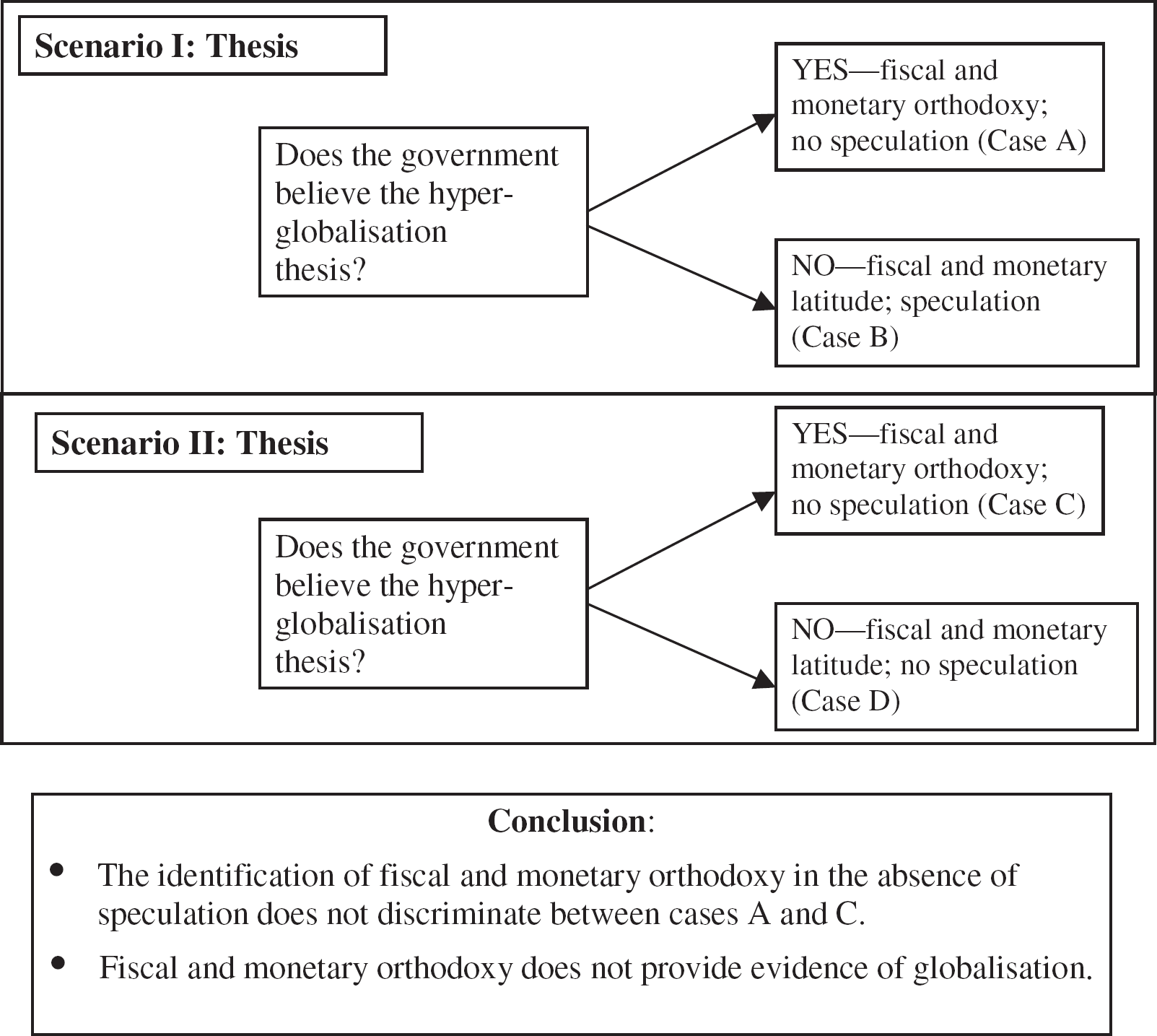
That globalisation has come to circumscribe the parameters of social democratic economic policy is a commonplace. In a context characterised by the increased mobility of capital and the increased speed, severity and significance of financial markets' speculative dynamics, social democrats must accommodate themselves to the new financial and monetary orthodoxy. Or so it is widely assumed. In fact an increasing body of literature, based on an exhaustive evaluation of the empirical evidence, has come to challenge this view (for a review, see Hay 2004b). The most recent additions to this literature point to the fact that although the liberalisation of financial markets has indeed unleashed speculative dynamics, increasing the speed and severity of investors' reactions to government policy, capital market participants appear far less discriminating or well-informed in their political risk assessment than is generally assumed (Mosley 2003). Consequently, it should not surprise us that there is, in fact, no evidence in OECD countries of speculative dynamics in financial markets being unleashed against governments pursuing social democratic policies (Swank 2002; Wilensky 2002).
Important though such evidence is, however, it does not prevent social democratic and labour parties revising their programmatic ambitions in the light of the conventional wisdom and the fears it engenders. If they believe there to be no alternative other than to swallow large doses of fiscal moderation and the new monetary orthodoxy, then in accordance with the predictions of the globalisation thesis, that is precisely what they will do. In so doing they may contribute—indeed, they almost certainly have contributed—to an inadvertent confirmation of the thesis' prediction, as globalisation has come to be associated with the spread of fiscal and monetary discipline. In this way, the hyper-globalisation thesis, as it has come to be known, is both a self-fulfilling prophecy and, for social democrats at least, a self-denying ordinance.
The process can be represented schematically as follows (see Figure 1): As this example shows, when it comes to the hyper-globalisation thesis, if political parties believe the thesis and act on it we get the same outcome—whether the thesis is true or false. A belief in the thesis is sufficient to bring about the thesis' prediction. Consequently, though the thesis predicts the imposition of fiscal and monetary orthodoxy (amongst other things), the spread of such fiscal and monetary discipline tells us no more than that the thesis is influential.
The Hyper-Globalisation Thesis
This is but one example and it is important to be clear about its limitations. Influential ideas may well become self-fulfilling prophecies in the manner here described. Yet, in a different context, they may become self-denying. The theory of revolution provides ample illustration of this. For, if it is believed that revolution is inevitable—classically an almost preordained unfolding of history's inner logic precipitated by the ripening of the inherent contradictions between the forces and relations of production—then the action required to ensure its ‘inevitability’ will remain untaken. The effect is that the inevitable will be indefinitely postponed. Similarly, a thesis designed to expose the structural frailty of the system to a revolutionary vanguard may well be ‘disproved’ by the counter-revolutionary actions released on its disclosure or discovery by agents of that system. Here the thesis is only self-denying in so far as it gets into the wrong hands.
Yet, whether self-fulfilling or self-denying, what all of these examples demonstrate is the potentially causal role of ideas in political and economic system dynamics. The development of the system depends not merely on the context, the condition of the system itself and the preferences and/or rationality of the actors within it, but on the understandings of those actors. Such ideational variables may be difficult to gauge, but there are excellent reasons for thinking both that they exist and that they should be accorded a far more central role in contemporary political analysis. Bevir and Rhodes would no doubt agree, but the precise contribution that their brand of interpretivism can make to that task remains, as yet, frustratingly unclear.
Meaning and Politics: Assessing Bevir and Rhodes
Introduction
A little over 50 years ago David Easton challenged ‘the decline of modern political theory’. Instead of conducting narrow analyses of a limited number of historical texts, he argued, political theory should be fulfilling two main duties: ‘creatively constructing a valuational frame of reference’ and ‘building systematic theory about political behaviour and the operation of political institutions’ (Easton 1951, 37). All these decades later and it seems that the decline was halted only at a cost: the separation of political theory into its philosophical and sociological strands. On the one side we have developed sophisticated notions about how to read those historical texts and, with the help of John Rawls, been co-opted into moral philosophy. On the other, political science has a surfeit of contending causal theories. But the two sides do not often meet. Mark Bevir and Rod Rhodes (B&R), a philosopher-historian of ideas and an analyst of public administration, are to be congratulated on trying to bring together these two halves of our discipline. That their marriage does not always succeed ought not to detract from the bravado of their having a go. Their union allows them to step outside of some of the boundaries within which the analysis of British politics and government is usually confined. But, they do not stay outside, and in the end leave their potentially critical edge unsharpened. To see why this is so we will first look, critically, at some of the concepts they employ before considering some alternative ‘interpretive’ approaches to analysing British politics.
The Bevir and Rhodes Version of Interpretivism
There are many different ways of pursuing interpretivism. B&R locate theirs between hermeneutics and post-structuralism. It is more radical than the former which can sometimes ‘come dangerously close to embodying an analysis of the subject as autonomous and an analysis of reason as pure and universal’ (B&R 2003, 43) but less radical than the latter which ‘can come dangerously close to denying any scope to the subject and reason’ (ibid., 43). So, to avoid danger, B&R stake out an interpretive ‘third way’. They want to stress ‘local’ reasoning embedded in traditions, in the context of which agents are significantly, if not fully, autonomous. ‘Tradition’ acts as a background but does not fix everything; it is ‘an initial influence’ on people that ‘colours their later actions’ but is always contingent (ibid., 32). They ‘regard traditions as purely contingent entities that people produce through their own actions as agents’ (ibid., 35). This approach is not unlike Giddens' theory of structuration. And like that theory it needs to think through the concept of power. If power is not simply located in either the ‘determining’ structures or the ‘autonomous’ agents, if it is elsewhere, different in kind to what we previously thought or involved in some complex interplay between all these, then we need to know. Without such a theorisation the relation between the structure and the agent will remain ambiguous and analyses will always be at risk of dissolving into one or the other, or even of oscillating between them. B&R's insistence that they do not reify or hypostasise tradition is not sufficient. They need to present a theory of power that illuminates how and why some things become part of a tradition and others do not. But it is unclear what sort of theory of power B&R hold.
Unsurprisingly, B&R want to reject the notion of power implied by the ‘Westminster model’. Presumably, then, they wish to embrace or develop some notion of power adequate to making sense of networks of governance. But they are also critical of institutionalist theories that locate power in the structured context of an institutional order. They are very clear that one cannot ‘read off people's beliefs from knowledge of objective social facts about them’. Instead we have to ‘explore both how traditions prompt them to adopt certain meanings and how dilemmas prompt them to modify these traditions’. They continue: ‘political actors construct their understanding of pressures or dilemmas … and so the policies they adopt depend on the traditions on which they draw’ (ibid., 64). This is not clear: traditions prompt an actor to see certain dilemmas in a certain way but it is also the way they view a dilemma that leads an actor to follow a certain tradition. Are we to see traditions as exercising a kind of power over actors or do the actors exercise power over tradition through their choices to follow it or not? The emphasis on one or the other is beginning to oscillate.
The concept of dilemma is clearly important here. It is the key to explaining changes in traditions, since it is when these arise that, in the B&R schema, actors act. Dilemmas are defined as occurring ‘when a new idea stands in opposition to existing beliefs or practices and so forces a reconsideration of these existing beliefs and associated traditions’. This makes it seem as if the new ideas exercise a power of some kind, so perhaps power is to be imagined as external to the interactions of agents with traditions, imposed by the real in history. But they insist also that ‘we cannot straightforwardly identify dilemmas with allegedly objective pressures in the world’ (ibid., 36) and go on to say that people may modify their beliefs ‘irrespective’ of these dilemmas or pressures being real. Their intention here, I think, is simply to stress that there is no unitary or closed definition of a dilemma; that ‘there cannot be a foundational type of dilemma’ since they ‘can arise from an experience of the relationships of production, an acquaintance with a philosophical argument or scientific theory, an encounter with another culture and so on’ (ibid., 37). But these are certainly all things that exist in the real world—unless one presumes producing, arguing, theorising and meeting new people to be purely illusory activities. The need, surely, is for social scientists or political analysts to realise that arguments, theories and cultures are ‘pressures’ of particular sorts and can sometimes be decisive pressures just as, at other times, are contradictions between the forces and relations of production, the combined preferences of a majority block in the legislature or the army massing on the eastern border (although in all these cases there are also arguments, theories and cultures doing a lot of significant work).
Later on, B&R say that ‘the consequences, often unintended, of the Conservative governments’ public sector reforms throw up several dilemmas for many traditions' and use this as a way into talking about the modernising of the state (ibid., 131). The dilemmas in question are ‘welfare dependency, state overload, inflation and globalisation’ but we are not told whether these are the dilemmas identified in a study of the traditions or somehow otherwise derived by B&R themselves. One can immediately think of other candidates for the central ‘dilemmas’ in play before, during and after the Thatcher administrations: employment, crime or ethnicity for example. It seems that what is meant is only that certain issues get framed in certain sorts of ways and that these tend to induce people to think of certain sorts of solution. But it is unclear who or what is producing these frames and who or what is making the challenge to traditions. However, the dilemmas are related to the narratives that B&R identify as an important aspect of their theory and analysis. So let us look at this concept and see if we can find something about power there.
B&R contrast their concept of a narrative to that of a model (ibid., 25). The latter evokes ‘a monolithic and unchanging object of study’ while their concept ‘points to the need to decentre institutions and practices’. Narratives ‘reveal the diversity of beliefs and traditions on which institutions rest’. But the concept is not specifically defined though it is linked, in a broad family resemblance kind of way, to others such as ‘organising perspective’, ‘set of assumptions’ or ‘visions of the historical field’ and we are told that narratives ‘explain actions by reference to the beliefs and preferences of the relevant individuals … [and] encompass the maps, questions, languages, and historical stories used to explain British government’ (ibid., 26). It would seem that narrative is a kind of explanatory concept, used by the analyst when looking at, say, British government. Later, however, we are told that the writers ‘think of political practices or institutions as the contingent products of numerous actions inspired by competing narratives’ (ibid., 38). Here the narrative appears as something to be explained, something that occurs ‘in the field’ as it were, and that the analyst can uncover and examine.
The concept of narrative vacillates between this status as an explanatory tool and as an object to be examined. In the actual analysis of narratives presented in the book it continues to be unclear whether the narratives lead to explanations or the explanations to narratives. What B&R actually undertake is a categorisation of, mostly, academic literature concerned with explaining Thatcherism. These are understood to be rooted in different traditions (liberal, Tory, Whig and socialist) and the argument put is simply that there is more than one view of what Thatcherism was and none can claim any scientific superiority to the others. The authors do not choose to examine relevant political speeches, interviews and so forth and do not subject anything to an actual narrative analysis. Narrative analysis argues that people are story-tellers: that they explain their actions to themselves and to others by ordering things in sequences with a story structure, seeking coherence through conforming to generic structures and assigning people positions within the ‘plot’ that define their character. B&R do not seek such patterns. Presumably they would not want to since the implication of such an argument is that thought is structured by ‘conventions’ and that takes one ‘dangerously’ close to circumscribing ‘the subject’. Something similar happens in a section on narratives of civil service reform (chapter 8) where we find a description of positions within a broader debate and in long extracts from interviews with senior civil servants (chapter 9) that contain a lot of interesting, and some rather amusing, material but are not subjected to interpretation beyond general indications that they conform to the traditions B&R have previously identified.
B&R seem to be saying only that, when wanting to make sense of things in politics, people reach out to some set of ideas; these lead them to see things in different ways and to reach different sorts of conclusion; such differences are real and matter and people act on the basis of them; we ought to acknowledge this plurality and participate in it rather than act like we know everything. The first part of this is certainly true but we can say a lot more about the formation of these ‘sets of ideas’, their historical development, their successes and failures and the ways in which they constitute action. What is more, such an activity, the excavation and examination of these sets of ideas, showing how they condition the thoughts and actions of contemporary political actors, is not just a way of classifying academic analysis. It is a way of understanding politics in a critical fashion, showing how actors do not, and cannot, always know what they are doing. This leads, ineluctably, to meta-political questions about how ‘sets of ideas’ are instituted, attaining and maintaining authority. These are questions about power. If we do not pursue them then interpretive analysis comes ‘dangerously’ close to insisting that political actors are just doing the best they can in an uncertain world; that there are just lots of views about things, none is any better than any other and ‘what's right is what works’.
Interpretivism and the British Tradition
Interpretivism and hermeneutics need not be, but generally are, rather conservative in nature. In contrast to progressive Enlightenment rationalism the hermeneutic position emphasises the embeddedness of rationality in traditional contexts and one ought to make note of the way this connects directly to forms of romantic anti-Enlightenment thinking. Furthermore, if interpretivism is understood as saying that social institutions and traditions afford meaning in the lives of individuals; that individuals operate on the basis of those traditions, and within those institutions, animating and altering them only over the course of time through their actions; that we live in ‘webs’ of meaning and belief that can never quite be reduced to the will of individuals who can never quite be reduced to the institutions and beliefs by which they live, if we say all that, then interpretivism sounds like a definitively English way of looking at politics: that odd combination of Germanic romanticism, (small ‘e’) empiricism and a pragmatic approach to maintaining order and keeping power. Such a view weaves its way through Burke, Bagehot, Bradley and Oakeshott: conservatism that approaches ‘the matter of politics as living matter, which cannot be carelessly torn apart in the service of pseudo-scientific categories’ (Scruton 1991, 3), celebrating the traditions that mould our ‘idea of what [we] are and what we should be’ and represent that which ‘survives and gives meaning to the acts that emerge from it’ (Scruton 1980, 42). This sort of conservative attitude has long pitched itself against the rationalist social sciences that established themselves across social democracies as central to the organisation, planning and improvement of modern life. 12
But the interpretive view need not be so conservative and need not eschew the capacity to make judgements or to try and intervene in the world. Indeed, in the 1970s, out of an internal critique of literary criticism, combined with an internal critique of Marxist sociology, there emerged an approach to political analysis fully focused on the production and dissemination of ‘the meaning of it’ that can be seen, in retrospect, as the basis of a distinctively British kind of critical interpretive political analysis. From Raymond Williams' combination of the principle that cultures and traditions persist, and have independent existence and value, with the realisation that they also change, are multiple in form and are the site of broader contradictions and conflicts, via ample doses of Gramsci and a sprinkling of Soviet linguistic theory, the Birmingham-based Centre for Contemporary Cultural Studies (CCCS) produced landmark work on the intersection of politics and culture and a famous, if highly controversial (but hugely influential) analysis of Thatcherism (see Hall et al. 1978; Hall 1980; Hall and Jacques 1983 and 1989). A small part of this analysis gets a brief mention in the B&R account of interpretations of Thatcherism (but does not make it into the Bibliography).
Stuart Hall‘s ‘cultural studies’ sought to make possible the investigation and critical analysis of the background contexts that shaped social action and the opportunities for political action to reshape them. It differed from traditional hermeneutics by foregrounding not tradition but ideology. This concept, for all its faults, has the virtue of bringing to the centre of analysis questions about conflict, contestation and power. Tradition is never uniform or natural, it is always the outcome of some prior series of political and social conflicts and struggles that make it look as if ‘we have always done things this way’. The ideological analyses of the CCCS were concerned to show how, through things like claims to tradition, partial conceptions of the world come to appear natural and incontestable. This idea of ‘decontestation’ has since become central to a number of perspectives on the analysis of ideology that have added to the mix further insights from deconstruction and psychoanalysis as well as elements of the philosophical ordinary-language tradition and the sort of context-based history of ideas that finds its way into B&R (see the excellent summary of approaches in Norval 2000).
This theoretical perspective markedly changes our conception of politics and of interpretation. It understands politics itself as a kind of interpretive activity. Political movements develop a particular interpretation of the world and attempt to secure the victory of that interpretation over others so that it ceases to appear as an interpretation and looks to be the truth. This activity is not confined to government but takes place across society in the media, educational systems, in professional associations, artistic culture and so on. And these ‘interpretations’ are not merely the conscious expressions of particular actors. They are formed on the basis of the conceptual and linguistic tools embedded in that social and cultural life, including our language.
But this does not mean that we cannot use our conceptual tools to analyse and interpret these interpretations. Political or policy statements and actions are formulated and enacted on the basis of prior institutionalised systems of meaning (what B&R call traditions) that have a kind of independent existence and can exert an independent pressure on those actors. Some of these are contained within government spheres but others exist outside (for example, the discourses of management and marketing that exercise such authority over contemporary politics). To understand these and their influence, we do indeed have to ‘decentre’ analysis from individual, intentional consciousness and develop a clear theory of interpretation, not taking the words of actors at face value. We can examine the dissemination of concepts, words and ideas (such as ‘monetarism’, ‘social capital’ or, indeed, ‘governance’), showing how they pass through institutions, getting promoted, destroyed, redefined and redeployed, and we can see if it is possible to establish what tends to make some more successful than others. In preparing such ‘genealogies’ we can gain critical access to the ways in which ‘common sense’ is constituted and altered and we might even find distinct ‘logics’ at work; patterns that are replicated in varied contexts. Instead of talking about traditions we think of ideologies and discourses and instead of dilemmas we look at contradictions and the formation of crises.
No doubt Bevir and Rhodes will not be alone in feeling that this goes too far down the ‘dangerous’ route of denying autonomy to agents. But then, we have to reformulate our concept of the subject or agent. An historically constituted horizon of meaning does not limit actions: it makes intelligible action possible. The autonomous subject is not the precondition or presupposition of either action or a theory of action. It is, rather, an achievement of our widespread, everyday theories of action; an outcome of our political history that has rendered implicit ‘norms or standards which organise an otherwise shapeless material reality … [and] are constitutive of human action’ (Shapiro 1981, 20). But those norms or standards do not constitute action in ways that are free of contradiction or conflict or that always succeed. One of the tasks of the analyst is to make that clear. As J. G. Pocock points out:
each of us speaks with many voices, like a tribal shaman in whom the ancestor ghosts are talking all at once; when we speak, we are not sure who is talking or what is being said, and our acts of power in communication are not wholly our own. Theory may be said to consist in attempts to answer questions of this order, to decide what power is being exercised over us when we seek to exercise it' (Pocock 1972, 29).
This is a theoretical and an analytical endeavour requiring what Easton called for: valuational standards (perhaps we should call them ‘transvaluational’) along with theories of behaviour and political institutions. It requires of us attention to what we can call meta-political concerns: questions about what defines, and limits, the scope of politics and political science; analysis of the politics of politics. Political analysts have to range broadly over social and cultural concerns to trace out where and how words and concepts came into or out of political discourse. At the limits of what people do and say is that which makes it possible for them to do and say it, their conceptual grammar if you like. As political analysts we would do well, echoing Wittgenstein rather than Laski, to show scepticism towards the grammar of politics.
Conclusion
Bevir and Rhodes undertake an important task in trying to bring philosophy and political science together. They help open up the terrain of British politics and government and begin to ask some new and interesting questions about it. But we have to go further and see that the analysis of government must also be, at times, the much broader analysis of culture and thought. Politics, as B&R know, is not a wholly rational activity. It is also a creative art in which the political actor seeks to create, out of the materials history has bequeathed, new ways to think about political problems (crises and dilemmas) and to persuade others to see things in these new terms. To understand politics in this way poses great problems for those whose primary concern is the rational validation of scientific claims and for whom meta-theoretical questions about reason, validation and science are a pointless distraction. But, I believe, asking these questions matters. It forces us to displace epistemology from the centre of philosophical and analytical concern and to see our efforts, and those of whom we study, as primarily ethical in as much as they propose and enact an ethos, a way of being in the world, of picturing the relations between persons. Wittgenstein said that the point of his philosophy was to show the fly the way out of the bottle, to free ourselves from a picture of the world in which we had become trapped. That is an activity necessarily different to positivist analysis and also from a hermeneutics that does not problematise the notions of subject and object on which it is based. It necessarily eschews an obsession with proving things in favour of a ‘showing’ and a ‘doing’. In our field that means what we do is also always itself a kind of political act and the judgement of our efforts is also always a political one. We cannot avoid that but we can be clear about it. And if being ‘too political’ is a charge people wish to make of a perspective in political science, then those of us who hold it are happy to plead guilty.
Interpretation as Method, Explanation and Critique: A Reply
Interpreting British Governance aims, first, to outline an interpretive approach to political science, and, second, to use this approach to provide a decentred narrative of governance. How ambitious are these aims? Keith Dowding contrasts an earlier piece, in which we suggested that understanding British governance required an interpretive approach, with the hope expressed in the book that our narrative is edifying. There is no ambiguity here. We defend an interpretive approach on philosophical grounds: the logic of our concepts implies that an interpretive approach alone is adequate to understanding human life (Bevir 1999). We would quickly add, however, that while an interpretive approach is necessary, it is not sufficient. So, our use of such an approach does not guarantee the objectivity of our narrative. Because we are sceptical of claims to objectivity outside a comparison with rival narratives, the most we can hope for our decentred account of governance is that it proves edifying—accurate, comprehensive and fruitful—when compared with others.
Given that objectivity arises from comparisons, the edifying nature of our account of governance will depend, in part, on its relation to, say, rational choice, institutionalism and post-structuralism. We are grateful to Keith Dowding, Colin Hay and Alan Finlayson for posing questions that allow us to clarify our arguments, address specific issues and make comparisons. In short, Dowding, Hay and Finlayson ask that we expand on issues of method, explanation and critique.
Method
We agree with Dowding that accounts of the physical world are interpretations, and that our accounts of the social world rely on folk psychology. However, an account of a physical event is just an interpretation. In sharp contrast, an account of a human action in terms of folk psychology is inevitably an interpretation of an interpretation. In other words, to describe people's beliefs is to interpret their interpretation of the world. An interpretive approach recognises that the human sciences offer interpretations of interpretations. So, we concentrate on spelling out the meanings—the beliefs, traditions, or discourses—embedded in human actions.
An interpretive approach rests on a philosophical analysis of the meaningful nature of human action. Later we will consider how this analysis inspires certain forms of explanation. For now, we want to emphasise the differences between a philosophical analysis and the ‘methodological toolkit’ with which Dowding associates it. To argue that the human sciences offer interpretations of interpretations is not to favour any particular methods. On the contrary, human scientists can construct their interpretations using data generated by many methods. They can use participant observation, interviews, questionnaires and mass surveys, as well as reading memoirs, newspapers and official and unofficial documents. An interpretive approach rests on a philosophical analysis. This analysis does not prescribe a particular method of creating data. Instead, it prescribes a particular way of treating any type of data. Interpretive approaches argue that human scientists should treat data in ways consistent with the philosophical analysis of their task as one of interpreting interpretations. They should treat data as evidence of the meanings or beliefs embedded in actions. They should not try to bypass meanings or beliefs by reducing them to given principles of rationality, fixed norms or social categories.
We disagree with Dowding in our analysis of how the human sciences should treat data. Indeed, we would argue, an interpretive philosophy leads to a rejection of the idea of a ‘methodological toolkit’. The differences are all too plain in Dowding's discussion of marriage. An interpretive approach implies that studies of statistical changes in the rate of marriage make sense only in the context of an interpretation of that term. Dowding thinks that this implication is widely accepted; statisticians would define their variables by specifying, say, whether to include same sex marriages. Yet his argument misses the point of our philosophical analysis of the human sciences, which suggests that we can make sense of statistical data about rates of change only if we treat this data as evidence about the beliefs that do or do not lead people to get married. Perhaps, then, a change in the rate of marriage might arise because of altered beliefs about whether same sex partners can or should get married. More generally, marriages can be contracted only within a whole set of meanings drawn from theology, law and morality. If human scientists operationalise marriage by treating it as a variable and specifying its content, they risk obscuring these important meanings, which can vary dramatically across time and place. In effect, they would impose their definition of marriage on those they study in a way that would fail to do justice to others' beliefs. We do not deny that statistical studies of changes in marriage rates produce useful data. We only insist that such data be treated as evidence of people's beliefs, rather than as a variable in objectified models, norms or categories.
Suppose the data provided by models, formal constitutions or large-scale surveys leads us to attribute a set of beliefs to a group of people. Because such data typically abstracts from individual circumstances to find common patterns, it elides differences between people, even lumping together people who act in broadly similar ways for different reasons. Hence we argue for more detailed studies of the beliefs of the relevant people using textual analysis, participant observation and in-depth interviews. Much present-day political science seems to denigrate such methods, preferring abstract models, typologies and correlations. So, while an interpretive approach does not require an exclusive use of any one type of data or method, it does redress the balance in favour of the qualitative analysis more often associated with anthropology and history than with political science.
Our case for anthropological and historical studies should not be confused with the claim that we must accept actors' own accounts of their beliefs or the claim that actors' beliefs are always conscious and reasoned ones. Obviously people's statements about what they believe offer significant evidence about what they do believe. Equally, however, people can be deliberately misleading. They can act on subconscious and unconscious beliefs. So, we might explain an action using beliefs other than the stated beliefs of the actors. Obviously people sometimes act on political commitments they have agonised over. However, people also act on habitual, unreflective beliefs about the nature of the world and about what is right in a given context. So we will do well to draw out the whole world-view of actors in our efforts to explain their actions.
Explanation
An interpretive approach uses all sorts of data to recover the meanings or beliefs embodied in actions. One distinctive feature of such analysis is the need to treat data as evidence of beliefs and desires. A second distinctive feature is the importance of a narrative form of explanation. We argue that when the human sciences recover the beliefs and desires embodied in actions, they do not just understand the action but also explain it. We agree with Hay, therefore, about the importance of challenging the false dichotomy between understanding and explanation.
The philosophical analysis informing our interpretive approach suggests that the human sciences rely on a distinct form of explanation. We accept Donald Davidson's (1980) argument that when we explain actions in terms of the relevant beliefs and desires, we rely on a concept of choice and on criteria of reasonableness that have no place in the natural sciences. It is important not to confuse the claim that the natural and human sciences use a different concept of causation with the idea that the human sciences are not interested in causal analysis. Rather, the human sciences explain actions and practices in narratives that point to the beliefs and desires that cause them.
We disagree with Hay about the form of explanation suitable to the human sciences. In our view, the human sciences require narrative explanations in which we unpack actions and practices by reference to the relevant beliefs and desires. Models, typologies and correlations can do explanatory work only if they are unpacked as narratives. So, when Hay complains that we fail to identify the precise links between meanings and causal analysis, we think he misses the point of our analysis of explanation in the human sciences. For us, to recover the beliefs that inform actions is to provide a causal explanation of those actions. Hay appears to think of ideas as ‘ideational variables’ to which he wants to give a prominent role alongside others. In contrast, we would argue that other variables only do explanatory work when unpacked as ideas or beliefs. Our analysis of a narrative form of explanation suggests correlations between variables never do any explanatory work. They point to a relationship. We need to adopt a narrative to explain that link. We disagree with Alexander Wendt, then, in a way that Hay does not mention. Wendt and Hay believe that constitutive and other causal logics apply to the human sciences, disagreeing only about whether these different logics are incommensurable. In sharp contrast, we believe that constitutive logics are causal, and we reject the idea that other causal logics apply to human actions.
Narratives are the way we explain actions and practices. They thus play a dual role in our work. First, when we offer an interpretation of British politics, we offer a narrative. Second, the actors in our narratives have their own interpretations of their actions and practices, and these accounts also include narrative explanations. We deliberately use narrative to describe both what we offer and what we study. To say that we offer narratives of narratives is merely to restate our philosophical analysis of the human sciences as interpretations of interpretations, given our claim that narratives are the way to explain human action.
When we argue that the human sciences explain actions by reference to meanings or beliefs, we raise the question of how we should explain these beliefs. In Interpreting British Governance, we explain webs of belief by reference to traditions and dilemmas. Dowding and Hay complain that we do not specify the explanatory mechanisms at work here. They want us to specify precise links between independent objects or variables. They worry that our understanding of a tradition depends on the actions that constitute it. They argue that because the two are not independent of one another in the way they should be within an explanation, all we can offer is redescription. Yet our interpretive approach is rooted in a philosophical analysis of the human sciences that rejects the methodological rigour they urge on us. Our philosophical analysis suggests that because people are not autonomous, they necessarily gain their beliefs against the background of an inherited tradition. The manner in which they get them can and does vary, but they always so inherit beliefs. 13 This philosophical argument provides the causal mechanism at work in our explanations. Moreover, it suggests belief and tradition— agency and practice—are entwined. Thus, when human scientists try to specify them independently of one another, they are misled by a spurious concept of scientific rigour into adopting a form of explanation that is inappropriate for human action.
Perhaps we do not differ much from Hay. He concentrates on arguing that ideas matter. We want to go on from this argument to analyse why people hold the ideas they do. Hay argues that ideas matter by showing that a thesis of hyperglobalisation can be a self-fulfilling prophecy. We would agree. But whereas Hay leaves the matter there, we would try to explain why people hold the hyperglobalisation thesis by reference to traditions and dilemmas.
Critique
An interpretive approach offers interpretations of interpretations, accommodates many types of data and uses a narrative form of explanation. Finlayson wants us to go further. He urges us to explain what does and does not become part of a tradition using a theory of power. His comments raise two related questions. How should we explain traditions? Can narratives act as critiques?
We distinguish tradition as an inevitable background to human beliefs and actions from the specific traditions human scientists slice out of this background to explain certain beliefs and actions. 14 The content of tradition derives from individual agency. Tradition and agency stand in a dialectical relationship to one another. Tradition has no existence apart from the beliefs and actions of individual agents, and yet individuals always reach beliefs and attempt actions against the background of tradition. When Finlayson asks whether we see traditions as exercising a kind of power over actors or actors as making traditions through their choices, we would say we do both; they are not incompatible.
At times, our difference with Finlayson appears to be a matter of choice of words. After all, we could use power to describe the influence tradition inevitably exerts on individuals. We do not do so only because if we did we would deprive the concept of power of all critical force: if power is everywhere, to point to its presence in a given case fails to provide any critical or explanatory leverage. At other times, Finlayson appears to have more substantive concerns about our analysis of tradition as individual agency undertaken against the background of tradition. He seems to want to distance himself from our analysis of agency. We argue that individuals are not autonomous since they always experience and reason against the background of tradition, but they are agents who have the capacity to modify and reject any aspect of a tradition. We are unsure whether Finlayson opposes agency as well as autonomy. If he does, we would argue against him that it is a mistake to treat traditions, discourses or languages as being reified quasi-structures that somehow limit the beliefs people can come to hold. 15
Can narratives act as critiques? Finlayson associates ideological analysis with contestation. His main worry is that our concept of tradition leads us to adopt an uncritical stance. Finlayson's contrast between tradition and ideology also appears to be a matter of words. We do not believe that tradition is ever uniform. Rather, we must decentre it into its conflicting strands. Nor do we think it is ever natural. Rather, we show that it arises as a contingent product of struggles over different ways of conceiving of and responding to constructed dilemmas. And we do not believe that political conflicts and contests over interpretations are confined to government. Indeed, we use the word governance to stress that such contests take place throughout society, whether in the civil service, hospitals or media. Because we conceive of tradition in this way, we often intend our narratives to be critiques. Our narratives often unmask the partiality of a political interpretation by showing that it arose against the background of a particular tradition. And our narratives often unmask the contingency of traditions and their interpretations by showing them to be one among several historical possibilities. Interpreting British Governance includes such critiques. So, whereas liberals define governance as the inherent rationality of market reforms, whereas Whigs think it evolved out of existing practices, and whereas socialists define it as joining-up, we narrate each of these perspectives as the contingent product of a particular tradition. If Finlayson wants critique to reveal the contingency and contestability of narratives that present themselves as natural and fixed, then we can only express disappointment that he did not find this in our work.
Conclusion
Interpreting British Governance offers a decentred narrative in which the broad contours of governance are explained by reference to four traditions and the dilemmas they faced. In brief, British governance arose from actions inspired by Tory beliefs in wrecked intermediate institutions and the need to preserve authority, a liberal commitment to using markets to roll back the state, a Whig faith in evolutionary changes to an organic constitution and a socialist belief in joined-up governance as a redefinition of the bureaucratic state. Dowding, Hay and Finlayson have prompted us to discuss issues of method, explanation and critique—how they appear in our approach, and what role they play in this narrative. In doing so, we distance ourselves from those varieties of political science that seek to avoid interpreting meanings or beliefs by appeal to models, typologies or correlations. Yet we have also tried to show that the boundaries between these approaches are fuzzy. The key questions are about how we treat data as much as the methods used to collect it. They are about how we explain beliefs as much as whether to ascribe causal efficacy to them. They are about whether we regard people as agents as much as how to theorise power.
Footnotes
1.
These articles began as contributions to a round-table session on interpretivism and political science held at the PSA Annual Conference from 15–17 April 2003 at the University of Leicester. The contributors would like to thank the conference organisers for supporting the round table and those who attended for engaging in a worthwhile discussion.
2.
It is certainly a presence however. Many perspectives within the disciplines of Politics and International Relations may be said to belong, very generally to the interpretive field. For example, British study of the history of political thought takes a broadly hermeneutic outlook and has contributed immensely to the theory and method of the history of ideas through attention to the connections between context, language and intention (see, for example, Skinner 1988; Pocock 1972). Poststructuralist and post-Marxist approaches to ‘the political’ interpret the construction and dissemination of meaning as a way of examining political action (see Norval 2000; Howarth, Norval and Stavrakakis 2000; Finlayson and Valentine 2002) and in International Relations a distinctive interpretivism is similarly in development (see, for example, Campbell 1992;  ).
).
3.
I would once have written, in good Humean fashion, ‘beliefs and desires’. But I now take desires to be a type of belief.
4.
I use the term institution here (as do Bevir and Rhodes) in the old-fashioned ‘public administration’ sense of a formal organisation making it distinguishable from a practice.
5.
The most famous example of course is the young Trobriand girls who made fun of Margaret Mead by telling her stories of the frivolous sex-filled lives they led.
6.
Man he undoubtedly was. Hard-nosed, empirical, objective about facts, subjective about what to do about them, atheoretical, amoral, lacked all airs and graces and probably had a Yorkshire accent to boot.
7.
8.
It is generally agreed amongst lawyers that generically speaking eyewitness accounts are the weakest type of evidence presented in court.
9.
Of course, forensic evidence is always given by a witness, and it goes without saying that that witness will interpret his or her findings. Scientific evidence can be collected and interpreted correctly or badly as recent cases have demonstrated. We should be particularly wary of medics giving opinions of risk. As well as recent horror stories over the probabilities of cot death (where the witness apparently did not understand the difference between probability and conditional probability) see also .
10.
11.
By talking of the ‘independent’ causal role of ideas I do not mean to suggest that ideas exert whatever causal influence they exert in isolation from, or independently of, other material factors, but that this affect is not reducible to such material factors. If ideas are merely epiphenomenal, there is no necessary threat to the positivist mindset.
12.
On the history of the involvement of social science in the organisation of modernity see Peter Wagner (2001, ch. 3). For a typical English conservative attack on it see Oakeshott's 1947 essay Rationalism in Politics (in ).
13.
We do not develop this argument here since it can be readily found in (Bevir and Rhodes 2003, 32-35) and in even more detail in (, 187–199).
14.
Incidentally, we explicitly reject conceptions of traditions as reified entities. We do not think of explanation, as Hay implies, as a matter of ‘demonstrating consonance between a previously identified or hypothesised tradition … and the beliefs and practices of specific actors’. Rather, we think traditions are defined pragmatically in the light of the questions we seek to answer.